Intellectual Capital at Risk: Data Management Practices
and Data Loss by Faculty Members at Five American
Universities
Jaime Schumacher Northern Illinois University
Drew VandeCreek Northern Illinois University
Abstract
A study of 56 professors at five American universities found that a majority had little understanding of principles, well-known in the field of data curation, informing the ongoing administration of digital materials and chose to manage and store work-related data by relying on the use of their own storage devices and cloud accounts. It also found that a majority of them had experienced the loss of at least one work-related digital object that they considered to be important in the course of their professional career. Despite such a rate of loss, a majority of respondents expressed at least a moderate level of confidence that they would be able to make use of their digital objects in 25 years. The data suggest that many faculty members are unaware that their data is at risk. They also indicate a strong correlation between faculty members’ digital object loss and their data management practices. University professors producing digital objects can help themselves by becoming aware that these materials are subject to loss. They can also benefit from awareness and use of better personal data management practices, as well as participation in university-level programmatic digital curation efforts and the availability of more readily accessible, robust infrastructure for the storage of digital materials.
Received 21 May 2014 | Revision received 28 April 2015 | Accepted 7 May 2015
Correspondence should be addressed to Drew VandeCreek, Northern Illinois University Libraries, DeKalb, Illinois 60115, USA. Email: [email protected]
The International Journal of Digital Curation is an international journal committed to scholarly excellence and dedicated to the advancement of digital curation across a wide range of sectors. The IJDC is published by the University of Edinburgh on behalf of the Digital Curation Centre. ISSN: 1746-8256. URL: http://www.ijdc.net/
Copyright rests with the authors. This work is released under a Creative Commons Attribution (UK) Licence, version 2.0. For details please see http://creativecommons.org/licenses/by/2.0/uk/
Introduction
In the past 20 years, college and university faculty members have made digital materials integral parts of their work. A scholar’s collection of work-related digital content often includes important, unique research data or other products of the creative process, as well as materials important to their teaching activities and committee work. As digital objects have become increasingly ubiquitous, many librarians and other information professionals have come to warn that they are very prone to loss. Acknowledging this reality, federal granting agencies in the United States have recently begun requiring scholars seeking financial support to describe in their proposals how they plan to provide for the long-term preservation and management of data sets and other materials produced in the course of research activities (National Science Foundation, 2012). In the interest of maintaining their faculty members’ eligibility for grant support, many colleges and universities have developed digital data management and preservation measures meeting or exceeding granting agencies’ specifications. They will secure an important portion of college or university scholars’ intellectual capital, but what of their faculty members’ other work-related digital objects? Within this mass of materials there surely exists other digital content of great significance to individual scholars and their institutions. This paper presents the findings of an investigation into the state of digital object management and preservation among 56 professors at five universities. It considers their responses, in an interview format, to a set of several questions: “What types of work-related materials do faculty members possess, and in what formats?” “What materials would they most like to recover in the event of an apparent loss?” “How do they presently manage and store their work-related digital materials?” “What are their expectations about these materials’ future availability?” and, finally, “What rates of digital object loss have they experienced?”
Our study found that participating faculty members produced a wide array of digital materials in the course of their professional work. They identified research data and other products of their scholarly activities, teaching resources, and administrative materials as those they would most like to recover in the event of an apparent loss. A large majority of participating faculty members reported that they stored and managed their work-related digital materials themselves, relying on a collection of free-standing devices, such as personal computers and portable hard drives, as well as cloud accounts, rather than their institution’s available networked capacity. Many of those not using university-provided, secure networked storage1 reported that they were unaware of its
existence or availability, or found its use inconvenient in some respect. In this context, a majority of respondents reported that they had experienced the loss of at least one work-related digital object that they considered to be important in the course of their academic career. Upon interviewers’ review of the leading causes of digital object loss, a large majority of participantsreported that they believed that their data loss was actually greater than they had initially indicated. Of those reporting both kinds of loss, a disproportionate number were among the individuals not using networked storage. Despite such a rate of loss, a majority of respondents expressed at least a moderate level of confidence that they would be able to make use of their digital objects well into the future.
1 In this paper, we define networked storage as a secure, server-based space provided by institutions for
These results indicate that digital object loss is a common, if not regular, component of academic life. They show a correlation between faculty members’ use of networked storage and the survival of their digital objects. Conversely, they also reveal a link between a sole reliance on non-networked devices and services for digital object storage and the more frequent loss of digital objects. Many participants’ failure to make use of available networked storage, as well as their upward revisions of digital object loss estimates after a review of the major potential causes of loss, show that many faculty members have little understanding of the factors placing digital materials at risk of loss or how they might mitigate that risk. They also demonstrate a strong connection
between this lack of knowledge of risk factors and basic data management practices and digital object loss itself. Finally, participants’ reported expectations about the future availability of their digital objects suggest that university professors are often very over-optimistic in this regard, a phenomenon that shows a correlation with their lack of knowledge of the causes of digital object loss.
These results suggest that many individual faculty members can take a first step toward more effective digital object preservation by using their institution’s available networked capacity, which is, in the vast majority of cases, backed up in a regular and systematic manner. Colleges and universities can encourage network usage by
increasing their efforts to bring its availability to faculty members’ attention and reducing barriers to its convenient use. Our study’s broader portrait of the precarious state of faculty-produced digital data on five campuses can also perhaps help those advocating their institution’s more effective, programmatic preservation of selected faculty-produced, non-grant related digital objects to persuade colleagues and administrators to provide the financial support needed to underwrite the necessary activities. Finally, however, our results suggest that many faculty members’ data management practices may present a significant obstacle to attempts to curate and preserve their digital objects in a more effective, programmatic manner. Any attempt to integrate faculty-produced digital objects stored outside of a college or university’s network into an institution-wide digital preservation program will require participating faculty members to devote a great deal of time and effort to the location, retrieval, and submission of their materials. It will also oblige information professionals taking part in the planning and administration of a digital preservation program to handle larger amounts of materials, usually not identified in any standard manner, and often lacking important metadata, than they would otherwise encounter. In this light, digital
preservation planners must carefully weigh the pros and cons of any attempt to integrate faculty-created digital objects residing outside an institution’s network into a digital preservation initiative. In cases where the time and expense required prohibit such an attempt, these materials will at best reside in a sort of limbo, neither demonstrably lost nor preserved in any programmatic, effective manner.
Literature Review
researchers have seldom provided empirical studies of rates of actual data loss in this population. In 2008 one investigator in the field called for more work devoted to “quantifying the extent of digital information loss or compromise, or, at the very least, to document more examples to supplement the few specific studies currently available” (Harvey, 2008). Seven years later, digital preservation professionals can still benefit from this type of empirical study.
Work providing information about the actual rate of loss of scholarly digital materials in a university setting is hard to find. In 2006 the Digital Preservation Coalition (UK) presented Mind the Gap: Assessing Digital Preservation Needs in the UK, a report based on a survey of “a wide range of organisations in different sectors,” including education, libraries, archives, museums, local and central government bodies, scientific research institutions, as well as organizations in the pharmaceutical, financial, manufacturing, engineering, media, energy and chemical, and publishing industries (Waller and Sharpe, 2006). In it, researchers reported that only 29% of respondents to a 2005 survey reported that they had “not lost access to some digital information as a result of it being impossible or too expensive to recover. Even when referring to their most important type of data, this proportion only rose to 43%” (Waller and Sharpe,
2006). In a 2013 study, a team of Canadian scientists working at universities and research institutes examined the availability of data sets, ranging from two to over 20 years old, finding that amidst prevailing data management practices “the odds of a data set being extant fell by 17% per year,” and concluding that “the availability of research data declines rapidly with article age” (Vines et al., 2013).
The available literature provides a clearer picture of university professors’ current data management practices and understanding of the life cycle of digital objects. A 2012 study found that 95% of faculty members at a medium-sized university reported that they believed that they should be personally responsible for their data. (Scaramozzino, Ramírez and McGaughey, 2012). A 2013 study of faculty members at American universities and colleges conducted by Ithaka (the organization behind JSTOR and Portico) found that 80% of respondents in the Sciences, and nearly 80% in the Humanities and Social Sciences, preserved research data themselves, using
commercially or freely available software or services (Housewright, Schonfeld and Wulfson, 2013). The University of North Carolina’s 2012 report Research Data Stewardship at UNC: Recommendations for Scholarly Practice and Leadership found that “[w]hile some [faculty members] save data in repositories or centralized servers, others relied on external hard drives or CDs for backup. Beyond the research project period, some faculty admitted that few, if any steps were taken to preserve their data long-term” (Ahalt et al., 2012). A 2011 publication concluded that a group of academic archaeologists and arts historians generally preserved their images on such “an ad hoc basis,” and concluded that they “generally did not understand preservation issues
surrounding their images” (Beaudoin, 2011). Two 2009 reports also concluded that most scholars lacked the knowledge of effective practices necessary to manage their digital objects in an effective manner. (Martinez-Uribe, 2008; RIN and The British Library,
2009). Nonetheless, one recent study has found that over one-third of researchers at a large American university expected their digital objects to remain usable after “ten years or more” (Fear, 2011).
This study explores how faculty members’ data management attitudes and practices may affect future attempts to integrate some of their digital objects into campus-wide digital preservation programs. Beaudoin has observed that attempts to integrate faculty members’ collections of work-related images into an institutional repository and
intellectual property issues and a likely dearth of metadata as major causes of these difficulties (Beaudoin, 2011). The present study turns from these issues to assess what impact faculty members’ reliance on non-networked storage devices may have on attempts to integrate their data into a digital preservation program. Many standards and best practices published in the field of digital preservation call for institutions to manage selected materials as a whole in “an archive, repository, data centre, or other custodian” or simply assume that this has been done (Higgins, 2008) To date, no studies have explored what implications college and university faculty members’ data management attitudes and practices might have for the seemingly straightforward work of bringing together a set of digital objects for programmatic digital preservation measures.
Finally, this article examines the relationship between college and university faculty members’ data management attitudes and practices and their loss of digital objects. More specifically, it asks if the use of networked storage can provide higher levels of preservation for faculty-produced digital objects and explores factors bearing on faculty members’ use of it. In 1996 and 1997, three scholars studied factors influencing
engineering professors’ use of computer networks for email, electronic discussion groups, accessing remote databases, accessing remote computer facilities and file transfer. (Abels, Liescher and Denman, 1996; Liescher, Abels and Denman, 1998). Their work did not examine faculty members’ use of networked storage. The authors know of no scholarly inquiries into the relationship between faculty members’ use of networked storage and the preservation of their work-related digital objects.
Research Methodology
In 2012 and 2013 members of a team studying how medium-sized and smaller
institutions of higher education might begin to address the issue of digital preservation explored faculty members’ creation and use of digital objects, as well as their
understanding of preservation issues pertaining to them. Digital preservation can be understood as a very broad concept. For publications discussing the differences between file storage, digital curation, and digital preservation, as well as how these concepts relate to one another, see Charles Bailey’s Digital Curation Bibliography (2012).
This study was conducted with the support of the Institute of Museum and Library Services (National Leadership Grant 05-11-0156-11), at five Illinois universities: Northern Illinois University, Chicago State University, Illinois State University, Illinois Wesleyan University, and Western Illinois University.
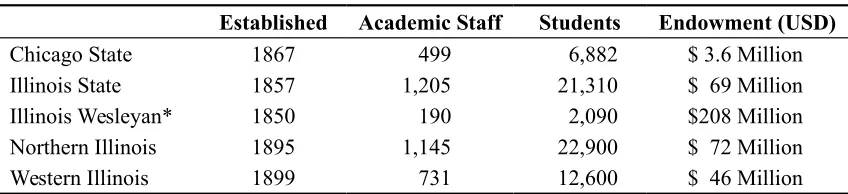
Table 1. Digital POWRR2 project partner institutions. (The College Blue Book, 2013;
Schumacher et al., 2014). *Illinois Wesleyan is a private institution and offers only undergraduate programs.
Established Academic Staff Students Endowment (USD)
Chicago State 1867 499 6,882 $ 3.6 Million
Illinois State 1857 1,205 21,310 $ 69 Million
Illinois Wesleyan* 1850 190 2,090 $208 Million
Northern Illinois 1895 1,145 22,900 $ 72 Million
Western Illinois 1899 731 12,600 $ 46 Million
Potential faculty participants included grant applicants and recipients (as provided by the institutions’ Offices of Sponsored Projects), as well as scholars whose
publications resided in an institutional repository. Drawing on a pool of 119 candidates contacted via an email message requesting a 30 minute, in-person interview, team members conducted 56 faculty interviews, the results of which were de-identified. Participating individuals represented a wide range of disciplines, including specialists in the humanities, the physical sciences, the biological sciences, the social sciences,
engineering and education. During the individual interviews, participants were asked to describe their professional activities, the nature of the digital information they had created in the course of their work and the types of data formats included in their body of work. They were then asked to describe how they stored and managed their data, and to identify those materials they considered to be most valuable and hence would most want to recover in the event of their apparent loss. Subsequent questions asked
participants to report experiences of data loss (if any), then asked them to review their report in light of a discussion of leading causes of digital object loss. Finally,
interviewers asked participants to describe their level of confidence in the long-term availability of their digital files.
Findings
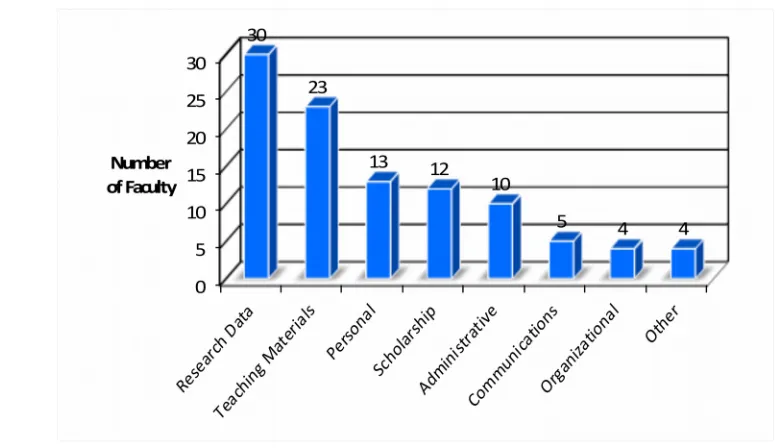
Study participants provided the following data (VandeCreek and Schumacher, 2014). When asked to identify up to three sets of electronic files they would attempt to recover first in the event of an apparent loss, the majority of participants selected materials pertaining to four major functions of university life. 42 participants (75%) identified electronic files within the category of scholarly materials (including research data and scholarship in a broader sense); 23 (41%) designated teaching materials; ten (17.8%) selected administrative and/or organizational materials; and five (8.9%) named electronic communications.
Researchers then asked participants to list any and all file types that made up the objects within each category. They named JPEG, PDF and .doc files most often, but answers reporting the use of a file type not found in the study’s roster of 28 common types (“other”) were fourth most common. Within this group, several participants mentioned both proprietary and custom formats, as well as types unique to software programs designed for use in their specific area of expertise. A full set of participant responses is shown in Figure 2.
Figure 2. File format types used in high priority categories mentioned in Figure 1.
Faculty members’ responses revealed that most managed their data themselves, relying on some combination of individual devices and storage services. Again, participants were asked to name any and all digital object storage and preservation methods that they used. 37 (66%) relied on the hard drives of their office computer; 22 (39%) used an external hard drive; 21 (37.5%) used a hard drive as a built-in component of a personal computer; 18 (32%) used cloud-based services; 16 (28.5%) used a
Flash/USB drive; ten (17.8%) used their email account(s); six (10.7%) used means or devices not mentioned in the project interview’s list of storage options; and three (5.4%) relied on optical discs like CDs or DVDs. Few faculty members interviewed took
advantage of opportunities to back up their materials in more secure environments. 20 (35.7%) employed institutional networked capacity made available for the storage of work-related materials. One (1.8%) participant made use of a discipline-specific external repository, meaning that 35 (62.5%) relied entirely on free-standing, non-networked devices for digital object storage.
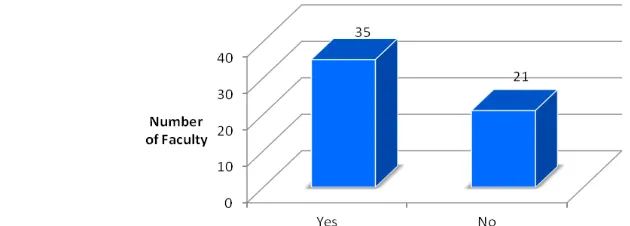
Participating faculty members’ data management practices in many cases resulted in a loss of digital materials that they considered to be important to their professional activities. 31 (55.3%) of participants indicated that they were aware that they had lost such work-related digital objects and been unable to replace them with backup files in the course of their professional career.
Figure 4. Faculty reporting significant data loss.
Researchers then asked participants if they possessed digital content that, despite having made no recent attempts to access the materials, they would likely be unable to open and use in light of researchers’ descriptions of common causes of digital data loss other than the simple failure of storage media. 35 (62.5%) participants reported that they did indeed have such materials, a situation researchers referred to as a “previously unrealized data loss.”
Figure 5. Faculty reporting previously unrealised data loss. Despite having the data at hand, participants would be unable to open and use digital files that were created with out-of-date software or stranded on obsolete media, like floppy disks.
Faculty members able to use college or university-administered networks from campus also reported slightly lower levels of data loss. At institutions providing off-campus access to available networked storage capacity, ten of the 14 (71%) individuals surveyed reported a data loss of some kind. At institutions without remote network access available, 34 of the 42 (81%) individuals surveyed stated that they had lost data.
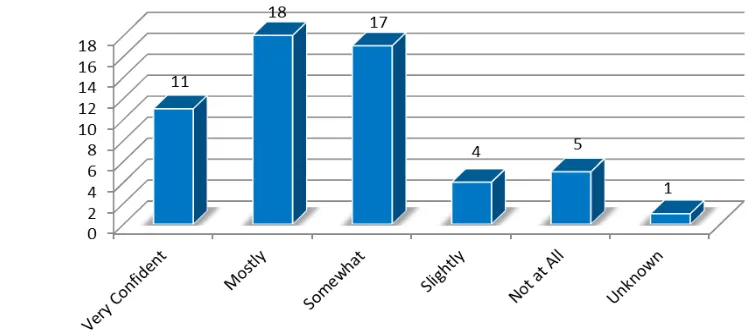
In this context, participating faculty members expressed considerable confidence that they would be able to recover (retrieve and use) work-related digital objects in the event that they discovered their apparent loss at the time of the interview. Of a total of 56 individuals interviewed, 11 (19.6%) indicated that they were “very confident” that they would successfully recover their digital objects; 18 (32.1%) reported that they were “mostly confident;” and 17 (30.4%) declared that they were “somewhat confident.” Four (7.1%) faculty members stated that they were “slightly confident;” and five (8.9%) expressed the fact that they were “not at all confident” in their ability to recover their digital objects. One replied that they did not venture to estimate their level of
confidence in the future retrieval ofdigital objects.Thus fully 85% of participating faculty members expressed at least a modest (“somewhat” or better) level of confidence in their ability to retrieve and use digital objects existing at the time of the survey, with 51.8% of them indicating that they were very or mostly confident in this outcome.
Figure 6. Researchers’ confidence in their ability to recover their data.
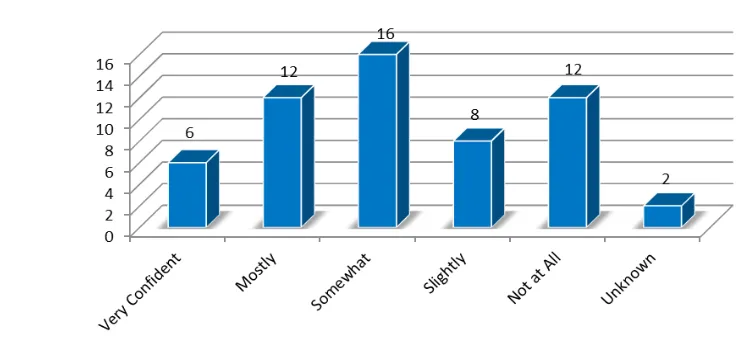
In response to an inquiry asking if they were confident that they would be able to make use of their present digital objects in 25 years, six (10.7%) participating faculty members reported that they were “very confident,” 12 (21.4%) concluded that they were “mostly confident,” and 16 (28.6%) were “somewhat confident.” Eight (14.2%)
reported that they were “slightly confident” and 12 (21.4%) stated that they were “not at all confident” that they would be able to recover their digital objects at that time. Two indicated that they did not know if they would be able to recover their digital objects in 25 years. In this matter, a total of 32.1% reported that they were “very” or “mostly” confident they would be able to recover their data 25 years in the future, 60.7%
Figure 7. Researchers’ confidence in their ability to recover their data in 25 years time.
Discussion
The data presented in this study shed light on several topics of interest to information professionals studying digital preservation or simply seeking to provide enhanced levels of preservation for collected materials in a college or university environment. Many participants’ descriptions of using an ad hoc system of free-standing computers, hard drives and cloud accounts corroborated earlier studies showing that other groups of university professors had adopted very similar personal data management practices. (Housewright et al., 2013; Ahalt et al., 2012).
Study participants’ widespread disinclination to make use of available networked storage and their frequent acknowledgment that they did not understand the major causes of digital object loss supported the findings of previous work (Beaudoin, 2011; Martinez-Uribe, 2008; RIN and The British Library, 2009) showing that other groups of university professors struggled to grasp the causes and risk of digital object loss and lacked the knowledge of data-management practices necessary (Digital Preservation Coalition, 2008) to increase the likelihood that digital objects would be available for future use.
In addition, this study provided empirical information about actual data loss, as requested by Ross Harvey. Its survey of university professors demonstrated that a majority of participants lost the use of work-related digital objects, a result supporting the findings of the Digital Preservation Coalition’s Mind the Gap study and Canadian scientists’ review of the availability of research data over time (Vines, et al., 2013). Responses showed that those storing and managing digital objects in a collection of free-standing devices and accounts alone showed a larger rate of data loss than those who made use of their institution’s network. The authors of this paper believe this to be the first instance in which a study has explored possible relationships between faculty members’ understanding of data storage, their data management practices and their reported rates of actual data loss.
participants taking advantage of the opportunity to use their network from off campus experienced a slightly lower rate of data loss than those who ignored it.
The study’s data also provided evidence supporting and augmenting a recent finding that many university professors at a single institution believed that they would be able to recover and use seemingly-lost digital objects today and in the future (Fear, 2011). In that research, the author found that more-confident participants expected to be able to recover and use their digital materials after a period of ten years. The present study showed that a sizeable number of participating faculty members expected their digital materials to be intact and usable in 25 years. The great gap between basic best practices developed by information science professionals and many participating professors’ actual data management practices suggests that faculty members will continue to lose the use of digital materials in the future. In this light, many participants’ assumption that their digital objects will remain available for use at such a distant date indicates that librarians, archivists and other professionals aware of digital objects’ susceptibility to loss should take it upon themselves to initiate or increase efforts to educate their colleagues of the dangers they face.
This study’s findings suggest that even as colleges and universities move to create digital preservation policies and measures necessary to meet funding agencies’ data management mandates, a need for programmatic digital preservation measures also exists at an even broader institutional level: that pertaining to faculty members’ digital materials not bound by a granting body’s preservation mandate. Information
professionals now enjoy a remarkable opportunity to enhance the level of service they and their larger libraries and archives provide to their university or college. They already possess the foundational knowledge on which an institution’s digital preservation program can be established and developed, and can gain additional expertise and skills within the established channels of their professional discourses (Fyffe, Ludwig and Warner, 2005).
This study’s findings reveal a major challenge that confronts professionals seeking to build a digital preservation program on such an expanded, institutional level.
Discussions of best practices for digital object preservation direct those beginning a new program to bring available digital objects together in a single repository and compile an inventory of them (DCC, n.d.; NDSA, n.d.; Angevaare, 2009). The collection of
materials in a single repository facilitates their management and evaluation. Professors using a college or university network for digital object storage can readily submit materials for evaluation and potential preservation measures simply by moving an object and its metadata from one location on the network to another made available to them. However, any attempt to include other faculty-created materials in an institution-wide digital preservation program will need to rely on professors’ willingness to search their free-standing devices and cloud accounts for digital objects potentially appropriate for preservation and transfer the materials to digital preservation planners. These
great value, or should they plunge into the daunting prospect of attempting to work with individual faculty members in order to include materials of enduring value stored within their collections of devices and accounts in a digital preservation program?
Conclusion
This study sought information describing what types of work-related digital objects professors working at five institutions produced; how they stored and managed such as they considered to be important to their professional activities, and why; what data losses they experienced; and how successful they believed their data management activities would be in rendering their materials available for future use. In gathering responses from 56 participants, the study produced data that are important for a number of reasons. Librarians, archivists and other professionals wrestling with the challenges posed by the ongoing preservation and use of digital objects have largely framed the problem by emphasizing that several factors, including software and hardware incompatibility and imperfect or otherwise compromised storage media, can lead to digital content loss. This study’s findings, by contrast, show that over half of its participants have indeed experienced the loss of at least one digital object that they considered important.
Although these results may initially be discouraging in that they document the ongoing loss of digital materials in a university setting, they are hopeful in that they suggest that these losses are very likely not due to mysterious, unknown causes. Rather, they can be correlated with a set of readily comprehensible and problematic dynamics and practices. The study showed that most participating faculty members were largely unaware of basic principles of personal data management, and many sought to manage and preserve digital materials by relying on a wide array of free-standing devices and service provider accounts, rather than their university network. Faculty members’ higher rates of networked storage usage and participation in programmatic digital curation activities at the institutional level could address and mitigate these risk-enhancing practices. Likewise, sharing this study’s findings with faculty members could encourage them to take these steps toward the more effective curation of their digital objects.
Acknowledgements
The authors wish to thank Lynne Thomas, Stacey Erdman, Katharine White and Sarah Fraser of Northern Illinois University Libraries; Aaisha Haykal of Chicago State University Libraries; Dr. Patrice-Andre Prud’homme of Illinois State University Libraries; Meg Miner of Illinois Wesleyan University Libraries; and Dr. Jeff Hancks of Western Illinois University Libraries for their collection of data for this paper.
References
Abels, E., Denman, D., & Liebscher, P. (1996). Factors that influence the use of electronic networks by science and engineering faculty at small institutions part I: Queries. Journal of the American Society for Information Science, 47(2), 146–158.
Ahalt, S., Barker, M., Carsey, T., Dole, N., Elston, T., Johns, A., ... Styner, M. (2012). Research data stewardship at UNC: Recommendations or scholarly practice and leadership. Retrieved from University of North Carolina, School of Information and Library Science website: http://sils.unc.edu/sites/default/files/general/research /UNC_Research_Data_Stewardship_Report.pdf
Angevaare, I. (2009). Taking care of digital collections and data: ‘Curation’ and organisational choices for research libraries. LIBER Quarterly, 19(1). Retrieved from http://nbn-resolving.de/URN:NBN:NL:UI:10-1-113552
Bailey, C. W., Jr. (2012). Digital curation bibliography: Preservation and stewardship
of scholarly works. Retrieved from http://digital-scholarship.org/dcbw/dcb.pdf
Beaudoin, J. E. (2011). Specters in the archive: Faculty digital image collections and the problems of invisibility. The Journal of Academic Librarianship, 37(6), 488–494.
doi:10.1016/j.acalib.2011.07.005
The College Blue Book (40th ed.). (2013). Detroit, MI: Gale.
Digital Preservation Coalition. (2008, November). Preservation management of digital materials: The handbook. Retrieved from
http://www.dpconline.org/advice/preservationhandbook
Fear, K. (2011). “You made it, you take care of it”: Data management as personal information management. International Journal of Digital Curation, 6(2), 53–77.
doi:10.2218/ijdc.v6i2.190
Fyffe, R., Ludwig, D., & Warner, B. F. (2005). Digital preservation in action: Toward a campus-wide program. Educause Center for Applied Research research bulletin,
2005(19). Retrieved from https://net.educause.edu/ir/library/pdf/erb0519.pdf
Harvey, R. (2008). So where is the black hole in our collective memory? Digital Preservation Europe. Retrieved from http://web.archive.org/web/20110413110146 /http://www.digitalpreservationeurope.eu/publications/position/Ross_Harvey_black _hole_PPP.pdf
Higgins, S. (n.d.). The DCC curation lifecycle model. International Journal of Digital
Curation, 3(1), 134–140. doi:10.2218/ijdc.v3i1.48
Holdren, J. P. (2013, February 22). Memorandum for the heads of executive departments and agencies. Retrieved from Office of Science and Technology Policy website: http://www.whitehouse.gov/sites/default/files/microsites/ostp /ostp_public_access_memo_2013.pdf
Housewright, R., Schonfeld, R. C., & Wulfson, K. (2013, April 8). Ithaka S+R US
faculty survey 2012. Retrieved from http://www.sr.ithaka.org/research-publications
Liebscher, P., Abels, E., & Denman, D. (1998). Factors that influence the use of electronic networks by science and engineering faculty at small institutions II: Preliminary use indicators. Journal of the American Society for Information Science, 43(6).
doi:10.1002/(SICI)1097-4571(199706)48:6<496::AID-ASI3>3.0.CO;2-P
Martinez-Uribe, L. (2008). Findings of the scoping study and research data
management workshop [Data set]. Retrieved from http://ora.ox.ac.uk/objects/uuid
%3A4e2b7e64-d941-4237-a17f-659fe8a12eb5/datastreams/ATTACHMENT02
National Digital Stewardship Alliance. (n.d.). NSDA levels of preservation. Retrieved from http://www.digitalpreservation.gov/ndsa/activities/levels.html
National Science Foundation. (2012, October). Chapter II: Proposal preparation instructions. In Proposal and Award Policies and Procedures Guide (NSF 13-1). Retrieved from http://www.nsf.gov/pubs/policydocs/pappguide/nsf13001
/gpg_2.jsp#dm
Pogue, D. (2009, March 26). Should you worry about data rot? New York Times. Retrieved from http://www.nytimes.com/2009/03/26/technology/personaltech /26pogue-email.html?_r=2&
Research Information Network & The British Library. (2009). Patterns of information use and exchange: Cases studies of researchers in the life sciences. Retrieved from
http://www.rin.ac.uk/system/files/attachments/Patterns_information_use-REPORT _Nov09.pdf
Scaramozzino, J. M., Ramírez, M. L., & McGaughey, K. J. (2012). A study of faculty data curation behaviors and attitudes at a teaching-centered university. College &
Research Libraries, 73(4), 349–365. doi:10.5860/crl-255
Schumacher, J., Thomas, L., VandeCreek, D., Erdman, S. (2014). From theory to action: Good enough digital preservation for under-resourced cultural heritage institutions. Retrieved from the Northern Illinois University Huskie Commons website: http://hdl.handle.net/10843/13610
VandeCreek, D. & Schumacher, J. (2014). Dataset for “Intellectual property at risk: data management practices and data loss by faculty members at five American
universities” [Data set]. Retrieved from http://hdl.handle.net/10843/13609
Vines, T. H., Albert, A. Y. K., Andrew, R. L., Débarre, F., Bock, D. G., Franklin, K. J., ... Rennison, D. J. (2013). The availability of research data declines rapidly with article age. Current Biology 24(1), 94–97. doi:10.1016/j.cub.2013.11.014
Waller, M., & Sharpe, R. (2006). Mind the gap: Assessing digital preservation needs in the UK. Retrieved from Digital Preservation Coalition website: