CRITICAL THINKING IN EDUCATION:
WHY TO AVOID LOGICAL FALLACIES?
Janez Bregant
University of Maribor, Slovenia E-mail: [email protected]
Abstract
The study argues for the claim that a correct argumentation, i.e. a non-fallacious or good reasoning, should be the essential part of the education process, which is not always the case. The bad argumenta-tion makes human standards and interpersonal relaargumenta-tionships worse, and leads to the growth of social
con-flicts and an instable society. If the legislature, executive and judiciary branches of power did not listen to good arguments, our lives would not be as good as they are since the state might pass bad, dangerous and unjust laws. A person trained in critical thinking starting in their youth would be able to tell a dif -ference between good and bad arguments and recognize the fact that accepting the former and dropping
the latter is the only way to avoid the above mentioned negative characteristics of a society. By teaching pupils how to employ the prescribed standards of a correct argumentation using everyday examples helps them to avoid adopting certain views on the ground of their popularity, affections produced in observers, their popularity etc., which are classic examples of logical fallacies. An early training in critical thinking could make obvious the fact that, a democracy consisting among other things also in a social, racial and
gender equality, after all, does not mean that sometimes left arguments win and sometimes the right ones, and that there is no difference between them in the long run.
Key words:argument, critical thinking, deduction, education, induction, logical fallacy, validity.
Introduction
In an everyday conversation, on a scientific conference, or on a political floor we al
-ways face the following challenge: how to speak in such a way that we will respect the truth, use arguments and persuade others to accept our opinion? How to avoid cheap rhetorical and demagogical tricks in order to sound persuasive, and at the same time stay committed to good arguments that will presumably convince the decisive umpire? Is it not too often the case that what wins in our private life, public debates, or moral judgments, are cheap rhetorical tricks and argumentative deceptions? Where at all is a limit between good arguments and argumentative fallacies and why are we fond of crossing it over and over again?
The (philosophical) theory of argumentation supposes that in an argumentative discus
-sion one points to the truth of some claim found in, or formulated as, a conclu-sion with the help of true premises put together in a specific and appropriate way which represents a form of an argument and makes it valid. The argumentation is essential in the public debate and dialogue and rests on rules of logic or inference. It is practically unavoidable and contributes to the quality of positions and debates, not to mention moral and scientific research which can
19 But the lack of argumentation should not be something left out from our lives consist
-ing of permanent interactions with other people. Opinions and beliefs are often changed, and it is argued for or against them. Surely, one has already been rejected on the following grounds: »Maybe this is true for you but for me it is not«. However, good arguments, fortunately, do not depend on subjective views and beliefs. However, many people still believe that they do and sometimes an exhaustive training in critical thinking is not part of the educational process. Since it is still the case that judgments are based on emotions, popularity, power etc. the paper deals with logical fallacies committed in such a reasoning and argues for an early training in critical thinking in order to avoid destructive consequences that they might have for a society if not recognized. The first part describes a connection between education system and critical thinking in terms of improving the teaching/learning process by the incorporation of the argu
-mentative theory, the second part introduces a definition of an argument and how to evaluate it, the third part presents a distinction between bad arguments (fallacies) and good arguments, and the last part advocates the claim that learning, how to avoid the bad argumentation at an early stage in the education process, helps any society to flourish.
Education System and Critical Thinking
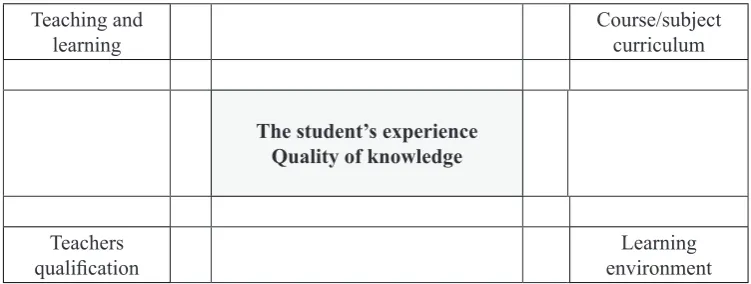
The key question regarding education today is how to improve the teaching/learning process. The latter is usually thought to consist of the four pillars which are represented by Figure 1.1.
Teaching and
learning Course/subject curriculum
The student’s experience Quality of knowledge
Teachers
qualification environmentLearning
Figure 1.1: 4 pillars of the education system (Aberšek, 2013).
20
Figure 1.2: School system and innovative pedagogies.
It is naïve to assume that addressing only one dimension will automatically improve the education system as evidence from research shows (Punie et al., 2006; Law et al., 2011). Obviously, a significant number, if not all of the dimensions need to be tackled by the common efforts of a critical mass of actors.
Since complex organisms, and a classroom is no exception, constantly evolve over time, mainly depending on the context, i.e. the culture and its values, it is of no surprise that in some education systems, e.g. Slovenian, the teaching/learning dimension does not recognize critical thinking yet as a vital part of it, which cries for a change. But what is critical thinking? Since it consists of ‘thinking’ and ‘critical’ let us first see what they mean. A decent definition of ‘think
-ing’ would be that it is a goal directed activity and of ‘critical’ that it is reflective in the sense of observing its own progress, evaluating individual steps leading to given goals and correcting its own mistakes (Hoaglund, 1999, p. 1–2). Keeping that in mind we are ready to give a defini
-tion of critical thinking: it is a reflective mental act that leads to decisions upon analysing and
synthesizing information.
So, one necessary but not sufficient step to the improvement of education in systems that do not include critical thinking as part of the teaching/learning process would be to include the argumentative theory. The remain of the paper is devoted to show the importance of recogniz
-ing argumentative fallacies at an early stage in the education process. It can help overcome social conflicts as a result of judgments grounded in affections, authorities or power. Since the recent European education policy suggests “that Europe’s school systems become more flexible and effective in improving learning outcomes, and argues that Europe’s capacity to compete in the global knowledge economy will depend on whether its higher education institutions can meet the rapidly growing demand for high-level skills” (Aberšek, Borsnter & Bregant, 2014, p. 13) the incorporation of critical thinking in the education systems neglecting it so far would be an innovation for them.
Arguments and their Evaluation
21 controlled. As a reason for this he offers the idea that the media are, much like legislative, ex
-ecutive and judicial branches, to which power is usually divided, an actual branch of the power. In a wider sense, every rational support of a certain claim providing reasons for its acceptance is called an argument. Arguments are used to advocate decisions, criticising positions as well as evaluating actions and searching for the truth. They try to persuade us to accept different claims. When deciding what to accept, however, one must bear in mind whether the arguments offered by their opponents in order to support their statements are good. Since the argument is one of the most powerful means of a persuasion, it is understandable that everyone tries to ground their ideas in such a way.
Anyhow, the argument is not merely a collection of statements to which the truth value is ascribed, i.e. it can be said whether they are true or false, which is why they are called proposi-tions, but it is also its characteristic that these statements are arranged in a special way. Such an arrangement of propositions can be called the structure of an argument. It always consists of propositions for which we know or believe that are true called premises, and more or less questionable propositions called conclusions, that are for this reason supported or justified by premises. In addition, the relation between premises and conclusions is also considered to be part of the argument. The relation must be such that the reasons (premises) ground the conclu
-sions. For example, in the argument “A progressive tax rate is the most just model of filling the
country’s treasury as the poor contribute less while the rich contribute more” the first proposi
-tion is a conclusion while the second one is a premise. The rela-tion between them is such that the second one justifies the first one. Usually we talk of inferring something from something, where the word ‘inferring’ refers to the procedure in which propositions accepted as being true lead us to the truth of other propositions being controversial (conclusions). A place of conclu
-sions in arguments is not fixed; they can be in the end, in the middle or at the beginning. The same goes for premises. Conclusions and premises can also be unstated or hidden, which occurs when the author, due to the belief that a reader can without the effort figure out what is missing in the argument, deliberately leaves out a proposition that is widely known and accepted. For example, in the “Scientists discovered remains of water on Mars. Therefore there must be life
on Mars.” a proposition ‘Water ensures the origin and preservation of life.’is missing. An argu
-ment with unstated propositions is called enthymeme.
Questions, orders and exclamations are not propositions as we cannot affirm or deny them, which is why they cannot be part of an argument. Questions can only be asked, orders given and exclamations uttered. There is also a difference between sentences and propositions as the latter refer to what sentences express, i.e. a meaning. Thus, two different sentences can characterize the same proposition, e.g. sentences ‘Criticism of a government about a tax reform being bad came from syndicates.’ and ‘Syndicates criticized a government over a bad tax re
-form.’ have different structure which is why they are indisputably different, yet have the same meaning. In a narrow sense, an argument is a sequence of sentences in the indicative form with a specific content, of which some sentences are premises and some conclusions following from
them.
22 which is provided by premises usually expressing common truths. The relation pointed out by inference indicators is helpful but secondary. In an argument we try to persuade our opponents with the help of reasons that a certain statement is true, while in an explanation, with which it is sometimes confused, we merely describe with the help of reasons why something is as it is. For example, the text “An act prohibiting smoking in indoor public places is unjust, as smokers are denied the right to a free choice” is an argument (the first statement is controversial and the second supports it), while the text “Hitler came to power because the Allies destroyed the Ger
-man economy after the first World War” is an explanation (the first sentence is not controversial and the second only explains it).
Upon the criterion called inductive probability, which is a probability of a conclusion given a set of premises, arguments are normally classified into two categories: deductive and
inductive. Deductive arguments are those which conclusion must be true if its premises are true,
and inductive arguments are those which conclusion is merely more or less probable with re
-spect to its true premises. For example, the argument “All humans are mammals. Angela Merkel
is a human, therefore she is a mammal” is a deductive argument, while the argument “Few
politicians strive to solve the Ukraine crisis. Anton Rocket is a politician, therefore solving the
Ukraine crisis is of no interest to him.” is inductive. In other words, deductive arguments take
such a form that, if the premises are true, it is not possible for an inferred conclusion to be false, while inductive arguments take such a form that despite of the true premises an inferred conclu
-sion still might be false. And this is why it is said that deductive arguments are valid and induc
-tive arguments invalid. However, it must be pointed out that the valid argumentative form only prohibits the appearance of true premises and a false conclusion. This means that arguments can be valid even if containing false premises and a false conclusion. So, the argument “All
Venusians are intelligent. Axel Xenon is Venusian, therefore he is intelligent.” is valid although
far from being good. Anyone would, even though merely intuitively, agree about that.
Obviously then, validity itself is not enough for an argument to be good. The latter should be the main criteria for adopting arguments proving certain positions: clearly, it is not reasonable to accept statements supported by bad arguments. But in order to be good an argu
-ment must also contain premises that are true. Only a high inductive probability together with
true premises make a good argument. “The argument with acceptable premises which is strong enough according to adequate standards of evidence and criteria of persuasiveness is good” (Šuster, 1998, p. 179). Deductive arguments since being valid and therefore having the high
-est (maximal) inductive probability are surely the b-est candidates for being good, but they are not the only ones. Inductive arguments, which make up the majority of arguments that we deal with in our everyday life, can be good as well. Inductive probability is denoted by values from 0 to 1, with no mathematical formula existing to calculate it. The value is fixed on the basis of how strong the support of premises for a conclusion is. This is determined with the help of the relevancy of premises according to the context in which they appear. With deductive arguments, since conclusions necessarily follow from premises inductive probability is always 1, while it is never 1 with inductive arguments since conclusions follow from premises merely with a greater or lesser probability. However, even inductive arguments can be strong. If they are strong or not depends on a probability of their conclusions to be false given a set of premises: if a conclusion is highly probable regarding the premises they are strong, and if a conclusion is less probable considering the premises they are weak. For example, the argument “Most Slovenians speak at least one foreign language. Borut Pahor is Slovenian, therefore he speaks
at least one foreign language” (taking into account that the number of Slovenian speaking at least one foreign language is vast, it is likely that he is one of them as the conclusion states) is strong, while the argument “Few politicians speak the truth. Paul Hair-splitter is a member
23 weak. The threshold is set at 0.5: above that we are talking about strong inductive arguments, below that we are talking about weak inductive arguments. Again, even a maximal inductive probability cannot make an argument good if it does not also contain true premises. Deductive arguments meeting both conditions, a high inductive probability and the truth of premises, are called sound arguments.
But how to persuade someone that building and using arguments is important? People, namely, usually understand an exchange of arguments as a conflict of their authors and a ver
-biage with no practical value, i.e. an end in itself. Sometimes this is true, but only due to our ignorance of general logical principles and concrete rules of inference, or the unstoppable de
-sire for something to be true and our need to defeat the opponent in a discussion at any cost. However, if one holds on to logical principles and is capable of realizing when their reasons for a certain belief are bad, and is in this case also ready to admit that they are wrong, then there is no other way to find the truth in the world beside arguments.
Logical Fallacies
Of course, the path to the truth is full of traps that must be avoided. Unfortunately, there is no other way than knowing the methods and principles through which we distinguish a good from a bad reasoning, and the ability to use it on concrete practical examples. This, however, does not mean that only a person who has dedicated a significant part of her life to the study of logic can reason correctly. Each of us is already by her nature inclined to accepting some views while rejecting others. Indisputably, a person trained in distinguishing good from bad arguments and able to neglect her feelings and emotions to the degree that they do not cloud her judgement, has an enormous advantage in a discussion on what is true and what is false.
In bad arguments, the premises do not support conclusions and do not justify or prove them even if they are true. It is said that the author committed a fallacy, where the word ‘fal
-lacy’ is used for typical examples of a poor reasoning. The Latin expression fallacia (decep
-tion) points to the fact that fallacies were traditionally considered as deceptions. It is worth emphasising that a reasoning which is fallacious in a given context can later after learning new information become a good argument. A general rule that we have to take into account when evaluating arguments is that a given argumentative form is not fallacious (is a good argument) when given premises are relevant for conclusions. Recognizing fallacies is difficult for the imperfect argumentation and emotional rhetoric being significant for them. The accurate iden
-tification of fallacies is sometimes difficult also because of the violation of several principles of a good reasoning at once.
Let us now take as an example of a fallacy the words quoted at the beginning and show why they represent a bad argument: “If the media, as some claim, are the fourth branch of the power, the citizens must have a control over them”. Granted, our assumption that it is an argu
-ment still holds. The argu-mentative form is, however, not ideal: the conclusion ‘the citizens must have a control over the media’ is, for instance, unstated (as well as the premise ‘some claim that the media are the fourth branch of the power’) which makes it, in the best case sce
-nario, enthymeme, with the only stated premise being the conditional. Moreover, the conclusion follows from the premises necessarily, meaning that it classifies as a deductive argument with the maximal inductive probability. However, is the argument good? As already said, in order to be good an argument must have a high inductive probability and true premises. And it is the latter where our argument goes wrong. It assumes that the ‘the media are the fourth branch of power’ which is, of course, false since the branches of the power are legislature, executive and judiciary. Thus the argument is bad because the false premise cannot be relevant for the true conclusion, even though the conclusion follows from the premise due to the form of reason
24 Anyhow, Rupel could respond that the phrase ‘the fourth branch of the power’ must be understood metaphorically. It is not used to describe the actual power but merely to emphasize “the importance of independent and autonomous media in order for a normal democracy to work, where media functions and rights are written in international resolutions, constitutions of our and other democratic countries, and last but not least, in the media legislation which in the end define, on the executive level, the right to the independent and autonomous operation of the media and journalists” (Repovž, 2007, p. 2). And this is why our analysis of her argument shown above, and under which the argument is fallacious, is wrong. However, even this is of no help since one of the most important principles that must be respected when arguing is a seman-tic clarity. Words are often a source of misunderstandings and, in order to avoid them, those that take place in arguments must be unambiguous, which is achieved by their prior careful defini
-tion. And this is not the case in a given argument. In our argument the phrase ‘thefourth branch of the power, which is essential for it, can be interpreted in, at least, two ways. Unfortunately, it is not clear what meaning the author of the argument had in mind, which is why she commit
-ted the so called fallacy of equivocation. It is not hard to see that such arguments are bad: the speaker will not persuade the listener to accept her conclusion as they understand key words differently and are actually speaking about two different things.
The concept of the argument and its elements have been explained, but fallacies only mentioned. Let us take a closer look at their definition with the help of the following example. Imagine a politician, Peter Kamen, who has to vote on a selection of some candidate, say, a governor of the bank. About his choice he says for a newspaper the following: “While this person might have good references to be the governor of the bank, she is not the only one. This is why I will not vote for her.” Usually, we offer good reasons for our decisions. The candidate could have seemed unsuitable for us if he had lacked experience, references, or a representative bibliography, good reputation in public, etc. If we are opposing a selection (for which we have legitimate political rights) then it is our task to offer rational reasons in order to justify our deci
-sion about the denial. Now, how does the above reason saying that the candidate is not the only one (and therefore not suitable for the job) sound to you? Certainly not good. Instead of giving a good reason for voting against the candidate, Peter Kamen merely said that he was not the only one. Of course, in a banal way this is true, since there are others beside him. But is it not being the only candidate for the position really a relevant reason for voting against the candidate? No, and this is why the conclusion ‘I will not vote for her’ does not validly follow from it.
When we talk about logical fallacies, their definition ever since Aristotle goes like this: “A fallacious argument /…/ is one that seems to be valid but is not so.” (Hamblin, 1970, p. 12), or “A fallacy is a type of argument that may seem to be correct, but that proves, on examination, not to be so” (Copi & Cohen, 1994, p. 115). It includes four characteristics that can already be found, at least to some extent, in Aristotle’s On Sophistical Refutations. As Woods (2003) states them, an accepted reasoning pattern is fallacious when it is (a) wrong, (b) persuasive (making the incorrectness unobvious), (c) generally accepted and used, (d) incorrigible in a sense that the degree of repeating the same mistake is high even after the “diagnosis”.
Walton offers the following definition of fallacies in Routledge Encyclopaedia of Phi -losophy: “Fallacies are common types of arguments that have a strong tendency to go badly wrong, or to be used as deceptive tricks when two parties reason together. In some instances they are simply careless errors in thinking, while in other cases they are techniques of argumen
-tation used by one arguer more or less deliberately to try to fool another into accepting a false conclusion” (Walton, 1998, p. 544).
25 are dealt with in formal logic. More often, fallacies arise informally. They do not involve a mis
-take in formal inference, but arise from the misapplication of a contextual method or a tactic to get a conclusion accepted” (Bunnin & Yu, 2004, p. 248).
Nolt and Rohatyn offer the widest definition of fallacies by saying that “fallacies are simply mistakes that occur in arguments and affect their cogency” (Nolt & Rohatyn, 1988, p. 165), and that there is neither a universally accepted definition of a ‘fallacy’ nor a universally accepted classification of fallacies.
However, logical fallacies have their history, and it was the great Aristotle who paved the way in this field as well. Moreover, his list of thirteen fallacies is taken as a standard and still serves as a reference. In On Sophistical Refutations he mentions them in a condensed form. Without describing them in detail, let us merely list them in Latin, according to a scholastic tradition, following Aristotle’s classification to linguistic and non-linguistic fallacies.
Fallaciae dictionis (linguistic fallacies): 1. Equivocation (fallacia aequivocationis); 2. Amphiboly (fallacia ambiguitatis); 3. Composition (fallacia compositionis); 4. Division (fallacia divisionis);
5. Emphasis or accent (fallacia accentus); 6. Figure of speech (fallacia figuarae dictionis).
Fallaciae extra dictionem (non-linguistic fallacies):
1. Accident (fallacia accidentis);
2. Confusion of absolute and qualified statement (fallacia secundum quid et impliciter); 3. Ignorance of refutation (ignorantia elenchi);
4. Begging the question (petitio principii);
5. Confirming the consequent (fallacia consequentis); 6. False cause (fallacia de non causa ut causa); 7. Many questions (fallacia plurium interrogationum).
It is important to note two things: first, that the most of these fallacies kept the same names, and second, that the most of them still represent the core in all standard surveys of logi
-cal fallacies, both being, in their own ways, astonishing (Bregant & Vezjak, 2007, p. 29).
Discussion: Bad Arguments Lead to Intolerable Consequences
Why such mistakes are made at all? Well, sometimes we do that accidentally sometimes deliberately. But what is a psychological motivation or foundation for them?The paper does not deal with this aspect of logical fallacies, however, it is worth to mention that in order to understand the context in which a particular argumentative mistake has been made someone’s motives and intentions should be kept in mind.
It is agreed that our thoughts and actions must follow the principles of a clear reasoning. What a luck, at a declarative level we all shout for the argumentative debate. Why? The argu
26 This example shows that a right understanding of why a certain fallacy has been commit -ted frequently requires a psychological insight. Obviously, this is not a job for a philosopher but for a psychologist. However, if we ask ourselves why someone sticks to a particular logical mis
-take two answers could be given. The first suggests that she is not aware of committing a fallacy. In this case, if we deal with an intellectually honest man on the other side, the misunderstanding can be quickly resolved. Sadly, this does not happen very often because people are vain and not ready to admit their mistakes; they rather insist or withdraw to defend their interests despite knowing that they are wrong. The second is even bitterer: what if someone uses bad arguments deliberately? The »purpose« here could be understood very broadly and is, consequently, hard to describe. Some people cheat in order to defend their good names or their institution’s views. We would probably agree that in this case objections and persuading will not do since the other party will not show any kind of regret or confession over its bad and wrong behaviour. A correct discussion will not take place and appealing to honesty will not do.
The bad argumentation seeks for opportunities everywhere: in a consumer rhetoric, polit
-ical manipulations, professional discussions, neighbouring conversations, newspaper polemics, etc. If the one in bars and in the street is not taken seriously, the one in professions and politics should be. Namely, arguments are part of a scientific discourse and acquisition of knowledge, and politics affect our lives by passing and administering the law. But if science rejects badly supported conclusions by itself and is constantly undergoing examinations, at least in more exact, natural sciences (in social sciences, it is still, unfortunately, often otherwise), politics normally stick to a logically ill argumentative practice at any price. Only here, for example, an argumentation that allowing homosexual marriages would lift homosexual marriages to a level of desirable and, presumably, sudden jumps from heterosexual to homosexual partnerships, as if homosexuality were a cultural habit, provided by a representative can contribute to a rejec
-tion of the equaliza-tion of homosexual and heterosexual marriages. No wonder then that the bad argumentation makes human standards and interpersonal relationships worse, and leads to the growth of social conflicts and an instable society.
Moreover, if the legislature, executive and judiciary branches of power did not listen to good arguments, our lives would not be as good as they are. The state might pass bad, danger
-ous and unjust laws that would, for example, increase discrimination, intolerance, or racism as well as social instability, stratification, or emigration. And this is something that our civilised society cannot afford.
Conclusion
This analysis shows that one step leading to the improvement of the education system, would be to include critical thinking in the teaching/learning process. Through a substantial analysis of good and bad arguments and possible psychological reasons for adopting the latter rather than the former, a claim is made that committing logical fallacies might have destructive consequences for a society. The current events in the world speak for themselves and justify the claim, if listen to justifications of world leading politicians, in its own way. However, this could be marginalized if not avoided by training pupils in critical reasoning at an early stage of their education emphasising the importance of good arguments and destruction of bad ones.
27
Acknowledgments
The author acknowledges the support of the Ministry of Education, Science and Sport of Republic of Slovenia and European Social Fund in the frame of Project: “Innovative pedagogy 1: 1 in the light of competences of the 21st century” on Faculty of Natural Sciences of Univer
-sity of Maribor.
References
Aberšek, B. (2013). Cogito ergo sum homomachine? Journal of Baltic Science Education, 12 (3), 268-270.
Aberšek, B., Borstner, B., Bregant, J. (2014). Virtual teacher: Cognitive approach to e-learning material. Newcastle upon Tyne, England: Cambridge Scholars Publishing.
Aristotle (c. 330 B. C.). Sophistical refutations and prior analytics, Rhetoric, On interpretation posterior Analytics and Metaphysics. In J. Barnes (Ed.) (1984), The Complete works of Aristotle, The Re-vised Oxford translation, Vols. 1 and 2. Princeton, NJ: Princeton University Press.
Bregant, J., Vezjak, B. (2007). Zmote in napake v argumentaciji (Misconceptions and errors in argumen -tations). Maribor, Slovenia: Subkulturni azil.
Copi, I. M., Cohen, C. (1994). Introduction to logic. New York, NY: Macmillan Publishing Company. Bunnin, N., Yu, J. (2004). Fallacy. In The Blackwell dictionary of Western philosophy (p. 42). Oxford,
England: Blackwell Publishing.
Law, N., Yuen, A., Fox, R. (2011). Educational innovations beyond technology – Nurturing leadership
and establishing learning organizations. New York, NY: Springer.
Punie, Y., Cabrera, M., Bogdanowicz, M., Zinnbauer, D., Navajas, E. (2006). The Future of ICT and
Learning in the Knowledge Society (Technical Report No. EUR 22218 EN). Seville, Spain: Euro-pean Commission - Joint Research Centre - Institute for Prospective Technological Studies, http:// ipts.jrc.ec.europa.eu/publications/pub.cfm?id=1407.
Repovž, G. (2007, January 15). Komunisti sovjetskega tipa (Communists of Soviet type). Mladina, 2. Rupel, D. (2006, December 30). Novoletne želje (New Year wishes). Delo, 5.
Hamblin, C. L. (1970). Fallacies. London, England: Methuen.
Hoaglund, J. (1999). Critical thinking (3rd Edition). Newport News, VA: Vale Press. Nolt, J., & Rohatyn, D. (1988). Theory and problems of logic. New York, NY: McGraw-Hill.
Šuster, D. (1998). Moč argumenta (The strength of the argument). Maribor, Slovenia: Pedagoška fakulte-ta.
Walton, D. (1998). Fallacies. In Routledge encyclopedia of philosophy (Vol. 3, p. 544–545). London, England: Routledge.
Woods, J. (2003). Paradox and paraconsistency: Conflict resolution in the abstract sciences. Cambridge, England: Cambridge University Press.
Advised by Boris Aberšek, University of Maribor, Slovenia
Received: July 29, 2014 Accepted: August 21, 2014
Janez Bregant PhD., Professor, University of Maribor, Koroška cesta 160, 2000 Maribor, Slovenia. E-mail: [email protected]