PROBLEMS OF EDUCATION IN THE 21st CENTURY Volume 68, 2015
6
DEVELOPMENT OF THE RESEARCH TOOL
TO IDENTIFY FACTORS AFFECTING
THE USE OF CHEMISTRY EDUCATIONAL
SOFTWARE
Kateřina Chroustová, Martin Bílek University of Hradec Králové, Hradec Králové, Czech Republic
E-mail: [email protected], [email protected]
Andrej Šorgo University of Maribor, Maribor, Slovenia E-mail: [email protected]
Abstract
Currently, the implementation of information and communication technologies (ICT) has been strongly recommended to science teachers. For identification the factors of successful ICT implementation the Unified Theory of Use and Acceptance of Technology (UTAUT) is applied, which works as the theoretical background of planned monitoring of Czech chemistry teachers´ attitudes to this problem. This theoretical review introduces the process of creating the modified UTAUT model serving as the basis for a research tool to be exploited for the future survey. Within this process three sources were exploited: (1) theories dealing with factors which influence user behaviour in relation to the use of modern technologies, (2) the analysis of research results focused on the acceptance and use of ICT in chemistry instruction and (3) results of researches conducted by the authors in the field of the effectiveness of the educational software used in chemistry teaching and learning. The conducted analysis of these three sources resulted in defining the presented survey and designing the appropriate theoretical model and research tool.
Key words: chemistry education, educational software, The Unified Theory of Use and Acceptance of Technology (UTAUT), teachers´ attitudes.
Introduction
Within the last decades, numerous resources had been attributed towards the implementation of hardware components and peripherals into schools, following with the use and adaptation of primarily non-educational software and development of educational software and teaching multimedia materials. However, this potential cannot be fully developed if teachers do not accept educational software as an educational tool and a source providing learning
content and do not use it. The rejection has two rationales; the first one is the acceptance and use
of ICT in education in general, and the second one is the use of particular pieces of hardware and software. A number of researches has been accomplished, both on the acceptance of ICT in general, (e.g. Martinovic, Zhang, 2012; Valtonen, Kukkonen, Kontkanen, Sormunen,
Dillon, & Sointu, 2015), or on the acceptance of specific technologies, e.g. tablets (Ifenthaler, Schweinbenz, 2013), interactive whiteboards (Tosuntaş, Karadağ, Orhan, 2015) and different educational software (Šorgo, Verčkovnik & Kocijančič, 2010). To determine factors affecting
the use and acceptance of educational software by all the actors of the educational process is an integral part of the search for reasons, whether and, if so, when and why is the use of this
IN THE 21 CENTURY Volume 68, 2015 7
Considering the fact that in the Czech Republic there has been a lack of researches on
the acceptance and use of educational software in specific educational context, we started our
research activities. The main objective of our research is to create a model of factors affecting the acceptance and the use of educational software by learners and teachers of chemistry as the general-education subject. The theoretical background of the proposed model includes:
1) Eight theories related to The Unified Theory of Use and Acceptance of Technology, including personal traits and characteristics such as gender, age, experience in the use of
educational software and ICT etc.
2) Results of analyses of other researches (e.g. Donnelly, McGarr, O’Reilly, 2011; Prestridge, 2012; Hernández-Ramos, Martínez-Abad, Peñalvo, García, & Rodríguez-Conde, 2014).
3) Results of our own researches.
Eight Theories Relating to the Unified Theory of Use and Acceptance of Technology (UTAUT)
The Unified Theory of Use and Acceptance of Technology (UTAUT) was designed by
Venkatesh, Morris, Davis, & Davis (2003). It was built on a combination of the eight earlier theories on the acceptance and motivation for the usage of technology with the purpose to
create a unified theory. This theory resulted from following theories: Theory of Reasoned
Action (TRA), Technology Acceptance model (TAM), Motivational Model (MM), Theory of Planned Behaviour (TPM), Combined Theory of Planned Behaviour/Technology Acceptance Model (C-TPB-TAM), Model of Personal Computer Use (MPCU), Diffusion of Innovations
Theory (IDT), and Social Cognitive Theory (SCT). The UTAUT theory identifies four basic
determinants of behavioural intention towards the acceptance of information technology:
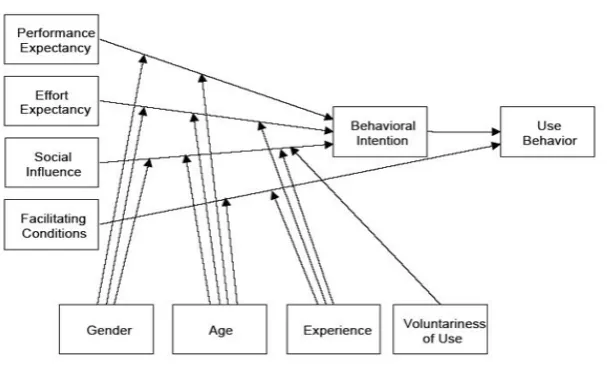
performance expectancy (i.e. the degree of persuasion that use of the system helps users achieve improvement of job performance), effort expectancy (i.e. the degree of simplicity associated with the use of the system), social influence (i.e. the degree of persuasion that people that
are important for the users believe that he or she should use this new system) and facilitating conditions (i.e. the degree of persuasion of the user that there is an organizational and technical
infrastructure to support the use of the system) that are influenced by gender, age, experience,
and voluntariness of use. We intend to apply the UTAUT theory to carry out the research
survey focused on the description and interpretation of factors influencing the acceptance and
use of educational software by teachers and learners in education of chemistry as a
general-education subject based on its modification and adaptation to the current conditions of the
PROBLEMS OF EDUCATION IN THE 21st CENTURY Volume 68, 2015 8
Figure 1: The Unified Theory of Use and Acceptance of Technology model. (Venkatesh, Morris, Davis, G. B., & Davis, F. D., 2003)
The UTAUT theory was formulated on the basis of the eight known theories affecting
the motivation and reasons of our behaviour, environmental influences and surroundings on
the acceptance of the new technology or on the speed of innovation diffusion (in this case on the diffusion of the new technology) among the population. It was necessary to study the foundations to create a research tools based on this theory.
Theory of Reasoned Action (TRA)
The Theory of Reasoned Action (TRA) was created by social psychologist Ajzen and Fishbein in 1975 and 1980 (Fishbein, & Ajzen, 1975; Chang, 1998). This theory states that it is possible to predict “Behaviour of individual” (B) on the basis of “Behavioural Intention” (BI)
which is influenced by two factors: “Attitude toward act or behaviour” (A) and “Subjective
Norm” (SN). The attitude includes feelings of favourableness or unfavourableness towards
this behaviour. The Subjective Norm includes individuals´ persuasion of whether it is expected
from them to act in a certain way, or not. This theory has been applied to many different types of behaviour, including the acceptance of new technologies and become the basis for
the Technology Acceptance Model (Oye, Iahad, & Rahim, 2014). Reflecting this, Ajzen defined
the Theory of Planned Behaviour (see below).
Figure 2: Theory of Reasoned Action model (Fishbein & Ajzen, 1975).
Technology Acceptance Model (TAM)
IN THE 21 CENTURY Volume 68, 2015 9
also collaborated with Bagozzi, and Warshaw (1989). It intends to explain and predict the
behaviour of users with regard to information technology: whether they accept and use the
ICT. Other factors influencing attitudes to using IT were the perceived usefulness of the system
and perceived ease of use; the perceived ease of use affects the perception of the usefulness
for the individual. These two factors are also affected by external factors, such as e.g. systemic
properties or characteristics of the user.
Figure 3: Technology Acceptance Model (Davis, Bagozzi, & Warshaw, 1989).
Motivational Model (MM)
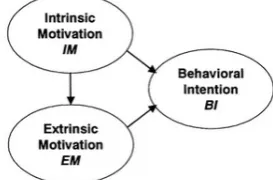
After processing the TAM model, the same authors (Davis, Bagozzi, & Warshaw, 1992)
have also started examining another factor influencing the computer use, respectively I(C)T in general – motivation. They proceed from theories that distinguish extrinsic and intrinsic motivation. The extrinsic motivation is defined as the supposition that users carry out their
activity because they consider it to be a tool that leads to the achievement of valuable outcomes,
such as promotion, salary etc. Then, the intrinsic motivation is expected to perform an activity without any other obvious fixation, but the performance of activity itself, i.e. they carry on the activity for its own sake than for any external reward. They asked the question whether users exploit the computer to work because they find it useful, i.e. to improve their job performance (extrinsic motivation), or because they enjoy its usage (intrinsic motivation). Within their research they proved the influence of both factors on the behavioural intention (Davis, Bagozzi,
& Warshaw, 1992).
Figure 4: Motivational Model (Wilson, & Lankton, 2004).
Theory of Planned Behaviour (TPB)
Theory of Planned Behaviour (TPB) was designed by Ajzen, co-author of Theory
of Reasoned Action (TRA), in 1991, as a follow-up one. It extends the factors influencing
behaviour intention with the “Perceived behavioural control”, which is related to a sense of
the individual whether it is simple or difficult to him or her to behave in that way. It is also closely connected to self-efficacy and its definition by Bandura in 1977 and 1982. The theory
PROBLEMS OF EDUCATION IN THE 21st CENTURY Volume 68, 2015 10
Figure 5: Theory of Planned Behaviour (Ajzen, 1991).
Combined Theory of Planned Behaviour/Technology Acceptance Model (C‑TPB‑TAM)
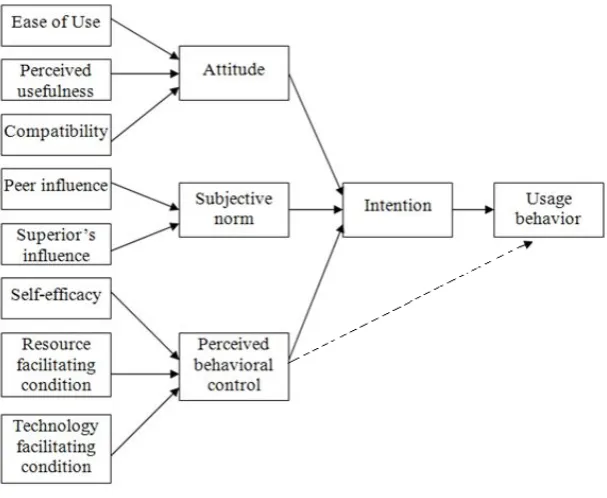
As it is evident from the name, this theory combines the Theory of Planned Behaviour (TPB) and the Technology Acceptance Model (TAM). It was created by Taylor and Todd in 1995. According to these authors, the TAM is useful for predicting the behaviour with regards to the usage of IT but the combined model provides a comprehensive understanding of the behaviour and behaviour intention (BI) considering the inclusion of the effects of normative and control beliefs of individuals. The authors assume that their model helps to better manage the process
of IT implementation because it focuses on social influence and control factors in the system,
which affect the use of IT (Taylor & Todd, 1995).
Figure 6: Combined Theory of Planned Behaviour/Technology Acceptance Model (Taylor, & Todd, 1995).
IN THE 21 CENTURY Volume 68, 2015 11
Model of Personal Computer Use (MPCU)
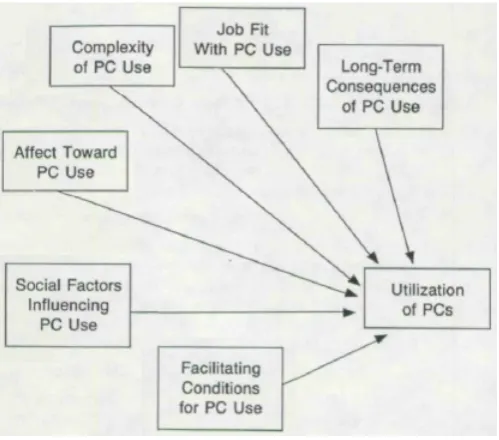
This model designed by Thompson, Higgins and Howell (1991) is based on the theory of behaviour created by Triandis in 1980. Unlike Fishbein and Ajzen (see TRA), the Triandis’s theory distinguishes the persuasions relating to the emotions of the moment of action, or more
precisely the behaviour from persuasions that are related to consequences, and indicates that the behaviour intention (BI) is influenced by the feelings towards this behaviour (affect), by what they think they should do (social factors), and by anticipated consequences of behaviour. The behaviour is then influenced by what people usually perform (habits), their behaviour
intention (BI), and facilitated conditions (Thompson, Higgins, & Howell, 1991). Based on this
theory, they created a model of factors influencing the use of personal computers (see Figure 7).
Figure 7: Model of Personal Computer Use (Thompson, Higgins, & Howell, 1991).
Diffusion of Innovations Theory (IDT)
This theory was created by E. M. Rogers in 1962 and describes the process and factors
affecting the diffusion of innovation, which was defined as the process in which an innovation
is given out through communication channels between individuals of the social system in
time and space. This process consists of five stages: (1) knowledge (innovation gets into the
consciousness of the individual, but he or she haven´t any further information about it), (2) persuasion (the individual gets active interest in the innovation), (3) decision (the individual is considering the advantages and disadvantages of the innovations and decides whether to accept or not this innovation), (4) implementation (acceptance of innovation and its use) and
(5) confirmation (Rogers, 2003). There are many factors that affect how likely and how quickly
PROBLEMS OF EDUCATION IN THE 21st CENTURY Volume 68, 2015 12
Figure 8: A model of Five Stages in the Innovation-Decision Process (Rogers, 2003).
Social Cognitive Theory (SCT)
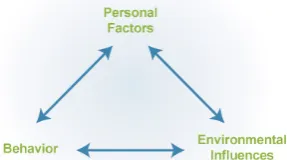
The Social Cognitive Theory designed by A. Bandura is based on the interpretation of human behaviour from the model triadic reciprocal determinism which considers three groups of factors: behavioural (actions and decisions), as well as the personal factors (cognitive,
emotional, physical factors, internal competencies) and environmental influences (e.g. the culture, laws and social context). The reciprocity consist in two-way interaction of factors and by determinism, i.e. the final effect of interrelated influences. This means that the behaviour itself interacts and influences the personal factors and environmental influences, it is not the
product of this factors only (Bandura 1986; Bandura, 2001).
Figure 9: A Model of Triadic Reciprocal Determinism (Bandura, 1986).
From Researches Focused on the Exploitation of ICT in Science Education
The analysis of selected researches was the second source for the modification and adaptation of the UTAUT to the conditions of the Czech educational system in the field of
science education, particularly in chemistry education. These researches were structured into three categories: the usage of particular educational software in various science subjects,
the usage of alternative ICT tools in a real lab or real excursion and the usage of
computer-based or computer-assisted instruction approaches in science education (Chroustova, Bilek,
2014a). We looked deeper at researches dealing with the influence of education software for
IN THE 21 CENTURY Volume 68, 2015 13
teachers in their use. In selected databases (Web of Science, Scopus, EBSCO – SCI-INFO:
scientific information sources for the Republic and Springer) we ran the search using keywords
“educational software” plus “chemistry” within the time period of last 20 years, i.e. 1995–2015. The set of collected publications was subjected to critical reading of abstracts, and afterwards
the remaining researches were examined with a focus on an exact description of the used
methodology (Chroustova, Bilek, 2015).
Below, there are listed researches, providing major importance for the creation of our research tools based on the UTAUT.
The first research is the second data analysis of PISA 2006 in the Czech Republic
(Kubiatko, & Vlckova, 2010), which discovered a positive relationship between the usage of ICT and knowledge of the natural sciences by 15-year learners where the ICT were used in the educational process, regardless of place of use i.e. at home, in the school or elsewhere. The results
of the analysis suggest that ICT could fulfil a supportive role in reducing the difference between
the achieved knowledge of the natural sciences among learners. These results show that ICT
is a powerful tool for science education and therefore should be used more frequently and to a larger extent, and so we should deal with factors influencing the ICT implementation in the
natural science/chemistry education.
Another research focused on the exploitation of ICT by teachers in innovative ways (Drent, & Meelissen, 2008) examined factors such as pedagogical approach, attitude to ICT
and ICT competence, personal entrepreneurship, the perceived change and school factors. The results of this research show that teachers using ICT innovatively can be characterized by a
specific combination of knowledge, skills, attitudes, and general competencies that determine their profile: (1) they are willing to keep extensive contacts with colleagues and experts in the field of ICT for their own professional development, (2) they understand and experience the benefits of innovative usage of ICT in their education, (3) their pedagogical approach can
be described as oriented to the learners, (4) their ICT competence is in conformity with their pedagogical approach.
The research by Valtonen, Kukkonen, Kontkanen, Sormunen, Dillon, & Sointu (2015)
examined how the experience of learning with the ICT support in pedagogically meaningful way may affect the attitude, subjective norm, self-efficacy and behaviour intention towards the
use of ICT for teaching and learning of pre-service teachers with using the Theory of Planned Behaviour (TPB). The results of this research show that after the application of the e-learning
course, statistically significant differences were detected in self-efficacy and in subjective
norms related to the use of ICT for teaching and learning. However, there were no differences in attitudes and behaviour intention.
Another research by Voogt (2010) compared the factors influencing the so called extensive and the non-extensive use of ICT among teachers of natural sciences with regard to their educational orientation, their competence in the field of ICT and their professional engagement. This research showed a positive relationship between the frequency of the use
of information and communication technologies and pedagogical orientation of teachers, their skills in ICT and their professional engagement.
The research by Efe (2011) focused on learners of science education and their attitudes
towards education technology in the light of experience with its use, the intention to use it
in their class, the efforts to provide opportunities to use ICT by learners and the belief in the value of educational technology for science education. A correlation was discovered between
certain factors, e.g. learners with more experience in using educational technology had a
PROBLEMS OF EDUCATION IN THE 21st CENTURY Volume 68, 2015
14 Previous Researches Accomplished by Our Own
The third source for the creation of our model are our own researches focusing on
the comparison of the effectiveness of the educational software exploitation in different
educational methods and organizational forms of chemistry education and on the optimization of the conditions for the application of educational software in a variety of educational methods and organizational forms.
The first research focused on the effectiveness of educational software in the final
revision of inorganic nomenclature on the secondary chemistry education (Chroustova, Bilek,
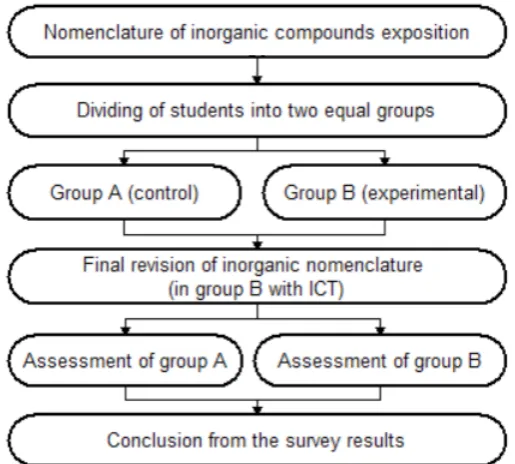
2014b). In this research, we verified the hypothesis that learners achieved better results in chemistry lesson of traditional type (frontal education) where the educational software was used for the presentation of the learning content at the interactive whiteboard compared to identical frontal education of the same learning content where the educational software on
interactive whiteboards was not used. The pedagogical experiment (see Figure 10) was
conducted at the secondary school in lessons of chemistry as a general-education subject.
The independent variable was exploitation of the education software called “Didakta – Chemie”
at the interactive whiteboard. The dependent variable was the results achieved by learners in the
test of knowledge. The pedagogical experiment followed the structure of pre-test – post-test – retention test (after six weeks).
Figure 10: Course of the pedagogical experiment (Chroustova, Bilek, 2014b).
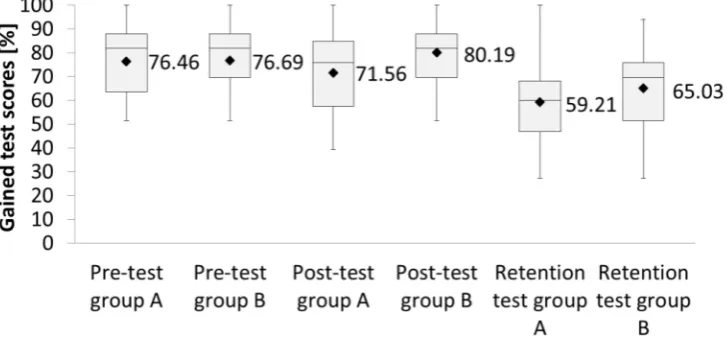
The results of pedagogical experiment (see Figure 11) show a higher rate in correct solving of algorithmic tasks by learners of the experimental group compared to the control group, but the positive effect (or more precisely significant difference) was not discovered to
the total depth of learners´ knowledge when applying the educational software compared to the control group (in detail in Chroustova, Bilek, 2014b). The results of the post-test show that
learners of the experimental group demonstrated the higher degree of acquiring the learning
content immediately after its revision where the educational software “Didakta – Chemie” was
used. In the retention test administered six weeks later the expected deterioration of learners’
knowledge was discovered. If we compare the results of both groups, there is no statistically
significant difference between them, which is why the longer retention of learners’ knowledge
IN THE 21 CENTURY Volume 68, 2015 15
after the general repetition with the use of educational software was detected. This fact points to missing the difference between learners who once revised the learning content applying the educational software, or did not. Therefore, we assume that regular use of educational software
as a standard part of the lesson could have a stronger effect on fixing the learning content.
Figure 11: Results of didactic tests in the pedagogical experiment (Chroustova, Bilek, 2014b).
From the Means and Standard deviations (Figure 11) effect sizes (Cohen’s d) were calculated, to present differences in knowledge gain. Between pre-test groups A and B difference
(d = 0.02) is almost non-existent, what shows uniformity of both groups. Difference between
post-tests of groups A and B falls close to the large effect (d = 0.49), and difference between retention tests of groups A and B is in medium effect (d = 0.285).
The second research focused on the evaluation of educational software (Chroustova, Bilek, 2014c). A comparative analysis of educational software for science education, particularly for chemistry education, in terms of its interactivity and its role in these multimedia educational materials was carried out. We used evaluation tool of LORI – Learning Object Review Instrument (v. 1.5) for evaluation of educational software. This tool includes all of the latest
requirements for various types of educational software, including the international standards
for metadata and usability for disabled learners (Belfer, Nesbit, Leacock, 2004). The results of our analysis show that the current educational software has different levels of interactivity. Usually they are interactive in the sense of response to program control and commands from
the learner, but they are not interactive, or they are interactive to little extent only, in terms of real adaptation to the learners´ knowledge (the moderate extent of adaptation was demonstrated
by e.g. the above mentioned educational software “Didakta – Chemie”). Generally, various
types of educational software differ in the quality and fulfilment of the requirements of the
LORI evaluation tool, depending mainly on their purpose. Thanks to the ICT development, the different types of educational software ordinarily include animation and visualization of high
quality, but none of them provided tools to adjust the software to the needs of learners with
sensory and motoric disabilities.
Creation of Research Model
From the above mentioned theories and results of selected researches, we designed
the modified UTAUT model, which consists in identifying factors and their relations influencing
PROBLEMS OF EDUCATION IN THE 21st CENTURY Volume 68, 2015
16 theories the model was generated which reflects the impact of factors on the acceptance and use of educational software by participants of chemistry as a general-education subject instruction
in the Czech Republic. On this basis a research tool was designed in the form of a questionnaire with 5-level scale (see Questionnaire items) for the verification of the model. Research sample will consist of approximately 400 teachers of chemistry as a general-education subject in the Czech Republic. With this sample size confidence interval of 5% at 95% confidence level is expected.
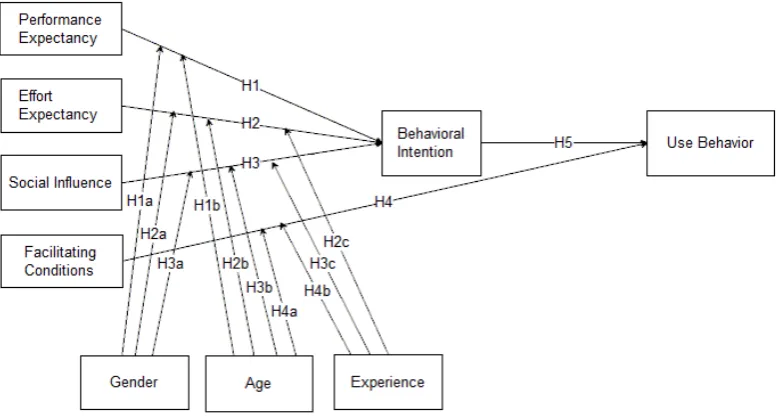
Figure 12: Research model and hypotheses based on UTAUT.
Research hypotheses relating to the modified UTAUT
The key point of our analysis in the preparation of research tools to identify factors
influencing the use of educational software in chemistry education in the Czech Republic is
to formulate hypotheses that are built on the relation within the UTAUT model (see Figure 12). We were inspired by a series of researches based on this theory during production of their formulations, (Chiu, & Wang, 2008; Van Raaij, & Schepers, 2008; Terzis, & Economides, 2011; Paola Torres Maldonado, Feroz Khan, Moon & Jeung Rho, 2011; Thomas Singh & Gaffar, 2013; Wong, Teo, & Russo, 2013). The hypotheses are as follows:
H1: Performance Expectancy has a significant effect on behavioural intention regarding the
acceptance and use of educational software for instruction of chemistry as the general education subject.
H1a: Performance Expectancy affects men’s and women’s behavioural intention differently
regarding the acceptance and use of educational software for instruction of chemistry as the general education subject.
H1b: Performance Expectancy affects young and old teachers’ behavioural intention
differently regarding the acceptance and use of educational software for instruction of chemistry as the general education subject.
H2: Effort Expectancy has a significant effect on behavioural intention regarding the acceptance
and use of educational software for instruction of chemistry as the general education subject.
H2a: Effort Expectancy affects men’s and women’s behavioural intention differently
regarding the acceptance and use of educational software for instruction of chemistry as the general education subject.
IN THE 21 CENTURY Volume 68, 2015 17
H2b: Effort Expectancy affects young and old teachers’ behavioural intention differently
regarding the acceptance and use of educational software for instruction of chemistry as the general education subject.
H2c: Effort Expectancy affects experienced and inexperienced ICT users’ behavioural
intention differently regarding the acceptance and use of educational software for instruction of chemistry as the general education subject.
H3: Social influence has a significant effect on behavioural intention regarding the acceptance
and use of educational software for instruction of chemistry as the general education subject.
H3a: Social influence affects men’s and women’s behavioural intention differently
regarding the acceptance and use of educational software for instruction of chemistry as the general education subject.
H3b: Social influence affects young and old teachers’ behavioural intention differently
regarding the acceptance and use of educational software for instruction of chemistry as the general education subject.
H3c: Social influence affects experienced and inexperienced ICT users’ behavioural
intention differently regarding the acceptance and use of educational software for instruction of chemistry as the general education subject.
H4: Facilitating conditions have a significant effect on the use of educational software for
instruction of chemistry as the general education subject.
H4a: Facilitating conditions affect the use of educational software for instruction of chemistry as the general education subject of young and old teachers’ differently. H4b: Facilitating conditions affect behavioural intention of experienced and inexperienced
ICT users differently regarding the acceptance and use of educational software for instruction of chemistry as the general education subject.
H5: Behavioural intention has a significant effect on the use of educational software for
instruction of chemistry as the general education subject.
Questionnaire items
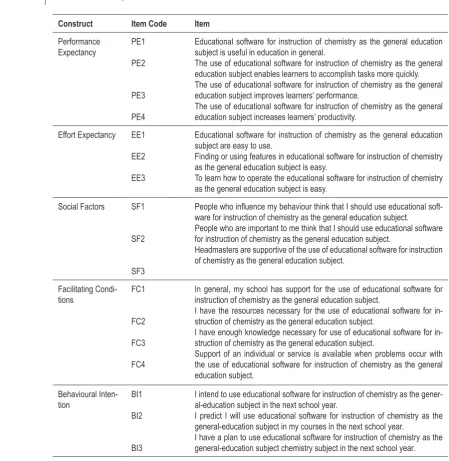
As we mentioned above, the UTAUT theory identifies a number of factors. Their degree can be measured by scaled items in Table 1. Each item is rated on a 5-grade scale expressing
approval or disapproval. These items are common in many researches using the UTAUT theory
PROBLEMS OF EDUCATION IN THE 21st CENTURY Volume 68, 2015
18 Table 1. The Questionnaire Items based on UTAUT.
Construct Item Code Item
Performance
Expectancy PE1
PE2
PE3
PE4
Educational software for instruction of chemistry as the general education subject is useful in education in general.
The use of educational software for instruction of chemistry as the general education subject enables learners to accomplish tasks more quickly. The use of educational software for instruction of chemistry as the general education subject improves learners’ performance.
The use of educational software for instruction of chemistry as the general education subject increases learners’ productivity.
Effort Expectancy EE1
EE2
EE3
Educational software for instruction of chemistry as the general education subject are easy to use.
Finding or using features in educational software for instruction of chemistry as the general education subject is easy.
To learn how to operate the educational software for instruction of chemistry as the general education subject is easy.
Social Factors SF1
SF2
SF3
People who influence my behaviour think that I should use educational soft -ware for instruction of chemistry as the general education subject.
People who are important to me think that I should use educational software
for instruction of chemistry as the general education subject.
Headmasters are supportive of the use of educational software for instruction of chemistry as the general education subject.
Facilitating
Condi-tions FC1
FC2
FC3
FC4
In general, my school has support for the use of educational software for
instruction of chemistry as the general education subject.
I have the resources necessary for the use of educational software for in -struction of chemistry as the general education subject.
I have enough knowledge necessary for use of educational software for in -struction of chemistry as the general education subject.
Support of an individual or service is available when problems occur with the use of educational software for instruction of chemistry as the general education subject.
Behavioural Inten
-tion BI1
BI2
BI3
I intend to use educational software for instruction of chemistry as the gener -al-education subject in the next school year.
I predict I will use educational software for instruction of chemistry as the
general-education subject in my courses in the next school year.
I have a plan to use educational software for instruction of chemistry as the
general-education subject chemistry subject in the next school year.
Scale labels: 1 – Disagree, 2 – Partially disagree, 3 – Neither Agree nor Disagree, 4 – Partially agree, 5 – Agree
Conclusions
Being aware of the factors and their influence on the acceptance and use of educational
software in the instruction of chemistry as the general-education subject, we should support the use of educational software in the classroom. That is, above all, through the preparation of the pre-service teachers and the continuing education of in-service teachers. The process of designing research tools to deliver meaningful results applicable in educational practice
requires profound preparation and analysis of all relating circumstances. In our case we used a thorough analysis of the theoretical background of The Unified Theory of Acceptance and
IN THE 21 CENTURY Volume 68, 2015 19
related attitudes of learners and teachers in the analysis of previous researches focused on the ICT implementation in teaching the natural sciences, particularly in laboratory activities. From our own previous researches we focused mainly on the effect of the use of educational software on learners’ knowledge in instruction of chemistry as the general-education subject and the evaluation of educational software. Due to the development of technologies, the more
frequent use of educational software is highly required. Based on the analysis of identified factors and their empirical verification under Czech conditions, recommendations should be defined towards a more effective use of educational software for instruction of chemistry as
the general-education subject, as well as towards the development of methodologies for both the teachers and learners on how to integrate educational software within the instruction of chemistry as the general-education subject and how to use it.
Acknowledgements
This study supported by the Specific Research Project N. 2102/2015 of Faculty of
Science, University of Hradec Kralove.
References
Ajzen, I. (1991). The theory of planned behaviour. Organizational Behaviour and Human Decision Processes, 50 (2), 179-211.
Bandura A. (1986). Social foundations of thought and action: A Social Cognitive Theory. Englewood Cliffs, NJ: Prentice-Hall
Bandura, A. (2001). Social cognitive theory: An agentic perspective. Annual review of psychology, 52 (1), 1-26.
Belfer, K., Nesbit, J., Leacock, T. (2004). Learning object review instrument (LORI): User manual. Version 1.5. Retrieved November 1, 2014, from http://www.transplantedgoose.net/gradstudies/ educ892/LORI1.5.pdf
Chang, M. K. (1998). Predicting unethical behaviour: a comparison of the theory of reasoned action and the theory of planned behaviour. Journal of Business Ethics, 17 (16), 1825-1834.
Chiu, C. M., & Wang, E. T. (2008). Understanding Web-based learning continuance intention: The role of subjective task value. Information & Management, 45 (3), 194-201.
Chroustova, K., Bilek, M. (2014a). Effectiveness of Educational Software in Science Education with Focus on Chemistry – From the Results of Research Projects. In Nodzyńska, M., Cieśla, P., Różowicz, K. (Eds.), New technologies in science education (p. 47–59). Kraków: Pedagogical University of Kraków.
Chroustova, K., Bilek, M. (2014b). On the efficiency of using didactic software in chemistry instruction. In Turčání, M., Drlík, M., Kapusta, J., Švec, P. (Eds.), DIVAI 2014 – 10th International Scientific
Conference on Distance Learning in Applied Informatics: Conference Proceedings (p. 305–315). Prague: Wolters Kluwer.
Chroustova, K., Bilek, M. (2014c). The Comparative Analysis of Educational Software Focused on Natural Sciences from the View of Interactivity. Paper presented at Information and Communication Technology in Natural Science Education – 2014, 23 - 24 October 2014, Siauliai University, Lithuania.
Chroustova, K., Bilek, M. (2015). Současné výzvy pro využití didaktického softwaru ve výuce chemie – z výsledků výzkumných studií [Current Challenges for Educational Software Using in Chemistry Education – from Results of Research Studies]. Media4u Magazine [online], 12 (3), 24-29. Davis, F. D. (1986). A technology acceptance model for empirically testing new end‑user information
systems: Theory and results. Doctoral dissertation. Cambridge, MA: MIT Sloan School of Management.
Davis, F. D., Bagozzi, R. P., & Warshaw, P. R. (1989). User acceptance of computer technology: A comparison of two theoretical models. Management Science, 35 (8), 982-1003.
Davis, F. D., Bagozzi, R. P., & Warshaw, P. R. (1992). Extrinsic and intrinsic motivation to use computers in the workplace1. Journal of Applied Social Psychology, 22 (14), 1111-1132.
PROBLEMS OF EDUCATION IN THE 21st CENTURY Volume 68, 2015
20 Drent, M., & Meelissen, M. (2008). Which factors obstruct or stimulate teacher educators to use ICT innovatively? Computers & Education, 51 (1), 187-199.
Efe, R. (2011). Science student teachers and educational technology: Experience, intentions, and value.
Educational Technology & Society, 14 (1), 228–240.
Fishbein, M., & Ajzen, I. (1975). Belief, attitude, intention and behaviour: An introduction to theory and research. Available at: http://people.umass.edu/aizen/f&a1975.html.
Hernández-Ramos, J. P., Martínez-Abad, F., Peñalvo, F. J. G., García, M. E. H., & Rodríguez-Conde, M. J. (2014). Teachers’ attitude regarding the use of ICT. A factor reliability and validity study. Computers in Human Behaviour, 31, 509-516.
Ifenthaler, D., & Schweinbenz V. (2013). The acceptance of Tablet-PCs in classroom instruction: The teachers’ perspectives. Computers in Human Behaviour, 29 (3), 525–534.
Kubiatko, M., & Vlckova, K. (2010). The relationship between ICT use and science knowledge for Czech Students: A secondary analysis of PISA 2006. International Journal of Science and Mathematics Education, 8 (3), 523-543.
Martinovic, D., & Zhang, Z. (2012). Situating ICT in the teacher education program: Overcoming challenges, fulfilling expectations. Teaching and Teacher Education, 28 (3), 461-469.
Oye, N. D., Iahad, N. A., & Rahim, N. A. (2014). The history of UTAUT model and its impact on ICT acceptance and usage by academicians. Education and Information Technologies, 19 (1), 251-270. Paola Torres Maldonado, U., Feroz Khan, G., Moon, J., & Jeung Rho, J. (2011). E-learning motivation
and educational portal acceptance in developing countries. Online Information Review, 35 (1), 66-85.
Park, S. Y. (2009). An analysis of the technology acceptance model in understanding university students’ behavioural intention to use e-learning. Educational Technology & Society, 12 (3), 150–162.
Prestridge, S. (2012). The beliefs behind the teacher that influences their ICT practices. Computers & education, 58 (1), 449-458.
Rogers, E. M. (2003). Diffusion of innovations. Fifth Edition. The Free Press, New York.
Šorgo, A., Verčkovnik, T., & Kocijančič, S. (2010). Information and communication technologies (ICT) in biology teaching in Slovenian secondary schools. Eurasia Journal of Mathematics, Science & Technology Education, 6 (1), 37-46.
Taylor, S., & Todd, P. A. (1995). Understanding information technology usage: A test of competing models. Information Systems Research, 6 (2), 144-176.
Thomas, T., Singh, L., & Gaffar, K. (2013). The utility of the UTAUT model in explaining mobile learning adoption in higher education in Guyana. International Journal of Education and Development Using ICT, 9 (3).
Thompson, R. L., Higgins, C. A., & Howell, J. M. (1991). Personal computing: toward a conceptual model of utilization. MIS quarterly, 125-143.
Terzis, V., & Economides, A. A. (2011). The acceptance and use of computer based assessment. Computers & Education, 56 (4), 1032-1044.
Tosuntaş, Ş. B., Karadağ, E., & Orhan, S (2015). The factors affecting acceptance and use of interactive whiteboard within the scope of FATIH project: A structural equation model based on the Unified Theory of acceptance and use of technology. Computers & Education, 81 (February 2015), 169-178.
Valtonen, T., Kukkonen, J., Kontkanen, S., Sormunen, K., Dillon, P., & Sointu, E. (2015). The impact of authentic learning experiences with ICT on pre-service teachers’ intentions to use ICT for teaching and learning. Computers & Education, 81 (February 2015), 49-58.
Van Raaij, E. M., & Schepers, J. J. (2008). The acceptance and use of a virtual learning environment in China. Computers & Education, 50 (3), 838-852.
Venkatesh, V., Morris, M. G., Davis, G. B., & Davis, F. D. (2003). User acceptance of information technology: Toward a unified view. MIS Quarterly, 27 (3), 425-478.
Voogt, J. (2010). Teacher factors associated with innovative curriculum goals and pedagogical practices: differences between extensive and non‐extensive ICT‐using science teachers. Journal of Computer Assisted Learning, 26 (6), 453-464.
Wilson, E. V., & Lankton, N. K. (2004). Modeling patients’ acceptance of provider-delivered e-health. Journal of the American Medical Informatics Association, 11 (4), 241-248.
Wong, K. T., Teo, T., & Russo, S. (2013). Interactive whiteboard acceptance: Applicability of the UTAUT model to Student teachers. The Asia‑Pacific Education Researcher, 22 (1), 1-10.
IN THE 21 CENTURY Volume 68, 2015 21
Advised by Ivana Šimonová, University of Hradec Králové, Czech Republic & Jarmila Kmeťová, Matej Bel University, Banská Bystrica, Slovakia
Received: November 11, 2015 Accepted: December 25, 2015
Kateřina Chroustová Mgr. in Education of Chemistry and Mathematics for High School, Ph.D. Student of Didactics of Chemistry, Department of Chemistry, Faculty of Science, University of Hradec Králové, Rokitanského 62, 50003 Hradec Králové, Czech Republic.
E-mail: [email protected]
Website: http://www.uhk.cz
Martin Bílek PhD., Professor of Didactics of Chemistry, Department of Chemistry, Faculty of Science, University of Hradec Králové, Rokitanského 62, 50003 Hradec Králové, Czech Republic.
E-mail: [email protected]
Website: http://www.uhk.cz
Andrej Šorgo Ph.D in Biology, Associate Professor of Biology Didactics, Faculty of Natural Sci
-ences and Mathematics, University of Maribor, Koroška cesta 160, Maribor, Slo -venia.