Chatrabhuji et al. World Journal of Pharmaceutical and Medical Research
ANALYTICAL STUDY TO EVALUATE THE EFFECT OF DIFFERENT SHODHANA
METHODS ON BHALLATAKA
Dr. Milind P. Chatrabhuji*1, Dr. Mita Mashru2, Dr. Madhavi Patel3
1
PG Scholar, Dept of RSBK, Parul Institute of Ayurved, Parul University, Vadodara, GJ, India.
2
Professor, Dept of RSBK, Parul Institute of Ayurved, Parul University, Vadodara, GJ, India.
3
Associate Professor, Dept of Pharmacognosy, Parul Institute of Pharmacy, Parul University, Vadodara, GJ, India.
Article Received on 19/05/2018 Article Revised on 09/06/2018 Article Accepted on 30/06/2018
INTRODUCTION
The word bhallataka describes the sharp attribute of the herb, in comparison to that of a javelin. It has various synonyms, describing the different properties, like anala – a fire, shophakrita one which causes oedema, krimighna - vermicide, vatari - enemy of vata etc.
Bhallataka (Semecarpus anacardium Linn; Anacardiaceae) fruit is one of the upavisha dravya (semi poisonous drugs). Its importance and utility is increasing day by day because of its therapeutic significance in many diseases including cancer. Though the fruits of
Bhallataka have many therapeutic values, pharmacies are scared to use this drug because of its irritant vesicating nature. The fruit contains tarry oil which causes contact dermatitis. Medically it is named as Urushiol Induced Contact Dermatitis because the chemical Urushiol is responsible for the dermatitis. If this vesicant nature is removed, the drug could be a good source for pharmaceutical industries in manufacturing many formulations containing Bhallataka as an ingredient.
Shodhana is the purificatory measure used in Ayurveda
to purify toxic medicinal plants (upavisha dravyas) so that they can be used in medicinal form internally. Ayurveda advocates use of Bhallataka after Shodhana
(Purificatory procedures). There are different Shodhana
methods mentioned in Ayurveda. Rasamrutam mentions
soaking the fruits in cow‟s urine, cow‟s milk and rubbing it in brick powder. Rasatarangini mentions is rubbing it in brick powder and boiling in coconut water.
MATERIALS AND METHODS Materials
1. Bhallataka Fruits
Matured fruits of Semecarpus anacardium Linn., were collected as market samples from five different places, those are, two samples from Vadodara (Gujarat) and one sample from Ahmedabad (Gujarat), Junagadh (Gujarat) and Nasik (Maharashtra) each respectively. The fruits were authenticated and the best sample amongst these five was identified by macroscopic observation; it was the one collected from Nasik (Maharashtra). So, the sufficient quantities (8 kg) of Bhallataka fruits were collected from Nasik (Maharashtra).
2. Shodhana Media
Fresh Gaumutra (cow-urine) was collected from the Ataladara Swaminarayan Gaushala early in the morning at around 04:15 AM every day on the days of their use. Fresh Gaudugdha (cow-milk) was purchased from
ISSN 2455-3301
WJPMR AND MEDICAL RESEARCH
www.wjpmr.com
*Corresponding Author:Dr. Milind P. Chatrabhuji
PG Scholar, Dept of RSBK, Parul Institute of Ayurved, Parul University, Vadodara, GJ, India.
Email ID: [email protected],
ABSTRACT
Bhallataka (Semecarpus anacardium Linn; Anacardiaceae) fruit is one of the upavisha dravya (semi poisonous drugs). It can be used only after shodhana (purification) for pharmaceutical purpose. Bhallataka can be purified with different shodhana methods as per various classical references. Here two classical references are taken viz. Rasamrutam and Rasa Tarangini. The detailed analytical study of Shuddha Bhallataka and different media used for shodhana is recorded. Performing shodhana of bhallataka by these three methods respectively, and by seeing the results of analysis of raw bhallataka and shodhita bhallataka of three different methods; it can be clearly seen that there is difference in the results of these three shodhana methods. The oil content is found in Ishtika churna (brick powder) after the process of shodhana, while solid contents of liquid media increase. That may be because of removal of toxic oily impurities from bhallataka fruits and they may be getting into the media used for shodhana. By comparing the results of analysis of these three methods, it can be said that removal of oil content; which is proportional to decrease of toxicity and increase of efficacy and safety; is seen more is the “Rasamrutam First Shodhana Method” than that of “Rasa Tarangini First and Second Shodhana Methods”
Ataladara Swaminarayan Gaushala in the morning at around 07:00 AM every day on the days of their use. Ishtika (dry bricks) were collected from the local area. Narikela (coconut fruits) were purchased in sufficient quantity from Parul University campus on the day of their use.
Methods
1. Bhallataka Fruits
The fruits were cleaned by removing the small fruits and other organic stuff and stored in container. Bhallataka fruits, which sink in water, are considered to be acceptable for medicinal use as per classical reference. So fruits which sunk in water were collected and dried properly. The dried fruits were used for further studies.
Total weight Bhallataka fruits at first = 8.00 kg
Total weight after removing small fruits = 6.06 kg
Total weight of fruits floating in water = 2.16 kg
Total weight of fruits sunken in water (after drying)
= 3.90 kg
From these 3.90 kg quantity of fruits, 100 gm of fruits were sampled for analytical study as Raw Bhallataka Sample. From remaining 3.80 kg quantity, 9 batches of 250 gm each were made; and three batches were taken for each shodhana method respectively.
They are as follows:
Method 1: Rasamrutam Shodhana Method (Three
batches of 250 gm each).
Method 2: Rasa Tarangini First Shodhana Method
(Three batches of 250 gm each).
Method 3: Rasa Tarangini Second Shodhana
Method (Three batches of 250 gm each).
Remaining 1.55 kg of Bhallataka fruits were stored separately as backup if their use would be needed at anytime throughout this work.
2. Shodhana Media
Gaumutra (cow-urine) was filtered through a cotton
cloth to remove physical impurities. 750 ml of Gaumutra at each was used for batches of 250 gm of Bhallataka fruits.
Gaudugdha (cow-milk) was not boiled and it was
used as it is. 750 ml of Gaudugdha at each was used for batches of 250 gm of Bhallataka fruits.
Ishtika (dry bricks) were made in to small pieces with the help of metal mortar and pestle. Then they were made into powder form with the help of grinder. The powder was filtered through a cotton cloth to remove any coarse particles of Ishtika and the fine powder obtained was used for this work. 750 gm of fine powder of Ishtika churna at each was used for batches of 250 gm of Bhallataka fruits.
Narikela udaka (coconut water) was obtained from Narikela (coconut fruit) at the time of their use. 750 ml of Narikela udaka at each was used for batches of 250 gm of Bhallataka fruits before starting of
every 20 minutes to each batch during boiling procedure.
Details of Shodhana Methods 1. Rasamrutam Shodhana Method
250 g of sunken Bhallataka fruits, in water, were taken in three batches.
The thalamus portion of the fruits was removed with
the help of a sudi (beetle cutter). After removing thalamus, the fruits were cut into four pieces each.
Then they were taken in plastic vessels containing 750 ml Gaumutra (cow urine) and kept for seven days.
Every day the fruits were taken out of the media and
washed with water, the used media was sampled and taken for analysis; and fresh Gaumutra (cow urine) in 750 ml was added.
On eighth day Bhallataka was washed and shifted to
the vessel containing 750 ml Gaudugdha (cow-milk) and kept for seven days.
Every day the fruits were taken out of the media and
washed with water, the used media was sampled and taken for analysis; and fresh Gaudugdha (cow milk) in 750 ml was added.
On 15th day the Bhallataka fruits were taken out of
the media and washed with water then shifted to a bag containing brick powder and rubbed thoroughly with proper precautions.
Then it was transferred to plastic container with a total of 750 gm of brick powder and it was allowed for three days in the vessel containing brick powder.
On 18th day brick powder in the samples was
removed physically, sampled and taken for analysis; and the samples of Shodhita Bhallataka were washed with hot water to remove brick powder attached to them.
Later, the samples were dried properly, sampled and
taken for analysis.
2. Rasa Tarangini Fist Shodhana Method
250 g of sunken Bhallataka fruits, in water, were taken in three batches.
The thalamus portion of the fruits was removed with
the help of a sudi (beetle cutter). After removing thalamus, the fruits were cut into four pieces each.
Then they were cut into four pieces and taken in to a
jute bag containing brick powder and rubbed thoroughly with proper precautions.
Then they are shifted in a plastic jar containing a total of 750 gm of brick powder.
Every day the plastic jars were shaken / jolted very
well.
It was allowed for seven days in the plastic jar containing brick powder.
On 8th day brick powder in the samples was
Later, the samples were dried properly, sampled and taken for analysis.
3. Rasa Tarangini Second Shodhana Method
250 g of sunken Bhallataka fruits, in water, were taken in three batches.
The thalamus portion of the fruits was removed with
the help of a sudi (beetle cutter). After removing thalamus, the fruits were cut into two pieces each.
Then they were put in to a cotton cloth and made pottali to be used in Dola Yantra.
Pottali were tied in the middle of iron rods and put in vertical steel-vessels of 1.25 liters capacity.
750 ml of Narikela Udaka (coconut-water) was
poured in to the vessel and pottali were made to hang inside the media to make Dola Yantra.
The Dola Yantra were put on gas-stove and
subjected to mild heat for three hours for boiling procedure in Narikela Udaka (coconut-water).
100 ml of Narikela Udaka (coconut-water) was
added every 20 minutes to each batch so that pottali stays completely inside the media even after the reduced quantity of Narikela Udaka (coconut-water) because of boiling.
Temperatures of boiling Narikela Udaka
(coconut-water) were measured with Infrared beam thermometer every 30 minutes. After three hours of boiling, pottali were removed from Dola Yantra and residual media were sampled after swangasheeta (self-cooling) and taken for analysis.
The pottali were opened after swangasheeta (self-cooling).
Later, the samples were dried properly, sampled and
taken for analysis.
OBSERVATIONS
Pharmaceutical observations
All water-sunken fruits of Bhallataka did not sink in
Gaumutra on first day. Some of the fruits floated in Gaumutra while some sunk in it. This continues up to 4th day. Fifth day and onwards all Bhallataka sunk in Gaumutra.
Appearance of Gaumutra changed when it was
removed after 24 hours every day. It contained some oily part of Bhallataka each time in each batch.
Appearance of Gaudugdha changed when it was
removed after 24 hours every day. It contained some oily part of Bhallataka each time in each batch.
Gaudugdha did not remain in its own form after 24
hours of exposure to Bhallataka. Its form changed to semisolid somewhere in between curd and paneer. This happened in each batch on every day.
Ishtika churna when removed after shodhana
procedure, its form changed to somewhat oily and blackish in colour in both the methods.
Narikela udaka when obtained after boiling changed
its colour completely and became hazy black in all
three batches. It contained some visible oily part of Bhallataka.
Toxicity observations
Being an upavisha dravya, Bhallataka has very good
efficacy as a medicine; as well as it also has clearly showing toxic effects while in purification stage. In this work, researcher has got toxic effects of Bhallataka at 9th day of shodhana; even after taking all the precautions like applying coconut oil to body parts, wearing hand gloves and face mask for protective measures. The observed toxic effects include:
i) Starting with a fever with chills at night, this subsided on its own without any medicine; and the other toxic effects started to be shown from the next morning.
ii) Itching over whole body, this did not get subside by anti-histamine medicine like chlorphinaramine maleate.
iii) Redness on skin with red patches, swollen patches, looking like urticaria or a viral rash. This is observed more on right upper and lower limbs.
iv) However burning sensation was not observed at all.
Pain is very less; actually it was tenderness which started on 13th day of shodhana at right arm along with inflammation. This remained for two days. NSAID like ibuprofen helped a little in this.
v) Red patches over face subsided after a one time application of nimba kalka.
vi) Red swollen patches over whole body did not
subside after two time application of nimba kalka; but they started to subside after five days of daily twice application of lepa made from sarshapa, daruharidra and butter.
vii) After 14th day; redness, inflammation and
ANALYTICAL STUDY
Table 1: Mean of weight loss (in gm and in percentage). Weight loss
(gm)
Mean of weight loss (gm)
Weight Loss (%)
Mean of weight loss (%) Rasamrutam
Shodhana Method
Batch 1 51.30
39.93
22.46
17.59
Batch 2 37.24 16.46
Batch 3 31.24 13.84
Rasa Tarangini 1st
Shodhana Method
Batch 1 35.35
34.31
15.35
15.28
Batch 2 33.18 14.85
Batch 3 34.40 15.65
Rasa Tarangini 2nd
Shodhana Method
Batch 1 15.70
15.94
6.85
7.03
Batch 2 15.49 6.98
Batch 3 16.64 7.25
Weight loss is observed in all the shodhana methods.
It may be due to removal of oil content from the Bhallataka and it is seen more first two methods, it
may be because of removal of fruits‟ outer surface, too.
Table 2: Organoleptic parameters.
Colour Odour Touch Form
Raw Bhallataka Brownish black Odourless Greasy coarse Very Hard
Rasamrutam Shodhana Method Dark brown Odourless Dry coarse Minimal hard
Rasa Tarangini 1st Shodhana Method Dark brown Odourless Dry coarse Moderately hard
Rasa Tarangini 2nd Shodhana Method Blackish Odourless Greasy coarse Minimal hard
Colour changes from blackish brown to dark brown
may be because of processing with Ishtika churna (brick powder). Colour changes from blackish brown to blackish may be because of processing with Narikela udaka (coconut water) and spreading of oil from inside of fruits to the surface of them.
Odourless Bhallataka gets goumutra Gandhi
(smelling of cow urine) while processing in gomutra. But after processing them in Godugdha and Ishtika churna, they become odourless again. No odour changes were found in other two methods.
Greasy coarse touch of bhallataka remains same
after processing with liquid media but changes to dry coarse touch when processed with dry solid media like Ishtika churna (brick powder).
Very hard form of bhallataka transforms to minimal
hard after processing with liquid media but changes to moderately hard form when processed with dry solid media like Ishtika churna (brick powder).
Table 3: Loss on drying at 105oC.
Loss on drying at 105 oC (%w/w)
Mean of loss on drying At 105oC (%w/w)
Raw Bhallataka 6.32 6.32
Rasamrutam
Shodhana Method
Batch 1 8.14
8.11
Batch 2 8.12
Batch 3 8.06
Rasa Tarangini 1st
Shodhana Method
Batch 1 8.57
8.56
Batch 2 8.24
Batch 3 8.86
Rasa Tarangini 2nd
Shodhana Method
Batch 1 8.32
8.47
Batch 2 8.61
Batch 3 8.49
The value of loss on drying changes from that of raw
bhallataka‟s 6.32% w/w to 8.11% w/w, 8.56% w/w and 8.47% w/w respectively for all the three
Table 4: Oil Content in Bhallataka.
Oil content (%) Mean of oil content (%)
Raw Bhallataka 29.42 29.42
Rasamrutam
Shodhana
Method
Batch 1 17.35
16.57
Batch 2 16.59
Batch 3 15.78
Rasa Tarangini 1st Shodhana
Method
Batch 1 21.42
21.36
Batch 2 22.12
Batch 3 20.53
Rasa Tarangini 2nd Shodhana
Method
Batch 1 24.58
22.25
Batch 2 21.85
Batch 3 20.32
Oil content is the most useful analytical parameter found in the process of bhallataka shodhana as it is inversely proportional to removal of toxic oil i.e. toxicity and directly proportional to its safety and efficacy. Here in this research, oil content result found in raw bhallataka is 29.42%. and the value get
reduced in all the methods up to 16.57%, 21.36%
and 22.25% respectively. It denotes that
Rasamrutam Shodhana Method removes
significantly more oil content than that of both the methods of rasa Tarangini shodhana methods.
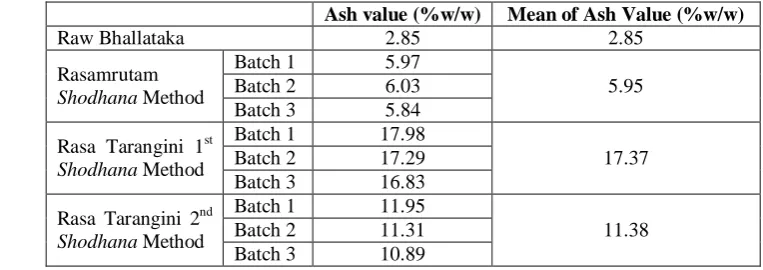
Table 5: Ash value.
Ash value (%w/w) Mean of Ash Value (%w/w)
Raw Bhallataka 2.85 2.85
Rasamrutam
Shodhana Method
Batch 1 5.97
5.95
Batch 2 6.03
Batch 3 5.84
Rasa Tarangini 1st
Shodhana Method
Batch 1 17.98
17.37
Batch 2 17.29
Batch 3 16.83
Rasa Tarangini 2nd
Shodhana Method
Batch 1 11.95
11.38
Batch 2 11.31
Batch 3 10.89
Ash value of all the three shodhita bhallataka
increases significantly. In raw bhallataka it is found to be 2.85% w/w while in shodhita bhallataka they are found to be 5.95% w/w, 17.37% w/w and
11.38% w/w respectively. It is the highest in rasa Tarangini first shodhana method, it may be because that method does not contain any type of liquid media.
Table 6: Acid Insoluble Ash.
Acid Insoluble Ash Mean of Acid Insoluble Ash
Raw Bhallataka 0 0
Rasamrutam
Shodhana Method
Batch 1 3.35
3.36
Batch 2 3.27
Batch 3 3.45
Rasa Tarangini 1st
Shodhana Method
Batch 1 14.39
14.09
Batch 2 14.02
Batch 3 13.87
Rasa Tarangini 2nd
Shodhana Method
Batch 1 0.21
0.27
Batch 2 0.29
Batch 3 0.32
There is no acid insoluble ash in raw bhallataka while it is found in the results that the acid insoluble ash values of the shodhita bhallataka are 3.36, 14.09
Table 7: Water Soluble Extractive (% w/w).
Water Soluble Extractive (%w/w)
Mean of Water Soluble Extractive (%w/w)
Raw Bhallataka 8.87 8.87
Rasamrutam
Shodhana Method
Batch 1 4.35
4.89
Batch 2 4.97
Batch 3 5.34
Rasa Tarangini 1st
Shodhana Method
Batch 1 10.57
10.15
Batch 2 10.02
Batch 3 9.85
Rasa Tarangini 2nd
Shodhana Method
Batch 1 7.38
7.79
Batch 2 7.95
Batch 3 8.04
The water soluble extractive value of raw bhallataka
that is 8.87% w/w; decreases in first and third method of shodhana up to 4.89% w/w and 7.79% w/w respectively while it increases up to 10.15%
w/w in second shodhana method. It is the highest in rasa Tarangini first shodhana method, it may be because that method does not contain any type of liquid media.
Table 8: Methanol Soluble Extractive (% w/w).
Methanol Soluble Extractive (%w/w)
Mean of Methanol Soluble Extractive (%w/w)
Raw Bhallataka 28.89 28.89
Rasamrutam
Shodhana Method
Batch 1 22.45
22.44
Batch 2 22.89
Batch 3 21.98
Rasa Tarangini 1st
Shodhana Method
Batch 1 10.25
10.92
Batch 2 11.98
Batch 3 10.54
Rasa Tarangini 2nd
Shodhana Method
Batch 1 32.65
33.36
Batch 2 33.48
Batch 3 33.94
The values of methanol soluble extractive decrease in first two methods while increases in third
shodhana method. The cause behind this change can be further researched.
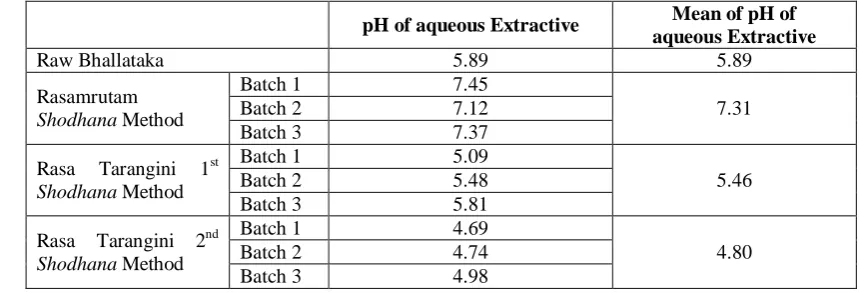
Table 9: pH of aqueous extractive.
pH of aqueous Extractive Mean of pH of aqueous Extractive
Raw Bhallataka 5.89 5.89
Rasamrutam
Shodhana Method
Batch 1 7.45
7.31
Batch 2 7.12
Batch 3 7.37
Rasa Tarangini 1st
Shodhana Method
Batch 1 5.09
5.46
Batch 2 5.48
Batch 3 5.81
Rasa Tarangini 2nd
Shodhana Method
Batch 1 4.69
4.80
Batch 2 4.74
Batch 3 4.98
pH of water soluble extractive of bhallataka increase
ANALYSIS OF MEDIA
Table 10: pH of Gaumutra (cow-urine).
pH Mean of pH
Blank Sample 7.48 7.48
Day 1
Batch 1 7.05
7.04
Batch 2 7.09
Batch 3 6.98
Day 2
Batch 1 7.02
6.95
Batch 2 6.99
Batch 3 6.85
Day 3
Batch 1 7.05
6.95
Batch 2 6.97
Batch 3 6.82
Day 4
Batch 1 6.98
6.87
Batch 2 6.84
Batch 3 6.80
Day 5
Batch 1 7.02
6.98
Batch 2 6.98
Batch 3 6.95
Day 6
Batch 1 7.08
7.03
Batch 2 7.02
Batch 3 6.99
Day 7
Batch 1 7.12
7.09
Batch 2 7.05
Batch 3 7.10
Table 11: pH of Gaudugdha (cow-milk).
pH Mean of pH
Blank Sample 6.65 6.65
Day 1
Batch 1 5.43
5.39
Batch 2 5.35
Batch 3 5.39
Day 2
Batch 1 5.28
5.28
Batch 2 5.34
Batch 3 5.21
Day 3
Batch 1 5.12
5.08
Batch 2 5.02
Batch 3 5.09
Day 4
Batch 1 4.78
4.87
Batch 2 4.89
Batch 3 4.95
Day 5
Batch 1 5.24
5.30
Batch 2 5.39
Batch 3 5.27
Day 6
Batch 1 5.14
5.38
Batch 2 5.65
Batch 3 5.35
Day 7
Batch 1 5.12
5.12
Batch 2 5.14
Batch 3 5.09
Table 12: pH of Narikela Udaka (coconut-water).
pH Mean of pH
Blank Sample 5.71 5.71
Batch 1 4.78
5.00
Batch 2 5.34
Batch 3 4.89
pH value of used shodhana media are recorded on daily basis for Gaumutra and Gaudugdha. They show decrease of pH in each of the samples. It may be because of removal of oil content containing anacardic acid from bhallataka fruits and getting into the media used for shodhana.
Table 13: Oil Content in Ishtika Churna. Oil content (%) Mean of oil content (%)
Unused Ishtika Churna 0 0
Ishtika Churna of Rasamrutam
Shodhana Method
Batch 1 3.25
3.17
Batch 2 2.48
Batch 3 3.78
Ishtika Churna of Rasa Tarangini 1st
Shodhana Method
Batch 1 5.22
4.98
Batch 2 5.29
Batch 3 4.42
Oil content in unused brick powder is zero while it shows oil contents in results of analysis of each batch of every shodhana method that uses Ishtika churna (brick powder). This clearly says that oil content removed from bhallataka fruits comes to the media used for shodhana procedure.
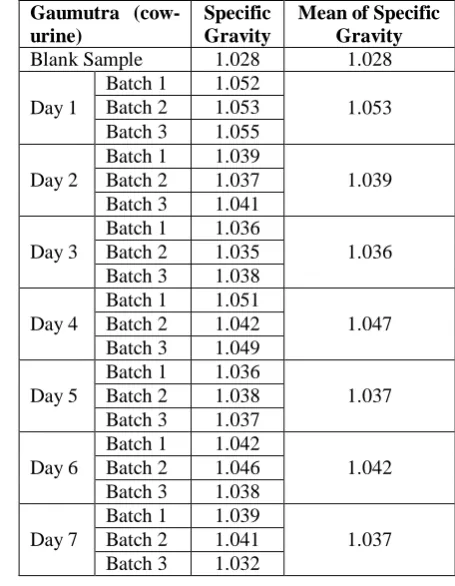
Table 14: Specific Gravity at 20oC of Gaumutra (cow-urine).
Gaumutra (cow-urine)
Specific Gravity
Mean of Specific Gravity
Blank Sample 1.028 1.028
Day 1
Batch 1 1.052
1.053
Batch 2 1.053
Batch 3 1.055
Day 2
Batch 1 1.039
1.039
Batch 2 1.037
Batch 3 1.041
Day 3
Batch 1 1.036
1.036
Batch 2 1.035
Batch 3 1.038
Day 4
Batch 1 1.051
1.047
Batch 2 1.042
Batch 3 1.049
Day 5
Batch 1 1.036
1.037
Batch 2 1.038
Batch 3 1.037
Day 6
Batch 1 1.042
1.042
Batch 2 1.046
Batch 3 1.038
Day 7
Batch 1 1.039
1.037
Batch 2 1.041
Table 15: Specific Gravity at 20oC of Gaudugdha (cow-milk).
Gaudugdha (cow-milk) Specific Gravity Mean of Specific Gravity
Blank Sample 1.029 1.029
Day 1
Batch 1 1.047
1.047
Batch 2 1.046
Batch 3 1.047
Day 2
Batch 1 1.046
1.046
Batch 2 1.046
Batch 3 1.047
Day 3
Batch 1 1.045
1.046
Batch 2 1.045
Batch 3 1.047
Day 4
Batch 1 1.043
1.045
Batch 2 1.046
Batch 3 1.045
Day 5
Batch 1 1.045
1.045
Batch 2 1.047
Batch 3 1.044
Day 6
Batch 1 1.045
1.046
Batch 2 1.044
Batch 3 1.048
Day 7
Batch 1 1.047
1.046
Batch 2 1.048
Batch 3 1.044
Table 16: Specific Gravity at 20oC of Narikela Udaka (coconut-water). Narikela Udaka
(coconut-water) Specific Gravity Mean of Specific Gravity
Blank Sample 1.020 1.020
Batch 1 1.049
1.046
Batch 2 1.047
Batch 3 1.043
Specific gravity of the media used for shodhana increases in each batch of every shodhana method. It indicates about increase in the contents that are
heavier than the media itself gets in to media from the bhallataka. Details about them can be further researched.
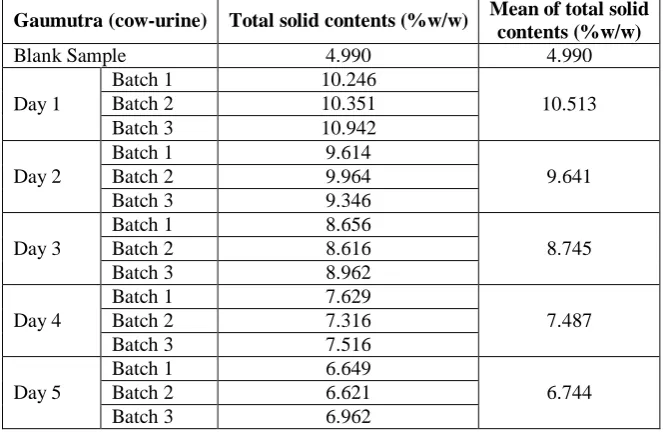
Table 17: Total Solid Contents (%w/w) of Gaumutra (cow-urine).
Gaumutra (cow-urine) Total solid contents (%w/w) Mean of total solid contents (%w/w)
Blank Sample 4.990 4.990
Day 1
Batch 1 10.246
10.513
Batch 2 10.351
Batch 3 10.942
Day 2
Batch 1 9.614
9.641
Batch 2 9.964
Batch 3 9.346
Day 3
Batch 1 8.656
8.745
Batch 2 8.616
Batch 3 8.962
Day 4
Batch 1 7.629
7.487
Batch 2 7.316
Batch 3 7.516
Day 5
Batch 1 6.649
6.744
Batch 2 6.621
Day 6
Batch 1 5.635
5.374
Batch 2 5.135
Batch 3 5.351
Day 7
Batch 1 5.125
5.483
Batch 2 5.632
Batch 3 5.691
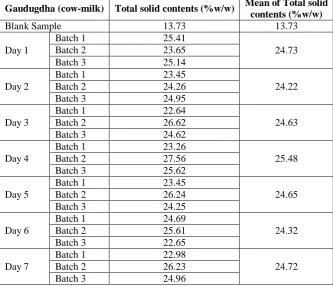
Table 18: Total Solid Contents (%w/w) of Gaudugdha (cow-milk).
Gaudugdha (cow-milk) Total solid contents (%w/w) Mean of Total solid contents (%w/w)
Blank Sample 13.73 13.73
Day 1
Batch 1 25.41
24.73
Batch 2 23.65
Batch 3 25.14
Day 2
Batch 1 23.45
24.22
Batch 2 24.26
Batch 3 24.95
Day 3
Batch 1 22.64
24.63
Batch 2 26.62
Batch 3 24.62
Day 4
Batch 1 23.26
25.48
Batch 2 27.56
Batch 3 25.62
Day 5
Batch 1 23.45
24.65
Batch 2 26.24
Batch 3 24.25
Day 6
Batch 1 24.69
24.32
Batch 2 25.61
Batch 3 22.65
Day 7
Batch 1 22.98
24.72
Batch 2 26.23
Batch 3 24.96
Table 19: Total Solid Contents (%w/w) of Narikela Udaka (coconut-water). Narikela Udaka
(coconut-water)
Total solid contents (%w/w)
Mean of Total solid contents (%w/w)
Blank Sample 4.5 4.5
Batch 1 10.12
10.14
Batch 2 9.85
Batch 3 10.45
Total solid contents of media used for shodhana increases in each batch of every shodhana method. It indicates about increase in the solid contents in the liquid media from the bhallataka. Details about them can be further researched.
DISCUSSION
Three batches of bhallataka were processed by the shodhana method mentioned in Rasamrutam and Rasa Tarangini. Weight loss was observed in all the samples. This loss may be due to the reduction of the oil content in the fruits. The media Gaumutra (cow-urine) is reported for its antimicrobial, antibacterial etc. Gaudugdha (cow-milk) is recommended as one of the antidote for bhallataka blisters. Ishtika Churna (brick powder) is having adsorbent property; by which it
the diversity in chemical nature and properties of the drug. More percentage of oil got reduced by soaking the fruits in the Rasamrutam Shodhana method. The brick powder is having the adsorbing nature, so some percentage of oil may be absorbed by the brick powder. Its value is seen by the result of analysis of oil content in processed brick powder of first two methods. While boiling with coconut water, it was clearly seen than oil from the fruits was being removed by boiling and started floating on the surface of coconut water. There are probable chances that some chemical changes might have taken place due to the various media like gomutra, Godugdha, Ishtika churna and Narikela udaka etc used for its purification. Total solid contents increased in all the methods as per the reports.
CONCLUSION
Bhallataka has been used since a long time of history for medicinal purpose. It is used only after its shodhana is done. There are many methods of shodhana of bhallataka available in classics, traditional methods and modern science methods. Classical methods of bhallataka shodhana consist of mainly of two references viz Rasamrutam and Rasa Tarangini. The media used for shodhana and procedure of shodhana are different in Rasamrutam Shodhana method and both shodhana methods of Rasa Tarangini. Performing shodhana of bhallataka by these three methods respectively, and by seeing the results of analysis of raw bhallataka and shodhita bhallataka of three different methods; it can be clearly seen that there is difference in the results of these three shodhana methods. Thus, alternate hypothesis H1 is accepted and null hypothesis H0 is rejected. More overly, there is significantly difference is the results of analysis of media used for shodhana, before and after. It clearly indicates that some chemical changes might have happened during the shodhana processes of bhallataka. The oil content is found in Ishtika churna (brick powder) after the process of shodhana, while solid contents of liquid media increase. That may be because of removal of toxic oily impurities from bhallataka fruits and they may be getting into the media used for shodhana. By comparing the results of analysis of these three methods, it can be concluded that removal of oil content; which is proportional to decrease of toxicity and increase of efficacy and safety; is seen more is the “Rasamrutam First Shodhana Method” than that of “Rasa Tarangini First and Second Shodhana Methods” So, it can be better to use Rasamrutam Shodhana Method for Bhallataka Shodhana; which consists of more steps and complex processes. Further studies can be conducted to evaluate the clinical efficacy and safety for the use of shodhita bhallataka, done shodhana by different shodhana methods.
REFERENCES
1. Acharya Harita, Harita Samhita with „Hari‟ Hindi commentary, Chaubhambha Krishnadas academy,
2. Acharya Madhava, Madhava Nidana, „Madhukosha‟
Hindi Commentary, Chaubhambha Prakshan,
Varanasi, Reprint: 2010.
3. Acharya Sharangadhara, Sharngadhara Samhita,
Commented By Adhamalla And Kashiram, 6th Edition, Chokhambha Orientalia, Varanasi, 2005.
4. Acharya Sadanada Sharma, Rasa Tarangini,
Translated By Shri Kashinatha Shastri, Motilala Banarsidas, New Delhi, 11th Edition, Reprint 2004.
5. Astanga Hridaya, With Sarvanga Sundara And
Ayurveda Rasayana Commentary, Chaubhambha Surbharati Prakashan, Reprit: 2010.
6. Ashtanga Sangraha, Hindi Vyakhya, Atrideva Gupt,
Chokhambha Krushnadas Academy, Varanasi, Reprint: 2005.
7. Acharya YT, Dravya Guna Vigyanam, Shree
Baidyanath Ayurved Bhawan Limited, Calcutta, 1956.
8. Ayurvediya Paribhasha, Gangadhara Ray,
“Vaidhyaprabha” Hindi Commentary, Chokhambha Orientalia, Varanasi, 1st Edition: 1982.
9. Anonymus, The Ayurvedic Pharmacopeia Of India,
Appedix Vol.-5, First Ed., New Delhi, Ministry Of Health & Family Welfare, 2004.
10. Bhavamishra, Bhavaprakasha With „Vidhyodini‟
hindi Commentry, Chokhambha Sanskita Bhavana, Varanasi. 11th Edition: 2010.
11. Charaka Samhita With Ayurveda Dipika
Commentary, Edited By Yadavji Trikamji Acharya, Published By, Chaukhamba Surbharati Prakashan, New Delhi, Edition 2009
12. Chakrapanidatt, Chakradatt,‟Vaidhyaprabha‟ Hindi
Commentary, Chokhambha Sanskrita Bhavana, Varanasi. Reprint: 2011.
13. Daljeet Sing, Unani Dravya Guna Adarsha,
Ayurveda Evam Tibbi Academy, Lakhnow, 1st Edition: 1974.
14. Jaykrishna Indrajita Thakar, Vanaspati Shastra,
Gujarati Printing Press and Nirnaya Sagar Vardhak Karyalaya, Ahmedabad, 1910.
15. Krishnaraman Bhatta, Siddha Bhaishajya Manimala,
2/276, „Vaishwanara‟ Hindi Commentary,
Chowkhambha Krishnadas Academy, Varanasi, 4th
Edition: 2008.
16. Shri Govinda Das, Bhaishajya Ratnavali, Paribhasha
Prakarana 4/14, „Vidhyodini‟ hindi Commentary, Chokhambha Prakashana, Varanasi, 20th Edition: 2010.
17. Shree Bapalal Vaidhya, Nighantu Adarsha, Part-1, Guggulvadi Varg, Gujarat Prakashana, Vadodara, Reprint: 1999.
18. Sushruta Samhita, Nibandhasmgraha Vyakhya,
Chokhambha Surbharti Prakashan, Varanasi,
Reprint:2008
19. Vaidhya Shodhala Gadanigraha, „Vidhyodini‟ Hindi
Commentry, Chaukhamba Sanskrita
Sansthan,Varanasi, Reprint: 2011.