Volume-5 Issue-2
International Journal of Intellectual Advancements
and Research in Engineering Computations
Productivity Improvement in Polypropylene Bag Manufacturing Using
Value Stream Mapping
Mr.S.Balakrishnan1, K.Mohanraj2, K.S Naveen2, G.Pethanan2, M.Rajaram2 1
Assistant Professor, 2UG Students
Department of Mechanical Engineering, Nandha Engineering College, Erode, TamilNadu, India. [email protected], [email protected], [email protected]
Abstract-The project explains the scope of implementing lean practices in polypropylene bag manufacturing activities with an aim to eliminate wastes and to improve the productivity with the help of VSM. A value stream includes all the operations and processes to transform raw materials into finished goods or services, including non-value added activities. Using current state map we can find the non value added activities and we can provide solution to eliminate such non value added activities and improve productivity. Using current state map we can identify the non value added activity in stitching section. We apply some techniques to reduce the manual effort and improve the production rate.
Key words— CSM, FSM, productivity increase, waste elimination, time reduce.
I. INTRODUCTION
Lean manufacturing essentially focuses on minimizing the waste, maintaining perfect first-time quality, flexible production and continuous improvement. The first step of value stream mapping is to create a current state map to make a chart of production flow process and understand the company’s current cycle time, process communications, and machine equipment capacity. The company has several sections like Tape plant, Loom section, Lamination, Printing, Cutting, Stitching, and Baling. With the help of process which are going on that several section we can list out the value-added and non-value value-added activities and we do project to eliminate waste also to improve productivity. The lean manufacturing contains nine wastes such as over production, over processing .Using this information to produce a future state map by creating a vision of an improved value flow.
II. LITERATURE REVIEW
AbuShaaban et al. (2013)have investigated about the elimination of seven wastes in the manufacturing firms and the main role is reducing the cost of production rate and also it has an additional aim to upgrade lean manufacturing through studying the seven wastes that are targeted by lean philosophy. Waste Relations Matrix (WRM) was implementing to research the effect of waste by other wastes.
Sanjeev Verma (2012) Lean is a approach to identify and eliminate waste through continuous improvement. The value stream initiates at the concept and ends when delivered to
consumer. VSM is a method to describe the flow of material and information through the production system. The ratio of value added to total lead time is determined by documenting the current lead time, inventory levels, and cycle times. Value added activities make the product more closely to the customer requirement. Non Value added activities do not create customers value, and anything that does not constitutes to value is defined as Waste.
Easwaramoorthi (2011) Every manufacturing industry has put in continuous efforts for its survival in the current volatile economy. In order to face the situation, industries are trying to implement new and efficient techniques in their manufacturing operations. Some of the established tools in this context are lean practices, and its realization has been growing among the industries, particularly in manufacturing sector. The data recorded through the survey across the core machine tool manufacturers have been analyzed, and the results are presented. The results show that the status of lean implementation in the machine tool sector is still in infant stage
Hudli Mohd and Rameez (2010) Many organizations are nowadays interested to adopt lean manufacturing strategy that would enable them to compete in this competitive globalization market. In this respect, it is necessary to assess the implementation of lean manufacturing in different organizations so that the important best practices can be identified the development of key areas which will be used to assess the adoption and implementation of lean manufacturing practices. There are some key areas developed to evaluate and reduce the most optimal projects so as to enhance their production efficiency and increase the purpose of the economic benefits of the manufacturing unit.
III. SUMMARY OF LITERATURE REVIEW
value added activities are identified and discussed in this paper.
IV. METHODOLOGY
The section explains the details explanation of methodology that is being used in this project as follows,
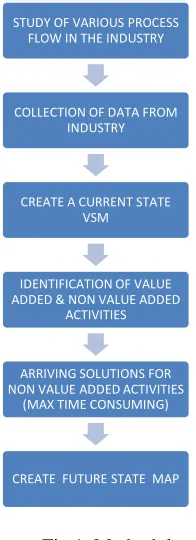
Fig 1, Methodology
A. Study of various process flow in the industry
There are several operations which are undergoing in the industry such process
i. Tape plant
ii. Loom section (weaving process) iii. Lamination
iv. Printing v. Auto cutting vi. Stitching vii. Auto cutting viii. Baling
These are the several processes which are undergoing in the industry. In this step, we are analyzed the above process in what are all going to manufacture the polypropylene bags.
B. Collection of data from industry
In this step, we collect the basic data from the industry to create current state map which includes all the operations (each and every step) to manufacture the pp bags.
C. Create current state map
A current state map shows how a process is currently done. It may be a current state process flowchart, or a current
state value stream map (VSM), but the principle is the same. It
shows the current methodology of how you produce products or perform services for your customers.
In this step, we are creating the current state map with above mentioned information.
D. Identification of wastes
The identification of wastes is the process in which the defects in the production process of polypropylene of several sections are identified.
E. Defects in lamination and stitching
The defects in the lamination and the stitching section are identified in this process. In next step we are doing the solution to avoid such wastes.
F. Create future solution for the defect
We have done a project on the stitching section to eliminate the human effort and improve the productivity
V. WORK FLOW PROCESS
A. VSM (Value Stream Mapping)
VSM came in to existence after the success of the TOYOTA Company in Japan since 1980’s.It was developed by the Toyota Company between 1960 and 1970. It is a lean manufacturing or lean enterprise technique used to document, analyze and improve the flow of information or materials required to produce a product or service for a customer. At the beginning VSM used as a methodology which identifies waste time and unneeded actions occurring in the process. But now a day’s VSM is being used as a re-engineer business for identifying unnecessary work and resources are being used for the process of operation .it contains current state map and future state map.
B. Varieties of Polypropylene Bags:
Un-lamination bags Lamination bag
Lamination Printed bags Un-lamination Printed bags Sandwich bag (Tea bag)
Offset Printing bag (For Chemical) Bopp Film bag (For Fertilizer) Paper Sandwich bag
C. Current State Map
A current state map shows how a process is currently done. It may be a current state process flowchart, or a current state value stream map (VSM), but the principle is the same. It shows the current methodology of how you produce products or perform services for your customers.
This company contains seven sections like Tape plant, Loom section, Lamination, Printing, Cutting, Stitching, baling. The company main aim is to manufacture the polypropylene bags. We can identify the overall process of the industry in each section like cycle time, lead time and change over time, defects, travelled time. We can analyze the all the
STUDY OF VARIOUS PROCESS FLOW IN THE INDUSTRY
COLLECTION OF DATA FROM INDUSTRY
CREATE A CURRENT STATE VSM
IDENTIFICATION OF VALUE ADDED & NON VALUE ADDED
ACTIVITIES
ARRIVING SOLUTIONS FOR NON VALUE ADDED ACTIVITIES
(MAX TIME CONSUMING)
section by using current state mapping after that we will find the defects in lamination section. The fig1 of CSM is shown below.
We can also inspect the stitching section. In the stitching section two persons were worked under their machine. We suggest that the work done by the two people were reduced to a single person by applying some lean techniques. We can do the project in stitching section to eliminate the cost and time.
Fig 2, Current State Map
D. Stitching
In the stitching section the polypropylene bags are stitched. In this section two persons were worked. One of the person stitched bag and another person can arrange the stitched bags.
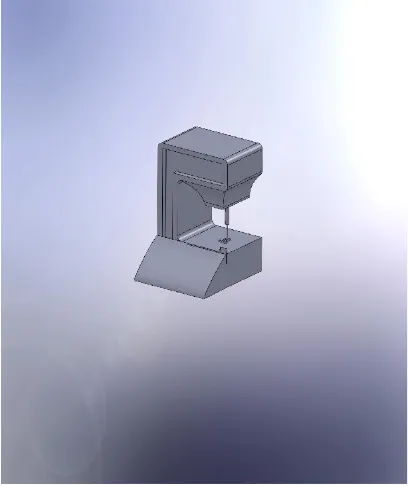
The machine consists of an actuator, solenoid coil, sensor and a blade. With the help of the project we can eliminate the work of one labour by means of automation. In this project we used a solenoid coil and actuator to move the blade and with the help of sensor.The main aim of the project is to improve productivity.
E. Pie chart
There are many wastes which are including in the production process such overall waste in industry was shown in fig
Fig 4. Pie Chart of Overall Waste
F.Future state map
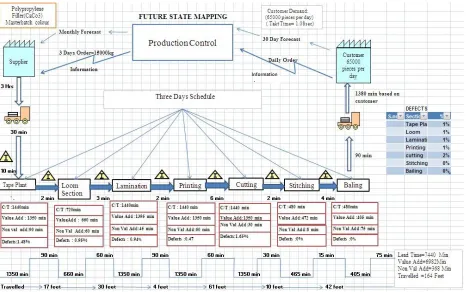
Future state map is visual tools that show how a value stream can look after improvements have been implementing shown.
The current state map shows the existing practices which on analysis would reveal the waste elimination opportunities. After gathering this knowledge the future state map is developed. During this stage, the nature of the customer demand namely quantity, quality, lead time and price are determined. In future state map we can eliminate the non value added activities in stitching section with the help of automatic cutting machine. The fig 2 of FSM is shown in below.
Fig 5. Future State Map WAITING
21%
TRANSPO RTATION
22%
DELAY
24%
MOTION
12%
DEFECT
21%
VI. CONCLUSION
The purpose of this study was to investigate and compare the impact of lean manufacturing concept in the polymer industry. Value stream mapping has proven to be an effective way to analyse a company’s current production state and point out problem areas. The visual nature of VSM is done by combining information and material flow on the map. With the help of auto cutting machine non value added activities has been eliminated and productivity has been increased..
REFERENCES
i. AbuShaaban et al, Seven wastes elimination targeted by lean manufacturing case study “Gaza strip manufacturing firms”, International Journal of Economics, Finance and Management (2013), Vol 2.
ii. Sanjeev Verma , “Value Stream Mapping in an Automotive Industry”, International Journal of Current Engineering and Technology ISSN 2277 – 4106 (2012).
iii. Easwaramoorthi, et al (2011) “A survey on lean practices in Indian machine tool industries” ,pp. 1091-1011
iv. Hudli Mohd and Rameez,” Areas of Lean manufacturing for Productivity Improvement in a Manufacturing Unit”, World Academy of Science (2010)’ Vol 45.
v. Baitmangalkar and Sanjeev,”The Lean Mindset”, Internatioal Journal f Opertaion and Production Management (2004), Vol.43.
vi. Vijaya Ramanath et al,’Application of Kanban
System for Implementing Lean