_____________________________________________________________________________________________________
International
23(2): 1-10, 2019; Article no.JGEESI.51308
ISSN: 2454-7352
Multi-way Degradation and Process Optimization of
Phenol from Simulated Wastewater System
Pratik M. Kolhe
1, Sanjay N. Patil
1, Seema P. Bhole
2and Nilesh D. Wagh
3*1School of Environmental and Earth Sciences, Kavayitri Bahinabai Chaudhari North Maharashtra
University (KBCNMU), Jalgaon, India. 2
D. N. College, Faizpur, Yawal, Jalgaon, India. 3
Amity School of Applied Science, Amity University, Mumbai, India.
Authors’ contributions
This work was carried out in collaboration between all authors. Authors PMK and SPB designed the study, performed the statistical analysis, wrote the protocol and wrote the first draft of the manuscript. Authors SNP managed the analyses of the study. Author NDW managed the literature searches. All authors read and approved the final manuscript.
Article Information
DOI: 10.9734/JGEESI/2019/v23i230167 Editor(s): (1) Prof. Mohamed Nageeb Rashed, Department of Chemistry, Faculty of Science, Aswan University, Egypt. Reviewers: (1) Moses Mwajar Ngeiywa, University of Eldoret, Kenya. (2)Graciela Pucci, Universidad Nacional de la Patagonoia San Juan Bosco, Argentina. Complete Peer review History:http://www.sdiarticle3.com/review-history/51308
Received 10 June 2019 Accepted 07 September 2019 Published 16 September 2019
ABSTRACT
This research was based on the comparative study between microbial, enzymatic and photocatalytic phenol degradation. Different experiments were carried out under three distinct methodologies that seeked to examine which method is more feasible between them through various aspects. For the microbial study, E. coli was used for phenol degradation at an optimum condition of E. coli. In the enzymatic study, peroxidase was extracted from soybean seed hulls, and it was purified. The purified peroxidase enzyme was applied in phenolic solution at neutral pH. The H2O2/UV/TiO2 scheme was adopted in the photocatalytic treatment of phenol. Maximum phenol
degradation was observed in photo catalysis. From this comparative study, a microbial method was found to be more time consuming and an enzymatic method require more steps to perform the experiment while photo catalysis took less time with a more feasible results.
Keywords: Comparative study; microbial treatment; enzymatic treatment; photocatalytic treatment; first-order reaction kinetics.
1. INTRODUCTION
Recently, considerable attention has been received by many researchers on biodegradation of aromatic compounds due to their toxicity. Among them, phenol and its derivatives are a standard compound in wastewater of many industries such as oil refineries [1], coal refining, petroleum, textiles and pharmaceuticals [2]. It is quite known that the toxicity of phenols towards the whole environment is high and thus has been incorporated in the list of pollutants by the U.S. Environmental Protection Agency [3]. Many researchers are engaged in research on phenol degradation by diverse techniques and methods. The attention is that to investigate which technology will be most feasible, eco-friendly, cost-effective and time saving is the primary goal of the present investigation. The present study compares three methods viz. microbial degradation, enzymatic degradation and photocatalytic degradation.
Until today, many investigators have reported numerous types of microorganisms that remove phenol from wastewater. From the literature reviewed, some microorganisms can consume phenol as a sole source of carbon and energy. These bacterial species include Streptococcus epidermis [4], Escherichia coli, Micrococcus sp., Brucella sp. [5], Bacillus subtilis, Pseudomonas putida, Acinetobacter calcoaceticus, Bacillus subtilis [6-8] and Streptococcus sp. [8].
Besides, enzymes are applied in biodegradation study of the phenol. Enzymes play a vital role in phenol biodegradation reactions as a biocatalyst [9]. These enzymes include Peroxidase, Chloroperoxidase, Lignin peroxidase, Mn-peroxidase [9] and catalase [10] that isolated from specific plants viz. soybean [11], horseradish, radish [12], and their materials such as seeds [13], leaves [14], stem [15], roots [16]. Tyrosinase and Laccase [9] are obtained from different fungal species.
In recent years, photocatalysis has been developed in wastewater treatment. In this technique, some photocatalysts and their chemically modified transformations were employed for the photodegradation of toxic compounds. The TiO2 and ZnO were broadly
tested as photocatalyst used in this technique [17-20]. Many researchers increase the efficiency
of a catalyst by doping with metals such as Ag, Fe, Pr, Co, V under various illumination systems [21]. Some researchers synthesized bimetallic or trimetallic transformations for degradation study [22].
Here, we focus on all related aspects or parameters to select a better, efficient, cost-effective and feasible degradation technique. From the overall primary study, we use E. coli for the microbial study while peroxidase extracted from soybean seed hulls and selected for the further process of phenol degradation. Alike we introduced single TiO2 nanoparticles in phenolic
wastewater under both UV and Solar light.
2. MATERIALS AND METHODS
2.1 Materials
All analytical grade and HPLC grade chemicals were purchased from Fisher scientific and Himedia, Mumbai, India. Milli-Q water used for chemical preparations obtained from Milli-Q make of Schimadzu, Japan. E. coli microbial culture was used for the study. Soybean seeds were collected from agricultural fields and washed thoroughly with distilled water.
2.2 Microbial Methodology
E. coli bacterial culture was grown on slants of nutrient agar medium for further microbial phenol degradation study and stored at 4°C until further use. Then the minimal salt medium was prepared as (g/L) Na2HPO4 33.9, KH2PO4 15, NH4Cl 5,
NaCl 2.5, 2 ml of MgSO4 0.1 M and 0.1 ml of
CaCl2 1 M per liter for actual degrading study [4].
The samples were centrifuged, and the remaining phenol concentration determined quantitatively by direct UV-visible spectrophotometric method [23]. Optical density was measured at λmax = 269 nm. Remaining
concentration of phenol (%) was calculated using following formula:
% ℎ
= ( ) (1)
2.3 Enzymatic Methodology
The experimental procedures of SBP extraction and purification followed with some modifications reported by Liu et al. [24]. The fresh soybean seed hulls was weighed and washed with milli-Q water. These cleaned seeds were soaked in milli-Q water overnight. The soaked seeds were smashed and blended with 500 ml milli-Q water for 10 to 15 min. Then the homogenized mixture was filtered through cheesecloth and after that filtrate of cheesecloth centrifuged at 10,000 rpm for 20 min at 4°C. The collected supernatant was rich in proteins.
The SBP purification process was performed as reported in Liu et al. [24]. The process included three steps. The first step was acetone-ammonium sulphate cooperation precipitation. It comprised both acetone and ammonium sulphate precipitation simultaneously. The volume of acetone taken 0.3 fold of the original amount and solid ammonium sulphate added to form up to 45% saturation. This combination was placed in a refrigerator for 2 h. After that, the mixture was centrifuged for 15 min at 5000 to 7000 rpm. The supernatant and precipitant were collected separately. This 45% saturation was continued to 75% saturation by adding solid ammonium sulphate again with 0.3 fold acetone in the supernatant. The mixture was centrifuged for 15 min at 5000 to 7000 rpm. Only one condition followed that the acetone was pre-stored in a refrigerator and that cooled acetone was added under a cold atmosphere in all our experimental sets. The resulted precipitants were dissolved in milli-Q water to get primary purified SBP. The second step consisted of acetone precipitation alone. The volume of acetone mixed as 1.4 fold separately into the primary purified SBP. The mixture was centrifuged for 15 min at 5000 to 7000 rpm. The resulted precipitant was dissolved in milli-Q water to get secondary purified SBP. The third step included only zinc sulphate precipitation. Before introducing zinc
sulphate into the enzyme solutions, the pH was adjusted to eight by HCl or NaOH and then 1.0 mol L-1 zinc sulphate solution was mixed to form 0.015 mol/l zinc concentration. The mixture was centrifuged for 15 min at 5000 to 7000 rpm. Lastly, the supernatant was collected and denoted as highly purified SBP enzyme solution [24].
Enzyme assay and protein content were examined after each purification step by the procedures described by Kolhe et al. 2015 [13]. The Reinheitszahl (RZ) values were assayed after each purification steps. The purified SBP stored at 4°C untill the further use of the enzyme. Different concentrations of phenolic wastewater were prepared in the range between 250 mg/L to 1000 mg/L in phosphate buffer with pH 7.0. The reaction mixture contained 50 ml phenolic wastewater, 30 per cent H2O2 and enzyme
solution. Analyze the initial phenol concentration. The sample was collected after every 1h to examine the residual phenol.
The remaining phenol concentration of each sample was determined quantitatively by the direct UV-visible spectrophotometric method at phenol λmax. The remaining concentration of
phenol (%) was calculated by formula 1.
2.4 Photocatalytic Methodology
The third methodology opted for photocatalytic degradation of phenol. In this study, TiO2
nanoparticles were used as the photocatalyst while 11 watts of UV lamp was used as illumination for energy. Various concentrations of phenolic wastewater were prepared in the range between 250 mg/L to 1000 mg/L. The pH range
kept as 2, 4, 6, 8 and 10 and adjusted with 0.1 M HCl and 0.1 M NaOH solutions. The retention time was 10 h, but samples were collected at every 1h time interval. The
reaction mixture contained 50 ml phenolic solution, 30% H2O2 and TiO2 nanoparticles.
Analyze the initial phenol concentration. The sample was collected after every 1h to examine the residual phenol.
The remaining phenol concentration of each sample was determined quantitatively by the direct UV-visible spectrophotometric method at phenol λmax. The residual concentration of phenol
3. RESULTS AND DISCUSSION
3.1 Microbial Treatment
The phenol degradation performance of E. coli strain was examined for different phenol concentrations viz. 250 mg/L, 500 mg/L, 750 mg/L and 1000 mg/L at various time intervals. The per cent phenol degradation was derived based on residual phenol concentration. Fig. 1 shows the effect of phenol concentration indicating that 60.07% phenol degradation was observed at 250 mg/L phenolic concentration at neutral pH after 96 h. As the phenolic concentration increases the phenol degradation decreases. Hence, only 11.75% phenol degradation was observed at 1000 mg/L phenolic concentration at neutral pH after 96 h. Reshma et al. 2014 also used E. coli treatment on phenolic wastewater. They obtained 100% phenol degradation for 10 mg/L phenolic solution. We had only 60.07% phenol degradation because 250 mg/L concentration was much more than 10 mg/L concentration. Some bacterial strain may have died at this high phenolic concentration; hence, the E. coli bacterial strain did not achieved 100% phenol degradation.
3.2 Enzymatic Treatment
The SBP was extracted from soybean seed hulls by blending it for 10 to 15 min. During the blending of soybean seed hulls, the blended material was lightly warmed, but this was not essential because the SBP activity persisted up
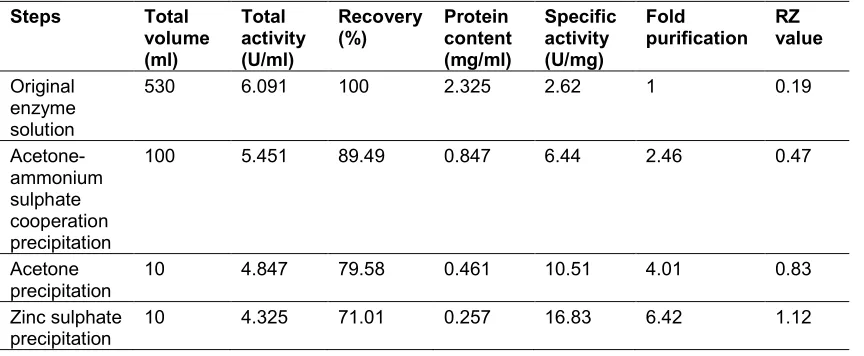
to 75°C [11]. A volume of the original enzyme solution was recorded as 530 ml. Table 1 shows the enzyme purification steps and their characteristics. A product of the last purification step having 71.01% recovery and 1.12 RZ value which is near about 1.32 RZ value reported in Liu et al. [24]. This enzyme purification method is more comfortable and cost-effective than other purification methods because it is merely based on only precipitation technique. Total volume, total activity, % recovery, protein content, specific activity, fold purification and RZ value for each step are shown in Table 1.
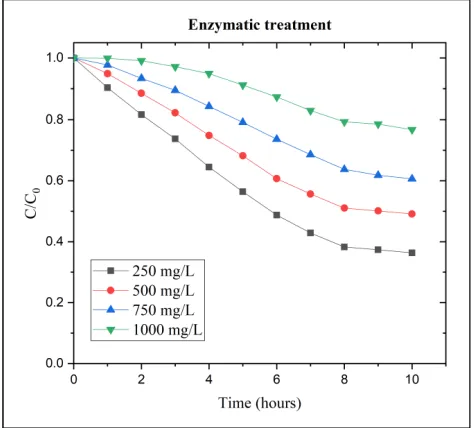
This purified SBP was introduced in various phenol concentrations viz. 250 mg/L, 500 mg/L, 750 mg/L and 1000 mg/L at various time intervals to evaluate the phenol degradation. The per cent phenol degradation was determined based on residual phenol concentration. Fig. 2 on effects of phenol concentration shows that
62.31% phenol degradation was obtained in 250 mg/L phenolic concentration at neutral pH
after 8 h. As in microbial treatment, here also it was observed that as phenol concentration increases the phenol degradation decreases. Hence, only 21.82% phenol degradation was observed in 1000 mg/L phenolic concentration at neutral pH after 8 h but this 21.82% phenol degradation is more as compared to microbial treatment. Pradeep et al. [12] also gave a treatment of SBP on phenolic wastewater. They obtained 72% phenol degradation of 100 mg/L phenolic solution. We had 62.31% phenol degradation in 250 mg/L concentration, which was more.
Table 1. Purification steps and their characterization of SBP
Steps Total volume (ml)
Total activity (U/ml)
Recovery (%)
Protein content (mg/ml)
Specific activity (U/mg)
Fold purification
RZ value
Original enzyme solution
530 6.091 100 2.325 2.62 1 0.19
Acetone-ammonium sulphate cooperation precipitation
100 5.451 89.49 0.847 6.44 2.46 0.47
Acetone precipitation
10 4.847 79.58 0.461 10.51 4.01 0.83
Zinc sulphate precipitation
Fig. 1. Phenol degradation by microbial treatment for different concentration of the phenol
Fig. 2. Phenol degradation by enzymatic treatment for different concentration of the phenol
3.3 Photocatalytic Treatment
3.3.1 Effect of pH condition
Some properties of photocatalysts are highly pH dependent. Hence phenol degradation at different pH was carried out under UV light. In this treatment, TiO2 nanoparticles were used as
a photocatalyst. These nanoparticles were introduced at different pH (2-10) conditions to examine the phenol degradation. It is clearly
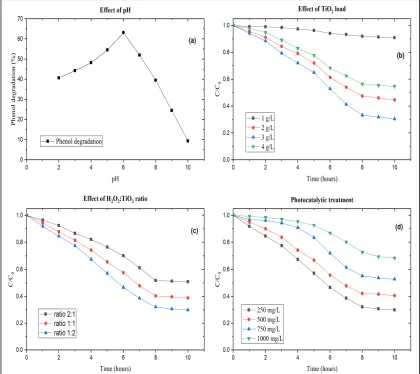
seen that in Fig. 3, the basic conditions are unfavorable while acidic conditions are favorable for the photocatalytic degradation of phenol. In acidic medium, from pH 2 to pH 6 phenol degradation increases and after pH 6 it decreases. The higher phenol degradation was observed with 63.08% at pH 6. The optimal pH condition was found to be acidic.
range studied; i.e., the attraction and interaction between both photocatalyst and phenol will be diverse with the solution pH. Moreover, as the pKa value of phenol is 9.95, it has negative charge above pH 9.95 ≈ 10 and referred as phenolate anions but the conversion of phenolate anions commences when solution pH in between 6 to 8 [26]. Conversely, in highly acidic condition phenol gets a positive charge while in weak acidic and neutral condition phenol molecules exist primarily in their non-ionic form. Additionally, the maximum OH● radicals are produced in the pH range of 6 to 7 [27], due to this reason rate of phenol degradation is higher in this pH range. These hydroxyl radicals are formed from some photocatalytic oxidative and reductive reactions. They have a capacity to directly break down an aromatic ring of phenol molecule and transmute them into the final products which are CO2 and H2O through various
intermediates, because they are extremely strong, non-selective oxidants [28].
3.3.2 Effect of catalyst load
To examine the effect of TiO2 nanocatalyst
dosing on the phenol degradation, several experiments were carried out at catalyst loading from 1 to 4 g/L with 250 mg/L pollutant concentration. Fig. 3 indicates that the increase in the amount of nanocatalyst loading also increases the rate of phenol degradation up to a particular catalyst dose of 3 g/L. This increased rate of degradation may be due to the higher surface area. Nevertheless, after 3 g/L amount of catalyst loading the degradation rate starts declining. As the catalyst load increases, the experimental solution becomes turbid and resulting in UV rays getting scattered leading to a decrease in reaction rate [29]. The maximum phenol degradation at 3 g/L of catalysts dose was considered as an optimum condition for further study.
3.3.3 Effect of H2O2 and TiO2 ratio
An oxidizing agent is another aspect of the photocatalytic oxidation process. Other experimental sets were performed for the study of the impact of various rates between H2O2 and
catalyst load as 2:1, 1:1 and 1:2. Fig. 4 shows that a maximum phenol degradation was recorded at 1:2 ratio. It happens obviously because half the quantity of H2O2 as on catalyst
dose was enough for phenol degradation. The H2O2 used only an oxidizing agent in a reaction
medium. There is no use of a double quantity of H2O2 in the reaction mixture. Because in an
excess amount of H2O2 reacts with those
hydroxyl radicals which are responsible for degrading the pollutant molecule [30]. While the same quantities of H2O2 and catalyst load, also
not well for the degradation because there is no sufficient amount of catalyst in the mixture. This phenomenon was reported earlier in 2001 by Ghaly et al. [30]
3.3.4 Effect of phenol concentration
TiO2 nanoparticles applied in various phenol
concentrations viz. 250 mg/L, 500 mg/L, 750 mg/L and 1000 mg/L at various time intervals to evaluate the phenol degradation. The per cent phenol degradation was determined based on residual phenol concentration. As initial phenol concentration increases, the rate of phenol degradation decreases from 250 mg/L to 1000 mg/L. This happens due to the competitive adsorption on the active sites of photocatalyst between the hydroxide radicals and phenol molecules [31]. Fig. 4 on effect of phenol concentration shows that 68.39% phenol degradation obtained in 250 mg/L phenolic concentration at neutral pH after 8 h. As in microbial treatment, here also seen that the phenolic concentration increases the phenol degradation decreases. Hence, only 28.46 % phenol degradation observed in 1000 mg/L phenolic concentration at neutral pH after 8 h, but this 28.46% phenol degradation is more than in microbial treatment. Pradeep et al. [12] also gave a treatment of SBP on phenolic wastewater. They obtained 72% phenol degradation of 100 mg/L phenolic solution. We had 68.39% phenol degradation in 250 mg/L concentration, which was more.
3.3.5 Degradation rate kinetics
The kinetic study of photodegradation of phenol was investigated for UV/H2O2/TiO2 system. A
model with a higher value of correlation coefficient (R2) considered as more applicable. The equation for first and second order kinetics is shown below.
First order reaction kinetics: log( − ) = log − 2.303 (2)
Second order reaction kinetics: =
+ (3)
Where qe and qt are the amounts of phenol
time t (min), respectively. Kf is the rate constant
of first-order reaction (min-1) which can be obtained from the slope of log (qe-qt) versus time plot. Also, a rate constant of pseudo-second-order Ks reaction (g mg-1 min) can be obtained
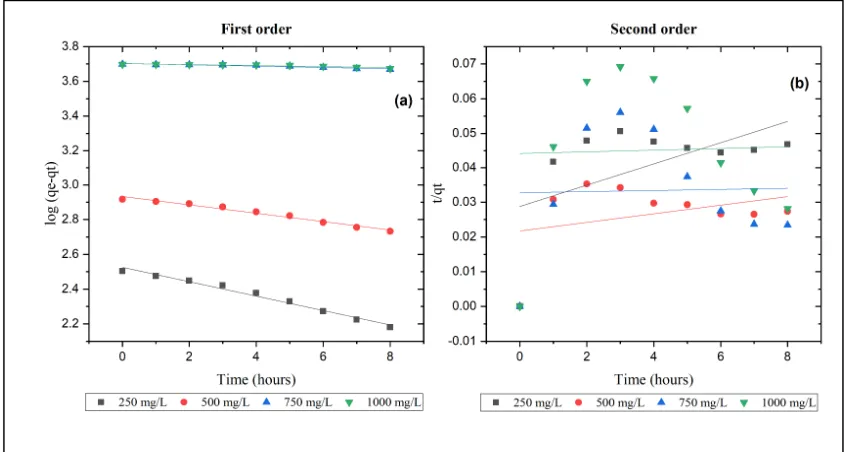
from t/qt versus t plot. For the phenol, first-order reaction kinetic was fitted than second-order reaction kinetics first order having a maximum
value of R2. Besides the apparent first-order rate constants decreased with the increase of initial phenol concentrations [32]. Hence, kinetic constant based on phenol degradation by UV calculated for a first-order reaction. Table 2 shows a description of first-order reaction kinetics.
Fig. 3. (a) Phenol degradation at various pH conditions, (b) Effect of TiO2 nanoparticles loading on phenol degradation, (c) Effect of H2O2:TiO2 nanoparticle ratio on phenol degradation and (d)
Effect of different phenolic concentration on phenol degradation under UV light
Table 2. Description of first-order reaction kinetics
Substrate Concentration (mg/L) K (min-1) R2
Phenol 250 0.0953 0.9838
500 0.0555 0.9793
750 0.0088 0.8960
Fig. 4. Phenol degradation corresponds to the (a) first-order and (b) second-order model for 250, mg/L, 500 mg/L, 750 mg/L and 1000 mg/L
4. CONCLUSION
This study adopted three methodologies which were microbial, enzymatic and photocatalytic treatments of phenol for the degradation. Microbial treatment gave 60.07%, enzymatic treatment gives 62.31%, and photocatalytic treatment gives 68.39% phenol degradation in 250 g/L phenolic concentration. All treatments gave approximately the same phenol degradation, but each treatment has some advantages as well as some disadvantages. About 60.07% phenol degradation achieved under 96 h in microbial treatment whereas 62.31% and 68.39% phenol degradation takes place under 8 h in enzymatic and photocatalytic treatment. Based on the time parameter, microbial treatment is a very time-consuming method for phenol degradation while the other methods are less time-consuming.
In enzymatic treatment, additional one-step is required for phenol degradation. That step was enzyme purification. Enzyme purification method was adopted in this study, and that the purified enzyme used as a catalyst. An enzymatic treatment did not show significant phenol degradation even after purified enzyme was introduced in the reaction mixture. In phenol degradation follow another one-step and degrade the phenol which is not much more. Therefore,
this enzymatic treatment is not a feasible method for phenol degradation.
A remaining method is a photocatalytic degradation. It requires less time, no need for extra steps. The maximum phenol degradation achieved in this photocatalytic method was 68.39%. The whole photocatalytic degradation was performed under acidic condition, this is one thing which is noticeable. However, there is no need of extra handling of that acidic medium. Overall, from the comparative study of all the three methods reported in this study, the photocatalytic process is efficient for phenol degradation than others.
ACKNOWLEDGEMENTS
This work supported by UGC, New Delhi, Government of India through BSR (RFSMS) fellowship [F.7-289/2009 (BSR)] to the PMK is gratefully acknowledged. PMK is also thankful to Kavayitri Bahinabai Chaudhari North Maharashtra University, Jalgaon for necessary help.
COMPETING INTERESTS
REFERENCES
1. Sukan A, Sargin S. Enzymatic removal of phenol from industrial wastewaters. Journal of Biomaterials and Nano-biotechnology. 2013;4:300-07.
2. Kolhe PM, Ingle ST, Wagh ND. Degradation of phenol containing waste-water by advance catalysis system – a review. Annual research and review in biology. 2015;8(3):1-15.
DOI: 10.9734/ARRB/2015/19936
3. Environmental Protection Agency (EPA). Sampling and Analysis Procedure for Screening of Industrial Effluents for Priority Pollutants; EPA: Cincinnati, OH, USA; 1977.
4. Mohite BV, Jalgaonwala RE, Pawar S, Morankar A. Isolation and characterization of phenol degrading bacteria from oil contaminated soil. Innovative Romanian Food Biotechnology. 2010;7:61-5.
5. Reshma JK, Thanga VSG, Mathew A. Phenol degradation by bacteria isolated from coir retting beds of south Kerala coast. Journal of Global Biosciences. 2014;3(6):935-940.
6. Liu Z, Xie W, Li D, Peng Y, Li Z, Liu S. Biodegradation of phenol by bacteria strain Acinetobacter Calcoaceticus PA isolated from phenolic wastewater. Int. J. Environ. Res. Public Health. 2016;13:1-8.
DOI: 10.3390/ijerph13030300
7. Kafilzadeh F, Mokhtari S. Isolation and identification of phenol degrading bacteria from mangrove sediments in the Persian Gulf (Asaluyeh) and their growth kinetics assay. Biomedical and Pharmacology Journal. 2013;6(2):189-96.
8. Parihar R, Dubey SK. Identification and characterization of potential phenol degrading bacterial strains isolated from municipal sewage, Bilaspur, Chhattisgarh. Int. J. Appl. Sci. Biotechnol. 2016;4(3):288-93.
9. Rao MA, Scelza R, Scotti R, Gianfreda L. Role of enzymes in the remediation of polluted environments. J. Soil Sci. Plant Nutr. 2010;10(3):333-53.
10. Tayefi-Nasrabadi H, Dehghan G, Daeihassani B, Movafegi A, Samadi A. Some biochemical properties of catalase from safflower (Carthamus tinctorius L. cv. M-CC-1 90). African J. Agri. Res. 2011; 6(23):5225-226.
11. Ghaemmaghami F, Alemzadeh I, Motamed S. Seed coat soybean peroxidase:
Extraction and biocatalytic properties determination. Iranian J. Chem. Eng. 2010; 7(2):28-38.
12. Pradeep NV, Anupama, Hampannvar US. Comparison of horseradish peroxidase, soybean peroxidase and radish peroxidase for the polymerization of phenol. J. Res. Bio. 2011;7:503-07.
13. Kolhe PM, Ingle ST, Wagh ND. Removal of phenol at higher concentration from aqueous medium using crude peroxidase catalyzed reaction coupled with hydrogen peroxide. Int. J. Adv. Sci. Tech. Res. 2015; 3(5):70-8.
14. Anbuselvi S, Balamurugan Kumar S. Purification and characteristics of peroxidase from two varieties of Tulsi and Neem. Res. J. Pharmaceut. Biol. Chem. Sci. 2013;4(1):648-54.
15. Yadav P, Singh VK, Yadav M, Singh SK, Yadav S, Yadav KDS. Purification and characterization of Mn-peroxidase from Musa paradisiaca (Banana) stem juice. Ind. J. Biochem. Biophy. 2012;49:42-8. 16. Mamatha J, Vedamurthy AB, Shruthi SD.
Degradation of phenol by turnip root enzyme extract. J. Microbiol. Biotech. Res. 2012;2(3):426-30.
17. Laoufi NA, Tassalit D, Bentahar F. The degradation of phenol in water solution by TiO2 photocatalysis in a helical reactor. Global NEST J. 2008;10(3):404-18. 18. Bamuza-Pemu EE, Chirwa EMN. Profile of
aromatic intermediates of titanium dioxide mediated degradation of phenol. Chem. Eng. Transac. 2013;35:1333-338.
DOI: 10.3303/CET1335222
19. Parida KM, Parija S. Photocatalytic degradation of phenol under solar radiation using microwave irradiated zinc oxide. Solar Energy. 2006;80:1048-054.
DOI: 10.1016/j.solener.2005.04.025 20. Malekshoar G, Pal K, He Q, Yu A, Ray AK.
Enhanced solar photocatalytic degradation of phenol with coupled graphene-based titanium dioxide and zinc oxide. Ind. Eng. Chem. Res. 2014;53:18824-8832.
DOI: doi.org/10.1021/ie501673v
21. Chiou CH, Juang RS. Photocatalytic degradation of phenol in aqueous solutions by Pr-doped TiO2 nanoparticles. J. Haz.
Mate. 2007;149:1–7.
DOI: 10.1016/j.jhazmat.2007.03.035 22. Jethave GN, Fegade UA, Attarde SB, Ingle
kinetic, isotherm and thermodynamic behaviours. J. Ind. Eng. Chem. 2017;53: 294-306.
DOI: doi.org/10.1016/j.jiec.2017.04.038 23. Nicell JA, Saadi KW, Buchanan ID. Phenol
polymerization and precipitation by horseradish peroxidase enzyme and an additive. Biore. Tech. 1995;54:5-16. 24. Liu J, Zhang Y, Qui L, Ye L, Xia Y, Su Z. A
novel process of purifying soybean hull peroxidase. Chem. Biochem. Eng. Q. 2005;19:199-205.
25. Akbal F, Nur Onar A. Photocatalytic degradation of phenol. Env. Moni. Asses. 2003;83:295-302.
26. Abbassian K, Kargari A, Kaghazchi T. Phenol removal from aqueous solutions by a novel industrial solvent. Chemical Engineering Communications. 2015; 202(3):408–13.
DOI:doi.org/10.1080/00986445.2013.848804
27. Nakabayashi Y, Nosaka Y. The pH dependence of OH radical formation in photo-electrochemical water oxidation with rutile TiO2 single crystals. Physical
Chemistry Chemical Physics. 2015; 17(45):30570–0576.
Available:https://doi.org/10.1039/C5CP045 31B
28. Zhang Y, Selvaraj R, Sillanpaa M, Kim Y, Tai CW. The influence of operating parameters on heterogeneous photo-catalytic mineralization of phenol over BiPO4. Chemical Engineering Journal.
2014;245:117–23.
Available:https://doi.org/10.1016/j.cej.2014. 02.028
29. Dixit A, Mungray AK, Chakraborty M. Photochemical oxidation of phenol and chlorophenol by UV/H2O2/TiO2 process: A
kinetic study. Int. J. Chem. Engi. Appl. 2010;1(3):247-50.
30. Ghaly MY, Hartel G, Mayer R, Haseneder R. Photochemical oxidation of p-chlorophenol by UV/H2O2 and
photo-phenton process: A comparative study. Waste Management. 2001;21:41-7. 31. Ahmed S, Rasul MG, Brown R, Hashib
MA. Influence of parameters on the heterogeneous photocatalytic degradation of pesticides and phenolic contaminants in wastewater: A short review. Journal of Environmental Management. 2011;92(3): 311–30.
32. Matthews RW. Kinetics of photocatalytic oxidation of organic solutes over titanium dioxide. Journal of Catalysis. 1988;111(2): 264–72.
_________________________________________________________________________________ © 2019 Kolhe et al.; This is an Open Access article distributed under the terms of the Creative Commons Attribution License (http://creativecommons.org/licenses/by/4.0), which permits unrestricted use, distribution, and reproduction in any medium, provided the original work is properly cited.
Peer-review history: