Somtoochukwu et al. World Journal of Engineering Research and Technology
CORE THREATS AND PREVENTION IN DATABASE SECURITY
1
*ILO Somtoochukwu F., 2Ubochi Chibueze and 3Osondu U. S.
1,2
Computer Engineering Department, Michael Okpara University of Agriculture Umudike,
Abia State, Nigeria.
3
Electronical/Electronic Engineering Department, Federal Polytechnic Nekede, P.M.B 1036,
Owerri, Imo State, Nigeria.
Article Received on 10/04/2019 Article Revised on 30/04/2019 Article Accepted on 20/05/2019
ABSTRACT
Database security is a growing concern evidenced by an increase in the
number of reported incidents of loss of or unauthorized exposure to
sensitive data. As the amount of data collected, retained and shared
electronically expands, so does the need to understand database
security. Database security should provide controlled, protected access
to the contents of a database as well as preserve the integrity,
consistency, and overall quality of the data. At its core, database security strives to insure that
only authenticated users perform authorized activities at authorized times. This paper focuses
on the concepts and mechanisms particular to securing data. Within that context, database
security encompasses sub-topics: these topics include Malware, Weak Authentication,
Database Misconfiguration, SQL Injection, nested query and excessive privilege abuse
(grant/ revoke). This work was concluded by examining data security strategies which can
help us protect our system‘s information.
KEYWORD: Database security, database vulnerability, nested query, excessive privilege abuse, auditing mechanisms.
1. INTRODUCTION
Database security is a growing concern evidenced by an increase in the number of reported
incidents of loss of or unauthorized exposure to sensitive data. As the amount of data
collected, retained and shared electronically expands, so does the need to understand database
World Journal of Engineering Research and Technology
WJERT
www.wjert.org
SJIF Impact Factor: 5.218*Corresponding Author ILO Somtoochukwu F.
security. The main goal of database security is Information Security during all database
transactions. The Defense Information Systems Agency of the US Department of Defense
(2004), in its Database Security Technical Implementation Guide, states that database
security should provide controlled, protected access to the contents of a database as well as
preserve the integrity, consistency, and overall quality of the data therefore understanding of
the issues and challenges related to database security and its possible solution should be
considered.
At its core, database security strives to insure that only authenticated users perform
authorized activities at authorized times. While database security incorporates a wide array of
security topics, notwithstanding, physical security, network security, encryption and
authentication, this paper focuses on the concepts and mechanisms particular to securing data.
Within that context, database security encompasses three constructs: confidentiality or
protection of data from unauthorized disclosure, integrity or prevention from unauthorized
data access, and availability or the identification of and recovery from hardware and software
errors or malicious activity resulting in the denial of data availability.
1.1 Database
A database is an organized collection of data (Jeffrey Ullman, 1997). The data are typically
organized to model relevant aspects of reality in a way that supports processes requiring this
information. Databases are created to operate large quantities of information by inputting,
storing, retrieving and managing that information. Databases are set up so that one set of
software programs provides all users with access to all the data.
1.2 Database Objects
Table: a table is the backbone of every database; it serves as a container where data are stored. A table comprises of columns (fields) and rows (records).
Field: this is a single item of information within a database. Fields run in columns, they are permanent place holders for records.
Record: this is complete information about an item. Records run in rows and keep changing File: a file is a collection of related records within a database.
Database Management Systems (DBMSs) are specially designed software applications that interact with the user, other applications, and the database itself to capture and analyze data.
A general-purpose DBMS is a software system designed to allow the definition, creation,
querying, update, and administration of databases. Well-known DBMSs include MySQL,
SQLite, Microsoft SQL Server, Microsoft Access, Oracle and dbase . (Beynon-Davies P.
2004).
The interactions catered for by most existing DBMSs fall into four main groups:
Data definition – Defining new data structures for a database, removing data structures
from the database, modifying the structure of existing data.
Update – Inserting, modifying, and deleting data.
Retrieval – Obtaining information either for end-user queries and reports or for
processing by applications.
Administration – Registering and monitoring users, enforcing data security, monitoring
performance, maintaining data integrity, dealing with concurrency control, and recovering
information if the system fails.
1.3 Database Security
Database Security can be defined as protecting information against unauthorized disclosure,
alteration or destruction using hardware or software techniques (Frank R, 1979). We can also
define database security as the mechanisms that protect the databases against intentional or
accidental threats. Data security includes mechanisms that control access to and use of the
database at the object level, it determines which users have access to a specific schema
object, and the specific types of actions allowed for each user on the object. For example,
user scott can issue SELECT and INSERT statements but not DELETE statements using the
Data security is determined primarily by the level of security you want for the data in your
database. For example, it might be acceptable to have little data security in a database when
you want to allow any user to create any schema object, or grant access privileges for their
objects to any other user of the system. Alternatively, it might be necessary for data security
to be very controlled when you want to make a database or security administrator the only
person with the privileges to create objects and grant access privileges for objects to roles and
users.
Overall data security should be based on the sensitivity of data. If information is not
sensitive, then the data security policy can be more lax. However, if data is sensitive, then a
security policy should be developed to maintain tight control over access to objects.
Some means of implementing data security include system and object privileges, and through
roles. A role is a set of privileges grouped together that can be granted to users. Views can
also implement data security because their definition can restrict access to table data. They
can exclude columns containing sensitive data.
2. Review of Related Article on Threat Analysis
According to literature, in 2012 Saurabh Kulkarni and Siddhaling Urolagin concluded that a
database is the backbone for any type of application. The content of a database is salient. It
contains very important and confidential information, so there is a chance of attacks. Various
database vulnerabilities are discussed in this paper. Review of some important control
methods for database threats like Discretionary Access Control Policy, Mandatory Access
Control Policy, Role Based Access Control Policy and Auditing Mechanism are discussed
following the study called out by Bertino et. al, he explained the discretionary access control
and mandatory access control mechanisms in RDBMS. They illustrated the limitations of
traditional discretionary access control and the need for mandatory access controls. In 2014,
Shelly Rohilla, Pradeep Kumar Mittal explained that Databases are a favorite target for
attackers because of their confidential and important data. There are many ways in which a
database can be compromised. This is because there are various types of attacks and threats
from which a database should be protected. According to Shivnandan Singh et al (2014) they
are the primary form of storage for many organizations. So the attacks on databases are
constantly increasing by the day and they are very dangerous form of attack. They reveal
salient data to the attacker. Everyday critical vulnerabilities are reported on a wide variety of
becoming the number one security problem, which ranges between large scale social
engineering attacks and exploiting critical vulnerabilities. Recent sophisticated attacks use
SQL injection, nested query, excessive privilege abuse, weak authentication database
misconfiguration and malware. The Evolution of new malicious code threats as reported by
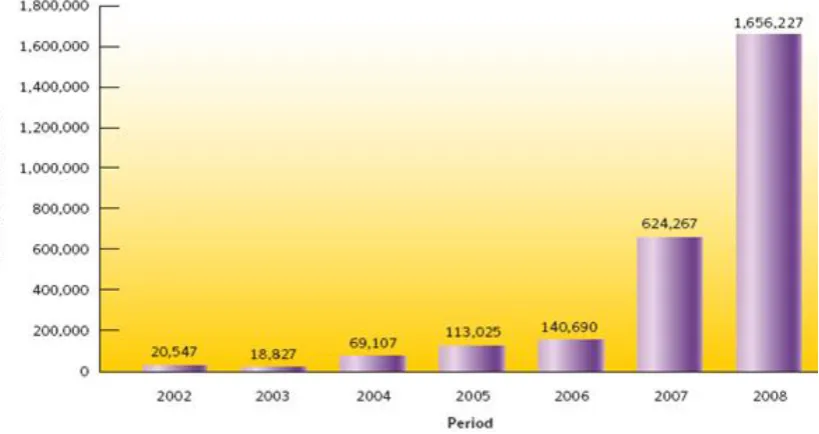
Symantec is shown in fiqure2.
Figure 2: Evolution of new malicious code threats as reported by Symantec, (Mihai C. et al, 2008).
In figure2 reported malicious code threats detected in 2008 (1,656,227) by Symantec
representing over 60 percent of the approximately total (2.6 million) malicious code threats
detected in total, over time. This reality is enough to saliently reduce the validity of database
content. The increase of complexity and sophistication of such attacks, the
professionalization of attackers and evolution of attack patterns represent the major changes
in the current threat landscape, and justify the need for urgent resolution against database
insecurity. Nowadays a fast and reliable mechanism to mitigate, discern and generate
vaccines for such attacks is vital for the successful protection of database contents. This
research will lead to more concrete solution for database security issue.
3. Database Vulnerabilities
Today, databases are obviously faced with different kinds of attacks. The knowledge of an
attack is the first step to its rectification. At the apex, the sensitivity of data determines ―the
database is very salient before describing the technique to secure the database. These attacks
are further elaborated in the following sections
a. Malware - One of the most dangerous database threats we are facing today is the unprecedented spread of malware. According to Honig, A. et al, These threats can be
delivered in many different variant modes often called blended threats which contain multiple
components such as fishing attempts, spams, viruses, worms and Trojan. This blended threats
or malware categories in percentage are shown in Figure 3.
Figure 3: A Pie Chart Showing in Percentage, the Different Categories of Malware (Guri, M. et al).
According to Mubina Malik (2016), Cybercriminals, state-sponsored hackers, and spies use
advanced attacks that blend multiple tactics – such as spear phishing emails and malware – to
penetrate organizations and steal sensitive data. Unaware that malware has infected their
device; legitimate users become a conduit for these groups to access your networks and
sensitive data. Basically, to prevent malware, enable firewall protection and install Antivirus.
b. Weak Authentication - Before a data object can be accessed, the access control mechanism checks the rights of the user against a set of fixed authorizations. If the
authentication mechanism is weak, it allows attackers to take up the identity of a legitimate
database user. Basically, when the strength of the authentication mechanism is relatively
vulnerable compared to the value of the assets being protected, then the content of the
database is seriously prone to attack. Brute force, social engineering are some specific attack
authentication is a must. For scalability and ease-of-use, authentication mechanisms should
be integrated with enterprise directory/user management infrastructures.
c. Database Misconfiguration - It is still very common to find un-patched databases, or randomly discover databases that have default configuration parameters. Rational attackers
very well know how to exploit this ignorance and launch attack against an organization. The
sad news is that organizations often struggle to stay on top of maintaining database
configurations even when patches are available. Basically these scenarios include the
challenge of finding a maintenance window to take down and work on what is often
classified as a business-critical system, time-consuming requirements for testing patches and
mounting backlogs and workloads for the associated database administrators. In the research
carried out by (Mubina Malik et al, 2016), the net result is that it generally takes
organizations months to patch databases, during which time they remain vulnerable.
d. SQL Injection - Security breaches are an increasing phenomenon. As more and more databases are made accessible via the Internet and web-based applications, their exposure to
security threats will rise. The objective is to reduce susceptibility to these threats. Perhaps the
most publicized database application vulnerability has been the SQL injection. SQL injection
is a code injection technique that exploits a security vulnerability occurring in the database
layer of an application. The vulnerability is present when user input is either incorrectly
filtered for string literal escape characters embedded in SQL statements or user input is not
strongly typed and thereby unexpectedly executed. It is an instance of a more general class of
vulnerabilities that can occur whenever one programming or scripting language is embedded
inside another. SQL Injection is one of the most common application layer attack techniques
used today. SQL injection attacks are also known as SQL insertion attacks.
e. Rephrased, this means using special input to trick the SQL server. SQL injections provide excellent examples for discussing security as they embody one of the most important
database security issues, risks inherent to non-validated user input. SQL injections can
happen when SQL statements are dynamically created using user input. The threat occurs
when users enter malicious code that ‗tricks‘ the database into executing unintended
commands. The vulnerability occurs primarily because of the features of the SQL language
that allow such things as embedding comments using double hyphens (--), concatenating
SQL statements separated by semicolons, and the ability to query metadata from database
A common example depicts what might occur when a login process is employed on a web
page that validates a username and password against data retained in a relational database.
The web page provides input forms for user entry of text data. The user-supplied text is used
to dynamically create a SQL statement to search the database for matching records. The
intention is that valid username and password combinations would be authenticated and the
user permitted access to the system. Invalid username and passwords would not be
authenticated. However, if a disingenuous user enters malicious text, they could, in essence,
gain access to data to which they have no privilege. For instance, the following string, ' OR
1=1 --entered into the username textbox gains access to the system without having to know
either a valid username or password. This hack works because the application generates a
dynamic query that is formed by concatenating fixed strings with the values entered by the
user. For example, the model SQL code might be:
SELECT Count (*) FROM UsersTable
WHERE UserName = ‗contents of username textbox‘
AND Password = ‗contents of password textbox‘;
When a user enters a valid username, such as ‗Mary‘ and a password of ‗qwerty‘, the SQL
query becomes:
SELECT Count (*) FROM UsersTable
WHERE UserName=‗Mary‘ AND Password=‗qwerty‘;
However, if a user enters the following as a username: ‗OR 1=1 -- the SQL query becomes:
SELECT Count (*) FROM UsersTable
WHERE UserName=‗‗OR 1=1 - -‘ AND Password=‗‗;
The expression 1 = 1 is true for every row in the table causing the OR clause to return a value
of true. The double hyphens comment out the rest of the SQL query string. This query will
return a count greater than zero, assuming there is at least one row in the users table, resulting
in what appears to be a successful login. In fact, it is not. Access to the system was successful
without a user having to know either a username or password.
f. Nested Query - Another SQL injection is made possible when a database system allows for the processing of stacked queries. Stacked queries are the execution of more than one
passed to the database system with multiple queries, each separated by a semicolon. The
following example demonstrates a stacked query. The original intent is to allow the user to
select attributes of products retained in a Products table. The user then injects a stacked query
incorporating an additional SQL query that also deletes the Customers table, going beyond
the intended privilege given to user.
Select * From Products; Drop Customers
This string when passed as an SQL query will result in the execution of two queries. A listing
of all information for all products will be returned. In addition the Customers table will be
removed from the database. The table structure will be deleted and all customer data will be
lost. In database systems that do not allow stacked queries, or invalidate SQL strings
containing a semicolon, this query would not be executed.
g. Excessive Privilege Abuse (Grant/ Revoke) - When users (or applications) are granted database access privileges that exceed the requirements of their job function, these privileges
may be abused for malicious purpose. For example, a university administrator whose job
requires only the ability to change student contact information may take advantage of
excessive database update privileges to change grades.
A given database user ends up with excessive privileges for the simple reason that database
administrators do not have the time to define and update granular access privilege control
mechanisms for each user. As a result, all users or large groups of users are granted generic
default access privileges that far exceed specific job requirements.
4. Database Security Control
The following gives us different ways core database security threats are being controlled.
1. Access Control Policies (Authentication and Authorization) - Access Control Mechanisms are used for securing databases. It ensures data confidentiality. Whenever a user
tries to access a data object, the access control mechanism checks the rights of the user
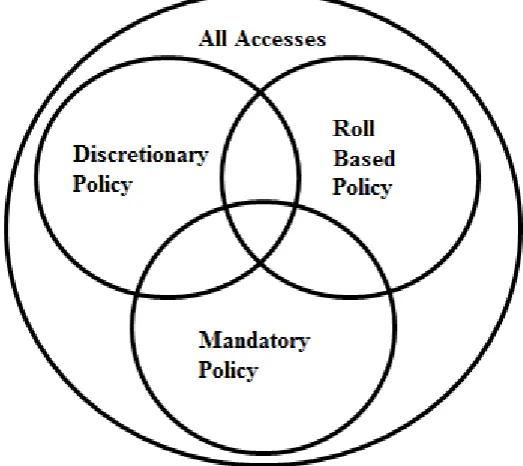
against a set of fixed authorizations. Different policies can be combined to provide a more
suitable protection to database system. There are two main access control policies -
Mandatory Access Control Policy and Discretionary Access Control Policy. In modern age
new access control policy -Role Base Access Control is used. The RBCA is most popular
Figure 4: Different Access Control Policies (Ravi S. 1996).
a. Discretionary Access Control Policy - Discretionary protection policies govern the access of users to the information on the basis of the user‘s identity and authorizations. These
authorizations are also known as rules. These rules specify the access modes, for each user
(or group of users) and each object in the system. Discretionary Access Control (DAC) can
be referred as a means of restricting access to objects based on the identity of subjects and/or
groups to which they belong. This policy places the decision of who can access information
at the discretion of the information creator i.e. owner of data or database administrator.
Security policy implementation is based on granting and revoking privileges. Access is
granted or denied based on the identification of the user. The Authorization Administration
Policy supervises this function in DAC. Common Administration Policies used in DAC are
Centralized Administration and Ownership Administration. In centralized administration only
some privileged subjects may grant and revoke authorizations while in ownership
administration grant and revoke operations on data objects are entered by the creator (or
owner) of the object (Ravi S. 1994). User-level privileges in DAC define access permissions
based on the general account information of user, whereas the relation-level privileges
control access to the individual relations of the database (Feikis John 1999). The figure below
gives basic implementation of DAC. The flexibility of discretionary policies makes them
Figure 5: Discretionary Access Control Policy (Feikis John 1999).
b. Mandatory Access Control Policy - Mandatory Access Control (MAC) constrains the ability of a user to access or generally perform some sort of operation on database objects.
MAC policy requires all users to follow the rules of access set up by the Database
Administrator (DBA). This policy needs objects (e.g. Database) to be classified and subjects
(e.g. Users, Process) to be cleared. It is enforced by comparing attributes of a subject and an
object to control access to the object. It restricts access to objects based on the sensitivity of
the information. (Feikis John, 1999).
c. Role Based Access Control Policy - Role Based Access Control (RBAC) models represent the most important recent innovation in access control model. RBAC has been
motivated by the need to simplify authorization administration and to directly represent
access control policies of organizations. Role-based policies regulate users‘ access to the
information on the basis of the activities the users execute in the system i.e. RBAC models
are based on the notion of role. A Role represents a specific function within an organization
and can be seen as a set of actions or responsibilities associated with this function. Under an
RBAC model, all authorizations needed to perform a certain activity are granted to the role
associated with that activity, rather than being granted directly to users. Users are then made
members of roles, thereby acquiring the roles‘ authorizations. Thus user access to objects is
mediated by roles; each user is authorized to play certain roles and, on the basis of these
roles, a user can perform accesses to the objects. (Bertino Elisa, 2005)
2. Preventing SQL Injection
a. Input validation - One effective prevention against SQL injection attacks is due
diligence on the part of the web programmer. The programmer must insure that all text
entered into HTML input fields is validated and stripped of malicious SQL content before it
is sent to the database. This is an example of the ―Secure By Design‖ philosophy. NEVER
take user input and place it directly into a SQL query. Always sanitize user input. Watch for
characters like ‗,‖, _,%,\x00,\n,\r,\, and \x1a. If possible create a white list of what characters are acceptable, and don‘t make it contain any more than you need.
b. Minimum Password Length - The MinPasswordLen property sets the minimum length of a user password. If set to 0 then the minimum password length is not limited. By setting
the minimum password length you can prevent using too short passwords, therefore lowering
the possibility of a password to be guessed by an intruder. This property is set by the security
administrator.
c. Establish strong password: Implementing strong passwords is the easiest thing you can
do to strengthen your security against SQL Injection. Use a combination of capital and
lower-case letters, numbers and symbols and make it 8 to 12 characters long. Avoid using: any
personal data (such as your birthdate), common words spelled backwards and sequences of
3. Auditing Mechanism
Just as video cameras supplement audible alarms on doors and windows in homes and
businesses, auditing provide the corresponding who, what, and when that complement
database monitoring.
Database auditing is used to track database access and user activity. Auditing can be used to
identify who accessed database objects, what actions were performed, and what data was
changed. Database auditing does not prevent security breaches, but it does provide a way to
identify if breaches have occurred. Common categories of database auditing include;
monitoring database access attempts, Data Control Language (DCL) activities, Data
Definition Language (DDL) activities, and Data Manipulation Language (DML) activities
(Yang, 2009). Monitoring database access attempts includes retaining information on
successful and unsuccessful logon and logoff attempts. DCL audits record changes to user
and role privileges, user additions, and user deletions. DDL audits record changes to the
database schema such as changes to table structure or attribute data types. DML audits record
changes to data. Database auditing is implemented via audit tables.
Auditing is generally used to:
Enable future accountability for current actions taken in a particular schema, table, or
row, or affecting specific content
Investigate suspicious activity. For example, if an unauthorized user is deleting data from
tables, then the security administrator could audit all connections to the database and all
successful and unsuccessful deletions of rows from all tables in the database.
Monitor and gather data about specific database activities. For example, the database
administrator can gather statistics about which tables are being updated, or how many
concurrent users connect at peak times.
Audit trail records can contain different types of information, depending on the auditing
options set. The following information is always included in each audit trail record, if the
information is meaningful to the particular audit action:
User name
Password
Name of the schema object accessed
Operation performed or attempted
System privileges used (Yang, 2009)
3.1 Basic Architecture Of Auditing System - The basic architecture of an auditing system is:
Figure 7: Anatomy of Auditing System (Bishop 2003).
The logger records information. The information that is stored in the log is determined by the
security and the system capabilities. The analyzer takes the log as the input and analyzes it to
either determine if an event of interest or a problem has occurred, or if other information
needs to be logged. The notifier receives the analysis from the analyzer, and reports the result
of the audit to the analyst, auditor, or other entities such as GUI form. In the following
sections we will describe features of each component in detail and provide a framework to
classify database auditing systems.
a. Logger - Some important issues related to logging include what, when, where, how, and how often a database was logged. More customized auditing procedures can be written for
table-oriented logging systems. The mechanisms used to set the type of event and condition
to be monitored address the ―how‖ question of logging. A variety of sanitization and
encryption techniques have been utilized by database auditing systems. The extent of auditing
required and/or desired is the most essential factor in determining what to log by the Logger
Analyzer Notifier Anatomy of Auditing System (Bishop 2003) because the ability to
reconstruct an event which is of interest to the analyst depends on how accurately a database
has logged the data for those suspicious events. An entry in a log must contain sufficient
information to find the consequence of a certain action. Nonetheless, monitoring for critical
tables and system is required.
b. Analyzer - In analyzing there are two major issues: what to analyze for and when to analyze. The question, ―what to analyze‖ considers the goals of auditing, which are usually
related to the detection of security violations. Regarding ―when to analyze‖, the analysis can
be periodic, based on transaction counting, and/or occur in real-time.
There are two major categories of frequency of analysis: periodic and real-time (Orman
1997). More frequent analysis can detect violations faster and allow prompt settlement.
time analyses analyze and validate each transaction and report immediately of the policy
violation. Real-time analysis provides most frequent analysis and is done for policies that are
critical to the system. Periodic analyses perform analysis after a given period of time. This
method is most often employed to give insight of the overall system transitions via providing
periodic reporting.
c. Notifier - There are two issues in the notification stage that are of primary interest. The first is the audit browsing techniques available. The second is the ability of the notification
system to sanitize the data based on the policy and the viewer‘s privilege level. The goal of
the audit browsing tools is to be able to present information in a way that it is easy for the
security administrators and auditors to identify potential threats or violations of policy.
Before a user is allowed to view the log or result of analysis, information that is not relevant
or information level that is higher than user‘s allowed access, is removed. In the context of
database auditing, it is salient that users be restricted to search and view entries of a narrow
scope so no user is allowed to access all entries.
4. CONCLUSION
The need to secure computer systems is well understood and securing data must be part of an
overall computer security plan. Growing amounts of sensitive data are being retained in
databases and more of these databases are being made accessible via the Internet. As more
data is made available electronically, it can be assumed that threats and vulnerabilities to the
integrity of that data will increase as well. Failing to safeguard databases that store sensitive
data can cripple your operations and result in regulatory violations. Understanding database
threats and implementing the solutions outlined will enable you to recognize when you‘re
vulnerable or being attacked, maintain security best practices and ensure that your most
valuable assets are protected.
REFERENCE
1. Abel D. J., Relational Data Management Facilities for Spatial Information Systems.
Proceedings of the 3rd International Symposium on Spatial Data Handling International
Geographical Union. Columbus Ohio, 1998; 9-18.
2. Abel D. J., Smith J. L., A Relational Database Accommodating Independent Partitions of
the Region. Proceedings of the 2nd International Symposium on Spatial Data Handling.
3. Anil L. Pereira, Vineela Muppavarapu and Soon M. Chung Role-Based Access Control
for Grid Database Services Using the Community Authorization Service‖, IEEE
Transactions on Dependable and Secure Computing, 2006; 3(2).
4. Bertino, E., & Sandhu, R. Database Security—Concepts, Approaches, and Challenges.
IEEE Transactions on Dependable and Secure Computing, 2005; 2(1): 2-18.
5. Bertino, E., Byun, J., & Kamra, A. Database security. In M. Petkovic & W. Jonker (Eds.),
security, privacy, and trust in modern data management (Data-centric systems and
applications), 2007; 87-102.
6. Beynon-Davies P. Database Systems 3rd Edition. Palgrave, Basingstoke, UK, 2004.
7. Bishop A. Anatomy of Auditing System, 2003.
8. Chen P. The Entity-Relational Model – Towards A Unified View Of Data. Association
for computing machinery transaction on database systems, 1976; 9-36.
9. Clark D. M., Hastings D A, Kineman J. J. Global Database and Their Implications, 1991.
10.Codd E. F. Extending the Database Relational Model To Capture More Meaning.
Association for Computing Machinery Transactions on Database Systems, 1979;
397-434.
11.Codd E. F., A Relational Model of Data for Large Shared Data Banks. Communications
of the Association for computing machinery, 1970; 377 – 87.
12.Collins J. Review of Competitive Database Software, 1982.
13.Fagin R. Normal Forms and Relational Database Operations, 1979; 153-60.
14.Feikis John Database Security: IEEE Journals, 1999.
15.Frank A U. Requirements for A Database Management System Based On Linear
Quadrees And A Relational Database For Regional Analysis, 1988; 213-32.
16.Frank R. Requirements for Database Systems Suitable To Manage Large Spatial
Database. Proceedings of The 1st International Symposium On Spatial Data Handling,
1979; 1: 38-60.
17.Guimaraes, M. New challenges in teaching database security. Proceedings of the 3rd
Annual Conference on Information Security Curriculum Development, Kennesaw, GA,
USA, 2006; 64-67.
18.Guri, M. et al, Y. "BitWhisper: Covert Signaling Channel between Air-Gapped
Computers Using Thermal, 2015.
19.Honig, A. et al. Practical Malware Analysis. No Starch Press. Retrieved 5 July, 2012.
21.Jaquith, A. Security metrics: Replacing fear, uncertainty, and doubt. Redwood City, CA:
Addison Wesley Professional, 2007.
22.Jeffrey Ullman First course in database systems, Prentice–Hall Inc., Simon & Schuster,
1997; 1.
23.Journal of Advanced Research in Computer Science and Software Engineering, 3(5).
24.Knox, D. C. Effective Oracle database 10g security by design. New York:
McGraw-Hill/Osborne, 2004.
25.Marius ConstantinLeahu, Marc Dobson, and Giuseppe Avolio. Access Control Design
and Implementations in the ATLAS Experiment‖, IEEE Transactions on Nuclear Science,
May 2013; 55(1).
26.Mihai Christodorescu, et al. Malware threats and mitigation strategies: US-CERT
informational whitepaper, 2013.
27.Mr. Saurabh Kulkarni, Dr. Siddhaling Urolagin, Review of Attacks on Databases and
Database.
28.Mubina Malik database security – attacks ans control methods. International Journal of
Information Sciences and Techniques (IJIST), 2016; 6(1/2).
29.Orman A. Database Security, 1997.
30.Ravi S. Sandhu and Pierangela Samarati, Access Controls Principles and Practice‖, lEEE
Communication\ Magazine, 1994.
31.Ravi S. Sandhu, Edward J. Cope, Hal L. Feinstein, Charles E. Youman. Roll Based
Access Control Models‖, IEEE Journals, 1996.
32.Security Techniques, Facility International Journal of Engineering Technology and
Database Security.
33.Shelly Rohilla, Pradeep Kumar Mittal, Database Security: Threats and Challenges,
International.
34.Shivnandan Singh, Rakesh Kumar Rai, A Review Report on Security Threats on
Database.
35.Staddon, J. Dynamic inference control. Proceedings of the 8th ACM SIGMOD Workshop
on Research Issues in Data Mining and Knowledge Discovery, San Diego, CA, USA,
2003; 94-100.
36.Techniques Research, November-2012; 2(11).
37.The Defense Information Systems Agency of the US Department of Defense, 2004.
38.Yang, L. Teaching database security and auditing. Proceedings of the 40th ACM