Volume-7 Issue-1
International Journal of Intellectual Advancements
and Research in Engineering Computations
An automatic toll collection and pollution detection in transportation
using embedded system
Mr. R. Murugasami
1,K. Hema Priya
2, E. Sakthivel
2, S. Sarika
2, A. Tamilselvan
21
Assitant professor, Department of Electronics and Communication Engineering,
Nandha Engineering College (Autonomous), Erode-52
2
UG
students
,
Department of Electronics and Communication Engineering,
Nandha Engineering College (Autonomous), Erode-52
ABSTRACT
Nowadays most of the highway toll plazas are manually operated, where an operator collects the cash from the driver and provides a receipt. Since this procedure is too slow. As the population is increasing day by day which results in high traffic congestion on roads. Most of the people find it difficult to be a part of long queue for toll collection. This causes high fuel consumption while waiting for a payment, which is going to extinct in coming years. This also increases air pollution. The air pollution may impact severely on the global environment if it is not controlled in right manner. The research is providing a great solution to this problem. Every management system is trying to make automatic, portable and remote control. The RFID technology plays a significant role in the areas of Transport. In now a day’s transportation is one of the main disputes in our country. RFID tags began to be extensively used in vehicles to automate toll processes. The spontaneous electronic toll collection system depends on RFID. In Toll Plaza collection requires an amount of actions like prohibiting the vehicle, reducing the casement, presiding the accurate coinage prior than travellers can carry on their journey. RFID technology uses tags that are fixed on the motor ve hicles, through which data entrenched on the tags are read by RFID readers. The main study of this article is to explore the various existing approach while addressing the prevention of motorists and toll authorities manually perform ticket payments. The automatic toll collection using radio frequency identification (RFID) is the efficient technique used to collect the toll automatically from the moving vehicle when they cross the toll plaza. The money is automatically paid from the users bank as soon as the vehicle approaches the TOLL and user also get an acknowledgement SMS. This system also contains pollution detection. Thepollution of the vehicle is monitored by MQ 2 sensor. When the emission level shoots beyond the already set threshold level, it will be indicated that the limit has been reached and this information has been send to traffic control room through GPS and GSM technology.
Keywords:
Radio-frequency identification (RFID) tag, RFID reader, MQ 135, Global System for Mobile (GSM).INTRODUCTION
It has become a trend to integrate automatic systems via wireless applications over network. Along with the advancement of technology development, research on wireless applications and remote control has become significant and popular today. As we as a whole realize that transportation
is the foundation of any nation's economy. Improvement in transportation system results into the better lifestyle in which we succeed amazing freedom for movement, vast trade in manufactured goods and services, as well as higher rate of employment levels and social mobility. In fact, the monetary state of a country has been firmly
identified with effective methods for transportation. Increasing number of vehicles on the road, result into number of drawback such as overcrowding, accident amount, air pollution and many others. All financial activities for dissimilar task use different methods of transportation. For this reason, increasing transportation is an immediate mischance rate, air contamination and numerous others.
Automatic Toll Plaza is capable of finding if the vehicle is recorded or not, and then informing the management center about to process violations, debits, and partitioning accounts. The most excellent advantage of this system is that it is capable of eliminates congestion in toll plaza, especially during those seasons when traffic seems to be higher than normal. The automatic toll collection and pollution detection is the system used here to reduce the man power and it also saves time and effort. In this system each vehicle consist of RFID tag and MQ 2 sensor. This systems can be incorporated with embedded controllers such as GSM modem to transmit the data over the mobile network. RFID tag contains unique identification number assigned.The tag mounted on the vehicle is the active tag which consist of inbuilt battery.The RF signal received by the RFID reader sends this signal to the computer’s serial port it then collects the information about the vehicle’s owner from the database which consist of vehicle’s number owner name and his prepaid account number . Then the amount is deducted from his account and the amount deduction is sent to the owner’s mobile phone through the GSM module.GPS is a main module in this Vehicle tracking system. As vehicle is tracked using GPS technology. To get exact location of any vehicle it need to be in a focus of four satellites.
CONVENTIONAL SYSTEM
There are two approaches utilized they are, First is the traditional manual approach.Most of the toll gate system around the world are manually operated where one individual accumulate cash then issues a slip and the transaction makes time and effort. The other one is the smart card approach where the person is essential to indicate
the smart card to the system installed at the toll tax section to open the gate.The 9g SG 90 type Micro Servo Motor module is used in this method. The Servo Motor is used for the automatically gate opening and closing purpose when the motor receives signal from the controller. This Servo motor rotates at 180 degree.SIM800 module is used for the power supply for supplying from 3.5V to 4.5V. The average voltage is 4.0V and provides a maximum of 2A current. USB cable that gives the supply to Arduino controller and it is used to dump the program to the controller. It is also frequently transform the RX and TX signals. It also creates a time delay and the vehicle waiting for to pay the toll amount may creates a pollution. Both the above declared approach for gathering tax is time consuming approach. Probabilities of escaping the payment of tax are there. It leads to line up of following vehicles.
PROPOSED SYSTEM
BLOCK DIAGRAM
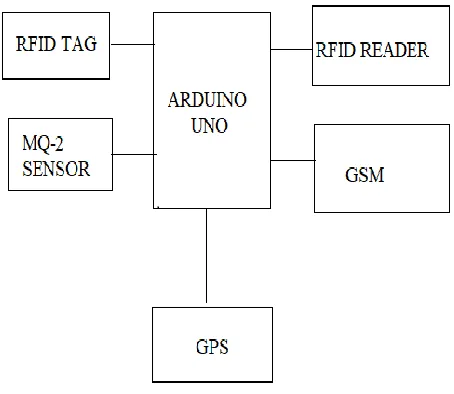
The Figure 2.1 shows the block diagram of the proposed system. It consists of an arduino, RFID tag, RFID reader, GSM,GPS and MQ-2 sensor.
Figure 2.1 Block diagram
RFID TAG
An RFID tag, or transponder, consists of a chip and an antenna. A chip can store a unique serial number or other information based on the tag’s type of memory, which can be only, read-write, or write-once memory. The antenna attached to the microchip transmits information from the chip to the reader. The tag is attached or embedded in an object to be identified, such as a product, case or pallet and can be scanned by mobile or stationary readers using radio waves.The use of RFID in vehicles are access control, vehicle identification, vehicle tracking. Access Control – The ability to allow or deny access based on a vehicle having a specific RFID tag is a valuable way to provide a building or parking lot an enhanced level of security. RFID uses radio waves to identify and track objects. Endpoints are attached RFID tag that uniquely identifies the items. Connectivity is a bi-directional wireless communication network with endpoints. Software, is to collect the real-time data and transform data
to the information centre for the application purposes.
RFID READER
higher delay is used between “end of one transmission” and the “start of transmission”. A smaller delay used between “start of transmission”. This is to avoid the transmission of the same data more than once. The RFID module at the toll plaza is configured with some reading capability
GSM (GLOBAL SYSTEM FOR
MOBILE COMMUNICATION)
GSM (Global System for Mobile communication) is a digital mobile network that is widely used by mobile phone users in Europe and other parts of the world.GSM uses a variation of time division multiple access (TDMA) and is the most widely used of the three digital wireless telephony technologies: TDMA, GSM and code-division multiple access (CDMA). GSM digitizes and compresses data, then sends it down a channel with two other streams of user data, each in its own time slot. It operates at either the 900 megahertz (MHz) or 1,800 MHz frequency band.GSM, together with other technologies, is part of the evolution of wireless mobile telecommunications that includes High-Speed Circuit-Switched Data (HSCSD), General Packet Radio Service (GPRS), Enhanced Data GSM Environment (EDGE) and Universal Mobile Telecommunications Service (UMTS).
GPS (Global Positioning System)
GPS stands for Global Positioning System. The Global Positioning System (GPS) is a satellite radio navigation system developed by the Department of Defense (DoD) owned by the United States Government (USG) and operated by the United States Air Force (USAF).GPS has provided positioning, navigation, and timing services to military and civilian users on a continuous worldwide basis since first launch in 1978. An unlimited number of users with a civil or military GPS receiver can determine accurate time and location, in any weather, day or night, anywhere in the world [3].The system makes use of a medium earth orbit satellite constellation transmitting microwave signals allowing a GPS receiver to determine its position, velocity and time. Different types of positioning can be carried out using GPS receivers depending on the
algorithms, type of measurements and corrections used in the navigation solution.
MQ 2 SENSOR
The MQ-2 Smoke LPG Butane Hydrogen Gas Sensor Detector Module is useful for gas leakage detection (home and industry). It is suitable for detecting H2, LPG, CH4, CO, Alcohol, Smoke or Propane. This sensor can detect a variety of flammable gas, is a low-cost sensor for many applications. The MQ-2 is a flammable gas and smoke sensor detects the concentrations of combustible gas in the air and outputs its reading as an analog voltage. The sensor can measure concentrations of flammable gas of 300 to 10,000 ppm.
ARDUINO UNO
The Arduino Uno board is a microcontroller based on the ATmega328. Arduino consists of both a physical programmable circuit board (often referred to as a microcontroller) and a piece of software, or IDE (Integrated Development Environment) that runs on your computer, used to write and upload computer code to the physical board. It has 14 digital input/output pins in which 6 can be used as PWM outputs, a 16 MHz ceramic resonator, an ICSP header, a USB connection, 6 analog inputs, a power jack and a reset button. This contains all the required support needed for microcontroller. Most microcontroller systems are limited to Windows. The Arduino programming environment is easy-to-use for beginners, yet flexible enough for advanced users to take advantage of as well. Arduino is an open source electroics platform based on easy to use hardware and software.
SCOPE OF THE PROJECT
The scope of the project lies on the following important features
Accuracy: All the functionally bonded logical dependencies must be integrated.
Cost effectiveness:As our software do not require any special software for implementation hence is less costly as compared to other existing system.
Any prerequisite for the use: As the existing system are not altered, and integration is done at the background hence there is no need for any training.
FLOW CHART
Figure 4.1 Flow diagram
This flow chart explains the overall work of this proposed system. Two methods are used in this system. One method is automatic toll collection, when the vehicle enters toll the RFID reads the RFID tag located in the vehicle which includes the details of the vehicle and the amount is transferred to the toll automatically. Then the smoke detection sensor also fixed in the vehicle when the pollution level exceeds beyond the value then the message send to RTO with information of vehicle.
FEATURES
Flexibility is the main feature and with the help of an RFID the implementation is very simplified. RFID technology with a very secure database yields into a highly efficient and secure system. Following are the advantages of this system
Wastage of money is reduced
RFID cannot be cloned so cannot be cheated
Pollution is reduced to a large extents
Very efficient saving of time.
Speedy transport.
Less congestion on the roadways.
Comparatively less maintenance cost.
CONCLUSION
After implementing this system we easily detect the vehicle identity. There are several benefits of the proposed toll collection mechanism. The usage of Radio Frequency Identification (RFID) makes the data transfer accurate and enable the data to be received and processed even when the vehicle is moving. By utilizing this system in toll plaza it will reduced the complete processing time by few second which is very important as
well as help to reduce vehicle congestion at toll plaza. RFID is not replacement of bar code but it is a technology offering various features. RFID offers highly reliable data collection in harsh environments. RFID is a technology offering various features and it is a very efficient technique used to collect the toll amount automatically. It provides new capabilities as well as an efficient method to collect, manage, disseminate, store and analyze information. The automatic toll plaza can have the best solution over money loss at toll plaza by reducing the manpower required for collection of money and also to reduce the traffic indirectly reduction of time at the toll plaza. This also controls the pollution from vehicles.
REFERENCES
[1]. Amol Dhumal-International Journal of Advanced Research in Computer Engineering & Technology (IJARCET) 4(4), 2015.
[2]. F. Don, “Electronic Toll Collection:An Introduction and Brief Look at Potential Vulnerabilities,” in SANS Institute infoSec Reading Room, 1.4, 2004.
[3]. Alberto carini and silvia Malatini, “Automated toll plaza system using RFID”, IEEE transactions on signal processing, 16, 2008, 1588-1563.
[4]. Elliot,S.J, and Nelson P.A..,”Advanced vehicle tax collection”, IEEE transactions on signal processing, 125(12), 1993, 1072-1079.
[5]. Hui Lan,Ming Zhang and Wee ser.”Automatic tax plaza”, IEEE transactions on signal processing, 9, 2002, 1070-1077.
[6]. W.-H. Lee, B.-S.Jeng, S.-S.Tseng, and C.-H. Wang, ―Electronic toll collection based on vehicle-positioning system techniques, in Proc. IEEE Int. Conf. Networking, Sensing, and Control, Ta ipei, Taiwan, R.O.C., 2004, 643-648.
[7]. Evaluation of an active RFID system for fast tag collection”, computer communications, 2008
[8]. International Research Journal of Engineering and Technology (IRJET) e-ISSN, www.irjet.net p-ISSN: 3(2), 2016, 2395-0072, 2395 -0056.
[9]. International Journal of Electronics, Electrical and Computational System IJEECS ISSN 2348-117X 6, 2017.
[10]. The Time’s of India paper “Now Road toll can be paid without stopping at Toll Plazas”, 2012. [11]. Kasturi Shah, Projakta Joshi, DishaGarg, "automatic toll c ollection using QR code".IRJET, 3, 2016. [12]. Sanchit Agarwal, Shachi Gupta, Nidheesh Sharma, "Electronic toll collection system using barcode