Return to Preinjury Status after Routine Knee
Arthroscopy in Military Population
Joshi A,
1Kayastha N,
1Maharjan R,
2Chand P,
1KC BR
11Shree Birendra Hospital, Chhauni, Kathmandu, Nepal, 2National Academy of Health Sciences, Bir Hospital, Kathmandu,
Nepal.
Correspondence:
Dr. Amit Joshi, Department of Orthopedics, Nepalese Army
Institute of Health Sciences, Shree Birendra Hospital, Chhauni, Kathmandu, Nepal.
Email: [email protected].
ABSTRACT
INTRODUCTION
Knee injuries are amongst the frequent occurrences in military. Most of the knee injuries occur during training, so in fear of being expelled from the training, these patients are reluctant to accept any surgical intervention including the arthroscopy. The major concern of these patients is time to training readiness and when will they be able to go back to their regular duties. Despite arthroscopy being minimally invasive and claimed faster recovery, there are very few literature mentioning the recovery period in routine uncomplicated arthroscopy.1
The scanty published literature have found wide range of recovery duration ranging from nine days to four weeks.
However, non of these studies have evaluated military population.2-4 Since military training and activities are
more demanding, we hypothesized that the recovery period will be longer than reported for other population. So, this study was designed with an aim to ascertain the recovery pattern and time taken to return to full physical activities after routine knee arthroscopy in military population.
METHODS
After getting ethical approval from the hospital administration, a prospective descriptive hospital based
Background: Knee arthroscopy is frequently advised procedure for knee-related problems in serving soldiers. The
scanty published literatures have documented wide range of recovery duration ranging from nine days to four weeks
even for routine uncomplicated arthroscopy. However, neither of these studies evaluated military population, where
arthroscopic procedures are frequent and physical demands are different. The aim of this study was to ascertain the
time required to return to unrestricted physical activities in serving military population.
Methods: This was a prospective descriptive study enrolling 51 patients who underwent two portal arthroscopic
procedures like diagnostic arthroscopy, meniscectomy, loose body removal and excision of plica or combination of
these. A uniform home based physiotherapy protocol was used for everyone. All of them were followed up at 2nd,
4th, 6th, 8th and 12th postoperative weeks. At each follow up, 2000 International Knee Documentation Committee
subjective knee evaluation form was filled and submitted for analysis.
Results: Although all of our patients were able to walk around without any support at two weeks follow up, 88% had
restriction to activities of daily living because of knee related problems. The mean International Knee Documentation
Committee score was 41 at 1st follow up, which gradually improved to 64, 86, 94, 94 at 4
th, 6
th, 8
thand 12
thweek
follow up respectively. At 6 weeks 91% resumed their preinjury status which reached 94% in eight weeks.
Conclusions: Most of the soldiers return to unrestricted activities within six to eight weeks after diagnostic
arthroscopy, meniscectomy, loose body removal and excision of plica or combination of these procedures.
Keywords: arthroscopy; military; pysical activity.
J Nepal Health Res Counc 2014 Jan;12(26):14-8
Original
study was conducted over a period of two year (December 2009 to December 2011). Fifty-one consecutive patients who underwent two portal arthroscopic procedures (diagnostic arthroscopy, meniscectomy, loose body removal and excision of plica or combination of these procedures) were analyzed for their recovery and return to preinjury status. Patients requiring meniscal repair, ligamentous reconstruction, cartilage procedures and arthroscopies requiring more than two portals were excluded from the study. Patients older than 50 years, radiological osteoarthritic changes in any of the knees and any other comorbid diseases were also excluded from the study. An informed written consent was obtained from each patient and a detailed pro-forma was filled recording their epidemiological data, mode of injury, pre and post injury IKDC (International Knee Documentation Committee) scores were recorded.5
All surgeries were performed under spinal anesthesia with automatic pneumatic tourniquet applied in upper thigh after exsanguinating the limb using Esmarch bandage. All arthroscopies were performed by trained arthroscopic surgeons using two portals (anterolateral and anteromedial). Irrigation and distention of the joint was maintained by normal saline and passed through the arthroscopic sheath. Using a pressure inflow system, joint distention pressure was maintained at 100 mm Hg. After the surgery the portals were closed with 2/0 prolene sutures and Jone’s bandage was applied.
A standardized post-operative protocol was maintained for all the patients. All post-operative problems and procedures were recorded, incase of uneventful postoperative period they were discharged on third postoperative day. All participants received a written home exercise program and advice leaflet while in the hospital. The advice and exercises were explained to all the patients by a physical therapist before discharge. The leaflet included information about the surgery, post operative instructions, and basic home exercises for the knee. Patients were instructed to manage pain and swelling with rest, elevation of the limb, and application of crushed ice to the knee for 15 mins, four times daily. Weight bearing was allowed after 24 hours within the limits of pain as tolerated by pain. They were advised to use crutch-assisted full weight bearing walk for three days and discontinue the crutches thereafter. Exercises included ten repetitions hourly for the first three days, then four times daily of static and terminal extension quadriceps strengthening exercises, straight leg raises, hip flexions in supine and circular hip movements in long sitting. On third post operative day bulky dressing was removed and knee bending was allowed as tolerated by pain. The exercises were to be continued until the patient’s final orthopedic review. All patients were
followed up on 2nd, 4th, 6th, 8th and 12th post operative
weeks. At each follow up 2000 IKDC subjective knee evaluation form was filled and submitted for analysis. In addition to 2000 IKDC form we also asked our patients two additional questions: 1. Are you able to walk around without any support? 2. Do you have any restriction of ADL due to knee related problems?
RESULTS
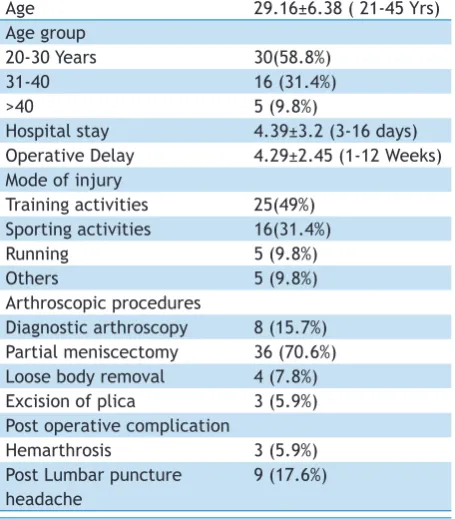
All 51 patients were male between ages of 21 to 45 years with mean of 29.16±6.38. More than 50% patients were in age group of 20-30 years. The mean hospital stay was 4.39±3.2 days ranging between 3-16 days. The commonest mode of injury was training activities (49%) followed by sporting activities (31%) and running (9.8%). The most commonly performed arthroscopic procedure was partial meniscectomy (70.8%). The mean operative delay (time from onset of symptoms to arthroscopy) was 4.29±2.45 weeks ranging from 1 to 12 weeks (Table 1).
Table 1. Descriptive analysis of study population.
Age 29.16±6.38 ( 21-45 Yrs)
Age group
20-30 Years 30(58.8%)
31-40 16 (31.4%)
>40 5 (9.8%)
Hospital stay 4.39±3.2 (3-16 days) Operative Delay 4.29±2.45 (1-12 Weeks) Mode of injury
Training activities 25(49%) Sporting activities 16(31.4%)
Running 5 (9.8%)
Others 5 (9.8%)
Arthroscopic procedures
Diagnostic arthroscopy 8 (15.7%) Partial meniscectomy 36 (70.6%) Loose body removal 4 (7.8%) Excision of plica 3 (5.9%) Post operative complication
Hemarthrosis 3 (5.9%)
Post Lumbar puncture headache
9 (17.6%)
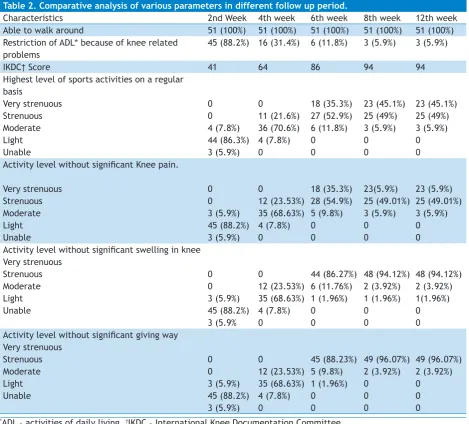
All the patients were able to walk around without any support in two weeks follow up, but 88% had restriction of activities of daily living (ADL) because of knee related problems. The restriction of ADL with knee related problems were only in six (11.8%) at six weeks and three (5.9%) at eight weeks (Figure 1). The mean IKDC score was 41 at 1st follow up (2 Weeks), which gradually
improved to 64, 86, 94, 94 at 4th,6th,8th and 12th weeks
Table 2. Comparative analysis of various parameters in different follow up period.
Characteristics 2nd Week 4th week 6th week 8th week 12th week
Able to walk around 51 (100%) 51 (100%) 51 (100%) 51 (100%) 51 (100%) Restriction of ADL* because of knee related
problems
45 (88.2%) 16 (31.4%) 6 (11.8%) 3 (5.9%) 3 (5.9%)
IKDC† Score 41 64 86 94 94
Highest level of sports activities on a regular basis Very strenuous Strenuous Moderate Light Unable 0 0 4 (7.8%) 44 (86.3%) 3 (5.9%) 0 11 (21.6%) 36 (70.6%) 4 (7.8%) 0 18 (35.3%) 27 (52.9%) 6 (11.8%) 0 0 23 (45.1%) 25 (49%) 3 (5.9%) 0 0 23 (45.1%) 25 (49%) 3 (5.9%) 0 0 Activity level without significant Knee pain.
Very strenuous Strenuous Moderate Light Unable 0 0 3 (5.9%) 45 (88.2%) 3 (5.9%) 0 12 (23.53%) 35 (68.63%) 4 (7.8%) 0 18 (35.3%) 28 (54.9%) 5 (9.8%) 0 0 23(5.9%) 25 (49.01%) 3 (5.9%) 0 0 23 (5.9%) 25 (49.01%) 3 (5.9%) 0 0 Activity level without significant swelling in knee
Very strenuous Strenuous Moderate Light Unable 0 0 3 (5.9%) 45 (88.2%) 3 (5.9% 0 12 (23.53%) 35 (68.63%) 4 (7.8%) 0 44 (86.27%) 6 (11.76%) 1 (1.96%) 0 0 48 (94.12%) 2 (3.92%) 1 (1.96%) 0 0 48 (94.12%) 2 (3.92%) 1(1.96%) 0 0 Activity level without significant giving way
Very strenuous Strenuous Moderate Light Unable 0 0 3 (5.9%) 45 (88.2%) 3 (5.9%) 0 12 (23.53%) 35 (68.63%) 4 (7.8%) 0 45 (88.23%) 5 (9.8%) 1 (1.96%) 0 0 49 (96.07%) 2 (3.92%) 0 0 0 49 (96.07%) 2 (3.92%) 0 0 0
*ADL – activities of daily living, †IKDC – International Knee Documentation Committee.
Figure 1. Restriction of activities because of knee related problems.
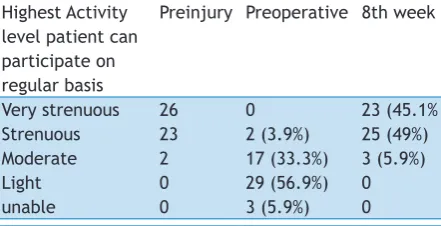
Forty nine (96%) patients out of 51 could perform strenuous or very strenuous activities before they sustained injury however only 2 (3.9%) could perform
strenuous activity preoperatively. At six weeks follow up 91% resumed their pre-injury status of strenuous or very strenuous activity level which reached 94% at 8th week
(Table 3).
Table 3. Comparison of activity level with pre-injury status.
Highest Activity level patient can participate on regular basis
Preinjury Preoperative 8th week
Very strenuous Strenuous Moderate Light unable
26 23 2 0 0
0 2 (3.9%) 17 (33.3%) 29 (56.9%) 3 (5.9%)
23 (45.1% 25 (49%) 3 (5.9%) 0 0
DISCUSSION
Routine arthroscopic procedures like diagnostic arthroscopy, meniscectomy, plica excision and loose body removal are very frequently advised in military. While advising arthroscopy we emphasize the faster recovery but when they ask “how soon I will be able to return to my duties?”, our answer becomes a guess as we lack published data. Recovery can be presumed according to the rehabilitation protocol in cases of advanced arthroscopic reconstructive procedures like ligament reconstruction, meniscal repairs and cartilage procedures. But there are no exact rehabilitation protocol for simpler arthroscopic procedures like meniscectomy, plica excision and loose body removal etc. Researches including diverse population and athletes have stated recovery duration ranging from nine days to four weeks.2-4 However, to our knowledge,
there are no studies published which included military population exclusively. During our clinical practice, we observed that our military patients were taking longer time to return to unrestricted activities even after uncomplicated routine arthroscopies.
In our series, although all 51 patients were able to walk around without any walking aid at two weeks follow up, 45 (88.2%) patients had restriction of activities of daily living (ADL). Similarly the mean IKDC score was only 41 and none of our patient could perform strenuous and very strenuous activities at two weeks follow up (Table 2). At four weeks when most of our patients supposed to be returning to their full physical activities as per published literature, 16 (31.4%) out of 51 had restriction of ADL because of knee related problems, the IKDC score was 64 and only 11 could perform strenuous activities. Although majority 45 (88.2%) could perform unrestricted activities even at six weeks, only 18 (35.3%) could perform very strenuous activities. At eight weeks follow up, 23 (45.1%) patients could perform very strenuous and 25 (49%) could perform strenuous activities. The activity level at eight weeks follow up was similar to that of the preinjury activity level. In a study of Stetson and Templin4, most of their patients returned to work
and normal activities at a mean of nine days after two portal arthroscopy. Lysholm and Gilquist,3 did report
that 68% of athlete resumed full athletic training with in two weeks of arthroscopic meniscectomy. In a study of diverse population of athletes and nonathletes, Lubowitz,7 reported that most of their patients return
to unrestricted activities within four weeks after knee arthroscopy. Klein and Schulitz,8 in their 100
cases of meniscectomy reported that the majority of those patients with a meniscus lesion as the exclusive abnormality experienced a rapid recovery and return to work within two weeks after surgery. St-Pierre,9 in
their study found that patients are able to walk without support within one to three days, return to work after one to two weeks, resume athletic training by two to four weeks and return to competition in three to four weeks. In contrast to all these published literature, our study showed that most of the military patients return to unrestricted physical activities in eight weeks.
We presume that most of our patients were undergoing training and trainings are physically very demanding which may have cause delayed return to unrestricted physical activities. Review of available literature did not focus on identifying the causes of delayed recovery in certain group of people. This may be because their recovery period was very short. Only St-Pierre,9 in his
study has highlighted the effect of preoperative strength deficit and extent of injury and hinted that these patients may require longer period of recovery. Since our aim was not to identify the causes of delayed recovery, this study cannot answer this question and we believe that this is one of the major limitations of this study. None of the published articles have mentioned about the operative delay (time from onset of symptoms to arthroscopy). In our study the mean operative delay was 4.29±2.45 weeks ranging from 1-12 weeks and 27 (52.9%) of our patient were operated more than six weeks after the injury. Since our sample size was small for this kind of analysis, we could not correlate operative delay with the recovery period but a study with larger number of cases is recommended.
In contrast to study by Lubowitz,7 where mean age of
their patient was 44 years (range 12-75 years), the mean age of our patient was 29.16±6.38 ranging from 21 to 45 years. Almost 60% of our patient fell into age group of 20-30 years. Despite the fact that this study was done in military population, we also presumed that people older than 50 years would have some osteoarthritic knee pain, which may compromise the outcome, so they were excluded from the study. This may be the reason for younger age of patients in our study.
lumbar puncture headache. All of these patients were successfully managed by bed rest, plenty of fluids and analgesics, but hospital stay had to be prolonged.
Although we followed our patients only for 24 weeks, arthroscopic procedures like meniscectomy, plica excision, loose body removal can be considered as effective method of treatment as 48 (94.1%) of our patient could perform strenuous and very strenuous activities at eight weeks follow up and all of our patients had returned to full physical activities at 12 weeks follow up.
CONCLUSIONS
Our result supports that therapeutic arthroscopy like meniscectomy, plica excision and loose body removal are effective method of treatment and most patient return to unrestricted activities within eight weeks after routine knee arthroscopy.
REFERENCES
1. Paulos LE, Rosenberg TD, Beck CL. Postsurgical care for arthroscopic surgery of the knee and shoulder. Orthop ClinNorth Am. 1988;19:715-23.
2. Lubowitz HJ, Ayala M, Appleby D. Return to Activities after Knee Arthroscopy. Arthroscopy. 2008;24(1):58-61.
3. Lysholm J, Gilquist J. Arthroscopic meniscectomy in athletes. Am J Sports Med 1983;11:436-8.
4. Stetson WB, Templin K. Two- versus three-portal technique for routine knee arthroscopy. Am J Sports Med. 2002;30:108-11. 5. Orthopaedic Scores [Online]. [cited 2012 Jan 12]; Available from:
URL:http://www.orthopaedicscore.com/
6. Morrissey MC, Milligan P, Goodwin PC. Evaluating treatment effectiveness: Benchmarks for rehabilitation after partial meniscectomy knee arthroscopy. Am J Phys Med Rehabil. 2006;85:490–501.
7. Klein W, Schulitz KP. Arthroscopic meniscectomy. Technique, problems, complications, and follow-up results. Arch Orthop Trauma Surg. 1983;101(4):231-7.