ABEPRO
DOI: 10.14488/BJOPM.2017.v14.n3.a5
PARAMETERS INVOLVED IN THE INTERNAL REVERSE LOGISTICS
OF A HOSPITAL PHARMACY
Kao Pei Yui1, Camila Candida Compagnoni dos Reis2, Matheus Fernando Moro2,
Sandrine de Almeida Flores3, Adriana Yolanda Morales Garza3, Neron Alípio Cortes Berghauser1, Andreas Dittmar Weise3
1 Federal Technological University of Paraná; 2 Federal University of Santa Catarina; 3 Federal University of Santa Maria
ABSTRACT
This research aims to identify the causes linked to internal reverse logistics of materials and medicines in a hos
-pital, covering studies for process optimization performed by this department. The study is based on a hospital located in the State of Paraná, Brazil. First, observations were performed through visits during the months of September/2015 to April/2016, and the month of March was chosen for the collection of data. Also, “in loco” visits were carried out for better understanding the process that occurs in both of the drug shipment to patients, as the internal reverse logistics was performed with drugs. To collect the data a survey form was used on the main reasons for discarding of drugs and materials for the central pharmacy. The instrument was adapted from the form used by the institution aimed specifically to the Intensive Care Unit. Through the observations made in the Hospital Unit, it was revealed that the company has a structured logistics process, standardized, and has a fundamental tool for this: information technology, creating efficient, reliable and fast data, requiring however, some improvements aiming primarily to prevent and reduce waste of both time and materials/medicines.
1. INTRODUCTION
The health sector is presented as extremely important for the development of Brazil (Dallora et Foster, 2013). In order to have an idea of its representation in the econom
-ic scenario, in 2011 the financial transactions of this sector were nearly 9% of the gross domestic product – GDP, about 20 billion reais, employing about 12 million formal workers (Brasil, 2011). Given its representation and socio-economic importance, the sectors are showing an increasing demand for resources due to the high technology involved in it, as
-sociated to insufficient resources in the public sector, which justifies, according to Bonacim et Araujo (2010), the need for studies and practices in this area.
Considering countries with universal health system, Bra
-zil is the one with the lowest percentage of investment in terms of GDP – 4% against an investment of 4.9% in Argenti
-na, 7.7% in the United Kingdom and 7.8% in Canada (Brasil, 2014). Parallel to low investment, recent problems of fund
-ing reduction for public health (Louise, 2015) has impacted the sector, resulting in a concern regarding the scope and quality of the services offered by the Unified Health System (SUS-Sistema Único de Saúde).
Regarding hospitals, specifically, they are meant to serve and assist people in order to promote health, involving com
-plete medical, preventive, therapeutic and healing assis
-tance (Araújo et al. (2012), in such a way that they assume part of the responsibility of costs and quality of the entire health system (Porter et Teisberg (2007). Hospitals represent a type of organization with a structure considered complex, including a variety of professionals and advanced technolog
-ical resources, conciliating entrepreneurial interests, with
-out distancing themselves from their own ethical and legal principles (Lemos et Rocha, 2011).
Hospital buildings operate 24 hours a day, seven days a week, 365 days a year, thus making them major consumers of resources (Zioni, 2015). Therefore, coexisting situation with the use of high technology for diagnosis and treat
-ments, as well as high waste rates (Contreras Pinochet et al., 2014) tend to increase the operating costs of these fa
-cilities. Vogl (2014) claims that over 90% of costs in hos
-pitals in Germany are considered operating costs, which confirms, as advocated by Bonacim et Araujo (2010) and Dallora et Forster (2013) the need to intensify research in order to reduce them.
In this manner, the operations management in hospitals is presented as essential and of unique character (Araújo et al., 2012). Corroborating, Souza et al. (2013), highlighting the logistical challenge in these environments, where orga
-nizational needs must be met in a quick, correct and efficient way, since they relate not only with the costs involved, but
also with the quality of health assistance provided to the us
-ers. With regard to logistics costs, a survey conducted in the US showed that on average 35% of total spending in a hospi
-tal refers to the purchase of materials and services (Minham, 2007). In this sense, Oliveira et Musetti (2014) advocate that flaws in the distribution of medication and materials, for example, could result in irreparable disasters for both the hospital and the patient.
The involvement of different sectors and areas in hospi
-tals, according to Pereira (2006), must present a harmoni
-ous relationship so that greater efficiency in terms of the services provided can be achieved. In general, they can be segmented in areas intended for patient assistance (as am
-bulatory, emergency department, inpatient units, operating rooms, etc.), and support areas, which provide assistance for the operation of the entire organization (Souza et al., 2013). Support areas can be divided, as Gonçalves et Ache
(1999) present in: (a) administrative support involving finan
-cial, materials, human resources and systems management, besides warehouse and pharmacy; (b) logistical support in
-volving laundry, materials sterilization center, maintenance, janitorial service, security, and cleaning; and (c) technical support, which includes nursing services, medical services (diagnosis and treatment), nutritional and dietetic services, physiotherapy and psychology services.
The importance of another factor for these areas to com
-municate effectively is noted: the Information Technology (IT). According to Taraboulsi (2009) IT should be under
-stood as a technology portfolio that automates procedures, routines, and processes of human labor in productive and administrative levels. Technology is essential in the health sector and can often be a fine line between survival and fa
-tality (Santos, 2006). In addition, IT in healthcare institutions provides an enhancement of the treatment processes, prop
-agation and transfer of information, adding value to services and turning decision making more agile, effective and con
-sistent (Tarabolusi, 2009).
As this research approaches the study of internal reverse logistics of materials and medications in hospitals, for its de
-velopment the administrative support area was considered, specifically the hospital pharmacy. According to the Brazilian Agency for Industrial Development (ABDI - Agência Brasile-ira de Desenvolvimento Industrial, 2013), hospitals consti
-tute an important link in dispensing medication to the pop
-ulation. Therefore, the aspect of some hospital pharmacies should be understood as follows.
The management of a pharmacy or hospital warehouse is something of great importance, as they are sectors which keep the most expensive inputs: medicines and hospital sup
hospital pharmacy as a unit of clinical and healthcare na
-ture, with administrative and managerial capacity, being one of the most important sectors in the hospital context.
Among its essential functions are storage, distribution, dispensing and control of all the medicines and health products for inpatient and outpatient of the hospital, as well as the fractionation and preparation of medications (SBRAFH (2007). According to the Basic Guide for the Hos
-pital Pharmacy of the Ministry of Health (1994), a hos-pital pharmacy must be located in an area of free access and movement, in order to meet the distribution of medica
-tion to patients, as well as to receive other pharmaceuti
-cals purchased for consumption.
It can be stated that there are five fundamental pillars for the hospital pharmacy sustainability: (a) selection of medications, germicides and related; (b) acquisition, con
-servation and control of selected medications; (c) han
-dling/production of medication, germicides-Pharmaco
-techniques; (d) establishment of a medications rational distribution system; and (e) implementation of medica
-tion informa-tion system (Ministério da Saúde, 1994). The SBRAFH (2007) states that implementation of a rational distribution system should be prioritized by the pharma
-cist and by the institution in order to seek processes that promote greater safety for patients.
Once removed from the hospital pharmacy, reverse logistics proceeds to respond about the medications. As stated by Melo et Scapini (2016) the definition for Re
-verse Logistics involves the continuation of products’ cy
-cle, so that it does not end in the consumer. In the case of the present study, only the internal reverse logistics of medications or materials is involved in the causes by which they return to the hospital pharmacy or are sent to disposal. Once opened, most of the medicines cannot return to storage, so they should be discarded, which, in case of wrong procedures, can generate waste not only of the product in matter, but also of the preparation time of a new dose and materials used.
Given the above, this research aims to identify the causes linked to internal reverse logistics of materials and medications in a hospital, covering studies for the opti
-mization of the process performed by this sector. A good integrated management in this sector may result not only in reducing losses, but also in a greater efficiency in terms of the quality of services provided by the hospital phar
-macy unit.
For better understanding of the undertaken activities, after the introductory section, the addressed methodol
-ogy is presented, covering the identification of the object of study and developed steps. Following, achieved results
are presented, in order that the reader can identify the information gathered in the study case, as well as some relevant considerations. Finally, relevant conclusions con
-sistent with the objective and some suggestions for fu
-ture research are discussed.
2. METHODOLOGY
The research is based on a hospital located in the Western Region of the State of Paraná, Brazil, founded in 1979, being the first hospital in Paraná to be certified by the National Accreditation Organization (ONA- Organização Nacional de Acreditação), it counts with the quality seal, level I and II, proving that it has security, standardization of procedures, training programs and quality of services. It is classified as a General Hospital of large scale, with over 300 beds in 16,000 square meters of built physical area, offering everything from emergency assistance to high complexity services. The hospital is considered as regional reference in cancer treat
-ment, cardiology and high-risk pregnancy.
The pharmaceutical service counts with five pharmaceu
-tical professionals, 11 administrative auxiliaries and 23 phar
-macy auxiliaries, which act in four pharmacies that the hos
-pital owns, being three satellite pharmacies: Intensive Care Unit (ICU), Surgical Center and Emergency Department and the Central Pharmacy, object of study of this research.
The dispensing system of the pharmacy under study is classified as individualized centralized, characterized by dispensing materials and medications per patient in three shifts, and having the central pharmacy to distribute them. The central pharmacy is strategically centered between the hospital blocks, facilitating the dispensing flow. It provides for six different blocks, divided into: UTI (general, coronary and neonatal), Block 2: SUS (oncology), Block 6: private and covenant, Block 7: maternity, Block 8: covenant and particu
-lar, Block 10: SUS (general clinic).
In the search for resolution of the proposed objective observations were made by conducting visits during the months of September of 2015 to April of 2016, being March the month used for data collection. For the present study, on-site visits were carried out in order to understand the process that occurs in both the delivery of medication to the patient, and the internal reverse logistics carried out with medications.
Block: Patient: Bed:
( ) Discharge ( ) Death
( ) Incorrect medication ( ) Incorrect dose ( ) Medical Criteria / If Necessary ( ) Suspended
( ) Change of sector ( ) Error in prescription / distribution
( ) Patient declined ( ) No justification Number of beds occupied:
Figure 1. Form of causes for return of medication and materials
Source: The author
Data was collected only from Blocks 6 and 8, because au
-thorization for this research was obtained only for those two sectors. It was systematically stipulated that on Mondays, Wednesdays and Fridays, data would be collected from ma
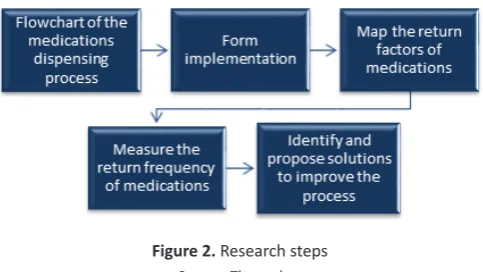
-terials and medications returned from the night shift and on Tuesdays and Thursdays it would be from the morning shift inputs. For an objective view, the steps of the research are presented in Figure 2. The study began performing on-site observations.
Figure 2. Research steps
Source: The author
Through the collected observations, a flowchart of the medication dispensing process was elaborated. The data ob
-tained from the forms was tabulated and then graphed in order to help clarify and emphasize the mass of data, thus being able to understand and visualize relevant aspects. In this way, the frequency with which medications were re
-turned could be measured and the causes that led to it could be identified. Finally, it was intended to identify and propose solutions for improvements in the process.
3. RESULTS AND DISCUSSION
From the on-site observations made and the applied forms during the months of research, the following results, related to the study’s objectives, are presented.
3.1 Processes description
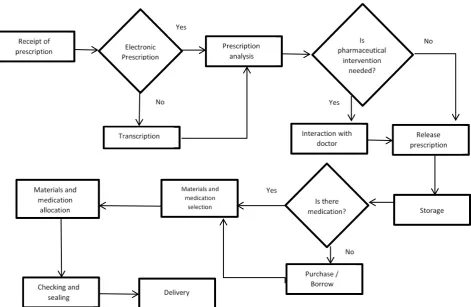
Through observations, it was possible to understand the expedition process of pharmaceutical inputs and elaborate the flowchart of this process, shown in Figure 3.
The process begins with the receipt of the medical prescription, if it is electronic it is printed, otherwise it is transcribed. The need for pharmaceutical intervention is verified and after this, the prescription is released. The pharmacy’s employee, who has the medical prescription recipe, takes each product on the pharmacy’s shelf and deposits them in a plastic tray; if the pharmacy is out of the required input, then it is borrowed from another hos
-pital or a purchase is effectuated. After all the required medication is on the tray, they are removed from the sys
-tem and entered in the patient’s account, with the aid of a bar code scanner. After the removal of the inputs from the system, materials and medications are separated by schedules and disposed in a tray properly identified, then, they are taken to a sealing machine, which individ
-ually package the required inputs.
As drugs are being individually packaged, they are identified with self-adhesive labels with information such: patient’s name, bed number, medication’s name, time to be administered and responsible doctor. Finally, these products are taken to each block by means of carts, in case the medication is for urgent use, it is disposed in a basket labeled “NOW” in order to be distributed to the appropriate patients.
The software used in the organization has a specific al
-gorithm to prevent non prescribed medications and ma
-terials to be brought to the patient; it even prevents them from being mistakenly downloaded from the system, so as the wrong amount. For better understanding it was elaborated a schematic illustration shown in Figure 4.
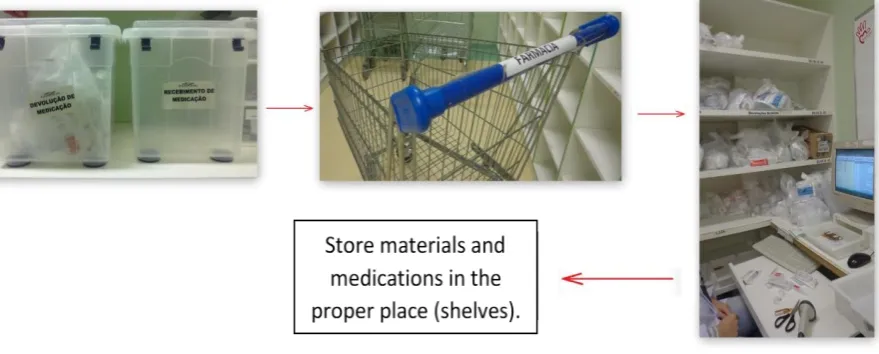
For the process of the return of pharmaceutical inputs from the blocks to the central pharmacy, a flowchart is presented in Figure 5.
Reverse logistics of pharmaceutical inputs begins in hospital blocks with the inputs being deposited in plas
-tic boxes labeled as “Medication Return”. In varying and non-specific intervals, the central pharmacy employees go through the different blocks and with the aid of a shopping cart collect the medications that are temporar
-ily stored in the shelf and are reinserted into the system. At the end of the reverse logistics process, the medica
-tions are relocated in the proper storage. Figure 6 se
Figure 3. Flowchart of the process of pharmaceutical inputs supply to hospital beds Source: The author
Figure 4. Illustration of the dispensing process of pharmaceutical inputs
3.2 Factors linked to the return of medications and materials
It is necessary to identify the reasons that cause the in
-ternal reverse logistics of materials and medications. These losses are activities completely unnecessary, which gener
-ate cost, do not add value and, therefore, must be imme
-diately eliminated.
The hospital in matter develops mapping practices of the main reasons for the return of medications occurred only in the ICU sector. For these practices, a form is used, which must be completed by the nursing staff from this sector, im
-mediately after the process occurs. In this way, more accu
-Figure 5. Flowchart of the return of materials and drugs to the hospital pharmacy
Source: The author
Figure 6. Illustration of the return of materials and pharmaceutical medication process
Source: The author
rate records of the causes of medication return in this sec
-tor are obtained. In order to fill the form with the causes of return of medication, the form provides the following factors: (a) Patient discharge; (b) Death; (c) Under Medical Criteria / If necessary; (d) Incorrect medication; (e) Incor
-rect dose of medication; and (f) Medication suspended by medical orders.
Blocks 6 and 8, which received authorization for this re
-search, count with medical assistance designated for a private convention. Therefore, new arguments for the return of med
as follows: (a) Change of patient’s sector (due to emergencies, exams, or surgery); (b) Error in prescription / distribution; (c) Patient declined; and (d) No justification identified.
With the addition of these four items, the list increased to ten justifications for the return of inputs to the central phar
-macy. The resulting analysis of the justifications for medica
-tion return in Blocks 6 and 8 are discussed in the following sections.
3.2.1 Analysis of the return of inputs in Block 6
In Block 6, the relation between the causes of materials and medication return and the percentage of occurrence of the period studied is detailed in Figure 7. It is important to mention that, during this period, 149 returns were observed.
Figure 7. Causes for return of inputs in Block 6
Source: The author
Of the ten reasons, three of them have not been verified, they are: (I) Death; (II) Incorrect Medication; and (III) Error in prescription / distribution. It is noted that the main cause for returns in Block 6 was “Upon Medical Criteria / if neces
-sary”. These causes represent 61% of the returns occurred in a month. Patient discharge and incorrect dose obtained 10% returns each. These three causes represent 81% of returns during the month. It should be noted that this block has ca
-pacity of 30 beds and the occupancy average for the month of March was 22 beds / day.
3.2.2 Analysis of the return of inputs in Block 8
The percentage of occurrence of returns in Block 8, and the causes thereof, are presented in Figure 8. During the study period 93 returns we observed.
Figure 8. Causes for return of inputs in Block 8
Source: The author
3.3 Suggestions for improvements
Based on the results of the research presented in the pre
-vious section, opportunities to leverage the performance of the hospital pharmacy from the point of view of returns of inputs were identified and are presented in Figure 9.
Causes Propositions Improvements Discharge immediately when the patient is discharged.Adjust the software to alert pharmacy staff
Death Adjust the software to alert pharmacy staff immediately if the patient dies.
Under Medical Criteria / If
Necessary
1- Do not send medications as soon as they are classified. Only release medication when the
patient really needs it.
2- Modify pharmacy’s system: instead of being centralized, create small satellite pharmacies in
the blocks.
Thereby reducing the number of returns by this reason.
Incorrect dose ference between the standard unitized amount Adjust the software so that it detects the dif -and the one prescribed by the doctor.
Change of
sector
Adjust the software so that the change of sector is scheduled (surgery, exams, etc.); inform about it and avoid sending medication to this sector at
this time. Error in
prescription / distribution
Adjust the software in order to fill the recipe’s header automatically, with the date and sched
-ule set.
Figure 9. Proposed improvements to minimize input returns
Source: The author
For the reasons of discharge, death and change of sector an adjustment in the software is proposed in order to inform immediately the patient’s situation. This can be achieved by means of a panel (window) that displays the patients that suffered one of these situations; a beep to draw attention to a particular patient or; the use of colors to alert the phar
-macy staff.
According to perception during the process, incorrect dose occurs most often with ointments and not so stable liquid medications that are delivered in the original presen
-tation. If the doctor prescribes these types of medications in smaller doses than their laboratory presentations and/or more than once a day, they are delivered to the patient as many units of medications prescribed by the doctor, without calculating, for example, that only one of these bottles could be used by patient during the prescription period (day). The proposition for this situation is to create a virtual database, on the software used in pharmacy, of medications whose presentation is in liquid form or ointment with their respec
Error in prescription / distribution process occurred only once with the date informed on the medical prescription’s heading. As an improvement proposal for this point, it is sug
-gested this heading to be automatically filled and fixed by the system and, not allowing the user to make any changes.
Due to the significant number of returns of materials and medicines under “Medical Criteria / if necessary”, the first exposed suggestion is not to send these materials right after they are classified, since these are optional inputs in the patient’s treatment. The delivery should be effectuated only when required and if the patient chooses to use it. The pharmacy operates 24 hours, so there is always availability to supply the requirements. The second option involves the installation of satellite pharmacies on every block or certain blocks. This suggestion would possibly end with the occur
-ring returns; it should be considered that at least five em
-ployees would be needed for each satellite pharmacy and that the maximum capacity that a block of this hospital has is 36 beds.
4. CONCLUSIONS
Through the observations made in the Hospital Unit it was possible to notice that the company present a struc
-tured and standardized logistics process, and counts with a fundamental tool for this: information technology, generat
-ing efficient, reliable and fast data. The mapp-ing of new in
-dicators for returns was possible thanks to the daily contact with the nursing staff at the place where the returns occur.
Quantitatively measuring the justifications for returns and presenting the data in graphics helped to clarify and highlight the main cause involved in the reverse logistics. In this study, the inputs returned due to the cause of “Medi
-cal Criteria” were responsible for over 60% of returns, both for Block 6 as for Block 8. An interesting finding, since these drugs are prescribed by doctors, if there is a need to use by the patient, or optional inputs that generate a significant number of returns. Still, according to the data entry, most of these medications are usual (do not present contraindica
-tion) and in lower incidence they are ‘black box medications’.
The following improvements were proposed: adjustments in the software used by the pharmacy to alert the patient’s condition, not sending inputs classified as “Medical Criteria” directly, installation of satellite pharmacies in certain blocks and creation of an input database, which presents the med
-ication in liquid and ointment form, in order to calculate the required amount correctly and avoid that returns caused by an incorrect dose occur.
The proposed objective was achieved through demon
-strated results and through the analysis of this important is
-sue which is the reverse logistics of medications in hospitals. Due to the relevance of the topic, research on this subject should be carried out in order to seek knowledge in cost re
-duction within the hospital management. It is suggested, as a continuation of the research: (a) the economic feasibility study of the installation of satellite pharmacies in each hos
-pital block; (b) economic feasibility study of the software ad
-justment; and also (c) the economic feasibility study for the acquisition of new software that meets more effectively the needs of the establishment.
The improvements proposed in this research do not only fit the hospital under study but also different health estab
-lishments. The optimization of the medications and materi
-als dispensing process reflects in lower operating costs and greater efficiency and quality of the services provided, being presented as a strategic tool in operations management.
REFERENCES
Adrados, M., Lajam, C., Hutzler, L., Slover, J. and Bosco, J. (2015), “The effect of severity of illness on total joint arth
-roplasty costs across New York state hospitals: an analysis of 172,738 cases”, The Journal of arthroplasty, Vol.30, No.1, pp. 12–4.
Agência Brasileira de Desenvolvimento Industrial (2016), “Logística Reversa para o setor de medicamentos”, available at: http://portal.anvisa.gov.br/wps/wcm/connect/6035fe8 04362f6fbaca0be0eb77d2a7a/Log%C3%ADstica+Reversa+ de+Medicamentos.pdf?MOD=AJPERES (Acessed on 15 May 2016).
Araújo, E. A., Araújo, A. C. and Musetti, M. A. (2012), “Es
-tágios organizacionais da logística: estudo de caso em orga
-nização hospitalar filantrópica”, Produção, Vol.22 No.3, pp. 549-563.
Bonacim, C. A. G. et Araujo, A. M. P. (2010), “Gestão de cus
-tos aplicada a hospitais universitários públicos: a experiência do Hospital das Clínicas da Faculdade de Medicina de Ribeirão Preto da USP”, Revista de Administração Pública, Vol.44 No. 4, pp. 903–931.
Brasil (2011), Portal Brasil, Economia e Emprego. Brasília, available at http://www.brasil.gov.br/economia-e-empre
-go/2011/05/alexandre-padilha-destaca-papel-da-saude-na
--economia-brasileira (Acessed on 18 January 2016).
Brasil (2014), Senado Federal, Em Discussão: Revista de audiências públicas do senado federal. Brasília, availa
-ble at http://www.senado.gov.br/noticias/jornal/emdis
-cussao/Upload/201401%20-%20fevereiro/pdf/em%20 discuss%C3%A3o!_fevereiro_2014_internet.pdf (Acessed on 20 January 2016).
Informação e Comunicação na Gestão da Saúde”, Revista de Gestão em Sistemas de Saúde, Vol.03 No.02, pp. 11–29.
Dallora, M. E. L. D. V. et Forster, A. C. (2013), “Gerenciamento de custos de material de consumo em um hospital de ensino”, Revista Administração em Saúde, Vol.15 No.59, pp. 46–52.
Gonçalves, E.L. et Aché, C.A. (1999), “O hospital-empresa: do planejamento à conquista do mercado”, Revista de Admi
-nistração de empresas, Vol.39 No.1, pp. 84-97, available at http://www.scielo.br/pdf/rae/v39n1/v39n1a09.pdf (Acessed on 25 January 2016).
Lemos, V. M. F. et Rocha, M. H. P. (2011), “A Gestão das Organizações Hospitalares e suas complexidades”, paper pre
-sented at CNEG 2011: Congresso Nacional de Excelência em Gestão, Niterói, RJ, 12-13 August 2011, available at http:// www.inovarse.org/node/2811 (Acessed on 12 April 2016).
Louise, A. (2015), “Em 2016, Ministério da Saúde reduzirá gasto com SUS em quase R$10 bilhões”, available on http:// www.hojeemdia.com.br/horizontes/em-2016-ministerio
--da-saude-reduzira-gasto-com-o-sus-em-quase-r-10-bilh
--es-1.367603 (Acessed on 20 January 2016).
Mello, M. F. et Scapini, R. (2016), “Reverse Logistics of agro
-chemical pesticide packaging and the impacts to the environ
-mental”, Brazilian Journal of Operations & Production Mana
-gement, Vol.13 No.1, pp. 110-117.
Minaham, T. (2007), “Can supply management technology be the antidote to the healthcare crisis”, Health Management Technology, Vol.28 No.9, pp. 52-55.
Ministério da Saúde (1994), Coordenação de controle de Infecção Hospitalar, “Guia Básico para a Farmácia Hospitalar”, Brasília, available at http://bvsms.saude.gov.br/bvs/publi
-cacoes/partes/guia_farmacia1.pdf (Acessed on 26 January 2016).
Oliveira, T. S. et Musetti, M. A. (2014), “Revisão compreen
-siva de logística hospitalar: conceitos e atividades”, Revista de Gestão em Sistemas de Saúde, Vol.3 No.1, pp.1-13.
Pereira, M. (2006), Um Modelo de Gestão de Abastecimen
-to de Medicamen-tos em Farmácia Hospitalar, Tese de Dou-to
-rado em Engenharia de Produção, Universidade Metodista de Piracicaba, Santa Bárbara D’Oeste, SP.
Porter, M. E., et Teisberg, E. O. (2007), Repensando a saú
-de: estratégias para melhorar a qualidade e reduzir os custos, 1 ed., Bookman, Porto Alegre, RS.
Santos, G. A. A. (2006), Gestão de Farmácia Hospitalar, Se
-nac, São Paulo, SP.
Sociedade Brasileira de Farmácia Hospitalar – SBRAFH (2007), Padrões mínimos para farmácia hospitalar e serviços de saúde, Goiânia: SBRAFH.
Souza, A. A., Pereira, A. C. C., Xavier, A. G., Xavier, D. O. and Mendes, E. S. (2013), Logística Hospitalar: um estudo de caso diagnóstico das dificuldades na gestão logística de setor de engenharia clínica. Revista Eletrônica de Administração, Vol.12, No.1, pp. 1-14.
Tarabolusi, F. A. (2009), Administração de hotelaria hospi
-talar, 4 ed., Atlas, São Paulo, SP.
Vogl, M. (2014), “Hospital financing: calculating inpatient capital costs in Germany with a comparative view on ope
-rating costs and the English costing scheme”, Health policy, Vol.115 No.2-3, pp. 141–51, available on http://www.heal
-thpolicyjrnl.com/article/S0168-8510%2814%2900026-8/pdf (Acessed on 24 January 2016).