Author for correspondence:
Department of Mechanical Engineering, Nandha Engineering College, Erode-52, Tamil Nadu, India
Optimisation of mechanical properties of different printing mode in 3D
printing
V.N.Loganathan
1, S.Arunkumar
2, J.Arun Prakash
2, M.Balasagayaeswaran
2,
N.Hariharan
2Department of Mechanical Engineering, Nandha Engineering College, Erode -52, Tamil Nadu,
India
ABSTRACT
Additive manufacturing is a layer-wise fabricating technology. There is no need for a machining process for final product because of its accurate layer fabrication to one another. This allows the user to manufacture parts directly from design software. There are many types of the additive manufacturing like selective laser sintering (SLS), fused deposition modeling (FDM), stereo lithography, polyjet printing. Materials used for a 3d printing should have a low melting point. In the polyjet printing, there a re many materials like ABS, Vero Blue, Vero White, Vero Clear and so on. In this Vero Blue is the cheapest among the mainly used 3D printing materials. But we should check for its values on each way of printing types to get verified about its tensile and f lexural values with regards to other materials.
Keywords:
Polyjet, Object 360, Vero Blue, Tensile and Flexural properties .INTROCUCTION
Rapid prototyping is a procedure of the producing models before the production of actual product. There are various methods of rapid prototyping. The main advantage lies in the speed of the producing physical prototypes as well as almost unlimited complexity of geometry. Additive manufacturing procedures do not require planning during the process. The materials used for rapid prototyping can differ according to the properties
Figure 1: Build tray position
LITERATUR EREVIEW
ASTM means the American Society of Testing and Materials. They are giving the standards for testing like minimum dimensions and the properties of the materials. Because everyone should use the same dimension properties for every materials only for the same dimensional analysis.
In This paper the authors discussed about the build orientation for the 3D printing machine like XY, YX and ZX orientations. They have concluded that the parts build from the XY orientation would have a better tensile strength than other two.
In This paper, Authors used five materials and they are Loctite 406, Loctite hysol 9483, vero black and Vero blue and fullcure720. The
fluctural modulus of vero blue is lower than fullcurw 720 but maximum than vero black. The tensile strength also same as like the fluctural modulus. Fullcure 720 has higher tensile strength than vero blue. Vero blue materials has higher tensile strength than vero black.
MATERIAL
Material we have selected for our project is a rigid photopolymer. Photopolymer is a In All photopolymers we have taken the Vero Blue. Vero blue combining dimensional stability and high detail visualization, this materials simulate opaque, rigid plastic. They gives the power to rapidly prototype models that closely resemble the appearance of your finished part.
Copyrights © International Journal of Intellectual Advancements and Research in Engineering Computations, High quality glossy blue YMGT- 01, 02, 03
High speed glossy overcurring XMGT- 04, 05, 06 High quality glossy blue overcurring YMGT- 04, 05,06
There are two types of the printing mode and they are High Quality and High Speed.
For flexural test
Table 2: Specimen description for flexural test MATERIAL ABBREVATION
Hign speed matte blue XMBF- 01, 02, 03 High quality matte blue YMBF- 01, 02, 03 High speed glossy blue XMBF- 01, 02, 03 High quality glossy blue YMBF- 01, 02, 03 High speed glossy overcurring XMBF- 04, 05, 06 High quality glossy blue overcurring YMBF- 04, 05,06 `
Matte appearance
Its dull or death surface, often slightly roughened and its having a lusterless surface. Matte things ore not shiny.
Glossy appearance
Its reflective or shiny surface and its having a surface luster or brightness, superficially attractive appearance.
Design
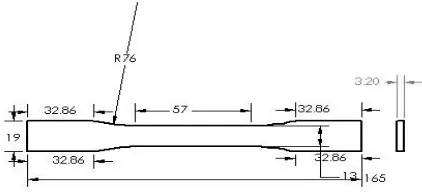
Design of each and every material should base on some standard dimensions. That standard
Figure 3: 2D model for tensile and flexural test
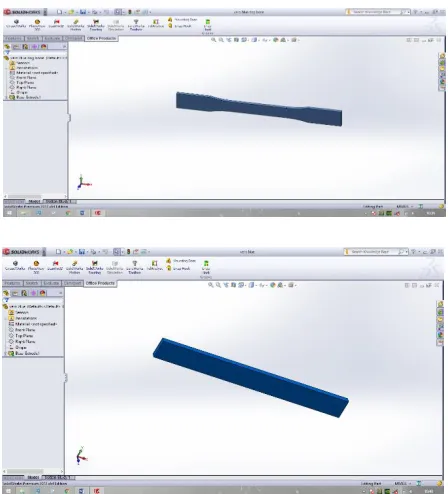
Figure 4: 3D model developed from solid works
Testing procedure
Basically the matte and glossy materials have the same material dimensions but their dimensions change according to the test which we have taken. Their dimensions are taken from the ASTM standard. But the ASTM standard have different variety for dimensioning but we have taken the Type 1 dimensions from 5 types of the dimensions. They should designed as a 2D model and designed as a 3D model from the designed software. We have used Solidworks software for designing 3D model.
After designing the 3D model, feed the design into 3D printing software by the converting modeling format into 3D printing format i.e., .STL format. After feeding the software from computer to the polyjet machine, the software automatically changes into .STL format.We have taken 3
specimen for every type of printing mode and for every finish. For tensile test two finishes are available and two printing modes are there.
For tensile test, the combination of the materials is High speed matte finish and High speed glossy finish printing mode. And High quality matte finish, High quality glossy finish printing modes are taken for our testing.
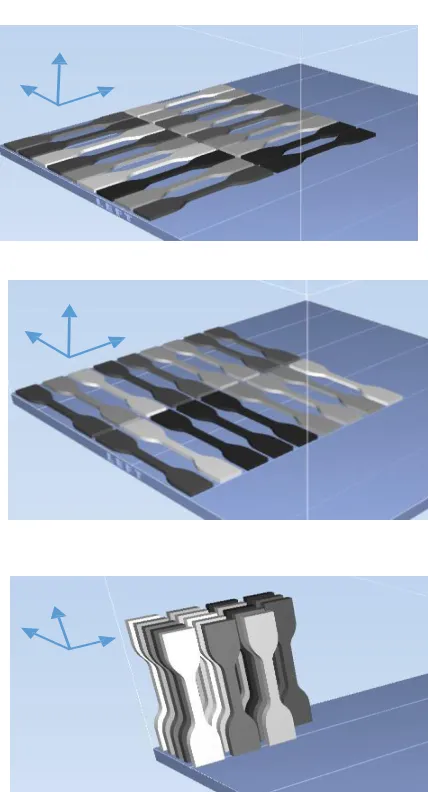
Build orientation of the specimen should select to get a efficient and cheapest build of the specimen. From the literature review [1]. The XY, YX and ZX orientation figures are mentioned in the figure 4. From the literature review we have selected the XY orientation.
Copyrights © International Journal of Intellectual Advancements and Research in Engineering Computations,
Figure 4 : Build orientation
The values from graph are mentioned below For tensile test
No S.ID LOW MPa MPa high
Et MPa
1 XGBT01 0.895 3.083 1100
2 XGBT02 0.565 1.937 705
4 YGBT04 0.704 2.498 912
5 YGBT05 0.702 2.236 777
6 YGBT06 0.714 2.437 880
7 XGBT04 0.949 3.215 1100
8 XGBT05 0.749 2.473 888
9 XGBT06 0.808 2.756 995
10 YGBT01 0.578 2.177 829
11 YGBT02 0.701 2.154 729
12 YGBT03 0.535 1.817 633
13 YMBT01 0.613 2.169 812
14 YMBT02 0.578 1.964 719
15 YMBT03 0.545 2.021 764
16 XMBT01 0.791 2.471 886
17 XMBT02 0.747 2.114 681
18 XMBT03 0.755 2.044 650
And for the flexural test, the values are obtained form are mentioned below
S.ID EH MPa
SM MPa
WB/V Kj/m2
Copyrights © International Journal of Intellectual Advancements and Research in Engineering Computations, curring series have the higher tensile modulus.
XMBT series have the lowest tensile modulus. The complete order for the tensile modulus will be like XGBT over curing higher than XGBT higher than YGBT over curing higher than YMBT higher than YGBT higher than XMBT series. Finally the High Quality over curing series have the
XGBF over curing series has the higher values. Lowest values are obtained from the XMBF series. The complete order for the flexural modulus will be in the order, XGBF over curing series higher than YGBF over curing series higher than XGBF series higher than YGBF series higher than YMBF series higher than XMBF series.
REFERENCES
[1]. Standard Terminologyfor Additive Manufacturing Technologies, ASTM Standard 2012, F2792-12a.
[2]. Lindsey B. Bass, Nicholas A. Meisel, and Christopher B. Williams “Exploring variability in material properties ofMulti-material jetting parts”.
[3]. J. Kotlinski, “Mechanicalproperties of commercial rapid prototypingmaterials,”Rapid Prototyp. J., vol. 20, no. 6, pp. 499–510, 2014.
[4]. K. Puebla, K.Arcaute, R. Quintana, and R. B.Wicker, „‟Effects of environmental conditions, aring, and build orientations on the mechanical properties of ASTM type 1 specimens manufactured via sterolithography, Rapid Prototupe. J., 18(5), 2012, 374-388.
[5]. C.S. Lee, S.G.Kim, and S.H. Ahn “Measurement of anisotropic compressive strength of rapid prototyping parts,‟‟ J..Mater. process. Technical,. 187, 2007, 627-630.