An Empirical Study of Agile Testing Attributes for
Higher Customer Satisfaction in IT Projects in India
Nasina Jigeesh [email protected]
&
Samyadip Chakraborty [email protected]
Department of Operations & Systems IBS Hyderabad, IFHE University
Dontanpalli, Shankerpalli Road, Hyderabad-501203, India
&
Tulika Chakravorty
Accenture (India) Services Pvt. Ltd., Hyderabad, India. [email protected]
ABSTRACT
Achieving customer satisfaction by meeting client demand within a stipulated time frame is a major challenge for any organization. To this end, many organizations are showing a greater inclination to adopt agile testing. This is especially true of information technology (IT) firms that have clients in the services and manufacturing sectors. This study focuses on the implications of agile testing attributes across different phases of IT development and maintenance projects in the services and manufacturing sectors in India. Taking an empirical approach, it examines the impact and implications of five key agile testing attributes aimed at achieving higher customer satisfaction. One-way ANOVA is used to analyze the variances. From the findings, significant differences were identified among the attributes, both in terms of types and phases of projects. The outcomes reveal that the five attributes exhibit significant differences across project phases. These contribute to creation of a handy managerial framework for prioritizing the project-specific agile testing attributes.
International Journal of Business and Information
1. INTRODUCTION
Continuous dynamic changes in today’s business environment pose a challenge to business entities in terms of their readiness and flexibility to adapt to such changes in order to maintain their competitive advantage. The information technology (IT) services sector is no exception. As the needs of their clients change, so do their requirements. Such circumstances demand innovative and flexible approaches to incorporate changes in a fast and reliable manner. A close look at the software industry reveals a transformation, especially in the case of client-centric projects, with regard to clear articulation of the new order of thinking and working [exemplified by dynamic approaches like Scrum and Extreme programming (XP)]. These new approaches are called “agile.”
The rise of the “agile” era made “agile” a buzz word and opened the door for parallel and dynamic service development, maintenance, and support. Agile approaches can manage constantly changing needs and requirements because they lack the disadvantages of traditional linear methodologies such as the waterfall model. These disadvantages include prolonged time requirements, less flexibility, and concrete phased processes. Because agile approaches are supported by the principles of transparency, responsiveness, collaboration, and iteration, they are close to the hearts of managers and clients. Agile approaches are being implemented in both development and maintenance projects. Along with agile development, organizations have adopted agile testing, with its wider acceptance and adherence to time and quality. Agile testing highlights the practice of testing software products for bugs or performance issues within the context of an agile workflow. The agile approach in the software sector considers developers and testers as two sides of the same production coin, acting parallel and concurrently, rather than sequentially.
Organizations are seeking to implement agile-oriented approaches to address several business issues, such as revenue, speed-to-market, superior quality, better visibility, smaller and incremental risk management, flexibility in meeting customer needs, frequent requests for requirements changes, superior cost control, better business engagement, and improved customer satisfaction. Active involvement, cooperation, and collaboration among project team members are necessary to implement such an agile environment in an organization. In today’s business environment, the performance or success of a project can be measured in terms of the level of customer satisfaction. Hence, the primary objective of developing and testing agile approaches is to achieve customer satisfaction at higher levels.
A vast amount of literature discusses the concepts, different methods, and methodology of agile development in software projects, but the literature is very much limited in the case of agile testing. There are various characteristics or attributes for any agile approach, and most of them are oriented to achieve the primary objective of agile approach; that is, customer satisfaction. In the current study, we were highly motivated to conduct an in-depth analysis of agile testing attributes essential to achieve higher customer satisfaction in software projects. This paper examines five select attributes of agile testing that foster higher customer satisfaction in the development and maintenance of IT projects. The study deals with two industries – services (banking and telecom) and manufacturing. It attempts to analyze the importance of each attribute among different phases of the project life cycle to improve customer satisfaction.
2. LITERATURE REVIEW
Although adoption of agile testing methodologies has been extensive, research on the subject has been somewhat limited. In the recent past, however, the research fire in this area has been re-ignited by a scant few studies [Talby, Keren, Hazzan, and Dubinsky, 2006; Dybå and Dingsøyr, 2008; Qumer and Henderson-Sellers, 2008; Zhang, Colin, and Jasbir, 2014; Fontana, Meyer, Reinehr, and Malucelli, 2015; Misra and Singh, 2015; Vlietland and Vliet, 2015]. These studies have dealt, in the main, with different aspects of agile development, and give less emphasis to agile testing aspects.
International Journal of Business and Information phase-wise procedures, milestones, and documentations. Complexity in projects adds additional effort and processes and demands more resources and measurement/testing criteria. Software development and maintenance projects face frequent problems of repetitive and error-prone processes, unclear communication among project stakeholders, and risks of late discovery of defects and delays in the software release. A strong life cycle is very much needed for developing software to address the changing needs of customers and to build software effectively [Madhu, Jigalur, and Lokesha, 2010].
In addition, effective testing criteria, tools, and techniques help such projects measure quality and performance at different moments and stages. Joint application design (JAD) and rapid application development (RAD) oriented the software projects to become more agile to meet dynamic requirements and changes. From a survey conducted among agile professionals in agile projects across the globe, Chow and Cao [2008] identified three critical success factors for agile software development projects: delivery strategy, agile software engineering techniques, and team capability. Organizations using agile software development would deliver products faster, with high quality and at low cost to the customer [Dybå and Dingsøyr, 2008]. Processes like XP, Lean development, Crystal, and Scrum are considered agile. Scrum processes are ideally suited for agile projects with rapidly changing requirements.
Instead of one major release of a software application, agile development supports iterative releases with no fixed plan by adding more and more value in terms of better features compared with the previous releases. Software development agility is the continued readiness to rapidly or inherently create change, proactively or reactively embrace change, and learn from change while contributing to perceived customer value (economy, quality, and simplicity) through its collective components and relationships with its environment [Conboy, 2009].
The evolution of agile methodologies and practices aimed at achieving higher rates of change in software requirements and customer expectations [Williams, 2010].
From a survey, Misra, Kumar and Kumar [2009] derived several important success factors for agile software development projects from the perspective of ASD practitioners. These factors include customer satisfaction, customer collaboration, customer commitment, decision time, corporate culture, control, personal characteristics, societal culture, and training and learning.
According to Alleman [2005], agile methodologies generally promote a project management process by encouraging project stakeholder involvement, feedback, objective metrics, and effective controls. Because of incremental improvements taking place in the product, testing is very essential to check how the current changes affect the earlier release and to meet customer requirements.
Agile development and agile testing evolved in parallel to ensure quality at every stage of development. In this scenario, agile testing is embedded in each step of the agile software development process. Any development or modification done during iteration must be tested at that time only. To establish a good fit between software and functional requirements and to enhance quality and user acceptability in the case of production of software for business applications, there should be intensive collaboration between both the developers and testers [Zhang et al., 2014]. Both developers and testers work more closely in an agile process. Developers, testers, and other project stakeholders are integrated in any agile project.
Hametner, Winkler and Zoitl [2012] highlighted the significance of systematic and agile testing in industrial control software development in order to ensure and improve quality in systems. Roosmalen [2012] presented ten tips for agile testing based on their experience:
1. Integrate the testers in the development teams. 2. Use risk-based testing.
3. Have testers review unit tests.
4. Create a test automation framework and appoint a toolsmith. 5. Display quality metrics in a public location.
6. Add a test scrum.
7. Implement test retrospectives. 8. Plan for open problems.
International Journal of Business and Information He concluded that they improved more exploratory testing, by saying that they just started testing and improved it every month.
Talby [2006] reported that agile testing practices actually work by dramatically improving quality and productivity of development.
According to Anderson and Schragenheim [2003], agile testers need to adapt to rapid deployment cycles and changes in testing patterns. The ultimate objective of agile testing is to ensure and embed high quality in both the software and related services in a rapid manner.
Fontana et al. [2015] examined the evolution of agile teams to maturity in agile software development and developed a framework in which people have the central role and improvement is guided by outcomes of agile teams.
The research paper of Chakravorty, Chakraborty, and Jigeesh [2014] reported that the issue of prioritization of customer requirements is most vital and is common across all software development life cycle phases of agile testing.
3. RESEARCH METHOD
To understand the relevant managerial issues linked with agile testing in the context of information technology (IT) projects in both the services and manufacturing sectors, as a qualitative research approach, we held focused group discussions with around 15 project managers working in three multi-national IT companies in India. As a result of the discussions, we identified “higher customer satisfaction” as one of the most important priorities in agile development and maintenance projects, and also identified certain key agile testing attributes that lead to higher customer satisfaction.
attributes by deleting the sixth attribute, “client/customer involvement in inside team decision making.” The five attributes are:
1. Prioritization of the features according to the customer requirement 2. Early customer involvement
3. Incremental and iterative readiness for release
4. Flexible development environment with less documentation 5. Complexity management
3.1.1. Prioritization of Features According to Customer Requirement As per the client’s requirements and priorities, features of the ultimate product or service can be decided and incorporated. According to Racheva, Daneva, and Herrmann [2010], this process of prioritizing requirements and incorporating related features adds value to the deliverables. This value-based incorporation of changing requirements and the delivery of software with the customer’s prioritized features are the essence of agile development. After analysis of the requirements that the customer perceives as having high business value, key features will be identified and necessary modifications made in the software from time to time in different iterations. Hence, in agile development, proper testing should be performed at every stage of the project to check whether the features are based on the changed requirements of the customers at each stage of release.
3.1.2. Early Customer Involvement
International Journal of Business and Information 3.1.3. Incremental and Iterative Readiness for Release
In the Scrum process, which follows the incremental development process, all of the functionally related requirements are included in one sprint of 3 to 4 weeks, covering all of the project phases. Each release achieves the ready state without any backlog and defect. Because of this incremental delivery system in the form of releases, time-to-market will be reduced, resulting in higher revenue. At every stage, testing is conducted throughout the process by allowing the project team to make changes in the scope or direction of the project.
3.1.4. Flexible Development Environment with Less Documentation The agile model supports a flexible and value-driven approach and does not document requirements in detail. It is more oriented toward fulfilling the requirements of the customers through face-to-face communication and oral meetings. Software development and maintenance projects should fulfill the requirements of the customers throughout the project life cycle by providing a flexible environment with less documentation. This feature develops trust among the customers toward the project team and developer organization.
3.1.5. Complexity Management
The number of modules in a project, the number of interactions/linkages among the modules, and the level of differentiation between the modules contribute to the complexity of an IT project. Repeated modifications to features and iterative developments and releases impact the number and size of the modules. Hence, managing complexity is very important attribute of the agile model with regard to the development and maintenance of projects. Thorough monitoring and testing of complexity management is necessary.
business was collected on a Likert scale of 1 to 5, with 1 representing the lowest significance, 5 representing the highest significance, and the values between these two extremes representing the relative significance. About 200 people were contacted either personally or through emails, and proper responses were received from 165 people working in the banking and manufacturing sectors. Of the 165 responses, 90 were received for development projects – 39 from banking, 30 from the telecom services sector, and 21 from the manufacturing sector. Of the total 165 responses, 75 were for maintenance projects – 31 from banking, 25 from the telecom services sector, and 19 from manufacturing.
Of the total 165 respondents, 35 reported less than two years of experience dealing with IT projects, 52 reported between two and five years of experience, and 78 reported more than five years of experience (Table 1). The majority of respondents (117) were male employees.
Table 1
Demographics of Respondents
Sector
Total Number of Respondents
Experience (in years)
Gender
0 – 2 >2 to 5
> 5 Male Female
Services Sector (Banking + Telecom)
Development projects 69 28 39 58 91 34 Maintenance projects 56
Manufacturing Sector
Development projects 21 7 13 20 26 14 Maintenance projects 19
Total 165 35 52 78 117 48
3.2. Development of Null Hypothesis
International Journal of Business and Information “There is no statistically significant difference in the importance of an agile testing attribute among all the different phases of an IT project for high customer satisfaction in both the services and manufacturing industries.”
From this null hypothesis, a total of four different null hypotheses were developed covering the development and maintenance projects under the services and manufacturing industries, separately. Using one-way ANOVA, we analyzed the feedback collected on the importance of each of the five agile test attributes among all five project phases. In addition to descriptive statistics, the homogeneity of variances was tested and F-values derived. Multiple comparisons of the feedback among the five attributes were performed using the Tukey HSD method.
4. RESULTS AND DISCUSSION
This section discusses validation of the hypotheses, analysis of the results with respect to project phase and industry, and comparison of the importance of agile testing attributes in the plan and analysis phase in three industries (banking, telecom, and manufacturing).
4.1. Validation of Hypotheses
From the test of homogeneity of variances and Levene statistic in all of the cases, it is found that the p-value (significance) is always zero (0). The same result has been derived from the ANOVA table also. That is, the p-value is 0, which is below 0.05, meaning that there is statistically significant difference among the five attributes across the five project phases. This result is redundant in the case of each type of project (development and maintenance) and for each type of industry (services and manufacturing). Hence, the null hypothesis can be rejected, and the modified and validated hypotheses for all the four different cases can be framed as follows:
Hence, the validated Hypothesis (1a) can be interpreted as follows:
Hypothesis 1a
There is a statistically significant difference in the importance of an agile testing attribute for high customer satisfaction among different phases of IT development projects in the services industry.
Likewise, the remaining three validated hypotheses (1b, 2a, and 2b) can be interpreted as follows:
Hypothesis 1b
There is a statistically significant difference in the importance of an agile testing attribute for high customer satisfaction among different phases of IT development projects in the manufacturing industry.
Hypothesis 2a
There is a statistically significant difference in the importance of an agile testing attribute for high customer satisfaction among different phases of IT maintenance projects in the services industry.
Hypothesis 2b
There is a statistically significant difference in the importance of an agile testing attribute for high customer satisfaction among different phases of IT maintenance projects in the manufacturing industry.
4.2. Analysis of Results with Respect to Project Phase and Industry
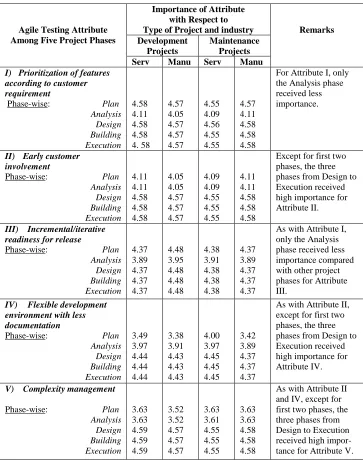
All the means of the feedback collected on the importance of each agile testing attribute in each project phase in both development and maintenance projects of the two major sectors of business (services and manufacturing) are listed in Table 2 for comparison.
International Journal of Business and Information Table 2
Comparison of Means of Feedback on Importance of Each Agile Testing Attribute Phase-Wise and Industry-Wise for Development and Maintenance Projects
Agile Testing Attribute Among Five Project Phases
Importance of Attribute with Respect to
Type of Project and industry Remarks
Development Projects
Maintenance Projects
Serv Manu Serv Manu
I) Prioritization of features according to customer requirement
Phase-wise: Plan Analysis Design Building Execution 4.58 4.11 4.58 4.58 4. 58 4.57 4.05 4.57 4.57 4.57 4.55 4.09 4.56 4.55 4.55 4.57 4.11 4.58 4.58 4.58
For Attribute I, only the Analysis phase received less importance.
II) Early customer involvement
Phase-wise: Plan Analysis Design Building Execution 4.11 4.11 4.58 4.58 4.58 4.05 4.05 4.57 4.57 4.57 4.09 4.09 4.55 4.55 4.55 4.11 4.11 4.58 4.58 4.58
Except for first two phases, the three phases from Design to Execution received high importance for Attribute II. III) Incremental/iterative
readiness for release
Phase-wise: Plan Analysis Design Building Execution 4.37 3.89 4.37 4.37 4.37 4.48 3.95 4.48 4.48 4.48 4.38 3.91 4.38 4.38 4.38 4.37 3.89 4.37 4.37 4.37
As with Attribute I, only the Analysis phase received less importance compared with other project phases for Attribute III.
IV) Flexible development environment with less documentation
Phase-wise: Plan Analysis Design Building Execution 3.49 3.97 4.44 4.44 4.44 3.38 3.91 4.43 4.43 4.43 4.00 3.97 4.45 4.45 4.45 3.42 3.89 4.37 4.37 4.37
As with Attribute II, except for first two phases, the three phases from Design to Execution received high importance for Attribute IV. V) Complexity management
Phase-wise: Plan Analysis Design Building Execution 3.63 3.63 4.59 4.59 4.59 3.52 3.52 4.57 4.57 4.57 3.63 3.61 4.55 4.55 4.55 3.63 3.63 4.58 4.58 4.58
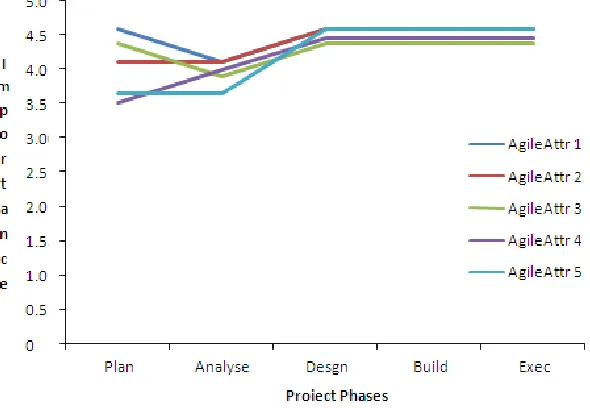
Figure 1. Importance of Agile Testing Attributes In Development Projects of Service Industry
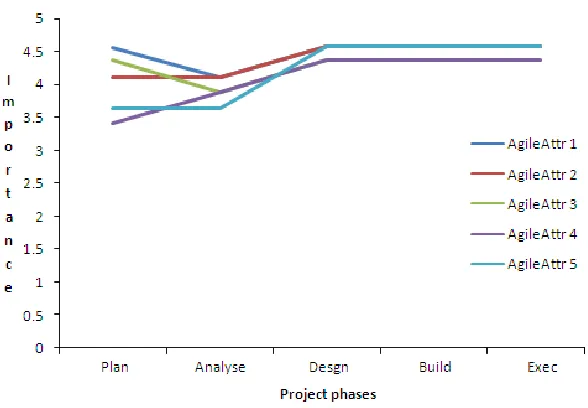
International Journal of Business and Information Figure 3. Importance of Agile Testing Attributes
In Maintenance Projects of the Services Industry
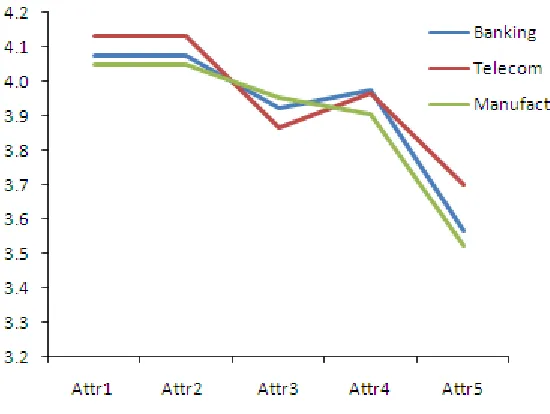
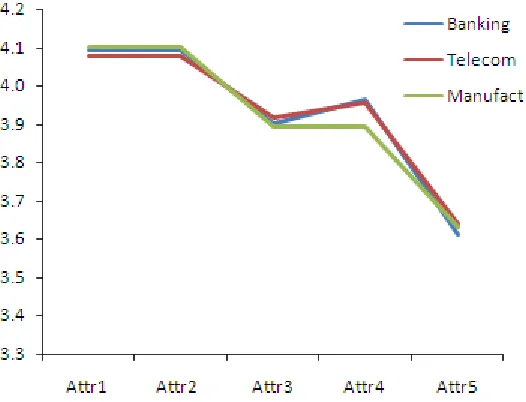
Two agile testing attributes (I: prioritization of features, and II: incremental/iterative readiness for release) acquired relatively high importance in all of the project phases, except analysis. The other three attributes were perceived as highly important in only three phases – design, building and execution. From the results, especially from the four graphs in Figures 1 through 4, it is evident that all of the five selected agile testing attributes differed from each other significantly only in the first two project phases (plan and analysis), whereas, in the remaining three project phases (design, building, and execution), they acquired high importance and continued as such uniformly.
4.3. Comparison of Importance of Agile Testing Attributes
This comparison of the importance of agile testing attributes pertains to the plan and analysis phases in three industries: banking, telecom, and manufacturing. In view of the earlier result that all five agile testing attributes differed significantly in the first two project phases (plan and analysis), this part of the study focused on those two phases.
For a clear understanding of the way the importance of all five agile attributes has been perceived by the project people in these two phases, industry-wise, the service sector was bifurcated into two sectors (banking and telecom), as surveyed separately, instead of integrating them under one sector as was done in the first part of study.
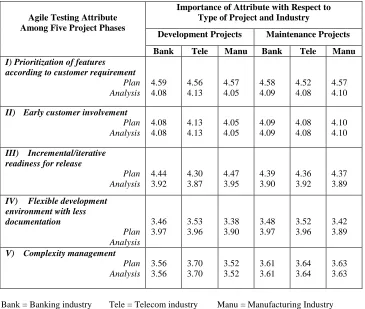
With this modification, three industrial sectors (banking, telecom, and manufacturing) were used to elaborate the comparative study of agile attributes in the plan and analysis phases. This part of the study examined the variation of all five attributes in each of the two phases, industry-wise and projects-wise (development and maintenance). Accordingly, the collected data was segregated to derive the means of importance accumulated by each of the five attributes in both phases with respect to both development and maintenance projects in the three industries. Table 3 provides the comparison of means.
International Journal of Business and Information Hence, in the plan phase, according to Attribute I (customer requirement), the necessary features of the product/service should be thoroughly checked and prioritized for incorporation in the final output. The project team should address the issue of incremental and iterative readiness of releases as per the prioritized features. The analysis phase should create a flexible development environment with less documentation. Both phases should strive to involve customers in the early stages so as to avoid frequent change requests. They should also contribute to managing complexity in the development and maintenance of the product or service.
Table 3
Comparison of Importance of Agile Testing Attributes Project-Wise and industry-Wise for Both the Plan and Analysis Phases
Agile Testing Attribute Among Five Project Phases
Importance of Attribute with Respect to Type of Project and Industry
Development Projects Maintenance Projects
Bank Tele Manu Bank Tele Manu
I) I) Prioritization of features according to customer requirement
Plan Analysis 4.59 4.08 4.56 4.13 4.57 4.05 4.58 4.09 4.52 4.08 4.57 4.10 II) Early customer involvement
Plan Analysis 4.08 4.08 4.13 4.13 4.05 4.05 4.09 4.09 4.08 4.08 4.10 4.10 III) Incremental/iterative
readiness for release
Plan Analysis 4.44 3.92 4.30 3.87 4.47 3.95 4.39 3.90 4.36 3.92 4.37 3.89 IV) Flexible development
environment with less documentation Plan Analysis 3.46 3.97 3.53 3.96 3.38 3.90 3.48 3.97 3.52 3.96 3.42 3.89 V) Complexity management
Plan Analysis 3.56 3.56 3.70 3.70 3.52 3.52 3.61 3.61 3.64 3.64 3.63 3.63
Figure 5. Industry-Wise Importance of Agile Test Attributes For the Plan Phase of Development Projects
International Journal of Business and Information Figure 7. Industry-Wise Importance of Agile Test Attributes
For the Plan Phase of Maintenance Projects
The preceding results indicate that the importance of agile testing attributes vary significantly, depending on the functions and requirements of each phase of an IT project related to different industries. To achieve higher customer satisfaction, the attributes need more focus, fulfillment, and implementation at each stage of the project. In this study, the variation among attributes was found to be very high in the plan and analysis phases of projects. Hence, all the attributes should be thoroughly addressed during those two initial project phases by taking into account the significant variations among their importance.
5.
IMPLICATIONS AND CONCLUSIONS
To meet the requirements and demands of customers in a timely manner with products or services of quality, the whole business world is aggressively moving toward agile models of development. This paper makes some important practical contributions to the emerging field of agile testing attributes of IT projects. By virtue of its nature, scope, and results, this study would be very useful to project developers and developing organizations.
When the development of a product or service is agile, its testing at every stage should also be agile. In such an agile environment, both developers and testers should strive for project success through strong skills and coordination. In addition to the development factors, they should have a good knowledge about the important testing factors to be addressed at each stage.
This study sought to identify major agile testing attributes and to investigate their role and importance at different stages of a project in different industries. The results would definitely help project team members, managers, and organizations to understand the significance of agile testing attributes for achieving high customer satisfaction of projects. This is because, all the results are derived from the interactions with and feedback collected from the project people, users, and senior management.
International Journal of Business and Information attributes may also increase. The present work focused only on the project objective of achieving higher customer satisfaction. For the success of a project, in addition to the objective of achieving customer satisfaction there will be several criteria, on which vast research has been done and is going on. Hence the future research is also aimed to identify additional agile testing attributes along with the additional objectives to be achieved through fulfillment of those attributes. Once such exhaustive list of research items is prepared, survey instrument and measurement scales can be developed to collect useful data and information. From analysis of data with the help of appropriate statistical tools, valuable results and insights can be derived for the benefit of project people, senior management, organizations and even the customers.
REFERENCES
Alleman, G. 2005. Agile program management: Moving from principles to practice, Agile Product & Project Management 6(9), Cutter Consortium, September.
Anderson, D.J., and E. Schragenheim. 2003. Agile Management for Software Engineering: Applying the Theory of Constraints for Business Results, New Jersey, USA: Prentice Hall.
Beck, K. 2000. Extreme Programming Explained, Boston, MA: Addison Wesley. Chakravorty, T.; S. Chakraborty; and N. Jigeesh. 2014. Analysis of agile testing
attributes for faster time to market: Context of manufacturing sector related IT projects, Procedia Economics and Finance 11, 536–552.
Chow, T., and D.B. Cao. 2008. A survey study of critical success factors in agile software projects, Journal of Systems and Software 81(6), 961-971.
Conboy, K. 2009. Agility from first principles: Reconstructing the concept of agility in information systems development, Information Systems Research 20, 329–354. Coram, M., and S. Bohner. 2005. The impact of agile methods on software project
management, In Proceedings of the 12th IEEE International Conference and Workshops on the Engineering of Computer-Based Systems (ECBS), April, 363-370.
Dyba, T., and T. Dingsøyr. 2008. Empirical studies of agile software development: A systematic review, Information and Software Technology 50, 833-859.
Hametner, R.; D. Winkler; and A. Zoitl. 2012. Agile testing concepts based on keyword-driven testing for industrial automation systems, IECON 2012 – 38th Annual Conference on IEEE Industrial Electronics Society 25-28 October, Montreal, QC, 3727 – 3732.
Highsmith, J. 2002. Agile software development ecosystems, Boston, MA: Addison Wesley.
Madhu, B.K.; M. Jigalur; and V. Lokesha. 2010. A study on agile software testing: Emergence and techniques, African Journal of Mathematics and Computer Science Research 3(11), 288-289.
Misra, S.C., and V. Singh. 2015. Conceptualizing open agile software development life cycle (OASDLC) model, International Journal of Quality and Reliability Management 32(3) (in Press).
Misra, S.C.; V. Kumar; and U. Kumar. 2009. Identifying some important success factors in adopting agile software development practices, Journal of System Software 82, 1869-1890.
Qumer, A., and B. Henderson-Sellers. 2008. An evaluation of the degree of agility in six agile methods and its applicability for method engineering, Information and Software Technology 50(4), 280–295.
Racheva, Z.; M. Daneva; A. Herrmann; K. Sikkell; and R.J. Wieringa. (2010. Do we know enough about requirements prioritization in agile projects: Insights from a case study, In: 18th International IEEE Requirements Engineering Conference, 27 September - 01 October, Sydney. IEEE Computer Society, 147-156.
Roosmalen, R.V. 2012. Ten tips for agile testing, downloadable from website http://www.logigear.com/magazine/agile/2132/
Talby, D.; A. Keren; O. Hazzan; and Y. Dubinsky. 2006. Agile software testing in a large-scale project, Software, IEEE 23(4), 30-37.
Vlietland, J., and H.V. Vliet. 2015. Towards a governance framework for chains of Scrum teams, Information and Software Technology 57, 52-65.
Williams, L. 2010. Agile software development methodologies and practices, Advances in Computers 80, 1-44.
International Journal of Business and Information ABOUT THE AUTHORS
Nasina Jigeesh, Ph.D. (physics and management science), is professor and head of the Department of Operations & Systems at IFHE University, India. He has more than 25 years of experience in industry and academia. He has been involved in several public and private IT projects from inception to implementation. He supervises Ph.D. students in the areas of project management, knowledge management, supply chain management, and customer relationship management. He has published articles in national and international journals.
Samyadip Chakraborty is a doctoral researcher pursuing his Ph.D. in Operations & Systems, IFHE University, Hyderabad, India. He received his MBA from the University of Liverpool. He has been a visiting doctoral scholar at the University of Toledo, College of Business and Innovation, Toledo, Ohio. His areas of interest and research include IT, healthcare operations, and supply chain management. He has published articles in national and international journals and has presented papers at both national and international conferences.