Andrey Korotayev
(Eurasian Center for Big History & System Forecasting, Institute of Oriental Studies, Russian Academy of Sciences, National Research University Higher School of Economics, Faculty of Global Studies of the Lomonosov Moscow State University)Abstract: The idea that in the near future we should expect “the Singularity” has become quite popular recently, primarily thanks to the activities of Google technical director in the field of machine training Raymond Kurzweil and his book The Singularity Is Near (2005). It is shown that the mathematical analysis of the series of events (described by Kurzweil in his famous book), which starts with the emergence of our Galaxy and ends with the decoding of the DNA code, is indeed ideally described by an extremely simple mathematical function (not known to Kurzweil himself) with a singularity in the region of 2029. It is also shown that, a similar time series (beginning with the onset of life on Earth and ending with the information revolution – composed by the Russian physicist Alexander Panov completely independently of Kurzweil) is also practically perfectly described by a mathematical function (very similar to the above and not used by Panov) with a singularity in the region of 2027. It is shown that this function is also extremely similar to the equation discovered in 1960 by Heinz von Foerster and published in his famous article in the journal “Science” – this function almost perfectly describes the dynamics of the world population and is characterized by a mathematical singularity in the region of 2027. All this indicates the existence of sufficiently rigorous global macroevolutionary regularities (describing the evolution of complexity on our planet for a few billion of years), which can be surprisingly accurately described by extremely simple mathematical functions. At the same time it is demonstrated that in the region of the singularity point there is no reason, after Kurzweil, to expect an unprecedented (many orders of magnitude) acceleration of the rates of technological development. There are more grounds for interpreting this point as an indication of an inflection point, after which the pace of global evolution will begin to slow down systematically in the long term.
Correspondence | Andrey Korotayev, [email protected]
Citation | Korotayev, Andrey (2018) The 21st Century Singularity and its Big History Implications: A re-analysis . Journal of Big History, II(3); 73 - 119.
DOI | http://dx.doi.org/10.22339/jbh.v2i3.2320
1 This research has been supported by the Russian Foundation for Basic Research [Project # 17-06-00476]. Introduction
The issue of the Global History singularity (or even the Big History singularity) is being discussed rather actively nowadays (see, e.g., Eden et al. 2012; Shanahan 2015; Callaghan 2017; Nazaretyan 2015a, 2016, 2017, 2018). This subject has been made especially popular by Raymond Kurzweil, Google technical director in the field of machine training, first of all with his book The Singularity Is Near (2005), but also with such activities as the establishment of the Singularity University (2009) and so on. To the
History threshold.
Kurzweil – Modis Time Series and Mathematical Singularity
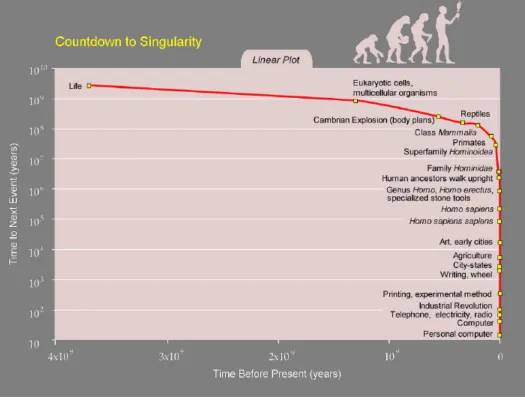
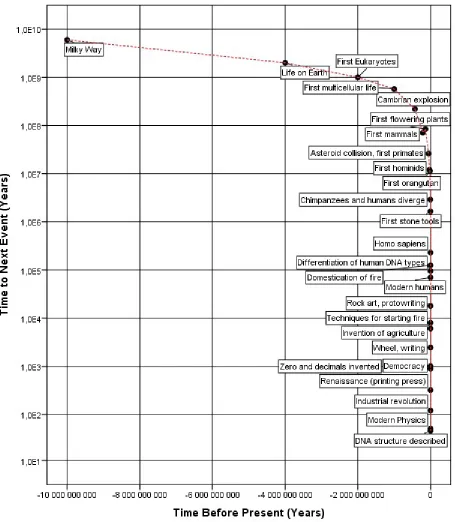
Raymond Kurzweil was one of the first to arrange the major evolutionary shifts of a very significant part of the Big History along the hyperbolic curve that can be described by an equation with a mathematical singularity. For example, at page 18 of his bestseller The Singularity is Near (2006) he reproduces the following figure (see Fig. 1)2.
However, rather surprisingly, Kurzweil does not appear to have recognized that the curve represented at this figure is hyperbolic, and that it is described by a an equation possessing a true mathematical singularity (what is more the value of this singularity, 2029, is not so far from the one professed by Kurzweil himself). This appears to be explained first of all by some mathematical inaccuracies of the Google technical director (suffice to mention that he consistently calls the global evolution acceleration pattern “exponential” without paying attention to the point that the exponential function does not have any singularity).
Against this background, it appears a bit surprising that Kurzweil himself does know about the notion of mathematical singularity and describes it more or less accurately. Indeed, at pages 22–23 of his bestseller he provides a fairly accurate description of the concept of “mathematical singularity”:
“To put the concept of Singularity into further perspective, let’s explore the history of the word itself. ‘Singularity’ is an English word meaning a unique event with, well, singular implications. The word was adopted by mathematicians to denote a value that transcends any finite limitation, such as the explosion of magnitude that
2 Actually, a protype of this figure (but in a double logarithmic scale) was reproduced by Kurzweil already in 2001 in his essay “The Law of Accelerating Returns” at page 5.
results when dividing a constant by a number that gets closer and closer to zero. Such a mathematical function never actually achieves an infinite value, since dividing by zero is mathematically ‘undefined’ (impossible to calculate). But the value of y exceeds any possible finite limit (approaches infinity) as the divisor x approaches zero” (p. 22–23).
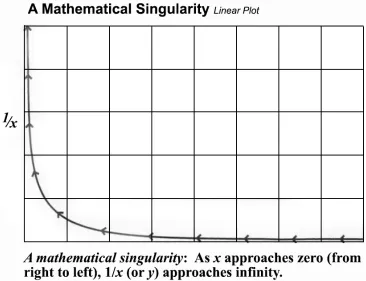
What is more, he supplies his description of the concept of “mathematical singularity” at page 23 with a rather appropriate illustrating diagram (see Fig. 2).
However, having provided his fairly adequate description of the “mathematical singularity” concept, Kurzweil appears to be loosing any interest in this concept – suddenly switching to the use of the term “singularity” by astrophysicists (p. 23).
One of the most enigmatic things in Kurzweil’s book is that he manages not to notice that the shape of the hyperbolic curve at his figure “A mathematical singularity” (page 23 of Kurzweil’s book, see Fig. 2 on page 74) is fundamentally identical (though, of course, rotated 180 degrees) with the one of the curve of his figure “Countdown to Singularity” (page 18 of the same book, see Fig. 1 on page 73). What is more, as we will see below, the mathematical model providing the best-fit approximation of the curve of the type seen in Fig. 1 is basically identical with the hyperbolic function displayed in Fig. 2, that is y = k/x. Thus, if Kurzweil had done a basic mathematical analysis of the time series in his Fig. 1, he would have found that it is best described by a mathematical equation of the type he features in his Fig. 2 (with such a really slight difference that we would have “2” rather than “1” in the equation’s numerator3). What is more, he would have discovered that the mathematical singularity of the best-fit equation describing Kurzweil’s “Countdown to Singularity” curve is 2029, which is not so much different from 2045, suggested by him
in his book, and that is simply identical with the date proposed by Kurzweil most recently (Ranj 2016)4.
4 To be more exact, this is the date, when according to the most recent Kurzweil forecast, the humans will become immortal, which still can well be considered as a sort of singularity (as well as a rather valid candidate for the possible dating for Threshold 9 of the Big History) – even if we actually deal with the radical increase in the human (or posthuman?) life expectancy rather than with the immortality per se, as this would still imply the change of
Panov’s transformation
Another amazing thing is that what was not done by Kurzweil in 2005, was done in 2003 by Alexander Panov5. Panov analyzed an essentilly similar time the biological nature of the humans, which cannot but affect the course of the human history in a rather dramatic way. 5 His calculations described below were first presented in November 2003 at the Academic Seminar of the State Astronomic Institute in Moscow (Nazaretyan 2005: 69) Fig. 1. “Countdown to Singularity” according to Raymond Kurzweil
series taken from entirely different sources but arrived at very similar conclusions, but in a much more advanced form. It is very important that he made a step (to which Kurzweil was very close but which he did not make actually) that allowed him to make the analysis of the time series in question much more transparent and to identify the singularity date in a rigorous way.
In his 2005 book Kurweil plotted at the Y-axis of his diagrams “time to next event”, which hindered for him their interpretation in a rather significant way. In his 2001 essay at page 5 while analyzing a diagram with a similar time series (whose source, incidentally, was not indicated), Kurzweil began speaking about the acceleration of “paradigm shift rate” (Kurzweil 2001: 5), but (as is rather typical for the Google Chief and subsequently published in his articles (Panov 2004, 2005a, 2005b, 2006, 2011, 2017) and monograph (Panov 2008).
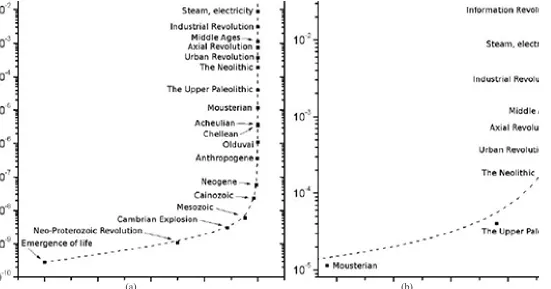
Engineer) almost immediately switched to another theme. However, what was necessary to make his diagrams much more intelligible was to plot at Y-axis not “Time to Next Event”, but just “Paradigm Shift Rate” – just as was done by Panov. Indeed, to transform the time to next paradigm shift into paradigm shift rate one needed to do a rather simple thing – to take one year and to devide it by time to next paradigm shift; this will yield number of paradigm shifts per year, that is just a “Paradigm Shift Rate”. As we have already said, this was not done by Kurzweil but was done by Panov who obtained the following graphs as a result (see Fig. 3).
At Figure 3 the right-hand diagrame (3) depicts the acceleration of the global macroevolution rate starting from 4 billion BP, whereas the left-hand diagram (3b) describes this for the human part of the Big History6. Note immediately that Panov’s curve 3a is a mirror image of Kurzweil’s “Countdown to Singularity” graph (see Fig. 4).
However, the mathematical interpretation of Panov’s graph is much easier and more straightforward. Note that Panov himself denoted the variable plotted at Y-axis as “Frequency of the phase transitions per
6 Note that the left-hand diagram was only presented by Panov at the Academic Seminar of the State Astronomic Institute in November 2003, whereas in his printed works he only reproduces the right-hand diagram, using another visualization of the global macrodevelopment acceleration for the whole of the global history since 4 billion BP. On the other hand, the left-hand diagram was reproduced in print by Akop Nazaretyan (2015a: 357; 2018: 31) with reference to Panov.
year”. However, it is quite clear that Panov’s “phase transition” is a synonym of Kurzweil’s “paradigm shift”, whereas “frequency of the phase transitions per year” describes just “paradigm shift rate”, or global evolutionary macrodevelopment rate. This transformation makes it much easier to detect rigorously the pattern of acceleration of the global macrodevelopment rate.
Modis – Kurzweil time series: a mathematical analysis
Below we will perform a mathematical analysis of Kurzweil’s time series along the lines suggested by Panov (though with some modifications of ours).
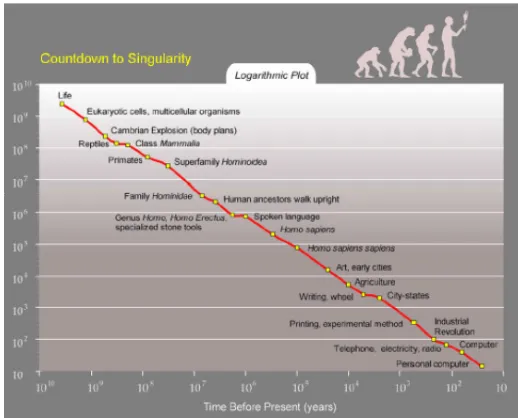
In addition to Kurzweil’s “Countdown to Singularity” graph in single logarithmic scale presented above at Fig. 1, Kurzweil publishes two other versions of this
graph in double logarithmic scale (see Figs. 5 and 6).
Though the time series presented in Fig. 5 looks for me a bit more convincing than the one presented in Fig. 6, I have decided to analyze the time series in Fig. 6 due to the following reason. The point is that the source of data for Fig. 5 remains entirely obscure; hence, I do not see any way to reconstruct the respective time series in such a detail that is necessary for its formal mathematical analysis. There are no such problems with the source of data for Fig. 6, as Kurzweil indicates it very clearly. This is a paper by Theodore Modis “The Limits of Complexity and Change” (2003) prepared in its turn on the basis of his earlier article published in the Technological Forecasting and Social Change (2002). Fortunately, Modis provides all the necessary dates in his articles, which makes it perfectly possible to analyze this time series mathematically.
Fig. 3. The dynamics of the global macrodevelopment rate according to Panov (source: Nazaretyan 2018: 31, Fig. 3).
We will start our analysis with the abovementioned transformation, i.e. replace “time to next event” with “paradigm shift rate” ~ “phase transition rate” ~ “macrodevelopment rate”. The result looks as follows
(see Fig. 7):7
Applying the same technique (“Countdown to 7 See Fig. 6 above.
Fig. 5. The first log-log version of Kurzweil’s “Countdown to Singularity” graph
Source: Kurzweil 2005: 17.
Fig. 6. The second log-log version of Kurzweil’s “Countdown to Singularity” graph (= “Canonical Milestones”) Source: Kurzweil 2005: 20.
Singularity”) as the one used by Kurweil for Fig. 1, we
would obtain for this time series the following graph (see Fig. 8): 8
At figure 9 we can see that one figure is an exact mirror image of the other (see Fig. 9):
(b)
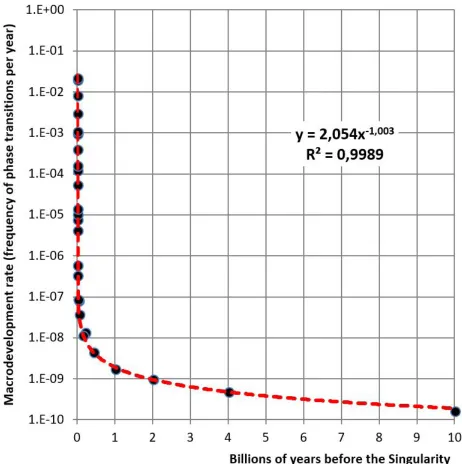
It can be clearly seen that the curve in Fig. 7 (= Fig. 9a) is virtually the same as the hyperbolic one in Fig. 2 representing the mathematical singularity. At the next step let the X-axis represent the time before the singularity (whereas the Y-axis will represent the macrodevelopment rate) – and calculate the singularity
date by getting such a hyperbolic curve that would describe our time series in the most accurate way. The results of this analysis are presented in Fig. 10 (as has been mentioned above, our mathematical analysis has identified the Singularity date for this time series as 2029 CE).
Below the same figure is presented in the double logarithmic scale (see Fig. 11).
Fig. 11. Scatterplot of the phase transition points from the Modis – Kurzweil list with the fitted power-law regression line (double logarithmic scale) – for the Singularity date identified as 2029 CE with the least squares method.
Let us now analyze the results. As we see, Kurzweil time series is described precisely with a mathematical function of a type y = k/x having an explicite mathematical singularity that was decribed by Kurzweil at pages 22–23 of his book – surprisingly without understing of its relevance for the mathematical
,
(1) where y is the global macrodevelopment rate, x is the time remaing till the singularity, and 2.054 and 1.003 are constants.Note that the denominator’s exponent (1.003) turns out to be only negligibly different from 1 (well within the error margins); hence, there are all grounds to use this equation in the following simplified form:
, (2)
where y is the global macrodevelopment rate, x is the
time remaing before the Singularity, and 2.054 is a constant.
Thus we find out that the Kurweil data series is the best described mathematically just by a simple hyperbolic function of that very type that he presents at pages 22– 23, with the only difference that it has 2 (rather than 1) in the numerator.9
Exponential and hyperbolic patterns of global acceleration: a comparison
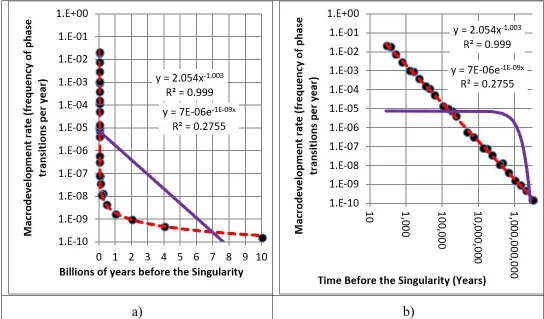
Let us stress again that the mathematical analysis demonstrates rather rigorously that the development acceleration pattern within Kurzweil’s series is
9 Or, to be exact, 2.054.
NOT exponential (as is claimed by Kurzweil), but hyperexponential, or, to be more exact, hyperbolic (see Fig. 12).
Let us recollect that, with a logarithmic scale for the Y-axis, an exponential curve looks like a straight line (whereas a hyperbolic line looks like an exponential curve). On the other hand, in double logarithmic scale the hyperbolic curve looks like a straight line, whereas the exponential curve looks like an inversed exponential line. Thus, Fig. 12 demonstrates how wrong Kurzweil is when he claims that the megaevoluton has followed the exponential acceleration pattern, indicating that this pattern was not exponential but hyperbolic.
Formula of acceleration of the global
macroevolutionary development in the Modis – Kurzweil time series
To make the model more transparent, it makes sence to make a small transformation of Eq. (2). Let us recollect that this is a slightly simplified version of Eq. (1) that was used to generate the hyperbolic curves at Fig. 12 above, and it looks as follows:
, (2)
where y is the global macrodevelopment rate, x is the time remaing before the singularity, and 2.054 is a constant.
Of course, x (the time remaining till the singularity) at the monment of time t equals t* – t, where t* is the time of singularity. Thus,
х = t* - t.
Hence, Eq. (2) can be re-written in the following way:
, (3)
where yt is the global macrodevelopment rate at time t, t* is the time of singularity, and 2.054 is a constant. Finally, let us recollect that our least squares analysis of the transformed Modis – Kurzweil series has identified the singularity date as 2029 CE. Thus, Eq. (3) can be further re-written in the following way:
. (4)
Of course, in a more general form it should be written as follows:
, (5)
where C and t* are constants.
Equation (4) generates curves that demonstrate an extremely accurate fit with empirical estimates and that are presented in fugures 13–15 below.
The curve generated by this extremely simple equation describes in an unusually accurate way the planetary macroevolution acceleration pattern at the scale of billions of years (see Fig. 13).
However, if we “zoom in” Fig. 13 to see in more detail the recent two billions of years, we will see that Eq. (4), notwithstanding its extreme simplicity, turns out to be as capable to describe rather accurately the planetary macroevolution acceleration pattern (see Fig. 14).
If we zoom in further – to see in some detail the global macroevelutionary development acceleration during the last hundreds of thousands of years of Big History (corresponding to the pre-history and history of the humankind) we will see a similarly astonishingly close fit between the curve generated by model (4) and the empirical estimates of the global macroevolution rate (see Fig. 15).
Finally, if we concentrate on the last millennia of the “human history” phase of the Big History, we will see that the same equation describes them as accurately (see Fig. 16).
As we see, a very simple hyperbolic equation yt = 2.054/(2029 – t) describes the general pattern of the macrodevelopment rate acceleration observed up until recently in an extremely accurate way for all the main eras.
In fact, Model (4) has a rather straightforward “physical sense”. Indeed, let us calculate the macroevolution rate around 200 years before the “Singularity” (that is around 1829) using this equation in a further simplified form (yt = 2/(2029 – t)): y1829 = 2/(2029 – 1829) = 2/200 =
and the evolution proceeded at that time at the scale of millennia. On the other hand, around 18 000 BCE we would find that planetary macroevolution occurred at the scale of tens of thousands of years, around 200 000 years before present (BP) – at the scale of hundreds thousands of years (around one global phase transition per 100 thousand years), around 2 million BP – at the scale of millions of years, around 20 million BP – at the scale of tens of millions of years, around 200 million BP – at the scale of hundreds of
such an acceleration pattern makes a perfect sense.
Note that algebraic equation of the type
, (5)
can be regarded as solution of the following differential equation:
, (6)
(see, e.g., Korotayev, Malkov, Khaltourina 2006a: 118–120).
Thus, the acceleration pattern implied by Eq. (4) can be spelled out as follows:
. (7)
with model (4) / (5) can be spelled out as follows: “the increase in macroevolutionary development rate a times is accompanied by a2 increase in the acceleration speed of this development rate; thus, a twofold increase in macroevolutionary development rate tends to be accompanied by a fourfold increase in the acceleration speed of this development rate; an increase in macroevolutionary development rate 10 times tended to accompanied by 100 times increase in the acceleration speed of this development rate; and
so on…”.
Now, let us apply a similar methodology to analyze mathematically the series of global macroevolutionary “phase transition”/ “biospheric revolutions” compiled by Alexander Panov (2005a, 2005b; see also Panov 2008, 2011, 2017)
However, before we do this I would like to analyze a few points.
Time series of Panov and Modis – Kurzweil: an external comparative analysis
Alexander Panov and Theodore Modis compiled their time series entirely independently of each other. As suggest my personal communications with both Panov and Modis, none of them knew that at almost the same time10 in another part of Europe another person compiled a similar time series (Alexander Panov worked in Moscow, whereas Theodore Modis worked in Geneva). As we will see below, they relied on entirely different sources and the resultant time series turned out to be very far from being identical. Indeed the Modis time series (2003) standing behind Kurzweil’s “Canonical Milestones” graph (Kurzweil 2005: 20) looks as follows – we reproduce below this time series as it was published in Modis’ essay in the Futurist (2003), as it is this version of Modis’ series that is reproduced by Kurzweil and that has been analyzed mathematically above; however, we sometimes use fuller versions of the description of some Modis “milestones” from his 2002 article in the Technological Forecasting & Social Change:
(1) Origin of Milky Way, first stars – 10 billion years ago.11
(2) Origin of life on Earth, formation of the solar system and the Earth, oldest rocks – 4 billion years ago.
(3) First eukaryotes, invention of sex (by microorganisms), atmospheric oxygen, oldest photosynthetic plants, plate tectonics established – 2 billion years ago.
10 Modis first presented his results in an article in Technological Forecasting and Social Change (that Panov only read in March 2018 after it was sent to him by me) in 2002, whereas Panov first presented his results next year at the Academic Seminar of the State Astronomic Institute in Moscow.
11 Actually, Modis starts with the “Big Bang”; however, Kurzweil, quite reasonably, prefers to start with the origins of the Milky Way.
(4) First multicelluar life (sponges, seaweeds, protozoans) – 1 billion years ago.
(5) Cambrian explosion/invertebrates/ vertebrates, plants colonize land, first trees, reptiles, insects, amphibians – 430 million years ago.
(6) First mammals, first birds, first dinosaurs – 210 million years ago.
(7) First flowering plants, oldest angiosperm fossil – 139 million years ago.
(8) First primates/asteroid collision/mass extinction (including dinosaurs) – 54.6 million years ago.
(9) First hominids, first humanoids – 28.5 million years ago.
(10) First orangutan, origin of proconsul – 16.5 million years ago.
(11) Chimpanzees and humans diverge, earliest hominid bipedalism – 5.1 million years ago.
(12) First stone tools, first humans, Homo erectus – 2.2 million years ago.
(13) Emergence of Homo sapiens – 555,000 years ago.
(14) Domestication of fire/ Homo heidelbergensis – 325,000 years ago.
(15) Differentiation of human DNA types – 200,000 years ago.
(16) Emergence of ‘‘modern humans’’/ earliest burial of the dead – 105,700 years ago.
(17) Rock art/ptotowriting – 35,800 years ago.
(18) Techniques for starting fire – 19,200 years ago.
(19) Invention of agriculture – 11,000 years ago12.
(20) Discovery of the wheel/writing/ archaic empires/large civilizations/Egypt/ Mesopotamia – 4,907 years ago
(21) Democracy/city states/Greeks/Buddha [≈ Axial Age] – 2,437 years ago.
(22) Zero and decimals invented, Rome falls, Moslem conquest – 1,440 years ago.
(23) Renaissance (printing press)/discovery of New World/the scientific method – 539 years ago
(24) Industrial revolution (steam engine)/ political revolutions (French, USA) – 225 years ago.
(25) Modern physics/radio/electricity/ automobile/airplane – 100 years ago.
(26) DNA structure described/transistor invented/nuclear energy/WWII/Cold War/ Sputnik – 50 years ago.
(27) Internet/human genome sequenced – 5 years ago.
* Note that Modis himself maintains rather explicitely that “present time is taken as year 2000” (Modis 2003: 31). Indeed, this makes good sense for “milestones” (24)–(27) above. However, there are some indications that Modis compiled first versions of his milestone list a few years before 2000, and appears not to have adjusted a few datings to the 2000 present point in his 2003 publication. Otherwise it is difficult to understand his datings of milstones (20), (21), and (23).
Modis (2002: 393–401) indicates the following list of sources he consulted to compile the time series above: Barrow, Silk 1980; Burenhult 1993; Heidmann 1989; Johanson, Edgar 1996; Sagan 1989; Schopf 1991; to this Modis also adds “Timeline of the Universe” (American Museum of Natural History, Central Park West at 79th Street, New York), Encyclopedia Britannica13, “the web site of the Educational Resources in Astronomy and
13 Without providing any exect references.
Planetary Science (ERAPS), University of Arizona”14, “Private communication, Paul D. Boyer, Biochemist. Nobel Prize 1997. Dec 27, 2000”, “a timeline for major events in the history of life on earth as given by David R. Nelson, Department of Biochemistry at the University of Memphis, Tennessee” (http://drnelson. utmem.edu/evolution2.html)
Panov relied on entirely different sources15 (see Table 1). As we see, there was not a single source consulted by both Modis (2002, 2003) and Panov (2005a) when they compiled their series of “canonical milestones / biospheric revolutions.” Their reference lists are 100% different. What is more, they mostly relied on sources belonging to different scientific traditions.
Indeed, Modis relied exclusively on the works of Western scientists published in English.16 In a striking contrast with this, out of 30 references consulted by Panov (2005a), 18 are works of Russian scientists published in Russia; 9 are works of Western scientists
14 Without providing its URL.
15 At least when preparing his first list of “phase transitions/biospheric revolutions” in Russian (Panov 2004, 2005a). Note that when preparing the publication of his results in English Panov (2005b) added to his originally overwhelmingly Russian bibliography 8 references in English (Begun 2003; Carrol 1988; Jones 1994; Nazaretian 2003; A.H. 1975; A.P. 1975; J.B.W. 1975; T.K. 1975) and 1 reference in German (Jaspers 1955). One cannot exclude that this might have affected some of Panov’s datings of some of his “biospheric revolutions” (there are indeed some slight difference in datings between Panov 2005a and Panov 2005b). Note that these new references included four articles in Encyclopedia Britanica, which made the list of sources in Panov 2005b not as perfectly different for Modis’ list as the list of sources in Panov 2005a (because Modis also lists Encyclopedia Britanica among his list of sources). So for the sake of “the purity of experiment” we decided to rely for our calculations on Panov’s list of “phase transitions” provided in his original publication of his results in Russian (2005a) rather than in English (2005b).
translated into Russian; and just 3 references are original works of Western scientists in English.
Against this background, it is hardly surprising that Panov’s list of phase transitions (2005a: 124–127; 2005b: 221) has turned out to be very far from identical with the one of Modis17:
17 The description of Panov’s phase transitions/ “biospheric revolutions” have been taken from 2005 Panov’s presentation of his findings in English (Panov 2005b: 221); however, the datings of those phase transitions are from the earlier Russian version (Panov 2005a); I indicate explicitely the difference between those datings when it is observed. Note that for our calculation below we have used the datings from Panov 2005a
“0. The origin of life – 4 · 109 years ago. The biosphere
after its appearance was represented by nucleusless
procaryotes and existed the first 2–2.5 billion years
without any great shocks.
1. Neoproterozoic revolution (Oxygen crisis) – 1.5 · 109 years ago. Cyanobacteria had enriched the
atmosphere by oxygen that was a strong poison for anaerobic procaryotes. Anaerobic procaryotes
(not Panov 2005b). In cases when Panov 2005a indicated time ranges rather than exact time points, we have used middle values for our calculations – for example, Panov (2005a) indicates as the date of his “biospheric revolution 5” (“Hominoid revolution/ The beginning of the Neogene period”) 25–20 • 106 years ago,
whereas for our calculations we use the intermediate value for this time range (22.5 • 106 years ago).
Table 1. Comparison of sources used by Modis (2002, 2003) and Panov (2005a) for the compilation of their lists of phase transitions / “biospheric revolutions” / “canonical milestones” / “evolutionary turning points” / “complexity jumps”
Sources consulted by Theodore Modis for the compilation of his phase transition list published in Modis 2002, 2003
Sources consulted by Alexander Panov for the compilation of his phase transition list published in Panov 2005a (1) Barrow, Silk 1980;
(2) Burenhult 1993; (3) Heidmann 1989; (4) Johanson, Edgar 1996;
(5) Sagan 1989; (6) Schopf 1991; to this Modis also adds
(7) “Timeline of the Universe” (American Museum of Natural History, Central Park West at 79th Street, New York),
(8) Encyclopedia Britannica,
(9) “the web site of the Educational Resources in Astronomy and Planetary Science (ERAPS), University of Arizona”, (10) “Private communication, Paul D. Boyer, Biochemist. Nobel Prize 1997. Dec 27, 2000”,
(11) “a timeline for major events in the history of life on earth as given by David R. Nelson, Department of Biochemistry at the University of Memphis, Tennessee” (http://drnelson.utmem.edu/evolution2. html)
Works by Russian scientists published in Russian: (1) Boriskovsky 1970, (2) Boriskovsky 1974a,
(3) Boriskovsky 1974b, (4) Boriskovsky 1978; (5) Diakonov 1994; (6) Fedonkin, 2003; (7) Galimov 2001; (8) Kapitza 1996b; (9) Keller 1975; (10) Lopatin 1983; (11) Muratov, Vahrameev 1974; (12) Nazaretian 2004; (13) Rozanov, 1986; (14) Rozanov 2003; (15) Rozanov, Zavarzin 1997; (16) Shantser 1973; (17) Zavarzin 2003; (18) Zaytsev 2001.
Works by Western scientists translated into Russian: (1) Antiseri, Reale 2001; (2) Begun 2004; (3) Carrol 1992, (4) Carrol 1993a, (5) Carrol 1993b; (6) Foley 1990; (7) Jaspers 1991; (8) Kring, Durda 2004; (9) Wong 2003.
Original publications of the works of Western scientists in English:
started to die out and anaerobic procaryote fauna was changed by an aerobic eucaryote and multicellular one.
2. Cambrian explosion (The beginning of Paleozoic era) –
590–510 · 106 years ago18. All the modern phyla of
metazoa (including vertebrates) appeared during a few of tens of million years. During the Paleozoic era the terra firma was populated by life.
3. Reptiles revolution (The beginning of Mesozoic era) –
235 · 106 years ago. Almost all paleozoic Amphibia
died out. Reptiles became the leader of the evolution
on the terra firma.
4. Mammalia revolution (The beginning of the Cenozoic
era) – 66· 106 years ago. Dinosaurs died out.
Mammalia animals became the leader of the
evolution on the terra firma.
5. Hominoid revolution (The beginning of the Neogene period) – 25–20 · 106 years ago19. A big evolution
explosion of Hominoidae (apes). There were 14
genera of hominoidae between 22 and 17 millions
years ago – much more than now. The flora and
fauna became contemporary.
6. The beginning of Quaternary period (Anthropogene)
– 4.4 · 106 years ago20. The first primitive Homo
genus (hominidae) separated from hominoidae. 7. Palaeolithic revolution – 2.0–1.6 · 106 years ago21. Homo
habilis, the first stone implements.
8. The beginning of Chelles period – 0.7–0.6 · 106 years
ago22. Fire, Homo erectus.
9. The beginning of Acheulean period – 0.4 · 106 years
ago. Standardized symmetric stone implements.
10. The culture revolution of neanderthaler (Mustier culture) – 150–100 · 103 years ago. Homo sapiens
neandertalensis. Fine stone implements, burial of deadmen (a sign of primitive religions).
11. The Upper Palaeolithic revolution – 40 · 103 years
ago. Homo sapiens sapiens became the leader of cultural evolution. Development of advanced hunter instruments – spears, snares. Imitative art is widespread.
18 570 · 106 years ago according to Panov 2005b.
19 24· 106 years ago according to Panov 2005b.
20 4–5 · 106 years ago according to Panov 2005b.
21 2–1.5 · 106 years ago according to Panov 2005b.
22 0.7 • 106 years ago according to Panov 2005b.
12. Neolithic revolution – 12–9 · 103 years ago. Appropriative economy [foraging] had been replaced by productive economy [food production].
13. Urban revolution (the beginning of the Ancient world) – 4000–3000 B.C. Appearance of state formations,
written language and the first legal documents. 14. Imperial antiquity, Iron age, the revolution of the
Axial time – 800–500 B.C.23. The appearance of
a new type of state formations – empires, and a culture revolution. New kinds of thinkers such as Zaratushtra, Socrates, Budda, and others.
15. The beginning of the Middle Ages – 400–630 CE.24
Disintegration of Western Roman Empire, widespread Christianity and Islam, domination of feudal economy.
16. The beginning of the New Time [Modern Period], the first industrial revolution – 1450–1550 CE25
Appearing of manufacture, printing of books, the New time culture revolution etc.
17. The second industrial revolution (steam and electricity) – 1830–184026. Appearance of mechanized industry,
the beginning of globalization in the information field (telegraph was invented in 1831), etc.
18. Information revolution, the beginning of the
postindustrial epoch – 1950. The main part of
population of industrial countries work in the field of information production and utilization or in the service field, not in the material production”.
In his Russian 2005 publication (Panov 2005a: 127), Panov adds to these “Phase Transition 19. Crisis and Collapse of the Communist Block, Information Globalization – 1991 CE”. The respective datapoint is not found in diagrams below, but it has been used to estimate the macroevolutinary development rate for the previous datapoint (#18).
Against the background of the above discussed radical difference in the source base of Modis and Panov and the total independence of their research activities, it is hardly surprising to see that Panov’s list of “biospheric revolutions” differs from the Modis – Kurzweil series 23 750 B.C. according to Panov 2005b.
24 A.D. 500 according to Panov 2005b.
25 A.D. 1500 according to Panov 2005b.
of “canonical milestones” in many rather significant ways:
1) Modis – Kurzweil list contains 27 “canonical milestones”, whereas Panov’s series only includes 20 “biospheric revolutions”. Thus, at least 7 Modis – Kurzweil milestones have no parallels in the Panov series.
2) There is just one “milestone” for which both Modis and Panov have more or less exactly the same name and date (Modis – Kurzweil 2 = Panov 0). There is also one milestone (Modis – Kurzweil 26 = Panov 18), to which Modis and Panov give the same date, while giving to it totally different names.
3) There are a few milestones to which Modis and Panov give distantly similar names and roughly (but not exactly) similar dates (for example, Modis – Kurzweil 23 ≈ Panov 16; Modis – Kurzweil 19 ≈ Panov 12; Modis – Kurzweil 17 ≈ Panov 11; Modis – Kurzweil 9 ≈ Panov 5). In one case Modis and Panov give to the same milestone (Modis – Kurzweil 5 ~ Panov 2) the same name, but rather different dates.
4) However, for very substantial parts of those series the correlation beween them looks very distant indeed. For example, for the period between 400 million years ago and 150,000 years ago this correlation looks as follows (see Table 2 on the next page)
As one can see for a major part of the planetary history (between the Cambrian explosion and the formation of Homo sapiens sapiens) the correlation between the two series is really weak; they look as really independent (and rather different) series.
Panov time series: a mathematical analysis
Now, knowing all this, let us analyze Panov’s time series the same way we have analyzed above the Modis – Kurzweil list of “canonical milestones”. The
results of such an analysis look as follows (see Fig. 17 below).
In the double logarithmic scale the fit between the power-lower model y = 1,886/x1,01 (where x denotes number of years before the singularity point defined as 2027 CE) and the empirical estimates of Panov look as follows (see Fig. 18 below),
Actually, I expected that the equation best describing the Panov series should look fairly similar to the one best describing the Modis – Kurzweil one; but, to tell the truth, I did not expect that they would look SO SIMILAR (especially, keeping in mind that Modis and Panov relied on totally different sources, and that the resultant lists of “canonical milestones” were very far from being identical).
However, the resultant equations turned out to be EXTREMELY similar (this is especially striking taking into consideration the point that neither Modis, nor Panov tried to approximate their time series with Eq. (10)). Indeed, in the unsimplified form the power-law equation best describing the acceleration pattern in the Modis – Kurzweil series looks as follows (see Fig. 10 above):
,
(8)where, let us recollect, y is the global macrodevelopment rate (number of phase transitions per a unit of time), and 2029 CE is the best-fit singularity point estimate.
In the meantime, the power-law equation best describing the acceleration pattern in the Panov (2005a) series looks as follows (see Fig. 18 above):
.
(9)In general form, the respective equation looks as follows:
This equation has 3 parameters – C, t*, and β. Note that all the three parameters turn out to be extremely close for both Modis – Kurzweil and Panov.
Formulas of the acceleration of global macroevolutionary development
in Panov amd Modis – Kurzweil series: a comparison
Indeed, the comparison of the best-fit power-law equations for both series yields the following results (see Table 3 on page 97).
Actually, for me the most impressive result was not even that the singularity (t*) parameters for both regressions have turned out to be so close (just 2 year
difference!). For me, an even more impressive point is that exponent β in both cases has turned out to be so close to 1, which, incidentally, allows to reduce an already very simple power-law Eq. (10)
(10) to an even simpler hyperbolic Eq. (5):
. (5)
Even the third parameter in Eq. (10) also turns our to very similar for both Modis – Kurzweil (C = 2.1) and Panov (C = 1.9).
A special remark should be said about the extremely close fit that theoretical curves generated by the extremely simple equations of (5) type demonstrate
Table 2. Correlation between the phase transition lists of Modis and Panov for the period between 400 million years ago and 150,000 years ago
Modis – Kurzweil series Panov (2005a) series
(6) First mammals, first birds, first dinosaurs – 210 million years ago.
(7) First flowering plants, oldest angiosperm
fossil – 139 million years ago.
(8) First primates/asteroid collision/mass extinction (including dinosaurs) – 54.6 million years ago.
(9) First hominids, first humanoids – 28.5 million years ago.
(10) First orangutan, origin of proconsul – 16.5 million years ago.
(11) Chimpanzees and humans diverge, earliest hominid bipedalism – 5.1 million years ago. (12) First stone tools, first humans, Homo erectus – 2.2 million years ago.
(13) Emergence of Homo sapiens – 555,000 years ago.
(14) Domestication of fire / Homo heidelbergensis
– 325,000 years ago.
(15) Differentiation of human DNA types –
200,000 years ago.
(3) Reptiles revolution (The beginning of Mesozoic era) – 235 million years ago.
(4) Mammalia revolution (The beginning of the Cenozoic era). Dinosaurs died out. Mammalia animals became the leader of the evolution on the terra firma. – 66 million years ago.·
(5) Hominoid revolution (The beginning of the Neogene period). A big evolution explosion of Hominoidae (apes) – 22.5 million years ago.
(6) The beginning of Quaternary period (Anthropogene) / The first primitive Homo genus (hominidae) separated from hominoidae – 4.4 million years ago.
(7) Palaeolithic revolution / Homo habilis, the first stone implements – 1.8 million years ago.
(8) The beginning of Chelles period – 650,000 years ago. Fire, Homo erectus.
with both Modis – Kurzweil and Panov series. With respect to Modis – Kurzweil Eq. (5) describes 99,89% of all the variation of planetary macroevolution development rate in the period of a few billion of years, whereas for Panov this fit reaches whopping 99,91% –
their time series with equations (5) or (10)).
Needless to say, that the differential acceleration pattern for Panov also turns out to be very close to Modis – Kurzweil.
Indeed, as we have already mentioned, there are sufficient grounds to simplify Eq. (9)
.
(9)to the simple hyperbolic version (11)
.
(11)As we remember, such an algebraic equation can be regarded as a solution of the following differential equation that is very similar to the one that we obtained above for the Modis – Kurzweil series:
. (12)
Thus, the overall pattern of acceleration of planetary macroevolution that describes so accurately the Panov series of “biospheric revolutions” turns out to be virtually identical with the one that we have detected above for the Modis – Kurzweil series: “the increase in macroevolutionary development rate a times is accompanied by a2 increase in the acceleration speed of this development rate; thus, a twofold increase in macroevolutionary development rate tends to be accompanied by a fourfold increase in the acceleration speed of this development rate; an increase in macroevolutionary development rate 10 times tended to accompanied by 100 times increase in
the acceleration speed of this development rate; and so on…”.
To my mind, all these indicate the existence of sufficiently rigorous global macroevolutionary regularities (describing the evolution of complexity on our planet for a few billion of years), which can be surprisingly accurately described by extremely simple mathematical functions.
A striking discovery of Heinz von Foerster
It appears appropriate to recollect at this point that in their famous article published in the journal Science in 1960 von Foerster, Mora, and Amiot presented their results of the analysis of the world population growth pattern. They showed that between 1 and 1958 CE the world with population (N) dynamics can be described in an extremely accurate way with the following astonishingly simple equation:
, (13)
where Ntis the world population at time t, and C and t* are constants, with t* corresponding to the so called „demographic singularity“. Parameter t* was estimated by von Foerster and his colleagues as 2026.87, which corresponds to November 13, 2026; this made it possible for them to supply their article with a public-relations masterpiece title – „Doomsday: Friday, 13 November, A.D. 2026” (von Foerster, Mora, Amiot 1960). Note that von Foerster and his colleagues Table 3.
The power-law equation of type (10) demonstrating the
best fit with the Modis – Kurzweil series The power-law equation of type (10) demonstrating the best fit with the Panov series
detected the hyperbolic pattern of world population growth for 1 CE –1958 CE; later it was shown that this pattern continued for a few years after 1958, and also that it can be traced for many millennia BCE (Kapitza 1996a, 1996b, 1999; Kremer 1993; Tsirel 2004; Podlazov 2000, 2001, 2002; Korotayev, Malkov, Khaltourina 2006a, 2006b). In fact Kremer (1993) claims that this pattern is traced since 1 000 000 BP, whereas Kapitza (1996a, 1996b, 2003, 2006, 2010) even insists that it can be found since 4 000 000 BP.
It is difficult not to see that the world population growth acceleration pattern detected by von Foerster in the empirical data on the world population dynamics between 1 and 1958 turns out to be virtually identical with the one that has been detected above with respect to both Modis – Kurzweil and Panov series describing the planetary macroevolutionary development acceleration. Note that the power-law regression has yielded for all the three series the value of exponent β being extremely close to 1 (1.003 for the Modis – Kurzweil series, 1.01 for Panov, and 0.99 for von Foerster).
However, the resultant proximity of parameter t* (that is just the singularity time point) estimates is also really impressive (the power-law regression suggests 2029 for the Modis – Kurzweil series, 2027 for Panov series, and just the same 2027 for von Foerster series27). We have already mentioned that, as was the case with equations (8) and (9) above, in von Foerster’s Eq. (13)
27 Note that the power-law regression that produced this value for the world populations series had been performed more than 50 years before a similar regression produced the same value of t* for the Panov series (actually, the first regression was performed before the birth of the author of the present article). Still I would not take too seriously such astonishingly similar values of t* parameter produced by different power-law regressions for very different time series in very different years; of course, there is a very high degree of coincidence here. In any case, as we will see below, there are no grounds at all to expect anything like Doomsday on Friday, November 13, A.D. 2026…
the denominator’s exponent (0.99) turns out to be only negligibly different from 1, and as was already suggested by von Hoerner (1975) and Kapitza (1992, 1999), it can be written more succinctly as
. (14)
As we see the resultant equation turns out to be entirely identical with Eq. (5) above that described so accurately the overall planetary macrodevelopment acceleration pattern since at list 4 billion years ago. Note that Eq. (14) has turned out to be as capable to describe in an extremely accurate way the world population dynamics (up to the early 1970s), as Eq. (5) is capable to describe the overall pattern of macredevopment acceleration (at least between 4 billion BCE and the present). We will show just an example of such a fit.
Let us take Eq. (14). Now replace t* with 2027 (that is the result of just rounding of von Foester’s number, 2026.87), and replace C with 215000.28 This gives us a version of von Foerster – von Hoerner – Kapitza Eq. (14) with certain parameters:
.
The overall correlation between the curve generated by von Foerster‘s equation and the most detailed series of empirical estimates looks as follows (see Fig. 19).
As we see, indeed, Eq. (14) has turned out to be as capable to describe in an extremely accurate way the world population dynamics (up to the early 1970s), as Eq. (5) is capable to describe the overall pattern of global macredevopment acceleration.
In the Big History context it is definitely of great significance that Eq. (5) describing the global acceleration of the macroevolutionary development rates and Eq. (14) describing the world population 28 Note that all the calculations below of the world population are conducted in millions. Note also that the value of parameter С used by us is a bit different from the one used by von Foerster.
growth are entirely identical. What is more, both empirical and mathematical analyses indicate that there a rather deep substantial connection between those two equations, that they describe two different aspects of the same global macroevolutionary process (see Appendix 1 below).
On the formula of acceleration of the global evolutionary development
I must say that I had serious doubts when I first got across calculations of Panov and Modis (and I am not surprised that most historians get very similar doubts when they see their works). I have lots of complaints regarding the accuracy of many of their descriptions of their “canonical milestones”, their selection, and their datings. I have only started taking their calcualtions seriously, when I analyzed myself the two respective time series compiled (as we
have seen above) entirely independently by two independenly working scientists using entirely different sources with a mathematical model not applied to their analysis either by Modis or by Panov, and found out that they are described in an extremely accurate way by an almost identical mathematical hyperbolic function – suggesting the actual presence of a rather simple hyperbolic planetary macroevolution acceleration pattern observed in the Earth for the last 4 billion years. This impression became even stronger when the equation describing the planetary macroevolution acceleration pattern turned out to be identical with the equation that was found by Heinz von Foerster in 1960 to describe in an extremely accurate way
the global population growth acceleration pattern between 1 and 1958 CE.
I had some grounds to expect that the planetary macroevolutionary acceleration in the last 4 billion
years could be described by a single hyperbolic equation quite accurately, because our earlier research found that both biological and social macroevolution could be described by rather similar simple hyperbolic equations (Korotayev 2005, 2006a, 2006b, 2007a, 2007b, 2008, 2009, 2012, 2013; Korotayev, Khaltourina 2006; Khaktourina et al. 2006; Korotayev, Malkov, Khaltourina 2006a, 2006b; Markov, Korotayev 2007, 2008, 2009; Markov, Anisimov, Korotayev 2010; Korotayev, S. Malkov 2012; Korotayev, Markov 2014, 2015; Grinin, Markov, Korotayev 2013, 2014; 2015; Korotayev, A. Malkov 2016; Zinkina, Shulgin, Korotayev 2016; Korotayev, Zinkina 2017), but I
NOTE: black markers correspond to empirical estimates of the world population by McEvedy and Jones (1978) for 1000–1950 and UN Population Division (2018) for 1950–1970. The grey curve has been generated by von Foerster‘s Eq. (15). R2 = 0.996. Fig. 19. Correlation between Empirical Estimates of World Population (in millions, 1000 – 1970) and the Curve
must say that even I was really astonished to find such a close fit.
To my mind, all these indicate the existence of sufficiently rigorous global macroevolutionary regularities (describing the evolution of complexity on our planet for a few billion of years), which can be surprisingly accurately described by extremely simple mathematical functions, as well as the presence of a global planetary macroevolutionary development acceleration pattern described by a very simple equation:
, (6)
where C1 is a parameter in the following hyperbolic equation:
, (5)
where t* is the singularity date.
It is also not without interest that the singularity dates in all the three (rather different) cases under consideration have turned out to be almost entirely identical (2029 CE for Modis – Kurzweil, and 2027 CE for both Panov and von Foerster).
Toward the Singularity interpretation.
The place of the Singularity in the Big History and global evolution
But how seriously should we take the prediction of “singularity” contained in such mathematical models? Should we really expect with Kurzweil that around 2029 we should deal with a few order of magnitude acceleration of the technological growth (indeed, predicted by Eq. (4) if we take it literally29)?
I do not think so. This is suggested, for example, by the empirical data on the world population
29 This is done, for example, by Nazaretyan (2015a, 2018).
dynamics. As we remember, the global population growth acceleration pattern discovered by Heinz von Foerster is identical with planetary macroevolutionary acceleration patterns of Modis – Kurzweil and Panov, and it is characterized by the singularity parameter (2027 CE) that is simply identical for Panov and has just 2 year difference with Modis – Kurzweil. However, what are the grounds to expect that by Friday, November 13, A.D. 2026 the world population growth rate will increase by a few orders of magnitude as is implied by von Foerster equation? The answer to this question is very clear. There are no grounds to expect this at all. Indeed, as we showed quite time ago, “von Foerster and his colleagues did not imply that the world population on [November 13, A.D. 2026] could actually become infinite. The real implication was that the world population growth pattern that was followed for many centuries prior to 1960 was about to come to an end and be transformed into a radically different pattern. Note that this prediction began to be fulfilled only in a few years after the “Doomsday” paper was published” (Korotayev 2008: 154).
Indeed, starting from the early 1970s the world population growth curve began to diverge more and more from the almost ideal hyperbolic shape it had before (see Figs. 19 and 20) (see, e.g., Kapitza 2003, 2006, 2007, 2010; Livi-Bacci 2012; Korotayev, Malkov, Khaltourina 2006a, 2006b; Korotayev, Goldstone, Zinkina 2015; Grinin, Korotayev 2015; UN Population Division 2018), and in recent decades it has been taken more and more clearly logistic chape – the trend towards hyperbolic acceleration has been clearly replaced with the logistic slow-down (see Fig. 20).
be replaced with an opposite decelerating trend. The process of this trend reversal has been studied very thoroughly by now (see, e.g., Vishnevsky 1976, 2005; Chesnais 1992; Caldwell et al. 2006; Khaltorina et al. 2006; Korotayev, Malkov, Khaltourina 2006a, 2006b; Korotayev 2009; Gould 2009; Dyson 2010; Reher 2011; Livi-Bacci 2012; Choi 2016; Podlazov 2017) and is known as the “global demographic transition” (Kapitza 1999, 2003, 2006, 2010; Podlazov 2017). Note that in case of global demographic evolution the transition from the hyperbolic acceleration to logistic deceleration started a few decades before the singularity point mathematically detected by von Foerster.
There are all grounds to maintain that the deceleration of planetary macroevolutionary development has also already begun – and it started a few decades before the singularity time points detected both in Modis – Kurzweil and Panov.
So, how seriously should we take the prediction of “singularity” contained in hyperbolic mathematical models? For example, could we really use the point
Fig. 20. World population dynamics (billions), empirical estimates of the UN Population Division for 1950–2015 with its middle forecast till 2100
that our analysis of the Modis – Kurzweil time series reveals a singularity around 2029 CE as an indication to expect that around this time the transition to Big History Threshold 9 could actually start?
Note that some big historians take such “mathematically grounded” predictions rather seriously. The most prominent among them is Akop Nazaretyan. In his article with a symptomatic title “Megahistory and Its Mysterious Singularity” in the Russian Academy of Sciences flagship journal he maintains the following:
“The solar system formed about 4.6 billion years ago, and the very first signs of life on Earth date back to 4 billion years. Thus, our planet became one of the (most likely, numerous) points on which the subsequent evolution of the metagalaxy was localized. Although its acceleration was noted long ago, a new circumstance has been discovered of late. The Australian economist and global historian G.D. Snooks, the Russian physicist A.D. Panov, and the American mathematician R. Kurzweil compared independently, proceeding from different sources and using different mathematical apparatuses, the time intervals between global phase transitions in biological, presocial, and social evolutions (Panov 2005a, 2008; Kurzweil 2005; Snooks 1996; Weinberg 1977). Calculations show that these periods decreased according to a strictly decreasing geometrical progression; in other words, the acceleration of evolution on the Earth followed a logarithmic law” (Nazaretyan 2015: 356). Furthermore, in his article in the recent issue of the Journal of Globalization Studies he goes on to claim that:
“having extrapolated the hyperbolic curve into the future, the researchers have come to a nearly unanimous (ignoring the individual interpretations) and even more striking result: around the mid 21st century, the hyperbole turns into a vertical. That is, the speed of the evolutionary processes tends to infinity, and the time intervals between new phase transitions vanish” (Nazaretyan 2017: 32; see also Nazaretyan
2015a: 357).
As we see, Nazaretyan does use the mathematical calculations of the singularity point for the global evolutionary hyperbola to predict the possible timing of Threshold 9 (that according to him should be much more profound than preceding Thresholds 7 (“Agricultural Revolution”) and 8 (“Modern Revolution”).
However, do the calculations presented by Panov in 2003–2005, or by us above, really give grounds to expect “the Singularity”/onset of Big History Threshold 9 between 2029 and 2050 CE? I do not think so.
In fact, as we can see, our paper appears to be the first attempt to “extrapolate the line of the hyperbolic acceleration to the future”30. Contra Nazaretyan, such an attempt was not undertaken by Donald Snooks (1996), who did not try to calculate any mathematical singularities. No formal attempts to “extrapolate the line of the hyperbolic acceleration to the future” using any mathematical techniques have been undertaken by Ray Kurzweil – at least because he seems to be still sure that he is dealing with exponential (but not hyperbolic) acceleration. Thus, almost the only person who (before us) has conducted any attempts to calculate mathematically the singularity time for the line of the acceleration of the planetary evolution appears to be Alexander Panov (2005a, 2005b) – though in some respects this can be also said about Sergey Grinchenko (2001, 2004, 2006a, 2006b etc.), Theodore Modis (2002, 2003), and David LePoire (2013, 2015).
Panov’s technique was somehow different from the “extrapolation of the line of the hyperbolic acceleration to the future” (this was rather the 30 While demonstrating that the resultant singularity
technique applied by us), but, no doubt, Panov has applied a rather rigorous mathematical technique to identify the Singularity of the planetary evolution. But what was the result of these calculations? After Panov applied his mathematical analysis to the time series starting from Phase Transition 0 (Emergence of the life on the Earth, ≈ 4 billion BP) to Phase Transition 19 (“Crisis and collapse of the Communist Block, information globalization”), he found that the mathematical singularity point for this time series is in no way situated somewhere “around the mid 21st century” as is claimed by Nazaretyan, but in 2004 CE31 (Panov 2005a: 130; 2005b: 222). Nazaretyan has even happened to miss that soon after detecting this singularity point, Panov got involved in the study of the processes of the slow-down of the global technological-scientific growth (Panov 2009, 2013). As LePoire puts it, “Big History trends of accelerating change and complexity with related increases in energy use may not be sustainable. The indications of potential slowdown in the rate of change in economies, technology, and social response were investigated. This is not to say that change will stop, just the rate of change will not accelerate. In fact, at the inflection point in a logistic learning curve only half of the discoveries have been made. Since there were three major phases in life, human, and technological civilization32, the continuation of the logistic curve would suggest three more phases33. The direction of the development of technologies points to the next phase including enhanced human technology through advanced biotech and computer integration… A rapid change is not necessarily good. 31 Incidentally, this is very close to the singularity of 2005 CE that we detected earliear for Maddison (2001) series of the world GDP estimates (Korotayev, Malkov, Khaltourina 2006a, 2006b; Korotayev, Malkov 2016), and that was detected even much earlier for the same date by Rein Taagepera (1976) in the world GDP estimates available to him by that time.
32 This roughly corresponds to Big History Threshoholds 5, 6, and 8.
33 And, thus, at least three more Big History Thresholds.
It tends to push systems away from efficiency because there are little long-term expectations…” (LePoire 2013: 115–116). As major factors of the starting deceleration LePoire names “higher costs of energy and limited natural resources, the diminished rate of fundamental discovery in physical sciences, and the need for investment in environmental maintenance” (LePoire 2013: 109).
Note that Modis (2002, 2003, 2005, 2012) also interprete the maximum acceleration of the complexity growth rate that he detects around 2000 CE as an inflexion point after which we will deal with the deceleration of the global complexity growth rate. In fact, the earliest known to me attempt to detect mathematically a singularity in a series of what Modis would call “canonical milestones” of planetary evolution34 was undertaken in 2001 (thus, just a year before Modis’ seminal article in the Technological Forecasting and Social Change) by Sergey Grinchenko (see Grinchenko 2001; see also Grinchenko 2004, 2006a, 2006b; 2007, 2011, 2015; Grinchenko, Shchapova 2010, 2016, 2017a, 2017b; Shchapova, Grinchenko 2017); the singularity point was detected by him mathematically35 as 1981 CE, whereas the subsequent period was interpreted by Grinchenko as a period of deceleration of the “metaevolution rate”. Note that this correlates very well with our detection of 1973 CE as an inflection point, after which the hyperbolic acceleration of the world population growth (as well
34 The earliest attempt to detect mathematically the singularity on the basis of data from the human history seems to have been undertaken in 1909 by Henry Adams who found it for year 1921 according to one version of calculations, and, according to the second version of his calculatons – for 2025 CE (Adams 1969 [1909]: 308) – incidentally not so far at all from 2027 CE detected by Heinz von Foerster in 1960, and by us in the Panov series just above…
as the quadratic hyperbolic acceleration of the world GDP growth) started to be replaced in the long term by the opposite deceleration trend (Korotayev 2006a; Korotayev et al. 2010; Korotayev, Bogevolnov 2010; Akaev et al. 2014; Sadovnichy et al. 2014; Korotayev, Bilyuga 2016). This is well supported by the growing body of evidence suggesting the start of the long term deceleration of the global techo-scientific and economic growth rates in the recent decades (see, e.g., Krylov 1999, 2002, 2007; Huebner 2005, Khaltourina, Korotayev 2007; Maddison 2007; Korotayev, Bogevolnov, 2010; Korotayev et al. 2010; Modis 2002, 2005, 2012; Akaev 2010; Gordon 2012; Teulings and Baldwin 2014; Piketty 2014; LePoire 2005, 2009, 2013, 2015; Korotayev, Bilyuga 2016; Popović 2018 etc.).
Conclusion
Thus the analysis above appears to indicate the existence of sufficiently rigorous global macroevolutionary regularities (describing the evolution of complexity on our planet for a few billion of years), which can be surprisingly accurately described by extremely simple mathematical functions. At the same time this analysis suggests that in the region of the singularity point there is no reason, after Kurzweil, to expect an unprecedented (many orders of magnitude) acceleration of the rates of technological development. There are more grounds for interpreting this point as an indication of an inflection point, after which the pace of global evolution will begin to slow down systematically in the long term.
Appendices36
Appendix 1. Relationship between the pattern of
the planetary complexity growth and the equation of the world population hyperbolic growth
36 I would like to express my deep gratitude to Sergey Shulgin and Alexey Fomin for their invaluable help with the calculations contained in Appendices 1 and 2.
As we could see above, the pattern of the acceleration of the planetary complexity growth (5) has turned out to be virtually identical with the equation discovered by von Foerster et al. (1960) to describe almost perfectly the hyperbolic growth of the global population (14). Indeed, as regards the Panov series, the equation describing the acceleration of the planetary complexity growth looks as follows (cf. formula (11) above):
.
(16)It is not difficult to see that this formula is virtually identical with the law of the hyperbolic growth of the Earth population discovered by von Foerster well in 1960 (see Eq. (15) above and below):
.
(15)It is easy to see that these two equations only differ with respect to the value of parameter C in the enumerator. Note, however, that this acceleration pattern is not trivial at all. In the meantime, it appears important to note that, notwithstanging some fundamental similarity, the pattern of the planetary macroevolutionary acceleration (that can be traced in the Panov and Modis – Kurzweil series) differs substantially from the pattern discovered by von Foerster with respect to the world population growth.
The point is that у of Eq. (16) is the global complexity growth rate, that is why equation y = C1/2027–t does not describe the growth of the global complexity; it describe precisely the increase in the global complexity growth rate. And, that is why у of Eq. (16) does not correspond to the world population (N) of Eq. (15); it corresponds to the world population growth rate; whereas the equation describing the growth of the world population (N) differs substantially from the equation describing the dynamics of the world population growth rate (dN/dt).