https://doi.org/10.26637/MJM0704/0005
Analysis of thermoelastic characteristics of disk
using linear properties of material
Dinkar Sharma
1, Ramandeep Kaur
2* and Honey Sharma
3Abstract
In this paper, finite element method (FEM) is applied on vibrating disk to study thermoelastic characteristics (stress, strain and displacement). Thermoelastic characteristics of disk are examined under two distinct cases of temperature distribution (uniform and steady-state). The material properties young’s modulus, coefficient of thermal expansion and density are considered as constant as well as linear function of radius of the disk The materials Aluminimu (Al) and Alumina (Al2O3) are considered for construction of functionally graded material
(FGM) disk. Further, Poisson’s ratio taken as constant because an effect of Poisson’s ration on thermoelastic characteristics is negligible. To find solution of governing equation standard discretization approach of finite element method is used. The Graphical results show’s significance variation of the Radial stress, Circumferential stress, Radial strain, Circumferential strain and Displacement with respect to normalized radial distance and Kibel Number. The analysis of the results shows that thermoelastic characteristics are not independent of temperature distribution as well as material properties.
Keywords
Functionally Graded Material; Axisymmetric; Thermoelastic field; Finite Element Method, Kibel Number.
AMS Subject Classification 74A15, 80M10, 74S05
1Department of Mathematics, Lyallpur Khalsa Collge, Jalandhar-144001, India.
2Department of Mathematics, I.K. Gujral Punjab Technical University,Kapurthala-144603, India. 3Department of Mathematics, Gulzar Group of Institutes, Khanna-141401, India.
*Corresponding author:[email protected]
Article History: Received17May2019; Accepted15September2019 c2019 MJM.
Contents
1 Introduction. . . 633
2 Mathematical Modelling of FGM Disk. . . 633
3 Formulation of the Problem. . . 634
3.1 Uniform temperature distribution in FGM disk (TD-I) 634 3.2 Steady-state temperature distribution in FGM disk (TD-II) . . . 634
4 Boundary Conditions. . . 634
5 Basic Equation. . . 634
6 Finite Element Formulation of Problem. . . 634
6.1 In case of Temperature Distribution I . . . 634
6.2 In case of Temperature Distribution II . . . 634
7 Results and Discussions. . . 635 7.1 For n=0(Constant Distribution) under Temperature Distribution I and Temperature Distribution II . 635 7.2 For n=1(Linear Distribution) under Temperature
Dis-tribution I and Temperature DisDis-tribution II. . . . 637
7.3 For n=0(Constant distribution) and Temperature Dis-tribution I for different values of Kibel Number . . . 638
7.4 For n=0(Constant Distribution) and Temperature Dis-tribution II for different values of Kibel Number . . . 639
7.5 For n=1(Linear distribution) and Temperature Distri-bution I for different values of Kibel Number. . . . . 640
8 Conclusion. . . 641
References. . . 642
1. Introduction
The study of circular disks has received a great deal of attention because of their industrial application in computer memory disk, disk brakes, turbine roots and circular saw blades. FGM is used to make such type of circular disks. FGM’s disks maintain structural integrity ensuring thermal conductivity, machinability and toughness in unfavourable environment of high heat, high rate corrosive wear. Therefore, the researcher’s give emphasis on study FGM circular disk characteristics. Many numerical as well as analytical methods are developed to study the characteristics.
The finite element method is one of the powerful numerical tool to solve ordinary and partial differential equations. Finite element method is closely related to Galerkin’s method and Rayleigh’s power method. The literature regarding finite ele-ment method is given in [1–4]. The finite element method was used to investigate thermoelastic field in rotating FGM disk, where the material properties of disk vary exponentially in radial direction only[5]. Thermoelastic field studied by finite difference method in FGM disk under mechanical and thermal properties of disk vary as the power function and exponential variation of radius of disk[6]. Wave progagation studied in ro-tating thermoelastic media which includes the study of phase velocity, attenuation and specific loss with respect to kibel number[7]. Thermal stress discussed in rotating functionally graded hollow circular disk by converting the problem into Fredholm integral equation[8]. Bluk waves studied in rotating thermoelastic media by using voids[9]. A thermoelastic anal-ysis represented by using two types of deflection, small and large, In case of small deflection exact solution was obtained for displacement field and In case large deflection solution was obtained in form of series[10]. Stress, strain and displace-ment investigated by using finite eledisplace-ment method in a rotating homogeneous thermoelastic annular disk under different types of temperature fields[11]. Deformation and stress predicted in rotating disk by finite element method and direct numerical integration of governing differential equation[12]. Analytical as well as numerical solution carried out for rotating annular disk with variable thickness[13]. The effect of temperature distribution, angular speed and thickness showed on displace-ment, stress and strain for thin FGM annular disk[14]. Stress was investigated for functionally graded rotating disc by using analytical and numerical method[15]. Investigation of ther-mal stress carried out for functionally graded hollow circular cylinders[16]. Thermoelastic characteristics studied for expo-nentially vary material properties in disk[17]. A finite element formulation developed for analysis of functionally graded plates and sheets[18]. Analysis of rotating disk carried out by finite element method either in a space-fixed co-ordinate or body-fixed system[20]. Thermoelastic stress, strain and displacement discussed by finite element method for thin cir-cular FGM disk subjected to thermal load[21]. Thermoelastic
characteristics analyzed in rotating homogeneous circular disk by using Kibel Number[22]. The thermoelastic response of finite grid disk studied under variable thickness[23]. Stress in functionally graded rotating disks obtained by using finite difference method with non-uniform thickness and variable angular velocity[24]. Displacement and stress calculated in rotating FGM circular disk for a variable speed and mass den-sity studied by using Runge-Kutta method[25].
In the present study, material properties named as young’s modulus (E), coefficient of thermal expansion (α) and density (ρ) taken as a constant and linear function of radiusr. How-ever the value of Poisson ratio is taken as constant. Two tem-perature distributions are taken on rotating FGM disk which consists of two types of materials. Matlab programming is used to find the solution of governing equation by FEM. For constant and linear properties of material thermoelastic char-acteristics values such as stress, strain and displacement are calculated numerically with the help of FEM and then pre-sented graphically.
2. Mathematical Modelling of FGM Disk
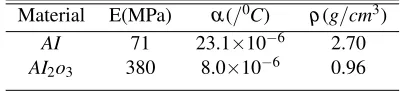
Table 1.Properties ofAlandAl2O3 Material E(MPa) α(/0C) ρ(g/cm3)
AI 71 23.1×10⁻⁶ 2.70
AI2o3 380 8.0×10⁻⁶ 0.96
variation according as:
E=EA+EBrn
α=αA+αBrn
ρ=ρA+ρBrn (2.1)
The material properties of A and B are represents by using subscript A and B respectively. The MaterialsAlandAl2O3 are used for construction of inner and outer surface of FGM disk. For ingredient material thermo-mechanical properties are shown in table1.
3. Formulation of the Problem
We take two different cases of thermal variation as:
3.1 Uniform temperature distribution in FGM disk (TD-I)
: The temperature distribution remains constant in this case therefore temperature is written as:
T(r) =T0,
dT
dr =0 (3.1)
3.2 Steady-state temperature distribution in FGM disk (TD-II)
:The temperature distribution remains steady therefore ∂ ∂t =
0, where heat conduction equation as given in [19] and the temperature distribution written as:
(d
2
dr2+ 1
r d dr)T =0
With the help of thermal conduction the solution of this equa-tion is
T(r) =bT0log(r/a),
dT dr =
bT0
r (3.2)
4. Boundary Conditions
To find the boundary conditions of problem, we consider that inside surface of the disk is fixed to a shaft and outside surface is continued at consistent temperature gradient. Hence, the two boundary conditions are:
µr=0, T =0, atr=a (4.1)
σr=0, dT
dr =T0, atr=b (4.2)
5. Basic Equation
By using equilibrium equations in polar coordinates for two dimensions, thermal eigenstrain, total strain, Hookes Law[21] for axisymmetric problem we obtained a differential equation as:
rd
2F
dr2 + (1−
nEArn
E )
dF dr + (
nEArnυ
E −1) F
r
= (1+Γ2)r2Ω2(nEAr n
E ρ−3ρ−nρAr
n−υ ρ)
−Er(T(r)αAnrn−1+α(r)T”(r) (5.1)
whereΩis angular speed of rotation in the disk,ωis angular frequency of vibration in the disk,T(r)is the change in tem-perature at any distancer,υis Poisson’s ratio of the material andΓis kibel number.
6. Finite Element Formulation of Problem
Using equation (5.1), we get
d2F dr2 +P
dF dr +Q
F r +RΩ
2(1+
Γ2) =S (6.1)
where P,Q,R and S are defined as:
6.1 In case of Temperature Distribution I
P= (1
r−
nEArn−1
E ),
Q= (nEAr n−1
E −
1
r),
R= (3ρ+nρArn+ν ρ−
nEArnρ
E ),
S=−ET0αAnrn−1
6.2 In case of Temperature Distribution II
P= (1
r−
nEArn−1
E ),
Q= (nEAr n−1υ
E −
1
r),
R= (3ρ+nρArn+υ ρ−
nEArn
E ρ),
S=−EbT0(
α(r)
r +αAnr
n−1log(r
a))
Analysis of thermoelastic characteristics of disk using linear properties of material — 635/642
discretization the element size is equal and total domain is divided into N elements and then equation is converted into simultaneous equations:
2
∑
j=1
Ki jeFje=Lei i=1,2; e=1,2,3, ...N (6.2)
The valuesKi je andLei, in each case are given by:
Ki je =
Z re+1
re
dφie
dr dφej
dr dr− Z re+1
re
(1
r−
nEArn−1
E )φ
e i
dφej
dr dr
(6.3)
− Z re+1
re
1
r(
nEArn−1υ
E −
1
E)φiφjdr
Lei =
Z re+1
re
φief(r)dr+φie(re+1)
dφej
dr (re+1)−φ
e i
dφej
dr (re)
(6.4)
where
f(r) = (3ρ+nρArn+ν ρ−
nEArnρ
E )rΩ
2(1+Γ2)
(6.5)
+ET0αAnrn−1,f orT D−I
f(r) = (3ρ+nρArn+ν ρ−nEAr n
ρ
E )rΩ
2(1+Γ2)
(6.6)
+EbT0(
α(r)
r +αAnr
n−1log(r
a)),f orT D−II
φ1e=
re+1−r
re+1−re
φ2e=
r−re
re+1−re
(6.7)
Here the symbol e is used to indicates the element number which is used for disk discritization. The thermoelastic char-acteristics radial stress(σr) , circumferential stress(σθ) , radial
strain(εr), circumferential strain(εθ) and displacement(µr) are
calculated by using below formula:
σr=
1
r
2
∑
j=1
Fjeφej, (6.8)
σθ =
2
∑
j=1
Fjedφ
e j
dr +ρΩ
2r2(1+
Γ2) (6.9)
εr= 1
E
2
∑
j=1
(φ e jFje
r −υF
e j
dφej
dr )−
υ ρΩ2r2(1+Γ2)
E +ε
∗
(6.10)
εθ= 1
E
2
∑
j=1
(Fjedφ
e j dr − υ rF e jφej) +
υ ρΩ2r2(1+Γ2)
E +ε
∗
(6.11)
µr=
r E
2
∑
j=1
(Fjedφ
e j dr − υ rF e jφej) +
υ ρΩ2r3(1+Γ2)
E +rε
∗
(6.12)
whereε∗=α(r)*T(r)
7. Results and Discussions
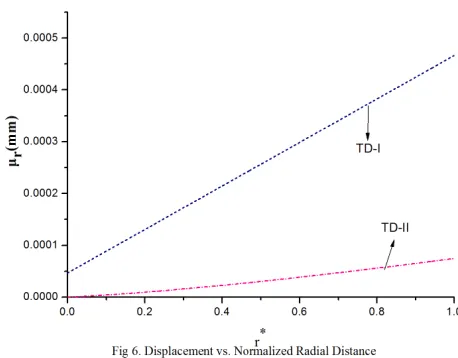
In this section, thermoelastic characteristics(stress, strain and displacement) have been represented numerically for a circu-lar FGM disk of materials A and B. For both materials the value ofυis fixed as 0.3. To achieve numerical results, we assumed the inner radiusaas 15mm and outer radiusbas 150 mm respectively so thatb/a=10. The value of angular speed is taken as 1 rad/s. The thermoelastic characteristics have been calculated and represented graphically under effect of two temperature distributions against normalized radial distance (r∗=br−−aa). Further the vibration analysis made by introducing Kibel Number and thermoelastic characteristics are calculated for different values ofr.
7.1 For n=0(Constant Distribution) under Tempera-ture Distribution I and TemperaTempera-ture Distribution II
For n=0: E,αandρ become constant.
Analysis of thermoelastic characteristics of disk using linear properties of material — 637/642
7.2 For n=1(Linear Distribution) under Temperature Distribution I and Temperature Distribution II
For n=1: E,αandρare linear functions ofr.
Fig 7. presents the radial stress against different values ofr∗
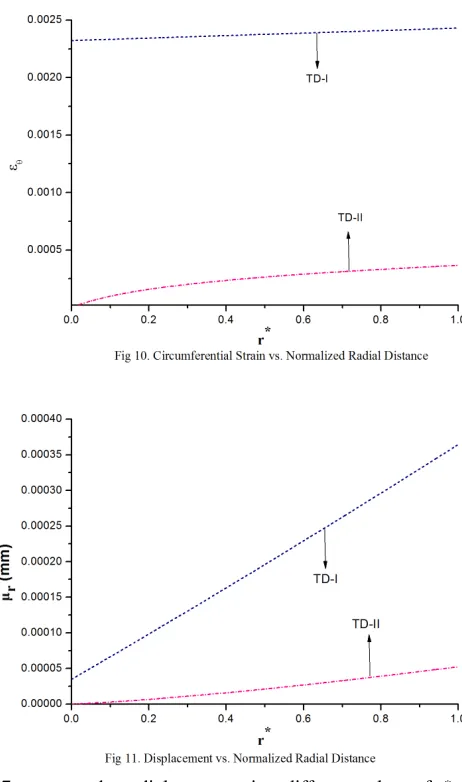
for two temperature distributions. The value of radial stress is very less which is near about zero for both temperature distributions. From the curves, it is cleared that there is no effect of temperature field on radial stress when all the mate-rial properties are linear functions ofr. Fig 8. represents the circumferential stress againstr∗for two different temperature fields. The behaviour of both circumferential stress curves are increasing in nature. Also from these curves is observed that circumferential stress is independent of temperature field. Fig 9. shows the radial strain againstr∗for different temperature fields. It is noticed that the radial strain is greater for tem-perature distribution I than temtem-perature distribution II. But radial strain is more variable for temperature distribution II. Fig 10. presents circumferential strain andr∗for two different temperature fields. It is clear from graph the numeric value of circumferential strain is grater in temperature distribution I than from temperature distribution II.Fig 11. shows displace-ment for different values ofr∗for two temperature fields. The displacement numerically greater for temperature distribution II but for both temperature fields displacement increase as the values of normalized radial distance increases.
7.3 For n=0(Constant distribution) and Temperature Distribution I for different values of Kibel Num-ber
It is observed from Fig 12 and Fig 13 the value of radial and circumferential stress increases as the value of Kibel Number increases. Also the value of these components is greatest for
Analysis of thermoelastic characteristics of disk using linear properties of material — 639/642
7.4 For n=0(Constant Distribution) and Temperature Distribution II for different values of Kibel Num-ber
It is noticed that, behaviour of radial stress curve change when Kibel Number is 1. Radial stress curve changes from increases to decreases at for Kibel Number1. Radial Stress is maximum forr=0.6mm and minimum forr=0.2mm but circumferential stress is opposite in nature. From Fig 19 and 20 it is observed that radial strain, circumferential strain and displacement are maximum for r=0.6mm and minimum forr=0.2mm.
7.5 For n=1(Linear distribution) and Temperature Dis-tribution I for different values of Kibel Number
Analysis of thermoelastic characteristics of disk using linear properties of material — 641/642
7.6 For n=1(Linear distribution) and Temperature Dis-tribution II for different values of Kibel Number
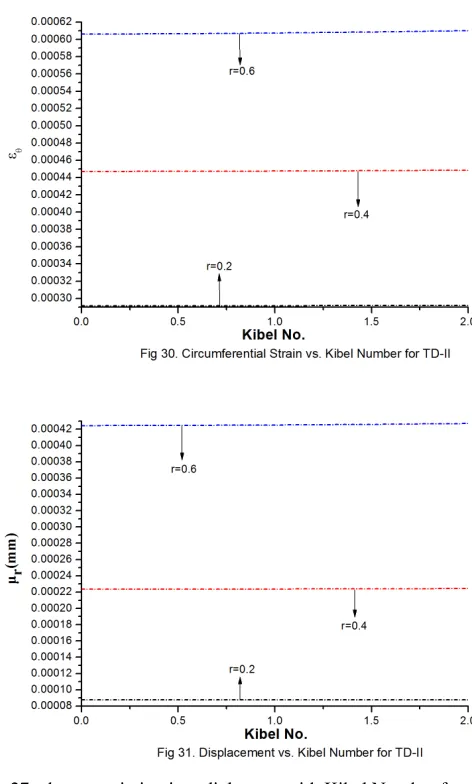
Fig 27. shown variation in radial stress with Kibel Number for three fixed values ofr, it has been observed that radial stress decreases as value of Kibel Number increases but when Kibel Number is 1 the variation in values of radial stress is opposite in nature . Circumferential stress is maximum forr=0.6mm and minimum forr=0.2mm as shown in Fig 28. radial strain, circumferential strain and displacement are maximum for
r=0.6mm and minimum forr=0.2mm and also independent of Kibel Number as shown in Fig 29-31.
Acknowledgment
One of the author Ms. Ramandeep Kaur is grateful to I.K. Gujral Punjab Technical University, Kapurthala for providing research facilities.
8. Conclusion
A finite element method is developed to study stress, strain and displacement in FGM rotating disk for two temperature fields. For two different temperature distributions two cases for material properties (Constant and Linear) are discussed. It is conclude that thermoelastic characteristics of disk are
changed with change made in temperature field. It is noticed that there is very less effect of temperature on circumferen-tial stress. The behaviour of curves of radial, circumferencircumferen-tial strain and displacement are same in two temperature cases. Temperature distribution-II is better for construction of disk. It is noticed that when vibration frequency and angular fre-quency are one, the behaviour of radial stress changes for the different values ofr. As Kibel Number is greater than 1 varia-tion is increased circumferential stress curve. The behaviour of radial strain, circumferential strain and displacement is independent of Kibel Number.
References
[1] J.N. Reddy, An introduction to Finite element method,
Tata McGraw-Hill, (2005).
[2] O.C. Zienkiewicz, R.L. Taylor and J.Z. Zhu, The Finite
Element Method its Basis and Fundamentals,Elsevier, (2005).
[3] R.D. Cook, D.S. Malkus D, M .E. Pleasha and R.J. Witt,
Concept and application of Finite Element Analysis, Wi-ley India Edition, (2001).
[4] D.V. Hutton, Fundamental of Finite Element Analysis,
Tata McGraw-Hill, (2005).
[5] A.M. Afsar and J. Go, Finite Element Analysis of
Ther-moelastic Field in a Rotating FGM Disk,Appl Math Mod, 34 (2010), 3309–3320.
[6] B. Arnab, S.M.R. Islam, A.A. Khalak and A.M. Afsar,
Finite Difference solution of Theroelastic field in circular FGM disk with concentric hole,Procedia Eng, 90 (2014), 193–198.
[7] J.N. Sharma and D. Grover, Body Wave Progpagation
in Rotating Thermoelastic Media,Mech Re Commu, 36 (2009), 715–721.
[8] X.L. Peng and X.F. Li, Thermal Stress in Rotating
func-tionally graded hollow circular disks.Compos Struct, 92 (2010), 1896–1904.
[9] J.N. Sharma, D. Gorver and D. Kaur, Mathematical
mod-eling and analysis of Bulk waves in a rotating general-ized thermoelastic media with voids,Appl Math Mod, 35 (2011), 3396–3407.
[10] M. Bayat, M. Saleem, B.B. Sahari, A.M.S. Hamouda and
E. Mahdi, Thermoelastic analysis of a functionally graded rotating disk with small and large deflections,Thin wall Struct, 45 (2007), 677–691.
[11] J.N. Sharma, D. Sharma and S. Kumar, Analysis of Stress
and Strains in a Rotating Homogeneous Thermoelastic Circular Disk by using Finite Element Method, Int J Comput Appl, 35 (2011).
[12] J.F. Durodola and O. Attia, Deformation and stresses in
functionally graded rotating disks,Compos Sci Techol, 60 (2000), 987–995.
[13] A. Zenkour and D. Mashat, Stress Function of a
Rotat-ing Variable-Thickness Annular Disk UsRotat-ing Exact and Numerical Methods,Eng, 3 (2011), 422–430.
[14] J.N. Sharma, D. Sharma and S. Kumar, Vibration
Anal-ysis of Rotating FGM Thermoelastic Axisymmetric Cir-cular Disk Using FEM,Int J Comput Methods Eng Sci Mech, 14 (2013), 262–270.
[15] H. Callioglu H, N.B. Bektas and M. Sayer, Stress
anal-ysis of functionally graded rotating discs analytical and numerical solutions,Acta Mech Sin, 27 (2011), 950–955.
[16] K.M. Liew, S. Kitipornchai, X.Z. Zhang and C.W. Lim,
Analysis of the thermal stress behaviour of functionally graded hollow circular cylinders,Int J Solids Struct, 40 (2013), 2355–2380.
[17] J. Go, A.M. Afsar and J.I. Song, Analysis of
Thermoelas-tic CharacterisThermoelas-tics of a Rotating FGM Circular Disk by Finite Element Method,Adv Compos Mater, 19 (2010), 197–213.
[18] R. Naghdabadi and S.A.H. Kordkheili, A finite element
formulation for analysis of functionally graded plates and shells,Arch Appl Mech, 74 (2005), 375–386.
[19] R.S.Dhaliwal and A. Singh, Dynamic Coupled
Thermoe-lasticity. ,Hindustan Publishing Corporation, New Delh, 1980.
[20] G.L. Nigh and M.D. Olson, Finite Element Analysis of
rotating Disk,J Sound Vib, 77, 61–78.
[21] J.N. Sharma, D. Sharma, S. Kumar, Study of vibration
analysis of a rotating homogeneous thermoelastic circular disk by using FEM,Int J Compt Appl, 35 (2011).
[22] J.N. Sharma, D. Sharma and S. Kumar, Stress and Strain
analysis of a rotating FGM thermoelastic circular disk by using FEM,Int J Pure Appl Math, 74 (2012), 339–352.
[23] M. Khorsand and Y. Tang, Design functionally graded
rotating disks under thermoelastic loads: weight opti-mization,Int J Pres Ves Pip, 161 (2018), 33–40.
[24] Y. Zheng, H. Bahaloo, D. Mousanezhad, E. Mahdi, A.
Vaziri and N. Hashemi, Stress analysis in functionally graded disks with non-uniform thickness and variable angular velocity,Int J Mech Sci, 119 (2016), 283–293.
[25] T. Dai and H. Dai, Investigation of mechanical behaviour
for a rotating FGM circular disk with a variable angular speed,J Mech Sci Tech, 29 (2015), 3779–3789.
? ? ? ? ? ? ? ? ?
ISSN(P):2319−3786 Malaya Journal of Matematik
ISSN(O):2321−5666