http://www.sciencepublishinggroup.com/j/ajee doi: 10.11648/j.ajee.20180603.12
ISSN: 2329-1648 (Print); ISSN: 2329-163X (Online)
Designing an Energy-Efficient Building in a Context of
Helping Self-Build
Emmanuel Ouédraogo
1, *, Ousmane Coulibaly
2, Kossi
Bouto Imbga
2,
Ouamnoaga Alain Gilbert Koala
3, Abdoulaye Ouédraogo
1, Florent Pèlèga Kieno
1,
Diendonné Joseph Bathiebo
11
Department of Physics and Chemistry, Formation and Research Unit in Sciences and Technologies, University of Ouahigouya, Ouahigouya, Burkina Faso
2
Department of Physics, Formation and Research Unit in Exact and Applied Sciences, University Ouaga 1 Pr Joseph KI-ZERBO, Ouagadougou, Burkina Faso
3Bioclimatic Architecture Agency, Ouagadougou, Burkina Faso
Email address:
*
Corresponding author
To cite this article:
Emmanuel Ouédraogo, Ousmane Coulibaly, KossiBouto Imbga, Ouamnoaga Alain Gilbert Koala, Abdoulaye Ouédraogo, Florent Pèlèga Kieno, Diendonné Joseph Bathiebo. Designing an Energy-Efficient Building in a Context of Helping Self-Build. American Journal of Energy Engineering. Vol. 6, No. 3, 2018, pp. 29-37. doi: 10.11648/j.ajee.20180603.12
Received: October 22, 2018; Accepted: November 7, 2018; Published: November 30, 2018
Abstract:
This article presents a study of the performance of a typical building with walls made of local materials. The work consisted in evaluating the thermal comfort in a building built of cut lateritic blocks. This study is a contribution to the development of thermal regulations in Burkina Faso, a country with a dry tropical climate. It will also contribute to solve housing problems in rural and peri-urban areas through the construction of decent housing. The proposed standard building was modelled using TRNSYS software and the simulation determined the atmosphere (relative air temperatures and humidity) in the building's rooms. Air temperature values range from 25.5°C to 31.6°C in the Yako side block rooms. A reduction in the temperature and relative humidity values of the internal air and a high damping of the internal thermal amplitudes have been observed. However, the temperature values have shown that thermal comfort is not achieved in the rooms during the hot periods of the year. This comfort is improved with the use of Reo blocks, because there is a decrease from 1.0 to 1.5°C in the monthly average values of the internal temperature. However, comfort deteriorates when the walls are made of Bobo-Dioulasso lateritic bricks due to the minimum increase in the average temperature of 0.5°C. The values of energy consumption ratios, thermal phase shift times and damping factors show that the building has good energy performance.Keywords:
Air Temperature, Thermal Comfort, Energy Saving, Decrement Factor and Time Lag1. Introduction
Energy consumed in the building sector represents about 30% of the world's energy consumption. This sector is therefore a key target for improving energy efficiency [1]. The improvement of this efficiency requires the development of energy efficiency codes, which aim above all to provide answers to a triple problem [1]. First, there is the absence of energy consideration problem in the design and management
in each country requires public services to honour their commitments to electricity, water and telephone companies, to name but a few. As a result, for many countries, electricity bills for air conditioning have become unsustainable. It is estimated that the energy consumption of public and private buildings and the tertiary sector in sub-Saharan Africa amounts to between 250 and 450 kWh/m² air-conditioned/year depending on the number of floors [2] In Burkina Faso, buildings have been designed to date without energy constraints. This results in very high costs, especially for operators who are not aware of rational energy use. Thus, the energy consumption of public sector buildings, particularly for the operation of air conditioning equipment, is estimated at 30,000 MWh/year, which corresponds to an estimated financial cost of CFA F 3.4 billion/year [3]. An analysis of the conditions under which electricity is used in public and private buildings revealed shortcomings [3]. These shortcomings are due to the lack of a management and maintenance policy for energy equipment, the low general qualification of maintenance staff and the "energy-intensive" nature of most buildings. This energetic character is linked to the architectural and functional design problems of these buildings. Halawa et al [4] have shown that building envelopes that separate the indoor environment from outdoor environments, and in particular building facades, play an important role in saving energy in buildings. The energy and thermal performance of building façades depends on the various possible designs and technical configurations, particularly in hot and humid climates. Architects and engineers should take into account, from the design stage, the ultimate impacts of building physics on overall energy performance and indoor comfort conditions. Mirrahimi et al [5] have shown that energy consumption can be significantly reduced by adopting energy efficiency strategies in such buildings. Due to environmental concerns and high energy costs in recent years, there has been renewed interest in energy efficiency in buildings. A recent study in Malaysia indicates that residential buildings consume about 19% of the total energy consumed in Malaysian sectors. One of the most potential strategies applied to the building envelope in hot and humid tropical regions is the passive design method and applies to the building envelope in these regions. Abreu-Harbich et al [6] have shown that the use of mechanical systems that cool environments such as air conditioners to reduce indoor air temperature can increase the building's energy consumption by about 50%. The work of Dabe et al [7] has highlighted the very important role of the building profile in controlling the direct penetration of daylight into the interior space of a building. This study showed that excessive penetration can cause visual and thermal discomfort for occupants in the Nagpur region of central India, which has a hot and dry climate. The work of Ren et al [8] assesses the impact of thermal comfort criteria by lowering the acceptability limits of cooling energy requirements for Australian residential buildings in current and future climates (with an assumed global warming of 2°C), using building simulations using three different types
(light, heavy and combined constructions). The results show that in future climates, relaxing the criteria for thermal comfort by lowering the limits of acceptability. They also found that, for all climates, the relaxation of the acceptability limits from 90% to 80% had a greater impact than that of 80% to 70%. By relaxing the limits of acceptability, energy consumption for space cooling can be minimized in tropical and subtropical areas for lightweight, high-performance houses. Savings could be achieved in the building sector if the architectural design and choice of building materials took into account the thermal behaviour of buildings in order to minimize air conditioning and lighting requirements. David Y. K. Toguyeni et al [9] showed that the clay-straw mixture reduces air conditioning requirements compared to the clay wall by about 8%. Concerning the roof, the study showed that 1.5 cm thick insulation (common situation) results in savings of around 8.3% (white wood) to 12.1% (insulating panel) on air conditioning loads. The results of Compaore et al [10] show that local building materials represent a good alternative for the search for energy efficiency in buildings. Compaore et al [11] also showed that air temperatures inside habitats with walls made of local materials (earth materials) are lower than those of modern habitats (cement blocks). This study proposes to assess the thermal performance of a building. The building is type F2 in cut lateritic blocks. It is intended to be scalable and must be accessible to as many people as possible. The cut lateritic blocks come from three quarries and have good thermal performance [12].
2. Methodology
2.1. Bioclimatic Design of an F2 building
walls. Finally, natural ventilation is used to the best of its ability. This ventilation is at the heart of bioclimatic design in hot climates. It allows thermal loads to be evacuated during the night when outdoor air temperature values are low, so it is important to use the cold strategy of protecting yourself from
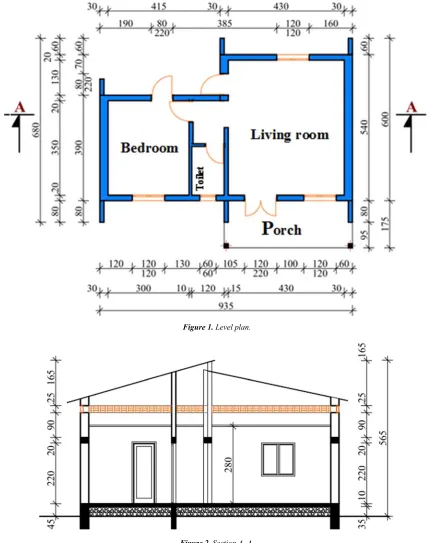
solar gains, adopting passive cooling solutions using natural ventilation or humidification and limiting internal loads. All these design principles have allowed us to arrive at the following architectural plan:
Figure 1. Level plan.
Figure 3. 3D Building Plan.
- The south walls are made of 20 cm thick lateritic brick and 05 cm of thermal insulation (polystyrene). - The west, east and north walls are made of 20 cm thick cut lateritic bricks.
- Lateritic bricks are used from the three (03) quarries whose thermo-physical properties are represented in Table 1.
Table 1. Thermal physical properties of cut laterite blocks (BLT) [12].
Thermal-physical properties Bobo-Dioulasso lateritic block (BLT_Bobo) Reo lateritic block (BLT_Reo) Yako lateritic block (BLT_Yako)
Thermal conductivity (W.m-1.K-1) 0.577 ± 0.014 0.444 ± 0.012 0.469 ± 0.011
Density (kg.m-3) 1892.293 ± 47.305 1813.024 ± 45.327 1853.319 ± 46.323
Thermal capacity (J.kg-1.K-1) 1027.853 ± 25.698 1143.945 ± 28.569 982.562 ± 24.565
Thermal diffusivity (10-7 m2.s-1) 2.973 ± 0.074 2.145 ± 0.053 2.783 ± 0.070
Thermal effusivity (J.s-1/2m-2.K-1) 1059.363 ± 26.483 958.676 ± 23.967 889.043 ± 22.215
2.2. Assembly of Modules Under TRNSYS
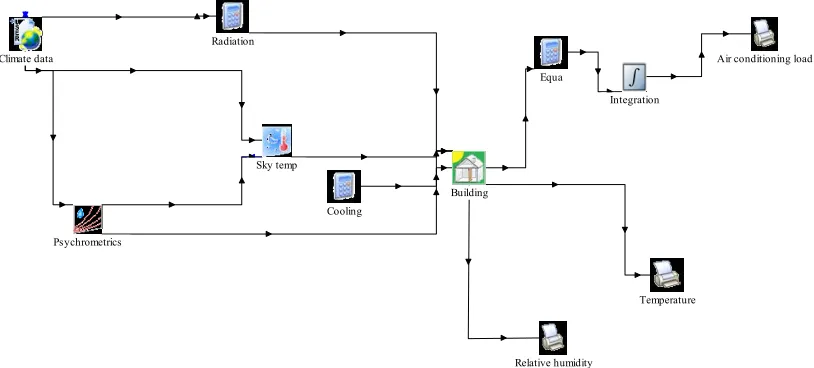
The building plan is describedusing TRNSYS' multi-zone model (TYPE 56)[15]. In summary, the assembly shown in Figure 4 includes:
1. Climate data entry. At this level the files used are the typical meteorological year for the city of Ouagadougou [16, 17]. 2. The calculation of short and long wavelength radiation in different directions, the equivalent temperature of the celestial
vault, psychrometrics parameters and ground temperature.
3. Calculation of the thermal loads of the building through the TRNSYS multi-zone building model type 56. 4. Finally, there is the data output through the integrator and the printer.
Figure 4. Assembly of modules for building description in TRNSYS.
The values of the simulated internal temperatures and those of the external air temperatures were used to evaluate the thermal phase shift time and the damping factor.
The thermal phase shift time is the time required for the indoor temperature to reach its maximum from the time the outdoor temperature peak occurs. It evolves with the inertia
Radiation
Building
Integration Equa
Cooling Sky temp Climate data
Psychrometrics
Air conditioning load
Temperature
of the building and is determined by equation 1:
,max ,max
=
t
Tin−
t
Texϕ
(1)Where: ϕ (h) is the thermal phase shift, tTin,max and tTex,max
are the times at which the internal and external temperature peaks are reached respectively.
The damping factor is the ratio of the amplitudes of the indoor temperature and the outdoor temperature. The lower the damping factor, the more the indoor temperatures are damped. It is determined by equation 2:
∆ =
∆ ine x
T f
T (2)
With ∆Tin: internal temperature amplitude and ∆Tex: external temperature amplitude.
These properties of the building envelope are important because they allow the internal environment to be characterized. They are evaluated according to internal and external temperatures and provide information on the behaviour of the envelopes.
To also evaluate the energy consumption performance of a building due to air conditioning. The overall efficiency is estimated by using energy consumption per unit of floor space. This energy consumption ratio R (kWh.an-1.m-2) is determined by equation 3:
S E
R = (3)
Where: E (kWh) is the power consumption and S (m-2) the air-conditioned area
3. Results and Discussions
For the simulations, first, Yako lateritic bricks have been used. Then the thermo-physical characteristics of the lateritic blocks of the three (03) quarries were used to evaluate the monthly average temperatures in the building's premises. Figures 5 and 6 show the annual changes in air temperature and relative humidity in the different rooms of the building, respectively.
Figure 5. Annual evolution of hourly temperatures in the premises (Yako).
It can be noted that there is thermal discomfort in these rooms during the hot seasons (March-May and October-November) with maximum internal temperature values reaching 31.6°C (Figure 5). This maximum temperature is much lower than what would be observed in a conventional building (about 34°C [18]), and is also lower than the temperature obtained by Safarova [19], which is 31.59°C. During the other months of the year, internal temperatures are relatively low. As for relative humidity (Figure 6), these internal values are high during wintering due to high external relative humidity. High relative humidity values in rooms can
be uncomfortable. However, this relative humidity can be evacuated from the building by good ventilation of the premises. Thus, the lowest humidity levels correspond to the warm seasons and the harmattan period (November-February). These low indoor relative humidity values can be improved by the natural ventilation of the cooling humid air from the humidified green bins located near the low openings of the rooms.
Figures 7 and 8 show the evolution of air temperatures outside and inside the building premises.
Figure 7. Annual evolution of hourly temperatures in the living room (Yako).
Figure 8. Annual evolution of hourly temperatures in the room (Yako).
It has been noticed that the amplitudes of the internal temperatures are highly damped (Figure 7). This reduction in amplitude is due to the good thermal performance of the characterized materials. The roof is ventilated by continuous openings separating the roof and ceiling, creating a ventilated attic above an insulating false ceiling. To ensure comfort, a trapdoor system can be used to evacuate, during the night, the
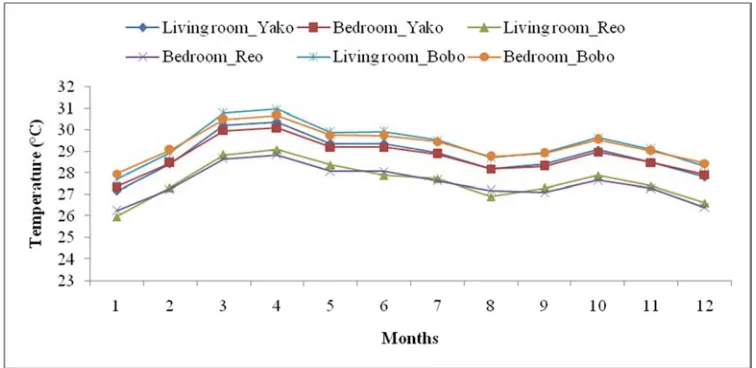
heat stored during the day [18] Thermal comfort in the premises will be improved if the simulation is done with the thermo-physical properties of the Reo bricks, as they have the lowest thermal conductivity.
Figure 9. Annual evolution of hourly temperatures in the rooms according to the type of materials.
The internal temperature values (Figure 9) show that thermal comfort has been improved when the building walls are made of laterite blocks from Reo's quarry. This improvement is due to the fact that these blocks have better thermal performance. On the other hand, the use of lateritic bricks from the Bobo-Dioulasso quarry degrades the thermal comfort of the premises. The increase in internal temperature values (Figure 9) is related to the higher thermal conductivity values of these bricks; the use of Reo blocks allows the temperature to be reduced from 1.0 to 1.5°C compared to Yako's, but Bobo-Dioulasso's blocks increase the temperature by about 0.5°C. Regardless of the type of lateritic block, the internal temperature of the building is much lower than that of a conventional building [18].
Table 2 shows the values of the damping factors and the thermal phase shift times of the building rooms as a function of the composition of the walls.
Table 2. Damping factors and thermal phase shift time.
Type of wall Damping factor (%) thermal phase shift time (h) Living room Bedroom Living room Bedroom
BLT_Yako 23,68 23,21 5 6
BLT_Reo 17,95 17,25 7 7
BLT_Bobo 26,68 26,53 5 5
The values of thermal phase shifts for double face walls are higher than those obtained by Ouedraogo in his work on the thermal study of a building of type F4 in compressed earth blocks. There is a significant phase shift (minimum 5 hours) between the internal and external temperature peaks for the different wall compositions. The walls have damping factors of less than 27%, so the temperatures passing through them (internal temperatures) are highly damped.
Figure 10 shows the values of the air conditioning loads of the rooms as a function of the composition of the building walls.
Figure 10. Values of room air conditioning loads.
The monthly consumption of air conditioners shows two (02) peaks corresponding to the two (02) hot seasons. During these periods, there is a very high consumption of air conditioners, with the maximum period being from April to
rainy season and the cold and dry period respectively. During these periods, outdoor air temperatures are low and heat
inputs into the room are minimal.
Figure 11. Annual energy consumption ratios of each room according to the nature of the walls.
The results in Figure 11, showing the energy consumption ratios, illustrate the building's performance. The values of these consumption ratios range from 82.65 kWh.year-1.m
-2
air-conditioned to 105.69 kWh.year-1.m-2conditioned. All values are below 130 kWh.year-1.m-2 air-conditioned, the reference ratio for apartments proposed by the Ivorian energy quality code [2]. It is also noted that the values found in this study are very low compared to the energy consumption reference value of an apartment in a humid tropical climate (no reference in the literature for dry tropical climate) which is in the order of 160 kWh.year-1.m-² [20]. Our building therefore has a very good energy performance.
The results obtained show that it is possible to do without active air conditioning in this type of housing while enjoying acceptable thermal comfort (building in BLT_Reo), anything that makes it possible to have a building that is energy-efficient. Compaore et al [11] showed that increasing wall thickness contributes to a better thermal inertia of the habitat by improving the damping factor and thermal phase shift time. The option of using local materials having good thermo-physical properties and locally available makes it possible to decrease excessive costs in the construction of housing (building). This choice also creates employment in the localities where the quarries are located. To combine the useful with the pleasant, the promotion of these housing units in a context of self-help will improve the quality and harmony of our residential areas.
4. Conclusion
Modeling and simulation with TRNSYS software made it possible to determine the atmosphere (relative air temperatures and humidity) in the rooms of a typical building. The hourly air temperature values range from 25.5°C to 31.6°C. From the results, a reduction in the temperature and relative humidity values of the internal air
and a high damping of the internal thermal amplitudes have been observed. The temperature values showed that thermal comfort is not achieved in the rooms during the hot periods of the year for the building in BLT_Yako and BLT_Bobo-Dioulasso. On the other hand, comfort is better in BLT_Reo premises. The values of damping factors, thermal phase shift times and energy consumption ratios show that the building has good energy and thermal performance. To improve this comfort, night ventilation and cooling humid air ventilation from the humidified green bins located near the low openings are available. Good ventilation of the premises by air mixers to obtain acceptable comfort temperatures is also suggested in accordance with the set temperatures (26°C). Lighting recommendations may include the use of low-energy lamps and solar energy.
References
[1] Institute of Energy and the Environment of the Francophonie, (2006). PRISME Datasheets, Energy Efficiency Codes for Buildings, http://www.iepf.org/.
[2] Institute of Energy and the Environment of the Francophonie, (2002). Books PRISME, Energy Efficiency of Air Conditioning in Tropical Region, Volume 1: Design of New Buildings, 186 pages, www.iepf.org.
[3] General Directorate of Energy Energy Audit, and Domestic Energy Strategy (SED), (2003). Ministry of Energy and Mines of Burkina Faso.
[5] Seyedehzahra Mirrahimi, Mohd Farid Mohamed, Lim Chin Haw, Nik Lukman NikIbrahim, Wardah Fatimah Mohammad Yusoff, Ardalan Aflaki, (2016). The effect of building envelope on the thermal comfort and energy saving for high-rise buildings in hot–humid climate. Renewable and Sustainable Energy Reviews, 53, 1508-1519.
[6] Zhengen Ren, Dong Chen, (2018). Modeling study of the impact of thermal comfort criteria on housing energy use in Australia. Applied Energy, 210, 152–166.
[7] Loyde V. de Abreu-Harbich, Victor L. A. Chaves, Maria Carolina G. O. Brandstetter, (2018). Evaluation of strategies that improve the thermal comfort and energy saving of a classroom of an institutional building in a tropical climate. Building and Environment, 135, 257-268.
[8] Trupti J. Dabe, Vinayak S. Adane, (2018). The impact of building profiles on the performance of daylight and indoor temperatures in low-rise residential building for the hot and dry climatic zones. Building and Environment, 140, 173-183. [9] David Y. K. Toguyeni, Ousmane Coulibaly, Abdoulaye
Ouedraogo, Jean Koulidiati, Yvan Dutilc, Daniel Rousse, (2012). Study of the influence of roof insulation involving local materials on cooling loads of houses built of clay and straw. Energy and Buildings, 50, 74–80.
[10] Compaore A., Ouedraogo B., Guengane H., Malbila E., Bathiebo D. J., (2017). Role of Local Building Materials on the Energy Behaviour of Habitats in Ouagadougou. IRA International Journal of Applied Sciences, 8 (2), 63-72. [11] Abdoulaye Compaore, Boureima Dianda, Gilbert Nana, D.
Joseph Bathiebo, Belkacem Zeghmati, Xavier Chesneau and Stéphane Abide, (2018). Modeling of Heat Transfer in a Habitat Built in Local Materials in Dry Tropical Climate. Physical Science International Journal, 7 (1): 1-11.
[12] Emmanuel Ouédraogo, Ousmane Coulibaly, B. Kossi Imbga, P. Florent Kiéno and Abdoulaye Ouédraogo, (2018). Experimental Study of the Thermo-physical Properties of
Lateritic Blocks Used in the Habitat in Dry Tropical Climate. Physical Science International Journal, 19 (2): 1-10.
[13] Lawane A., Vinai R., Pantet A., Thomassin J. H, (2011). Characterisation of laterite stone as building material in Burkina Faso. Scientific day 2IE.
[14] Abdou Lawane, Anne Pantet, Raffaele Vinai, Jean Hugues Thomassin, (2011). Geological and geomechanical study of the laterites of Dano (Burkina Faso) for a use in the habitat. The annals BTP.; n° 1n°6.
[15] Ousmane Coulibaly, Emmanuel Ouedraogo, Abdoulaye Ouedraogo et Jean Koulidiati, (2015). Determination of typical meteorological years used for thermal and energy simulation of buildings in ten cities of Burkina Faso. Afrique Science, 11 (6), 158-169.
[16] E. Ouedraogo, O. Coulibaly et A. Ouedraogo, (2012). Elaboration of a typical meteorological year for the city of Ouagadougou for study the energy performances of buildings, Revue des Energies Renouvelables, 15 (1), 77–90.
[17] Emmanuel Ouedraogo, (2015). Determination of basic climate data and characterization of compressed earth blocks for the study of thermal comfort in the building in dry tropical climate, PhD Thesis, University of Ouagadougou.
[18] O. Coulibaly; A. Ouedraogo; J. Koulidiati, P. Abadie; (2013). Thermal study of a double-wall bioclimatic building called NEWANGO: thermal inertia, comfort and energy consumption, Francophone energy link, 94, 80-86.
[19] Shokhida Safarova, (2017). Thermal Performance of 6 Star Rated Houses in the Hot and Humid Tropical Climate of Darwin. Procedia Engineering, 180, 510-519.