on Measurements and Estimations Using
SpekCalc and Ipem78 Models
Suk Chiang Chen, Wei Loong Jong, Ahmad Zaky harun
Medical Radiation Programme, School of Health Sciences, Universiti Sains Malaysia, Health Campus, 16150 Kubang Kerian, Kelantan, Malaysia
Submitted:20 Aug 2011 Accepted:5 Dec 2011
Abstract
Background: Different computational methods have been used for the prediction of X-ray spectra and beam quality in diagnostic radiology. The purpose of this study was to compare X-ray beam qualities based on half-value layers (HVLs) determined through measurements and computational model estimations.
Methods: The HVL estimations calculated by IPEM78 (Spectrum Processor of the Institute of Physics and Engineering in Medicine’s Report 78) and SpekCalc software were compared with those determined through measurements. In this study, the HVLs of both Philips (Phil) (Philips Healthcare, Best, NL) and General Electric Company (GE) (GE Global Research, Niskayuna, US) diagnostic range X-ray machines (50 kVp to 125 kVp) were evaluated.
Results: In the HVL estimations, SpekCalc and IPEM78 showed maximum differences of 10% and 9%, respectively, compared with direct measurements. Both models provided means and SDs of HVLs that were within 5% of the HVL measurements of GE and Phil machines.
Conclusion: Both computational models provide an alternative method for estimating the HVL of diagnostic range X-ray. These models are user-friendly in predicting HVLs, which are used to characterise the quality of the X-ray beam, and these models provide predictions almost instantly compared with experimental measurements.
Keywords: beam quality, effective energy, HVL, IPEM78, SpekCalc
Introduction
X-rays play an important role in modern technology, especially for medical imaging purposes. Medical sources of ionising radiation are the largest contributor to the population dose from artificial sources, and most of this radiation comes from diagnostic X-rays (1). The X-ray spectrum and beam quality are must- know parameters for studying the dosimetric properties of X-ray beams in diagnostic radiology. In order to completely describe the X-ray beam spectrum, the spectral photon fluence needs to be determined. A spectrometer is needed to measure the true spectral photon fluence; however, spectrometry is too expensive and time-consuming for routine application to X-rays. Therefore, determination of the half-value layer (HVL) is often used to describe the X-ray beam quality. The HVL of a beam is the thickness of material required to reduce the intensity of an X-ray or gamma-ray beam to one-half of its initial value (2,3). In kilovoltage X-ray, determination of the HVL of the X-ray beam can be used to characterise the effective energy by converting the HVL to the linear attenuation coefficient or
mass attenuation coefficient. The effective energy of a polyenergetic beam is equal to the energy of a monoenergetic X-ray beam that is attenuated at the same rate as the polyenergetic beam (4). The effective energy is used to describe the penetration of a polyenergetic X-ray.
based on a theoretical formulation to calculate the X-ray spectra by mathematical derivation followed by tuning in the equations’ parameters using measured data (5). IPEM78 (Spectrum Processor of the Institute of Physics and Engineering in Medicine’s Report 78) is a software that simulates X-ray spectra using a semi-empirical model based on the Birch and Marshall model (6). IPEM78 results in higher transmission curves for all tube voltages compared with measured spectra, and the differences increase with tube voltage. SpekCalc (Institute of Cancer Research in London, UK) is a software programme used to calculate X-ray spectra from a tungsten anode X-ray tube. SpekCalc relies on deterministic equations for bremsstrahlung productions in combination with numerically pre-calculated electron distributions (7).
The purpose of this study is to compare the results of HVL estimations of IPEM78 (semi-empirical model) and SpekCalc (deterministic model) with HVLs determined from measurements. These 2 X-ray prediction models were evaluated as alternative and quick methods to determine X-ray beam quality in the clinical environment. The determined HVLs were compared with one another because the HVL is the parameter used to describe the quality of the X-ray spectrum. The effective energies for the range of X-ray energy peaks from 50 kVp to 125 kVp were also determined
based on the linear attenuation coefficients determined experimentally.
Materials and Methods
Materials
This study was conducted with a (Phil) (model SRO 33 100 X-ray machine with ROT 350 Optimus 80-kW high frequency generator) and a General Electric Company (GE) (model 2336058 X-ray machine with housing 46-15540VG48 and MPH 50 high frequency generator) X-ray machines. The Phil machine has an anode angle of 13°. The permanent filtration inside the X-ray tube is 0.66 mm aluminium (mm Al) equivalent, the tube housing is 2.5 mm Al equivalent, and the additional filtration is 2.0 mm Al equivalent. The GE X-ray machine has an anode angle of 13°. The inherent filtration inside the tube is 0.8 mm Al equivalent at 150 kV and the tube housing is 0.3 mm Al equivalent at 150 kV. The filtration inside the collimator is 1.5 mm Al equivalent at 80 kV.
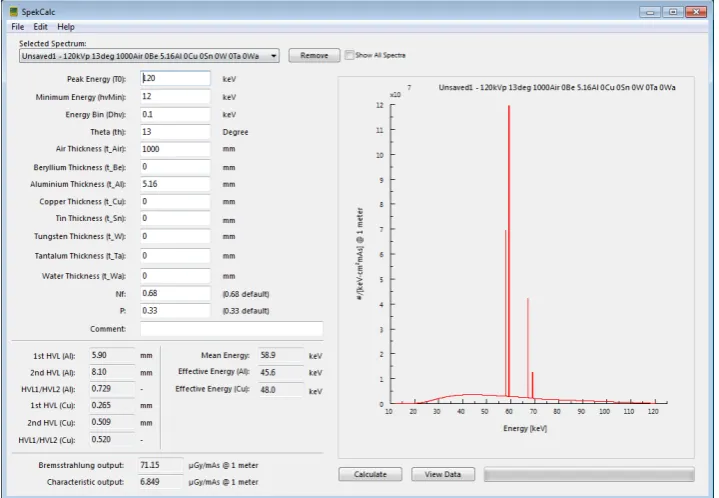
SpekCalc software was used to calculate the X-ray spectra. The spectra are presented for tungsten targets at tube voltages from 40 kV to 300 kV and target angles with a maximum of 90° with respect to the beam axis. The energy interval can be customised by the user. The SpekCalc graphical user interface (GUI) is shown
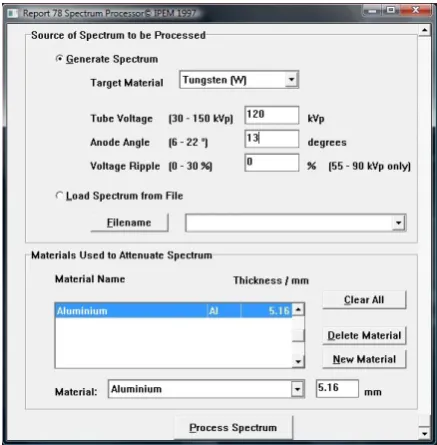
in Figure 1. IPEM78 uses an XCOM programme to calculate linear attenuation coefficients for various materials and contains sets of radiology and mammography X-ray spectra with considerably wider ranges (6). These spectra are presented for tungsten targets at tube voltages from 30 kV to 150 kV and target angles from 6° to 22°. Different materials can be chosen as additional filters. All spectra are provided at an energy interval of 0.5 kV. Voltage ripple is an input parameter for IPEM78. The IPEM78 GUI is shown in Figure 2.
Measurement of HVL
A Rad-Check Plus X-ray exposure meter (model 06-526-2200 [Fluke Biomedical, US]) was used as a dosimeter to measure the output of the X-ray machines. Aluminium attenuators of 10 × 10 cm with thicknesses of 0.5 mm and 1.0 mm were used in this study. The density of the aluminium attenuators is 2.699 g/cm3.
The Rad-Check Plus exposure meter was positioned 100 cm perpendicular to the X-ray tube. The internal chamber of the Rad-Check Plus exposure meter was fully collimated within the X-ray field and was positioned in the centre of the 10 × 10 cm field, as shown in Figure 3. The first measurement was done without the aluminium attenuator. Next, measurement was repeated with a 0.5 mm Al attenuator in place between the X-ray tube and the exposure meter. The exposure was repeated while incrementing the aluminium thickness by 0.5 mm each time until
Figure 2: IPEM78 graphical user interface.
the values approached the expected HVL value. The exposure measurements were subsequently repeated for a range of peak energies from 50 kVp to 125 kVp. A final exposure without an aluminium attenuator was repeated for every voltage to confirm an output stability of less than 2% from the first exposure without the aluminium attenuator. The relative intensity of the X-ray beam without an aluminium attenuator versus the aluminium attenuator thickness for every tube voltage was plotted on semi-log graphs, as shown in Figure 4 and Figure 5, for both GE and Phil machines respectively.
Determination of the linear attenuation coefficient (µ) and the HVL
The linear attenuation coefficient (µ) of aluminium for the corresponding tube voltage was determined by plotting a best-fit line using Graphpad Prism 5 (GraphPad Software Inc., California, US), as shown in Figures 4 and 5. The HVL was determined from the linear attenuation coefficient.
Determination of the effective energy
The effective energy of the X-ray machine was determined from the linear attenuation coefficient of the aluminium attenuator for various voltages using data from National Institute of Standards and Technology, as shown in Figure 6 (8). Later, the effective energy of both broad and fine focuses of the GE and Phil X-ray machines were compared.
Figure 6: The energy of the X-ray beam versus the linear attenuation coefficient for effective energy determination based on National Institute of Standards and Technology (NIST) data. The solid line shows the data from NIST, and the dashed line shows the best-fit line for determination of the effective energy.
Evaluation of SpekCalc and IPEM78 for HVL estimations
The X-ray spectra calculated by the SpekCalc and IPEM78 models were evaluated by comparison with the measured spectra. The calculated HVLs were compared with the measured HVLs. The beam quality depends on tube voltage, filtration and anode angle; hence, both computational models were run to simulate spectra with the same parameters as the machines used in the direct measurements. The beam quality determined by direct measurement was taken to be the standard. The mean HVL ratios for all tube voltages in this study for both Phil and GE machines were calculated, and SDs were determined. For the accuracy comparison of the SpekCalc and IPEM78 models, mean HVL ratios were calculated for both broad and fine focuses of the 2 machines used, and SDs were subsequently determined.
Figure 5: Transmission curves for the X-ray beam of a GE X-ray machine corresponding to tube voltages ranging from 50 kVp to 125 kVp with (A) fine focus and (B) broad focus. The solid lines show the measured data, and the dashed lines show the best-fit line for half-value layer determination (in centimeter aluminium equivalent).
Table 1: Comparison of the effective energies in Phil and GE X-ray machines at tube voltages in the diagnostic range of radiology energy
Tube voltage (kVp)
Phil X-ray machine GE X-ray machine
Effective energy (keV) Effective energy (keV)
Fine focus Broad
focus Deviation (%) a
Fine focus Broad
focus Deviation (%) a
50 30.49 30.49 0.00 27.31 27.03 -1.04
60 34.87 33.11 -5.07 29.01 28.75 -0.89
70 36.68 35.81 -2.37 30.70 30.80 0.34
81 38.79 37.60 -3.08 33.27 32.46 -2.43
90 40.60 39.80 -1.97 34.58 34.33 -0.72
102 42.32 42.24 -0.18 37.30 36.62 -1.84
109 43.70 43.63 -0.16 38.01 37.66 -0.92
125 45.83 45.88 0.11 40.63 40.04 -1.45
a The deviations were related to the fine focus.
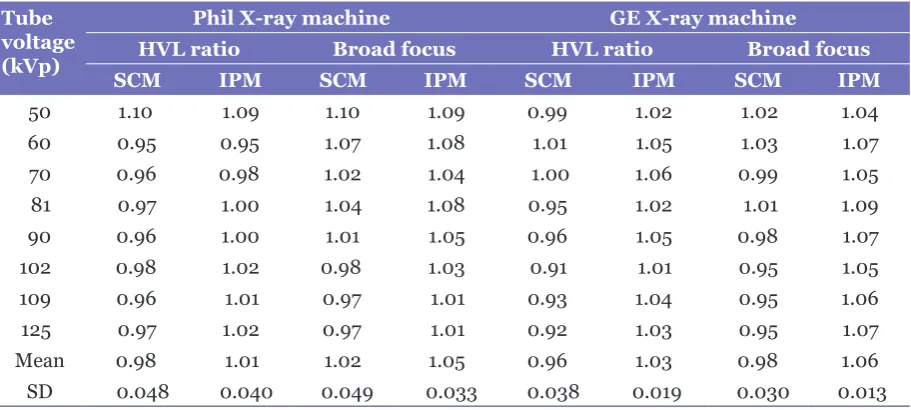
Table 2: Comparison of half-value layer (HVL) estimations from SpekCalc and IPEM78 models to measurements of tube voltages of Phil and GE X-ray machines. The estimations and measurements were made in the diagnostic range of radiology energy
Tube voltage (kVp)
Phil X-ray machine GE X-ray machine
HVL ratio Broad focus HVL ratio Broad focus
SCM IPM SCM IPM SCM IPM SCM IPM
50 1.10 1.09 1.10 1.09 0.99 1.02 1.02 1.04
60 0.95 0.95 1.07 1.08 1.01 1.05 1.03 1.07
70 0.96 0.98 1.02 1.04 1.00 1.06 0.99 1.05
81 0.97 1.00 1.04 1.08 0.95 1.02 1.01 1.09
90 0.96 1.00 1.01 1.05 0.96 1.05 0.98 1.07
102 0.98 1.02 0.98 1.03 0.91 1.01 0.95 1.05
109 0.96 1.01 0.97 1.01 0.93 1.04 0.95 1.06
125 0.97 1.02 0.97 1.01 0.92 1.03 0.95 1.07
Mean 0.98 1.01 1.02 1.05 0.96 1.03 0.98 1.06
SD 0.048 0.040 0.049 0.033 0.038 0.019 0.030 0.013
Abbreviations: HVL = half-value layer, IP = IPEM78 estimation, M = measurement, SC = SpekCalc estimation.
Results
Comparison of effective energy
The HVLs determined from the direct measurements were used to determine the effective energies. The determined effective energies are summarised in Table 1. The effective energies of the Phil machine were higher than those of the GE machine for the entire range of tube voltages. For both machines, most of the
effective energies observed when using a broad focus were slightly lower than those observed when using a fine focus.
Evaluation of SpekCalc and IPEM78 for HVL estimations
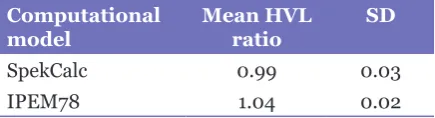
Table 3: Comparison of SpekCalc and IPEM78 models for half-value layer (HVL) estimation in both Phil and GE machines.
Computational
model Mean HVL ratio SD
SpekCalc 0.99 0.03
IPEM78 1.04 0.02
voltages from 50 kVp to 125 kVp on 2 different machines (Phil and GE) are tabulated in Table 2. SpekCalc showed a maximum of 10% difference for 50 kVp tube voltage compared with the HVL based on direct measurement of the Phil machine. Similarly, IPEM78 showed a maximum of 9% difference in HVL estimations at 50 kVp and 81 kVp for the Phil and GE machines, respectively. All the means of HVL ratios for both the Phil and GE X-ray machines for the tube voltages studied were less than 5% difference, except the estimation by IPEM78 for the GE X-ray machine with broad focus, which showed a difference of 6%. The SDs of the means of HVL ratios for beam quality estimations were less than 5% difference. The means and SDs used to evaluate the accuracy of the SpekCalc and IPEM78 models for estimating the HVLs for both Phil and GE X-ray machines are summarised in Table 3. The mean HVL ratio for the SpekCalc model was calculated using the HVL ratios of both fine and broad focuses for both machines. The same method was used to determine the mean HVL ratio for IPEM78 model. The HVL ratios were subsequently used to calculate the SD for each model. Both the SpekCalc and IPEM78 models showed a percentage difference of the means and SDs within 5% of the HVL from the directly measured values for both the Phil and GE X-ray machines.
Discussion
There is a maximum of 5.07% difference of the effective energies between the fine focus and broad focus for both Phil and GE X-ray machines. For both X-ray machines, most of the effective energies were slightly lower when using a broad focus compared with when using a fine focus. The effective energies of the Phil X-ray machine were higher than the GE X-ray machine because of the thicker filtration in the aluminium equivalent inside Phil’s X-ray tube.
SpekCalc mostly underestimated the beam quality for both the Phil and GE X-ray machines.
For both machine types, the underestimation especially occurred at higher tube voltages, but also occurred at lower tube voltages when used with broad focus. Poludniowski et al. (7) have obtained similar results. SpekCalc showed an agreement within 5% of the direct measurement for estimating the beam quality. IPEM78 overestimated the beam quality for both X-ray machines at all tube voltages, except for the Phil X-ray machine at 60 kVp and 70 kVp with a fine focus. IPEM78 has previously been shown to overestimate the beam quality from tube voltages ranging from 50 kVp to 250 kVp (7). IPEM78 estimated the beam quality to be higher than the measured beam quality in a previous report by Ay et al. (5). However, in this study, IPEM78 showed an agreement within 5% of the direct measurement, except at 81 kVp with broad focus of the GE X-ray machine and at 50 kVp with both broad and fine focuses of the Phil X-ray machine.
The total filtration of the X-ray machine is required as an input parameter for all computational models. The determination of total filtration is important because its value will influence the theoretical results. In this study, the total filtration of the Phil X-ray machine was obtained from the manual of the machine, and the total filtration for the GE X-ray machine was obtained from the label on the X-ray tube. The filtrations were not the actual thicknesses and materials of the filter inside the tube but the thickness in aluminium equivalents. Therefore, without knowing the actual filtration inside the X-ray tube, the thickness in aluminium equivalents of the inherent filtration was used as the input parameter for the SpekCalc and IPEM78 models. The use of these filtrations could affect the beam quality estimation when using these softwares. However, for a diagnostic range X-ray machine with a focus to detector distance of 104 cm, the total filtration in mm Al of the X-ray tube from tube voltages from 50 kVp to 125 kVp does not vary notably, except at 50 kVp (9).
quality of X-ray spectra generated with different tube voltages in the clinical environment.
The limitation of this study is the difficulty in determining the actual total filtration of the X-ray tubes for both Phil and GE machines. The total filtration for both of the X-ray tubes was given in mm Al equivalent. The total filtration of a machine must be determined because it is required as an input parameter for SpekCalc and IPEM78. The total filtration value will influence the predicted result. The beam quality estimations with the SpekCalc and IPEM78 models will also be influenced if the actual filtration inside the X-ray tube is not known. For future research, there must be a proper way to determine the actual total filtration of the X-ray machine studied.
Conclusion
Both SpekCalc and IPEM78 showed mean and SD differences within 5% of the measured HVL values for the Phil and GE machines. However, SpekCalc showed better agreement with the measured HVLs compared with IPEM78. The successful use of SpekCalc and IPEM78 for HVL estimation used for the instant prediction of X-ray beam quality is dependent on the accuracy in determining the actual total filtration in the X-ray machine. The actual total filtration of the X-ray machine must be determined and used for future studies for better accuracy in HVL prediction.
Acknowledgements
We would like to express our sincerest gratitude and thanks to the staff of the Medical Radiation Programme, School of Health Sciences and Department of Radiology, Hospital Universiti Sains Malaysia, for their support and help in this study.
Authors’ Contributions
Conception and design, drafting of the article: CSC
Collection, assembly, analysis, and interpretation of the data: JWL
Critical revision of the article, administrative, technical, or logistic support: AZH
Correspondence
Ms Chen Suk Chiang MSc Medical Physics (USM) Medical Radiation Programme School of Health Sciences
Universiti Sains Malaysia Health Campus 16150 Kubang Kerian
Kelantan, Malaysia Tel: +609-767 7639 Fax: +609-767 7515 Email: [email protected]
References
1. International Atomic Energy Agency. Dosimetry in diagnostic radiology: An international code of practice, Technical Report Series No. 457. Vienna (VA): International Atomic Energy Agency; 2007.
2. Seelentag WW, Panzer W. Equivalent half-value thicknesses and mean energies of filtered
X-ray bremsstrahlung spectra. Br J Radiol.
1980;53(627):236–240.
3. Bushberg J, Anthony Seibert J, Leidholdt EM Jr, Boone JM. The essential physics of medical imaging.
Med Phys. 2003;30(7):1936.
4. Khan F. The physics of radiation therapy. 4th ed. Baltimore (MD): Lippincott Williams & Wilkins; 2009.
5. Ay MR, Sarkar S, Shahriari M, Sardari D, Zaidi H. Assessment of different computational models for generation of X-ray spectra in diagnostic radiology and mammography. Med Phys. 2005;32(6): 1660–1675.
6. Cranley K, Gilmore B, Fogarty G, Desponds L. IPEM Report 78: Catalogue of diagnostic X-ray spectra and other data. [CD-ROM]. York (UK): The Institute of Physics and Engineering in Medicine (IPEM); 1997.
7. Poludniowski G, Landry G, Deblois F, Evans P M, Verhaegen F. SpekCalc: A program to calculate photon spectra from tungsten anode X-ray tubes.
Phys Med Biol. 2009;54(19):N433–N438.
8. National Institute of Standards and Technology. NIST standard reference database 66 [Internet]. Gaithersburg (MD): NIST Ionizing Radiation Division; 2005 [cited 2010 Dec 12]. Available from: http://www.nist.gov/pml/data/ffast/index.cfm.