http://www.sciencepublishinggroup.com/j/jps doi: 10.11648/j.jps.20190701.13
ISSN: 2331-0723 (Print); ISSN: 2331-0731 (Online)
Effect of Intercropping and Compost Application on Yield
and Yield Components of Common Bean in North Shewa,
Central Ethiopia
Negash Hailu
Department of Plant Sciences, Debre Berhan University, Debre Berhan, Ethiopia
Email address:
To cite this article:
Negash Hailu. Effect of Intercropping and Compost Application on Yield and Yield Components of Common Bean in North Shewa, Central Ethiopia. Journal of Plant Sciences. Vol. 7, No. 1, 2019, pp. 13-20. doi: 10.11648/j.jps.20190701.13
Received: December 24, 2018; Accepted: February 21, 2019; Published: March 25, 2019
Abstract:
Common bean is grown for its high nutritive, medicinal and market value in Ethiopia. Lack of soil nutrients and moisture are production constraints in central common bean producing regions of Ethiopia. Field experiments were conducted on two common bean varieties Awash Melka and Mexican 142 at Shewarobit and Ataye in 2016 and 2017 main cropping seasons with the objective of evaluating the effects of intercropping, compost application and their integration on yield and yield components of common bean. The four management options used were compost application, intercropping, their integration and a control. The results of the study revealed that there was a decreasing trend in yield and yield components from the integrated cultural management practices to the separately applied and sole planting of common bean. Row intercropping with compost application increased the mean number of pods per plant by 41.1% compared to sole planting at Ataye in 2016 cropping season. At Ataye, the number of seeds per pod in Mexican 142 variety was higher by 18.1% and 31.3% in 2016 and 2017 respectively than Awash Melka variety. Row intercropping with compost application increased the mean 100-seed weight from 15.2 to 16.2% in both locations and both cropping seasons compared to sole planting. Compost application increased the average yield of common bean from 10.1% to 25.8% in both locations and both cropping seasons compared to sole planting. Relatively lower yield was obtained from intercropping plots than sole plots at both locations and in both seasons. The integration of intercropping with compost application had the highest LER (2.2) at Ataye in 2017 cropping season while the lowest LER (1.52) was found in the row intercropping at Ataye in the same cropping season. The results obtained from this study indicated the cultural management practices were responsible for increment of yield and yield components of common bean in central Ethiopia and in areas with similar agro-ecological conditions.Keywords:
Compost Application, Land Equivalent Ratio, Row Intercropping1. Introduction
Common bean (Phaseolus vulgaris L.) is the most widely produced and consumed legume worldwide and occupies an important place in human nutrition in the east and Great Lakes Regions of Africa for improving the nutritional status of many subsistent farmers [1-4]. It is an important source of income and nutrition. It provides a rich combination of carbohydrates (60- 65%), proteins (21- 25%) and fats (less than 2%), vitamins [5], good source of iron and zinc [6], have a low glycemic index and high fibers, contributing to the health conditions of human beings [7-8] and supplemental animal feed. It also used in intensifying crop production in
space and species mixture (intercropping) and soil fertility management. This ecologically and economically important legume is extensively cultivated in low and mid altitude areas (1200-2000 masl) of central Ethiopia [1,9-10]. Common beanwas grown on about 366,887hectares in Ethiopia from which about 469,615.4 tons are produced in the year 2015/16, with an average national yield of 1.28 tons per hectare [11]. Based on area and legume production, this crop ranked second next to faba bean at national level.
water availability in mid-latitude and semi-arid low altitudes. Dry spell causes poor seedling emergence, drying of seedlings after germination, stunted growth of crops and poor or no yield [12, 13]. Thus, any change in rainfall pattern, soil moisture, soil temperature, soil fertility has direct impact on the productivity and production of crops in general and common bean in particular. In semi-arid agro-ecologies, where food security is a priority concern, climate variability and uncertainty tend to be higher [13-15], that dispose subsistent farmers in the sub-Saharan region to high risks. The strategies that a particular agro-ecological region will cope with climate variability depend largely on the societies` ability to create and use available knowledge.
Enhancing resilience to the effects of climate variability is important, and functional diversity is one of the most effective targets for improved sustainability [16]. Nowadays, the debate on climate change is not on its occurrence and effects, but rather on how to mitigate the ever-happening effects of climate change to ensure food security of the ever-increasing human population and the proper functioning of the natural ecosystem. This needs to set alternative resilience strategies that mitigate the existing and ever happening impacts of climate change. Climatic condition contains a wide range of weather parameters such as temperature, relative humidity, wind speed, solar radiation and the like [17].
The most important and feasible climate change adaptation strategies for crop production and productivity are increased diversification with the use of species and cultivar mixtures through intercropping and compost application [2, 9; 18, 19], increasing nutrient use efficiency, improving water-holding capacity of the soil [10, 15, 17]. Intercropping refers to the spatial and temporal arrangement of different crops to exploit natural resources efficiently and enhance productivity per unit area and time by increasing the effective utilization of land, soil moisture and nutrients [17, 20]. It is known to make a more efficient use of growth factors as it captures and makes a better use of radiant energy [17, 21, 22], available water and nutrients [23] maintains and improves soil fertility [24, 25].
Compost is a valuable resource offering significant agricultural and environmental benefits to farmers and the community because of its unique characteristics, which can offer significant returns in the form of increased crop yields and improved quality of produce. Compost contains macro and trace elements essential for healthy plant growth [26, 27], reduces the need to use synthetic fertilizers by returning valuable nutrients to the soil.
Compost improves soil structure resulting in increased water holding capacity and nutrient retention of the soil. It also reduces the potential ground water contamination from synthetic fertilizers that are toxic to plants and beneficial organisms. Therefore, it is important to apply nitrogen via composts at environmentally and agronomically responsible levels, which requires understanding of soil factors regulating the release of nitrogen compounds in soil systems, such as moisture content, pH, soil organic matter content and quality,
soil texture, buffering capacity and nitrification rate [21, 23, 28].
Intercropping, compost application and their integration for crop production that leads to appropriate ecofriendly adaptation measures in action have to be investigated. However, little is known about the effect of intercropping and compost application on productivity of crops especially common bean in central Ethiopia. Therefore, the influence of intercropping and compost application on crop productivity need to be assessed since such data of crop production under cultural management practices would be useful in climate variable prediction and modeling [17, 21]. The objective of this study, therefore, was to assess the effects of intercropping and compost application on the productivity of common bean.
2. Materials and Methods
2.1. Experimental Sites
Field experiments were conducted at Shewarobit and Ataye at farmers’ fields in 2016 and 2017 during main cropping seasons (June to November). Both locations represent important common bean and sorghum growing areas in central Ethiopia. Shewarobit is located 225-kilo meters from Addis Ababa at the northeastern part of the country between 09, 99’ N latitude and 39, 89’ E longitude at an altitude of 1288 meters above sea level [29-30]. The area has an average annual rainfall of 1007 mm, with short rain between March and April and long rain between June and September and annual mean minimum and maximum temperatures of 16.5 and 31°C, respectively [30]. The location has varied soil types (from luvisol to vertisol) with pH range of 5.0-8.0[30].
Ataye is located 290 kilometer from Addis Ababa at north eastern part of country between 10,21’N latitude and 39,56 ‘ E longitude at an altitude of 1458 Masl. The area has an average annual rainfall of 1085 mm, with short rain between March and April and long rain between June and September and annual mean minimum and maximum temperatures of 15.18 and 32.95°C, respectively [29-30].
Sorghum was planted in 80 cm inter-row and 25 cm intra-row spacing. In intra-row intercropping, a intra-row of common bean was planted in the center of sorghum rows at 10 cm intra-row and 40 cm inter-row spacing[29]. In the row intercropping, simultaneous planting was used. Similarly, in sole planting of common bean 40 cm inter-row and 10 cm inter-plant spacing with 9 rows per plot were used. Spacing between blocks was 1.2 m and between plots was 1 m. (on a plot size of 3 m x 4 m (12 m2) with the net harvested plot size of 9.6 m2 for intercropping and 8.4 m2 for sole common bean.
2.2. Experimental Procedures
drilling seeds at the rate of 5 kg ha-1, and the plants were thinned to one plant per hill of 25 cm intra-row spacing after emergence. Common bean seeds were sown on 21 July 2016 and 25 July 2017 at Shewarobit and on 16 July 2016 and 18 July 2017 at Ataye. The rows were thinned to one plant per hill after emergency and establishment of seedlings. Plants were hand weeded three times and cultivated once during the growth periods in both cropping seasons.
2.3. Treatments and Experimental Design
Two field based management practices (intercropping and vermicompost application), their integration and a control
were used as treatments. Row intercropping was used as crop diversification and vermicompost application was used as soil nutrient management. The treatments were common bean-sorghum row intercropping, vermicompost application, their combination and sole planting applied separately and in integration for both common bean varieties (Awash Melka and Mexican 142). The common bean varieties were obtained from Melkasaa Agricultural Research Center, Ethiopia. Awash Melka is moderately resistant while Mexican 142 is susceptible to CBB. Sorghum variety, Teshale (3442-2 OP) was used. Eight treatment combinations were arranged in a randomized complete block design in three replications.
Table 1. Management practices of common bean anthracnose disease for 2 common bean varieties atShewarobit and Ataye, Ethiopia during 2016 and 2017 cropping seasons.
S. No Variety Managements Management practices description
1 Awash Melka SP sole planting
2 Awash Melka CA compost application
3 Awash Melka RI row intercropping
4 Awash Melka RI + CA row intercropping + compost application
5 Mexican 142 SP sole planting
6 Mexican 143 CA compost application
7 Mexican 144 RI row intercropping
8 Mexican 145 RI + CA row intercropping + compost application
2.4. Data Collection
The crop data such as plant height (cm), number of pods per plant, number of seeds per pod were recorded from 10 randomly taken plants and the averages were calculated. Hundred seed weight (g) of common bean, 1000-kernel weight of sorghum and yield of both crops (kg) were recorded at 12.5% seed moisture content for sorghum and 10% for common bean. The grain yields (kg) of both crops were converted to ton per hectare (t ha-1). Yield data of common bean was recorded for each plot from the middle seven rows of sole and four rows of intercropped plots excluding two border rows on both sides to avoid border effects. Yield of both crops from sole and from the intercropped plots were evaluated by using land equivalent ratio (LER) as described by [32] as:
LER =
aa ab
Y
Y
+
bb ba
Y
Y
Where Yab is seed yield of common bean in intercrop with
sorghum; Yaa seed yield/ha of sole common bean; Yba is grain
yield/ha of sorghum in intercrop with common bean Ybb is
grain yield/ha of sole sorghum.
2.5. Data Analysis
Data of plant height, number of pods per plant, number of seeds per pod, 100-seed weight and yield were subjected to analysis of variance using PROC GLM procedure of SAS version 9.1 to determine treatment effects[33, 34]. Differences among treatment means were compared using the Fisher's least significant difference test at 5% level of significance.
3. Results
3.1. Plant Height
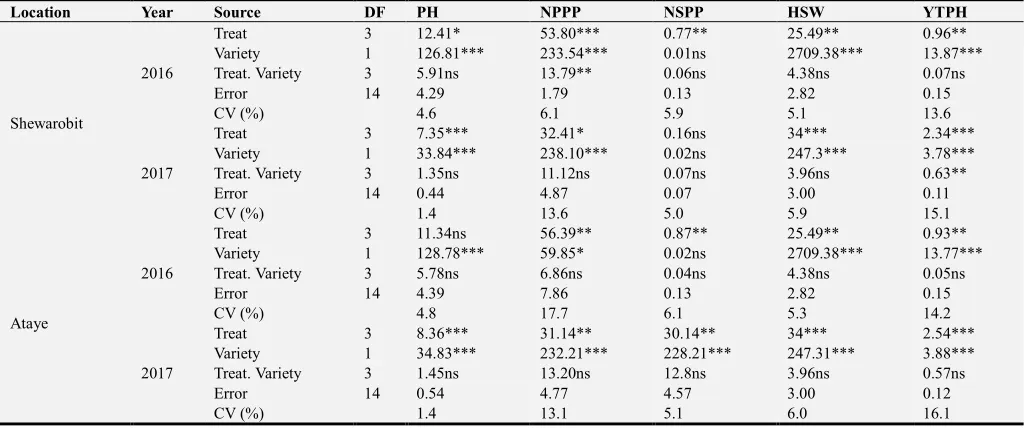
The management practices such as row intercropping, compost application and their combination significantly (P<0.05) affected plant height of common bean was compared to sole planting (SP) in 2016 cropping season at Shewarobit and Ataye (Table 2). Plant height was also significantly (P<0.001) affected by variety at in both locations and both cropping seasons (Table 2). During 2016, the plant height of variety Awash Melka was higherby 10.9% and 11.3% at Shewarobit and Ataye respectively, when compared to plant of Mexican 142. On the contrary, during 2017 cropping season, higher plant
height was obtained from Mexican 142 by 4.7% and 4.9% at Shewarobit and Ataye respectively compared to Awash Melka variety. Plant height was highest (50.0 cm) in the row intercroppingat Shewarobit in 2017 cropping season and was significantly lowest (41.5 cm) in compost application at Ataye in 2016 season (Table 3).
varieties was recorded during 2017cropping season than 2016 at both locations in all treatments.
Table 2. Analysis of variance with mean squares for the yield and yield components of 4 agronomic practices on two common bean varieties at Shewarobit and Ataye during 2016 and 2107 main cropping season(n=24).
Location Year Source DF PH NPPP NSPP HSW YTPH
Shewarobit
2016
Treat 3 12.41* 53.80*** 0.77** 25.49** 0.96**
Variety 1 126.81*** 233.54*** 0.01ns 2709.38*** 13.87***
Treat. Variety 3 5.91ns 13.79** 0.06ns 4.38ns 0.07ns
Error 14 4.29 1.79 0.13 2.82 0.15
CV (%) 4.6 6.1 5.9 5.1 13.6
2017
Treat 3 7.35*** 32.41* 0.16ns 34*** 2.34***
Variety 1 33.84*** 238.10*** 0.02ns 247.3*** 3.78***
Treat. Variety 3 1.35ns 11.12ns 0.07ns 3.96ns 0.63**
Error 14 0.44 4.87 0.07 3.00 0.11
CV (%) 1.4 13.6 5.0 5.9 15.1
Ataye
2016
Treat 3 11.34ns 56.39** 0.87** 25.49** 0.93**
Variety 1 128.78*** 59.85* 0.02ns 2709.38*** 13.77***
Treat. Variety 3 5.78ns 6.86ns 0.04ns 4.38ns 0.05ns
Error 14 4.39 7.86 0.13 2.82 0.15
CV (%) 4.8 17.7 6.1 5.3 14.2
2017
Treat 3 8.36*** 31.14** 30.14** 34*** 2.54***
Variety 1 34.83*** 232.21*** 228.21*** 247.31*** 3.88***
Treat. Variety 3 1.45ns 13.20ns 12.8ns 3.96ns 0.57ns
Error 14 0.54 4.77 4.57 3.00 0.12
CV (%) 1.4 13.1 5.1 6.0 16.1
PH= Plant height, NPPP= Number pods per plant, NSPP= Number of seeds per pod, HSW= Hundred seed weight, YTPH= Yield ton per hectare, CV= Coefficient of Variation; *, **, ***, are significant at p ≤ 0.05, P<0.01 and p ≤ 0.001 probability levels respectively, ns is non-significant, CA = compost application, RI = row intercropping, RI + CA = row intercropping + compost apllication, SP= sole planting.
3.2. Number of Pods per Plant
Number of pods per plant was significantly (P<0.01) affected by management practices at Ataye in both cropping seasons. Number of pods per plant was significantly (P<0.001) affected by management practices at Shwarobit during 2016 (Table 2). Likewise, the number of pods per plant was also significantly (P<0.001) affected by variety in both cropping seasons at Shewarobit and during 2017 at Ataye. Significantly, higher number of pods per plant was obtained from Mexican 142 than Awash Melka at both locations and both cropping
seasons. At Shewarobit, the number of pods per plant in Mexican 142 was higher by 24.9% and 32.4% than Awash Melka in 2016 and 2017 cropping seasons, respectively. Higher number of pods per plant was recorded in 2016 than 2017 cropping season at Shewarobit and in 2017 than 2016 at Ataye. Awash Melka and Mexican 142 had 44.9% and 30.5% higher number of pods per plant, respectively, in 2017 compared to 2016 cropping season at Shewarobit. The number of pods per plant of variety Awash Melka at Ataye in 2017 was higher by 12.1% compared to that of in 2016 (Table 3).
Table 3. Effects of intercropping, compost application and their integration on grain yield of common bean at Shewarobit and Ataye in 2016 and 2017 cropping seasons.
Location Shwarobit Ataye
year Variety PH HSW NPPP NSPP YTPH PH HSW NPPP NSPP YTPH
2016
Awash Melka 47.0 43.6 18.8 6.1 3.5 45.5 42.1 14.3 5.9 3.0
Mexican 142 42.4 22.3 25.0 6.1 1.9 40.9 20.8 17.5 5.9 1.5
LSD 2.3 2.1 2.8 0.2 0.4 2.2 2.4 3.2 0.4 0.5
Management Practices
CA 43.0 31.8 23.8 5.8 3.2 41.5 30.3 13.3 5.6 2.9
RI 45.8 33.7 20.6 6.5 2.3 44.3 32.2 18.6 6.3 2.1
RI+CA 45.9 35.5 18.3 6.4 2.4 44.4 34.0 18.5 6.2 2.2
SP 44.3 30.8 24.9 5.8 2.9 42.8 29.3 13.1 5.6 2.6
LSD 4.2 14.2 4.8 0.6 1.3 3.8 12.7 3.8 0.3 1.1
2017
Awash Melka 47.8 32.6 13.0 5.4 2.6 45.8 32.1 13.7 5.3 2.2
Mexican 142 50.17 26.1 19.2 5.3 1.8 48.2 25.6 19.9 5.2 1.4
LSD 1.0 2.3 2.6 0.3 0.6 1.1 2.4 2.7 0.2 0.6
Management Practices
CA 48.2 26.9 14.6 5.3 3.0 46.2 26.4 15.3 5.2 2.6
RI 50.0 30.4 17.3 5.4 1.6 48.0 29.9 18.0 5.3 1.2
RI+CA 49.9 32.2 18.6 5.5 1.8 47.9 31.7 19.3 5.4 1.4
SP 47.9 27.9 13.8 5.1 2.4 45.9 27.4 14.5 5.0 2.1
LSD 1.8 4.7 5.0 0.3 0.7 1.9 5.0 5.3 0.3 0.8
With respect to management practices, the highest number of pods per plant (24.9) was found in sole planting in 2016 and the lowest (13.8) from Sole planting in 2017 at Shewarobit. At Ataye, the highest (19.3) number pods per plant was obtained from row intercropping and compost application during 2017 and the lowest (13.1) was obtained from sole planting during 2016 cropping season. Row intercropping + compost application increased the mean number of pods per plant significantly by 35% and 33.3%, at Shewarobit and Ataye respectively, compared to sole planting in 2017 cropping season (Table 3). Row intercropping + compost application increased the mean number of pods per plant by 41.1% compared to sole planting at Ataye in 2016 cropping season.
3.3. Number of Seeds per Pod
Number of seeds per pod was significantly (P<0.05) affected by management practices in both cropping seasons and at both locations. On the other hand, the number of seeds per pod was not significantly affected by variety in both cropping seasons at Shewarobit and in 2016 at Ataye. Significantly, higher number of seeds per pod was obtained from Awash Melka than Mexican 142 at both locations in 2017. In 2016, the number seeds per pod of both varieties were similar at both locations. At Ataye, the number of seeds per pod in Mexican 142 variety was higher by 18.1% and 31.3% in 2016 and 2017 respectively than Awash Melka variety (Table 3).
In 2016 at Shwarobit, the mean number of seeds per pod was higher in the row intercropping and was significantly lower in the sole planting and compost application. At Ataye, the mean number of seeds per pod was significantly higher in the row intercropping and row intercropping + compost application and was significantly lower in the sole planting and compost application in 2016 cropping season.
3.4. Hundred Seed Weight
Hundred seed weight was significantly (P<0.01) affected by management practices during both cropping seasons and locations. It was also significantly (P<0.001) affected by variety in both cropping seasons and locations. Hundred seed weight was highest (35.5 g) in the row intercropping + compost application at Shewarobit in 2016 and was significantly lowest (23.8 g) in the compost application at Ataye during 2016. At Ataye, the mean 100-seed weight was the highest (34.0g) in the row intercropping + compost application in 2016 and was significantly the lowest (26.4g) in the compost application in 2017 cropping season.
Hundred seed weight was significantly higher for variety Awash Melka than Mexican 142 in both cropping seasons and locations (Table 3). The mean 100-seed weight of variety Awash Melka was higher by 95.2% and 24.6% in 2016 and 2017 cropping season, respectively, at Shewarobit and by 102% and 25%in 2016 and 2017 cropping seasons respectively, at Ataye. Row intercropping + compost application increased the mean 100-seed weight significantly
by 15.4% and 15.2% at Shewarobit in 2016 and 2017 cropping season, respectively, as compared to sole planting. Similarly, Row intercropping + compost application increased the mean 100-seed weight by16.2% and 15.6% in 2016 and 2017 cropping seasons respectively, compared to sole planting at Ataye. Row intercropping at both locations during both cropping seasons increased the mean 100-seed weight as compared to sole planting (Table 3).
3.5. Grain Yield
Grain yield weight was significantly (P<0.001) affected by management practices in both cropping seasons at both locations (Table 2). Likewise, grain yield was significantly (P<0.001) affected by the common bean variety where variety Awash Melka had significantly higher average grain yield (t ha-1) than variety Mexican 142 at both locations and in both cropping seasons. At Shewarobit, in 2016, the average yield of variety Awash Melka was higher by 34.1% compared to that of 2017 and the average yield of variety Mexican 142 was higher by 9.3% than that of 2017. Likewise, at Ataye, in 2016, the average yield of variety Awash Melka was higher by 33.7% compare to the average yield of Mexican 142 in 2017. The average yield of both varieties was significantly higher at Shewarobit compared to Ataye in both cropping seasons (Table 3).
At Shewarobit, the mean grain yield (t ha-1) was highest (3.2) in the compost application and was significantly lowest (2.3) in the row intercropping in 2016. In 2017, the mean grain yield (t ha-1) was highest (3.0) in the compost application and was significantly lowest (1.6) in the row intercropping at Shewarobit. At Ataye, the mean grain yield (t ha-1) was highest (2.9) in the compost application and was significantly lowest (2.1) in the row intercropping in 2016. In 2017, the mean grain yield (t ha-1) was highest (2.6) in the compost application and was significantly lowest (1.2) in the row intercropping at Ataye.
Compost application increased the average yield of common bean by 10.1% and 22.4%, respectively, in 2016 and 2017 compared to sole planting at Shewarobit meanwhile it also increased the average yield by 11%and 25.8% in 2016 and 2017respectively at Ataye compared to sole planting. Relatively lower yield was obtained from intercropping plots than sole plots at both locations and in both seasons.
3.6. Land Equivalent Ratio
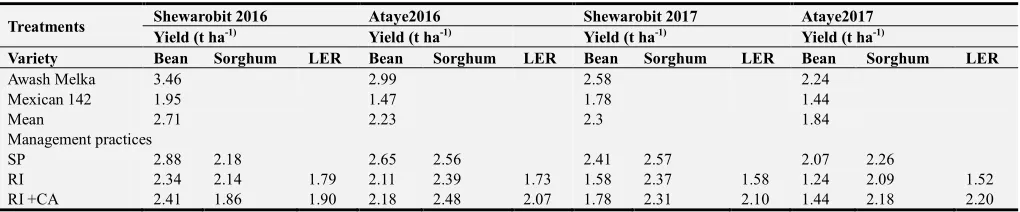
in the row intercropping at Ataye in the same cropping season (Table 4).
Table 4. The effect of intercropping on yields and land equivalent ratio (LER) at Shwarobit and Ataye in 2016 and 2017 cropping seasons.
Treatments Shewarobit 2016 Ataye2016 Shewarobit 2017 Ataye2017
Yield (t ha-1) Yield (t ha-1) Yield (t ha-1) Yield (t ha-1)
Variety Bean Sorghum LER Bean Sorghum LER Bean Sorghum LER Bean Sorghum LER
Awash Melka 3.46 2.99 2.58 2.24
Mexican 142 1.95 1.47 1.78 1.44
Mean 2.71 2.23 2.3 1.84
Management practices
SP 2.88 2.18 2.65 2.56 2.41 2.57 2.07 2.26
RI 2.34 2.14 1.79 2.11 2.39 1.73 1.58 2.37 1.58 1.24 2.09 1.52
RI +CA 2.41 1.86 1.90 2.18 2.48 2.07 1.78 2.31 2.10 1.44 2.18 2.20
LER = Land eqiuvalent ratio, RI = row intercropping, RI + CA = row intercropping + compost apllication, SP = sole planting.
4. Discussion
Plant height, number of pods per plant, number of seeds per pod, 100-seed weight and grain yield were significantly affected by applied management practices. The highest plant height was obtained from the row intercropping applied plots of Mexican 142 variety at Shwarobit in 2016 might be due to the indeterminate growth and climbing nature of Mexican 142 to component crop, the sorghum. There was a decreasing trend in yield and yield components from the integrated management practices to the sole planting.
The result of this study revealed that there is the synergic effect of the intercropping and compost application in increasing yield and yield components. It is important to note that the benefits of cultural management practices discussed above are season and location specific that is why compost relatively higher plant heights were obtained from intercropping, compost application and their integration varied in locations and seasons compared to sole planting control plots. The intercropped management practices, significantly increased plant height, number of pods per plant, number of seeds per pod and 100-seed weight and grain yield of both crops than sole planting at both locations and both cropping seasons, which might be due to relatively higher rainfall and lower mean temperature.
The cultural management practices were more effective when they were integrated and when the risk factors are minimized. At Ataye, there was heavy frost on 14 October 2016, when the crop was at physiological maturity, which might be the cause for reduction in yield and yield components, especially 100 seed weight of variety Mexican 142, the late maturing variety. It is highly observed that relatively lower yield obtained from intercropping was compensated by the yield of the component crop (sorghum) when evaluated using land equivalent ratio (LER) and all of the intercropping plots had additional yield advantage over sole crop of common bean.
The present study revealed that intercropping, compost application and their integration tested at Shewarobit and Ataye are feasible in conserving soil moisture, increasing productivity of common bean, averting crop failure risks, hence increasing climate change resilience. This result was in agreement with the reports of Niggli et al. [15] that described
sustainable land management practices such as compost application and crop diversification can improve soil carbon sequestration, crop yields and enhances resilience to climate change and increasing crop productivity (Bryan et al., [28]. Compost application had increased yield and yield components of both crops might be due to the availability of major elements of plant nutrients. In addition to its long-term effect of maintaining soil chemical property and physical structure, reduces emissions of greenhouse gases by compensating utilization of inorganic fertilizers harmful to the atmosphere [15].
In general, the results of present study showed that the integration row intercropping with compost application could be applied to increase the climate change resilience at higher extent, although the optimal integration of strategies depends on a number of factors including crop variety, soil type and agro-ecological zone.
5. Conclusion and Recommendation
Application of combined cultural management practices in field experiments increased yield and yield components of common bean when compared to singly applied management practices and sole planting in common beans across seasons and over locations. In addition, row intercropping with compost application, showed promising results in maintaining soil temperature and moisture. Thus, it could be concluded that farmers in central Ethiopia should design a strategy to promote common bean production through the application of row intercropping with compost application to improve the physico-chemical properties of soil and sustain enhanced production and productivity of common bean. It is strongly believed that the management practices would serve as ecofriendly disease management option and would enhance soil fertility management, contribute substantially to the efforts of increase in food production in the study area.
Acknowledgements
research center for their assistance in data collection. The research was financed by Debere Berhan Research Center and Debre Berehan University.
References
[1] Fininsa, C. and Yuen, J. (2001). Association of Bean Rust and Common Bacterial Blight Epidemics With Cropping Systems in Hararghe Highlands, Eastern Ethiopia. International Journal of Pest Management, 47(3): 211-219.
[2] Fininsa, C. (2003). Relationship between Common Bacterial Blight Severity and Bean Yield Loss in Pure Stand and Bean-Maize Intercropping Systems. International Journal ofPest Management, 49(3): 177-185.
[3] Shimelis, E., Meaza, M. and Rakshit, S. (2006). Physico-Chemical Properties, Pasting Behavior and Functional Characteristics of Flours and Starches from Improved Bean (Phaseolus vulgaris L.) varieties grown in East Africa. Agriculture and Engineering International, 8(1): 05-15.
[4] Lemessa, F., Sari, W. and Wakjira, M. (2011). Association between Angular Leaf Spot (Phaeoisariopsis Griseola (Sacco) Ferraris) and Common Bean (Phaseolus vulgaris L.) Yield Loss At Jimma, Southwestern Ethiopia. Plant Pathology Journal, 110(2):57-65.
[5] Martin-cabrejas, M. A., Eseban, R. M., Perez, P., Maina, G. and Waldron, K. W. (1997). Changes in Physico Chemical Properties of Dry Beans (Phaseolus vulgaris L.) during Long-Term Storage. Journal of Agriculture and Food chemistry, 45(1):3223-3227.
[6] Buruchara, R., Chirwa, R., Sperling, L., Mukankusi, C., Rubyogo, J. C., Muthoni, R. A. and Abang, M. M. (2011). Development and Delivery of Bean Varieties in Africa: The Pan-Africa Bean Research Alliance (PABRA) Model. African Crop Science Journal, 19 (4): 227-245.
[7] Martin-cabrejas, M. A., Eseban, R. M., Perez, P., Maina, G. and Waldron, K. W. (1997). Changes in Physico Chemical Properties of Dry Beans (Phaseolus vulgaris L.) during Long-Term Storage. Journal of Agriculture and Food chemistry, 45(1):3223-3227.
[8] Bindera, J. (2009). Technical Report on Analysis of Haricot Bean Production, Supply, Demand and Marketing Issues in Ethiopia. Ethiopia Commodity Exchange Authority, Ethiopia. pp. 10-22.
[9] Tana, T., Fininsa, C. and Worku, W. (2007). Agronomic Performance and Productivity of Common Bean (Phaseolus Vulgaris L.) Varieties in Double Intercropping with Maize (Zea mays L.) in Eastern Ethiopia. Asian Journal of Plant Science, 6(1):749-756.
[10] Katungi, E., Farrow, A., Chianu, J., Sperling, L. and Beebe, S. (2009). Base Line Research Report on Common Bean in Eastern and Southern Africa: A Situation and Outlook Analysis of Targeting Breeding and Delivery Efforts to Improve the Livelihoods of the Poor in Drought Prone Areas. ICRISAT, Uganda. PP.1-126.
[11] CSA (Central Statistical Agency) (2016). Statistical Bulletin on Area and Production of Crops, (Private Peasant Holding, Meher Season). Central Statistical Agency, Ethiopia. pp 1-126.
[12] Ghini, R., Hamada, E. and Bettiol, W. (2008). Review on Climate Change and Plant Diseases. Science and Agriculture Journal, 65(1):98-107.
[13] IPCC (Inter-governmental Panel on Climate Change) (2007). Fourth Assessment Report on Climate Change Mitigation. Contribution of Working Group of the Intergovernmental Panel on Climate Change. Cambridge University Press, Cambridge, New York, USA.
[14] Garrett, K. A., Dendy, S. P., Frank, E. E., Rouse, M. N. and Travers, S. E. (2006). Climate Change Effects on Plant Disease: Genomes To Ecosystems. Annual Review of Phytopathology, 44(1):489–509.
[15] Niggli, U., Fliebbach, A., Hepperly, P. and Scialabba, N. (2009). Low Greenhouse Gas Agriculture: Mitigation and Adaptation Potential of Sustainable Farming Systems. FAO, Italy.
[16] Newton, A. C., Johnson, S. N. and Gregory, P. (2011). Implications of Climate Change for Diseases, Crop Yields and Food Security. Euphathology, 179(1):3–18.
[17] Valipour, M. 2015. Importance of solar radiation, temperature, relative humidity, and wind speed for calculation of reference evapotranspiration. Archives of Agronomy and Soil Science, 61(2): 239–255.
[18] Wang, Q., Zhang, E. H., Li, F. M. and Li, F. R. (2008). Runoff Efficiency and the Technique of Micro Water Harvesting With Ridges and Furrows, For Potato Production in Semi-Arid Areas. Water Resource Mangement, 22: 1431–1443.
[19] Zhao, H., Xiong, Y. C., Li, F. M., Wang, R. Y., Qiang, S. C., Yao, T. F. and Mo, F. (2012). Plastic Film Mulch for Half Growing-Season Maximized WUE and Yield of Potato via Moisture-Temperature Improvement in A Semi-Arid Agroeco system. Agriculture and Water Management, 104: 68–78.
[20] Rahimi, S., Ali, M., Sefidkouhi, G., Raeini-Sarjaz, M. and Valipour. M. 2014. Estimation of actual evapotranspiration by using MODIS images (a case study: Tajan catchment). Archives of Agronomy and Soil Science, 61(5): 695-709.
[21] Grose, P. J. (2012). Restoring Seasonal Wetland Using Woven Black Plastic Weed Mat to Overcome a Weed Threshold. Ecological Management of Restoration, 13: 191–195.
[22] Matusso, J. M. M., Mugwe, J. N. and Mucheru-Muna, M. (2012). Research Application Summary on Potential Role of Cereal-Legume Intercropping Systems in Integrated Soil Fertility Management in Smallholder Farming Systems of Sub-Saharan Africa. Kenyatta University, Kenya.
[23] Sullivan, P. (2003). Agronomy Systems Guide on Intercropping Principles And Production Practices. Appropriate Technology Transfer for Rural Areas (ATTRA) Butte, California.
[24] Sanginga, N. and Woomer, P. L. (2009). Integrated soil fertility management in Africa: Principles, Practices and Development Process. Institute of the International Centre for Tropical Agriculture, Kenya.
[25] Seran, T. H. and Brintha, I. (2010). Review on Maize Based Intercropping. Journal ofAgronomy,9(3), 135-145.
[27] Shehata, S. A., Ahmed, Y. M., Emad, A. S. and Omaima, S. D. (2011). Influence of Compost Rates and Application Time on Growth, Yield and Chemical Composition of Snap Bean (Phaseolus vulgaris L.). Australian journal of Basic and Applied Science, 5(9): 530-536.
[28] Bryan, E., Ringler, C., Okoba, B., Koo, J., Herrero, M. and Silvestri, S. (2013). Can agriculture support climate change adaptation, greenhouse gas mitigation and rural livelihoods? Insights from Kenya. Climate Change, 118:151–165.
[29] DBARC (Deberebirhan Agricultural Research Center) (2014) Progress Report. Debereberhan, Ethiopia. Pp. 210-212.
[30] Molla, A. and Tekalign, A. (2010) Potato Based Intercropping in the Hot to Warm Moist Valleys of North Shewa, Ethiopia. World Journal of Agricultural Sciences, 6(5):485-488.
[31] EARO (Ethiopian Agricultural Research Organization) (2004). Directory of Released Varieties and Their Recommended Cultural practices. EARO, Addis Ababa, Ethiopia. Pp.1-36.
[32] Mead, R. and Wiley, R. W. (1980). The Concept of a ‘Land Equivalent Ratio’ and Advantages in Yield from Intercropping. J. Exp. Agr. 16(1):217-228.
[33] SAS (Statistical Analysis System). 2003. SAS/STAT Guide for Personal Computers, version 9.1 Eds. SAS Institute Inc., NC.
[34] Gomez, K. A. and Gomez, A. A. (1984). Statistical Procedures for Agricultural Research. 2nd Edition. Willey Interscience Publication, New York.