
INTERNATIONAL JOURNAL OF PHARMACEUTICAL, CHEMICAL AND BIOLOGICAL SCIENCES
Available online at
www.ijpcbs.com
METHOD DEVELOPMENT AND VALIDATION FOR SIMULTANEOUS
ESTIMATION OF RESVERATROL AND GALLIC ACID BY RP-HPLC
Monika Gupta
*and Amandeep Kaur
Amar Shaheed Baba Ajit Singh Jujhar Singh Memorial College of pharmacy,
Bela, Ropar-1401 11, Punjab, Chandigarh, India.
INTRODUCTION
Resveratrol (3,5,4’-trihydroxy-trans-stilbene) is a stilbenoid (Fig. 1a), a type of natural phenol, and a phytoalexin produced by several plants in response to injury or, when the plant is under attack by pathogens such as bacteria or fungi. Most resveratrol capsules sold in the U.S. contain extracts from an Asian plant called Polygonum cuspidatum. It is used in the treatment of cancer, heart diseases, Alzheimer and diabetes. Resveratrol can inhibit the phosphatidylinositol 3-kinase (P13K)/Akt pathway to regulate cell differentiation, growth, proliferation, and several other activities12-14. Gallic acid is a trihydroxybenzoic acid (Fig. 1b), a type of phenolic acid, found in gallnuts, sumac, witch hazel, tea leaves, oak bark, and other plants. It is found both free and as part of hydrolysable tannins. It possesses various
pharmacological activities like cancer, microbial, fungal, antioxidant and anti-inflammatory. It has pro-oxidant property in concentration dependent manner which induces the apoptotic signaling pathway in cancerous cells. Moreover, it has been revealed that matrix metallo proteinase-2 (MMP-2) and MMP-9 proteolytic activities were inhibited via gallic acid15-17.
The combination of these two drugs is not official in any pharmacopoeia; hence no official method is available for their simultaneous estimation. The aim of the present work was to develop simple, precise, accurate and reproducible RP-HPLC method for simultaneous determination of resveratrol and gallic acid. The proposed method was optimized and validated in accordance with ICH guidelines.
Research Article
ABSTRACT
In this study, a simple, fast, accurate, precise, reproducible, reverse phase high performance liquid chromatographic method have been developed and validated for the simultaneous estimation of Resveratrol and Gallic acid in pure drug form. The chromatography was carried out on a shimadzu LC-2010 ATVP prominence liquid chromatograph and using shimadzu
SPD-10AVP UV-Visible detector, an C-18, Nucleodur C18 having dimensions 5µ (250×4.6 mm)
column used as stationary phase, with a mobile phase consisting of Phosphate buffer pH 3 ±0.02 pH adjusted with ortho phosphoric acid and methanol and acetonitrile (50: 30: 20 v/v) at a flow rate of 1 ml/min and detection wavelength of Resveratrol and Gallic acid at 306 nm and 263 nm, respectively. The retention time of resveratrol was found to be 4.75 minute and retention time of gallic acid was 2.15 minute respectively. The proposed method has been validated for accuracy, precision, linearity, robustness and range were within the acceptance limit according to International Conference on Harmonisation (ICH) guidelines. The method was found to be
linear with r2 value of 0.998 for gallic acid and 0.999 for resveratrol. The calculated limit of
detection (LOD) values were 0.689207 and 0.130961 µg/mL and limit of quantitation (LOQ) values were 2.088505 and 0.39685 µg/mL for resveratrol and gallic acid correspondingly. The developed method can be successfully employed for the routine analysis of Resveratrol and
Gallic acid in API and Pharmaceutical dosage forms. Objective: The objective of present work
was method development and validation of RP-HPLC for estimation of Resveratrol and Gallic
acid.
(a)
OH OH HO
O OH
(b)
HO
OH
OH
Fig. 1: Chemical structure (a) Gallic acid (b) Resveratrol MATERIALS AND METHODS
CHEMICAL AND REAGENTS
The drug Resveratrol (RES) was gifted from Lupin laboratories [Aurangabad, Bihar] and Gallic acid was procured as a gift sample from Symbiosis pharmaceuticals private limited [Sirmor, H.P.]. Acetonitrile [HPLC grade] and triethylamine were purchased from Thermo fisher scientific india private limited [Mumbai] and glacial acetic acid purchased from Fischer scientific [Mumbai].
APPARATUS
Absorbance measurements were made on shimadzu UV-1800 UV/Visible spectrophotometer with 10 mm matched quartz cells. Chromatography was performed on shimadzu HPLC equipped with LC-10 ATVP pumps, SPD-10AVP UV-Visible detectors and rheodyne injector with a 50µL loop. Separation was performed on Nucleodur C18 column having dimensions 5µ (250×4.6 mm). Data acquisition and integration were performed using LC-solution version 6.42 software.
MATERIALS AND METHODS Chromatographic conditions
The method development for analysis of resveratrol and gallic acid was performed using various solvents. Final separation was achieved using a mobile phase consisting of buffer: methanol: acetonitrile (50: 30: 20 v/v) pumped at a flow rate of 1 ml/min. The eluent was monitored using a shimadzu SPD-10AVP UV-Visible detector at a wavelength of 263 and 306 nm for gallic acid and resveratrol respectively. The mobile phase was vacuum filtered through 0.22 µm nylon membrane filter followed by degassing in an ultrasonic bath prior to use.
Preparation of solutions Preparation of buffer solution
The buffer solution was prepared by dissolving 7.0g of potassium di hydrogen ortho phosphate in 1000ml of HPLC grade water and pH 3.0 was adjusted with orthophosphoric acid. It was filtered through 0.45µm nylon membrane filter and degassed with sonicator.
Preparation of blank solution
Acetonitrile and methanol in ratio of 50: 50 was used as blank solution.
Preparation of standard solution
The quantity of powder equivalent to 10 mg of resveratrol and gallic acid were weighed and transferred into 10 ml volumetric flask , 5 ml of diluent was added and sonicated for 15 minutes and the volume was made upto the mark with diluent. From this further dilution was made to get the final concentrations of resveratrol and gallic acid.
Validation of the developed method
The proposed analytical method was validated for system suitability, linearity and range, precision, limit of detection [LOD], limit of quantitation [LOQ] and accuracy in accordance with International Conference on Harmonisation (ICH) guidelines for analytical procedures Q2[R1]1-2
System suitability
System suitability factors were studied to verify the system performance study. Six replicate samples of both the drugs of concentration 10 µg/ml were analysed using the developed method. Various parameters such as theoretical plate count, tailing factor, percent relative standard deviation [%RSD] of peak area and retention/ capacity factor were taken into consideration for testing system suitability.
Specificity
Specificity is the ability of a method to discriminate the analyte response in the presence of other drugs, excipients, degradants and their potential impurities. In addition, specificity to show that there is no- elution of key analytes is demonstrated by a peak purity assessment using PDA or MS, or by comparing the results of the sample to those obtained by a second well characterized technique.
Accuracy and precision
proposed method, recovery tests are also carried out by analyzing the synthetic mixtures of the resveratrol and gallic acid. Parameters are concerned with the repeatability of method of a same concentration at different time periods, the recoveries from these sample mixtures were calculated for each compound.
Linearity
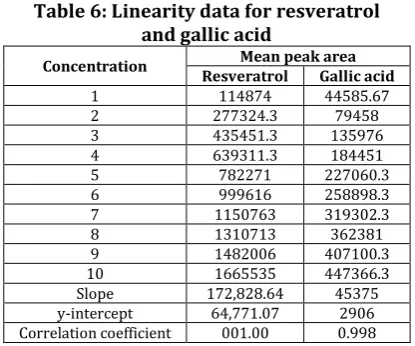
Linearity of the method was established by triplicate injections of the solutions containing the drugs in the range of 1-10 μg/ml for resveratrol and gallic acid separately at their λmax 306 and 263 nm. Resveratrol and Gallic acid, standard area was plotted against the concentration. The calibration curves were constructed and the acceptable fit to the linear regression was demonstrated and reported by the necessary parameters like regression coefficient, correlation coefficient, standard deviation and mean.
LOD and LOQ
Limit of detection and limit of quantification of the developed method were calculated from the standard deviation of the y-intercepts and slope of the calibration curve of resveratrol and gallic acid using the following formula:
Limit of detection = 3.3 σ/S Limit of quantitation = 10 σ/S
Where σ - Standard deviation (SD) of the y- intercepts
S – Slope of the calibration curve
Robustness and Ruggedness
Robustness is a measure of the performance of a method when small, deliberate changes are made to the specified method parameters such as in the Flow rate, Mobile Phase composition, Temperature Variation was made to evaluate the impact on the method. Ruggedness is the degree of reproducibility of results obtained by the analysis of the same sample under a variety of normal test conditions i.e. different analysts (i.e. from analyst to analyst from, laboratory to
laboratory). Acceptance criteria for ruggedness, the Percentage relative standard deviation for the area of five standard injections should not be more than 2%.
RESULTS AND DISCUSSION
Method development and Optimization of the method
Method development for resveratrol and gallic acid was started with a different combination of solvents with different ratios. Several trials were conducted with different isocratic or gradient mobile phases. However, finally a combination of methanol: buffer: acetonitrile 30:50:20 v/v has shown good resolution for resveratrol and gallic acid. To get a adequate separation increase and decrease in the flow rate was applied and finally 1.0 ml/min shows good resolution between the peaks of resveratrol and gallic acid.
Chromatographic conditions
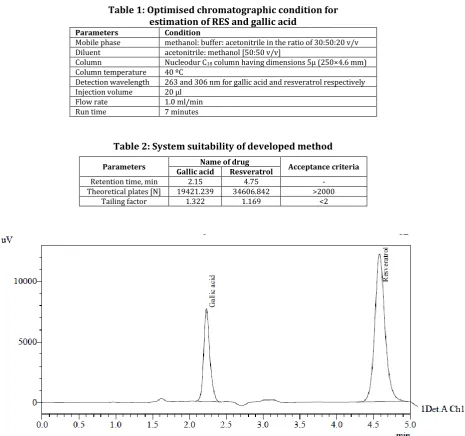
The analytical conditions were selected, keeping in mind the chemical nature of resveratrol and gallic acid. Several trails were taken using different conditions for the method development. Column selection has been done on the basis of back pressure, peak shape, theoretical plates and day-to-day reproducibility of the retention time. After evaluating all these factors, the chromatographic separation was carried out on Nucleodur C18 column having dimensions 5µ (250×4.6 mm) using a mobile phase methanol: buffer: acetonitrile in the ratio of 30:50:20 v/v, the flow rate 1.0 ml/min and the injection volume was 20 μl, the detection was carried out at 263 and 306 nm for gallic acid and resveratrol. The peak retention time of resveratrol and gallic acid were found to be 4.75 min and 2.15 min respectively. Hence this method was finalised as an optimized method for the estimation of resveratrol and gallic acid. The optimised chromatographic condition was shown in table 1.
Method validation System suitability
The developed method has produced theoretical plate above 2000 for resveratrol and gallic acid with tailing factor less than 2. Similarly, the percent relative standard deviation [%RSD] of peak area and retention time of resveratrol and gallic acid were less than 2, which ensure the suitability of the developed method. The results of the system suitability study were summarised in Table 2 and Fig.
Specificity
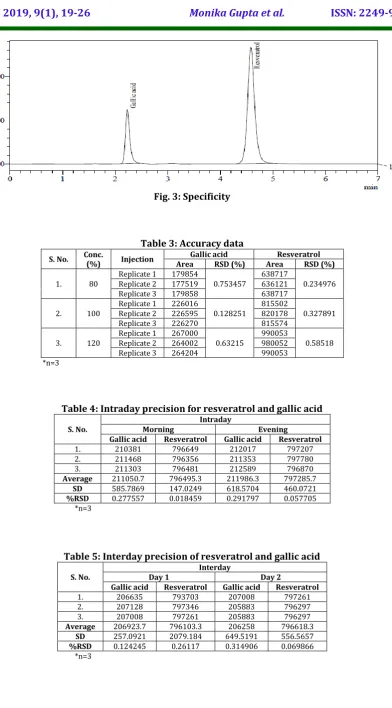
Study was performed by injecting blank. Specificity was carried out to determine whether there is any interference of any excipients and impurities in retention time of analytical peak. Specificity chromatogram was shown in Fig. 3, where the retention time of resveratrol does not interfere with the retention time of the gallic acid.
Accuracy
concentrations of standards. Results of recovery studies were summarised in Table 3
Precision
The developed method has shown percent relative standard deviation [% RSD] less than 2 for intra-day and inter-day precision study, which ensures precision of the developed method. The %RSD was found to be within the specified limits. Results of the precision study were summarised in Table 4 and 5.
Linearity
The linearity was established by the least squares linear regression analysis of the calibration curve. The constructed calibration curves were linear over the concentration range of 1-10 µg/ml for both the drugs. Standard areas of resveratrol and gallic acid were plotted against the concentration in the mobile phase, and linear regression analysis performed on the resultant curves and was confirmed by the high value of the correlation coefficients 0.998 for both drugs.
Results of resveratrol and gallic acid were summarised in Table 6.
Robustness
As per ICH, the prepared solution was analysed as per the proposed method with a slight variations in optimized conditions. The variations made were ±5 ºC in the temperature of column, ±0.1mL/min in the flow rate and ±5 nm in the wavelength. Results revealed that small changes could not hamper the suitability of the method (listed below Table 7 and 8).
Ruggedness
Ruggedness was determined by using the data obtained by the analysis performed by two different analysts and acceptance criteria for ruggedness, the Percentage relative standard deviation for the area of standard injections should not be more than 2%. Results were shown in Table 9.
LOD and LOQ
Limit of detection [LOD] and limit of quantification [LOQ] was estimated from the standard deviation of the y-intercepts and slope of the calibration curve of resveratrol and gallic acid. The LOD and LOQ for resveratrol were found to be 0.689207 and 2.088505 µg/ml respectively and LOD and LOQ for gallic acid were found to be 0.130961 and 0.39685 µg/ml respectively.
DISCUSSION
The LOD and LOQ value for the resveratrol and gallic acid obtained demonstrate the suitability
of the system for the analysis of the drugs; system suitability parameter may fall within ±2% range during routine performance of the method. To study the accuracy and reproducibility of the proposed method recovery experiment study were carried out, in this a fixed amount of pre analyzed sample taken and standard drug was added at 80%, 100%, and 120% level. Each level was repeated for three times. The mean recovery of resveratrol was in the range of 101.40-102.0 and that of gallic acid was in range of 98.43-101.02. Recovery data states that the proposed method is accurate and reproducible. These results concluded that the proposed method is better in comparison to previously reported method. In present method retention time of the resveratrol was 4.75 min which is least as compare to other method reported by Zhang et al., 20133; Singh et al., 20144; Cvetkovic et al., 20155; Singh et al., 20166; Kumar et al., 20167; that state the retention time of resveratrol is 11.5 min, 3.26 min, 2.535 min, 10 min, 4.34 min respectively and retention time of gallic acid was 2.15 min which is also least as compare to other methods reported by Zhang et al., 20133; Gurav et al., 20138; Fernandes et al., 20159; Damle et al., 201510; Pratima et al., 201711 that state the retention time of gallic acid is 5.883 min, 3.60 min, 8.5 min, 3.1 min and 6.4 min respectively. This shown that the run time of resveratrol and gallic acid is less than previous reported method. The LOD & LOQ value of resveratrol is 0.689207 µg/ml and 2.088505 µg/ml respectively, previously reported by Zhang et al., 2013 [0.007 & 0.023 µg/ml respectively]; Singh et al., 2014 [0.002 & 0.007 µg/ml respectively]; Cvetkovic et al., 2015 [0.125 & 0.413 µg cm-3 respectively]; Singh et al., 2016 [0.006 & 0.008 µg/ml respectively] and Kumar et al., 2016 [0.95 & 2.87 ng/ml respectively]. The LOD and LOQ value of gallic acid was found to be 0.130961 µg/ml and 0.39685µg/ml respectively, better than methods reported by Zhang et al., 2013 [0.032 & 0.098 µg/ml respectively ]; Gurav et al., 2013 [0.0178 & 0.0539 µg/ml respectively]; Fernandes et al., 2015 [1.22 & 1.82 µg/ml respectively]; Damle et al., 2015 [0.15 and 0.49 µg/ml respectively]; Pratima et al., 2017 [0.31 and 0.91 µg/ml respectively]. There results exhibited that the less sample is required for the quantitation and quantification of the drug. These data represent that this method is better than existing method and have less runtime compared to the previously reported method.
CONCLUSION
pharmaceutical preparations is stability indicating, precise, accurate and with a short run time. Method gives good peak resolution of resveratrol and gallic acid within short analysis time (<10 min) and high percentage of recovery shown that method is free from interference of excipients. The % RSD of each parameter lies below the limit of 2% proven the suitability. Method was fully validated showing satisfactory data for all the method validation parameters
tested. The developed method can be conveniently applied for the routine estimation of Gallic acid and Resveratrol.
ACKNOWLEDGEMENT
The authors acknowledge Lupin laboratories [Aurangabad, Bihar] and Symbiosis pharmaceuticals private limited [Sirmor, H.P.] for providing resveratrol and gallic acid as gift samples.
Table 1: Optimised chromatographic condition for estimation of RES and gallic acid
Parameters Condition
Mobile phase methanol: buffer: acetonitrile in the ratio of 30:50:20 v/v
Diluent acetonitrile: methanol [50:50 v/v]
Column Nucleodur C18 column having dimensions 5µ (250×4.6 mm)
Column temperature 40 ºC
Detection wavelength 263 and 306 nm for gallic acid and resveratrol respectively
Injection volume 20 µl
Flow rate 1.0 ml/min
Run time 7 minutes
Table 2: System suitability of developed method
Fig. 2: System suitability
Parameters Name of drug Acceptance criteria Gallic acid Resveratrol
Retention time, min 2.15 4.75 -
Theoretical plates [N] 19421.239 34606.842 >2000
Fig. 3: Specificity
Table 3: Accuracy data
S. No. Conc. (%) Injection Area Gallic acid RSD (%) Area Resveratrol RSD (%)
1. 80
Replicate 1 179854
0.753457
638717
0.234976
Replicate 2 177519 636121
Replicate 3 179858 638717
2. 100 Replicate 1 Replicate 2 226016 226595 0.128251 815502 820178 0.327891
Replicate 3 226270 815574
3. 120
Replicate 1 267000
0.63215
990053
0.58518
Replicate 2 264002 980052
Replicate 3 264204 990053
*n=3
Table 4: Intraday precision for resveratrol and gallic acid
S. No.
Intraday
Morning Evening
Gallic acid Resveratrol Gallic acid Resveratrol
1. 210381 796649 212017 797207
2. 211468 796356 211353 797780
3. 211303 796481 212589 796870
Average 211050.7 796495.3 211986.3 797285.7
SD 585.7869 147.0249 618.5704 460.0721
%RSD 0.277557 0.018459 0.291797 0.057705 *n=3
Table 5: Interday precision of resveratrol and gallic acid
S. No. Day 1 Interday Day 2
Gallic acid Resveratrol Gallic acid Resveratrol
1. 206635 793703 207008 797261
2. 207128 797346 205883 796297
3. 207008 797261 205883 796297
Average 206923.7 796103.3 206258 796618.3
SD 257.0921 2079.184 649.5191 556.5657
Table 6: Linearity data for resveratrol and gallic acid
Concentration Resveratrol Mean peak area Gallic acid
1 114874 44585.67
2 277324.3 79458
3 435451.3 135976
4 639311.3 184451
5 782271 227060.3
6 999616 258898.3
7 1150763 319302.3
8 1310713 362381
9 1482006 407100.3
10 1665535 447366.3
Slope 172,828.64 45375
y-intercept 64,771.07 2906
Correlation coefficient 001.00 0.998
Table 7: Robustness data for Resveratrol
Parameters Resveratrol
Retention time %amount found* %RSD
Temperature plus* (45 ºC) 4.416 102.3 0.894659
Temperature minus* (35 ºC) 4.588 102.2 1.233173
Flow rate plus* (1.1 ml/min) 4.759 102.3 0.55671
Flow rate minus* (0.9 ml/min) 4.895 102.8 0.968204
Wavelength plus* ( 311 nm) 4.452 98.2 0.260532
Wavelength minus* ( 301 nm) 4.433 102.1 1.963336
*n=3
Table 8: Robustness data for gallic acid
Parameters Gallic acid
Retention time %amount found* %RSD
Temperature plus* (45 ºC) 2.184 98.68 0.695691
Temperature minus* (35 ºC) 2.194 101.73 1.017611
Flow rate plus* (1.1ml/min) 2.412 102 1.352822
Flow rate minus* (0.9 ml/min) 2.434 100.41 1.291932
Wavelength plus* (268 nm) 2.186 101.98 0.382344
Wavelength minus* (258 nm) 2.203 102.53 0.41396
*n=3
Table 9: Ruggedness data for resveratrol and gallic acid
S. No.
Area
Analyst 1 Analyst 2 Gallic acid Resveratrol Gallic acid Resveratrol
1. 296386 949290 304720 982772
2. 299630 942019 303946 967160
3. 298815 986852 306061 986626
4. 298567 968447 302116 949362
5. 307706 987140 305294 991040
6. 303662 970681 302376 983862
Average 300794.3 967404.8 304085.5 976803.7
SD 4139.142 18719.38 1586.597 15688.45
REFERENCES
1. Gugulothu DB and Patravale VB. A New Stability-Indicating HPLC Method for Simultaneous Determination of Curcumin and Celecoxib at Single Wavelength: an Application to Nanoparticulate Formulation. Pharmaceut Anal Acta. 2012;3:1-6.
2. Tijare LK, Rangari NT and Mahajan UN. A Review on Bioanalytical Method Development and Validation. A J Pharm Clin Res. 2016;9:6-10.
3. Zhang A, Wan L, Cuiyun W, Fang Y, Guomin H, Hua L, Zhang Z and Wang H. Simultaneous Determination of 14 Phenolic Compounds in Grape Canes by HPLC-DAD-UV Using Wavelength Switching Detection. Molecules. 2013;18:14241-14257.
4. Singh G and Roopa SP. A Rapid Reversed-Phase HPLC Method for Analysis of Trans-Resveratrol in PLGA Nanoparticulate Formulation. ISRN Chromatography. 2014;1-6.
5. Cvetkovic ZS, Nikolic VD, Savic IM and Nikolic LB. Development and validation of an RP-HPLC method for quantification of trans-resveratrol in the plant extracts. Hem ind. 2015;69: 679–687.
6. Singh G, Roopa SP and Pandit V. Development and validation of a HPLC method for the determination of trans-resveratrol in spiked human plasma. J Adv Pharm Tech Res. 2016;3:130-135.
7. Kumar S, Lather V and Pandita D. Stability indicating simplified HPLC method for simultaneous analysis of resveratrol and quercetin in nanoparticles amd human plasma. Food Chemistry. 2016; 197:959-964.
8. Kardani K, Gurav N, Solanki B, Patel P and Patel B. RP-HPLC Method Development and Validation of Gallic acid in Polyherbal Tablet Formulation. Journal of Applied Pharmaceutical Science. 2013;3:037-042. 9. Fernandes FHA, Batista RS, Santos FS and
Medeiros ACD. Development of a rapid and
simple HPLC-UV method for determination of gallic acid in Schinopsis brasiliensis. Revista Journal of Farmacognosy. 2015;25:208-211.
10. Damle M, Dalavi N. Development and Validation of Stability Indicating HPLC Method for Determination of Ellagic and Gallic acid in Jambul Seeds (Syzygium Cumini). Int J Appl Sci Biotechnol. 2015;3:434-438.
11. Sushma V and Pratima A. Development and Validation of Stability Indicating RP- HPLC Method for Gallic acid. European Journal of Pharmaceutical and Medical Research. 2017;4:452-457.
12. International Conference on 11. Zotou A, Frangi E. Development and Validation of an SPE-LC Method for the Simultaneous Determination of trans-Resveratrol and Selected Flavonoids in Wine. Chromatographia. 2008;67:789–793. 13. Urbaniaka A, Delgado M, Kacprzak K and
Chambers TC. Activity of Resveratrol trimesters against primary acute lymphoblastic leukemia cells. Bioorganic & Medicinal Chemistry Letters. 2017;27: 2766-2770.
14. Fabjanowicz M, Wysyłka JP and Namieśnik J. Detection, identification and determination of resveratrol in wine. Trends in Analytical Chemistry. 2018;1-37.
15. Sawant NR and Chavan AR. Determination of Gallic acid from their Methanolic Extract of Punica granatum By HPLC Method. Int J ChemTech Res. 2013;5:2598-2602.
16. Verma S, Singh A and Mishra A. Gallic acid: Molecular rival of cancer. Enviornmental Toxicology and Pharmacology. 2013;35:473-485.
![Crystal structure, Hirshfeld surface analysis and PIXEL calculations of a 1:1 epimeric mixture of 3 [(4 nitrobenzylidene)amino] 2(R,S) (4 nitrophenyl) 5(S) (propan 2 yl)imidazolidin 4 one](data:image/gif;base64,R0lGODlhAQABAIAAAP///wAAACH5BAEAAAAALAAAAAABAAEAAAICRAEAOw==)