INTERNATIONAL JOURNAL OF PHARMACEUTICAL, CHEMICAL AND BIOLOGICAL SCIENCES
Available online at
www.ijpcbs.com
VALIDATION OF RP-HPLC METHOD FOR THE
ESTIMATION OF DOLASETRON IN INJECTION
Vamshi Sharatnath Kaveti
1, Vijay Kumar Kema
1,
Santhoshi Priya Dandamudi
2and Narender Boggula
2*1
Department of Pharmacognosy, Nalla Narasimha Reddy Education Society’s Group of
Institutions, School of Pharmacy, Chowdariguda, Ghatkesar, Telangana, India.
2
Department of Pharmaceutical Chemistry, School of Pharmacy, Anurag Group of
Institutions, Venkatapur, Ghatkesar, Telangana, India.
INTRODUCTION
Analysis is important in any product or service, but in drug it is very important as it involves life. In comparison to general consumer products, in drugs there is and there can be only quality/standard product and no other product1. This comes from series of tests from quality control, starting from raw materials in process during manufacture, finished product is the moral obligation to the patients, and hence the manufacture and quality of drugs should be
the detection of sample purity and standardization with accurate result for pharmaceutical uses2. HPLC is one among must useful tools available for quantitative analysis. Reverse Phase Chromatographyrefers to the use of a polar mobile phase with non-polar stationary phase in contract to normal phase being employed with a non-polar mobile phase HPLC is always used in injection with another analytical tool for quantitative and qualitative analysis. The mode of operation of
Research Article
ABSTRACT
By considering the current regulatory requirement for an analytical method development, a reversed phase high performance liquid chromatographic method for routine analysis of dolasetron in dosage form has been optimized using analytical quality by design approach. A simple, precise, rapid and accurate reverse phase HPLC method was developed for the estimation of dolasetron in injection dosage form. A column Altima (length 150mm, internal diameter 4.6mm; and 5µm particle size) was used. The mobile phase consisting 0.02M di potassium hydrogen orthophosphate buffer pH adjusted to 3 and acetonitrile in the ratio 20:80 (V/V). The flow rate was 1.0 ml/min and the effluents were monitored at 295 nm. The retention time was 11.57 min. The detector response was linear in the concentration of 20-60µg/ml. The respective linear regression equation being Y=3000181x+356238.2. The limit of detection and limit of quantification was 0.5µg/ml and 0.15µg/ml respectively. The assay of dolasetron in bulk was found to be 99.95%. From the recovery studies it was found that about 118.10 % on average of dolasetron was recovered which indicates high accuracy of the method. The method was validated by determining its accuracy, precision and system suitability. The results of the study showed that the proposed RP-HPLC method is simple, rapid, precise and accurate, which is useful for the routine determination of dolasetron in bulk drug and in its pharmaceutical dosage form.
gradient elution. The rate of distribution between stationary and mobile phase is controlled by diffusion process. A novel, simple and economic reverse phase high performance liquid chromatography (RP-HPLC) method has been developed for the quantification of Dolasetron in bulk and tablet dosage form with greater precision and accuracy3,4,5,6.
RP-HPLC (Reverse Phase High Pressure Liquid Chromatography) separates molecules on the basis of differences in their hydrophobicity. The components of the analytic mixture pass over stationary-phase particles bearing pores large enough for them to enter, where interactions with the hydrophobic surface removes them from the flowing mobile-phase stream. The strength and nature of the interaction between the sample particles and the stationary phase depends on both hydrophobic interactions and polar interactions. As the concentration of organic solvent in the eluent increases, it reaches a critical value for each analyte which desorbs it from the hydrophobic stationary-phase surface and allows it to elute from the column in the flowing mobile phase. The main principle involved in HPLC is adsorption. When a mixture of components is introduced into a HPLC column, they travel according to their relative affinities towards the stationary phase. The component which has more affinity towards the adsorbent travels slower. The component which has less affinity towards the stationary phase travels faster. Since no two components have the same affinity towards the stationary phase, the components are separated. The main principle involved in HPLC is adsorption. When a mixture of components is introduced into a
HPLC column, they travel according to their relative affinities towards the stationary phase. The component which has more affinity towards the adsorbent travels slower. The component which has less affinity towards the stationary phase travels faster. Since no two components have the same affinity towards the stationary phase, the components are separated. RP-HPLC method: For routine analytical purpose it is desirable to establish methods capable of analysing huge number of samples in a short time period with good robust, accuracy and precision without any prior separation step. HPLC method generate large amount of quality data which serve as highly powerful and convenient analytical tool 6.
Dolasetron is a 5-HT3 antagonist used in the prophylaxis treatment for women with predominant irritable bowel syndrome (IBS)7,8. IBS is a gastrointestinal disorder characterized by abdominal pain, distressed bowel function, and abdominal distension dolasetron was included in the United States Pharmacopeia (USP) prioritized list of chemical medicine monographs in 20139.
Literature survey reveals many chromatographic methods for the estimation of dolasetron in pharmaceutical dosage forms. But the availability of a HPLC method with high sensitivity and selectivity will be very useful for the determination of dolasetron in pharmaceutical formulations. The aim of the study was to develop a simple, precise and accurate reversed-phase HPLC method for the estimation of dolasetron in bulk drug samples and in pharmaceutical dosage form.
Drug profile
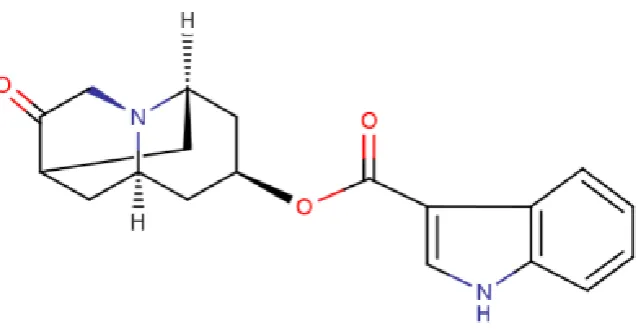
IUPAC name: 10-Oxo-8-azatricyclo [5.3.1.0] undec-5-yl 1H-indole-3-carboxylate.
Molecular formula C19H20N2O3
Molecular weight 324.374 g/mol
Category
Serotonin 5-HT3 receptor antagonist (used to treat nausea and vomiting following chemotherapy).
MATERIALS AND METHODS Experimental design
Table 1: Equipments and apparatus used S. No Equipment Make
1. pH Meter ELICOLI120
2. Sonicator Bandelin SONOREX Digital10P, Sigma Aldrich, India
3. Vacuum filter -
4. Analytical BalanceSartorius BP Sigma Aldrich, India
5. HPLC (Empower-2 Software)WatersAlliance 2695
Table 2: List of drugs used S. No Drugs Procured from
1. Dolasetron Hetero Drugs Limited
2. Dolasetron capsules (Anzemet® 50 mg) Aventis Pharmaceuticals
Table 3: List of reagents used S. No Reagents Specifications
1. Potassium dihydrogen phosphate HPLC grade (Qualigens)
2. Orthophosphoric acid Merck
3. Water HPLC grade, Millipak-40 Filter Unit, Merck Millipore
4. Methanol HPLC grade
5. Acetonitrile HPLC grade
6. Phosphate buffer Analytical grade
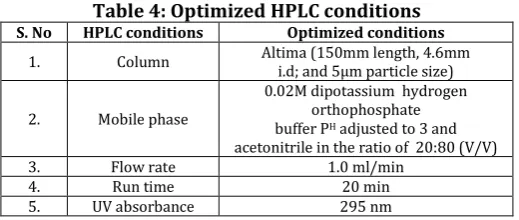
Table 4: Optimized HPLC conditions S. No HPLC conditions Optimized conditions
1. Column Altima (150mm length, 4.6mm i.d; and 5µm particle size)
2. Mobile phase
Preparation of Standard Stock solution A standard stock solution of the drug was prepared by dissolving 10 mg of dolasetron in 100 ml volumetric flask containing 10 ml of water, sonicated for about 15 min and then made up to 100 ml with water to get approximately 100µg/ml.
Working Standard solution
5ml of the primary standard stock solution of 100µg/ml was taken in 50 ml volumetric flask and thereafter made up to 50 ml with mobile phase to get a concentration of 50µg/ml.
Preparation of Sample solution
Anzemet® Injection (dolasetron mesylate injection) is a clear, colorless, non-pyrogenic, sterile solution for intravenous administration. Each milliliter of Anzemet ® Injection (dolasetron mesylate injection) contains 20 mg of dolasetron mesylate and 38.2 mg mannitol, USP, with an acetate buffer in water for injection. The pH of the resulting solution is 3.2 to 3.8. Anzemet Injection (dolasetron mesylate injection) multidose vials contain a clear, colorless, nonpyrogenic, sterile solution for intravenous administration. Each Anzemet multidose vial contains 25 ml (500 mg) dolasetron mesylate. Each milliliter contains 20 mg dolasetron mesylate, 29 mg mannitol, USP, and 5 mg phenol, USP, with an acetate buffer in water for injection. The pH of the resulting
solution is 3.2 to 3.7. Five vials of Anzemet multidose vial contains 25 ml (500 mg) dolasetron mesylate were collected and then mixed thoroughly. A sample of the blended sterile liquid, equivalent to 50 mg of the active ingredient was mixed with 70 ml of mobile phase in 100 ml volumetric flask. The mixture was allowed to stand for 1 hr with intermittent sonication for complete solubility of the drug, and then filtered through a 0.45 μm membrane filter, followed by addition of mobile phase upto 100 ml to obtain a stock solution of 500µg/ml. The resultant solution was further diluted by taking 5 ml of the stock solution with 50 ml of mobile phase to get the concentration of 50µg/ml.
RESULTS AND DISCUSSION
Validation for the method was carried out as per ICH Q2 (R1) guidelines. The validation parameters such as system suitability, linearity, recovery studies, robustness, detection limit, quantitation limit were studied.
System Suitability
The system suitability tests were carried out on freshly prepared standard stock solution of dolasetron. The system was suitable for use, the tailing factors for dolasetron were 1.85 and USP theoretical plates were found to be significantly high around 7245.
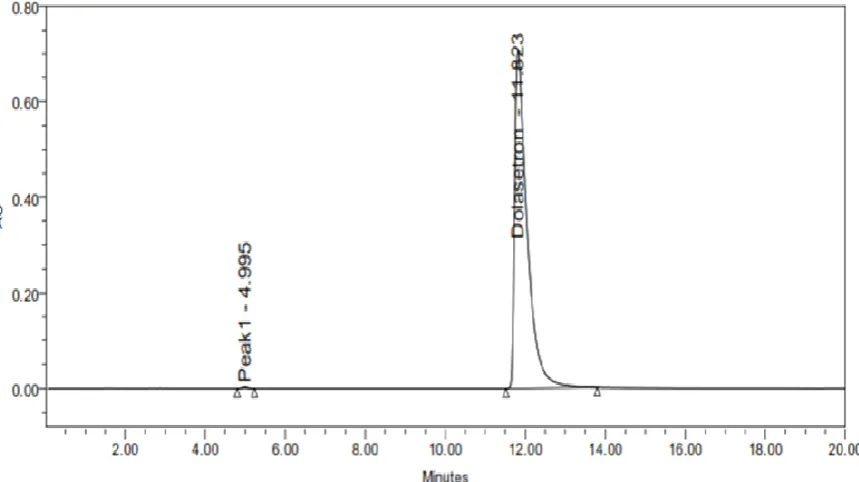
Fig. 3: Typical Chromatogram of dolasetron working sample (Anzemet®-500 mg I.V. Injections) solution
Precision
The HPLC systems was set up the described chromatographic conditions, mentioned as above and follow the system to equilibrate, and then injected the 50 µg/ml concentration of dolasetron standard 6 times and recorded the response (peak area). The proposed method was extended to the pharmaceutical dosage forms by injecting the 50 µg/ml of dolasetron
sample with the formulated sample from (Anzemet®-500mg, Sanofi Aventis, I.V. Injections) contains dolasetron of same concentration 6 times and recorded the response (peak area). The percent relative standard deviation and percent range of error (at 0.05 and 0.01 confidence limits) were calculated.
Table 5: Precision readings showing repeatability S. No. Concentration (µg/ml) Peak area Statistical analysis
1 50 8246
Mean=8247 SD=1.96 % RSD=0.02
2 50 8248
3 50 8244
4 50 8249
5 50 8245
Linearity
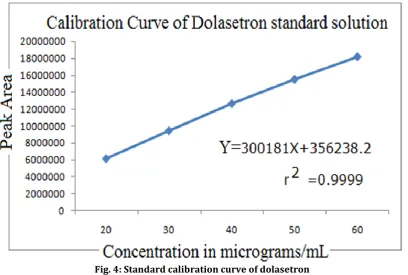
Aliquots of standard Dolasetron stock solution were taken in different 10 ml volumetric flasks and diluted up to the mark with the mobile phase such that the final concentrations of dolasetron are in the range of 20-60 μg/ml. Each
of these drug solutions (20 μL) was injected three times into the column, and the peak areas and retention times were recorded. Evaluation was performed with PDA detector at 295 nm and a calibration graph was obtained by plotting peak area versus concentration of Dolasetron.
Fig. 4: Standard calibration curve of dolasetron
Table 6: Optical & regression characteristics of HPLC method
Parameter Results of HPLC Method
Detection wavelength (nm) 295
Linearity range (µg/ml) 20-60
Regression Equation (y=mx + c) Y=3000181x+356238.2
Slope (m) 3000181
Intercept (c ) 356238.2
Correlation coefficient 0.9999
Relative Standard deviation* 0.1
Accuracy and recovery studies
Recovery studies were conducted by analyzing the concentration of 40 µg/ml of dolasetron, 50 µg/ml of Dolasetron and 60 µg/ml of dolasetron by the proposed method. Each concentration was injected 3 times and the peak area was recorded. Known amounts of pure drug (5 µg/ml) was then added to each 3 previously analyzed formulation and the total amount of the drug was once again determined by the proposed method (each concentration was again injected 3 times) after keeping the active ingredient concentration within the linearity limits.
Robustness
A method is robust if it is unaffected by small changes in operating conditions. To determine the robustness of this method, the experimental conditions were deliberately altered at two different levels and retention time and chromatographic response were evaluated. One factor at a time was changed to study the effect. Variation of the mobile phase flow rate was varied by ±10%) and different column had no significant effect on the retention time and chromatographic response of the method, indicating that the method was robust. When the chromatographic conditions were deliberately altered, system suitability results remained within acceptance limits and selectivity for individual substance was not affected. The results of the study prove the robust nature of the method.
Limit of Detection [LOD] and Limit of Quantification [LOQ]
The detection limit of the method was investigated by injecting standard solutions Dolasetron into the HPLC column. By using the signal-to-noise method the peak-to-peak noise around the analyte retention time is measured, and subsequently, the concentration of the analyte that would yield a signal equal to certain value of noise to signal ratio is estimated. A signal-to-noise ratio (S/N) of 3 is generally accepted for estimating LOD and signal-to-noise ratio of 10 is used for estimating LOQ. This method is commonly applied to analytical methods that exhibit baseline noise. The limit of detection (LOD) and limit of quantification (LOQ) for Dolasetron were found to be 0.05µg/ml and 0.15µg/ml respectively.
The method development and validation of HPLC was found to be accurate, precise and reliable. The method was proposed for the
studies should be preferred to evaluate the stability of Pharmaceutical formulation. The advantages of HPLC were high selectivity, sensitivity, economic, less time consuming and low limit of detection.
CONCLUSIONS
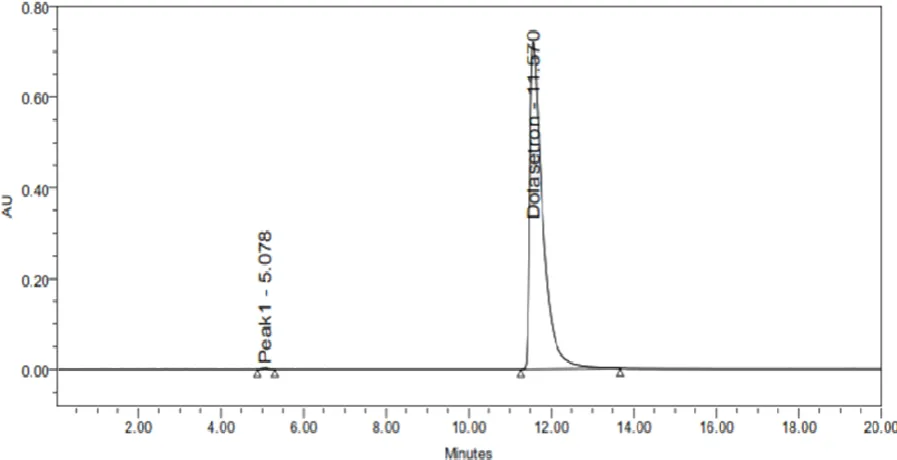
There are no reports on the HPLC determination of dolasetron in pharmaceutical formulations in the literature prior to commencement of this work. The author has developed a sensitive, accurate and precise HPLC for the estimation of dolasetron in bulk drug and in I.V. Injection dosage form. From the typical chromatogram of dolasetron as shown in fig 2, it was it found that the retention time was 11.570 min. The mobile phase consisting 0.02M di potassium hydrogen orthophosphate buffer PH adjusted to 3 and acetonitrile in the ratio 20:80 (V/V) in a isocratic mode of separation was used to resolute the Dolasetron at a flow rate of 1.0 ml/min and eluents were monitored at 284 nm, was found to be most suitable to obtain a peak well defined and free from tailing. In the present developed HPLC method, the standard and sample preparation required less time and no tedious extraction were involved. A good linear relationship (r2=0.9999) was observed between the concentration range of 100-300 µg/ml. The assay of Dolasetron in bulk was found to be 99.95%. From the recovery studies it was found that about 118.10 % on average of Dolasetron was recovered which indicates high accuracy of the method. The absence of additional peaks in the chromatogram indicates non-interference of the common excipients used in the I.V. Injections. This demonstrates that the developed HPLC method is simple, linear, accurate, sensitive and reproducible. Thus, the developed method can be easily used for the routine quality control of bulk and sterile powder for injection dosage form of dolasetron within a short analysis time. It can be seen from the results presented that the proposed procedure has good precision and accuracy. Results of the analysis of pharmaceutical formulations revealed that proposed methods are suitable for their analysis with virtually no interference of the usual additives present in the pharmaceutical formulations.
ACKNOWLEDGEMENT
research, inspiration, constant encouragement, facilities and support.
Conflicts of interest
There are no conflicts of interest.
REFERENCES
1. Kasture AV. Pharmaceutical analysis, volume 1, Published by NiraliPrakashan, 13th Edition, 1.1-1.8. 2. Sethi PD. Quantitative analysis of drug
in pharmaceutical formulation: CBS publication. 1993;2:11.
3. Beckett AH and Stenlake JB. Practical Pharmaceutical chemistry, University of London. Volume I,I 4th Edition. 1962 . 4. Gurdeep R Chatwal and Sham Anand.
Instrumental Methods of Chemical Analysis. 185-190.
5. James W Munson. Pharmaceutical Analysis Modern Method. 15-154. 6. Snyder LR, Kirkland JJ and Glajch JL.
Practical HPLC Method development., 2nd Edition. John Wiley and Sons. Newyork. 1997;165.
7. Diemunsch P, Leeser J, Feiss P, D’Hollander A, Bradburn BG and Paxton D. Intravenous dolasetron mesilate ameliorates postoperative nausea and vomiting. Can J Anesth. 1997;44:173-81. 8. Philip BK, Pearman MH, Kovac AL, Chelly JE, Wetchler BV and McKenzie R. Dolasetron for the prevention of postoperative nausea and vomiting following outpatient surgery with
general anaesthesia. A randomized, placebo-controlled study. The Dolasetron PONV Prevention Study Group. Eur J Anaesthesiol. 2000;17:23-32.
9. Graczyk SG, McKenzie R, Kallar S, Hickok CB, Melson T and Morrill B. Intravenous dolasetron for the prevention of postoperative nausea and vomiting after outpatient laparoscopic gynecologic surgery. Anesth Analg. 1997;84:325-30.
10. Ananda Kumar Chettupalli, Narender Boggula and Vivek Kunduru. Development and validation of capecitabine tablet (pharmaceutical dosage form) by using RP-HPLC method. IAJPS. 2017;4(03):550-557. 11. Ravichandran V, Shalini S, Sundram KM
and Harish R. Validation of anlyatical methods- strategies and importance. Int J Pharmacy and Pharm Sci. 2010;2(3):18-22.
12. Validation of analytical procedure: Methodology Q2B, ICH Harmonized Tripartite Guidelines. 1996;1-8.