The method to evaluate the susceptibility to injuries
during the fall – validation procedure of the specific
motor test
Maciej Roman Kalina
1ABCDE
, Bartłomiej Jan Barczyński
2ABCDE
, Krzysztof Klukowski
3,4AD
,
Józef Langfort
5D
, Bartłomiej Gąsienica-Walczak
6CE
1
Department of Physiotherapy, Academy of Physical Education, Katowice, Poland
2
Index Copernicus International S.A., Warsaw, Poland
3Military University of Technology, Warsaw, Poland
4
College of Physiotherapy, Wroclaw, Poland
5
Department of Sport Training, Academy of Physical Education, Katowice, Poland
6
Institute of Physiotherapy, The Podhale State Vocational School of Higher Education, Nowy Targ, Poland
Source of support:
Research project URWWF/S/04
Received:
19 September 2011;
Accepted:
10 October 2011;
Published online:
23 October 2011
Abstract
Background
In world literature an epidemiology of body injuries caused by the falls of people of different age and health condition is very well documented. However, there are not enough methods, which would make it possible to answer the ques-tion: which body parts of a given person are the most exposed to injuries during the fall and collision with a ground or other object. The aim of this paper is accuracy of “the susceptibility test of the body injuries during the fall” (STBIDF).Material/Methods: The structure of STBIDF is: three motoric tasks performed on a tatami mats. A manner of the body parts
protec-tion (head, hands, hips, legs) was being assessed, the most exposed to damage during the fall. Any incorrect colli-sion – simulated by the fastest possible change of the posture from vertical to horizontal (lying on the back), were documented by the errors of the first- (“1”) or the second grade (“2”), and no errors “0”. Total number of points is a general indicator of the susceptibility to body injuries during the fall (SBIDF): low (0), average (1–3), high (4–8), very high (9–14). Relatively for particular body parts (SBPIDF): low (0), average (1), high (2–6).The young, healthy, physically active women (n=68), who were insignificantly diversified in terms of the age (20–25 years, average 21.26), however considerably in terms of the somatic development – the mean range of the body height 27 cm and body weight 34 kg, were examined.
Results:
Most young women (57.35%) revealed a very high susceptibility to body injury caused by fall and collision with the ground or other obstacle and less than 6% showed the average susceptibility. The difference between the two proportions is statistically significant (p<0.005). Assuming a vertical posture as a reference system (also the ini-tial posture of all tasks STBIDF), the more young women are susceptible to damage of a certain part of the body during the fall, the more distant from the ground. There is no statistically significant difference only between the proportion of young women’s susceptibility to injury of hands and head during the fall. Both risks apply to more than 90% women. A very high convergence was found between results of individual tasks (made individually) and repeated simulation of falls of the same (Task 1) or very similar (Task 2 and 3) motor structure.Conclusions:
The test is simple and very safe tool and can be used for examining people of all ages who are able to indepen-dently change the posture from vertical to horizontal. The lack of ability to indepenindepen-dently rise from the horizon-tal posture does not exclude the possibility of applying the test. Quite the opposite, the researcher (doctor, phys-iotherapist etc.) obtains additional information that such person, after the fall may be deprived of aid, therefore is susceptible to the effects associated with long-term staying on the ground. The test is accurate tool to verify pre-vention programs.Key words: susceptibility test of the body injuries during the fall • collision avoidance • safe fall • exaggerated orthostatic response • epidemiology of injuries • ageing
Author’s address: Bartłomiej Barczyński, Index Copernicus International S.A., Al. Jerozolimskie 146 C, 02-305 Warsaw, Poland; e-mail: [email protected]
and Study Aim:
Authors’ Contribution:A Study Design
B Data Collection
C Statistical Analysis
D Manuscript Preparation
E Funds Collection
Volume 7
|
ISSUE 4|
2011|
203 © ARCHIVES OF BUDO|
HEALTH PREVENTIONB
ackgroundThe fall – depends on the context – is understood in two ways. From medical point of view, as a sudden, acciden-tal change of the position as a result of the loss of bal-ance (without the involvement of external forces) during walking or other activities, through which a person is on the ground or other low situated surface. We refer here to the definition, which Żak [1] based on the findings of Feder et al. [2] and Hauer et al. [3]. However we for-mulate one restriction: it is not true that the inevitable consequence of loss of balance and fall “is being injured”.
Injured may be primarily a person unable to fall safe-ly as well as well-prepared person, but in certain condi-tions having no control over the circumstances, which inevitably will cause certain damage to the body (i.e. during the fall in total darkness on the ground covered with sharp objects like glass, stones, etc.).
From theoretical point of view [4] and pragmatics of safe falling [5], the fall – accidental or intentional – is under-stood by us as a fully controlled operation. This means that in a situation of a sudden loss of balance (especial-ly due to external forces – i.e. slippery ground, pushing) a trained person immediately controls the different parts of the body, according to the falling direction (forward, backward, sideways and intermediate directions) and oth-er circumstances (force, identified voth-ertical obstacles etc.) and because of these circumstances either remains in a horizontal posture, or after the collision with the ground or some obstacle will return to the vertical posture. Fall deliberately caused, we understand as a motor response to emergency situations, which a person properly identi-fied and solved. Depending on the circumstances of ac-tion, after the safe fall the person either remains for some time in a horizontal posture or immediately returns to the vertical posture. The common assumption of motor action in both situations is the ability to control differ-ent parts of the body, so by the objective lack of exter-nal conditions of damage or structural failure, the colli-sion with the ground or a specific vertical obstacle would be properly absorbed by the human movement system.
In scientific international literature the epidemiology of injuries caused by falling of people of different age and health condition is very well documented. According to World Health Organization [6] falls are the second big-gest cause of unintentional death in the world and give way only to transport accidents. Every year about 424 000 deaths due to fall are reported, and the most sus-ceptible age group are people over 65 years old.
Based on many studies and simulations it is expected that as a result of extending the life of people falls will
affect an increasing number of older people. It is esti-mated that in England by 2025 the number of people over 65 years old will increase by three times, while over 80 years old will be doubled, and those exceeding 100 years old will be quadrupled [7, p. 5]. The authors of this report conclude that if no preventive action is tak-en, in 2025 the number of injuries of the oldest peo-ple as a result of falls and collisions will increase sig-nificantly. In the United States by 2040 the number of people over 65 will increase from 34 800 000 to 77 200 000, and in the group above 85 this ratio will be relatively higher [8].
The report of health and social consequences of falls is opened by fractures (64%), followed by fear of falling (44%), admission to hospital (32%), isolation (22%), loss of independence (14%), withdrawal from activity (12%), neurological damage (6%), social service home (2%) [9]. To fractures are exposed especially people with osteoporosis. The most fractures as a result of fall concern youths aged 15–18 and people over 60 [10]. However, fractures in children and youths do not often cause different complications, but the effects of falls of older people are a common cause of subsequent disability. Żak [1] summarizing the major results of epidemiologi-cal studies published in the years 1992–2005 states: in 1990 in the world came to about 1 600 000 fractures of the distal femoral epiphyses (forecast for 2050 is 6 260 000); fall is the cause of 25% of fractures of the spine; 90% fractures of the distal femoral epiphyses; 100% frac-tures of forearm; falls are the cause of more than 90% of non-vertebral fractures. Falls at home mostly occur in the bathroom, bedroom and kitchen. Persons hospi-talized frequently fall near the bed, in the toilet, in the bathroom and in the hallway. The cause of 50% falls is a slip or stumble, 10% syncope, 10% dizziness, while 20–30% are other balance disorders (when a person is changing position from sitting to standing, performs turns, leans or reaches for an item, or during the walk).
Many studies cited by Żak [1] show that 40% of older people who have fallen, although not injured, are not able to stand up alone. Long wait for help while lying on the ground or floor, causes a number of complica-tions (hypothermia, pneumonia etc.). One of the main factors that increases mortality after the fall is being in a horizontal posture for at least 1 hour [11]. Furthermore, effects of a long-term lying after the fall can be accumu-lated in some people with effects of exaggerated ortho-static response. In such a situation an adoption of ver-tical posture can cause a sudden loss of consciousness.
Multifactorial prevention strategy covers four areas: strength and balance training, elimination of home risk factors; improving eye, cardiovascular, and mental
204
|
2011|
ISSUE 4|
Volume 7 www.archbudo.comfunction; verification of drugs taken [12]. It is estimat-ed that it is possible to prevent 30–40% falls [13]. This means that in 60–70% circumstances, the fall is still in-evitable. Thus the weakness of similarly constructed sys-tems of injury prevention is focusing attention on re-ducing (decreasing) the number of falls in the course of daily or professional activities, however it is almost im-possible to avoid this kind of events (!). In our un-derstanding, this type of prevention programs should primarily support the general education of people (espe-cially children and youths) with a range of skills of safe falling and collision avoidance [4,5,14–17].
Apart from issue that there is no common implemen-tation of so defined injuries prevention, we determine objectively that there is also no commonly used diag-nostic methods that would enable us to answer the ques-tion: which parts of the body are the most exposed to injuries during the fall and collision with the ground or other object?
The aim of this paper is accuracy of “the susceptibility test of the body injuries during the fall” (STBIDF). Premises and assumptions of this test, by Roman M. Kalina, were published in Polish language edition of Medical Tribune in 2009 [16]. Thus adopted in Polish abbreviations for the name of this test and key indicators in glossary are compiled with English abbreviations.
For two reasons the test validation procedure is based pri-marily on the accuracy criterion. First of all, the aim which the test is supposed to serve and the need to ensure maxi-mal motor safety of analysed persons (especially older peo-ple) determine the accuracy as the most important crite-rion (!). Second – editorial limitations are decisive factor.
M
aterialandM
ethodsAssessment of the susceptibility to the body injuries during the fall
Subjects examined individually performed “the susceptibility test of the body injuries during the fall”
(STBIDF). Before the test they have remained in the room from which it was impossible to observe examined subjects. After the test they filled in the questionnaire concerning sports activities and past injuries, and then watched another examined person, without the possibil-ity to comment (in this way the verbal contact with ex-amined person and the awaiting people was prevented).
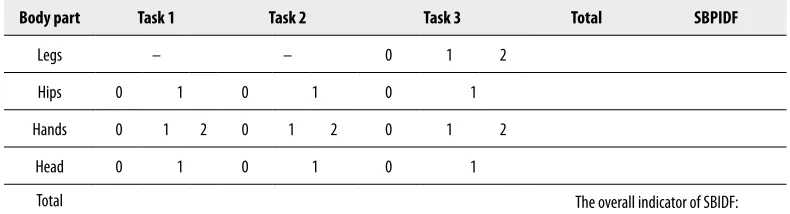
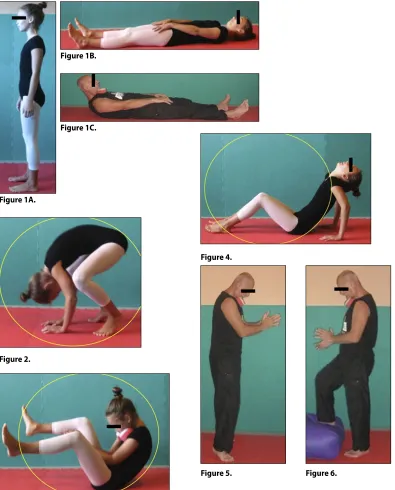
The test consists of three motor tasks, which should be performed on a soft surface (such as tatami mat). The criterion for evaluation is the way of protection (or lack) of those parts of the body, which during the fall are the most exposed to injury (head, hands, hips, legs). Each incorrect collision of that body part with the ground – simulated by the fastest possible change of vertical posture (Figure 1A) to the horizontal (lie down on the back Figure 1B) – should be recorded in the worksheet STBIDF (Table 1) by circling number “0” (no error), “1’ (first degree error) or “2” (second degree error).
Total number of points is a general indicator of suscep-tibility to injuries during the fall (SBIDF): low (0), av-erage (1–3), high (4–8), very high (9–14). The measure of susceptibility of the predetermined parts of the body to injuries (SBPIDF) is the sum of the points from all tasks (summarized points from the rows of the work-sheet) analyzed separately for the each parts of the body: low (0), average (1), high (2–6). The terms “susceptibil-ity level” relative to the indicators SBIDF and SBPIDF are used in the analysis of empirical data.
Marginal values of SBPIDF (as a result of adding er-rors made during the tasks) for the different parts of the body include between: legs 0–2; hips 0–3; hands 0–6; head 0–3. However the marginal values of adding points estimated after completing the Task 1 and 2 are in the range of 0 and 4 points, and Task 3 in the range of 0 and 6 points. For this reason a comparative analy-sis (for the parts of the body and each tasks) takes into account the indicator of proportion of errors (expressed in percentage) applied to the possible maximal value of estimated points (SBPIDF%max). For example, for the hands this value is 6 points and 2 points for legs. Body part Task 1 Task 2 Task 3 Total SBPIDF
Legs – – 0 1 2
Hips 0 1 0 1 0 1
Hands 0 1 2 0 1 2 0 1 2
Head 0 1 0 1 0 1
Total The overall indicator of SBIDF:
Table 1. Worksheet documenting the susceptibility to the body injuries during the fall.
Volume 7
|
ISSUE 4|
2011|
205 © ARCHIVES OF BUDO|
HEALTH PREVENTIONTask 1. Instructions for the test subject: “on the com-mand GO lie down on your back as fast as possible”. Performance: tested person should safely lie down on back as fast as possible – an attempt ends when heels, buttocks, back and head adhere to the ground (Figure 1A,B). When a person lies on the back and ad-here chin to chest (Figure 1C – what is primarily the essence of the correctness of lying on the back at the end of Tasks 2 and 3), it means that she has perfect control of the head during the fall (!) and attempt is considered valid.
Assessment: “hips” – hitting buttocks on the ground or during a change of posture from vertical to horizontal; keeping right angle or obtuse angle between the thighs and shanks 1 point; “hands” – leaning both hands on the back or hips, or elbows hitting the ground 2 points, same with one hand 1 point (leaning forward with one or both hands on the ground when squating prior to rolling on the back is correct – Figure 2), “head” – holding the head leaning back during postural changes from vertical to hor-izontal or hitting head on the ground, instead of resting head down gently when already lying on the back 1 point.
Correct performance of the task relies on fast squat with simultaneous tilt of the head forward and putting Figure 1A.
Figure 1B.
Figure 1C.
Figure 2.
Figure 5. Figure 6.
Figure 3.
Figure 4.
206
|
2011|
ISSUE 4|
Volume 7 www.archbudo.comhands forward – or leaning with both hands forward (Figure 2) – and gently rolling on the back and buttocks (“cradle”), keeping hands and head in front, adhering chin to chest (Figure 3). When lying on the back gen-tly touch the ground with heels and occiput. Similarly lie down on the back doing the Tasks 2 and 3 (but the head should be placed on the mat after the command STOP), to recognize activity as correct. Figure 4 shows the accumulation of errors when changing posture from vertical to horizontal.
Task 2. Instructions for the test subject: “from the verti-cal posture, press the sponge with the chin to the chest, on the command READY start clapping hands, and on the command GO again lie on the back”. Performance: tested person (this time pressing the washing sponge with the chin to the trunk) must lie on the back – clap-ping should stop at the command STOP. Assessment: identical to the task 1. Additional rigor – ceasing to clap, even though there was no leaning (hitting) hands on the ground 1 point (in the “hands”); falling out or holding the sponge with hands, or releasing the pressure of the chin when lying, despite the fact that the head did not hit the ground 1 point (in the “head”) – in both cases, these events should be recorded in a worksheet, to facil-itate detailed analysis of observational data.
Task 3 (tested person with sponge like in the Task 2, stands on a platform about 25 cm high, arranged from for example mattresses). Instructions for the test sub-ject: “all activities remain the same, but after command GO first jump back”. Performance: after the command READY tested person has to start clapping hands, af-ter the command GO has to jump back and afaf-ter the feet touch the ground should immediately lie on the back clapping hands – clapping should stop on the com-mand STOP. Assessment: “legs” – landing with straight knees, or after a jump stopping for 1 second or longer 2 points, landing on one leg stepping down of the plat-form 1 point (Figure 5); “hips”, “hands”, “head” – the same criteria as in the Task 2.
Additional arrangements. The elderly or a person who for some reason may have problems with the jump or even a descent from the platform (reduced to 10 cm), replace this component of Task 3 with standing on toes (Figure 6). Assessment: “legs” – stopping after the next contact of entire feet with the ground for 1 second or longer 2 points; “hips”, “hands”, “head” – the same cri-teria as in the Task 2. If the tested person is unable to adopt vertical posture – regardless of the task and the specific characteristics of SBPIDF – stop the test, take the result of SBIDF 14 points as the binding and de-scribe the event in the worksheet.
Assessment of appropriateness STBIDF
As the main criteria of accuracy we assumed: (1). Criterion oriented validity – concurrent validity and predictive validity; (2). Content validity; (3). Construct validity.
(1). Criterion oriented validity. In this procedure, the pri-mary criterion of validity on the border of concurrent validity and predictive validity is the power of test of dif-ferentiation, however, taking into account its specifici-ty. Already in the introduction we assumed that every person in certain circumstances of the loss of balance, fall and collision with the ground or other object may be injured or die. The result of SBIDF “0” points does not mean the lack of such susceptibility, but relatively low probability of such consequences of the fall (it is also a significant criterion of content validity and construct validity). The second assumption is that with sufficient-ly large random sample from the population, there is no guarantee that the observational data from this specif-ic motor test will be subject to the rules of the normal distribution (according to the Gaussian curve). With the large sample the results should be differentiated by the tested persons at least due to three of the four fixed levels of SBIDF: average, high, very high. The third as-sumption says that number of people qualified to low level in population is very low. These three assumptions lead to the conclusion that the most reliable comparative criterion of future studies results using STBIDF (indi-cators of the test) are significances of the difference be-tween two specific proportions. The consequence is the need to resolve two methodological issues. The first is to determine the conventional proportion pairs, which we call “relatively independent”. The second – to deter-mine simple, but adequate statistical tools.
By the “relatively independent” proportion we under-stand a set, which as a part of the same sample of the population is subjected to the procedure to determine significance of the difference with another set of mea-surements (also “relatively independent”) from the same sample. This “relative independence” of both sets is de-termined by at least a third set of this sample (“the rest of the set / sets”).
We calculate statistics based on modified formulas (12.1) and (12.2) of the Ferguson and Takane [18]. The standard error of the difference between the two proportions based on attempts to “relatively indepen-dent” we calculate:
As the main criteria of accuracy we assumed: (1).
Criterion oriented validity – concurrent
validity and predictive validity;
(2).
Content validity
; (3).
Construct validity.
(1).
Criterion oriented validity.
In this procedure, the primary criterion of validity on the
border of
concurrent validity and predictive validity
is the power of test of differentiation,
however, taking into account its specificity. Already in the introduction we assumed that
every person in certain circumstances of the loss of balance, fall and collision with the ground
or other object may be injured or die. The result of SBIDF “0” points does not mean the lack
of such susceptibility, but relatively low probability of such consequences of the fall (it is also
a significant criterion of
content validity and construct validity
). The second assumption is
that with sufficiently large random sample from the population, there is no guarantee that the
observational data from this specific motor test will be subject to the rules of the normal
distribution (according to the Gaussian curve). With the large sample the results should be
differentiated by the tested persons at least due to three of the four fixed levels of SBIDF:
average, high, very high. The third assumption says that number of people qualified to low
level in population is very low. These three assumptions lead to the conclusion that the most
reliable comparative criterion of future studies results using STBIDF (indicators of the test)
are significances of the difference between two specific proportions. The consequence is the
need to resolve two methodological issues. The first is to determine the conventional
proportion pairs, which we call “relatively independent”. The second – to determine simple,
but adequate statistical tools.
By the “relatively independent” proportion we understand a set, which as a part of the same
sample of the population is subjected to the procedure to determine significance of the
difference with another set of measurements (also “relatively independent”) from the same
sample. This “relative independence” of both sets is determined by at least a third set of this
sample (“the rest of the set / sets”).
We calculate statistics based on modified formulas (12.1) and (12.2) of the Ferguson and
Takane [18]. The standard error of the difference between the two proportions based on
attempts to “relatively independent” we calculate:
s
p1-
p2� ��� �
N�ƒ
�
� NR�
where:
p
– sum frequency of prevalence of the feature in both connected samples (ƒ
1i ƒ
2)
divided by sample count
Volume 7
|
ISSUE 4|
2011|
207 © ARCHIVES OF BUDO|
HEALTH PREVENTIONwhere: p – sum frequency of prevalence of the feature in both connected samples (ƒ1 i ƒ2) divided by sample count
p =
ƒ��ƒ��
=
�ƒ
�
q = 1 – p;
N
R= N –
N
ƒThe difference between two “relatively independent” proportions is calculated by dividing the
difference between the proportions by the estimated standard error of the difference:
� �
������ �����(2). Content validity
Fourth assumption draws attention to the fact that the test has strong relations with the
non-test criterion, adequacy of which should prove particular by the content validity procedures (in
the empirical research methodology also called logical [19] or internal [20]). The most
important, in our opinion, logical and common sense argumentation is that the most
expressive elements of STBIDF are methods to control hands and head during the fastest
possible change in the posture from vertical to horizontal (they are evaluated three times
during test tasks – indicators SBPIDF: hands, head). These indicators are easily observed
while the activity itself performed on a soft surface is safe and can be repeated many times in
the non-test conditions.
Empirical verification. Directly after the STBIDF, tested people (in groups of 8-10)
performed on a tatami mat after 6-8 repetitions of exercise with a very similar movement
structure to the separate tasks (without sponge). An experienced observer, who knew and
correctly identified all tested person, documented the cases of properly performed motor
activities. Exercise one: walk in place, “on the command GO lie down on your back as fast as
possible”, the assessment criteria as in Task 1. Exercise two: walk in place, clapping hands
“on the command GO lie down on your back as fast as possible” (the assessment criteria as in
Task 2). Exercise three: walk in the place “on the command GO first jump high up and after
landing on the mat lie down on your back” (the assessment criteria as in Task 3).
At least five times the correct control of hands (head) during these exercises is the fulfilment
of the convergence criterion with proper control of these parts of the body during the
appropriate tasks. Most of repetitions burdened by errors of the first or second degree, relative
to lack of the correctness in tasks, fulfil convergence criteria of errors. The discrepancy is
easy to determine.
(3). Construct validity
q = 1 – p; NR = N – Nf
The difference between two “relatively independent” proportions is calculated by dividing the difference be-tween the proportions by the estimated standard error of the difference:
p =
ƒ��ƒ��
=
�ƒ�
q = 1 – p;
N
R= N –
N
ƒThe difference between two “relatively independent” proportions is calculated by dividing the
difference between the proportions by the estimated standard error of the difference:
� �
������ �����(2). Content validity
Fourth assumption draws attention to the fact that the test has strong relations with the
non-test criterion, adequacy of which should prove particular by the content validity procedures (in
the empirical research methodology also called logical [19] or internal [20]). The most
important, in our opinion, logical and common sense argumentation is that the most
expressive elements of STBIDF are methods to control hands and head during the fastest
possible change in the posture from vertical to horizontal (they are evaluated three times
during test tasks – indicators SBPIDF: hands, head). These indicators are easily observed
while the activity itself performed on a soft surface is safe and can be repeated many times in
the non-test conditions.
Empirical verification. Directly after the STBIDF, tested people (in groups of 8-10)
performed on a tatami mat after 6-8 repetitions of exercise with a very similar movement
structure to the separate tasks (without sponge). An experienced observer, who knew and
correctly identified all tested person, documented the cases of properly performed motor
activities. Exercise one: walk in place, “on the command GO lie down on your back as fast as
possible”, the assessment criteria as in Task 1. Exercise two: walk in place, clapping hands
“on the command GO lie down on your back as fast as possible” (the assessment criteria as in
Task 2). Exercise three: walk in the place “on the command GO first jump high up and after
landing on the mat lie down on your back” (the assessment criteria as in Task 3).
At least five times the correct control of hands (head) during these exercises is the fulfilment
of the convergence criterion with proper control of these parts of the body during the
appropriate tasks. Most of repetitions burdened by errors of the first or second degree, relative
to lack of the correctness in tasks, fulfil convergence criteria of errors. The discrepancy is
easy to determine.
(3). Construct validity
(2). Content validity
Fourth assumption draws attention to the fact that the test has strong relations with the non-test criterion, ad-equacy of which should prove particular by the content validity procedures (in the empirical research method-ology also called logical [19] or internal [20]). The most important, in our opinion, logical and common sense argumentation is that the most expressive elements of STBIDF are methods to control hands and head dur-ing the fastest possible change in the posture from ver-tical to horizontal (they are evaluated three times dur-ing test tasks – indicators SBPIDF: hands, head). These indicators are easily observed while the activity itself performed on a soft surface is safe and can be repeated many times in the non-test conditions.
Empirical verification. Directly after the STBIDF, test-ed people (in groups of 8–10) performtest-ed on a tatami mat after 6–8 repetitions of exercise with a very simi-lar movement structure to the separate tasks (without sponge). An experienced observer, who knew and cor-rectly identified all tested person, documented the cas-es of properly performed motor activiticas-es. Exercise one: walk in place, “on the command GO lie down on your back as fast as possible”, the assessment criteria as in Task 1. Exercise two: walk in place, clapping hands “on the command GO lie down on your back as fast as pos-sible” (the assessment criteria as in Task 2). Exercise three: walk in the place “on the command GO first jump high up and after landing on the mat lie down on your back” (the assessment criteria as in Task 3).
At least five times the correct control of hands (head) during these exercises is the fulfilment of the conver-gence criterion with proper control of these parts of the body during the appropriate tasks. Most of repetitions burdened by errors of the first or second degree, relative
to lack of the correctness in tasks, fulfil convergence cri-teria of errors. The discrepancy is easy to determine.
(3). Construct validity
The basic criterion is the relation of STBIDF with the theoretical construct (theoretical variable). Jerzy Brzezinski [20], based on Cronbach’s and Meehl’s [21] findings, explains that construct is certain postulated com-petence of people, of which it is assumed that reveals itself in solution of the test. In case of the motor test, it is the ability (or lack thereof) to solve certain motor task (measured by either efficacy meaning compliance of the result with the aim, or the number and scale of errors). Means of solving a particular STBIDF tasks are measure of human capacity for optimal control of dif-ferent parts of the body during sudden change of pos-ture from vertical to horizontal (during simulated fall). Theoretical basis of this optimality explains the theo-ry of safe (soft) falling [4]. In this validation procedure it should be proved that SBIDF and SBPIDF are suf-ficiently sensitive to environmental factors, modifying the way of human collision with the ground (degree of difficulty of the task, learning safe falls, etc.).
Statistical analysis
We calculated arithmetic means, standard deviations, range (minimum and maximum values) and range of the analysed empirical variables, skewness (g1),
stan-dard skewness, kurtosis (g2), standard kurtosis. We
de-fined the significance of the difference between two proportions “relatively independent” and the propor-tions correlated of appropriate indicators of empiri-cal variables. In the multi-feature analysis of basic in-dicators studied phenomena, we used a normalization of arithmetic means and standard deviation [22]. As a criterion for separation of compared groups of female students, in accordance with the aim of research, we ad-opted SBIDF indicator.
Persons
The surveys included 68 physiotherapy students (young, healthy, physically active women – out of 107 people, men and women participating in two courses of safe fall-ing) of the fifth and sixth semesters of the first-degree studies (2009–20010) in the Podhale State Vocational School of Higher Education in Nowy Targ, Poland. Women were of insignificantly different age (20–25 years, mean 21.26). All participated in at least 90% of the lesson of the safe falling: the fifth semester of the first course “Theory and methodology of safe falling of the blind people” (10 hours of lectures, 10 lessons of ex-ercises – 90 minutes, including 45 minutes learning of
208
|
2011|
ISSUE 4|
Volume 7 www.archbudo.comsafe falling and 45 minutes observation of partner and documenting his/her physical effort; the sixth semester, second course, “Theory and methodology of safe fall-ing of people after amputations” (the same structure of lectures and exercises).
r
esults(1). Criterion oriented validity
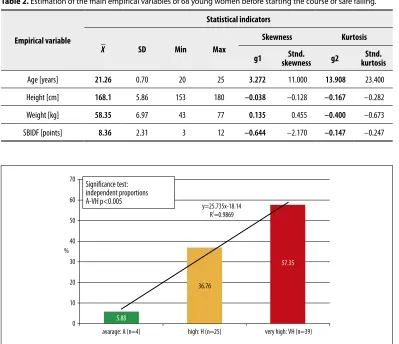
Although tested women individually differed signifi-cantly in terms of somatic development – range of body height 27 cm and body weight 34 kg, the standard de-viation of these two features indicates that only a lit-tle bit higher differentiation of inter-individual relates to body weight (Table 2). The factor of variation for age, height and body mass is: 3.31%, 3.49%, 12.0% re-spectively. Women were therefore – according to the as-sumption – a relatively homogeneous research material.
Most of the women (57.35%) revealed before starting safe falling course a very high susceptibility to injury due to falls and collisions with the ground or other ob-stacle (Figure 7). Less than 6% the average susceptibility.
The difference between the two “relatively indepen-dent” proportions is statistically significant (p <0.005).
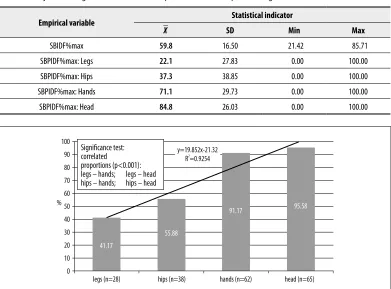
Assuming a vertical posture as a reference frame (also initial posture of all tasks STBIDF), young women are especially susceptible to damage a part of the body during the fall, the more it is distant from the ground (Figure 8, Table 3). There is no statistically significant difference in the proportion only between susceptibility of female students to damage the hands and head during a fall. Both risks concern more than 90% of the women.
Power of diversifying indicators SBIDF SBPIDF is ex-pressive. This phenomenon is even more clearly shown by the susceptibility analysis of injuries of various parts of the body during the fall in relation to the maximal possible amount of points (indicators SBPIDF%max). Range of results is 100 percent (Table 3). This range cov-ers the entire scope of the scale STBIDF used for each diagnosed part of the body (from 0 to 6 for the hands, from 0 to 3 for the head and hips, and from 0 to 2 for the legs). The variability of the susceptibility estimat-ed by standard deviation is various. The greatest disper-sion of results concerns the hips, while similar is in the Empirical variable
Statistical indicators
X _
SD Min Max
Skewness Kurtosis
g1 skewnessStnd. g2 kurtosisStnd.
Age [years] 21.26 0.70 20 25 3.272 11.000 13.908 23.400
Height [cm] 168.1 5.86 153 180 –0.038 –0.128 –0.167 –0.282
Weight [kg] 58.35 6.97 43 77 0.135 0.455 –0.400 –0.673
SBIDF [points] 8.36 2.31 3 12 –0.644 –2.170 –0.147 –0.247
Table 2. Estimation of the main empirical variables of 68 young women before starting the course of safe falling.
70
60
50
40
30
20
10
0
avarage: A (n=4) high: H (n=25)
y=25.735x-18.14 R2
=0.9869
5.88
36.76
57.35
very high: VH (n=39)
Significance test: independent proportions A-VH p<0.005
%
Figure 7. Structure of the susceptibility to body injuries during the fall of young women (n=68).
Volume 7
|
ISSUE 4|
2011|
209 © ARCHIVES OF BUDO|
HEALTH PREVENTIONcase of other parts of the body. Significant differences in the number of women susceptible to injuries of vari-ous parts of the body (28 legs, 65 head) causes the av-erage susceptibility of physiotherapy female students expressed as the relation of sum of all points diagnos-ing this phenomenon to the maximal possible sum of points (SBPIDF%max), to increase relatively proportion-ally (Table 3). The size of the indicator SBPIDF%max proves that the degree of threat the head during a fall and collision with the ground (84.8%)is the highest, and lowest for leg (22.1%).
(2). Content validity
People who correctly control hands and head while STBIDF simultaneously did not make errors during multiple repeating set of exercises in the session direct-ly after the test. Similardirect-ly, those who could not prop-erly control these body parts during STBIDF made er-rors in session after the test. This repeatability of erer-rors (hands and head), and even their accumulation (hands at the level of statistically significant), is also particular-ly visible in comparing the results of Task 2 and Task 3 (Table 4). These observations are also important em-pirical evidence of construct validity.
(3). Construct validity
SBIDF indicator divided tested person into three sep-arate groups due to the feature level: average, high, very high (Figure 7), which proves that this competence of people in comparable conditions (i.e. sudden change of posture from vertical to horizontal) reveal individ-ually with different power. For most young women of similar age with insignificantly differentiated somatic growth, but with similar motor experiences, triple sim-ulated collapse is a very difficult situation. Entitled is a conclusion that in real situation of loss of balance and fall over half of young women with similar characteris-tics cannot resolve this situation in an optimal manner. Few of them are able to overcome such a difficult situ-ation with the optimal effect (avoid or minimize dam-age of the body). The lack of statistically significant dif-ferences between women, who revealed average and high levels, and high and very high respectively, is empirical evidence that the extremeness a real situation of loss of balance and fall in specific circumstances will reveal whether a person will be less or more efficiently in con-trol of own body. Empirical data show that the proba-bility of events concerns every third young woman with the specified morphological characteristics and similar weekly physical activity.
Empirical variable Statistical indicator X
_
SD Min Max
SBIDF%max 59.8 16.50 21.42 85.71
SBPIDF%max: Legs 22.1 27.83 0.00 100.00
SBPIDF%max: Hips 37.3 38.85 0.00 100.00
SBPIDF%max: Hands 71.1 29.73 0.00 100.00
SBPIDF%max: Head 84.8 26.03 0.00 100.00
Table 3. Ratio of the sum of all points of diagnosing the susceptibility to the body (SBIDF) and each body part (SBPIDF) to injuries during the fall to the maximal possible amount of points of a given indicator.
100 90 80 70 60 50 40 30 20 10 0 %
legs (n=28) hips (n=38) hands (n=62)
41.17
55.88
91.17 95.58
head (n=65)
Significance test: correlated
proportions (p<0.001): legs – hands; legs – head hips – hands; hips – head
y=19.852x-21.32 R2
=0.9254
Figure 8. The proportions of young women (n=68) susceptible to injuries of particular parts of the body during the fall (SBPIDF).
210
|
2011|
ISSUE 4|
Volume 7 www.archbudo.comThreat scale of the injuries of different parts of the body caused by the fall show indicators SBPIDF (Figure 8, Tables 3 and 4). These are important empirical evidence that the test is sufficiently sensitive to environmental factors, which – according to the experience of many people, but also from elementary logic – determine how to resolve this difficult situation by a particular person. The possibility to observe three times ways in which the tested person controls the hips, hands and head in the simulated fall, is a chance for correct diagnosis in rela-tion to those parts of the body. Diagnosis method for controlling legs is limited to the Task 3 only seemingly. Reduced proportion of people who make errors during subsequent hips control tasks (all differences statistical-ly significant – Table 4), proves more accurate use of the absorbing function of leg muscles during rapid chang-es of posture from vertical to horizontal. Although this phenomenon is partly explained by the effect of warm-up (three fast squats with short intervals), probably the dominant factor is the higher level of adaptability to the new situation of motor action.
In this case STBIDF reveals these capabilities. The need for proper control of the body in such situations precise-ly explains the theory of safe falls. The authors of the “soft fall” theory [4] argue that during a fall the mus-cles tend to play the amortising role best if the joint sys-tem over which they run is set at the most convenient
angle. For example a jump down from a certain height onto the feet is best amortised by extensors of low-er limbs, provided that the plow-erson implementing this movement task keeps the correct angle of bending in knee and hip joints.
The empirical data presented in Tables 5 and 6 and Figure 9 clearly demonstrate the very high sensitivity of indicators SBPIDF as tools documenting the effects of the influence of environmental factors. After two courses of safe falling, the young women differ on the level sta-tistically significant in quality of the control twice with hands, and once with head during the following tasks (Table 5). Before the course there were eight differenc-es and they concerned hips (Table 4). Ddifferenc-espite teaching students the proper hands control during loss of bal-ance and collision with the ground, when the task dif-ficulty increases (first Task 2, than Task 3), the number of people making errors increases as well. Different are motor responses for head control. When sponge is not used during Task 1, nearly one-fifth of young women make error – despite endured training. The use of sponge (Task 2) significantly reduces errors. Despite sponge us-age women again generate errors when the level of diffi-culty of the task is increased (Task 3). But these are not statistically significant differences. However the high sensitivity of indicator on revealing the adaptability of specific persons is confirmed.
Body part/Task
Proportions of people making errors
[%] correlated proportions [p<]Significance test: Task 1 Task 2 Task 3
Tasks 1–2 Tasks 1–3 Tasks 2–3
Legs* – – 42.6
Hips 50.0 38.2 25.0 0.050 0.001 0.05
Hands 45.5 80.9 89.7 0.001 0.001 0.02
Head 72.0 88.2 92.6 0.010 0.001 –
Table 4. Proportions [%] of young women (n=68) who before the course of safe falling made at least one error of control a particular part of the body during subsequent tasks STBIDF.
* Assessment only in Task 3.
Body part/Task
Proportions of people making errors
[%] correlated proportions [p<]Significance test: Task 1 Task 2 Task 3
Tasks 1–2 Tasks 1–3 Tasks 2–3
Legs* – – 3.0
Hips 4.4 4.4 4.4 – – –
Hands 0.0 22.0 30.9 0.001 0.001 –
Head 17.6 4.4 14.7 0.050 – –
Table 5. Proportions [%] of young women (n = 68) who after the courses of safe falling made at least one error of control a particular part of the body during subsequent tasks STBIDF.
* Assessment only in Task 3.
Volume 7
|
ISSUE 4|
2011|
211 © ARCHIVES OF BUDO|
HEALTH PREVENTIONComparison of the results of STBIDF before and after completed courses (Table 6) shows that the test is ac-curate diagnostic tool for human susceptibility to inju-ries during the fall. The results provide evidence that in-tra-individual characteristics (more than twenty years of motor experience, before a man begin education of safe falling) strongly determine the ways in which particular person collides with the ground during a sudden loss of balance. The evidence of the accuracy of construction and content of individual tasks is the comparative pro-portion of young women before and after the courses safe falling who have committed at least one error in con-trolling a particular part of the body (Figure 9). Before the course none of those women was able to faultless-ly control the body even during a single task. After a two-step training that ability was shown by over 82% of them during the Task 1. The increasing level of diffi-culty of subsequent tasks proved to be accurate tool for selection of this ability – Task 2 (78%), Task 3 (69%).
The distance existing between young women, who re-vealed the average level of susceptibility to injuries
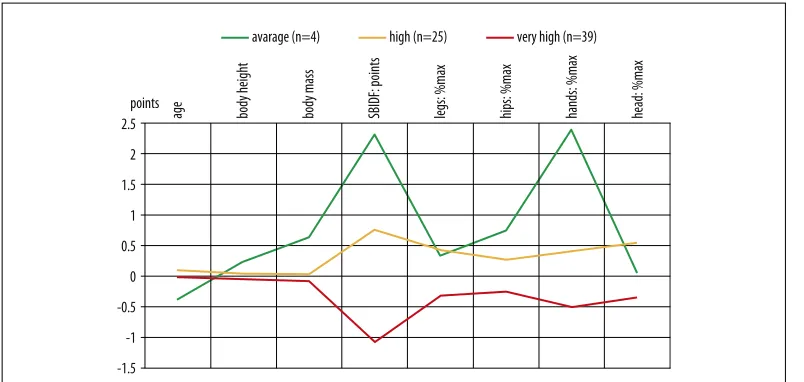
during the fall, from those who revealed a very high lev-el is primarily determined by the fact that those who are less susceptible are making fewer errors in control-ling hands and hips (trunk). They are also taller and a little bit heavier (Figure 10).
d
iscussionIn our opinion presented theoretical and empirical argu-mentation entitles us to draw a conclusion that the test meets the scientific criteria for diagnosing human suscep-tibility to body injuries during fall – both in a broad sense (SBIDF index) and in detailed sense (SPBIDF index). The results of this part of validation procedure (concerning test accuracy) cannot be grounds for drawing conclusions on the whole population. On contrary, the test is a specific tool. It assesses human features which appear only in spec-ified situations and apply to everybody – when the fall and collision with the ground or other barrier is inevitable.
Above mentioned specificity is very complex and multi-threaded. From the methodological and application point Study period
Body part and result of observation
Hips Hands Head
Task 1 Task 2 Task 3 Task 1 Task 2 Task 3 Task 1 Task 2 Task 3
Before course 50.0 38.2 25.0 45.5 80.9 89.7 72.0 88.2 92.6
After courses 4.4 4.4 4.4 0.0 22.0 30.9 17.6 4.4 14.7
Difference 45.6 33.8 20.6 45.6 58.9 58.8 54.4 83.8 77.9
Significance test: correlated proportions
[p<] 0.001 0.001 0.01 0.001 0.001 0.001 0.001 0.001 0.001
Table 6. Proportions [%] of young women (n = 68) who made an errors of control of hips, hands and head during subsequent tasks STBIDF – test before and after two courses of safe falling.
17.7
100
22
100
30.9
100
100 90 80 70 60 50 40 30 20 10 0 %
TASK 1 TASK 2 TASK 3
y=6.6x+10.333 R2
=0.9611
before the course after the courses
Figure 9. Proportions [%] of young women (n=68), who made at least one error of control a parts of the body during the subsequent tasks STBIDF – test before and after two courses of safe falling (significance test: correlated proportions p<0.001).
212
|
2011|
ISSUE 4|
Volume 7 www.archbudo.comit is important to clearly emphasize that developing any norms for the whole population based on the SBIDF in-dicator would be clearly an absurd. Determining norms of body injuries for the specific age groups would mean resignation in many areas of health prevention, not only in body injuries prevention. Monitoring human suscep-tibility to body injuries caused by fall or collision in dif-ferent age groups is a difdif-ferent issue. STBIDF is a tool which, when used widely, can make the said monitor-ing very reliable. Based on knowledge acquired in such way the rational preventive actions should (!) be taken.
We put an exclamation mark after the world “should” in previous sentence as it is striking why regardless of strong empirical evidence of effectiveness of educa-tional programs of safe falling for people in different age groups [5,14,15,17] there are still no implemen-tations especially in physical education classes com-pulsory for the youth. There are some exceptions. In Japan judo classes have been compulsory in schools for many years [23]. It is known that the basis of judo is teaching of safe falling (ukemi-waza). Thus Japan is one country where currently the youngest part of popula-tion is covered with body injuries prevenpopula-tion based on safe falling education. From the perspective of tenden-cy towards prolonging the population age Japan has the best developed prevention system. In the future – when the current youth is of retirement age – the num-ber of deaths and body injuries caused by fall and col-lision with the ground or other obstacle among elderly will be considerably reduced. However it is necessary to practice the safe falling skills as a part of constant health training [24,25].
Artur Kalina [15] based on declarations of 38 judo experts mainly from Poland, but also from Austria,
Germany and former Yugoslavia, proved that safe fall-ing education of children, elderly, and people who suf-fered from body injuries in the past is not harmful to their health. Out of thousands of people who were taught safe falling techniques only few suffered from body injuries during training. In four cases the experts pointed own error as a cause of injuries and more than once the cause was displacement of mattresses (the ac-cidents happened at the beginning of experts’ profes-sional carriers). From medical, psychological and meth-odological point of view it is important that 55.5% of experts declared certainty (and 26.3% did not exclude such possibility) that they were successfully teaching safe falling techniques to people who suffered from body injuries in the past or had movement impediment due to other reasons.
Basing the body injuries prevention on the sports aspect of judo should be regarded with caution. One of the ad-vantages of judo is also the fact that learners of this mar-tial art not only acquire safe falling skills (ukemi-waza), but are also taught how to secure their partners during formal throw training (nage-waza), and competitors dur-ing fight (randori). Epidemiology of judoists body inju-ries shows that paradoxically both those elements fail during sport fights. The main cause for that is the fact that throwing a competitor out of balance and leading him to fall on his back is the end of the fight (scoring 10 points – so called “big point” ippon) while fall to the side or with an insufficient dynamic gives 5 or 7 points (yuko, waza-ari), which might be enough to victory. Thus a contestant thrown out of balance avoids falling on his back. On the other hand a contestant performing a throw is not focused on securing his competitor but tries to score ippon. This is how a proportion of judo contes-tants body injuries caused by falling can be explained.
2.5 2 1.5 1 0.5 0 -0.5 -1 -1.5
age body height body mass SBIDF: points legs: %max hips: %max hands: %max head: %max
points
avarage (n=4) high (n=25) very high (n=39)
Figure 10. Normalized to the arithmetic means and standard deviations (n=68) indicators of the basic empirical variables of physiotherapy female students, who differ in the level of susceptibility to body injuries during the fall (SBIDF).
Volume 7
|
ISSUE 4|
2011|
213 © ARCHIVES OF BUDO|
HEALTH PREVENTIONAccording to German studies [26] among judoists who suffered from body injuries 72% were being attacked dur-ing fight, the number was 60.5% in Polish researches [27]. More detailed analysis show that among main direct causes of contestants’ body injuries during attack is leaning on a hand while falling and collision with the mat. These inju-ries are intensified by a contestant who attacks and make errors (especially when falls on the body of a competitor). Today’s statistics confirm these trends. However, there is empirical basis which indicates the phenomenon of inju-ries in judo (as a sport discipline) should be linked espe-cially to the quality of teaching methodology, and there-fore to the competence of teachers. In Japan during a year there are 36 to 54 accidents for 1000 athletes [28], and therefore injury rate is around 5%. In France, the accident happened to 21% of the students of judo [29]. In Italy the rate was 58.1% [30], but among students practicing judo in a year, there were less accidents: 259 out of 1000 athletes [31]. In Polish judo clubs that rate in the com-parable period was from 5.5% to 47% [27].
However we recommend as a “sport of the life” both, randori training and other forms of judo, in which the vertical posture is the initial moment of motor actions. The controlled fall and the need to protect the falling body of the partner (competitor in randori) are in fact the basic elements of these forms. Recent publications [32–37] re-discover the great possibilities of judo, not only in terms of injury prevention, but also as means of increasing the personal safety (self-defense) [38], a com-prehensive human development and sustain psychophys-ical availability at the optimal level by the entire life.
Emphasizing the prognostic value of STBIDF we draw at-tention to two verified empirical arguments however, be-yond the official validation procedure. The first concerns the observation that we made during the first course – safe falling for the blind. During the fifth lesson the task of 10 randomly selected students (women and men who had covered eyes with a band) was running at a distance of 6 meter alternately forward and back Each person held in hand a baby doll made of soft material. Students were informed that the purpose of this exercise is to improve the simple rescue activity in conditions of the lack of the visibility. During the exercise the other students expressed applause loud ovation and verbal doping. When an exer-cising athlete already ran very smoothly, assistants of the experimenter (at the time when athlete run backward), put five mattresses (each 4 cm thick, size 100×100 cm). None of the participants of the experiment fell back in a professional manner, even though during the previous four lessons preceding the experiment, each had perforemd approximately 150 repetitions of exercises with similar content (instead of dolls, we used rolled foam mattress). With the exception of one person, others either leaned
with one hand or both hands losing control of the doll. A student, who was holding a doll with both hands at the moment of impact with the ground, could not pro-tect it. Doll’s head hit the mat with the high dynamics when student after the loss of balance was rolling – in a correct manner – from buttocks to the back.
The second argument refers to the three events for which there is no doubt that they are reliable. In the moment of these events, two people were already graduates of both courses of safe falling in the Podhale State Vocational School of Higher Education, Nowy Targ, Poland, one (Bartholomew) participated in 15 lessons:
Michael (23 years old) doing repair work standing on a ladder, the feet of about 1.5 m above the ground. As a result of his own error he was falling to the back with a ladder. He threw the heavy crowbar away to a safe dis-tance and after his feet touched the concrete ground he immediately made a rear fall with turn. The ladder after a moment fell down in place, where he collided with the ground. Because he professionally steered his body, he avoided injury both in the moment of collision with the hard ground, as well as possible strikes by the lad-der (by immediate rotation of the body).
Bartholomew (21 years old) after the jogging (the body was sufficiently prepared for physical effort) was walking across pedestrian crossing (previously making sure the street is empty) when suddenly, car run on the crossing. Hit with a huge force he made consecutively two rear fall with turn on asphalt. When he immediately took a vertical posture he noticed that the car was moving away. Doctors were surprised that on the Bartholomew’s body they found no injuries and no evidence of a collision with the car.
Agnes (24 years old) was travelling by bus when the driv-er stopped suddenly. An old man (about 190 cm, more than 100 kg) standing next to her fell forward with huge force. Agnes grabbed his arm and gently slid him to the floor of the bus unharmed.
Above examples entitle us to draw a conclusion that among the students participating in the experiment dom-inated motor reactions, which they have gained during more than twenty years of living, before they started learning to control own body during a fall. Thus, people corresponding to the characteristics require lots of care. Teaching of safe falls should be intense (at least 3 train-ings per week). Is also entitled to conclude that people who have high level of ability to learn new motor func-tion are able, even for a short period of educafunc-tion (even if only 15 lessons) to reach optimum abilities of the pro-tection of own body or other people exposed to the in-evitable collision with the ground or vertical obstacles.
Motor safety – it is consciousness of the person undertaking to solve a motor task or consciousness the subject who has the right to encourage and even enforce from this person that would perform the motor activity, who is able to do it without the risk of the loss of life, injuries or other adverse health effects [24].
Susceptibility test of the body injuries during the fall STBIDF (TPUCPU)
Susceptibility to body injuries during the fall SBIDF (PUCPU)
Susceptibility to particular body parts injuries during the fall SBPIDF (PUCCPU)
214
|
2011|
ISSUE 4|
Volume 7 www.archbudo.comProceeding in this paper accuracy of STBIDF is rein-forced by the arguments belonging to the non-tests. The importance of this type of argument emphasizes Jerzy Brzezinski [20], who refers to many methodologists of science even from the middle of previous century.
An important methodological matter is that people using STBIDF were able to correctly identify specific phenom-enon of the studied features (human susceptibility to in-juries during the fall). It is easiest to determine whether the person with the horizontal posture, leaning on one or both hands or not; at the time of adhesion back to the ground protects head (pulling chin to the body) or con-necting the head is simultaneous with the back or slight-ly delayed; when should clapping hands (Tasks 2 and 3) during change of posture from vertical to horizontal in-terrupts this process; when to control the sponge, press-ing chin to the body (Tasks 2 and 3), sponge falls. The problem for many inexperienced observers is to see wheth-er the body in the moment of collision with the ground, the angle between the thighs and shins is obtuse or right (first-degree error), or whether these two parts of the body are at an acute angle. It is very easy to find the differ-ence. When there is obtuse- or right angle is it clearly to hear the moment of body collision with the ground. The more acute angle, the lower are sound effects, and the body freely moves to the rolling phase. The significance of this phenomenon precisely explains the theory of safe falling [4]. Lesser problem is to see whether the tested person after the jump from the platform (Task 3) stop for a second or longer, or that after landing do not bend the knees (error grade 2). Person using the test must be aware of the need to identify these facts. This phenom-enon also explains in detail by the authors of the theory of safe falling [4]. It is not a problem to say that the test-ed person leaves the platform with one leg (not jumps), or lands after jump down on one leg (error of 1 degree).
Research projects in the near future, in our opinion, should first of all verify the accuracy of this test. The condition is certainty that perception of people using STBIDF and awareness of the observed phenomena do not raise objections. We recommend each investigator that carefully studied the instructions of STBIDF and content of the above paragraph.
Referring in conclusion to ascertainment that we put in the introduction that the weakness of the systems of injuries prevention is to focusing attention on reducing the number of falls in the course of daily or professional activities, while avoiding this kind of events is impos-sible, we would like to emphasize that we are not con-cerned about decreasing the role of this kind of research and recommendations. On contrary, the importance of such researches in cognitive and applied meaning, the best proved by the multiplicity and high level of scien-tific papers presented during the 10{th International
Conference on Fall Prevention and Protection [39]. Permanent, multi-faceted researches on the causes of falls and building prevention systems, we concentrate on the same level of validity as the teaching of safe fall-ing. It does not change the fact that this knowledge should support common education of people from the scope of the skills of safe falling and avoiding collisions, but not inversely.
c
onclusionsThe test is simple and very safe tool and can be used for examining people of all ages who are able to inde-pendently change the posture from the vertical to hor-izontal. The lack of ability to independently rise from the horizontal posture does not exclude the possibility of applying the test. Quite the opposite, the researcher (doctor, physiotherapist etc.) obtains additional infor-mation that such person, after the fall may be deprived of aid, therefore is susceptible to the effects associated with long-term staying on the ground. The test is accu-rate tool to verify prevention programs.
Acknowledgement
The study was conducted within the research project URWWF/S/04: “Motor, methodological and mental ef-fects of educating students in safe falling of blinds and/ or after limbs amputations” (Resolution No. 03/02/2011 Bioethics Committee at the University of Rzeszow, Poland).
We would like to thank you Olivia and her parents for providing the photos for presentation of “the susceptibility test to the body injuries during the fall” (STBIDF).
1. Żak M: Determinanty powtarzalności upadków u osób po 75 roku życia. Studia i Monografie nr 60. Akademia Wychowania Fizycznego. Kraków, 2009 [in Polish, abstract in English]
2. Feder G, Cryer C, Donovan S et al: Guideline for the prevention of falls people over 65. BMJ, 2000; 321: 1007–11
3. Hauer K, Lamb SE, Jorstad EC et al: Systematic re-view of definition and methods of measuring falls risk in randomised controlled fall prevention tri-als. Age Ageing, 2006; 35: 5–10
4. Jaskólski E, Nowacki Z: Teoria, metodyka i system-atyka miękkiego padania. Część I. Teoria miękkiego padania. WSWF. Wrocław, 1972; 11: 83–88 [in Polish]
r
eferences:
Volume 7
|
ISSUE 4|
2011|
215 © ARCHIVES OF BUDO|
HEALTH PREVENTION5. Kalina RM, Barczyński BJ, Jagiełło W et al: Teaching of safe falling as most effective element of personal injury prevention in people regardless of gender, age and type of body build – the use of advanced information technologies to monitor the effects of education. Arch Budo, 2008; 4: 89 6. WHO: A Global Report on Falls Prevention.
Epidemiology of Falls, 2007
7. COI: Fracture prevention services. An economic evaluation. Produced by COI for the Department of Health. Nov 2009 at: www.dh.gov.uk/publications 8. Cummings SR, Rubin SM, Black D: The future
of hip fractures in the United States. Numbers, costs, and potential effects of postmenopausal es-trogen. Clin Orthop Relat Res, 1990; 252: 163–66 9. Rubenstein LZ: Falls in older people: epidemiology
of falls and strategies for prevention. Age Ageing, 2006; 3552: 37–41
10. Garraway WM, Stauffer RN, Kurland LT: Limb fractures in a defined population. I. Frequency and distribution. Mayo Clin Proc, 1979; 54(11): 701–7
11. Reece AC, Simpson JM: Preparing older people to cope after a fall. Physiother, 1996; 82: 227–35 12. Czerwiński E, Borowy P, Jasiak B: Current guide-lines for using physiotherapy to present falls. Ortopedia, Traumatologia, Rehabilitacja, 2006; 4(6)8: 380–87 [in Polish, abstract in English] 13. Finchley Memorial Day Hospital: Information
on falls. For patients and carers. Produced by the staff at the Falls Clinic FMH. London, 2005 14. Karner K: Sicheres Fallen. Algemeine
Unfallverische Rungsausaustalt. Wien [in German] 15. Kalina A: Universal character of exercises on
safe falls – an empirical verification [in:] Kalina RM, Kaczmarek A (eds.) Ukierunkowane przy-gotowanie obronne. PTNKT. Warszawa, 1997; (3): 100–6 [in Polish, abstract in English] 16. Kalina RM: Miękkie lądowanie. Medical Tribune,
2009; 13: 28–29 [in Polish]
17. Gąsienica-Walczak B, Barczyński BJ, Kalina RM et al: The effectiveness of two methods of teaching safe falls to physiotherapy students. Arch Budo, 2010; 6(2): 63–71
18. Ferguson GA, Takane Y: Analiza statystyczna w psychologii i pedagogice. Wydawnictwo Naukowe PWN. Warszawa, 1997 [in Polish]
19. Raczek J, Mynarski W, Ljach W: Kształtowanie i diagnozowanie koordynacyjnych zdolności mo-torycznych. Podręcznik dla nauczycieli, trenerów i studentów. Akademia Wychowania Fizycznego. Katowice, 2002 [in Polish, abstracts in English, in Russian]
20. Brzeziński J: Metodologia badań psychologicznych. Wydanie drugie. Wydawnictwo Naukowe PWN. Warszawa, 1997 [in Polish]
21. Cronbach LJ, Meehl PE: Construct validity in psychological test. Psychological Bulletin; 52: 281–302
22. Stupnicki R: Biometria. Krótki zarys. Wydanie drugie, poprawione i rozszerzone. Wydawnictwo MARGOS. Warszawa, 2005 [in Polish] 23. Tomita H: Judo in the system of physical
edu-cation of Japanese society. Master’s thesis. The Josef Piłsudski Academy of Physical Education. Warsaw, 2002
24. Kalina RM, Barczyński BJ: EKO-AGRO-FITNESS{© original author continuous pro-gram of health-oriented and ecological education in the family, among friends or individually im-plemented – the premises and assumptions. Arch Budo, 2010; 6(4): 179–84
25. Kalina RM, Barczyński BJ: Complementary health-related training – application in physiotherapy and recreation areas. EKO-AGRO-FITNESS; 1(1): 1–10
26. Witak H, Sturm H: Spezifische Verletzungen in der Kampfsportart Judo. Armeesportler, 1968; 8: 12–13 [in German]
27. Sterkowicz S: Accidens in judo in multifactoroal epidemiologic analysis. Akademia Wychowania Fizycznego. Rocznik Naukowy XXII. Kraków, 1987: 199–243 [in Polish, abstract in English]
28. Asuma T: [In:] Encyclopaedia of Sport Sciences and Medicine. The Macmillan Company. New York, 1971
29. Chevaleraud J, Perdiel C: Judo: complication oc-culaire inhabituelle. Médicine du Sport, 1978; 4: 45–46 [in French]
30. Pilardeau P: Traumatologiu du sport regional. Hilan de 6 ans an centre medico-sportif. De Meaux Medicine du Sport, 1980; 2: 5–11 [in French] 31. Franke K: Traumatologie des Sports Veb Verlag
Volk und Gesundheit. Berlin, 1977, [in German] 32. De Crée C, Jones L: Kōdōkan Jūdō’s Elusive Tenth Kata: The Gō-no-kata – “Forms of Proper Use of Force” – Part 2. Arch Budo, 2009; 5: 75–82 33. De Crée C, Jones L: Kōdōkan Jūdō’s Elusive Tenth
Kata: The Gō-no-kata – “Forms of Proper Use of Force” – Part 3. Arch Budo, 2009; 5: 83–95 34. De Crée C, Jones L: Kōdōkan Jūdō’s Inauspicious
Ninth Kata: The Joshi goshinhō – “Self-Defense Methods for Women” – Part 1. Arch Budo, 2011; 7(3): 105–23
35. De Crée C, Jones L: Kōdōkan Jūdō’s Inauspicious Ninth Kata: The Joshi goshinhō – “Self-Defense Methods for Women” – Part 2. Arch Budo, 2011; 7(3): 125–37
36. De Crée C, Jones L: Kōdōkan Jūdō’s Inauspicious Ninth Kata: The Joshi goshinhō – “Self-Defense Methods for Women” – Part 3. Arch Budo, 2011; 7(3): 139–58
37. De Crée C, Jones L: Kōdōkan Jūdō’s Elusive Tenth Kata: The Gō-no-kata – “Forms of Proper Use of Force” – Part 1. Arch Budo, 2009; 5: 55–73 38. Shishida F: Judo’s techniques performed from
a distance: The origin of Jigoro Kano’s concept and its actualization by Kenji Tomiki. Arch Budo, 2010; 6(4): 165–71
39. Research and Practice for Fall Injury Control in the Workplace: Proceedings of International Conference on Fall Prevention and Protection; DHHS (NIOSH) Publication No. 2012-103; 2011 Nov
216
![Table 5. Proportions [%] of young women (n = 68) who after the courses of safe falling made at least one error of control a particular part of the body during subsequent tasks STBIDF.](https://thumb-us.123doks.com/thumbv2/123dok_us/8595150.1722286/9.567.42.435.265.372/table-proportions-courses-falling-control-particular-subsequent-stbidf.webp)
![Table 6. Proportions [%] of young women (n = 68) who made an errors of control of hips, hands and head during subsequent tasks STBIDF – test before and after two courses of safe falling.](https://thumb-us.123doks.com/thumbv2/123dok_us/8595150.1722286/10.567.131.527.89.420/table-proportions-errors-control-subsequent-stbidf-courses-falling.webp)