http://www.sciencepublishinggroup.com/j/ss doi: 10.11648/j.ss.20180705.14
ISSN: 2326-9863 (Print); ISSN: 2326-988X (Online)
A Reflexive Method for Validating the Results of Qualitative
Analysis
Ranjan Vaidya
Digital Strategy & Architecture, University of Auckland, Auckland, New Zealand
Email address:
To cite this article:
Ranjan Vaidya. A Reflexive Method for Validating the Results of Qualitative Analysis. Social Sciences. Vol. 7, No. 5, 2018, pp. 223-232. doi: 10.11648/j.ss.20180705.14
Received: June 7, 2018; Accepted: September 5, 2018; Published: October 15, 2018
Abstract:
One of the central arguments of Pierre Bourdieu is that social science researchers should reflect not only on the research object but also on the subject. How to achieve this? This question also relates to the calls for the operationalisation of reflexivity. This study addresses this research question. The aim of this study is to present a method for operationalising reflexivity. The study is an empirical study of an agricultural marketing board in India. The board controls over two hundred market yards of the state. These yards are specialized wholesale commodity markets where the agricultural commodities are traded. The major stakeholders in the trade are farmers, government officers, traders, and private vendors. The board implemented an agricultural marketing information system project that intended to interconnect the yards by modern day information technology. The data for the study are collected in form of semi-structured interviews with these stakeholder groups. The study uses a qualitative methodology based on the constant comparison method. Using this method a set of constructs is identified. These constructs are scrutinised through the lenses of reflexivity. Finally, a framework is presented that can guide the operationalisation of reflexivity. The five step framework compares the empirical data from the field with the data about the researcher. The framework helps in establishing the validity of research results as the same research methods are applied to both the research phenomenon as well as the researcher. The paper contributes to the discussion on the operationalisation of reflexivity.Keywords:
Reflexivity, Bourdieu, Trust, ICT, Validity1. Introduction
Critical research paradigm is one of the three fundamental research paradigms in information systems research [1]. It is the only approach amongst interpretive, critical and positivist approaches that stresses on emancipation, empowerment and transformation of research subjects as well as the researcher [2, 3]. Such transformation is brought through the use of reflexivity - an essential ingredient of critical research [2]. Reflexivity is particularly useful in information systems research, and the approaches based on critical approach (such as critical realism) are identified to be most suited to its nature [4]. However, this approach has remained an under represented paradigm in information systems research. Surveys also indicate that there is a particular “dearth” of critical empirical studies [5]. Myers and Klein [1] identify gaps in the critical IS research and one of these gaps is in the area of practice of critical research. Other studies have also
suggested that there is a particular gap in the area of achieving the “criticality” [6]. Bourdieu’s work provide a central theoretical paradigm that informs information systems research. A central argument in his work on reflexivity is that social science researchers should objectify not only the research phenomenon but also their own persona. This is often referred to as the “second epistemological break” [7]. How to achieve this?
writing about oneself can be effectively used as tool to develop reflexivity. Discussing one’s own career story is well accepted method under auto-ethnography and can be used to bring critical reflection [11]. There are also some specific methods such as the voice centred relational method [12] and the use of maps [13]. This study addresses these calls on operationalization of reflexivity. The argument of this paper is that social theories and their conceptual elements are also used as heuristic tools for enhancing the quality of research. For example, social capital for Bourdieu, is a research tool “a heuristic device” through which sociability can be explored [14]. Following a similar line of reasoning, this study assesses reflexivity as tool for establishing the validity of qualitative information systems research. The validity is achieved by applying the same theoretical elements to both the research phenomenon as well as the researcher. This is achieved through the use of reflexivity.
To do so, the study first uses a constant comparison method to identify the major constructs related to the implementation of an agricultural marketing information systems project. The identified constructs are then re-assessed through reflexivity. The results are discussed and a framework is proposed for using reflexivity as a tool to validate the results. The reminder of the paper is organised as follows. Section two presents theoretical background on reflexivity in qualitative research. This is followed by the description of the case study of an Indian Agricultural Marketing Board that implemented an information systems project to connect the agricultural market yards of the state. Section 4 presents the research method. Section 5 presents the data analysis and results. In section 6 a framework for linking reflexivity and validity is proposed. Finally the conclusions are presented.
2. Reflexivity in Qualitative Research
This section presents a theoretical background on reflexivity in qualitative research. This is based on the literature review of twenty four research articles covering a period of 2001 to 2013. Before presenting the three terms namely critical research, reflexivity, and critical reflection, it is important to briefly describe these as used in this study. Critical research refers to one of the three major epistemological streams of IS research [15]. Reflexivity refers to awareness of the subjective self as well as an ‘other’, unlike reflecting which does not requires the ‘other’ necessarily [16]. Reflexivity is also identified as one of the five important themes of critical research amongst others such as emancipation, and critiquing of the traditions [17]. The current paper is limited to the discussion of reflexivity as situated within the critical research stream.
The analysis of the literature identifies two focal themes in the discussions of reflexivity. The first theme relates to the conceptualisation of reflexivity. The rationale for the use of reflexivity varies with the research traditions. For a phenomenologist, the same phenomenon will have different interpretations depending on the subject itself, and hence the
data of the subject is as important as the data of the object. On the other hand, from a social constructionist perspective, a reflection on our own history may help to change the course of the history. Reflexivity can be used with different objectives namely; of knowing the self or others, knowing the truth, and also for transcending these [16]. There can be also different types of reflexivity such as positional, textual or inter textual, introspection and discursive deconstruction [16, 18, 19]. Based on the specific research tradition, there can be differences in the notions of reflexivity [6, 18]. In spite of the differences of the levels and research traditions, it is certain that reflexivity is as described by Foucault “a technology of the self” [as quoted in 20 p. 1519]. There is a consensus that reflexivity is related to self-awareness, and that it helps refining the research results by making the researcher aware of the subjective influences [18], reduces the prejudices and biases of the researcher, and provides more rigour to the results of qualitative research [20].
The second theme, relates to the operationalization of reflexivity. There is a consensus amongst researchers that reflexivity can be a very beneficial tool for strengthening the research results but its implementation is difficult [9, 12]. Even within the critical IS research streams the achievement of criticality has always been a challenge, and there is an argument that rigour in method alone is insufficient to achieve the criticality [8]. Nonetheless, the analysis of current literature presents some methods that researchers have used to attain reflexivity in their research. For example, revealing one’s own story helps in achieving reflexivity and also bring trust on the writer [11]. Also, researchers have presented their journey of the doctoral studies and have revealed their doctoral stories in publications [12]. Within the IS research stream also, researchers have presented their stories (Walsham, 2005). In fact, writing (about one’s own self) has been identified as a method for developing reflexivity [10]. The results from the literature review indicate that reflexivity is better conceptualised than it is operationalized. One possible way to operationalize reflexivity is by linking it with the concept of validity of qualitative research.
results have been presented. Since measuring transformational validity is difficult, researchers usually apply transactional methods to establish validity. For example, getting the interview transcripts checked and corrected by the respondents. While doing this may ensure that the respondent opinions have been correctly documented but it does not suggest that the conclusions and interpretations reflect the real world relationships. Such forms of validity have been identified as necessary but not sufficient to establish the validity of research results [23 p. 333, 24]. Transactional forms of validity have also been criticised as these are sometimes included to fulfil the requirements of the funding agencies who would otherwise be “sceptical” about the research results [22]. Also, it is argued that criteria that are based on assumptions of quantitative studies cannot be applied to qualitative studies and that rigour of methods is not sufficient to establish the trustworthiness of a study [25].
This distinction between transactional and transformational validity has also been discussed in form of primary and secondary validity criteria. Primary criteria of validity have been identified as the necessary criteria applicable to all qualitative studies and the secondary criteria provide further credence to the research results. The primary criteria includes criticality, and reflexivity has been identified as a way of establishing the validity of qualitative research [25 p. 531 ]. Reflexivity is identified as a common phenomenon amongst various types of research approaches though the way reflexivity is used in these is different [13]. Also, reflexivity has been conceptualised well but, its operationalization has remained a challenge in IS discipline as well as in social science [8, 12]. The current study fills this gap in the operationalization of reflexivity, and presents a case of how reflexivity can also be used for establishing the validity of qualitative research.
3. Bourdieu and Reflexivity
The works of Pierre Bourdieu, in information systems research provides one stream of theoretical framework for doing critical research [1]. One of the core arguments of Bourdieu is that critical researchers seeking reflexivity should make two epistemological breaks. They should make an epistemological break from the reality that they are researching and they should also make an epistemological break from their own position as a researcher [7, 26]. Awareness about one’s own habitus, practices and field helps to achieve this. Since this paper uses these concepts to understand the research phenomenon, and then these are also applied to the researcher, it is important to briefly discuss these. Bourdieu’s theory of practices is based on three core conceptual elements namely field, habitus and practices. Each of these is described below.
3.1. Field
Field refer to the arena of struggle i.e. those social spaces where individuals struggle to gain or maintain their economic
or cultural capital. Depending on their accumulation of capital, individuals occupy different power positions in the fields.
3.2. Habitus
Habitus of individuals refers to the tastes and dispositions that individuals acquire as a result of their class and rank in the social set up. Bourdieu [27 p. 174] presents various kinds of tastes such as “popular”, “middle brow”, “barbarous”, “bourgeois”, “intellectual”, “petit-bourgeois”, “taste of reflection”, etc. At a macro level, two categories of tastes are prevalent, namely ‘tastes of necessity’ and ‘tastes for freedom’ [26]. The former refers to tastes developed out of economic necessity, while the latter reflects tastes developed out of freedom from such necessities. The habitus of agents develops a certain liking in them for tastes that are suited to their class. Thus through habitus, individuals then re-create the social structure of which they are a part. According to Bourdieu, habitus refers to the patterns of behaviour, especially in situations when the rules of conduct are not explicitly mentioned [26]. Drawing on this, in this paper habitus refers to the class specific perceptions about the behaviour of stakeholders. It is the behaviour that is deemed to be specific and representative of a stakeholder group.
3.3. Practices
Practices are an outcome of the agent’s habitus and the field in which they struggle. The habitus of individual determines certain pattern of behaviour that are class specific. When a class situated individual, patterned to behave in particular manner, comes in contact with a field of struggle, he improvises his behaviour so as to maintain or strengthen his capital position. This results in generation of stakeholder practices which is presented in form of a formula by Bourdieu [27 p. 101 ] as follows:
(habitus) (capital) + field = practice
This formula suggests that stakeholder practices are a cumulative outcome of habitus, their accumulated capital, and their adaptations to the field. These conceptual elements can be well used to study the IS implementation at the agricultural marketing board in India because the stakeholders there have different habitus, capital accumulations, and practices. They all come to a common yard and engage in trade transactions. The field here refers to the yard-field where all the stakeholders accumulate to negotiate on the commodity prices. In the next section on data analysis, these elements are used to explain the low levels of trust amongst stakeholders.
4. Case Study
Committee Act was formulated in 1950 which led to the creation of para-state organisations called as State Agricultural Marketing Board [30]. In the current state the state agricultural marketing board was created in the year 1972. The board controls over two hundred market yards of the state. The yards are specialized wholesale commodity markets where the farmers’ commodities are auctioned to the traders. Board employees endorse these auctions. After the payments are made to the farmer, the traders deposit a service charge which forms yard income. Generally, across all the Indian states the agricultural commodities are auctioned at the yards, though there are variations based on the commodity being auctioned [31]. The board implemented an information technology project to interconnect the over two hundred yards of the state.
Studies indicate that there are large price discrepancies across these market yards and often the farmers are not able to realize the best available prices [32, 33]. Moreover various loopholes in the manual system provide an opportunity to the traders to under report their trade transactions, and this has a negative impact on yard income. It is against this back ground that the board initiated an information systems project in year 2003 with an objective of connecting the yards so that price disparities can be minimised. The project was to be implemented in phases and in the first phase the project was implemented in sixty four market yards. The project involved establishing interconnectivity amongst the market yards. This interconnectivity would reduce the price dispersions across the yards, remove the role of middlemen from the trade transactions, and would help the farmers achieve better prices for their commodities. The implementation of the project was assigned to private partner group selected on the basis of contract bidding. The project was under implementation for over a period of nine years. However, it was abandoned as the private partners felt that successful project implementation was impossible as most of the government officers were corrupt, and wanted a share in the earnings of the private partner.
Though the project was abandoned by 2012, it had provide many benefits in the area of records management. Following the learnings from the abandonment of the project, in 2016, the state government decided to re-implement the project with a different implementation approach. Under the new approach, the complex yard operations were to be computerised one by one. The 2016 correspondence with the state agricultural marketing board indicated that the government is currently implementing the e-Anogya project. Under this project, one of the yard operations namely of generating no objections certificates is getting computerised [34].
5. Research Method
The data for the present study was collected through semi structured interviews and field visits. The stakeholders were identified on the basis of the importance-influence criteria. These criteria have been used in the past by researchers to
identify the stakeholder groups [35]. Past studies on the yard have identified farmers, traders and government officers as the key stakeholder groups in the yards of developing countries [33]. Also, studies indicate that traders have strong networks with other powerful groups and are influential in the yards [36]. Various information technology studies of developing countries indicate that the private partners play a critical role in the successful implementation of such projects [37, 38]. Following these studies, the key stakeholders included farmers, traders, government officers and private partners.
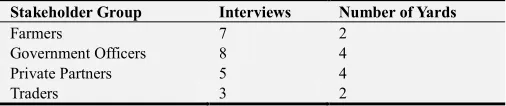
The data from these stakeholder groups was collected over a period of nine months from four market yards of the state where the information systems project was implemented. The first field visit was conducted between January and March, 2009. During this visit, initial discussions were undertaken with the government officers and the private partners. Following this, initial visits were undertaken to six yards to understand the workings of the yards. From these six yards, four yards were chosen to conduct detailed interviews with the stakeholders. These yards were selected on the basis of implementation status of the project, the volume of transactions and the access to these yards. The government officers and the private partners were interviewed at their back offices in the yards, and during the field visits to the yards. The farmers were initially interviewed at the yards, and then at their farms. Two traders were interviewed at the yards, and one was interviewed at his farm. Total twenty three respondents were interviewed from four stakeholder groups namely farmers, traders, government officers and the private partners. Table 1 presents the number of the interviews conducted within each stakeholder group.
Table 1. Stakeholder Interviews.
Stakeholder Group Interviews Number of Yards
Farmers 7 2
Government Officers 8 4
Private Partners 5 4
Traders 3 2
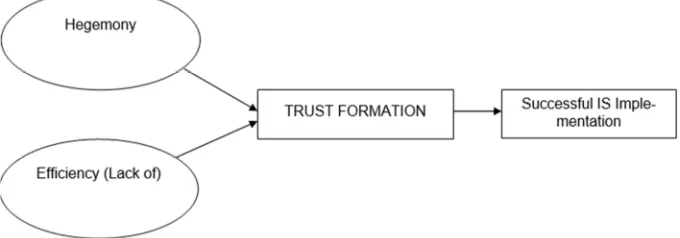
final thematic relationship. Figure 1 presents the integrated thematic relationship that indicates that lack of trust was the
core issue that led to the abandonment of the information systems project.
Figure 1. Trust formation model using constant comparison method.
Using the constant comparison method, the constant comparison results indicate trust formation was major issue in the implementation of the project, and that four constructs were related to it namely hegemony, lack of honesty, lack of sincerity, and efficiency. Apart from trust stakeholder resignation was also identified as a major issue in the successful implementation of the project. The validation of these results can be undertaken using different types of transactional validation approaches such as confirming the results with the respondents through member checking. The transactional validity was established by discussing these results with the stakeholders in the 2012 visit by the researcher. Also, reflexivity can contribute to establishing validity.
One way to achieve reflexivity is to apply the same theoretical tool to the researcher as these have been applied to the research subject. Under the critical approach that is based on the works of Pierre Bourdieu these have been called as the first and second epistemological breaks [7]. Since the current study uses the conceptual elements from Pierre Bourdieu’s theory of practices, these are applied both to the research phenomenon and the researcher in order to operationalise reflexivity. In the next section, these conceptual elements are applied both to the research subject and the researcher.
6. Data Analysis
6.1. Farmer Habitus and Practices
Discussions with the farmers indicted that the farmers
largely considered themselves as an exploited class. They had a strong sense of exploitation from nearly all quarters of the society be it the village or the yard field. In the villages they were exploited by the village based government officers and the local traders. In the yard they were exploited by traders in matters of payments. This was mentioned by one government officer (who was also a farmer) as follows:
“A farmer is in problems everywhere, in India... He is exploited everywhere and hence makes no progress…”
With an acute sense of exploitation the farmers approaches the yard field. In this field he confronts the traders and the government officers. Both these stakeholders are at a higher level of power hierarchy than the farmers. The traders have economic power as well as they are well connected with the powerful institutions of the state. The government on the other hand has state endorsed power.
According to Bourdieu [26], revolt and resignation are two possible outcomes when the habitus of a powerless stakeholder confronts that of a powerful stakeholder. In case of the yards, the discussions with the farmers clearly indicate that they had resigned from the system as they could do little to confront the practices of the powerful stakeholders. To suppress this sense of resignation, the farmers in fact justified their use of patience in the yards even when the practices of government officers and traders were completely unfair. The following statement of a farmer clarifies this situation.
labourers are very rude and rash, some of them are not worth talking to. But the farmer keeps his patience, he tolerates everything…he has to tolerate everything…he cannot help it…if he fights or opposes, his payment is delayed…so he tolerates everything…”
The resignation of the farmers has a recursive impact on their further exploitation as it only strengthens the exploitative tendencies of other powerful stakeholders. The cumulative impact of such a resignation is that the powerful stakeholders continue to maintain their power positions while acknowledging the powerlessness of the farmers. The following statement of a government officer clarifies that farmers were considered as powerless stakeholders who would be content with whatever payments were made to them:
“See the market yard is a place where the pitiful farmer comes. He takes whatever the trader pays him and goes back”.
The very existence of the yard field, helped to maintain the power positions of the traders and government officers. The farmers are required to travel huge distances to reach the yards. Once they have reached the yards, they cannot return back without selling their commodities as this would involve wastage of resources and time. Trader on the other hand can refuse to buy the commodities of the farmers as they are comfortably located in the cities and in vicinity of their houses.
Given the habitus characterised by an acute sense of exploitation, the practices of farmers are a symbolic response to their exploitation. As a consequence, some farmers often do not show true quality of their commodities to the traders. Their sample is often of a good quality, while the actual commodity is much inferior. Such trade transactions are often not fulfilled and this has a massive impact on data reconciliation. This was explained by one government officer as follows:
“For example, suppose we have issued a hundred auction slips in a day. That means there have been hundred auction-slips and hundred weight-auction-slips. Often there are some instances when the farmers and traders have a dispute, and they do not want to trade any further. So these auction slips, should be cancelled. In the manual process, this is done on papers. The trader and farmer submit an application, but the private partners do not update this cancellation in their system. This creates a problem and our records and their records do not match.”
Thus the habitus of the farmers was characterised by acute sense of exploitation. They felt, especially on coming to the yards, that every other stakeholder was in the waiting for exploiting them. This reduced their propensity to take initiatives for their betterment – one of such initiatives being to trust other stakeholders.
6.2. Government Officer Habitus and Practices
The next stakeholder group in the yard are the government officers. The government officers were higher on the power hierarchy compared to the farmers because they had state
sanctioned authority. First, the habitus of government officers ascribes a certain authority to them. They perceive that displaying authority is absolutely essential for controlling the yards. The government officers took ‘authority’ as a taken for granted trait for the government officers, without the use of which the functioning of the yards will be jeopardised. A government officer indicated this as follows:
“You need a tough person here, one with a baton. You need to show your strength, and then they will respect you. In a month or two, you need to display your authority. That keeps things in control. Because we are in a situation that if we do not show our authority, we will be in a big problem”.
Secondly, a government officer’s habitus is also characterised by a very high sense of job security. Often this job security inculcates a lack of commitment towards the job. One government officer describes this as follows:
“In a government system, the job is well secured. This is one of the biggest drawbacks of the governmental system. If I ever commit a mistake, then the government will suspend me. That is the best the government can do. They will suspend me for a few days after which, I will join again, and I will again get full salary. So once my job becomes secured, I become lazy. I will try my best to avoid the work. Ninety per cent yard employees are lazy and inactive. So when the job is secured, an individual is least concerned about the output”.
A combination of state sanctioned authority, coupled with a highly secured job inculcated certain hegemony in the government officer, whereby the government officers least cared for the needs and concerns of the farmers. Consequently, the government officers in the yard were deemed to be hegemonic and authoritative. Given their habitus, the practices of the government officers within their department included threatening the juniors about giving negative remarks on their confidential reports, no seriousness about the departmental show cause notices and bearing the field expenses of their senior officers. Outside their department, with other stakeholders, their practices included ignoring the conflicts or prolonging them, considering the socio-political status of the parties in the conflicts and accordingly resolve these, and putting pressure on stakeholders through other associated departments such as through income tax raids on traders.
6.3. Trader Habitus and Practices
The traders were the next stakeholder group who were at the highest level in the power hierarchy on account of their economic capital. The traders were trading certain commodities, such as soy bean, that were traded internationally. This brought the traders in close ambit with the government officers, politicians and certain industry houses. The following statement of a trader explains this as follows:
is a commodity that has political backing”.
The possession of economic power, coupled with a strong links with the other powerful groups certainly made them vibrant and well informed in the yards. However, this also made them secretive in the yards. The other stakeholders often felt that making profit was the sole concern of the traders, and values such as honesty and truthfulness meant little to the traders. The other stakeholders felt that profit motives made the traders vibrant, but at the same time this very motive made them dishonest as well. One of the farmers described this as follows:
“In the villages, the traders force the big farmers to purchase from the small farmers, but only at a specified rate. That is how the traders are; they never speak the truth. If they become honest and truthful, they cannot make money”.
The habitus of traders thus made them vibrant, confidant and well informed in the yard, but it also ascribed secretiveness to them. With these attributes of their habitus, the practices of the traders comprised of advance payments of service charges to the yard, under-reporting their trade transactions, delaying the payments of the farmers, manipulations of the weight of the commodity, offering bribes to the government officers, funding political parties and forming trade cartels.
6.4. Private Vendor Habitus & Practices
The private vendors were the last stakeholder in yard. They were responsible for implementation of information systems. Their organizational set up was completely different from that of the government. The following statement of the private partner establishes this chasm between the two organizational cultures.
“See if any senior government officer, from the head office, comes for a visit to the yard, then all his expenses are borne by his juniors. However, I have never seen a junior claiming these expenses from the yard. I fail to understand this, why the junior does not claim these expenses. Is it not his right, is he not entitled to claim these expenses? What is the reason? Why he does not claim these expenses?”
The characteristic feature of the habitus of private partner was that they were concerned and sensitive to their time usage, and hence every task was scheduled and planned. It was common for the government officers, especially at the higher levels of the organizational hierarchy, to come to the office at will and without any schedule. Subsequently, their tasks were not planned. This can be deduced by comparing the following tow statements of a private partner and a government officer, included below:
Table 2. Comparative statements of stakeholders.
Private Partner Statement Government Officer Statement
“The yard secretary comes here occasionally. He may come any time and these is no schedule of his availability. He hardly comes here, not every day, not often…”
“We actually do not have any plan of work for a day…everything is done on ad hoc basis…”
Another distinguishing feature of the private partners was that they were skilled users of computers and were technology savvy. The use of computers made them feel, as though they were relevant in the modern world, while the government employees were redundant. This can be inferred from the following statement of a private partner employee:
“The yard employees are old generation employees. They are still working on age old methods and systems. They are not properly skilled, and they do not even know typing”.
This was also corroborated by a government officer who accepted that the government employees lacked the necessary skills for doing day to day tasks of the yards and that they were not properly trained to work on the information systems implementation project. The government officer mentioned as follows:
“The yard staff has to be properly educated to do calculations, cross check the records, etc., but the yard employees are not adequately trained to perform these tasks. Furthermore, we were not properly trained to understand our role in this project. Neither the board, nor the national informatics centre has given us any training to understand this project”.
The private partners also had younger employees as most of the employees were in their twenties. Thus overall the habitus of the private partners, through the use of technology, possession of skills, and lesser average age of employees made them look relevant to the modern times. The central feature of their habitus was modernity. However, modern
dispositions did not make their practices honest. Often the government officers blamed the private partners of exaggerating their reports so as to prove the effectiveness of information systems implementation. One officer explained the practice of report exaggeration by the private partner as follows:
“I will give you one more example of the…tricks that private partners play to prove the effectiveness of the IS. The traders submit their records of the transaction usually after ten days. For instance for the trade done between the first and tenth of a month, the trader submits the record on eleventh. Similarly for the next ten days, the records are submitted after twentieth. Obviously, if you check the computerized records on the fifteenth, it will show that some traders have not paid their service charges. So the private partner reports a recovery from the trader, when the truth is that the trader has not yet submitted the records. So the private partners do such false reporting to show that the IS has been successful in recovering the service charge payments.
the trust loss resulted in the abandonment of the project in 2012. Using the constant comparison method, the trust loss was caused by four human factors namely lack of honesty, sincerity, efficiency and the prevalence of hegemonic attitude.
6.5. Application of Reflexivity for Establishing Validity
The purpose of this section is to reflect on my habitus, field and practices as these conceptual elements have been applied to the research subject. This is one way to establish reflexivity. Past studies indicate that writing about one’s own self has been used by researchers to bring reflexivity in their research. For example, Kaufman [10] stresses the importance of writing in bringing reflexivity, and suggests the dictum “Scribo Ergo Cogito”. Walsham [40] discusses his journey as a critical researcher, and identifies the factors that contribute to the doing of critical research. Humphreys [11] also discusses her career story and describes how the publication of journal papers aided in a career change. Deriving motivations from these studies, I started writing about my own habitus, practices and fields. For example, reflecting on my own habitus I wrote as follows
“At a socio-economic level, I consider myself as one belonging to the educated middle class. My economic status never brought a sense of poverty in me, but at the same time it did not made me feel secured about future. I always felt unsecured about the future…I was born in an academic environment, in which discussions about the contemporary social issues were common. I always felt that I belonged to a
highly educated family, but also one that was financially unsecured. The overall impact of the financial uncertainty coupled with a feeling that I belonged to a highly educated family was that my behaviour was characterised by certain inquisitiveness, and a sense of insecurity…”
Such write ups helped me to reflect on the biases that my social position had introduced in my own observations. Habitus, according to Bourdieu, refers to the tastes and dispositions of an agent and reflects the economic class and social rank [41 p. 85]. Reflecting on my habitus, it comes to me that I was born in a middle class family in a developing country. Usually such families will comprise of working class parents and one or two children. The parents may be either employed in private companies, semi-government or government jobs. Education of the children is the top priority of such families. Often, parents support the higher education through educational loans. A delineating attribute of such families, as in my case, is their financial insecurity. Some children may feel this during early childhood, some during adolescence and some at a later stage. In such uncertainties, entrepreneurism is rare. Most of the children, upon completion of their education would work for private companies, semi or government organizations. Within their jobs, some individuals attain extraordinary financial capital and their economic class gets changed from middle to upper middle or higher. Financial uncertainty was surely a delineating attribute of my habitus. It had a direct impact on my dispositions and tastes.
Figure 2. Trust formation model after applying reflexivity.
According to Bourdieu, practices of the agents are an outcome of the interaction between habitus and field [27]. The habitus predetermines the behaviour, tastes and dispositions of the agents. The fields on the other hand are social spaces of struggle, and require certain qualities for success. My habitus had inculcated in me a certain amount of insecurity. Reflection on my habitus indicates that financial insecurity was an attribute of my habitus. This insecurity resulted in a lowered confidence level which in turn resulted in a propensity to resign from situations that required certain persistence. It seems prudent to me that identifying resignation as a major implementation challenge was not more than the mirror image of my persona. Similarly, upon reflecting I concluded that honesty and sincerity were two attributes that were emanating from my own persona. The affinity for these must have
introduced a certain amount of bias in the research results because I would be more inclined to observe the deviations from these. This may result in higher instances of coding of data to indicate a lack of honesty and sincerity. It follows from this that resignation, honesty and sincerity cannot be reliably attributed as ‘objectified results’ as these are emanating from my own habitus. This leaves two constructs namely hegemony
7. Validity Framework
Based on the methods discuss above, I present a framework that can guide the operationalization of reflexivity in critical research. This framework proposes five phases for critically reflecting on the research results.
7.1. Coding of Data
In the first phase, the researcher codes the data assuming that certain codes will be more frequent than others, and that this may be due to the subjective influences.
7.2. Conclusions Before Reflexivity
After the coding is done, the researcher develops the themes using a method. For example, this study, uses a constant comparative method [39]. Based on these methods, a relationship between the various constructs is developed. For example, in this case it was initially suggested that honesty, sincerely, efficiency and hegemony were related to trust formation in information systems implementation.
7.3. Reflexivity on Researcher’s Position
In this phase, the researcher applies the same theoretical concepts to his persona. For example, in the current study the concepts of habitus and practice are applied both to the research phenomenon and to the researcher.
7.4. Comparison Between the Research Results Before and After Reflexivity
In the final phase, the researcher should compare the results before and after performing critical reflection. The themes that occur commonly between the two set of results can be attributed to the researcher’s own biases, persona or as in my case, the habitus.
8. Conclusion
This study uses reflexivity as a method to establish validity of qualitative research. This is achieved by applying set of theoretical concepts to understand a research phenomenon, and then the same sets are applied to the researcher. The comparison of these two results was used to arrive at the conclusion that hegemonic attitude and lack of efficiency are two constructs that can be reliably attributed to the lack of trust. This reduces the biases of researcher and provides validity to the research results. This method is inspired by the works of Pierre Bourdieu in which he used similar approach to explain the bachelorhood of the elder sons in rural France. According to Bourdieu, objectification of one’s own social world helps to establish the differences and similarities between scientific relationships that the researcher derives, and the “spontaneous sociology” that intuition dictates [42 pp. 60-61]. The key mechanism in this process is that the researcher should subject his/her own day to day social world to the same research instruments through which the social reality is investigated. In the past researchers have
demonstrated that writing about oneself, can be effectively used as tool to develop reflexivity [10]. Discussing one’s own career story is well accepted method under auto-ethnography and can be used to bring critical reflection [11]. Within information systems research also researchers have presented their own stories [40]. This paper takes this approach further. One implication of the study is that it will add to the discussions on the principles of evaluating critical studies [1]. One limitation of the study is the parsimony associated with the use of the second epistemological break. The study nearly implies that the second epistemological break is the only way of achieving reflexivity. Though this is certainly also demonstrated from the works of Bourdieu [26] yet there may be other rigorous methods through which the research results can be obtained in an unbiased manner.
References
[1] Myers, M. D. and H. K. Klein, A set of principles for conducting critical research in information systems. MIS Q., 2011. 35(1): p. 17-36.
[2] Orlikowski, W. J. and J. Baroudi, Studying information technology in organizations: research approaches and assumptions. Information Systems Research, 1991. 2(1): p. 1-28. [3] Stahl, B. C., The ethical nature of critical research in
information systems. Information Systems Journal, 2008. 18(2): p. 137-163.
[4] Pather, S. and D. Remenyi, Some of the philosophical issues underpinning research in information systems: from positivism to critical realism, in Proceedings of the 2004 annual research conference of the South African institute of computer scientists and information technologists on IT research in developing countries. 2004, South African Institute for Computer Scientists and Information Technologists: Stellenbosch, Western Cape, South Africa. p. 141-146. [5] Falconer, D., A demographic and content survey of critical
research in information systems for the period 2001–2005. Communications of the Association for Information Systems, 2008. 22(1): p. 30.
[6] McGrath, K., Doing critical research in information systems: A case of theory and practice not informing each other. Information Systems Journal, 2005. 15(2): p. 85-101.
[7] Jenkins, R., Pierre Bourdieu., ed. P. Hamilton. 1992, London: Routledge.
[8] Avgerou, C., Doing critical research in information systems: Some further thoughts. Information Systems Journal, 2005. 15(2): p. 103-109.
[9] Plumridge, L. and R. Thomson, Longitudinal qualitative studies and the reflexive self. International Journal of Social Research Methodology, 2003. 6(3): p. 213-222.
[10] Kaufman, P., Scribo Ergo Cogito: Reflexivity through Writing. Teaching Sociology, 2013. 41(1): p. 70-81.
[12] Mauthner, N. S. and A. Doucet, Reflexive accounts and accounts of reflexivity in qualitative data analysis. Sociology, 2003. 37(3): p. 413-431.
[13] Finlay, L., “Outing” the researcher: The provenance, process, and practice of reflexivity. Qualitative Health Research, 2002. 12(4): p. 531-545.
[14] Morrow, V., Young people's explanations and experiences of social exclusion: retrieving Bourdieu's concept of social capital. International journal of sociology and social policy, 2001. 21(4/5/6): p. 37-63.
[15] Klein, H. K. and M. D. Myers, A Set of Principles for Conducting and Evaluating Interpretive Field Studies in Information Systems. MIS Quarterly, 1999. 23(1): p. 67-93. [16] Pillow, W., Confession, catharsis, or cure? Rethinking the uses
of reflexivity as methodological power in qualitative research. International Journal of Qualitative Studies in Education, 2003. 16(2): p. 175-196.
[17] Howcroft, D. and E. M. Trauth, The choice of critical information systems research, in Information Systems Research. 2004, Springer. p. 195-211.
[18] Finlay, L., Negotiating the swamp: the opportunity and challenge of reflexivity in research practice. Qualitative research, 2002. 2(2): p. 209-230.
[19] Macbeth, D., On “reflexivity” in qualitative research: Two readings, and a third. Qualitative Inquiry, 2001. 7(1): p. 35-68. [20] McCabe, J. L. and D. Holmes, Reflexivity, critical qualitative research and emancipation: a Foucauldian perspective. Journal of advanced nursing, 2009. 65(7): p. 1518-1526.
[21] Lincoln Yvonna, S. and G. Guba Egon, Naturalistic inquiry. Beverly Hills: Sage Publications, 1985.
[22] Seale, C., Quality in qualitative research. Qualitative Inquiry, 1999. 5(4): p. 465-478.
[23] Cho, J. and A. Trent, Validity in qualitative research revisited. Qualitative Research, 2006. 6(3): p. 319-340.
[24] Cohn, E. S. and K. D. Lyons, The perils of power in interpretive research. American Journal of Occupational Therapy, 2003. 57(1): p. 40-48.
[25] Whittemore, R., S. K. Chase, and C. L. Mandle, Validity in qualitative research. Qualitative Health Research, 2001. 11(4): p. 522-537.
[26] Swartz, D., Culture and Power: The sociology of Pierre Bourdieu. 1997, London: The University of Chicago Press, Ltd.
[27] Bourdieu, P., Distinction. Translated by Richard Nice. Cambridge, MA: Harvard Univer, 1984.
[28] Abbott, J. C., Agricultural Marketing Boards in the
Developing Countries. Journal of Farm Economics, 1967. 49(3): p. 705.
[29] Pokhrel, D. M. and G. B. Thapa, Are marketing intermediaries exploiting mountain farmers in Nepal? A study based on market price, marketing margin and income distribution analyses. Agricultural Systems, 2007. 94(2): p. 151-164. [30] Shilpi, F. and D. Umali-Deininger, Market facilities and
agricultural marketing: evidence from Tamil Nadu, India. Agricultural Economics, 2008. 39(3): p. 281-294.
[31] Banker, R., S. Mitra, and V. Sambamurthy, THE EFFECTS OF DIGITAL TRADING PLATFORMS ON COMMODITY PRICES IN AGRICULTURAL SUPPLY CHAINS. MIS Quarterly, 2011. 35(3): p. 599-A3.
[32] Banerji, A. and J. V. Meenakshi Millers, Commission Agents and Collusion in Grain Auction Markets: Evidence From Basmati Auctions in North India. Centre for Development Economics, Delhi School of Economics Working Paper Series 2004. 129.
[33] Meenakshi, J. V. and A. Banerji, The unsupportable support price: an analysis of collusion and government intervention in paddy auction markets in North India. Journal of Development Economics, 2005. 76(2): p. 377-403.
[34] Vaidya, R., Trust formation in information systems implementation in developing countries: The role of emancipatory expectations. Journal of Information, Communication and Ethics in Society, 2016. 14(2): p. null. [35] Bailur, S., Using Stakeholder Theory to Analyze Telecenter
Projects. Information Technologies & International Development, 2007. 3(3): p. 61-80.
[36] Molony, T., Running out of credit: the limitations of mobile telephony in a Tanzanian agricultural marketing system. The Journal of Modern African Studies, 2008. 46(04): p. 637-658. [37] Best, M. and R. Kumar, Sustainability Failures of Rural
Telecenters: Challenges from the Sustainable Access in Rural India (SARI) Project. Information Technologies and International Development, 2008. 4(4): p. 31–45.
[38] Cecchini, S. and M. Raina, Electronic Government and the Rural Poor: The Case of Gyandoot. Information Technologies and International Development, 2004. 2 (2): p. 65–75. [39] Boeije, H., A Purposeful Approach to the Constant
Comparative Method in the Analysis of Qualitative Interviews. Quality & Quantity, 2002. 36(4): p. 391-409. [40] Walsham, G., Learning about being critical. Information
Systems Journal, 2005. 15(2): p. 111-117.
[41] Bourdieu, P. and R. Nice, The bachelors' ball. 2008: University of Chicago Press.