ISSN: 2231-5381
http://www.ijettjournal.org
Page 166
Relevance Feedback Techniques Implemented
in CBIR: Current Trends and Issues
Dr. (Mrs) Ananthi Sheshasaayee#1, Jasmine .C #2#1
Associate Professor and Head, Department of Computer Science, Quaid-E-Millath Government College for Women, Chennai, Tamil Nadu, India
#2Research Scholar
Quaid-E-Millath Government College for Women, Chennai, Tamil Nadu, India
Abstract— The semantic gap problem and the performance accuracy issues in a Content Based Image Retrieval System (CBIR) can be efficiently overcome by the Relevance Feedback mechanism. Based on this feedback the CBIR system modifies its retrieval mechanism in an attempt to return the desirable output. In designing a Relevance Feedback (RF) mechanism a number of design requirements have to be considered that helps the CBIR system to function efficiently. In this paper the different RF techniques will be analysed by their performance and will throw light on the latest feedback algorithms and their related issues.
Keywords — CBIR, Relevance Feedback mechanism, semantic gap, RF Techniques.
I. INTRODUCTION
CBIR performs image retrieval based on actual contents of the image rather than metadata such as keywords, tags and descriptors associated with the image. The advancements in image acquisition have resulted in tremendous growth in image databases. Content Based Image Retrieval makes use of the visual contents of an image such as colour, shape, texture and spatial layout to represent and index the image.
1) As the first step the visual contents of the images in the database are extracted and
described by multi-dimensional feature
database. To retrieve images, users provide the retrieval system with example images or sketched images. The system then changes
these examples into the internal
representation of feature vectors. This is called feature extraction.
2) The called classification matches using
similarities / distances between the feature
vectors of the query example or sketch and those of the images in the database.
3) Using the similarities / distances the
appropriate image is mined and retrieved with the aid of an indexing scheme. Relevance Feedback (RF) has been used to modify the
retrieval process and generate more
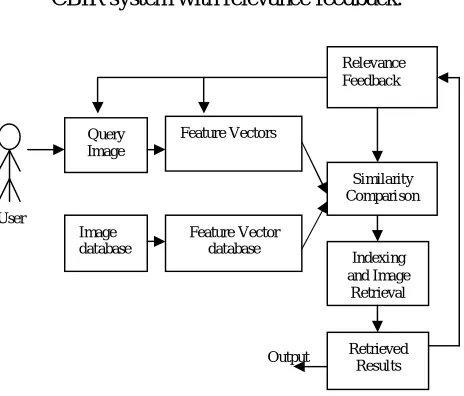
meaningful results [1]. Fig.1 shows a typical CBIR system with relevance feedback.
User
Output
Fig 1: A Typical CBIR System with RF
This paper is presented as follows. In section II the Relevance Feedback mechanism is discussed. In section III the current state of art on RF in CBIR and the various RF approaches and their related issues are discussed. Section IV discusses the evolution of Relevance Feedback techniques in the recent years with their advantages and limitations. Section V gives a table of comparison of the recent Relevance Feedback techniques. Section VI
Query Image
Feature Vectors
Image database
Similarity Comparison
Indexing and Image
Retrieval
Retrieved Results Feature Vector
database
ISSN: 2231-5381
http://www.ijettjournal.org
Page 167 concentrates on the challenges, current trends and
issues in RF. Finally conclusion is presented in section VII.
II. RELEVANCE FEEDBACK
The notion of “similar” in the mind of the user may fluctuate depending on the query, the history of retrievals observed, and the user. If there is a significant discrepancy between the similarity as calculated by the system and the notion of similarity in the user’s mind, the results are destined to be unsatisfactory. This problem has served as the impetus for what is known as “Relevance Feedback” (RF).
Relevance feedback retrieval systems prompt the user for feedback on retrieval results and then use this feedback on subsequent retrievals with the goal of increasing retrieval performance. A typical user-system session is as follows. A user presents an image query to the system whereupon the system retrieves a fixed number of images using a default similarity metric. The user then rates each returned result with respect to how useful the result is for his or her retrieval task at hand. Ratings may be simply “relevant” or “not relevant” or may have finer gradations of relevancy such as “somewhat relevant,” “not sure,” and “somewhat irrelevant.” The relevance feedback algorithm uses this feedback information to select another set of images. Whether the new and previous sets are disjoint depends on the particular system. The system’s goal is to effectively infer which images in the database are of interest to the user based on this feedback. The user could then rate these images in the second set in a similar way and the process may iterate indefinitely in this closed-loop fashion.
A relevance feedback retrieval system has a number of design requirements that allow the system to function in an efficient online manner.
After each iteration, when a set of images are retrieved, the system must require a reasonable amount of feedback. If the user needs to labour over providing feedback for numerous images after each and every
iteration, they will tire soon and not be satisfied with the process.
The system must produce acceptable results after only a few iterations. If large numbers of iterations are required, the user will also tire.
Feature extraction should be completed in a short period of time to prevent user frustration [3].
Also these low level features extracted and their semantic meanings may differ thus forming a gap known as the “Semantic Gap”. This problem is an important factor that affects the performance of RF in CBIR.
A wide variety of RF algorithms have been developed in the recent years with an effort to reduce this semantic gap and thus improving the performance of CBIR systems.
III. APPROACHESINRELEVANCEFEEDBACK
These approaches explain how a CBIR system learns from feedback provided by the user. This learning technique used in CBIR systems fall into the category of either Short-Term Learning or Long-Term Learning.
A. Short-Term Learning Approach(STL):
ISSN: 2231-5381
http://www.ijettjournal.org
Page 168 (SVM), Bayesian learning, boosting, feature
weighting, discriminant analysis and so on.
Limitations: However the STL approach has the
following limitations.
The size of the training set is smaller than the dimension of feature space
There is too much imbalance between the
users feedback
Since the process of learning is online, it consumes a lot of real time [6].
B. Long-Term Learning Approach (LTL):
In contrast with short-term learning, in which the state of the retrieval system has to be reset after every session, long-term learning approaches are designed to use the information gathered during previous sessions aiming to improve the retrieval results in future sessions. Long-term learning is also frequently referred to as collaborative filtering. The most popular approach in LTL is to refer inter
relationships between images by analysing
feedback logs that contain all the feedback given by users over time. With the help of this feedback logs a semantic space can be learned containing the relationships between the images and one or more classes obtained by applying factorization or clustering techniques. The early LTL approaches were mostly built only a static relevance models without the scope of updation, whereas the recent trend is to continuously update the model after receiving new feedback. [7]. A matrix stores the feedback labels provided by user for each image in every iteration. As the size of the matrix is large, statistical models and approaches such as Principal component analysis (PCA) and Latent Semantic Analysis (LSA) can be applied to increase the efficiency in LTL approaches.
Limitations: The limitations can be summarized as
follows
This approach has been found unsuitable for
applications that frequently add and remove images.
This approach requires huge memory and
computation to extend the knowledge across images as it strongly depends on the amount of user log that the system has stored for it. Feedback knowledge memory model was
introduced to collect sufficient log
information from a very large database [8]. This method not only brings out the hidden semantics but also helps to reduce the user log scarcity which is called memory learning.
Lastly it lacks in the ability to predict hidden semantics in terms of acquired semantics as it recommends only the memorized semantic knowledge to users [6]. Hidden Annotation (HA) method helps in overcoming this problem [9].
IV. RECENTTECHNIQUESINRELEVANCEFEEDBACK
Many RF methods have been introduced recently and they can be classified as follows [10].
A. Support Vector machine (SVM) based RF Techniques:
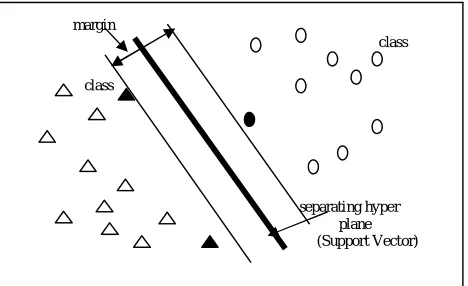
Recent studies are based on classifiers that have good generalization performance by maximizing the margin between positive and negative examples. One such classifier is the Support Vector Machine. Support Vector Machines are supervised learning methods used in the classification of images. The given image database is divided into sets of vectors in an ‘n’ dimensional space by constructing a hyper plane that maximizes the margin between these two vector sets i.e. relevant images and non-relevant images [12]. SVM is a kernel based RF approach and the kernel function used in SVM plays an important role in determining the performance of the RF mechanism. SVM helps to get optimal results for image classification.
ISSN: 2231-5381
http://www.ijettjournal.org
Page 169 quality in image classification. This idea [13] can
be best understood with the help of Figure 2.
margin
class
class
separating hyper plane (Support Vector)
Figure. 2. SVM Classification of images
Advantages: It helps in reducing the prediction error as it clearly draws a line between relevant and irrelevant images. This helps in reducing the time complexity at the same time. Another advantage of the SVM is the compact representation of the decision boundary, so that the number of support vectors is small as compared to the number of points in the training set [14]. SVM is therefore found capable of learning in a sparse, high-dimensional space by using very few training examples thus maximizing the margin and minimizing the classification error.
Limitations: SVM RF approaches ignore the basic difference between the two distinct groups of feedbacks i.e., all positive feedbacks share a similar concept while each negative feedback usually varies. This has been found to drastically degrade the effectiveness of this method. This can be overcome by implementing CBIR both on-line and off-line [15]. Also choosing proper kernel functions and parameters for a real specific database remains challenging. The number of support vectors that
compose the decision function increase
dramatically when the decision procedure becomes complicated. Moreover the over fitting problem can become more severe i.e., training samples may be few to train a good classifier in a high dimensional space [16].
B. Subspace learning based Techniques:
Based on the user’s relevant feedback, learning based approaches are typically used in modifying the feature set or similarity measure [17]. The subspace learning based methods define a class problem and find a subspace within which to separate the one positive class from the unknown number of negative classes. Few of the methods come under this category are: Biased Discriminant Analysis or BDA, the Direct Kernel Biased Discriminant Analysis (DKBDA) and Marginal Biased Analysis (MBA). To prevent the problem of learning from small training sets, discriminant algorithms have been used for unlabeled images in the database [18]. Recently, BDA has been used as a feature selection method to improve RF, because BDA models the RF better than many other methods. However, BDA assumes all positive samples from a single Gaussian distribution, which means all positive samples, should be similar with similar view angle, similar illumination, etc. Clearly, this is not the case for CBIR. The kernel-based learning is used in BDA to overcome the problem. However, kernel-based learning has to rely on parameter tuning, which makes the online learning unfeasible [19].
The performance of image retrieval task can be
significantly improved in low-dimensional
subspace by making the system learn a semantic concept subspace from the RF log data with contextual information without using any class label information. This method which is called the Semantic Subspace Learning (SSL) [20] exploits the RF log data to improve its performance.
C. Query refining Techniques:
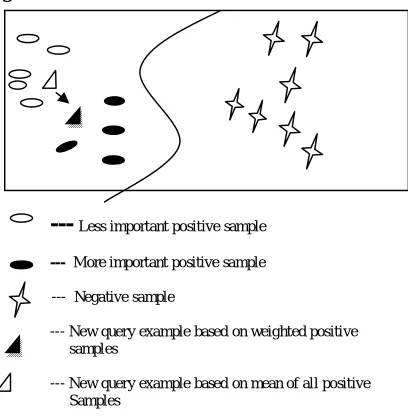
Query refining algorithms aims in obtaining a new query example to make it a more suitable candidate for representing the user’s query concept or semantic intent about the query. The mean of all returned relevant images can be taken as the new query example, which means all of them take identical contribution to the query refining.
ISSN: 2231-5381
http://www.ijettjournal.org
Page 170 probably more important than the others for query
refining. For example, when we search for the image of a boat sailing in the sea, the system will return retrieval results including an image of a boat on shore, which is also considered as a positive sample. However the image of a boat on shore contains less important information that the one with the boat sailing on the sea for the next round feedback iteration. Therefore the positive sample of the boat sailing on the sea should pay more contribution to the query refining. So the above stated query refining which is based on the mean of all positive samples cannot express this intention exactly [21]. Query refinement can be achieved by Query Point Movement, Updating weights to Query Vector and Query Expansion.
1) Query Point movement (QPM): To overcome this drawback of assigning equal importance to all positive samples this method can be used. The method of Query Point Movement associates a relevance degree to each of the positive sample of the query example. The aim of this approach is to make the new query example move closer to more important positive sample, i.e. how to move the new query in the most promising direction to be generalized better and moving away from bad example points. How to move a new query example towards more promising direction can be shown in Figure.3
--- Less important positive sample
--- More important positive sample
--- Negative sample
--- New query example based on weighted positive samples
--- New query example based on mean of all positive Samples
Fig. 3 Query refining procedure
Rocchio’s formula is the most commonly used technique to iteratively improve this approach of query point movement. (Rocchio, 1971) Equation is as follows –
β Jrel γ jnon-rel
q n+1 = αqn + --- ∑ Xj ─ --- ∑ Yj
N+(n) j=1 N – (n) j=1
Where, qn is the query point for nth round of the
search cycle. Parameters α, β and γ are the suitable constants denoted as the weight parameters, Jrel is the number of relevant images in Xj and Jnon-rel is the total number of non-relevant images in Yj. The parameters β and γ can be adjusted to be more biased towards one sample group depending on the nature of the data samples. If variable γ is set to zero, then the negative sample may totally be ignored and by setting variable α to zero the history of the query point can be ignored [22].
Limitations: But this method increases the user’s burden since it is sometimes difficult for the user to decide the importance of each positive image in query refining.
2) Updating weights to the query vector: Query weighting changes the relative weights of different features in the query representation. This updating weight vector mechanism allows the system to learn the user’s interpretation of similarity / distance function. The weights of the relevant vectors are increased while the weights of the irrelevant vectors are decreased.
ISSN: 2231-5381
http://www.ijettjournal.org
Page 171 and images are retrieved from iso-similarity regions
based on these points [23].
D. Feature selection based Algorithms:
Understanding the user’s needs in image retrieval can be a very challenging task because of the identification of the importance the user assigns to each feature. To understand this part better let us see this example. If we ask a group of people “does a tiger resemble a cat? Some may answer “yes” taking into account the cat family and the other may say “no” taking into account the difference in size. Hence depending upon the feature considered at that moment of time the judgement varies. So we see that the importance attached to each feature plays an important role in deciding the similarity of the images [24]. With a large number of extracted features and their combinations, it is difficult for a user to choose the best combination of features for similarity in image retrieval. RF techniques enable automatic weighting of features based on their degree of importance thereby enabling the selection of best features for the retrieval of relevant images [25]. Feature Selection based algorithms narrows the semantic gap by selecting the feature subset that best represents the query and discards redundant features. While the other RF algorithms completely ignore the mutual information for feature selection, this algorithm focuses on the low level features for effective image retrieval.
E. Boosting Techniques:
Another example of a classifier that helps in maximizing the margin between a positive and a negative sample is boosting. Boosting provides a good theoretical and practical convergence to a low error rate in less number of iterations. Furthermore the speed of the boosting algorithms is more when compared to other methods namely SVM. Also boosting can be used in feature selection algorithm. Given several weak classifiers whose error rate is slightly lower than 0.5 boosting provides a strong classifier by finding a suitable combination of the weak-classifiers. This combination provides weight to each of the classifiers based on their importance [26]. Adaboost is often regarded as the generic
boosting algorithm, since it is the first practical algorithm that used boosting. AdaBoost has been found to perform better than other classification algorithms and it does not get into the problem of over fitting. AdaBoost maintains a distribution (set of weights) over the training examples and selects a weak classifier from the weak learning algorithm at each iteration. Training examples that were misclassified by the weak classifier at the current iteration then receive higher weights in the following iteration. The end result is a final combined classifier, each component is the weak classifier obtained at each iteration and each component classifier is weighted according to how this classifier performed during each iteration [27].
F. Decision Tree Learning based RF Techniques:
A decision tree is a method for recursively partitioning a feature space such that each partition is labelled by a single class value. This algorithm is executed recursively until all instances within each partition are of the same class value [28].
ISSN: 2231-5381
http://www.ijettjournal.org
Page 172 G. Neural Networks based RF Techniques:
A major problem that arises in image retrieval strategies is the useful representations and similarity models with index structures to provide efficient similarity matching in large databases. Retrieving methods are based on the similarity measures between the feature vectors of the query image and the images in the database. One of the main difficulty is, searching most of the time has to be done with imprecise key features. To minimize this problem the neural networks can be put to work along with feedback from the user. This feedback improves the procedure of image retrieval significantly. From the initial set of images the user selects the best matched samples and annotates these images appropriately. From these samples weights of pre-extracted features are updated, according to subjective perception of visual content. The feature vectors extracted from such ranked images are then used as training examples for updating weights in neural network. These systems have good accuracy and retrieval speed. Better accuracy is obtained when larger feature vectors are used [30].
The two factors that should be taken in account for efficient image retrieval is working with high dimensional feature vectors which is time consuming and the semantic gap problem. The power of multilayer neural network along with its learning ability via a fuzzy radial basis function network (FRBFN) and relevance feedback reduces the data dimensionality and semantic gap in parallel. The use of FRBFN has two benefits. First in incorporates fuzzy nature of human decision into the system and the convergence time is low due to its fast learning algorithm which lacks back-propagation [31].
Another approach that reduces the feature dimensionality and the semantic gap is to generate micro structured image (using MSD) to identify low-level features of an image and then characterize images through neural network, which involves the use of low-level features as support for the high-level vector generation represented by the neural network. The generated image is used in retrieving the rank ordered images from the database. From these rank ordered images user feedback is given
for a pattern-based search to match user’s intention. The user’s fuzzy interpretation of image similarity was integrated into CBIR system by using Fuzzy Radial Basis Function Network (FRBF). This tends to be more flexible than other feedback algorithms and helps in retrieving the most relevant set of images from the database [32].
The neural networks have attracted research because of the following points [33].
Neural Networks have universal
approximation
They have very compact topology.
They possess the best approximation
property.
The learning speed of the neural network is very fast.
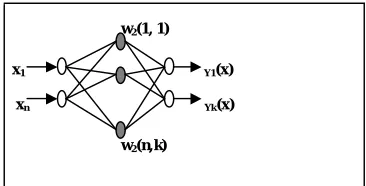
Structure of RBF (Radial Basis Function) Neural Network is given in figure 4.
w2(1, 1)
x1 Y1(x)
xn Yk(x)
w2(n,k)
Fig 4. Radial Basis Function Neural Network
The output of the ith RBF unit is as follows:
‖X-ci‖
Ri(X) = Ri(---), i = 1,2,...,n σi
Where X is an input feature vector with r dimensional, ci is a r-dimensional vector named
ISSN: 2231-5381
http://www.ijettjournal.org
Page 173
V. COMPARINGVARIOUSRFTECHNIQUES
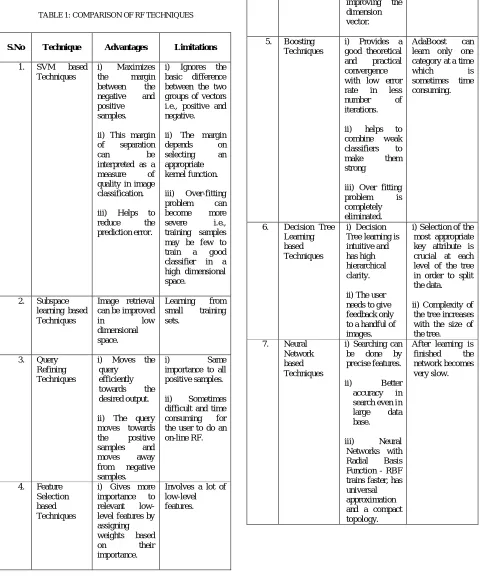
The various RF techniques discussed so far can be summarized in table 1.
TABLE 1: COMPARISON OF RF TECHNIQUES
S.No Technique Advantages Limitations
1. SVM based
Techniques
i) Maximizes
the margin
between the negative and positive samples.
ii) This margin of separation
can be
interpreted as a
measure of
quality in image classification.
iii) Helps to
reduce the
prediction error.
i) Ignores the basic difference between the two groups of vectors i.e., positive and negative.
ii) The margin
depends on
selecting an appropriate kernel function.
iii) Over-fitting
problem can
become more
severe i.e., training samples may be few to train a good classifier in a high dimensional space.
2. Subspace learning based Techniques
Image retrieval can be improved
in low
dimensional space.
Learning from small training sets.
3. Query
Refining Techniques
i) Moves the query
efficiently towards the desired output.
ii) The query moves towards the positive samples and
moves away
from negative samples.
i) Same
importance to all positive samples.
ii) Sometimes difficult and time consuming for the user to do an on-line RF.
4. Feature Selection based Techniques
i) Gives more importance to relevant low-level features by assigning weights based
on their
importance.
Involves a lot of low-level features.
ii) Avoids low-level feature redundancy thereby improving the dimension vector.
5. Boosting Techniques
i) Provides a good theoretical and practical convergence with low error rate in less
number of
iterations.
ii) helps to combine weak classifiers to
make them
strong
iii) Over fitting
problem is
completely eliminated.
AdaBoost can learn only one category at a time
which is
sometimes time consuming.
6. Decision Tree Learning based Techniques
i) Decision Tree learning is intuitive and has high hierarchical clarity.
ii) The user needs to give feedback only to a handful of images.
i) Selection of the most appropriate key attribute is crucial at each level of the tree in order to split the data.
ii) Complexity of the tree increases with the size of the tree. 7. Neural
Network based Techniques
i) Searching can be done by precise features.
ii) Better
accuracy in search even in large data base.
iii) Neural Networks with Radial Basis Function - RBF trains faster, has universal approximation and a compact topology.
ISSN: 2231-5381
http://www.ijettjournal.org
Page 174
VI.TRENDSANDISSUESINRF
It has been seen that the future direction in RF techniques are SVM, Subspace Learning, Query Refining, Feature selection, Decision trees and Boosting. The main challenge lies in improving the values of the evaluation parameter like precision, convergence and execution time using RF. Researchers have designed feedback algorithms that improve image retrieval for large data sets.
Pseudo Feedback: This method is another approach in the recent RF techniques used. These use relevance feedback methods without explicit user input. Just assume the top m retrieved images are relevant, and use them to reformulate the query. Allows for query expansion that includes terms that are correlated with the query terms.
The major issues in CBIR systems are:
1) Since RF has to be done on-line for both training and testing, it is time consuming. Users are sometimes reluctant to provide explicit feedback.
2) Results in long queries that require more computation to retrieve, and search engines process lots of queries and allow little time for each one.
3) Learning with small training sets can
minimize the efficiency of the retrieval system.
4) The semantic gap problem i.e., the mismatch between the low-level features extracted by the system and what the system perceives has to be bridged to improve the efficiency of the CBIR systems.
5) The major focus in CBIR system using RF is
minimum number of iterations the system can take to give the most similar image set. In many cases it can be seen that the RF becomes cumbersome and tiring for the user online when the number of iterations grow larger.
6) It can also be taken in consideration that lack of proper identification of the feedback samples as “relevant” and “irrelevant” can mislead and thus result in more number of iterations.
VII. CONCLUSION
The efficiency of the CBIR system with RF depends upon the choice of the feedback algorithm and the different parameters associated with the algorithm. Promising results in image retrieval is possible when the CBIR system takes a combination of techniques for its relevance feedback. Difficulties that arise when learning from small training sets were discussed and the two main drawbacks of CBIR system namely the “curse of dimensionality” and “semantic gap” can be successfully eliminated by the various RF techniques. Also this paper throws light on the various RF techniques recently used with their advantages and limitations discussed in detail. To conclude Relevance Feedback techniques used in a CBIR system helps in accurate image retrieval and improves the standard evaluation parameters like precision, convergence and execution time.
REFERENCES
[1] Dr. Fuhui Long, Dr. Hongjiang Thang and Prof. David Dagan Feng. “Fundamentals of Content Based Image Retrieval”.
[2] J. Peng, B. Bhanu, and S. Qing, Probabilistic feature relevance learning for content-based image retrieval, Comput. Vision Image Understand. 75, 1999, 150–164.
[3] Sean D. MacArthur, Carla E. Brodley, and Avinash C. Kak. ”Interactive Content-Based Image Retrieval Using Relevance Feedback”, Computer Vision and Image Understanding 88, 55–75 (2002) doi:10.1006/cviu.2002.0977.
[4] Kranthi Kumar, K, Sunil Bhutada, V.V.S.S.S. Balaram, “An Adaptive Approach to Relevance Feedback in Cbir Using Mining Techniques”.
[5] Xiaofie He, Wei-Ying Ma, Oliver King, Mingjing Li, Hongjiang Zhang, “ Learning and Inferring a Semantic Space from User’s Relevance Feedback for Image Retrieval”, Multimedia ’02, December 1-6, 2002, Juan-les-pins, France.
[6] Pusha B. Patil, Manesh B. Kokare, “Relevance Feedback in Content Based Image Retrieval: A review”, Journal of Applied Computer Science & Mathematics, No. 10(5)/2011, Suceava.
[7] Bart Thomee, Michael S. Lew, “Interactive search in image retrieval: a survey”, International Journal of Multimedia and Information Retrieval (2012) 1:71-86.
[8] Junwei Han, King H. Mingjing Li, Hong-Jiang Zhang, “ A Memory learning Framework for Effective Image Retrieval”, IEEE Trans. On Image Processing, Vol 14, no.4. pp. 511-523.
[9] Wei Jiang, Guihua Er, Qionghai Dai, Jinwei Gu, “Hidden annotation for image retrieval with long-term relevance feedback learning”, Pattern Recognition 35 (2005) 2007-2021.
[10] Puja Kumar, “Image Retrieval Relevance Feedback algorithms: Trends and Techniques”, International Journal of Scientific Engineering and Technology, Volume No.2, Issue No.1, pp: 13-21, (ISSN: 2277-1581), 1 Jan. 2013.
ISSN: 2231-5381
http://www.ijettjournal.org
Page 175
[12] Fabio F. Faria, Adriano Veloso, Humberto M. Almedia, Eduardo Valle, Ricardo Da S. Torres and Marcos A. Goncalves, “Learning to Rank for Content-Based Image Retrieval”, MIR’ 10, Mar20-31, 2010 Philadelphia, Pennsylvania, USA.
[13] Sonali Jain, Satyam Shrivastava, “A novel approach for image classification in Content Based Image Retrieval using Support Vector Machine”, Intermational Journal of Computer Science & Engineering (IJCSET) Vol.4 No.03, March 2013.
[14] Xiaohong Yu and hong Liu, “Image Semantic Classification Using SVM in Image Retrieval”, Proceedings of the Second Symposium International Computer Science and computational Technology (ISCSCT, ’09) Huangshan, P. R.China, 26-28, Dec.2009, pp458-461. [15] Swati Killikatt, Vidya Kulkarni, Madhuri Bijjal, “Content Based
Image Retrieval by Online and Offline”, International Journal of Advanced Research in Electronics and Instrumentation Engineering”, Vol 2, Issue7, July 2013.
[16] Wei Jiang, Guihua Er., Qionghai Dai, Jinwei Gu, “Similarity – Based Online Feature Selection in Content – Based Image Retrieval”, IEEE Transactions on Image Processing, Vol 15. No.3, March 2006.
[17] Ritendra Datta Dhiraj joshi, Jia Li and James Z. Wang, “Image Retrieval: Ideas, Influences and Trends of the New Age”, ACM Computing Surveys, Vol 40, No. 2, Article 5, Pub. Date april 2008. [18] Ritendra Datta, Jia Li, James Z. Wang, “Content-Based Image
Retrieval – Approaches and Trends of the New Age”, The Pennsylvania State University, University Park, PA 16802, USA. [19] Dacheng Tao and Xiaoou Tang, “Nonparametric Discriminant
Analysis in Relevance Feedback for Content – Based Image Retrieval”, The Chinese University of Hong Kong.
[20] Lining zhang, Lipo Wang, Weisi Lin, “A semantic subspace learning method to exploit relevance feedback log data for image retrieval”, Computational Intelligence and Data Mining (CIDM), 2013 IEEE symposium, pages 178-183.
[21] Yufeng Zhao, Yao zhao, Zhenfeng Zhu, “ Relevance Feedback based on Query Refining and Feature Database Updating in CBIR System”, National Science Foundation No. 60172062.
[22] Shanmugapriya N. and R. Nallusamy, “A New Content Based Image Retrieval System Using GMM and Relevance Feedback”, journal of Computer Science 10(2): 330-340, 2014.
[23] Suman karthik, C.V. Jawahar, “Analysis of Relevance feedback in Content Based Image Retrieval”.
[24] Mohammed Lamine Kherfi and Djemel Ziou, “Relevance Feedback for CBIR: A new Approach based on Probabilistic Feature Weighting with Positive and Negative Examples”, IEEE Transactions on Image Processing, Vol15, No.4, April 2006. [25] Carsten Tusk, Krsystoz Koperski, Selim Aksoy and Giovanni
Marchisio, “Automated Feature Selection Through Relevance Feedback”, IEEE 2003.
[26] Jaume Amores, Nicu Sebe, Petia Radeva, Theo Gevers, Arnold Smeulders, “Boosting Contextual Information in Content-Based Image Retrieval”, ACM, 2004.
[27] Jie Yu, Yijuan Lu, Yuning Xu, Nicu Sebe and Qi Tian, “ Integrating Relevance Feedback in Boosting for Content-based Image Retrieval”, Department of Computer Science, University of Amesterdam, The Netherlands.
[28] Sean D. MacArthur, Carla E. Brodley, Chi-Ren Shyu, “ Relevance Feedback Decision Trees in Content-Based Image Retireval”, Proceedings of the IEEE workshop on Content – Based Access of Image and Video Libraries, 2000.
[29] Ying Liu, Dengsheng Zhang, Guojun Lu, “Region-Based image retrieval with high-level semantics using decision tree learning”,Pattern Recognition 41 (2008) 2554-2570.
[30] Nenad S. Kojic, Slobodan K.Cabarkapa, Goran J. Zajic and Branimir D. Rejlin, “Implementation of neural Network in CBIR Systems with Relevance Feedback”, Journal of Automatic Control, University of Belgrade, Vol 16:41-45, 2006.
[31] Sharooz Nematipour, Jamshid Shanbehzadeh, Reza Askari Moghadam, “Relevance Feedback Optimization in Content Based Image Retrieval Via Enhanced Radial Basis Function Network”, proceedings of the International multiConference of Engineers and
Computer Scientists 2011, Vol I, IMECS 2011, March 16-18, 2011, Hong Kong.
[32] Kranthi Kumar, Dr. T. Venu Gopal, K. Dasaradha Ramiah, Dr. P. Sammulal, “A Novel Approach to Optimize Relevance Feedback in CBIR via Integerating MSD and FRB Function Network”, 2nd
International Conference on Innovative Research in Engineering and Technology (iCIRET2013), January3-5, 2013.
[33] B. Veera Jyothi, Dr. Uma Shanker, “Neural Network approach for Image Retrieval based on preference elicitation”, International Journal on Computer Science and Engineering, Vol 02, No. 04, 2010, 934-941.
[34] Ying Liu, Dengsheng Zhang, Guojun Lu, Wei-Yung ma, “A survey of content-based image retrieval with high semantics”, Pattern Recognition, 40(2007) 262-282.
[35] Darshana Mistry, “Survey of Relevance Feedback methods in Content-Based Image Retrieval”, International Journal of Computer Science & Engineering Technology (IJCSET), ISSN: 2229-3345. [36] C.Ramesh Babu durai, V. Duraisamy, C.Vinothkumar, “Improved
Content Based Image Retrieval Using Neural Network Optimization with Genetic Algorithm”, International Journal of Emerging Technology and Advanced Engineering, Vol2, Issue 7, July 2012. [37] Hamed Modaghegh, Malihe Javidi, Hadi Sadoghi Yazdi and Hamid
Reza Pourreza, “Learning of Relevanc Feedback Using a Novel kernel Based Neural network”, Australian Journal of Basic and Applied Sciences, 4(2): 171-186, 2010.
[38] Sasi Kumar and Y.S. Kumaraswamy, “A Boosting Frame Work for Improved Content Based Image Retrieval”, Indian Journal of Science and Technology.
[39] Dr. V.V.S.S.S.Balaram, Kranthi kumar and Sunil Bhutada, “An Integrated Relevance Feedback Method for CBIR using Histogram Values, Texture Descriptor and Interactive Boosting”, AP,India. [40] Suraj M. Gulhane, Akash G. Shinde and Amit kumar Singh,
“Relevance Feedback for Content-Based Image Retrieval by Mining User Navigation Patterns”, journal of Engineering, Computers & Applied Sciences (JEC & AS), Volume 2, No.3, march 2013. ISSN no. 2319-5606.
[41] Bhailal Limbasiya and Swati Patel, “Content Based Image Retrieval with Log based Relevance Feedback Using Combination of Query Expansion and Query Point Movement”, International Journal of Computer Science and Mobile Computing, IJCSMC, Vol2, Issue 5, may 2013, pg. 155-161.
[42] B. Dinakarn, J. Annapurna and Ch. Aswani Kumar, “Interactive Image Retrieval Using Text and Image Content”, Cybernrtics and Information Technologies, Vol 10. No.3. 2010.
[43] Abolfazl Llakdashti and Hossein Ajorloo, “Content – Based Image Retrieval Based on Relevance Feedback and Reinforcement Learning for medical Images”, ETRI Journal, Vol. 33, Number 2, April 2011.
[44] Latika Pinjarkar, Manisha Sharma and Kamal Mehta, “Comparative Evaluation of Image Retrieval Algorithms using Relevance Feedback and its Applications”, International Journal of Computer Applications (0975- 888), Volume 48 – No. 18, June 2012. [45] Karthik S, Snehanshu Saha and Chaitra G., “A New Relevance