THE TIME FACTOR IN THE SPHEROIDIZING AND GRAPHITIZING
MODIFICATION AND CAST IRON CRYSTALLIZATION
Lukianenko I.V., Fesenko M.A., Kosiachkov V.O., Fesenko. E.V. (National technical university of Ukraine “KPI”, Kyiv)
АBSTRACT:This work was carried out studies on the effect of different ways of modifying the microstructure and mechanical properties
of cast ductile irons identical to the final chemical composition. For comparative studies have chosen three ways of modifying the molten iron, characterized the time interval between the introduction of additives into the melt and crystallization of iron – autoclave method, processing method in an open ladle ( "Sandwich process") and a method of in-mold melt processing ("Inmold-process").
It is found that the process mold inoculation molten iron a more effective compared to other methods studied, by reducing the time interval between entering modifier in liquid iron and the onset of crystallization. This in turn enables the production of castings of several grades of ductile iron in the total process stream without additional alloying and heat treatment.
Results of research testify in favor of the fluctuation hypothesis about straight line graphitization of cast iron during primary crystallization.
KEYWORDS: HIGH-STRENGTH CAST IRON, MODIFIER, METHOD OF MODIFYING, MICROSTRUCTURE,
STRENGTH, HARDNESS, INMOLD- PROCESS, SANDWICH-PROCESS, AUTOCLAVE METHOD.
Structure and mechanical properties of ductile iron with nodular graphite in cast condition defined by four technological factors and may be substantially changed by heat treatment of castings. Influence of chemical composition of the base alloy, amount and absorption degree of spheroidizing magnesium and graphitizing silicon introduced into the liquid iron, as well as the cooling rate of the metal in the mold for the modification results in a sufficiently studied full [1-5] . Fourth factor influencing these results – the time interval between the input modifiers in liquid melt and the beginning of crystallization – most researchers pay negligible importance. Meanwhile it is well known that in contrast to the alloying efficiency of modification during isothermal exposure worsens: increased cast iron tendency to metastable
system crystallization "Fe-Fe3C" and reduced the degree of
graphite nodularity [1,2].
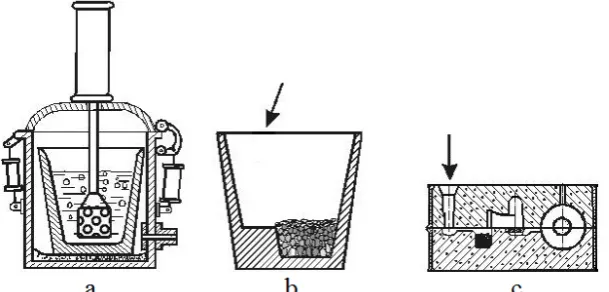
In the process of sequential replacement on four industrial enterprises autoclave method of ductile iron production (fig. 1, a) first by ladle (fig. 1, b), and then in-mold (fig. 1, c) accumulated extensive statistical material on the technical and economical efficiency of these methods of modification. Analysis of the results proved conclusively advantage of in-mold method of input magnesium and silicon in liquid iron, as compared with previous methods, and that was the main reason for its implementation in the production of complex thin-walled castings of hydraulic equipment weighing up to 180 kg of ferritic spheroidal graphite cast iron.
Fig. 1. Methods of complex spheroidizing and graphitizing modifying of cast iron in a sealed autoclave (a), in open ladle by
"sandwich" process (b) and directly in the casting mold by "in-mold" process (c).
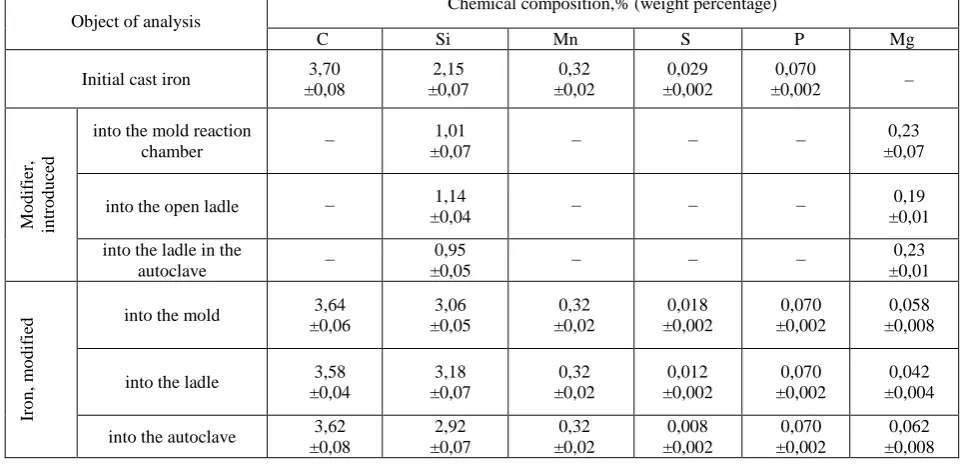
From the data array of plant laboratories accumulated during great enough time for analysis selected only the results of meltings, in which iron chemical composition meets the conditions listed in tab. 1. All three methods of modification provided a high (96…98%) degree of nodularity in metal castings suitable.
Table 1. Chemical composition of initial and modified cast-irons and amount of the silicon and magnesium entered in initial cast-iron
Object of analysis
Chemical composition,% (weight percentage)
C Si Mn S P Mg
Initial cast iron 3,70 ±0,08 2,15 ±0,07 0,32 ±0,02 0,029 ±0,002 0,070
±0,002 –
M o d if ie r, int ro duc ed
into the mold reaction
chamber −
1,01
±0,07 − − −
0,23 ±0,07
into the open ladle − 1,14
±0,04 − − −
0,19 ±0,01
into the ladle in the
autoclave −
0,95
±0,05 − − −
0,23 ±0,01 Ir on, m odi fi
ed into the mold
3,64 ±0,06 3,06 ±0,05 0,32 ±0,02 0,018 ±0,002 0,070 ±0,002 0,058 ±0,008
into the ladle 3,58 ±0,04 3,18 ±0,07 0,32 ±0,02 0,012 ±0,002 0,070 ±0,002 0,042 ±0,004
into the autoclave 3,62 ±0,08 2,92 ±0,07 0,32 ±0,02 0,008 ±0,002 0,070 ±0,002 0,062 ±0,008
According to the results of dispersion analysis comparing the experimental and tabulated values of Fisher's exact test with a coefficient of 95% found that the amount of silicon and magnesium, which is added to the molten metal, as well as the chemical composition of the studied cast irons modified by various methods did not significantly affect the microstructure and mechanical properties of the alloy. At the same time, these characteristics in the cast state essentially depend on the method of modification.
Mean values and the dispersion of mechanical characteristics of the cast iron modified into the reaction chamber of the mold by "in-mold"-process, into the ladle bottom lining open by "sandwich"-process and into the ladle placed in the autoclave mark "KM-2" are shown in tab. 2. Typical
microstructure of cast iron in the relevant standard samples is illustrated in fig. 2.
Found that in the cast iron in-mold modified, the amount of graphite spheroids in 1 mm2 area microsection 40% more than in the iron modified in the ladle, and 60% more than in the iron modified in an autoclave. With the same carbon content, average diameter of the spheroids is respectively 50, 65 and 85 µm. In cast iron, modified in an autoclave, there are separate sections ledeburitic eutectic, which are absent in cast irons, modified in-mold or in the ladle. Percentage of ferrite in cast iron in-mold modified is 85…95% and a metal matrix of cast iron, modified in the autoclave, preferably pearlitic with a fine ferrite rim around the graphite spheroids.
Fig. 2. The microstructure of the cast iron casting in-mold modified (a), in an open ladle (b), in an autoclave (c). × 100.
ВЧ 500-7, ВЧ 500-2. Mechanical characteristics of cast iron, modified in an autoclave in the cast state do not meet the requirements of ДСТУ 3925-99 to mark ВЧ 600-3 ductility, and to mark HF 700-2 strength. Therefore, to achieve the desired combination of strength and ductility of autoclave casts, depending on the desired mark, factories generally subjected to further ferrite annealing or perlite normalizing.
Thus, by method of in-mold modifying under certain conditions can stably produce castings from nodular iron several brands in the general process flow without additional alloying and heat treatment.
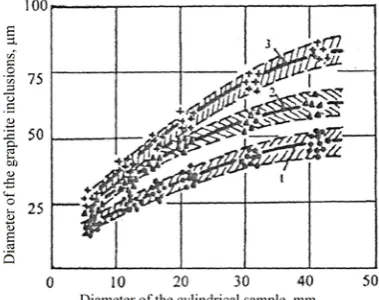
It confirms metallographic analysis of the microstructure of cast irons in the cylindrical samples of different diameters. In the in-mold modified cast irons, in the samples of 6 mm diameter graphite spheroids number reaches 500...800 units per 1 mm2 area microsection (fig. 3, curve 1) at their size 15...20 µm (fig. 4, curve 1). With the increase in the diameter of the sample, i.e. with reduced cooling rate, the amount of graphite spheroids rapidly decreases with a corresponding increase of their size in samples of 40 mm diameter to 45...55 µm. In cast iron, in an open ladle is modified or modified in the autoclave, the samples of 6 mm diameter graphite inclusions sizes are 20...25 µm, i.e. only slightly exceed the graphite dimensions of similar samples of cast iron, in-mold modified. However, the low degree of graphitization their amount does not exceed of 125 units per 1 mm2 area microsection (fig. 3 and 4, curves 2 and 3). In cast iron samples with a diameter of 6 mm, in-mold modified, a eutectic cementite is absent (fig. 5, a), whereas in the cast iron in the ladle or in the autoclave modified, main part of carbon in samples connected to the needle cementite of ledeburitic eutectic (fig. 5, b, c). In the ladle modified cast iron, the eutectic cementite disappears only in the samples of 20 mm diameter (fig. 5, e). In the autoclave modified cast iron, individual inclusions of
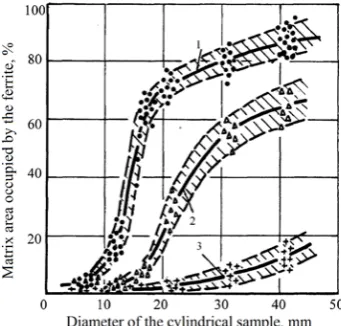
ledeburitic eutectic observed even in samples of 40 mm diameter (fig. 5, f). At the same diameter of cylindrical samples microsection area occupied by ferrite in cast iron, in-mold modified (fig. 6, curve 1), significantly more than in the ladle modified cast iron (fig. 6, curve 2). Cast iron metal matrix structure modified in the autoclave, in all the samples mostly pearlitic with fine ferrite rim around the graphite spheroids (fig. 6, curve 3).
Ceteris paribus, the main technological difference between the three methods of modification lies in the different time interval between introduction of modifier elements into the molten metal and the beginning of crystallization in the mold. To reduce the pressure in the autoclave to atmospheric, opening the autoclave and removed from him the ladle, slag removal, transportation and casting modified cast iron in form in a manufacturing conditions is spent 8...12 minutes. If the total time for these operations is more than 14...16 minutes, the propensity of cast iron to graphitization and degree of graphite nodularity in the modified cast iron begins to decrease rapidly. The removal of slag, transportation and metal pouring spent 4...6 minutes after modifying in the open ladle. Gist of the in-mold modifying cast iron method reduces that interval up to several tens of seconds, regardless of which form the first poured and which latter.
Thus, in the cast state with the same chemical composition and the same cooling rate inclination to graphitization during eutectic and eutectoid transformation, the amount of graphite inclusions, graphite spheroids dispersity, eutectic grain dispersion in the cast iron in-mold modified higher than in the cast iron, modified in ladle, and significantly higher than in the cast iron modified in the autoclave. The difference of these indicators is particularly evident at high cooling rate (fig. 3...6).
Fig. 4. The cooling rate influence (diameter of the cylindrical sample) by the diameter of the graphite spheroids in the cast iron
modified into the mold (1), into an open ladle (2), into an autoclave (3).
Fig. 5. The microstructure in cast iron specimens of 6 mm (a, b, c) and 40 mm diameter (d, e, f) modified: a, d – into the mold;
b, e – into an open ladle; c, f – into an autoclave. ×100
Fig. 6. The cooling rate influence (diameter of the cylindrical sample) by the relative microsection area occupied by ferrite in
the cast iron modified into the mold (1), into an open ladle (2), into an autoclave (3).
Tendency to crystallize on a metastable system "iron-cementite" mainly explaining by the fact that when the cast iron temperature drops to eutectic mean, probability of phase fluctuations with carbon concentration, approximate to the 6,67%, significantly higher than the probability of micro volumes with carbon concentration, approximate to 100%. But, from the point of view of thermodynamics, the minimum value of the free
and efficiency of graphitizing modification respectively reduced to zero. During cast iron modification directly into the mold such exposure does not exceed ten seconds. Therefore, the graphitizing efficiency of adding even small amounts of silicon in molten cast iron is shown at the maximum level.
The results of experiment are not quite consistent with the hypothesis mediated cast iron graphitization. According to this hypothesis, the eutectic crystallization of cast iron always takes place at a metastable system, followed by dissociation of the formed solid ledeburite cementite to austenite and graphite by "self-annealing" by the heat of the casting, cooling in the mold, similar to high temperature annealing white cast iron at malleable. In samples with a diameter of 6 mm made of cast iron in-mold modified cooling which occurs with the high speed inclusions of cementite or it "self-annealing" remains isn’t observed (fig. 4, a). Probably, under certain conditions graphite separation directly from the residual liquid without forming an intermediate cementite during eutectic crystallization takes place. However, at higher cooling rate, a low content of carbon and silicon, the presence of chromium or other carbide stabilizing elements, absence the operation of modification or long exposure of the modified alloy to it beginning of crystallization conditions are taking shape for full or partial crystallization by a metastable system. Thus, the hypothesis of a direct graphitization from liquid phase has the same right to exist as the hypothesis of iron mediated graphitization.
CONCLUSIONS
Technological process of spheroidizing and graphitizing modification directly into the mold provides a tendency of cast iron to graphitization at the eutectic and eutectoid transformation, the refinement of austenite grains and graphite spheroids, increased ductility with high strength cast iron more efficiently and reliably than the process of modification in the ladle or in an autoclave.
The researching shows the benefit of the fluctuation hypothesis of graphitizing modification and hypothesis about the possibility of a direct cast iron graphitization from liquid phase at the primary crystallization.
REFERENCES
1.Shebatinov M.P., Abramenko Y.E., Beh N.I. Visokoprochniy chugun v avtomobilestroenii. – M. : Mashinostroenie, 1988. – 216 p.
2.Otlivki iz chuguna s sharovidnim i vermikilyarnim grafitom / E.V. Zaharchenko, Y.N. Levchenko, V.G. Gorenko, P.A. Varenik. - Kyiv: Naukova dumka, 1986. – 248 p.
3. Lekah S.N. Vnepechnaya obrabotka
visokokachestvenih chugunov v mashinostroenii / S.N. Lekah, N.I. Bestugev – Nauka itechnika, 1992. – 269 p.
4. Bublikov V.B. Visokoprochnomu chugunu – 60 // Liteynoe proizvodstvo, 2008. – №11. – P. 2…8.
5.Lerner Y.S. Overview of ductile iron methods // Foundry Trade Journal, 2003. – V.177. – P.25…27.
Information about authors
Fesenko Maksym – PhD, assistant professor,
Department of foundry of ferrous and nonferrous metals National technical university of Ukraine “KPI”
Lukyanenko Ivan – graduate student, Department of foundry of ferrous and nonferrous metals National technical university of Ukraine “KPI”
Kosjachkov Vaycheslav - PhD, assistant professor, Department of foundry of ferrous and nonferrous metals National technical university of Ukraine “KPI”