A Study on the Effectiveness of Markov
Analysis – A Tool for Human Resource
Supply Forecasting
George C Mathew#1, Hareesh N Ramanathan*2, ArabhiP R#3
#1Assistant Professor, Department of Management Studies, TocH Institute of Science and Technology, Cochin, Kerala, India. *2Professor and Head, Department of Management Studies, TocH Institute of Science and Technology, Cochin, Kerala, India.
#3Student, Department of Management Studies, TocH Institute of Science and Technology, Cochin, Kerala, India.
Abstract—Human resource is an important asset
based on which the performance of company depends upon. To attain the organizational objectives it is important to have a human resourceplan. Human resource planning is the process of getting the right number of qualified people into the right job at the right time. It is a matching process between the supplies of people with the opening in the organisation. For this human resource planning process man power inventory is used. Manpower inventoryis the classification of characteristics of personal in an organization in addition to counting their number. The main objective of preparing manpower inventory isto find out the size of personnel available in an organization to work in various positions. To attain this objective an accurate manpower forecast is important. To forecast the internal labour supply there are different
techniques and Markov analysisis one of the important technique. The study measures effectiveness of Markov analysis.
Keywords—Human resource planning, Manpower, Inventory,Markov analysis, Skills.
I.INTRODUCTION
A plan for human resource is inevitable to the organization. Ineffective human resource planning may lead to organization saddled with employees with inadequate qualification and poor skills or overburdened with unwanted employees whose pay and benefits might ruin a business. Human resource planning may act as a reservoir of total talents. Human resource planning prepare people for future if the organization wants to expand or contract its scale of preparation it can do so with the help of an effective human resource planning. Likewise human resource planning helps to cut costs and as well as in succession planning
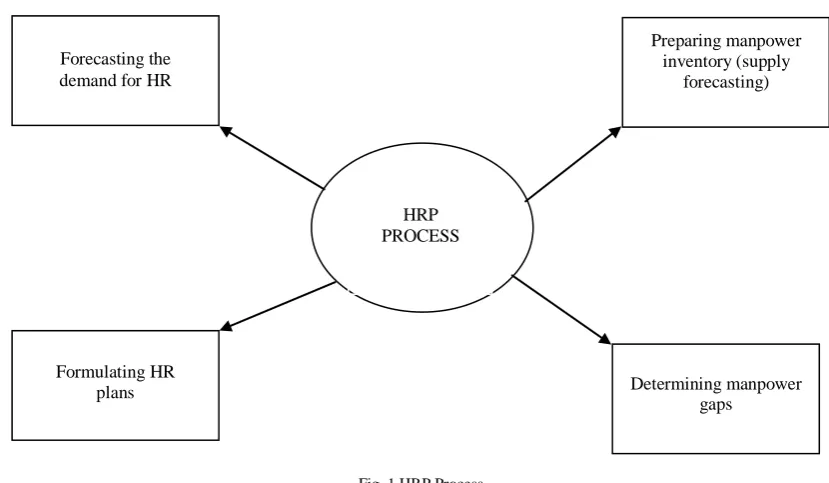
Fig. 1 HRP Process
Forecasting the demand for HR
HRP PROCESS
Preparing manpower inventory (supply
forecasting)
Determining manpower gaps
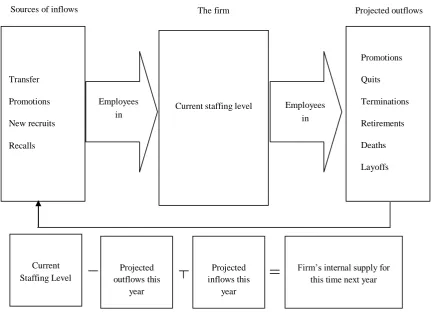
The basic purpose of preparing manpower inventory is to find out the size and quality of personnel available within the organisation. There are two major sources of supply of manpower: internal and external. An estimated internal labour supply for a given firm are from different sources.
Fig. 2 Estimated internal labour supply for a firm
II. LITERATURE REVIEW
(Steffy & Maruer, 1988)opined that Markov analysis done is a comprehensive model for conceptualizing and measuring the economic effects of human resource activities drawn from work on firm-specific human capital theory, human resources accounting, and utility analysis is presented. New ways of modelling the economic value of human resource activities and issues requiring empirical investigation are discussed.
(Heneman III & Sandver, 1977)says that Markov Analysis (MA) may be used to examine the movement of personnel into, within, and out of the organization. After briefly reviewing and illustrating MA, specific applications to human resource administration are suggested. Potential limitations of MA applications may place rather stringent constraints on their appropriateness and usefulness in human resource administration.
(Reid & Taylor, 1989)opined that among the various forecasting technique Markov analysis is
Markov analysis is used to determine the internal labour market, audit and control, career planning and development. However the reported application in human resource administration are limited to an analysis of staffing policy, quantifying teacher mobility, and forming reduction in force policy. The degree of accuracy in forecasting personnel continuity and changes has an obvious effect on educational budget, development and control.
(OCZKI, 2014)said that manpower planning and forecasting can contribute to improving company’s performance. Implementation of certain straightforward planning techniques can result in higher effectiveness of human resource policy and increased competitiveness of the organization. In this paper, a number of methods of forecasting internal labour supply has been described. Markov chain model has been characterized in more detail and a numerical example of manpower planning in a retail store, based on this approach has been presented. The main limitations of implementation of Markov
Transfer
Promotions
New recruits
Recalls
Current staffing level Employees
in Sources of inflows
Current Staffing Level
Projected outflows this
year
Projected inflows this
year
Firm’s internal supply for this time next year
The firm Projected outflows
Employees in
Promotions
Quits
Terminations
Retirements
Deaths
model to internal labour supply forecasting have been discussed and conclusions drawn.
(Igboanugo & Edokpia, 2014) opined that a Markovian approach to the analysis of data pertaining to recruitment, active staff wastage and retirement collected over a period of five years from a soft drink manufacturing company based in Lagos, Nigeria, is presented Our results suggest that although the company studied has a long term employment policy, staff who retire from the system are disproportionately small 15 to 26 compared to those who leave through wastage (74-85%). This paper proposes a review of the current manpower policy to moderate the perceived imbalance in policy structure. The author is convinced that the method advocated is effective as a decision support instrument for solving
manpower planning problems in industrial
organizations.
(Trivedi, Moscovice, Bass, & Brooks, 1987) Studied a semi-Markov formulation for modelling transitions of physicians, nurse practitioners, and physician assistants between different settings and locations within a geographic area and he stated that the model predicts the supply of primary care providers over a planning horizon. They then compared the model predictions with estimates of future demand and need for primary care for a community. Statistical tests for validation and sensitivity analysis of the model are also performed to establish the appropriateness of the semi-Markov approach. With the likelihood of an oversupply of physicians during this decade, he stated that the model offers a useful tool for health
planners, administrators, legislators, and
regulators, for objective decision making
(Rao & Kshirsagar, 1978)stated that In the study of population dynamics, the predator-prey system is recognized as a vitally important aspect in natural population control. One aspect of predator-prey interactions is studied in this paper. The attack cycle of a predator is assumed to consist of 4 different activities, namely, search, pursuit, handle and eat, and digestion. A semi-Markovian model is proposed to obtain the number of prey devoured by a predator during the activity of a day. The advantages of a new semi-Markovian model to the queuing model developed by Curry and DeMichele (1977) is demonstrated, as the results from the semi-Markovian model are closer to Holling's (1966) experimental data than their results, which were based entirely on Poisson assumption
III OBJECTIVE OF THE STUDY
1) To forecast manpower supply for the year
2016-2018 at a public sector undertaking n Cochin kerala.
2) To study the effectiveness of Markov
analysis on a tool for hr supply forecasting.
IVSCOPE OF THE STUDY
1) Make manpower procurement plans.
2) Access the internal movement of
employees in advance.
V. RESEARCH METHODOLOGY
The study is exploratory in nature. It is based on data from secondary sources. The data were gathered from a public sector company. The cadre selected is Executive Cadre.
VI.ANALYSIS
For the study, forecasting of executive cadre is selected since only in executive cadre time bounded promotion is done and for the workers and
supervisors their performance also matters
therefore including those category will affect the reliability of this test. The executive cadre consist of E01, E02, E03, E04, E05, E06, E07, E08.
E01 – Asst. Manager
E02 – Deputy Manager
E03 – Manager
E04 – Senior Manager
E05 – Asst. General Manager
E06 – Deputy General Manager
E07 – General Manager
E08 – Chief General Manager/ Executive Director
To calculate effectiveness:
TABLE I:FORECASTING FOR THE YEAR 2015IN EXECUTIVECADRE USING MARKOV ANALYSIS (STABILISED STRENGTH UPTO 300 EMPLOYEES)
Position Total number of
Employees
E01 E02 E03 E04 E05 E06 E07 E08 EXIT
E01 56 48 2 6
E02 19 10 6 3
E03 115 112 1 2
E04 35 32 3 -
E05 26 21 5 -
E06 16 16 -
E07 10 10 -
E08 3 3 -
Total 280
Employees Internal 48 12 118 33 25 21 10 3
How to calculate Markovian table
For example, let’s consider table 4.1. In the first row gives E01 cadre, the total no of employees in that position is 56. Out of the 56, it is forecasted that 6 people will retire so 6 is written in the exit column and 2 will get promoted to E02 cadre, that leads to 56-(6+2 ) = 48 remaining in that position. Similarly consider E02 position, the total numbers of employees are 19. Out of that 3 are forecasted to retire as per recordsand 6 are promoted to E03 and the remaining in E02 positions are 19-(6+3)= 10. In similar way for all the position like E03, E04, E05, E06, E07, E08 the exited and promotion can calculated and written in the respective columns.
By column wise addition, the total number of employees in all position is found and total number of employees in E02 is calculated by the addition of E02 column 10+2=12. Similarly the total numbers of employees are found in E03, E04, E05, E06, E07, E08 and exit (which gives the total number of employees leaving the organisation in 2015 due to retirement).The actual manpower supply of 2015 in Table 2 is shown in the format of an Markovian table for the easy comparison with the forecast.
TABLE II:ACTUAL MAN POWER SUPPLY IN 2015
Position Total noumber
of Employees
E01 E02 E03 E04 E05 E06 E07 E08 EXIT
E01 56
48
(from supervisor to E01: 10) 2 6
E02 19 10 6 3
E03 115 112 1 2
E04 35 32 3 -
E05 26 21 5 -
E06 16 16 -
E07 10 10 -
E08 3 2 1
Total 280
Employees Internal 58 12 118 33 26 21 10 2
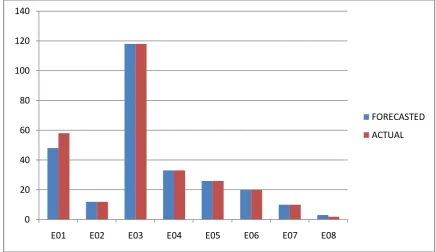
TABLE III:THE DEVIATION OF ACTUAL AND FORECASTED INTERNAL SUPPLY
Position Forecasted Actual Difference Reason
E01 48 58 10 Promotion of supervisors
E02 12 12 -
E03 118 118 -
E04 33 33 -
E05 26 26 -
E06 20 20 -
Fig. 3 Representing The Deviation Of Actual And Forecasted Internal Supply
Forecasting For The Next 3 Years (2016-2018)in Executivecadre Using Markov Analysis (Stabilised Strength Upto 300 Employees)
TABLE IV FORECASTING MANPOWER SUPPLY FOR (2016-2018)
Position Total number of employees
E01 E02 E03 E04 E05 E06 E07 E08 EXIT
E01 56 44 4 8
E02 19 16 3
E03 115 103 3 9
E04 35 34 1
E05 26 25 1
E06 16 15 1
E07 10 9 1
E08 3 2 1
Total 280
Employees Internal 44 20 103 37 25 13 9 2
VII.LIMITATIONS
1) Small samples yield unstable estimates of
future availabilities.
2) Can’t detect multiple moves during
specified time period.
3) Job category shouldn’t be too broad (unit
of analysis).
4) Doesn’t explain underlying causes among
specific employees
5) Only retirement can be predicted as exit,
not resignation.
6) Time bounded employees can be only
taken under studies.
VIII.CONCLUSION AND DIRECTION FOR FURTHER RESEARCH
The study shows that the Markov analysis is an effective tool for Human Resource Supply Forecasting. An updasted Human Resources data set is required for the forecasting process from the eight cadre of employees selected for the study. A deviation from the actual data was identified with executive cadre E01. This deviation was due to the promotion of supervisor to the E01 category. Since the supervisor cadre was not elected for the study, it is unable to forecast their promotion. Based on the result the researcher has come up with further study.
1) Study can be undertaken in other cadres
also
2) The study focused on public sector
company, other big private sector
0 20 40 60 80 100 120 140
E01 E02 E03 E04 E05 E06 E07 E08
FORECASTED
company can be also brought under the preview of the model.
REFERENCE
[1] Ball, K. S. (2006). The use of human resource information systems: a survey. Personnel Review .
[2] Belhaj, R., & Tkiouat, M. (2013). A Markov Model for Human Resources Supply Forecast Dividing the HR System into Subgroups. JSSM .
[3] Chan, A. P., Chiang, Y., Mak, S. W., Choy, L. H., & Wong, J. M. (2006). Forecasting the demand for construction skills in Hong Kong. Construction Innovation , 3-19.
[4] Feyter, T. D., & Guerry, M. A. (2011). Markov models in manpower planning: A review. JSSM .
[5] Heneman III, H. G., & Sandver, M. G. (1977). Markov Analysis in Human Resource Administration: Applications and Limitations. Management of Academy.
[6] Igboanugo, A., & Edokpia, O. R. (2014). A Markovian Study Of Manpower Planningin the Soft Drink Industry in Nigeria.Nijeria Journal Of Technology .
[7] Jackson, S. E., & Schuler, R. S. (1990). Human resource planning: Challenges for industrial/organizational psychologists. American Psychologist , 223-239.
[8] Nkomo, S. M. (1987). Human resource planning and organization performance: An exploratory analysis.
Strategic Management Journal , 387-398.
[9] Norbert Dreesch, C. D. (2005). An approach to estimating human resource requirements to achieve the Millennium Development Goals. Oxford journals , 267-276.
[10] OCZKI, J. (2014). Forecasting Internal Labour Supply with a Use of Markov. International Journal of Knowledge, Innovation and Entrepreneurship , 39-49.
[11] PA, P. (1991). Forecasting requirements for health care personnel. Nursing Economic , 18-24.
[12] Rao, C. R., & Kshirsagar, A. M. (1978). A semi markovian model for predator prey interactions. Biometrics. Academy of Management .
[13] Reid, W. M., & Taylor, R. G. (1989). An Application Of Absorbing Markov Analysis To Human Resource Issues In Public Administration. Sage , 76-74.
[14] Steffy, B. D., & Maruer, S. D. (1988). Conceptualizing and Measuring The Economic Effectiveness of Human Resource Activities. Academy of management .
[15] Trivedi, V., Moscovice, I., Bass, R., & Brooks, J. (1987). A Semi-Markov Model for Primary Health Care Manpower Supply Prediction .