ISSN: 2231-5381
http://www.ijettjournal.org
Page 358
Performance Characteristics of Oxy Hydrogen Gas on Two
Stroke Petrol Engine
*G.Ajay Kumar1 G.Venkateswara Rao2
1PG Student (M.Tech -TE), Dept.of ME, Bonam Venkata Chalamamaiah College of Engineering & Technology,
Odalarevu, AP, India
2Assistant Professor, Dept.of ME, Bonam Venkata Chalamamaiah College of Engineering &
Technology, Odalarevu, AP, India
Abstract: In order to conserve petroleum fuels for future and to eliminate the above limitations
there is a need of alternative and innovative fuel. Amongst many alternative fuels available oxy
hydrogen gas and producer gas are under study in this research work. Electrolysis of water can
give us hydrogen in form of Brown’s gas (HHO gas) or oxy-hydrogen gas, which can be used as
an alternative fuel for any internal combustion engine. Various methods for the generation of
oxy-hydrogen gas are discussed in the coming paragraphs. An agricultural waste like rice
husk, wood dust, and dried coconut leaves etc can also be used as an alternative fuels. An
attempt has been made in this work to use alternative fuel in two stroke petrol engine. Our fore
most aim in selecting this project is to use nonconventional fuel against conventional fuel
which is becoming scarce and costly now days. The combustion of a hydrocarbon fuel with air
produces mainly carbon dioxide (CO2) and Water (H2O). However, internal combustion engines
are not perfectly efficient, so some of the fuel is not burned, which results in the presence of
hydrocarbons (HC) other organic compounds, carbon monoxide (CO) and forming mainly nitric
oxide (NO).
Keywords: Two Stroke Petrol engine; Electrolysis; Oxygen Enriched hydrogen-HHO gas;
emission characteristics.
1.
IntroductionDecreasing supplies of fossil fuels and
steadily rising concentrations of
atmospheric carbon dioxide
concentrations and levels of atmospheric
pollutants are some of major challenges
to the modern society. The scientific
community is addressing these problems
by an attempt to replace fossil fuels with
cleaner and renewable sources of energy .
The research conducted so far indicates
the biomass-based fuels to be the best
option because they do not require
changes in the existing technologies in
use. Probably the best alcohol that can be
an alternative to petroleum is ethanol.
Thus a new path has been opened for
flex-fuel engines, i.e. engines that can
operate with gasoline blended with
anhydrous ethanol (18–25% vol/vol),
100% hydrous ethanol (4.0–4.9% vol/vol
of water) or any blend of these fuels (Melo
et al., 2012). The goal of this study was to
elucidate the hypothetical synergistic
combustion effects of various fuel
ISSN: 2231-5381
http://www.ijettjournal.org
Page 359
HHO gas and stabilized hydrogen
peroxide, and offer the optimal fuel
mixture for existing twostroke internal
combustion engines with no modifications
to existing injection and ignition systems.
Ethanol is interesting because of
various reasons: a) the cost of fuel and
minimal environmental effects b) can
blend with gasoline and Petrol c) higher
heats of vaporization and octane number,
d) reduction in particulate emissions, e)
can be made from wastes, agricultural
crop residues and residues from
processing. Ethanol was seriously
considered in programs designed for
conservation of natural resources.
Most of the research conducted so far
focuses primarily on ethanol that
contains 35% oxygen as a stand-alone
fuel and as an oxygenated additive to
hydrocarbon fuels to decrease emissions
of nitrogen oxides (NOx), unburned total
hydrocarbons (THC) and carbon
monoxide (CO). The idea was
superimposing oxidation over pyrolysis.
Even though considerable research effort
has been conducted in this, there are still
many uncertainties associated to use of
ethanol in flex-fuel engines and high
octane- rated fuels (85/15 v/v ratio
ethanol/gasoline) associated with high
rates of emissions of particulate matter
(soot). The role of hydrogen in emission
reduction of gasoline and Petrol engines
was also investigated. HHO gas is
renewable and clean burning fuel that
does not generate carbon dioxide.
Hydrogen has about nine times higher
flame speed than Petrol, and six times
higher than that of the gasoline air
mixture. Adding HHO gas beyond 5%
does not have significant effect in
enhancing the Petrol engine performance.
Small amount of hydrogen addition
produces an antiknock quality of fuel. In
this study one of the goals was to test if
the addition of HHO gas as source of
active intermediate substances would
result with measurable effects on engine
operation and fuel consumption. In early
1960-ies some studies identified a blend
of ethanol, water and stabilizer-free
hydrogen peroxide (H2O2) to be as highly
explosive. One of the goals of this study
was to investigate if such a blend with
stabilized hydrogen peroxide can be
applied directly to an internal combustion
engine and if the conditions in the
compression chamber could initiate
explosion of the mixture as a
consequence of the oxidation of ethanol
by hydrogen peroxide. Hydrogen peroxide
is very strong, storable
oxidizer/monopropellant. Hydrogen
peroxide, oxygen enriched additive
generates hydroxyl radicals in the thermal
decomposition, and OH radicals can
reproduce the HO2 radicals. Iron
complexes catalyze the decomposition of
H2O2[3].
In this paper we present, apparently
for the first time, various measurements
on a mixture of hydrogen and oxygen
called HHO gas produced via a new
electrolyze (international patents pending
ISSN: 2231-5381
http://www.ijettjournal.org
Page 360
Inc. of Clearwater Florida), which mixture
is distinctly different than the Brown and
other known gases. The measurements
herein reported suggest the existence in
the HHO gas of stable clusters composed
of H and O atoms, their dimers H–O, and
their molecules H2 , O2 and H2O whose
bond cannot entirely be of valence type
[1].Need for this paper arises because of
the scarcity of the crude-oil resources in
our mother nature for satisfying our
multiplying demands. This paper draws
the prime attention of the authors to
develop an alternative mechanism, which
can serve as a basis for driving the
automobile [2].In order to reduce the
atmospheric pollution emitted by
automobiles, control devices are being
incorporated in the vehicles in many
countries. This has resulted in a reduced
vehicle mileage to the extent of about
fifteen percent. With- out the introduction
of new technology, any further reduction
in emission levels would be expected to
extract payment in the form of further
fuel economy losses [3].
This paper investigates on green
transportation in India, where usage of
vehicles is increasing day-to- day.
Increase in vehicles will lead to fuel
scarcity in the mere future. These lead
researchers to think about alternate fuel
that can be utilized for the vehicles. This
paper talks about the project which is
aimed at developing and marketing a
product with conventional standard that
help in solving this issue.
2.
Experimental Setup and Machine SpecificationsOxy-Hydrogen is an enriched mixture
of hydrogen and oxygen bonded together
molecularly and magnetically.
Oxy-Hydrogen Gas is produced in a
common-ducted electrolyser & then sent to the
intake manifold to introduce into
combustion chamber of the engine.
Oxy-Hydrogen gases will combust in the
combustion chamber when brought to its
auto-ignition or self ignition temperature.
For a stoichiometric mixture at normal
atmospheric pressure, auto-ignition of
oxy hydrogen gas occurs at about 570°C
(1065°F). The minimum energy required
to ignite such a mixture with a spark is
about 20 micro joules. At normal
temperature and pressure, Oxy-Hydrogen
gas can burn when it is between about
4% and 94% hydrogen by volume. When
ignited, the gas mixture converts to water
vapour and releases energy. The amount
of heat released is independent of the
mode of combustion, but the temperature
of the flame varies. The maximum
temperature of about 2800°C is achieved
with a pure stoichiometric mixture, about
700°C hotter than a hydrogen flame in
air. Oxyhydrogen gas has very high
diffusivity. This ability to disperse in air is
considerably greater than gasoline and it
is advantageous in mainly two reasons.
Firstly it facilitates the formation of
homogeneous air fuel mixture and
secondly if any leak occurs it can disperse
at rapid rate. Oxy hydrogen gas is very
ISSN: 2231-5381
http://www.ijettjournal.org
Page 361
This results in a storage problem
when used as a fuel in an internal
combustion engine which is loaded on
automobile. Producer gas is the gas
generated when wood, charcoal or coal is
gasified with air and it consists of around
45-50% combustible gases, N2, CO2 and
water vapour. The gas contains
condensable oily substances, acids and
dust as well. The main aim of the gasifier
system is to generate a gas with a high
proportion of combustible components
and a minimum of impurities. There are
different methods to produce the gas,
three different types of arrangements can
be used viz. Updraft Gasifier, Downdraft
gasifier, Cross draft gasifier but the
problem with all these type of
arrangements while producing gas is
presence of tar content in them, which
when introduced in engine can damage
the cylinder lining as well as can cause
knocking problem [3, 4, 5]. In this
research work instead of using
conventional processes a Pyrolysis
method is used for the production of
producer gas. Exact analysis of the gas
produced is carried out and is mentioned
in this article.
Technical Specifications of the Engine:
Type: Tomos 4,
Spark: Ignition Engine
Cycle: Two stroke, air cooled
No. of cylinder: 1
Compression ratio: 10:1
Cubic capacity: 59.3 cu cm
Cylinder bore: 42 mm
Stroke: 43 mm
Rated output: 2.2 kW(3.0 HP) @ 5400 rpm
Engine speed: 3600 rpm
Ignition timing: Variable
No hardware modification in the
engine is required for the supply of
Oxy-Hydrogen gas. Only an inlet is to be given
for the entry of the gas into the
combustion chamber. This entry is
provided S.I engine and after air cleaner
in case of Petrol engine, so that the
Oxy-Hydrogen gas will get sufficient time to
adhere the fuel molecules. Thus the oxy
hydrogen gas is brought inside the
combustion chamber just because of
engine suction pressure. Thus the
Oxy-Hydrogen usage is compatible with any of
the running engine. To make the complete
Oxy-Hydrogen gas unit, components
required are the Oxy-Hydrogen Generator
or Electrolyser, Bubbler & Post Air
Cleaner Joint. Oxy-Hydrogen Generator
generates Oxy-Hydrogen gas as discussed
earlier. Terminals of electrolyser are
connected to the car battery by means of
two insulated wires. Insulated wires are
attached to the plates by means of hard
soldering. Soft solder should be avoided
as due to the rise in temperature there
are chances that the solder may melt and
the wires come in contact with adjacent
plate leading to generation of spark &
thus causing explosion of the generator /
electrolyser. Bubbler is component used
for the safety purpose in case of backfire
from engine. It is filled with water,
through which Oxy-Hydrogen gas is
allowed to pass; also if steam is generated
ISSN: 2231-5381
http://www.ijettjournal.org
Page 362
bubbler. Thus it allows only pure gas to
enter the engine. As its purpose is just to
act as a safety device plastic bottle is
sufficient it also reduces the cost and
even if back fire occurs the plastic bottle
will tear off quickly & avoid strong blast of
it. It does not allow the ignited gas to
reach the generator as the water present
in it extinguishes the ignited gas.
Figure 1 Block Diagram of Oxy-Hydrogen unit mounted on engine
Figure 2 Producer Gas Unit – Constructional details and supply
Refer figure 1 for more constructional
details of the assembly and flow of Oxy-
Hydrogen gas through the circuit. The
unit used in this research work for the
generation of producer gas consists of a
stainless steel body having geometry like
a cylinder with a flange for fixing the head
of cylinder having same flange [5]. The
head of Pyrolyser unit has provision for
introducing biomass and removal of gas
produced in the unit.
It also has two thermocouples, a long
and a short one the long thermocouple
measures the core temperature whereas
the short thermocouple measures the
temperature of the gas produced at top
inside the unit. Heating coils are fixed
circumferentially to the pyrolyser unit
from outside and insulation is provided
over the unit circumferentially from
outside. Scrubber tank is used to clean
the gas and also to condense the
condensable. It is partially filled with
water; gas comes from top of the tank
which is taken to the bottom of water
through pipe so that it passes through
water. There is an outlet for removal of
gas. Also there is a provision for flushing
out the water from the tank. Control unit
is the unit from which we can set the
temperature and also control the heating.
From 1500C to 4000C of inner core there
is continuous production of the gas. It
requires 70 to 75 minutes to produce 700
gm of gas. Figure 2 below demonstrates
the constructional details of producer gas
ISSN: 2231-5381
http://www.ijettjournal.org
Page 363
3. Performance EvaluationThe components obtained during the gas
chromatography resembles the constitution
of producer gas, the amount of tar was very
negligible. Generally calorific value of a
producer gas is 7000 to 9000 kJ/kg.
The gas obtained during the pyrolysis was
having calorific value 6918.26 kJ/kg. While
producing the gas, if we used 1 kg of biomass
almost 400 – 450 gm of gas along with
remaining amount of charcoal is also
obtained. Coal is obtained as by-product of
the Pyrolysis process. The calorific value
came out to be 2045.1426 cal/gm, which is
good for domestic purpose.
To check the rate of oxy hydrogen gas
generated with respect to rate of current rise,
a loss of weight of electrolyser is noted for
given period of time and current. Current
passing through electrodes is increased from
1 ampere to 3 ampere in step of 1 ampere.
Figure 3 shows that with increase in the time
for which the current is flowing through
electrolyser, weight of electrolyser decreases.
Larger the weight loss larger is the gas
generation weight. Also with increase in
amplitude of current the rate of generation
increases. For larger gas generation it is
possible to increase the amplitude of current
as well. As the engine keeps on consuming
the oxy hydrogen the level of electrolytic
solution in the electrolyser decreases which
further decreases the weight of the
electrolyser.
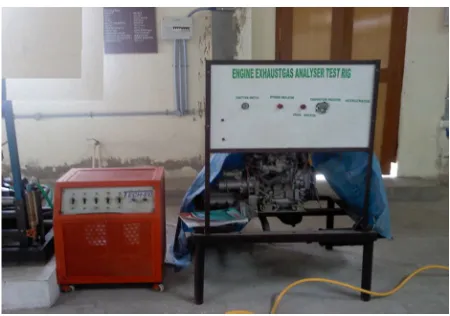
Fig 7 shows the exhaust gas analyzer,
which is used for analyzing gases and
percentage of CO, NOx and other HC gases
that are released from the engine during the
test. All the designs of electrolysers were
tested on twin cylinder four stroke Petrol
engines, technical specifications of which are
listed earlier in this article. All of them
showed the improvement in the operating
characteristics of engines when blend of oxy
hydrogen is send with conventional fuel.
Whichever may be the generation method
used for production of oxy hydrogen gas,
there is little effect of it as far as change in
the improved performance of the engine is
concern.
Figure 3 Time rate of gas generation with decreased weight of Electrolyser
In order to investigate the performance
variation between oxy hydrogen gas and
producer gas, amongst the various methods
for oxy hydrogen gas generation, second
design of first method is used. The reason for
this is the very high rate of oxy hydrogen gas
generation. To make comparison between
both the alternative fuels discussed earlier,
load tests are carried out the same twin
cylinder Petrol engine. Brake Specific Fuel
Consumption, Brake Thermal Efficiency,
Speed and Load are the parameters which
were kept under observation during the tests.
Following graphs are used to discuss the
comparison. Figure 4 shows the variation of
brake specific fuel consumption with increase
ISSN: 2231-5381
http://www.ijettjournal.org
Page 364
Figure 4 Variation of Brake Specific Fuelconsumption in kg/kW-hr v/s load in kg
Same is the reason for the lower values of
BSFC in case of producer gas and Petrol
blend. Almost 11% of Hydrogen in the
producer gas makes it possible again.
Amongst both the alternative fuels the oxy
hydrogen gas has shown larger decrease in
the values of BSFC especially when the load
increases. At the maximum load of 8 kg
during testing almost 200 grams of less fuel
is required to produce same power hour, with
both alternative fuels, oxy hydrogen gas is
having little more edge on the producer gas.
Figure 5 shows the variation of brake thermal
efficiency with increase in load for both the
alternative fuels [9].
Figure 5 Variation of Brake Thermal Efficiency in % v/s Load in kg
From the graphs of Brake Thermal
Efficiency v/s load it is clear that as the
load on the engine increases, brake
thermal efficiency further increases for
the blend of both alternative fuels and
Petrol compared to only Petrol. Presence
of hydrogen releases greater energy
during the process of combustion. That
increases the brake mean effective
pressure inside the combustion chamber.
More work is done onto the piston which
increases brake power of the engine as
well. Increase in brake power increases
the thermal efficiency of the engine. An
increase of almost 10% in the efficiency is
observed with the oxy hydrogen and
Petrol blend, compared to only Petrol and
an increase of almost 5% is observed with
the producer gas and Petrol blend,
compared to only Petrol [9].
Figure 6 Variation of Speed in RPM v/s Load in kg
Figure 6 shows the variation in the
speed of the engine with increasing load for
both the alternative fuels.
ISSN: 2231-5381
http://www.ijettjournal.org
Page 365
Graph of Speed v/s Load shows same
trend discussed earlier. At the same load
condition the RPM of the engine increases for
both the blends compared to only Petrol. As
power developed by engine is directly
proportional to the engine RPM, it is natural
that with the blends power produced by the
engine increases [9].
4. Conclusions
Oxy hydrogen gas has been generated
by electrolysis process and producer gas by
pyrolysis. Both the alternative fuels mixed
with fresh air before entering the
combustion chamber. BSFC, Brake thermal
efficiency, speed and load are the
performance parameters kept under
observation. The following conclusions are
drawn:
1. It is very easy to integrate both the
alternative fuels with existing engine. No
major hardware modification is required.
2. Combustion efficiency increases with both
alternative fuels due to presence of hydrogen
in the blend. Since hydrogen is present in
larger quantity oxy hydrogen gas compared
to producer gas, the oxy hydrogen and diesel
blend has shown best combustion efficiency
as a result of which larger values of BSFC
and brake thermal efficiency are obtained for
the same engine.
3. Presence of extra oxy in both alternative
fuels helps to improve the combustion
efficiency further more. Water vapour is one
of byproduct of combustion process with oxy
hydrogen and diesel blend. This decreases
the combustion chamber temperature and
thus decreases the chances of engine
detonation. Very less amount of oxygen is
available with producer gas and diesel blend
hence it is not the case with this
combination.
4. Cost of the producer gas generation is more
compared to oxy hydrogen gas generation.
Three phase AC power source is required for
the generation of producer gas using
pyrolysis process. Oxy hydrogen gas module
requires only 12 V DC supply from the
battery [9].
The size of the producer gas
generation module is very large and nearly
impossible to fit on automobile engines,
hence best suitable for the stationary
engines application like pump, generators
etc. Coal is coming as one of the byproduct
of the pyrolysis process, can be used for
domestic purpose, and hence an added
advantage [9].
Acknowledgements
The authors would like to thank the
anonymous reviewers for their comments
which were very helpful in improving the
quality and presentation of this paper.
References:
1. Anshu, Srivastava,Shakun, Srivastava, Nigam,A.C, “Alternative Fuel for Transportation”, International Journal O f Environmental Sciences, 2010, Volume 1, No 2.
2. Karthik, T.S, Murali, Ganesh. S”Impact of Green Transportation In Today’s Economy”, APJMER, November 2012, Volume 1, Issue 3.
3. Staša,Puškarić1*.,Damir,Oros2.,2012,
“Effects of Various Fuel Blends on the Performance of a Two-stroke Internal Combustion Engine”, RIThink, Vol. 2.
ISSN: 2231-5381
http://www.ijettjournal.org
Page 366
“Investigations on generation methods for oxy-hydrogen gas its blending with conventional fuels and effect on the performance of internal combustion engine”,journal of Mechanical Engineering Research .Vol. 3(9),pp: 325-332.
5. Yadav, Milind,S.1, Dr. S. M. Sawant2, “Investigations on oxy-hydrogen gas andproducer gas, as alternative fuels, on the performance of twin cylinder diesel engine”, IJMET, 2011,Volume 2. Issue 2, pp: 85-98.
6. Heywood J.B., “Internal combustion engine fundamentals”, Tata McGraw Hill Publishing Company Limited, McGraw Hill Company Limited, Newyork, 1988
7. Brown Y., Brown’s Gas, United States Patent, US Patent 4014,777; March 28, 1978
8. Parekh P.P., State of an art Report on Gasification of Biomass; IIT Bombay, 1989.
9. “Performance Analysis on 4-S Si Engine Fueled With HHO Gas and LPG Enriched Gasoline” B. Ramanjaneyulu et.al International Journal of Engineering Research & Technology (IJERT) Vol. 2 Issue 8, August - 2013