SCITECH
Volume 5, Issue 5
RESEARCH ORGANISATION
April 16, 2016
Journal of Research in Business, Economics and Management
www.scitecresearch.com
The Effective Adoption of ICT-Enabled Services in Educational
Institutions – Key Issues and Policy Implications
Abdullah Ismail, Ph.D.
Assistant Professor,College of Business Administration, Ajman University of Science & Technology, UAE.
Abstract
Educational institutions are becoming increasingly aware of the need to fully integrate the ICT enabled modern educational services in order to supplement the traditional paradigm of teaching and learning with more efficient and effective practices. However in achieving their urge for technology adoption at a quicker pace, they often get overwhelmingly obsessed with the supply-side dynamics of technology diffusion; thus running a risk of ignoring the demand-driven dimensions of technology adoption. Due to the poor understanding of the user-context and not paying enough attention to the inherent challenges faced by the users in the adoption of new technological services, these institutions may not achieve the intended results in terms of the desired educational improvements. Such a linear or “technology-push” approach may lead to a waste of organizational resources, as well as causing an increasing frustration both among teachers and students. This paper investigates the patterns of adoption for two ICT-enabled educational services: Learning Management System and e-books. Mixed method research has been employed to study the adoption experiences of newly enrolled university students in the UAE. The research findings and discussions are deemed to be highly relevant and beneficial for students, teachers, parents, researchers, policy makers, and administrators of academic institutions alike.
JEL Classification Codes:
I23, M15, O33, O38, L86, L88, L96, L98Keywords:
Adoption; Diffusion; Innovation; ICT; Education; LMS; Moodle; e-book; Policy.1.
Introduction
much bigger and wider research and policy agenda to effectively address the whole range of complexities involved in the adoption process.
An extensive amount of online available literature has been reviewed for this research; and for the sake of clarity, the selected 35 publications have been categorized here under specific themes for the readers‟ convenience: such as ICT applications in education, the associated challenges and barriers, different approaches towards e-learning such as the concepts of blended learning and LMS, and finally the experiences about one specific application of LMS called „Moodle‟ which has been widely adopted by a large number of educational institutions across the world. A significant number of papers (Shana, 2009; Vajargah, Jahani & Azadmanesh, 2010; Alodiedat & Eyadat, 2008; Hattangdi & Ghosh, 2008; Tubaishat, Bhatti & El-Qawasmeh, 2006; Makrakis, 2002; Walters & Lydiatt, 2004; Buabeng-Andoh, 2012; Noor-Ul-Amin, 2013; Fu, 2013) have discussed different types of ICT applications and their impacts on the educational practices to enhance the teaching and learning experiences. Some authors (Khan, Hossain, Hasan & Clement, 2012; Vrazalic, MacGregor, Behl & Fitzgerald, 2009; Bingimlas, 2009) have debated the barriers to successful integration of ICT in teaching and learning environments. The concept of e-learning and blended learning approach has been discussed quite in detail by Naaj, Nachouki & Ankit (2012), Hameed, Badii & Cullen (2008), Garrison & Kanuka (2004), Graham (2006), Singh (2003), Gazinoory & Afshari (2011), and Weber (2010); who have highlighted those factors which affect e-learning outcomes. The Factors that influence the effective use of LMS has been conferred by Asiri, bt Mahmud, Bakar & bin Mohd Ayub (2012), Busaidi & Al-Shihi (2010), Coates, James & Baldwin (2005), Dowling (2012), Nasir, Kabir & Arabia (2011), and Alharbi & Drew (2014). Finally the experiences related to the specific case of Moodle application has been shared by Morgado & Schmidt (2012), Kakbra & Sidqi (2013), Dougiamas & Taylor (2003), and Sallam & Alzouebi (2014).
Although there are quite a few studies done on this subject before, however the current research aims at treating this topic more extensively by including many of those aspects into inquiry as well which haven‟t been significantly discussed in the previous studies. Nevertheless, the reviewed literature has significantly helped this research to enrich by covering a wider range of dimensions and multitude of aspects related to this debate.
2.
Research Design and Methodology
The current research collects data from a selected sample of undergraduate students who are at large freshly enrolled into business and IT programs in Ajman University of Science and Technology, a semi-private university in the UAE. The employed research tool was a semi-structured questionnaire with both quantifiable questions on Likert scale, as well as open-ended questions for more qualitative analysis. The questionnaire was distributed to 4 sections of a course “Introduction to Management” which is an introductory level subject offered by the College of Business. An introductory level course was deliberately chosen, considering the fact that the students enrolled into this course would have been newly exposed to ICT equipped learning environment. The study further focused on recording their experiences with two ICT applications in their learning environment: one with Moodle e-learning service – the learning management system adopted in this campus; and second with the use of e-books.
The duration of each interactive session was around 60 minutes, where in first part of the session (about 45 minutes) students had to fill in the questionnaire under the supervision of researcher, who also took support of an Arabic speaking translator to further facilitate the students‟ understanding of the content; whereas in the second part of the session the researcher conducted a brief open-ended discussion with the students to collect their further critical reflections on this topic. These discussions were recorded for transcript analysis, whilst the students were pre-informed about that. A total number of 150 students participated in this survey, of which the number of male and female students were 80 and 70 respectively. 80% of the respondents were freshly enrolled students who were either in semester 1 or 2. The majority of the respondents (79.33%) were enrolled into the College of Business, whereas the remaining students were attending the College of IT. Most of the respondents (85%) were currently unemployed. The majority (68%) of the respondents belonged to different Arab nationalities, followed by the local citizens of the UAE (15%) and the rest 17% of the respondents belonged to different non-Arab nationalities. About 53% of the respondents were below the age of 20, and 43% were between the age bracket of 20-25 years.
3.
Results and Findings
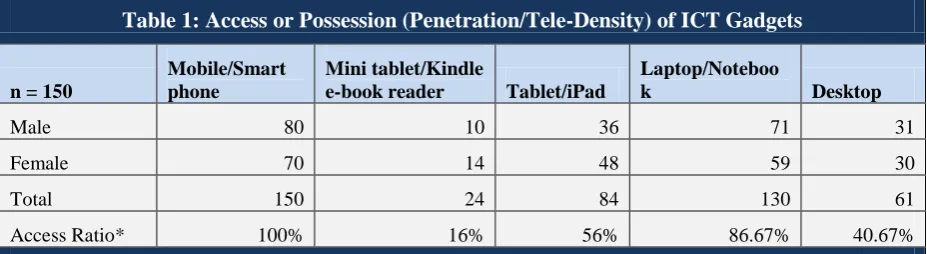
Table 1: Access or Possession (Penetration/Tele-Density) of ICT Gadgets
n = 150
Mobile/Smart phone
Mini tablet/Kindle
e-book reader Tablet/iPad
Laptop/Noteboo
k Desktop
Male 80 10 36 71 31
Female 70 14 48 59 30
Total 150 24 84 130 61
Access Ratio* 100% 16% 56% 86.67% 40.67%
Access ratio refers to the penetration rate or tele-density of ICT Gadgets either at an individual level or as a shared access point.
Table 1 reports on the tele-density or penetration rate of the compared ICT gadgets; either if these gadgets are in their personal possession or are used as a shared access points (e.g. having access to desktops/laptops in the computer labs). As per the result, mobile/smart phones have the highest penetration rate among the respondents, followed by laptops/notebooks, tablets/iPads, desktops and mini tablets/Kindle e-book readers. The interesting finding is the difference in usage trends among the males and females in the use of laptops and tablets/iPads; as male respondents are high in the use of laptops whereas the females are high in the use of tablets/iPads. In aggregate, the use of tablets/iPads (56%) has left behind the access/usage of stationary PCs or desktops (40.67%). Thus the trend is towards having an increased portability and mobility i.e. the nomadic use of ICT devices. As that trend continues, we may expect that soon the tele-density of tablets/iPads would also surpass the use of laptops.
Table
2: Reasons** for Adoption
A
Friends B
Image-Conscious C
Parents D
Academic E
Excited F
Self-Aware Other
Male 17 8 10 19 13 61 1
Female 6 5 18 18 15 49 1
Total 23 13 28 37 28 110 2
% * 9.54% 5.39% 11.62% 15.35% 11.62% 45.64% 0.83%
*The respondents marked 241 times at different listed reasons, and thus the percentages are derived by dividing each individual reason with the total number of marked reasons to indicate the relative significance of each listed reason in their adoption decision.
**Reasons for adoption refer to those potential factors that may have principally caused or largely influenced the users‟ decision to adopting most of the listed ICT gadgets.
A. Your friends were already having them and they convinced you to buy/use them B. You were self-conscious about your image in friends and society if you didn‟t buy them C. Your parents suggested you to use them or they just bought them for you
D. Your academic institution or workplace forced or convinced you to buy/use them E. You were excited on your own to try, without clearly knowing about their importance F. You were already aware of the needs & importance of these devices and their applications
than females; whereas the female respondents got more influenced by their parents in making adoption decision i.e. almost twice more than their male counterparts. That trend partly reflects and aligns with the local social context, as the females are traditionally more influenced by their parents when they are making their adoption choices.
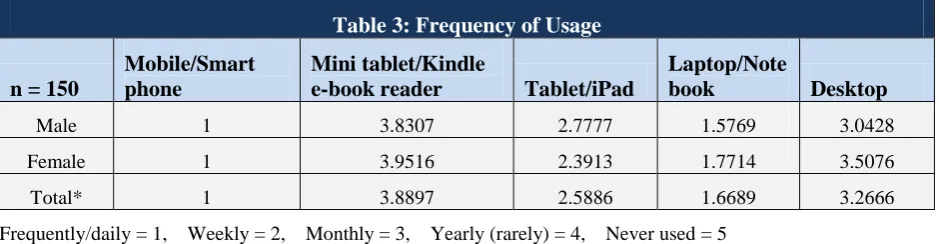
Table 3: Frequency of Usage
n = 150
Mobile/Smart
phone
Mini tablet/Kindle
e-book reader
Tablet/iPad
Laptop/Note
book
Desktop
Male 1 3.8307 2.7777 1.5769 3.0428
Female 1 3.9516 2.3913 1.7714 3.5076
Total* 1 3.8897 2.5886 1.6689 3.2666
Frequently/daily = 1, Weekly = 2, Monthly = 3, Yearly (rarely) = 4, Never used = 5
* The total frequency refers to an average (mean) of the whole sample size, since female and male respondents are not evenly divided in the total size of chosen sample.
Table 3 describes the frequency usage for these selected ICT devices. The results indicate that mobile/smart phones are used most frequently i.e. on the daily basis; followed by laptops/notebooks, tablets/iPads, desktops and mini-tablets/kindle e-book readers respectively. It‟s interesting to note that females were found high as compared to males in their usage frequency for tablets/iPads, but lower in using laptops/notebooks and desktops. These results are consistent with our findings of table 1 where female were found high in terms of accessibility/possession of tablets/iPads but lower in case of laptops. This finding leads to the fact that the personal ownership and possession of a device has a positive correlation with its usage frequency; as we may observe an increasingly tendency of gradually reduced usage of desktops despite the fact that desktops are made available in the computer labs at campus as shared access points. Personal ownership and possession gives a better sense of privacy and control over the devices, and that sense of privacy and control is absent in case of using the shared devices, even though if the personal accounts were created to login with personalized screens and individual memory spaces.
Frequently/daily = 1, Weekly = 2, Monthly = 3, Yearly (rarely) = 4, Never used = 5
* The total frequency refers to an average (mean) of the whole sample size, since female and male respondents are not evenly divided in the total size of chosen sample.
A. Learning/Education B. Fun/Entertainment
C. Personal Communication D. News/Information
E. Professional Requirement
F. Status symbol/Image consciousness G. Social networking
H. Professional networking I. Online Trading
Table 4 depicts pattern of usage for the listed ICT devices. The results explain the purpose of the usage for different devices, which help in understanding the specific needs and requirements of the users. This analysis sheds some
Table 4: Pattern of Usage
n = 150 A B C D E F G H I
light on the scale and scope of the convenience that these ICT gadgets and services are offering to the users‟ life. Apparently by looking at the table, we can see that in aggregate (putting male and female responses together), these devices are most frequently used for Personal Communications and social networking purpose; followed by a moderate use for accessing fun and entertainment contents/activities, learning and education, and acquiring news and information respectively. It was a bit surprising to note that the respondents scored quite low on online trading option, which partially reflects the fact that this trend has yet to grow in the UAE and there is still a long way to go before reaching to the saturation point what we already experience in the ICT-advanced countries. However, scoring quite low in the indexes of professional requirement and professional networking is quite understandable, as most of the respondents are still fresh students and 85% of them are not yet employed in professional firms or organizations. Further on, in terms of gender discrepancies, we may see some interesting patterns there. The male respondents are comparatively higher in the usage frequency for the applications such as fun/entertainment, social networking and online trading; whereas females were relatively higher on the indexes such as ICT use for learning/education, professional requirements & networking, and in being more status or image-conscious. The next two questions inquired about the extent to which the use of ICT gadgets has facilitated the students‟ formal education and learning in terms of communicating with their classmates and teachers (table 5) and in terms of accessing, storing and sharing information related to their coursework (table 6).
*Positive impact of ICT on learning & education through increased communication with teachers and students
Table 6: Accessing, Storing and Sharing Information**
n = 150
Very much
Somewhat
Not much
Not at all
Male 50 25 4 1
Female 38 25 6 1
Total 88 50 10 2
% 58.67% 33.33% 6.67% 1.33%
**Positive impact of ICT on learning & education in terms of accessing, storing and sharing information
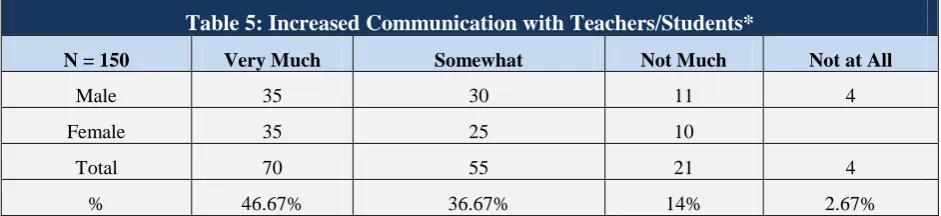
Table 5 & 6 reflect that the respondents realize in general a positive impact of the use of ICT gadgets and services in terms of learning and education. This positive impact was more visible for them in the domain of accessing, storing and sharing information as compared to having an increased communication with their classmates and teachers related to their studies and curricular activities. The male respondents were found slightly more positive of the ICT impact in terms of accessing, storing and sharing information.
In the second part of the questionnaire, the respondents experience with using Moodle was inquired. The vast majority (92.67 %) affirmed their familiarity with the use, and awareness about the importance of Moodle system in their education. However, only 54.67% considered that using Moodle and accessing the course webpages online significantly helped in their learning and education, whilst 40.67% perceived only a marginal role and importance of LMS service in their learning activities, and the rest of the respondents didn‟t see any added value or importance of this service. In the Likert scale of 1-5 (Frequently/daily = 1, Weekly = 2, Monthly = 3,Yearly = 4, Never used = 5), the average usage frequency of Moodle service was 1.7074. The usage frequency among the female respondents was slightly higher than the male respondents. 44% of the respondents confirmed that they started using Moodle essentially under the pressure of the course instructors in order to get access to course related information, activities and updates; thus here we may conceive the effect of “forced adoption” strategy, where the adoption of a system/service among the targeted population is basically triggered by either creating additional incentives, or otherwise eliminating the alternative options (such as manual, printed or verbal means) of getting access to the
Table 5: Increased Communication with Teachers/Students*
N = 150 Very Much Somewhat Not Much Not at All
Male 35 30 11 4
Female 35 25 10
Total 70 55 21 4
required information. Only 37.33% respondents confirmed the delivery of any sort of orientation program/session (about the need and use of Moodle) at an institutional level.
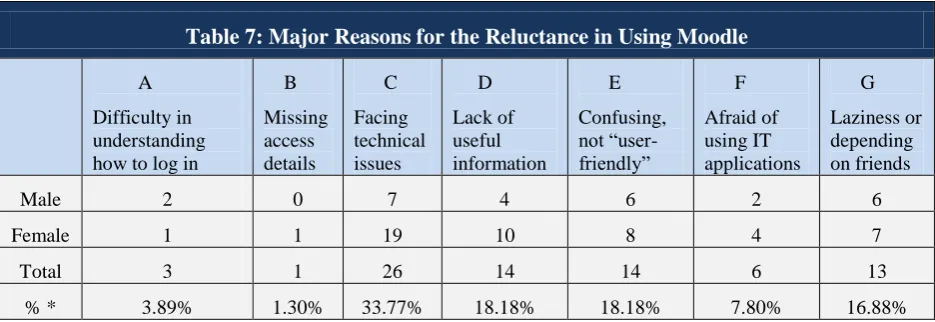
Responding to the question related to experiencing any sort of reluctance or hesitance in using Moodle, 34.67% answered in affirmation. Females admitted experiencing relatively more reluctance in using Moodle than their male counterparts. The major reasons for their reluctance in using Moodle can be inferred from table 7 below.
Table 7: Major Reasons for the Reluctance in Using Moodle
A Difficulty in understanding how to log in
B Missing access details
C Facing technical issues
D Lack of useful information
E Confusing, not “user- friendly”
F Afraid of using IT applications
G Laziness or depending on friends
Male 2 0 7 4 6 2 6
Female 1 1 19 10 8 4 7
Total 3 1 26 14 14 6 13
% * 3.89% 1.30% 33.77% 18.18% 18.18% 7.80% 16.88%
*These percentages are extracted by dividing the number of marked individual reasons with the total number of marked reasons, in order to indicate the relative significance of each listed reason.
A. I don‟t understand how to log into my MOODLE account
B. I don‟t have the access details (user name and password) to log into MOODLE C. I often face technical problems in logging into my MOODLE account
D. I don‟t find any useful information on the different courses‟ webpages on MOODLE E. I find it quite confusing or difficult to use MOODLE services, as it‟s not “user-friendly” F. I am somewhat afraid of using IT applications so I usually avoid troubling myself G. I am just a bit lazy and often depend on my friends to collect the information for me
From the table it is clear that the major reasons for the respondents‟ reluctance in using Moodle are: facing technical issues (e.g. inability to correctly submit the assignment), lack of useful information/material on the course webpages, confusing or non-user-friendly layout, and laziness on behalf of the students themselves due to counting on friends to collect the material and information for them. In parallel to inquiring about the respondents‟ grievances regarding the use of Moodle, they were also asked their opinions about the benefits of Moodle; in order to counter any bias, if exists.
*The percentages are calculated by dividing the number of marked individual list of benefits with the total number of marked benefits i.e. 374. The table indicates the relative significance of each listed benefit as perceived by the respondents in regard to Moodle service.
A. Unified source of information (one place to access all the course related information) B. Quite user friendly (easy to use this service)
Table 8: Benefits of Moodle Service
A
Unified source of information
B User friendly (Easy to use)
C Good channel of communication
D
Accessible from anywhere
E
Linking with the course activities
Male 40 27 35 37 50
Female 46 24 27 43 45
Total 86 51 62 80 95
C. Good channel of communication with course instructor/teacher
D. Accessible from anywhere (connected to course information/activities from anywhere) E. Linking with the course information/activities directly (no dependence on others)
From the above table, it can be inferred that the respondents consider that the possibility of linking with the course information and activities directly through the course webpage without relying on others has been perceived as the most important benefit of this service; followed by the other benefits such as: accessibility to course webpage from anywhere and anytime; and considering it a as a unified source of information to access all the course related information at one place.
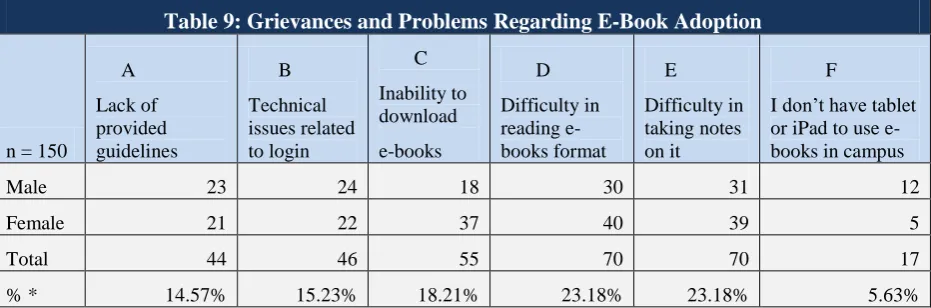
The third section of the questionnaire inquired the students‟ impression of e-book experience and their perception about the bottlenecks and benefits of this ICT application. Only 28% of the responses were in favor of the e-book initiative, recently taken by the university, which reflects the vast majority‟s disapproval of this educational innovation. Another question similar to the previous one, but with a little bit rephrasing inquired the students whether they would prefer e-books over the printed version (hard copy); 82% answered in “No”. In the scale of 1-5 (Frequently/daily = 1, Weekly = 2, Monthly = 3, Yearly = 4, Never used = 5), the average usage frequency was found 3.3533 for e-books. In the same 1-5 scale, the responses to the next question revealed that the students were used to read the printed book with an average frequency 1.8266. Hence, it is obvious from the above results that due to the introduction of e-books, the students' reading habit or the frequency of referring to textbooks has decreased from weekly readings to monthly (and in many cases only once in a semester, as the follow up discussion has revealed). These results inform us about two facts: one that there is in general a very low tendency among the students towards reading textbooks for their academic learning or for exams‟ preparation; and secondly the introduction of e-books has further significantly dropped their previous textbook reading attitude, which should definitely be an alarming sign for the academic administrators and policy makers. It would be definitely a point of interest for us to know the reasons behind the respondents‟ overwhelming discontentment and reluctance towards the use e-books. 70.67% of the respondents mentioned that they do have their grievances and concerns to share about the adoption of e-books.
Table 9: Grievances and Problems Regarding E-Book Adoption
n = 150
A Lack of provided guidelines
B Technical issues related to login
C Inability to download e-books
D Difficulty in reading e-books format
E Difficulty in taking notes on it
F
I don‟t have tablet or iPad to use e-books in campus
Male 23 24 18 30 31 12
Female 21 22 37 40 39 5
Total 44 46 55 70 70 17
% * 14.57% 15.23% 18.21% 23.18% 23.18% 5.63%
*The percentages are calculated by dividing the number of marked individual reasons with the total number of marked reasons i.e. 302 to indicate the relative significance of each individual reason.
A. I am not provided with enough guidelines how to download or access to E-books B. I often face technical issues related to accessing or logging into E-books account C. I cannot download it to read E-books offline, but just can access it online
D. I have difficulties in reading the E-book format, as compare to printed copy of the book
E. I don‟t know how to take notes on E-books, the way I can easily do in case of the printed copy of a book F. I don‟t have an iPad or notebook to use during the lecture to fully benefit from E-books
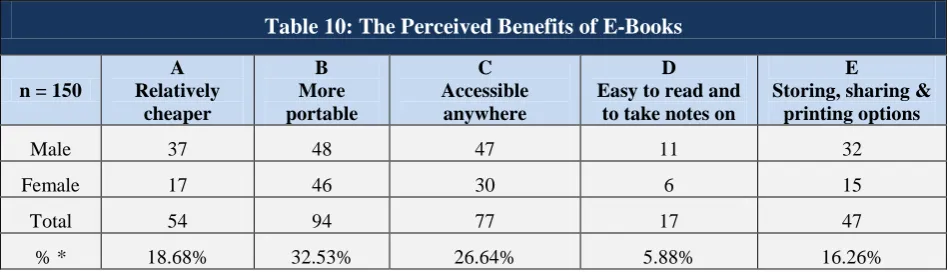
*The percentages are calculated by dividing the number of marked individual list of benefits with the total number of marked benefits i.e. 289 to indicate the relative significance of each listed benefit, as perceived by the
respondents
A. Cheaper (costs lesser than the printed book) B. Portable (no physical weight to carry) C. Accessible (can be accessed from anywhere) D. Easier to read and take notes on it
E. Easier to store, print and share notes with others
From the responses in table 10, it is evident that the respondents value the most to the e-books‟ portability feature (easy to carry along with anywhere in portable devices) and accessibility (omnipresence/ubiquity), particularly when the offline version is also made available; followed by the other perceived benefits such as the relative cost (cheaper as compared to printed books), and the option of storing, sharing and printing the selected parts of the e-books respectively.
4.
Transcript Analysis and Discussions
Through coding and categorization of the recorded transcripts and qualitative inputs, the data reveals some interesting facts about the respondents‟ perspectives and reflections upon their adoption experiences of Moodle and e-book initiatives. Some of the major findings of transcript analysis are summarized here to complement the previously illustrated tables and the results of quantitative analysis. The following qualitative analysis and subsequent findings have been structured in two sections. In the first section, the students‟ perceptions and opinions about the use of Moodle service is captured. The second section discusses the students‟ experiences with using e-books. The following two sections summarize the respondents‟ perceived challenges, grievances, concerns and proposed recommendations for the effective adoption of these two educational innovations within their academic context.
4.1 Adoption Experience with Moodle
The absence or lack of useful and relevant material related to the registered courses has been referred as the biggest reason for the students‟ lack of interest in logging into Moodle service. They complaint about the fact that most of the instructors do not upload the course related reading stuff or other supporting materials, so they consider it merely a waste of time to surf on Moodle or looking at course webpages. The second important reason for their dissatisfaction is the risk of losing their submitted data and assignments due to experiencing often technical issues in this respect; so they consider this service at large quite unreliable. At third place, they consider Moodle layout as quite confusing and non-user friendly. Some respondents mentioned their dislike for frequently changing themes on the main page as they often make these changes in the layout without even properly informing about the shifted icons. Also it has been debated that the school calendar on Moodle should be timely updated for the vacations, events, exams and lectures well ahead of time. Another important concern was about not having any smartphone applications for this service; so that they could access it on the go, as mostly all of them have smartphones in their possession. Some minor concerns were also mentioned about facing technical issues at occasions, particularly the service gets slow due to many students are logged in at the same time. Also it was brought into attention that Moodle is not very interactive between students; since they cannot make project groups among the students, provided with the secure access to only group members and course instructor, as well as having the possibility to assign the group administrator role to one of the group member to moderate the group activities and discussions. Some students also realized the need for an early orientation training to students about the effective use of Moodle
Table 10: The Perceived Benefits of E-Books
n = 150
A Relatively
cheaper
B More portable
C Accessible
anywhere
D Easy to read and
to take notes on
E
Storing, sharing & printing options
Male 37 48 47 11 32
Female 17 46 30 6 15
Total 54 94 77 17 47
at the time of their enrollment into school. Nevertheless some students did accept the laziness factor as well on their behalf due to having the “free-riding” attitude of depending on their friends to get the information and relevant material for them. However, one of the student who regularly uses Moodle to keep himself updated with any new information, mentions its advantage saying that “I like Moodle because it keeps me informed about the course activities and even if I miss the class, I can be aware of the lecture slides and class activities”.
Some students suggested that the university should facilitate provision of iPads or tablets to all enrolled students so they could take their quizzes and exams in the class in real time on Moodle. They advocated that by doing so the chances of cheating in exam would be minimized, and it would also enhance the teachers‟ check over the students‟ progress in order to make the assessment process much interactive, individualized, formative and efficient. Furthermore, online exams and quizzes on Moodle will be better for students to understand the elements of the course. Emphasizing again the point, they insist on providing the possibility for creating project groups within Moodle, where only the relevant instructor and the specific group members are provided access to the project forum to create, edit and share files, in addition to giving them the possibility of chatting in real time to keep group members updated with progress status of the project work. Some students mentioned that they already have had that experience in their previous educational institutions, where they had come from.
4.2 Adoption Experience with E-books
Most of the responses indicate some sort of habitual attachment (“locked-in effect”) and a sense of comfort in reading the printed versions of books, and they feel highly reluctant to get used to with the electronic version of the textbooks and thus adopting e-books as a new reality; as most of the publishers have already moved towards publishing e-editions of the printed books. The respondents put forward different explanations in this regard. They think it is very hard, impractical and inconvenient for them to focus on reading text-books in the e-format for long hours, particularly when they contain a lot of graphs, tables, figures and detailed contents; and this situation typically validates in case of reading the subject which is not of a reader‟s particular interest. It‟s further stated that the feeling of reading a printed book is totally missing in case of e-books, since the printed books are much more handy, interactive and convenient in use for all sort of reasons including taking notes, sticking notes, highlighting texts, placing post-its, turning the pages, and scanning or surfing through the whole book quickly at a glance. In their opinion, the interactive experience of reading or writing short messages (e.g. exchanging text messages or using social media), reading news, and surfing through fun and entertainment stuff is relatively quite different from the experience of reading a textbook on digital screens; since in the former case, it doesn‟t create the feeling of boredom, fatigue or lack of focus, as we usually experience in case of reading the electronic version of textbook material. Some students prefer reading only the lecture slides for the exam preparation and they do not perform any further readings from the textbooks despite having clear instructions from the course instructors, no matter if they get e-book or a printed copy of the textbook; hence in that case it is more a matter of reading attitude and study habit rather than showing concerns over the book format. In short, the element of interactivity, relative comfort and an intrinsic charm of the content itself, are considered here as the main determinant in their adoption decision. There were other important issues discussed by the respondents and they are summarized here as per the level of emphasis placed by them. They insist on having access to offline version of the e-books or the possibility to download the book on their devices; so they could use it anywhere and at any time. Secondly, the health concerns were also extensively discussed as they refer to the potential negative effects of intensive readings in e-format on their eyesight and a likely cause for the headache and fatigue; thus they urged to be given a choice to either opt for printed book or to choose e-book, as per their convenience and suitability to their health conditions. Another dimension of this discussion was related to the social and cultural aspects, as debated by some respondents. They mention that in the Arab culture, the individual freedom and privacy is comparatively more restricted, since the parents and elders want to keep an eye on them; so they often experience hard time in making their parents believe that textbooks are now mostly available in digital formats. Hence, when the parents find them sitting on their digital gadgets for long hours, they get rather suspicious and increasingly concerned about the misuse of computers for unproductive and undesirable purposes.
into their local languages for better understanding of parts of the contents, and also due to the fact that they are relatively cheaper and more portable to be carried along as personal digital gadgets.
Finally, some selected comments of the respondents are quoted here for policy debates. One student says that “if this is only a matter of cost reduction then I'm against e-book initiative as it's not helping in our studies”. On the comment that e-book is a more environmental friendly approach in terms of saving the trees from being cut and through promoting the paperless environment, one student reflects that “the concerns for saving the environment should not come at the cost of compromising on our health issues such as eyesight effects, headache, or the felt discomfort in case of sitting in front of a digital screen for hours.” Continuing the debate, she further comments that “we need to find a midway. Adopting the environment conscious approach would take more time and awareness until we fully realize the benefits of adopting the paperless working environment. The policy makers and academic administrators should adopt the e-book practice from the early schooling; so the students would already get familiar and feel comfortable when they reach to university level education.” Some students also realize the fact that “receiving more assignments and compulsory readings from book may also potentially force us to start using e-books more frequently. Moreover, with proper orientation about its use, the situation may get further improved.” In their opinion, a combination of printed books supported by different interactive digital materials such as; online available case studies and videos may prove to be a good idea; since many textbooks are currently doing that practice to enhance the reading experience by complementing the two versions (i.e. the printed and electronic versions) of the textbook.
5.
Conclusion and Policy Recommendations
The successful diffusion of ICT enabled services in a higher educational context demands pursuing an interactive approach and a better understanding of multitude of perspectives of different stakeholders related to the users‟ adoption context. The major actors involved in the transitional process of technological adoption in the higher educational institutions essentially include academic administrators, teachers, students, parents, equipment suppliers, policy makers, content developers and publishers. Adopting a linear model such as a supply-driven “technology-push” approach (Martin, 1994) would result in an ineffective adoption of the diffused ICT enabled services. Merely relying on the provision of service availability or accessibility either at an individual level or as a shared-access, cannot guarantee the effective adoption by students until all the other relevant issues are properly addressed, as discussed and highlighted in this paper. For example, students should be provided with Notebook/iPads/tablets as a mandatory item (by using different financial models to support this scheme) at the time of their enrollment; so that they could carry their personally owned gadgets in the campus and could effectively use it during the classes for accessing Moodle, e-books, tutorials, ICT-enabled teachers/students interactions, and the other online available resources. More orientation and training programs should be offered to students and teachers to overcome the existing psychological barriers, lock-in effect and professional incompetency. The teachers are required to make more effective use of the employed Learning Management System and e-books; so that the students feel the need and pressure to use these services on the daily basis for all sort of learning and assessment activities. The cultural barriers and family issues as discussed in the findings need also be addressed by improving the communications between parents, teachers and students. In addition to that the students should be given the choice to opt-in or opt-out from the e-book adoption based on any genuine reason, particularly when related to health issues. In short, the technology and ICT enabled educational services and facilities cannot be successfully diffused in or effectively adopted by any user-setting in a linear fashion – without having properly involved and effectively engaged the users and the other relevant stakeholders in the transitional process of ICT adoption i.e. without having thoroughly understood the users‟ context of adoption.
6.
Research Validity and Limitations
7.
List of References
[1] Al-Busaidi, K. A., & Al-Shihi, H. (2010). Instructors' Acceptance of Learning Management Systems: A Theoretical Framework. Communications of the IBIMA, 2010, 2010.
[2] Alharbi, S., & Drew, S. (2014). Using the technology acceptance model in understanding academics‟ behavioural intention to use learning management systems. International Journal of Advanced Computer Science and Applications (IJACSA), 5(1).
[3] Alodiedat, A., & Eyadat, Y. (2008). The effect of intranet use on students‟ achievement and self-confidence‟. International Management Review, 4(1), 72-87.
[4] Asiri, M. J., bt Mahmud, R., Bakar, K. A., & bin Mohd Ayub, A. F. (2012). Factors influencing the use of learning management system in Saudi Arabian Higher Education: A theoretical framework. Higher Education Studies, 2(2), p125.
[5] Bingimlas, K. A. (2009). Barriers to the successful integration of ICT in teaching and learning environments: A review of the literature. Eurasia Journal of Mathematics, Science & Technology Education, 5(3), 235-245.
[6] Buabeng-Andoh, C. (2012). Factors influencing teachers' adoption and integration of information and communication technology into teaching: A review of the literature. International Journal of Education and Development using Information and Communication Technology, Vol. 8, Issue 1, pp. 136-155.
[7] Coates, H., James, R., & Baldwin, G. (2005). A critical examination of the effects of learning management systems on university teaching and learning. Tertiary education and management, 11, 19-36.
[8] Dougiamas, M. & Taylor, P. (2003). Moodle: Using Learning Communities to Create an Open Source Course Management System. In D. Lassner & C. McNaught (Eds.), Proceedings of World Conference on Educational Media and Technology 2003 (pp. 171-178).
[9] Dowling, S. (2012), Open Learning Management Systems: Case Study, eLearning in Action (1).
[10] Fu, J. S. (2013). ICT in education: A critical literature review and its implications. International Journal of Education and Development using Information and Communication Technology, 9(1), 112.
[11] Garrison, D. R., & Kanuka, H. (2004). Blended learning: Uncovering its transformative potential in higher education. The internet and higher education, 7(2), 95-105.
[12] Gazinoory, S., & Afshari-Mofrad, M. (2011). Ranking different factors which affect E-Learning outcomes. In International Conference on Information and Computer Applications, Dubai (pp. 400-403).
[13] Graham, C. R. (2006). Blended learning systems. CJ Bonk & CR Graham, The handbook of blended learning: Global perspectives, local designs. Pfeiffer.
[14] Hameed, S., Badii, A., & Cullen, A. J. (2008). Effective e-learning integration with traditional learning in a blended learning environment. In European and Mediterranean Conference on Information Systems. [15] Hattangdi, A., & Ghosh, A. (2008). Enhancing the quality and accessibility of higher education through the
use of Information and Communication Technologies. In International Conference on Emergent Missions, Resources, and the Geographic Locus in Strategy as a part of the 11th Annual Convention of the Strategic Management Forum (SMF), India 2008 (Vol. 2011, pp. 1-14).
[16] Ismail, A. (2015a), “A Review of Theoretical Approaches on Diffusion Analysis: Discussing Issues Involved in the Adoption of ICT Services in a Complex Socio-Economic Context” – Australian Journal of Sustainable Business and Society, Vol. 1(1), pp. 97-108.
[17] Ismail, A. (2015b). The Entrepreneurial Attitude and Intentions of Newly Enrolled University Students– Issues and Policy Implications. Journal of Research in Business, Economics and Management (JRBEM), 4(3), pp. 426-436.
[18] Ismail, A. (2011), „Diffusion of Telecommunications Services in a Complex Socio-Economic Context‟, Dept. of Management Engineering, Technical University of Denmark (DTU): Lyngby (376 pages) - ISBN: 978-87-92706-21-8
[20] Khan, M., Hossain, S., Hasan, M., & Clement, C. K. (2012). Barriers to the Introduction of ICT into Education in Developing Countries: The Example of Bangladesh. Online Submission, 5(2), 61-80.
[21] Makrakis, V. (2002). Strategic planning for information and communication technologies in education: The case of the United Arab Emirates. ICTs in Education, 1, 491-500.
[22] Martin, M. J. (1994). Managing innovation and entrepreneurship in technology-based firms, Vol. 20, p. 43, ISBN 0-471-57219-5, John Wiley & Sons.
[23] Morgado, E. M., & Schmidt, R. (2012). Increasing Moodle resources through cloud computing. In Information Systems and Technologies (CISTI), 7th Iberian Conference on (pp. 1-4). IEEE.
[24] Naaj, M., Nachouki, M., & Ankit, A. (2012). Evaluating student satisfaction with blended learning in a gender-segregated environment. Journal of Information Technology Education: Research, 11(1), 185-200. [25] Nasir, S. K., Kabir, S. S., & Arabia, B. (2011). The Usage Trends of Learning Management Systems by
Students: A Case Study of Undergraduate Students at a Private College in the United Arab Emirates. In The 2 nd Conference on Technology Management (p. 19).
[26] Noor-Ul-Amin, S. (2013). An effective use of ICT for education and learning by drawing on worldwide knowledge, research, and experience: ICT as a change agent for education. Scholarly Journal of Education, 2(4), 38-45.
[27] Sallam, N., & Alzouebi, K. (2014), Teacher Perceptions of the Use of Moodle to Enhance the Quality of Teaching and Learning in a K-12 Private School in the United Arab Emirates, Journal of Teaching and Teacher Education, No. 2, pp. 93-102.
[28] Shana, Z. (2009). Learning with Technology: Using Discussion Forums to Augment a Traditional-Style Class. Educational Technology & Society, 12 (3), 214–228.
[29] Singh, H. (2003). Building effective blended learning programs. Educational technology, 43(6).
[30] Tubaishat, A., Bhatti, A., & El-Qawasmeh, E. (2006). ICT experiences in two different Middle Eastern universities. Issues in Informing Science and Information Technology, 3, 667-678.
[31] Vajargah, K. F., Jahani, S., & Azadmanesh, N. (2010). Application of ICTS in Teaching and Learning at University Level: The Case of Shahid Beheshti University. Turkish Online Journal of Educational Technology-TOJET, 9(2), 33-39.
[32] Vrazalic, L., MacGregor, R., Behl, D., & Fitzgerald, J. (2009). E-learning barriers in the United Arab Emirates: Preliminary results from an empirical investigation. Business Review, 4(1), 1-7.
[33] Walters, T., & Lydiatt, S. (2004). Teaching, technology, and the modern classroom. Learning and Teaching in Higher Education: Gulf Perspectives, 1, 1.
[34] Weber, A. S. (2010). Web-based learning in Qatar and the GCC states, online available at http://hdl.handle.net/10822/558293
Author’s Biography
Abdullah Ismail, Ph.D. is an Assistant Professor of Management at Ajman University of Science & Technology, UAE. His research interest includes areas related to new product development, technopreneurship, change management and innovation management. He teaches subjects related to above disciplines at undergraduate and graduate level. He is active in developing research communities within areas of his research interest locally and internationally. He is currently leading couple of research initiatives and consulting projects engaging academia, public sector institutions and the local industry. He was previously employed by University of Technology Brunei (UTB), Technical University of Denmark (DTU), and King Saud University (KSU) as assistant professor, and by a Danish consulting firm DAMVAD as a management consultant.