Ciliates, with Consideration of the Internal Transcribed Spacer 2
Secondary Structure of Three Systematically Ambiguous Genera
Jiamei Li,aWeiwei Liu,aShan Gao,bAlan Warren,cWeibo Songa Institute of Evolution and Marine Biodiversity, Ocean University of China, Qingdao, Chinaa
; Department of Pathology, University of Michigan, Ann Arbor, Michigan, USAb ; Department of Life Sciences, Natural History Museum, Cromwell Road, London, United Kingdomc
Oligotrichs are ciliates of great abundance, but their molecular systematics are rarely studied. In this study, nine species repre-senting three genera (Strombidium,Novistrombidium, andOmegastrombidium) of marine oligotrich ciliates were collected from coastal waters of China. The small subunit (SSU) rRNA gene of two species and the internal transcribed spacers and 5.8S region (ITS1-5.8S-ITS2) for all nine species were sequenced for the first time. Phylogenetic trees using both the SSU rRNA gene and ITS1-5.8S-ITS2 region sequences were generated. In addition, the secondary structures of ITS2 RNA transcripts of 11 taxa repre-senting four genera (Novistrombidium,Strombidium,Omegastrombidium, andLaboea) were investigated. The phylogenetic analyses show that (i) the family Strombidiidae is polyphyletic, (ii) the genusNovistrombidiumis probably paraphyletic, con-taining at least two subclades, which is consistent with recent cladistic analyses based on morphological data, and (iii) the tail-less genusLaboeais separate from other genera of Strombidiidae, clustering instead with the tontoniids. Comparisons of the secondary structure of ITS2 regions also show thatLaboeais clearly different from other strombidiids. These findings cast doubt on the monophyly of the family Strombidiidae.
M
ost members of the ciliate subclass Oligotrichia are thoughtto be cosmopolitan (1). Because of their high abundance
and growth rate, oligotrichs are an important component of ma-rine planktonic ciliate communities and play a critical role in the
trophic flux and nutrient cycling of the pelagial realm (2). To date
only c. 60% of oligotrichs, or about 120 species, have been de-scribed or redede-scribed using modern methods to reveal details of the infraciliature and other morphological features of taxonomic
importance (1,3–6). Consequently, many issues concerning the
systematics of members within the group remain unresolved. In recent years, molecular methods have been applied to inves-tigate phylogenetic relationships among oligotrichs, mostly based
on small subunit (SSU) rRNA gene sequence data (5–9). However,
it is increasingly recognized that any single gene has limitations for
elucidating evolutionary relationships among ciliates (10).
Fur-thermore, there appears to be more genetic variation among oligotrich and choreotrich genera than among other spirotrich ciliate groups, casting doubt on the likelihood that SSU rRNA
gene sequence data alone can reflect this variation (11). Additional
molecular markers that are increasingly used for investigating phylogenetic relationships among ciliates include the internal transcribed spacer 2 (ITS2) secondary structure and
ITS1-5.8S-ITS2 region sequence data (12,13). In the present study, we
com-bine data from all three sources (i.e., SSU rRNA gene sequences, ITS1-5.8S-ITS2 region sequences, and ITS2 secondary structure) in order to infer evolutionary relationships within the Oligotri-chia. Furthermore, in order to better resolve the phylogeny of the group, we increase the number of sampled taxa by adding molec-ular data for nine populations, representing seven species and three genera of oligotrichs.
MATERIALS AND METHODS
Ciliate collection and identification. Samples were collected using 20-m mesh plankton nets. Collection data for each species are given in
Table 1. Culturing and morphological examination of these species were performed using the methods of previous studies (3,14). Species identi-fication was based on the literature (4,15,16). Terminology and system-atics follow Lynn (17).
DNA extraction, PCR amplification, cloning, and sequencing.
Genomic DNA was extracted as described by Liu et al. (16). In brief, 10 to 15 cells were starved overnight in sterile seawater at room temperature to minimize the contents of food vacuoles and eliminate contaminants (13). DNA was extracted using a RdExtract-N-Amp tissue PCR kit (Sigma, St. Louis, MO) according to the manufacturer’s protocol, with the slight modification that only 1/10 of the volume suggested for each reagent solution was used.
Primers used for amplifying ITS1-5.8S-ITS2 region sequences were 5.8SF, 5=-GTA GGT GAA CCT GCG GAA GGA TCA TTA-3=, and 5.8SR, 5=-TAC TGA TAT GCT TAA GTT CAG CGG-3=. PCR conditions fol-lowed Yi and Song (13). Additionally, the universal eukaryotic forward primer Euk A (5=-AACCTGGTTGATCCTGCCAGT-3=) and reverse primer Euk B (5=-TGATCCTTCTGCAGGTTCACCTAC-3=) were used to amplify the SSU rRNA gene (18), using the PCR protocol described by Liu et al. (19).
The purified PCR product was inserted into the pUCm-T vector (Shanghai Sangon Biological Engineering & Technical Service Company, Shanghai, China) and transformed intoE. coliDH5␣cells. Sequencing was carried out on an ABI 3730 sequencer (Applied Biosystems).
Phylogenetic analyses.Other sequences used in this study were ob-tained from the NCBI GenBank database (accession numbers are given in
Received27 September 2012Accepted1 January 2013
Published ahead of print11 January 2013
Address correspondence to Shan Gao, [email protected].
Supplemental material for this article may be found athttp://dx.doi.org/10.1128 /EC.00270-12.
Copyright © 2013, American Society for Microbiology. All Rights Reserved.
doi:10.1128/EC.00270-12
on September 8, 2020 by guest
http://ec.asm.org/
Downloaded from
on September 8, 2020 by guest
http://ec.asm.org/
Downloaded from
on September 8, 2020 by guest
http://ec.asm.org/
Fig. 1and2A). Sequences were aligned using Clustal W implemented in BioEdit 7.0.0 (20), and the unique regions for oligotrichs were exported using Seaview 4 (21). Ends were trimmed, and the ambiguously aligned sites were refined, yielding an alignment of 1,532 (versus 2,005 in the
original alignment) sites for the SSU rRNA gene, 563 (versus 766 in the original alignment) sites for the ITS1-5.8S-ITS2 region, and 2,190 (versus 2,615 in the original alignment) sites for the concatenated SSU rRNA and ITS-5.8S gene sequences, respectively. For the phylogenetic analyses, the TABLE 1Oligotrichs sampled for this study
Species Sample location Date (mo/yr)
Novistrombidium sinicumpop1 Mangrove wetland, Shenzhen (22°32=N, 114°01=E; southern China) 01/2008 Omegastrombidiumcf.elegans Daya Bay, Guangdong (22°42=N, 114°32=E), southern China 01/2008
Strombidium stylifer Mangrove wetland, Shenzhen 04/2008
Strombidium basimorphum Mangrove wetland, Shenzhen 04/2008
Novistrombidium testaceum Mangrove wetland, Shenzhen 04/2008
Novistrombidium orientale Daya Bay, Guangdong 03/2008
Strombidium conicum Daya Bay, Guangdong 04/2008
Novistrombidium sinicumpop2 Daya Bay, Guangdong 04/2008
Strombidiumcf.conicum Daya Bay, Guangdong 12/2008
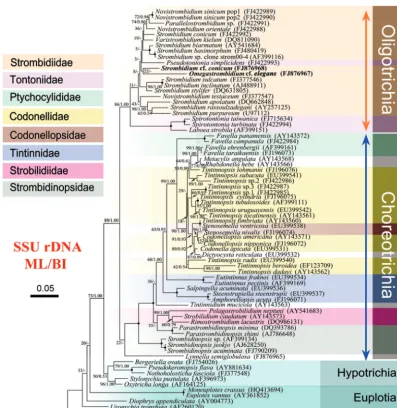
FIG 1Phylogenetic tree based on 72 SSU rDNA sequences inferred by maximum-likelihood (ML) and Bayesian inference (BI) analyses. Numbers near the nodes of branches represent the bootstrap value for the ML analysis and the posterior probability value of the BI analysis, respectively. Dashes (-) reflect disagreement between the two topologies. The scale bar corresponds to 5 substitutions per 100 nucleotide positions. Newly deposited sequences are in boldface. The codes in parentheses following the species name are the GenBank sequence accession numbers.
Multigene Phylogeny of Oligotrich Ciliates
on September 8, 2020 by guest
http://ec.asm.org/
program Modeltest (22) selected GTR plus I (0.4092) plus G (0.4771) for the SSU rRNA gene, GTR plus I (0.0673) plus G (0.5883) for the ITS1-5.8S-ITS2 region, and GTR plus I (0.3208) plus G (0.5055) for the con-catenated sequences as the best models under the AIC criterion, which were then used to construct maximum likelihood (ML) trees. Similarly, MrModeltest, version 2 (23), chose the same best-fitting model with the identical values for Bayesian inference (BI) analyses. ML trees were con-structed with the PhyML program, version 2.4.4 (24). The reliability of internal branches was assessed using a nonparametric bootstrap method with 1,000 replicates. The BI analysis was performed with MrBayes 3.1.2 (25). Four simultaneous Markov chain Monte Carlo (MCMC) chains were run for 1,000,000 (2,000,000 for concatenated sequences) genera-tions with a sample frequency of 100. The first 2,500 (5,000 for
concate-nated sequences) generations were discarded as burn-in. Posterior prob-abilities were calculated by applying the majority rule consensus. Protocruzia adherensof the subclass Protocruziidia was selected as the outgroup taxon in the analyses.
ITS2 secondary structure prediction.The ITS2 sequences were sub-mitted to the mfold website (http://mfold.rna.albany.edu/?q⫽mfold) for secondary structure prediction with default settings (26). Structures were edited for esthetic purposes with RnaViz 2.0 (27) under the model for ciliates (28).
Topology testing.In order to test the monophyly of the family Strom-bidiidae and of the generaNovistrombidiumandStrombidium, the ap-proximately unbiased (AU) test was used (29). Steps were as described in reference12. Eight constrained ML analyses were carried out on the SSU FIG 2Phylogenetic trees based on ITS1-5.8S-ITS2 region sequences (A) and SSU rRNA gene and ITS-5.8S region sequences (B) inferred by maximum likelihood (ML) and Bayesian inference (BI) analyses. Species newly sequenced in this study are in boldface. The codes following the names are the GenBank sequence accession numbers. Numbers on branches represent the bootstrap values from ML analysis and posterior probability of Bayesian analysis, respectively. Dashes (-) indicate disagreement between the ML and BI methods. The scale bar corresponds to 10 substitutions per 100 nucleotide positions.
on September 8, 2020 by guest
http://ec.asm.org/
rRNA alignment, as follows: (i) 18 strombidiids, (ii) 18 strombidiids and Pseudotontonia simplicidens, (iii) 18 strombidiids andLaboea strobila, (iv) 18 strombidiids,P. simplicidens, andL. strobila, (v) four species of Novis-trombidium, (vi)LaboeaandSpirotontonia, (vii)Pseudotontonia,Laboea, andSpirotontonia, and (viii) 11 species ofStrombidium. The resulting constrained topologies were then compared to the unconstrained ML topologies. The internal relationships within each constrained group and the relationships among the remaining taxa were unspecified.
Nucleotide sequence accession numbers.The SSU rRNA gene of two species (Strombidiumcf.conicumandOmegastrombidiumcf.elegans) and the ITS1-5.8S-ITS2 region for all nine species were sequenced for the first time. The sequences were deposited in the NCBI GenBank database with accession numbers, lengths, and GC contents as listed inTable 2.
RESULTS
There is only a 1-bp difference in the ITS1-5.8S-ITS2 region
se-quences between the two populations ofN. sinicum. The SSU
rRNA gene and the ITS1-5.8S-ITS2 region sequences of the 11 strombidiids used in the phylogenetic analyses share similarities of
68.4% to 99.6% (86.0% to 99.6% withoutStrombidiumsp.) and
73.2% to 99.8%, respectively.
Secondary structures of the order Strombidiida.Within the order Strombidiida, ITS1-5.8S-ITS2 region sequence data were
available for 11 lineages representing four genera (
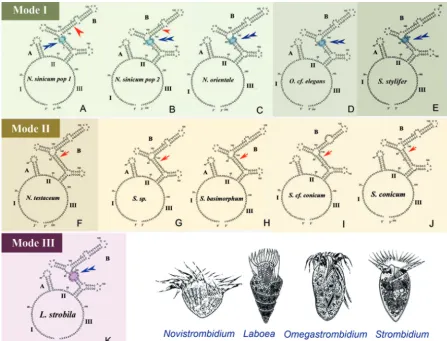
Novistrom-bidium,Omegastrombidium,Strombidium, andLaboea). The pre-dicted secondary structure of the ITS2 region generally consists of a large loop separated by two helices. Considering the primary sequences, as well as the secondary structures, of their ITS2 region, we found that (i) although four genera were represented, the 11
structures were divided into three modes (Novistrombidium
sini-cumpopulation 1 [pop1] and pop2,Novistrombidium orientale,
Omegastrombidiumcf.elegans, andStrombidium stylifer[Fig. 3A
toE];Novistrombidium testaceum,Strombidiumsp.,Strombidium basimorphum,Strombidiumcf.conicum, andStrombidium coni-cum[Fig. 3FtoJ]; and Laboea strobila[Fig. 3K]), (ii) the only
substituted nucleotide between two isolates ofN.sinicumwas
lo-cated at the 136th site of the ITS2 region (see Fig. S1 in the sup-plemental material), and (iii) the unique nucleotide contributing to the classification of these three modes, inferred from diagrams inFigure 3, was the 146th base (see Fig. S1).
Phylogenetic trees.Trees were constructed using different al-gorithms and with different gene sequences. The topologies were identical at higher taxonomic levels, whereas the relationships among certain strombidiid genera were inconsistent.
Trees based on SSU rRNA gene sequences with more taxa
se-lected showed the monophyly of both subclasses, Oligotrichia and
Choreotrichia (Fig. 1).Laboea strobilaclustered with two species
of the tontoniid genusSpirotontonia with high support values
(100% ML and 1.00 BI) and was the sister clade to the strombidiid assemblage.
Trees constructed using the ITS1-5.8S-ITS2 region (Fig. 2A)
showed that the subclass Oligotrichia was monophyletic with strong support (98% ML and 1.00 BI) and was sister to the sub-class Choreotrichia, which was also monophyletic with strong support values (97% ML and 1.00 BI). There were two clades
within the Oligotrichia, (i)Laboea-Strombidium(exceptS.
coni-cum) (30% ML and 0.74 BI) and (ii)Novistrombidium-
Omegas-trombidium-Strombidium conicum(27% ML and 0.69 BI). Within the second clade, there were two groups; one comprised the two
populations ofN. sinicum,O. cf.elegansandN. orientale, and the
other comprisedN. testaceumandS. conicum.
In order to mitigate the effect of base mutation among isolates, SSU ribosomal DNA (rDNA) sequences were, as far as possible, obtained from the same clones as those used to construct the ITS1-5.8S-ITS2 region tree and then combined with their corre-sponding ITS-5.8S region sequences. The resulting concatenated tree (SSU rDNA and ITS-5.8S region) shared a similar topology to
that of the ITS1-5.8S-ITS2 tree (Fig. 2B). For example, in both
trees, (i) both Oligotrichia and Choreotrichia were monophyletic
with high support and (ii) both Strombidium and
Novistrom-bidiumwere paraphyletic. However, the distribution patterns of the component species were different. In the ITS1-5.8S-ITS2 tree,
three of fourNovistrombidiumsequences formed a paraphyletic
clade nesting withOmegastrombidiumspecies (85% ML and 1.00
BI), whileN. testaceumclustered withS. conicum. In the
concate-nated tree,N. testaceumappeared as the second deepest branch of
Oligotrichia and the other three Novistrombidium sequences
formed a monophyletic clade. The inconsistency also applied to
Strombidium. In the ITS1-5.8S-ITS2 tree, five species of Strom-bidium scattered into 4 clades, while they clustered into two groups in the concatenated tree. The most obvious difference is
the position ofLaboea. In the concatenated tree (Fig. 2B),L.
stro-bilaoccupied a basal position within the oligotrichs (100% ML
and 1.00 BI), whereas in the ITS1-5.8S-ITS2 tree (Fig. 2A),L.
strobilagrouped with twoStrombidiumspecies (43% ML and 0.98 BI).
Topology testing.The AU test rejected the possibility that
La-boea belongs to the family Strombidiidae (Table 3, constraint
TABLE 2List of species for which both the ITS1-5.8S-ITS2 region and SSU-rDNA gene were newly sequencedaor obtained from GenBank
Species
ITS1-5.8S-ITS2 SSU-rRNA gene
GenBank accession no. Sequence length (bp) GC content (%) GenBank accession no. Sequence length (bp) GC content (%)
Strombidium conicum JN853793 546 48.53 FJ422992 1775 47.61
S. cf.conicum JN853788 542 46.68 FJ876968 1776 47.30
Omegastrombidiumcf.elegans JN853790 542 44.10 FJ876967 1772 43.74
S.stylifer JN853794 541 49.15 DQ631805 1774 48.03
S.basimorphum JN853787 543 47.88 FJ480419 1774 48.08
Novistrombidium orientale JN853791 536 48.51 FJ422988 1772 47.35
N. sinicumpop1 JN853789 534 50.37 FJ422989 1773 48.34
N. sinicumpop2 JN853792 534 50.56 FJ422990 1773 48.11
N.testaceum JN853795 538 47.21 FJ377547 1770 48.36
aAccession numbers for new sequences are in boldface.
Multigene Phylogeny of Oligotrich Ciliates
on September 8, 2020 by guest
http://ec.asm.org/
group 8,P⫽0.002), but the possibility that all species of
Strom-bidiidae exceptLaboeaform a monophyletic group was not
re-futed (constraint group 3,P⫽0.970). Moreover, even though
species ofStrombidiumandNovistrombidiumdid not form
mono-phyletic clades (Fig. 1), the possibility of monophyly of the genera
Strombidium andNovistrombidium was not rejected (Table 3,
constraint group 4,P⫽0.759, and constraint group 5,P⫽0.404).
Furthermore, the topology was robust for the tontoniid
Spiroton-toniaand Pseudotontoniatogether with Laboea(Table 3,
con-straint group 1,P⫽0.970, and constraint group 2,P⫽0.970).
DISCUSSION
The genusLaboea.In recently published SSU rRNA gene trees of
the Oligotrichia, the tail-less genusLaboeais more closely related
to the tailed tontoniid generaSpirotontoniaandPseudotontonia
than to the tail-less taxa of the family Strombidiidae (6,8). This
relationship was also recovered with maximum support (100% ML and 1.00 BI) in the present analyses based on SSU rRNA gene
sequence data (Fig. 1). Moreover, the AU test rejected all
con-strained trees which supposed the monophyly of Strombidiidae
with the inclusion of the genusLaboea(P⬍0.01), and the
con-strained tree which supposedLaboeawithSpirotontoniawas not
rejected (P⫽0.970). Besides the tree topology, there are another
three pieces of evidence supporting the closer relationship
be-tweenLaboeaand tontoniids, as follows. (i) The sequence
identi-ties ofLaboeawith three tontoniids (92.3% to 94.8%) were higher
than those ofLaboeawith strombidiids (88.3% to 90.4%). (ii)
FIG 3Secondary structures of the internal transcribed spacer 2 (ITS2) RNA transcript of representative species of four oligotrich genera ( Novistrom-bidium,Omegastrombidium,Strombidium, andLaboea). The diagrams illustrate the two helices, labeled A and B, present in the class Spirotrichea (28). The three parts of the largest loop are labeled I, II, and III, respectively. The red arrowheads (in panels A and B) mark the only nucleotide variation between two populations ofN.sinicum. Red arrows or blue double arrowheads indicate the different structures in helix B (elliptical shadowed region) among these three categories.
TABLE 3Approximately unbiased test results
Constraint
group Topology constraint
⫺ln
likelihood AU value (P)a
1 Laboea⫹Spirotontonia 15,809.24,178 0.970 2 Pseudotontonia⫹Laboea⫹
Spirotontonia
15,809.24,178 0.970
3 18 strombidiids 15,809.24,178 0.970 4 Strombidiummonophyly 15,813.87,249 0.759 5 Novistrombidium
monophyly
15,820.11,228 0.404
6 18 strombidiids⫹ Pseudotontonia
15,832.74,004 0.039
7 18 strombidiids⫹ Pseudotontonia⫹Laboea
15,940.07,464 4eⴚ004
8 18 strombidiids⫹Laboea 20,311.37,195 0.002 aAU values (P) below 0.05 are in boldface.
on September 8, 2020 by guest
http://ec.asm.org/
Laboeahas more common unique characters with tontoniids than with strombidiids both in molecular information (see Fig. S2 in the supplemental material) and in morphological features. The
morphology ofLaboeais very similar to that of the tontoniid
Spi-rotontonia, e.g., the irregular cone-shaped body with sinistrally spiraled girdle kinety, giving it a screw-like appearance, and the
multiple macronuclear nodules (3) (see Fig. S3 in the
supplemen-tal material). (iii) The secondary structure of the ITS2 region
shows thatLaboeaclearly differs from other strombidiids, such as
NovistrombidiumandStrombidium, by the presence of a loop in
helix B composed of 10 nucleotides (versus 8 inNovistrombidium
sinicumandN. orientaleand no loop inStrombidium) (Fig. 3). These findings were examples of a disagreement between molec-ular information and morphology. The “tail” may be not a good family-level diagnostic feature for the separation of Tontoniidae
from other oligotrich families (21), especially with the
consider-ation ofLaboea.
Is the family Strombidiidae paraphyletic?As a species-rich group of oligotrichs, the family Strombidiidae is characterized by having a bipartite oral ciliature with anterior and ventral mem-branelles, a strongly reduced somatic ciliature, and a unique
sto-matogenetic process which takes place within a transient tube (3,
17). Within the family, the somatic ciliature, which consists of
only one to several kineties, exhibits high diversity of arrangement and has been always regarded as an important generic character. Ten genera are currently assigned in the family Strombidiidae, i.e.,
Strombidium, Spirostrombidium, Parallelostrombidium, Novis-trombidium, Omegastrombidium, Apostrombidium, Varistrom-bidium,Opisthostrombidium,Foissneridium, andWilliophrya(3,
4,30) (see Fig. S3 in the supplemental material). Recently, Agatha
(3) separated strombidiids with a contractile tail from other family
members and placed them in a new family, Tontoniidae,
contain-ing four genera:Tontonia,Paratontonia,Spirotontonia, and
Pseu-dotontonia.
As mentioned above, members of the family Strombidiidae differ from the Tontoniidae in lacking a conspicuous, elongate,
contractile tail (17). Previous studies have reported the
mono-phyly of the family Strombidiidae (9, 11,31). However, recent
studies based on SSU rRNA gene sequence data revealed that the
tail-less genus Laboeaclusters with the Tontoniidae rather the
Strombidiidae (8,32), which renders the family Strombidiidae
paraphyletic.
In the present study, the ITS1-5.8S-ITS2 region tree and the concatenated tree were constrained by the limited number of taxa. With the absence of tontoniids, it is hard to test whether the family Strombidiidae is monophyletic. Therefore, we constructed an ex-panded SSU rDNA tree with 11 additional oligotrichid and 26
additional choreotrichid sequences (Fig. 1). Although the
boot-strap values are too low to define relationships among genera in
Strombidiidae (Fig. 1), it is clear that the family Strombidiidae is
not monophyletic if the genusLaboeais considered (Fig. 2and
Table 3).
Besides the intricate assignment ofLaboea, it is noteworthy
that the diversity of strombidiids is probably underestimated,
with three new strombidiid genera, i.e.,WilliophryaLiu, 2011,
FoissneridiumAgatha, 2011, andOpisthostrombidiumAgatha,
2011, being recently established (4,30). Furthermore, there is a
lack of molecular data, particularly multigene information, for
many strombidiid species (especially the ITS ofSpirotontonia
andPseudotontonia) and some genera are not represented in
any form of molecular information. Consequently, more data are needed to determine the monophyly of the family Strom-bidiidae.
The known taxa inStrombidiumbelong to a nonmonophyl-etic assemblage.The species-rich genusStrombidiumwas the ba-sic and earliest-established taxon in the family Strombidiidae. To
date, about 65 species have been assigned in this genus (1), while
only about 10 nominal and 9 undetermined species have their molecular information in the NCBI database. However, even
from this limited information, species ofStrombidiumhave
exhib-ited enormous diversities in both sequence identity and tree to-pology. The identities of the SSU rRNA gene sequences among
Strombidium species ranged from 69.9% to 96.3% (89.5% to
96.3% without Strombidium sp. and S. biarmatum). The
se-quences ofStrombidiumsp. andS. biarmatumshared similarity of
95.5%, but they are both notably different from other
Strom-bidiumspecies (similarities with others ranged from 69.9% to
75.9%). In SSU rRNA gene trees (Fig. 1), theStrombidiumspecies
were separated into four clades, as follows: (i)S. conicum; (ii)S.
biarmatum,S. basimorphum, andStrombidiumsp.; (iii)S. apola-tum,S. rassoulzadegani, andS. purpureum; and (iv)S. sulcatum,S. inclinatum, andS. stylifer. Intriguingly, the separation of
conge-ners was supported by morphological differences. For example,S.
conicumrevealed itself in a separate branch by possessing a unique hemitheca with longitudinal lines rather than polygonal platelets
(33). In addition,S. biarmatumandS. basimorphumjustified a
distinct clade by being the only two congeners with extra
extruso-mes attached to the anterior portion of cells (4,31). Our findings,
together with previous molecularly based results (4), further
sup-port thatStrombidiumshould be split into several
morphologi-cally and ontogenetimorphologi-cally defined genera (31). Although the
pos-sibility of the monophyly ofStrombidiumwas not rejected (Table
3, constraint group 4,P⫽0.759), it might still be possible that the
intrageneric morphological differences are not genuinely reflected in SSU rRNA genes.
The genusNovistrombidiumis paraphyletic.Previous reports based on SSU rRNA gene sequence data have suggested that the
genusNovistrombidiumis paraphyletic whenN. sinicumandN.
orientaleare included (4,6,8,15,16). The results of the present
multigene analyses are consistent with this finding (Fig. 1and2).
Data inferred from the secondary structure of the ITS2 region
corroborate the paraphyly ofNovistrombidium, withN. sinicum
andN. orientalehaving a mode I structure (with seven loops in
helix B) similar to that of S. stylifer and Omegastrombidium,
whereasN. testaceumhas a mode II structure (with six loops in
helix B) similar to the majority ofStrombidiumspecies (Fig. 3).
It should be noted in the SSU rDNA tree thatN. sinicumandN.
orientalereside in the same clade asParallelostrombidium. This topology could be explained by their shared characteristics with
Parallelostrombidium, including (i) the broadly ellipsoidal cell shape, (ii) extrusomes equidistantly arranged along the girdle kinety, (iii) the presence of thigmotactic membranelles, (iv) an ovoid macronucleus, and (v) the localization of the anterior end of
the ventral kinety below the right portion of the girdle kinety (15).
Furthermore, the respective sequence identities of
Parallelostrom-bidiumwith N. sinicumandN. testaceum are 97% and 96.2%,
slightly higher than those betweenN. testaceumand two other
congeners (95.1% and 95.7%). In contrast,N. testaceum, the type
species ofNovistrombidium, has a sausage-shaped macronucleus,
extrusomes grouped in bundles, and localization of the ventral
Multigene Phylogeny of Oligotrich Ciliates
on September 8, 2020 by guest
http://ec.asm.org/
kinety extending longitudinally through the gap in the girdle
kinety, which resulted in its separation from the other two
Novis-trombidiumspecies (34). Nevertheless, the monophyly of the ge-nusNovistrombidiumcould not be rejected by the AU test (Table
3, constraint group 5,P⫽0.404), and this discrepancy between
phylogenetic topology and AU test result may stem from under-sampling.
Conclusions from the multigene phylogenetic analysis.
When the ITS1-5.8S-ITS2 region was first applied to the study of oligotrichs and choreotrichs, it was suggested that the ITS and 5.8S regions could provide adequate polymorphism data to assess ge-netic variation at the genus/population level within these groups
(11). In the meantime, SSU rDNA sequences have been widely
used to infer evolutionary relationships among spirotrichs, and phylogenetic trees based on such data are generally concordant with many morphological hypotheses, albeit with some
discrep-ancies (17,35). The value of using a single gene marker in order to
elucidate evolutionary relationships among ciliates has been
ques-tioned (10). Therefore, we have used multigenes, i.e., SSU rRNA
gene and ITS-5.8S region sequences, to increase the robustness of our analyses of phylogenetic relationships among oligotrichs. In the present study, the overall mean distances in oligotrichs are 0.104 in the SSU rRNA gene and 0.159 in the ITS-5.8S region, while in choreotrichs, they are 0.067 in the SSU rRNA gene and 0.090 in the ITS-5.8S region, confirming that oligotrichs are more genetically variable than choreotrichs in both the SSU rRNA gene
and the ITS-5.8S region (11). Our findings support the removal of
Laboeafrom the Strombidiidae to the Tontoniidae, thus render-ing the family Strombidiidae monophyletic. Furthermore, the
monophyly ofNovistrombidiumwas doubted in the topologies of
trees and morphological features. However, we are currently un-able to resolve a number of phylogenetic relationships due to (i) differences between the two genes in length and variation rate, (ii) the lack of available ITS-5.8S region sequence data for oligotrichs,
and (iii) undersampling of certain key taxa, such as
Varistrom-bidium, Parallelostrombidium, and Omegastrombidium. There-fore, further studies are required to increase the resolution of the oligotrich systematics.
ACKNOWLEDGMENTS
This work was supported by the Natural Science of Foundation of China (project numbers 31201696, 31030059, and 31222050).
We thank Feng Gao (OUC), as well as three anonymous reviewers, for their help and advice with the early versions of this paper. Many thanks are also given to Jie Huang, Zhenzhen Yi, Qianqian Zhang (OUC), and Liang Zhou, Laboratory of Protozoology, South China Normal University, for their help with the laboratory work.
REFERENCES
1.Agatha S.2011. Global diversity of aloricate Oligotrichea (Protista, Cilio-phora, Spirotricha) in marine and brackish sea water. PLoS One6:e22466. doi:10.1371/journal.pone.0022466.
2.Pierce RW, Turner JT.1992. Ecology of planktonic ciliates in marine food webs. Rev. Aquat. Sci.6:139 –181.
3.Agatha S.2004. Evolution of ciliary patterns in the Oligotrichida (Cilio-phora, Spirotricha) and its taxonomic implications. Zoology (Jena)107: 153–168.
4.Liu W, Yi Z, Warren A, Al-Rasheid KAS, Al-Farraj SA, Lin X, Song W. 2011. Taxonomy, morphology and molecular systematics of a new oligo-trich ciliate, Williophrya maedai gen. nov., sp. nov., with redescriptions of Strombidium basimorphumandPseudotontonia simplicidens(Protozoa, Ciliophora, Oligotrichia). Syst. Biodivers.9:247–258.
5.Modeo L, Petroni G, Rosati G, Montagnes DJS.2003. A
multidisci-plinary approach to describe protists: redescriptions ofNovistrombidium testaceumAnigstein 1914 andStrombidium inclinatumMontagnes, Tay-lor, and Lynn 1990 (Ciliophora, Oligotrichia). J. Eukaryot. Microbiol. 50:175–189.
6.Zhang Q, Yi Z, Xu D, Al-Rasheid KAS, Gong J, Song W. 2010. Molecular phylogeny of oligotrich generaOmegastrombidiumand Novis-trombidium (Protozoa, Ciliophora) for the systematical relationships within family Strombidiidae. Chin. J. Oceanol. Limnol.28:769 –777. 7.Agatha S, Strüder-Kypke MC.2007. Phylogeny of the order Choreotrichida
(Ciliophora, Spirotricha, Oligotrichea) as inferred from morphology, ultrastructure, ontogenesis, and SSrRNA gene sequences. Eur. J. Protistol. 43:37– 63.
8.Gao S, Gong J, Lynn D, Lin X, Song W.2009. An updated phylogeny of oligotrich and choreotrich ciliates (Protozoa, Ciliophora, Spirotrichea) with representative taxa collected from Chinese coastal waters. Syst. Bio-divers.7:235–242.
9.Strüder-Kypke MC, Lynn DH. 2003. Sequence analyses of the small subunit rRNA gene confirm the paraphyly of oligotrich ciliates sensu lato and support the monophyly of the subclasses Oligotrichia and Choreotri-chia (Ciliophora, Spirotrichea). J. Zool.260:87–97.
10. Dunthorn M, Foissner W, Katz LA.2011. Expanding character sampling for ciliate phylogenetic inference using mitochondrial SSU-rDNA as a molecular marker. Protist162:85–99.
11. Snoeyenbos-West OL, Salcedo T, McManus GB, Katz LA.2002. Insights into the diversity of choreotrich and oligotrich ciliates (Class: Spiro-trichea) based on genealogical analyses of multiple loci. Int. J. Syst. Evol. Microbiol.52:1901–1913.
12. Gao F, Katz LA, Song W. 2012. Insights into the phylogenetic and taxonomy of philasterid ciliates (Protozoa, Ciliophora, Scuticociliatia) based on analyses of multiple molecular markers. Mol. Phylogen. Evol. 64:308 –317.
13. Yi Z, Song W.2011. Evolution of the order Urostylida (Protozoa, Cilio-phora): new hypotheses based on multi-gene information and identifica-tion of localized incongruence. PLoS One6:e17471. doi:10.1371/journal .pone.0017471.
14. McManus GB, Xu D, Costas BA, Katz LA.2010. Genetic identities of cryptic species in theStrombidium stylifer/apolatum/oculatumcluster, in-cluding a description ofStrombidium rassoulzadeganin. sp. J. Eukaryot. Microbiol.57:369 –378.
15. Liu W, Xu D, Lin X, Li J, Gong J, Al-Rasheid KA, Song W. 2009. Novistrombidium sinicumn. sp. andNovistrombidium orientalen. sp. (Protozoa: Ciliophora): two new oligotrich ciliates from a mangrove wet-land, South China. J. Eukaryot. Microbiol.56:459 – 465.
16. Liu W, Yi Z, Lin X, Al-Rasheid KA.2011. Morphologic and molecular data suggest thatLynnella semiglobulosan. g., n. sp. represents a new family within the subclass Choreotrichia (Ciliophora, Spirotrichea). J. Eukaryot. Microbiol.58:43– 49.
17. Lynn DH.2008. The ciliated Protozoa. Characterization, Classification, and Guide to the Literature. Springer, New York, NY.
18. Medlin L, Elwood HJ, Stickel S, Sogin ML.1988. The characterization of enzymatically amplified eukaryotic 16S-like rRNA-coding regions. Gene 71:491– 499.
19. Liu W, Yi Z, Lin X, Warren A, Song W. 2012. Phylogeny of three choreotrich genera (Protozoa, Ciliophora, Spirotrichea), with morpho-logical, morphogenetic and molecular investigations on three strobilidiid species. Zool. Scr.41:417– 434.
20. Hall TA.1999. BioEdit: a user-friendly biological sequence alignment editor and analysis program for Windows 95/98/NT. Nucleic Acids Symp. Ser. (Oxf.)41:95–98.
21. Gouy M, Guindon S, Gascuel O.2010. SeaView version 4: A multiplat-form graphical user interface for sequence alignment and phylogenetic tree building. Mol. Biol. Evol.27:221–224.
22. Posada D, Crandall KA. 1998. Modeltest: testing the model of DNA substitution. Bioinformatics14:817– 818.
23. Nylander JA.2004. MrModeltest version 2. Program Distributed by the author. Evolutionary Biology Centre, Uppsala University, Uppsala, Sweden.
24. Guindon S, Gascuel O.2003. A simple, fast and accurate algorithm to estimate large phylogenies by maximum likelihood. Syst. Biol.52:696 – 704.
25. Ronquist F, Huelsenbeck JP.2003. MRBAYES 3: Bayesian phylogenetic inference under mixed models. Bioinformatics19:1572–1574.
on September 8, 2020 by guest
http://ec.asm.org/
26. Zuker M.2003. Mfold web server for nucleic acid folding and hybridiza-tion predichybridiza-tion. Nucleic Acids Res.31:3406 –3415.
27. De Rijk PD, De Wachter RD.1997. RnaViz, a program for the visuali-sation of RNA secondary structure. Nucleic Acids Res.25:4679 – 4684. 28. Coleman AW.2005.Paramecium aureliarevisited. J. Eukaryot.
Micro-biol.52:68 –77.
29. Shimodaira H.2002. An approximately unbiased test of phylogenetic tree selection. Syst. Biol.51:492–508.
30. Agatha S.2011. Updated hypothesis on the evolution of oligotrichid cil-iates (Ciliophora, Spirotricha, Oligotrichida) based on somatic ciliary pat-terns and ontogenetic data. Eur. J. Protistol.47:51–56.
31. Agatha S, Strüder-Kypke MC, Beran A, Lynn DH.2005.Pelagostrobilidium neptuni(Montagnes and Taylor, 1994) andStrombidium biarmatumnov. spec. (Ciliophora, Oligotrichea): phylogenetic position inferred from mor-phology, ontogenesis, and gene sequence data. Eur. J. Protistol.41:65– 83.
32. Xu D, Sun P, Shin MK, Kim YO.2012. Species boundaries in tintinnid ciliates: a case study—morphometric variability, molecular characteriza-tion, and temporal distribution ofHelicostomellaspecies (Ciliophora, Tin-tinnina). J. Eukaryot. Microbiol.59:351–358.
33. Maeda M, Carey PG.1985. An illustrated guide to the species of the family Strombidiidae (Oligotrichida, Ciliophora), free-swimming protozoa common in the aquatic environment. Bull. Ocean Res. Inst.19:1– 65. 34. Agatha S.2003. Morphology and ontogenesis ofNovistrombidium
apsher-onicumnov. comb. andStrombidium arenicola(Protozoa, Ciliophora): a comparative light microscopical and SEM study. Eur. J. Protistol.39:245– 266.
35. Foissner W, Moon-van der Staay SY, van der Staay GWM, Hackstein JHP, Krautgartner Berger W-DH.2004. Reconciling classical and molecular phy-logenies in the stichotrichines (Ciliophora, Spirotrichea), including new se-quences from some rare species. Eur. J. Protistol.40:265–281.
Multigene Phylogeny of Oligotrich Ciliates
on September 8, 2020 by guest
http://ec.asm.org/
Multigene-Based Analyses of the Phylogenetic Evolution of Oligotrich
Ciliates, with Consideration of the Internal Transcribed Spacer 2
Secondary Structure of Three Systematically Ambiguous Genera
Jiamei Li,aWeiwei Liu,aShan Gao,bAlan Warren,cWeibo Songa Institute of Evolution and Marine Biodiversity, Ocean University of China, Qingdao, Chinaa
; Department of Pathology, University of Michigan, Ann Arbor, Michigan, USAb ; Department of Life Sciences, Natural History Museum, Cromwell Road, London, United Kingdomc
Volume 12, no. 3, p. 430 – 437, 2013. Page 434, Figure 3, lower right portion: the image ofNovistrombidiumis reproduced with
permission from W. Song and P. Bradbury, J. Mar. Biol. Assoc. U. K. 78:767–794, 1998; the image ofLaboeais reproduced with
permission from S. Agatha, M. C. Strüder-Kypke, and A. Beran, J. Eukaryot. Microbiol. 51:267–281, 2004; and the image of
Omega-strombidiumis reproduced with permission from W. Song, M. Wang, and A. Warren, Eur. J. Protistol. 36:327–342, 2000. The image of
Strombidiumis an original drawing.
In the supplemental material associated with this article, Figure S3 contained some typographical errors and the legend was
incom-plete. A revised supplemental material file has been posted online athttp://dx.doi.org/10.1128/EC.00270-12.
Copyright © 2014, American Society for Microbiology. All Rights Reserved.