ISSN: 2395-5929
www.eijfmr.com
©
Mayas Publication
Volume - V Issue - 2 February - 2019
Call For Innovative Facilitators to Career Satisfaction
Ms. Merin John
1& Dr. J. S. Gunavathy
21M.Phil. (Social Work) Research Scholar, Madras School of Social Work.
2Associate Professor, Post-Graduate & Research, Department of Social Work, Madras School of Social Work.
ABSTRACT
Today‟s employees spend an incredible amount of time at the workplace and are expected to deliver workplace and home duties efficiently. Empowered employees seek career satisfaction and women IT professionals are no exception. This paper presents the outcomes of a study on career satisfaction among married women IT employees in Kerala State. The study sought to trace how select individual and inter-personal factors namely self-efficacy and work-family conflict serve to predict career satisfaction. Data were collected from 150 married women IT employees from three different IT companies in Kerala state using questionnaire method. Multiple Regression Analysis was carried out to identify significant predictors of career satisfaction. The authors call for innovative and transformational human resource strategies to enhance career satisfaction of married women IT professionals.
Keywords: Career Satisfaction, Self-efficacy, Work-family conflict, IT professionals, married women, Kerala
JEL Classification: 015
I.INTRODUCTION AND PROBLEM STATEMENT
The Indian IT industry has widened the scope of opportunities for people seeking paid work, especially among women. The important factors that encourage women workforce to participate in IT sector are options for white-collar job with comparatively high salary, easy international mobility, gender-neutral policy based on knowledge-centric skills possession, flexible work routine and physically less demanding work process in comfortable indoor work - environment (Kumar 2001; Upadhya 2006; Shanker 2008). Performance and Success in the IT profession necessitates accentuated Individualisation capacities. One of the key facilitators of Individualisation capacities is efficacy. Self-efficacy is self-evaluation of one‟s ability to successfully achieve plan of action necessary to achieve desired outcome (Bandura:1977, 1982 & 1986). It is the personal belief in own abilities to fulfill the task needs and it has an impact on behavioural choices (Bandura 1977, 1989).
The IT industry as a knowledge industry is very demanding and work-intensive, more so for married women employees owing to responsibilities at work and home. Working women feel torn between the demands of their professional work and their social and marital life including childcare and
Received : 6thJanuary 2019
Accepted : 30thJanuary 2019
Published : 13th
February
2019household chores (Lee and Seow, 2001; Lo et al, 2003). One of the imminent social effects of the participation of women workforce in IT industry is Work -Family Conflict. Work - Family Conflict as a bi-dimensional construct comprising of Work to Family Conflict and Family to Work Conflict, is defined as a form of inter-role conflict in which the amount of time devoted to work and strain created by the job interferes with performing family-related responsibilities and vice - versa (Netemeyer, Boles, & McMurrian, 1996). However, in high performance organizations like IT companies, employees just do not look out for fat pay checks or fancy designations, but yearn for career satisfaction.
The study of Clark and Sekher (2007) has drawn inference that flexible labour market in this high tech sector improves women employees “financial autonomy, greater mobility and their larger social acceptance” in male dominated society. Clark et al., Shanker‟s study (2008) asserts that women professionals have enhanced their social status in terms of having economic capital (high income, foreign travels), social capital (role model and greater prospects of marriage) and symbolic capital (prestige attached to profession). These findings raise the question of whether these outcomes of employment contribute to the emotional, personal, financial fulfillment, which brings our attention to the concept of satisfaction, especially Career Satisfaction. Jen-Ruei Fu (2010) defined Career Satisfaction as the level of overall happiness experienced through one's choice of career. Career satisfaction is a subjective measure that captures employees‟ perceptions of their satisfaction with their overall career goals, goals for income, goals for advancement and goals for the development of new skills (Greenhaus, Parasuraman & Wormley, 1990). This study is an attempt to study the interplay of select factors at the individual and inter-personal levels namely, self-efficacy and work-family conflict and career satisfaction. The conceptual model of the study has been depicted in Diagram 1 given below.
Diagram 1 Conceptual Model of the Study
1.1 Significance of the Study
1.2 Research Questions
1. What is the relationship between Self - efficacy, Work - Family Conflict and Career Satisfaction of married women IT professionals?
2. Can Career Satisfaction be predicted in terms of Self - efficacy and Work - Family Conflict?
1.3 Objectives of the Study
To understand the socio-demographic profile of married women IT professionals in Kerala.
To measure the relationship between Self – efficacy, Work - Family Conflict and Career Satisfaction.
To predict Career Satisfaction in terms of Self - efficacy and Work - Family Conflict.
To put forth suggestions based on the findings of the study.
II.REVIEW OF LITERATURE
Self - efficacy helps employees to focus their attention and reduces distractions (Kanfer & Ackerman, 1996), impact the level of difficulty of the goals and the level of commitment towards those goals (Locke & Latham, 2002), regularly allot resources towards the accepted goals (Vancouver et al., 2008), and encourage the search for more efficient strategies(Tabernero & Wood, 1999). Self - efficacy has a direct impact on cognitive functioning through its impact on self-satisfaction with the demands of the goals and personal development. Bandura (1997) found that individuals who doubt their abilities feel dissatisfied with their achievements and themselves, they tend to lose interest in the tasks. Similarly, they tend to avoid change and stick to goals they are certain with. The higher their approach of Self - Efficacy, the greater the changes in their chosen goals (Earley & Lituchy, 1991).
In an extensive literature review on Self - Efficacy, Bandura and Edwin Locke (2003) found that self - efficacy is one of the most powerful determinants of job performance. In a study by Amtmann, et al (2012), it was concluded that there is a direct relationship between self - efficacy and psychological well-being resulting to a lot of implications such as quality of life which includes work – life as well. A similar study by (Prilleltensky and Prilleltensky, 2007) concluded that self - efficacy beliefs contribute to personal growth of an employee and quality of life in a positive ways including quality of working life. Compared with the employees who doubt their potential, those with high level of self - efficacy work harder, readily participate in tasks and encounter challenges and achieve success (Schun, 1995). Luthans et al. (2006) in his study quoted that people with high level of self - efficacy are more satisfied with their jobs and are more committed to their jobs.
satisfaction may vary depending upon an individual's family demographic characteristics. Also, support may affect how well individuals can cope with work to family conflict and therefore, may mitigate the negative effects of work to family conflict on career satisfaction.
2.1 Null Hypothesis
The following null hypothesis have been framed for statistical testing
NH1: There is no significant relationship between Self - Efficacy, Work - Family conflict and Career Satisfaction.
NH2: Self – Efficacy and Work-Family Conflict do not serve to predict Career Satisfaction.
2.2 Research Methods
Descriptive Research Design was adopted to collect the quantitative data from married women IT professionals drawn from three IT companies in the city of Trivandrum (the capital city and the largest city of Kerala) in Kerala State. The focus areas of the companies identified were digital technology and solutions, technology services and consulting and IT providers. The source of data was primary. Universe comprised of all married women IT professionals employed in these three IT companies. Simple random sampling was done to identify 150 samples. Inclusion criteria were that respondents had to be married women IT professionals with at least 10 years of total work experience. Data were collected through questionnaire method.
The questionnaire was a four-part tool soliciting responses pertaining to socio-demographic profile, self-efficiacy, work-family conflict and career satisfaction. Self-efficacy was measured using the self-efficacy scale developed by Schwarzer and Jerusalem (1995). It is a 10 item, unidimensional scale having a 5 point Likert type response pattern. Work-Family Conflict was measured using the Work to Family Conflict and Family to Work Conflict Scale developed byNetemeyer et al. (1996). The subscales for work to family conflict and family to work conflict have five items each. The 5-item Career Satisfaction Scale was developed by Greenhaus, Parasuraman, and Wormley (1990). The tool was pre-tested prior to data collection during early 2018. The Cronbach alpha value for the Self - Efficacy scale is 0.876,Work to Family Conflict sub-scale is 0.865 , Family to Work Conflict sub-scale is 0.925 and Career Satisfaction scale is 0.905 suggesting that the items have relatively high internal consistency (reliability coefficient of 0.70or higher is considered “acceptable” in most social science research). Inferential Statistics such as Pearson‟s Correlation, Multiple Regression Analysis were used for the analysis and the hypothesis testing. SPSS version 20 was used to process the data. The limitations of the study may emanate from sample size and self-report method.
2.3 Study Results
Profile of the respondents
Almost two - third (65.3%) of the respondents belonged to the age group of 35 years and above. Two-third (66.7 %) of the respondents had a family size of up to 4 members. Majority of the respondents (72.7%) had up to 2 children. Two-third of the respondents (66.7%) had completed their Post-graduation (degrees like M. Tech, MSc. Computer Science etc). While 68% of the respondents had total work experience of 10 to 15 years, the rest had total work experience ranging from 15 to 20 years.
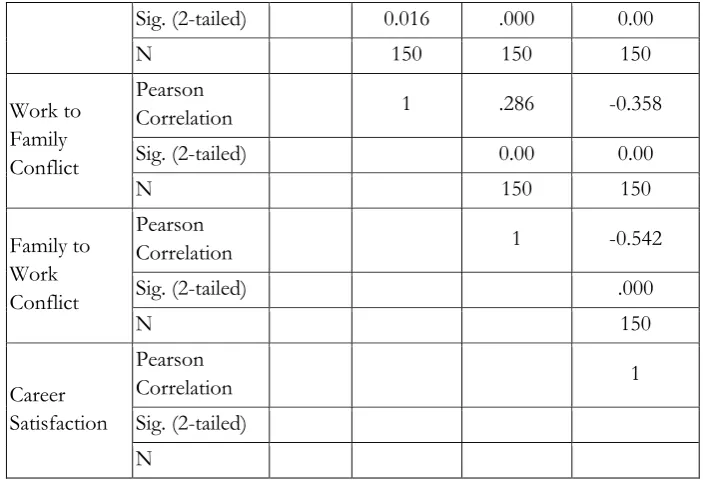
Correlation Between Self-Efficacy, Work-Family Conflict And Career Satisfaction Table 1
Inter-correlation matrix for Self-Efficacy, Work-Family Conflict & Career Satisfaction
Variables Values
Self – Efficacy
Work to Family Conflict
Family to Work Conflict
Career Satisfaction
Self - Efficacy Pearson
Sig. (2-tailed) 0.016 .000 0.00
N 150 150 150
Work to Family Conflict
Pearson
Correlation 1 .286 -0.358 Sig. (2-tailed) 0.00 0.00
N 150 150
Family to Work Conflict
Pearson
Correlation 1 -0.542
Sig. (2-tailed) .000
N 150
Career Satisfaction
Pearson
Correlation 1
Sig. (2-tailed) N
Table 1 represents the Pearson correlation analysis to examine the relationship between Self-Efficacy, Work to Family Conflict, Family to Work Conflict and Career satisfaction. To facilitate statistical testing, NH 1 „There is no significant relationship between Self - Efficacy, Work to Family Conflict (and Family-Work Conflict) and Career Satisfaction‟ was broken down into:
NH 1:1 - There is no relationship between Self-Efficacy and Career Satisfaction
NH 1:2 - There is no relationship between Work to Family Conflict and Career Satisfaction
NH 1:3 - There is no relationship between Family to Work Conflict and Career Satisfaction The correlation results revealed that there is high degree of positive correlation (r=0.75) between Self-Efficacy and Career Satisfaction that is statistically significant (p value = 0.00). Hence, NH 1:1 is rejected. Further, there is moderate degree of negative correlation (r= - 0.358) between Work to Family Conflict and Career Satisfaction; this relation is found to be statistically significant (r = -0.358, p = 0.000). Hence, NH 1:2 is rejected. Also, there is negative degree of moderate correlation (r= -0.542) between Family to Work Conflict and Career Satisfaction and this relation is found to be statistically significant (r = - 0.542, p = 0.000, p < 0.05). Hence, NH 1:3 is rejected.
Self-Efficacy and Work-Family Conflict As Predictors of Career Satisfaction Table 2a
Model Summary of Multiple Regression Analysis for Career Satisfaction*
Model Variables
Entered R
R Square
Adjusted R Square
Std. Error of the Estimate
F value
p value
1 Predictors: (Constant), Self - Efficacy 0.750 0.563 0.560 2.33 189.32 0.000
2
Predictors: (Constant), Self - Efficacy , Family to Work Conflict
0.787 0.619 0.614 2.18 118.64 0.000
3
Predictors: (Constant), Self - Efficacy, Work to Family Conflict and Family to Work Conflict
* Note: As Work-Family Conflict is bi-dimensional, the 2 dimensions, Work to Family Conflict and Family to Work Conflict have been considered as unique variables.
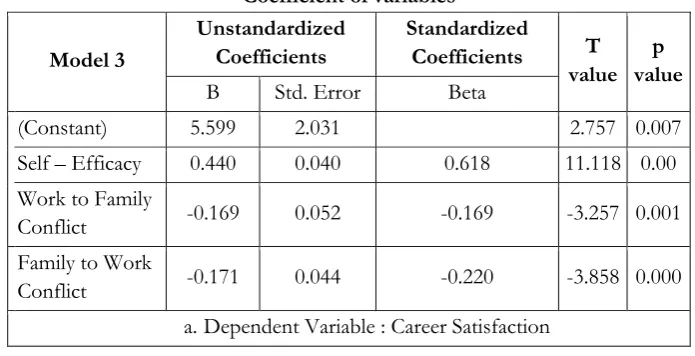
Table 2b Coefficient of variables
Model 3
Unstandardized Coefficients
Standardized
Coefficients T value
p value
B Std. Error Beta
(Constant) 5.599 2.031 2.757 0.007 Self – Efficacy 0.440 0.040 0.618 11.118 0.00 Work to Family
Conflict -0.169 0.052 -0.169 -3.257 0.001 Family to Work
Conflict -0.171 0.044 -0.220 -3.858 0.000 a.Dependent Variable : Career Satisfaction
Table 2a and 2b present the Multiple Regression Analysis outputs. To test the regression, NH 2 i.e., “Self-Efficacy and Work - Family conflict do not serve to predict Career satisfaction” was framed. Table 2a reveals that all the variables, namely, self-efficacy, work to family conflict and family to work conflict serve to predict career satisfaction.
Step wise Multiple Regression Analysis was applied to find out the predicted values of career satisfaction based on self-efficacy and work-family conflict. All the variables namely, self-efficacy, work to family conflict and family to work conflict reached the criterion for entry into the final regression equation as indicated by the significant t value (p<0.05). The Model summary is presented in Table 2a. From Table 2a, it is clear that 64.5 percent (based on R square value of model 3) of the variance in career satisfaction is explained by the independent variables. These variables (namely, self-efficacy, family to work conflict and work to family conflict) uniquely explained 56.3%, 5.6% and 2.6% respectively of the variance in the dependent variable. For model 3, the F value is 87.83 and the significance value is 0.000 which shows that the regression model is a good fit. Also, the relative importance of significant variables in predicting career satisfaction is self-efficacy (0.618) followed by work to family conflict (-0.169) and family to work conflict (-0.220). To conclude, NH 2 i.e., “Self -Efficacy and Work - Family conflict do not serve to predict Career satisfaction” is rejected.
Discussion
III.SUGGESTIONS
Transformation in the nature of work and organizing, the surge of women into the workforce in the later decades of the 20th century, and recent changes in the ways careers and career development are conceptualized. While the ranks of women in organizations have grown exponentially over the last decade, organizations are still fundamentally male-dominated. This trend continues even given the preponderance of research and anecdotal evidence suggesting that the most successful organizations will be the ones that continue to develop the talents and encourage the contributions of their female employees.
On the basis of results on, following suggestions are made.
i. As self-efficacy is a significant predictor of career satisfaction, Organizations need to identify and onboard individuals with high level of self-efficacy. Also, as the IT industry is knowledge and technology driven, there is a constant need to be up to date. Hence, organisations also need to continuously upgrade employees‟ level of self-efficacy through innovative and transformational talent development initiatives.
ii. As work to family conflict and family to work conflict determine career satisfaction, organisations and employees need to be wary of excessive work spill over. Hence organisational support is of paramount importance. Interventions could include family supportive supervisory behaviours and other family-friendly human resource management practices.
iii. Career satisfaction could be enhanced through customised career development programmes, analysis of career anchor data, benchmarking the success of career management initiatives with other companies, career counselling services and so on.
IV.CONCLUSION
The present study has highlighted that self - efficacy and Work- Family Conflict are important variables in determining career satisfaction and has enhanced our understanding of the ways in which individuals and organizations can address the same.
V.REFERENCES
1. Ackerman, P. L., & Kanfer, R. (1996). Cognitive/Self-Regulatory Aptitudes and Instructional Methods for Complex Skill Learning. PsycEXTRA Dataset. doi:10.1037/e446532006-001.
2. Bandura, A. (1977), “Self-efficacy: Toward a unifying theory of behavioral change”, Psychological Review, vol. 84, no. 2, pp. 191-215.
3. Bandura, A. (1989), “Regulation of cognitive processes through perceived self-efficacy”, Developmental Psychology, vol. 25, no. 5, pp. 729-735.
4. Bandura, A. (1986). Social foundations of thought and action: A social cognitive theory. Englewood Cliffs, NJ: Prentice-Hall.
5. Bandura, A. (1991a). Self-efficacy mechanism in physiological activation and health-promoting behavior. In J. Madden, IV (Ed.), Neurobiology of learning, emotion and affect (pp. 229- 270). New York: Raven.
6. Bandura, A. (1991b). Self-regulation of motivation through anticipatory and self-regulatory mechanisms. In R. A. Dienstbier (Ed.), Perspectives on motivation: Nebraska symposium on motivation (Vol. 38, pp. 69-164). Lincoln: University of Nebraska .
7. Bandura, A., & Locke, E. A. (2003). Negative self-efficacy and goal effects revisited. Journal of Applied Psychology, 88(1), 87-99. doi:10.1037/0021-9010.88.1.87
9. Carson, K. D., Carson, P. P., William Roe, C., & Phillips, J. S. (1996). A career entrenchment model: Theoretical development and empirical outcomes. Journal of Career Development, 22(4), 273-286. doi:10.1007/bf02259996.
10. Clair, L. S. (1992). Work, families, and organizations, edited by Sheldon Zedeck. San Francisco: Jossey-Bass Publishers, 1992. Human Resource Management, 31(3), 271-277. doi:10.1002/hrm.3930310311.
11. Clark, A. W., & Sekher, T. (2007). Can Career-Minded Young Women Reverse Gender Discrimination? A View from Bangalore‟s High-Tech Sector. Gender, Technology and Development,
11(3), 285-319. doi:10.1177/097185240701100301.
12. Cunha, L. V. (1983). Organizational Relationships. Operation of Complex Water Systems, 293-303. doi:10.1007/978-94-009-6807-3_17.
13. Duxbury, L., & Higgins, C. (n.d.). Work-life challenges professional women face in pursuing careers. Supporting Women’s Career Advancement. doi:10.4337/9781845423452.00017.
14. Earley, P. C., & Lituchy, T. R. (1991). Delineating goal and efficacy effects: A test of three models. Journal of Applied Psychology, 76(1), 81-98. doi:10.1037//0021-9010.76.1.81.
15. Fu, J. (2011). Career Commitment of IT Professionals Questionnaire. PsycTESTS Dataset. doi:10.1037/t34087-000.
16. Gaertner, K. N. (1989). Winning and Losing: Understanding Managers' Reactions to Strategic Change. Human Relations, 42(6), 527-546. doi:10.1177/001872678904200604.
17. George, J. M., Brief, A. P., Webster, J., & Burke, M. J. (1989). Incentive compensation as an injurious condition of work: A study of labelling. Journal of Organizational Behavior, 10(2), 155-167. doi:10.1002/job.4030100206.
18. Gordon, J. R., & Whelan, K. S. (1998). Successful professional women in midlife: How organizations can more effectively understand and respond to the challenges. Academy of Management Perspectives, 12(1), 8-24. doi:10.5465/ame.1998.254975.
19. Harter, J. K., Schmidt, F. L., & Hayes, T. L. (2002). Business-unit-level relationship between employee satisfaction, employee engagement, and business outcomes: A meta-analysis. Journal of Applied Psychology, 87(2), 268-279. doi:10.1037//0021-9010.87.2.268.
20. Honig, M., Blau, F. D., & Ferber, M. A. (1987). The Economics of Women, Men, and Work.
Industrial and Labor Relations Review, 40(4), 620. doi:10.2307/2524071.
21. Igbaria, M., Greenhaus, J. H., & Parasuraman, S. (1991). Career Orientations of MIS Employees: An Empirical Analysis. MIS Quarterly, 15(2), 151. doi:10.2307/249376
22. Korman, A. K., Wittig-Berman, U., & Lang, D. (1981). Career Success and Personal Failure: Alienation in Professional Managers. Academy of Management Journal, 24(2), 342-360. doi:10.2307/255846
23. Kumar, Nagesh, „Indian Software Development: International Perspective”, Economic Political Weekly, 36(45), 2001, 42784290.
24. Lee Siew Kim, J., & Seow Ling, C. (2001). Work‐family conflict of women entrepreneurs in Singapore. Women in Management Review, 16(5), 204-221. doi:10.1108/09649420110395692.
25. Locke, E. A., & Latham, G. P. (2002). Building a practically useful theory of goal setting and task motivation: A 35-year odyssey. American Psychologist, 57(9), 705-717. doi:10.1037//0003-066x.57.9.705
26. Luthans, F., Youssef, C. M., & Avolio, B. J. (2006). PsyCap Efficacy. Psychological Capital, 33-62. doi:10.1093/acprof:oso/9780195187526.003.0002
27. MacDermid, S. M., Parasuraman, S., & Greenhaus, J. H. (1998). Integrating Work and Family: Challenges and Choices for a Changing World. Journal of Marriage and the Family, 60(3), 798. doi:10.2307/353550
29. Powell, G. N., & Greenhaus, J. H. (2010). Sex, Gender, and the Work-to-Family Interface: Exploring Negative and Positive Interdependencies. Academy of Management Journal, 53(3), 513-534. doi:10.5465/amj.2010.51468647
30. Powell, G. N., & Mainiero, L. A. (1992). Cross-Currents in the River of Time: Conceptualizing the Complexities of Women's Careers. Journal of Management, 18(2), 215-237. doi:10.1177/014920639201800202