Bosn J Basic Med Sci 2013; 13 (1): 5-9
Abstract
Th e aim of this study was to investigate changes in serum nitric oxide (NO) concentration in infl ammatory bowel diseases (IBD) patients and its use as potential biomarker in diff erential diagnosis of ulcerative colitis (UC) and Crohn’s disease (CD) and in disease activity assessment. In patients of both genders – with ulcerative colitis and with Crohn’s disease - and controls serum nitric oxide concentration was determined by measuring nitrite concentration, a stable metabolic product of NO with oxygen. Conversion of nitrates (NO-) to nitrites
(NO-) was done with elementary zinc. Th e nitrite concentration was determined by classic colorimetrical Griess reaction.
Median serum NO concentration was statistically diff erent (p=,) between UC patients (. μmol/L; . – . μmol/L), CD pa-tients (. μmol/L; . –. μmol/L) and healthy controls (. μmol/L; . – . μmol/L). When active UC and CD papa-tients were compared with inactive UC and CD patients respectively a signifi cant diff erence in serum NO level was found (p=.). With a cut-off level of . μmol/L NO had a sensitivity of and a specifi city of in discriminating between active and inactive UC patients. With cut-off value of . μmol/L serum NO level had a sensitivity of and a specifi city of in distinguishing between patients with active CD and inactive CD.
Serum NO concentration is a minimally invasive and rapid tool for discriminating between active and inactive IBD patients and could be used as useful biomarker in monitoring of disease activity in IBD patients. © Association of Basic Medical Sciences of FBIH. All rights reserved
KEY WORDS: nitric oxide, infl ammatory bowel disease, ulcerative colitis, Crohn’s disease
in infl ammatory bowel disease
Nesina Avdagić1*, Asija Zaćiragić1, Nermina Babić1, Mirsada Hukić2, Mensura Šeremet2, Orhan Lepara1, Emina Nakaš-Ićindić2
1 Department of Physiology, Faculty of Medicine, University of Sarajevo, Čekaluša 90, 71000 Sarajevo, Bosnia and Herzegovina. 2 Department of Microbiology, University Clinical Center Sarajevo, Bolnička 25, 71000 Sarajevo, Bosnia and Herzegovina
INTRODUCTION
NO is a free radical gas messenger molecule with both intra- and extracellular regulatory functions for many cells. Endoge-nous NO is generated from the L-arginine by oxidation of ter-minal nitrogen in the guanidine group in reaction catalyzed by the enzyme nitric oxide synthase (NOS) []. Two distinct functional forms of NOS can be recognized: constitutive and the inducible forms. NO synthesis by the constitutive iso-forms, endothelial (eNOS) and neuronal (nNOS), generate low levels of NO under normal physiological conditions [, ]. In the gastrointestinal tract (GIT) constitutive isoforms
found in the endothelial cells (eNOS) and certain nerve ter-minals (nNOS) innervating the colon, regulate blood fl ow and bowel motility by promoting muscle relaxation of the vessels and the bowel, respectively []. Th ird isoform
induc-ible (iNOS) is highly expressed in macrophages, neutrophiles, endothelial and smooth muscle cells upon diff erent stimuli. After induction by endotoxine and/or cytokine, iNOS gener-ates high, sustained levels of NO. Th ese elevated levels of NO may be toxic and may damage healthy tissue. Tissue injury may result from an interaction of NO with superoxide an-ion, one of the reactive oxygen species, resulting in a forma-tion of peroxynitrite that further contributes to tissue dam-age and up-regulation of the infl ammatory response [, ]. Infl ammatory bowel disease (IBD), ulcerative colitis (UC) and Crohn’s disease (CD) are idiopathic, chronic and remitting infl ammatory diseases of gastrointestinal tract. Clinical symp-toms, endoscope fi ndings, hystopathological characteristics and immunopathophysiology diff er among them []. Despite extensive investigation the etiology and pathogenesis of hu-man IBD remains unknown. Previous experimental and clini-cal studies have suggested that the initiation and pathogen-esis of IBD are multifactorial and involve interaction between genetic, environmental, infective and immunological factors. Various mediators have been suggested as possible par-ticipants in the pathogenesis of the infl ammatory response. Nitric oxide (NO) is one of the proposed possible etiologi-* Corresponding author: Nesina Avdagić,
Department of Physiology, Faculty of Medicine, University of Sarajevo, Čekaluša 90, 71000 Sarajevo, Bosnia and Herzegovina Tel: +387 33 226 478; Fax: +387 33 226 478
e-mail: [email protected]
Bosn J Basic Med Sci 2013; 13 (1): 6-9 cal factors in the infl ammatory process of these diseases [].Numerous manifestations of IBD which include: vasodila-tion in the mucosa, increased vascularand epithelial perme-ability and motility disorders are related with direct or indi-rect eff ects of NO. Th ere is comprehensive evidence of an increased production of NO in IBD. Reynolds etal. [] have found increased levels of NO in the lumen of the colon in patients with active UC. Similar data were obtained Ljung et al. [] who found rectal NO increased in patients with active UC and CD. Although previous studies have only no-ticed the increased activity of NOS in the intestinal mucosa in patients with UC [], subsequent work showed increased NO production in the mucosa in patients with CD []. Th e results of recent studies support the hypothesis that NO is an important etiological factor for the development of chronic infl ammatory bowel disease and ulcerative colitis. Increased concentrations of NO and iNOS overexpression were found in altered infl ammatory mucosa of patients with IBD, which may contribute to the process of deterioration and exacer-bation of immune responses []. Active inflammation of the colon lining is associated with increased production of cytokines (TNF-α, IL- and IFN-γ) that are released by in-fl ammatory cells (macrophages and neutrophils), endothe-lial cells and smooth muscles of the digestive tract. These cytokines induce iNOS, which causes an increased release of NO and the consequent creation of reactive products such as peroxynitrite,hydrogen peroxide and superoxide anions. Peroxynitrite exert cytotoxic effects and can cause mem-brane lipid peroxidation with an additional increase in per-meability, causing breakdown ofDNA chains and activation of poly (ADP ribose) - synthase, which leads to energy con-sumption and impairment of intracellular ATP. Peroxynitrite once formed causes tissue damage and infl ammation [, ]. Since NO can be measured with the use of non-invasive methods, the aim of this study was toexamine the pos-sibility of its usage as potential serological marker in dif-ferential diagnosis of IBD, and in IBD activity assessment.
MATERIALS AND METHODS
Patients
Th e study included patients with ulcerative colitis (UC) and patients with Crohn’s disease (CD). Based on UC activity index (UCAI) defi ned by Seo et al. [] and Activ-ity index (AI) for CD patients defined by Van Hees et al. [] studied groups were divided into subgroups of those displaying the active and inactive phases of the disease. Con-trol group (n=) represented age and gender-matched, ap-parently healthy individuals. All subjects involved in the study went through detailed anamnestic questionnaire, medical history, physical examination and standard
labo-ratory analyses. Written informed consent was obtained from all of the study participants. Th e study was carried out at the Institute for Physiology and Biochemistry of Faculty of Medicine in Sarajevo, with an approval from the Local Ethic Committee. Investigations were carried out in accor-dance with the Declaration of Helsinki as revised in .
NO measurement
The serum nitric oxide concentration was determined by measuring nitrite concentration, a stable metabolic product of NO with oxygen. Conversion of nitrates (NO-) to nitrites
(NO-) was done with elementary zinc. Th e nitrite
concentra-tion was determined by classic colorimetrical Griess reacconcentra-tion []. Blood samples for the determination of serum NO lev-els were taken from the cubital vein and allowed to coagulate. After coagulation the samples were centrifuged at g for min, and the serum samples were deproteinized by add-ing μl of distilled water and μl of ZnSO to μl of each serum sample. Samples were further centrifuged at g for min and frozen at -C until the analysis was
performed. Th e procedure included suspending mg of ele-mental zinc in μl of distilled water and adding it to μl of supernatants. Also, μl of acetic acid and μl of dis-tilled water were added to it, thus reaching the total volume of ml. Samples prepared in this way were put on a vortex for minutes at room temperature and centrifuged at g for . minutes. Th en, μl of supernatant was mixed with an equal volume of the Griess reagent. Th e Griess reagent consists of equal volumes of . naphthylethylene diamine dihydrochloride in distilled water and sulfanilamide in HPO. Th ese two components were mixed hours prior to usage and stored in a cold place. Th e supernatants and the Griess reagent mixtures were put on a vortex for minutes and the light absorbance (optical density) was measured with a spectrophotometer at nm. Th e nitrate concentration was read from the standard curve with a known NaNO concentration (ranging from . – μmol). Blind samples were composed of the Griess reagent and distilled water.
Statistical analysis
The Shapiro-Wilk test of normality was used to test the distribution of variables. Since all variables were skewed they are presented as median and interquartile ranges. Th e difference in values of tested parameters was assessed by Kruskal-Wallis test. Afterwards, Mann-Whithey U-test was used to compare differences between two groups. A p value of <. was considered statistically significant. Sensitivity, specifi city, positive and negative predictive value were calculated according to the following formula []: Sensitivity = a/(a + c)
Bosn J Basic Med Sci 2013; 13 (1): 7-9
Positive predictive value = a/(a + b) Negative predictive value = d/(c + d)
Where: a = true-positive cases; b = false-positive cas-es; c = false-negative cascas-es; d = true-negative cases. Receiver operating characteristic (ROC) curves were constructed by calculating the sensitivities and specifici-ties of serum NO concentration at several cut-off points. Th e software used was SPSS for Windows (version .; SPSS, Chicago, IL, USA).
RESULTS
Serum nitric oxide concentration
Serum NO concentration of the studied five groups are showed in Figure . Median serum NO concentration was statistically different (p=.) between UC pa-tients (median . μmol/L; range . – . μmol/L), CD patients (median . μmol/L; range . –. μmol/L) and healthy controls (median . μmol/L; range . – . μmol/L). Comparison of the serum NO
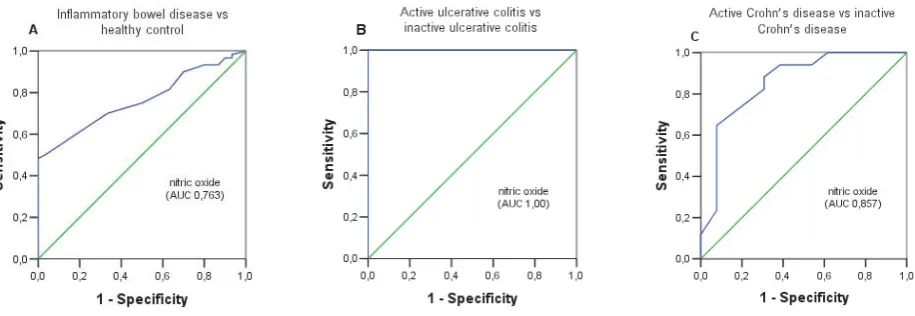
level of active UC patients (median . μmol/L; range . – . μmol/L) with inactive UC patients (median . μmol/L; range . – . μmol/L) showed a sig-nificant difference (p=.). A significant difference in serum NO level was also found when active CD patients (median . μmol/L; range . – . μmol/L) were compared with the group of inactive CD patients (me-dian . μmol/L; range . – . μmol/L) (p=.). The ROC curves for serum NO level in the patients with IBD vs healthy controls, active UC patients vs inactive UC patients and active CD patients vs inactive CD are shown in Figure . Serum NO level was the most accurate for dif-ferentiating patients with active UC from patients with inactive UC (AUC .). For differentiation between pa-tients with active and inactive CD or differentiation be-tween IBD patients and healthy controls serum NO level also had a good diagnostic accuracy (AUC . and .). Based on the proposed cut-off values, the
sensitiv-ity and specificsensitiv-ity of the serum NO concentration were calculated. Table . shows the predictive power of se-rum NO level in distinguishing patients with IBD and healthy controls, active UC patients from inactive UC pa-tients and active CD papa-tients from inactive CD papa-tients.
DISCUSSION
Th e immunology of IBD continues to be an intense area of investigations for clues to the pathogenesis of ulcerative coli-tis and Crohn’s disease. Typical for complex diseases, IBD research is continuously evolving. Without abandoning tra-ditional areas of study, such as cellular and humoral immu-nity and cytokines, examination is broadening to explore new molecules and biologic phenomena []. Infl ammatory me-diators, cytokines, free radicals, as well as mucosal immune system provide a basis not only for the understanding of in-FIGURE 1. Box-and-whisker plots of serum NO levels (μmol/L) in the fi ve studied groups. The solid horizontal lines denote the median value, the box represents the 25% and 75% interquartile ranges and the whiskers represent minimum and maximum val-ues.
N = normal, healthy control; iCD = inactive Crohn’s disease; aCD = active Crohn’s disease; iUC = inactive ulcerative colitis; aUC = active ulcerative colitis.
Optimal Cut-off
AUC
(95% CI) Sensitivity (%)
Specifi city (%)
Positive predictive value (%)
Negative predictive value (%)
IBD vs healthy control
Nitric oxide (≥13,65μmol/L) 0,763
(0,667-0,858) 70% 66% 80% 52%
Active UC vs inactive UC
Nitric oxide (≥17,39μmol/L) 1,00
(1,00-1,00) 100% 100% 100% 100%
Active CD vs inactive CD
Nitric oxide (≥14,01μmol/L) 0,857
(0,714-1,001) 88% 69% 78% 82%
Bosn J Basic Med Sci 2013; 13 (1): 8-9 flammatory processes but also for examining themecha-nisms that cause the reduction of inflammation and provide adequate diagnostic and therapeutic approach. It is now widely held that oxidants, including free radicals, such as nitric oxide, play a key role in the pathophysiology of tissue injury in IBD, particularly in the initiation and perpetuation of infl ammation and in the subsequent tissue damage [, ]. Th e aim of this study was to investigate changes in serum NO concentration and the possibility of its use as potential serum biomarker in disease activity assessment and in dif-ferential diagnosis of ulcerative colitis and Crohn’s disease. The reasons why we examined serum NO concentration as a potential laboratory marker in IBD was: fi rstly, to gain an objective measurement of disease activity as symptoms are often subjective; and secondly, to avoid invasive (endo-scopic) procedures which are often a burden to the patient. Th e results of our study showed that the serum NO level was
signifi cantly higher in IBD patients compared to the control group (p=.). Although the serum NO concentration was higher in UC patients compared to CD patients, there was no statistically signifi cant diff erence between the compared groups (p=.). Our results are in the accordance with the results of Oudkerk et al. [] who also found no statistically signifi cant diff erence in the median serum NO concentra-tion between patients with UC and CD patients. However, when we compared active UC patients with inactive UC patients we found a statistically signifi cant diff erence in se-rum NO level (p=.). Comparing active CD patients with inactive CD patients we also found a signifi cant diff er-ence in serum NO concentration (p=.). Our results confi rm fi ndings from previous studies such as the study by Oudkerk et al. [] who also observed signifi cant higher se-rum NO level in UC and CD patients in active phase of the disease compared to inactive phase. Numerous experimen-tal studies have shown raised NO concentrations in active
phase of disease not only in serum but also in stool [], urine [] and in the lumen of the rectum [] in patients with IBD. Levine et al. [] conducted a study which dem-onstrated that IBD patients with active colitis have in-creased stool and plasma NO concentration compared to IBD patients with normal colonic histology and those with mild, nonspecifi c colonic infl ammation. Goggins et al. [] demonstrated that urinary nitrite concentration, a stable end product of NO in patients with active IBD were signifi -canty diff erent from levels in inactive IBD patients. Th ese au-thors suggest that measurement of urinary nitrite may serve as a useful marker for monitoring disease activity in IBD. Based on the significant difference in serum NO level be-tween active IBD and inactive IBD patients, an attempt was made to diff erentiate active and inactive IBD patients. For clinical decision making, the selected cut-off value of a labo-ratory test should provide the best diagnostic performance for either ruling out or ruling in the particular disease. Th e ROC curve analysis is a graphic method which can be used to determine this optimal cut-off level. In addition, it is a pre-cise and valid measure of diagnostic accuracy []. In this study, based on the selected optimal cut-off value by ROC curve analysis, serum NO level showed a high specificity () and high sensitivity () in distinguishing pa-tients with active UC from inactive UC papa-tients; moder-ate specificity () and a good sensitivity () in distin-guishing patients with active CD from inactive CD patients. We further tested whether serum NO level, as a serological
Bosn J Basic Med Sci 2013; 13 (1): 9-9
tivation of iNOS in these patients. Earlier study by Middel-ton et al. [] has shown a marked increase in NO synthase activity only in the infl amed colonic mucosa of patients with ulcerative colitis. Th e cellular source of iNOS isoform in the infl amed mucosa may be product of resident or infi ltrating leucocytes (neutrophils or macrophages) or mucosal vas-cular smooth muscle or endothelium. Induction of iNOS in these cells may occur due to stimulatory cytokines (TNF and IL-), the mucosal levels of which are increased in ul-cerative colitis []. In contrast to ulul-cerative colitis, there was no increase in NO synthase activity detected in the in-fl amed colonic mucosa from patients with Crohn's disease, suggesting that there is no induction of NO synthase in the colon in this infl ammatory bowel disease []. Th e failure to detect induction of NO synthase in the infl amed tissue of Crohn's disease patients may refl ect a defi ciency in the duction process or could be due to mucosal formation of in-hibitory cytokines such as IL- or IL-, which can prevent NO synthase induction. Th e balance of stimulatory versus inhibitory cytokines could determine the expression of NO synthase in both ulcerative colitis and Crohn's disease.
CONCLUSION
Significant serum NO concentration increment during the active phase of disease and decrease during the inac-tive phase conveys possible use of serum NO level for monitoring disease activity in both types of IBD. Due to an absence of significant differences in serum NO concen-tration among patients with UC and CD, serum NO can not be recommended for IBD differential diagnosis use.
DECLARATION OF INTEREST
The authors state that there is no conflict of interest.
REFERENCES
[] Calcerrada P, Peluff o G, Radi R. Nitric oxide-derived oxidants with a focus on peroxynitrite molecular targets, cellular responses and therapeutic implications. Curr Pharm Des ; ():-. [] Lundberg JO, Weitzberg E, Gladwin MT. Th e nitrate-nitrite-nitric
oxide pathway in physiology and therapeutics. Nature Reviews Drug Discovery ; ():–.
[] Kolios G, Valatas V, Ward SG. Nitric oxide in infl ammatory bowel disease: a universal messenger in an unsolved puzzle, Immunology ; : –.
[] Palatka K, Serfozo Z, Veréb Z, Hargitay Z, Lontay B, Erdodi F, Bán-falvi G, Nemes Z, Udvardy M, Altorjay I. Changes in the expression and distribution of the inducible and endothelial nitric oxide
syn-thase in mucosal biopsy specimens of infl ammatory bowel disease. Scand J Gastroenterol ; ():-.
[] Friedman S, Blumberg RS. Infl ammatory bowel disease. In: Longo DL, Fauci AS, Kasper DL, Hauser SL, Jameson JL, Loscalzo J (eds). Harrison’s principles of internal medicine, th ed. New York, NY: McGraw-Hill; , Chapter .
[] Reynolds PD, Middleton SJ, Hansford GM, Hunter JO. Confi rma-tion of nitric oxide synthesis in active ulcerative colitis by infra-red diode laser spectroscopy. Eur J Gastroenterol Hepatol ; :-.
[] Ljung T, Lundberg S, Varsanyi M, Johansson C, Schmidt PT, Her-ulf M, Lundberg JO, Hellstrom PM. Rectal nitric oxide as biomark-er in treatment of infl ammatory bowel disease: Respondbiomark-ers vbiomark-ersus nonresponders. World J Gastroenterol ; (): -. [] Boughton-Smith NK, Evans SM, Hawkey CJ, Cole AT, Balsitis M,
Whittle BJ, Moncada S. Nitric oxide synthase activity in ulcerative colitis and Crohn's disease. Lancet ; :-.
[] Kimura H, Miura S, Shigematsu T, Ohkubo N, Tsuzuki Y, Kurose I, Higuchi H, Akiba Y, Hokari R, Hirokawa M, Serizawa H, Ishii H. Increased nitric oxide production and inducible nitric oxide syn-thase activity in colonic mucosa patients with active ulcerative coli-tis and Crohn's disease. Dig Dis Sci ; ():-. [] Roediger WE, Lawson MJ, Nance SH, Radcliff e BC. Detectable
co-lonic nitrite levels in infl ammatory bowel disease mucosal or bacte-rial malfunction? Digestion ; :-.
[] Middleton SJ, Shorthouse M, Hunter JO. Increased nitric oxide synthesis in ulcerative colitis. Lancet ; :-.
[] Seo M, Okada M, Yao T, Ueki M, Arima S, Okumura M. An index of disease activity in patients with ulcerative colitis. Am J Gastroen-terol ; (): -.
[] van Hees PA, van Elteren PH, van Lier HJ, van Tongeren JH. An in-dex of infl ammatory activity in patients with Crohn's disease. Gut ; :-.
[] Ibragic S, Sofi c E, Suljic E, Avdagic N, Bajraktarevic A, Tahirovic I. Serum nitric oxide concentrations in patients with multiple sclero-sis and patients with epilepsy. J Neural Transm ; ():-. [] Sox HC, Blatt MA, Higgins MC, Marton KI. Medical Decision
Making, Butterworth: London. ; pp. -.
[] Keshavarzian A, Banan A, Farhadi A, Komanduri S, Mutlu E, Zhang Y, Fields JZ. Increases in free radicals and cytoskeletal pro-tein oxidation and nitration in the colon of patients with infl amma-tory bowel disease. Gut ; :-
[] Oudkerk Pool M, Bouma G, Visser JJ, Kolkman JJ, Tran DD, Meu-wissen SG, Peña AS. Serum nitrate levels in ulcerative colitis and Crohn's disease. Scand J Gastroenterol ; ():-.
[] Levine JJ, Pettei MJ, Valderrama E, Gold DM, Kessler BH, Tracht-man H. Nitric oxide and infl ammatory bowel disease: evidence for local intestinal production in children with active colonic disease. J Pediatric Gastroenterol Nutr ; ():-.
[] Goggins MG, Shah SA, Goh J, Cherukuri A, Weir DG, Kelleher D, Mahmud N. Increased urinary nitrite, a marker of nitric oxide in active infl amatory bowel disease. Mediators of infl amation ; :-.
[] Herulf M, Ljung T, Hellström PM, Weitzberg E, Lundberg JO. Increased luminal nitric oxide in infl ammatory bowel disease as shown with a novel minimally invasive method. Scan J Gastroen-terol ; ():-.
[] Swets JA. Measuring the accuracy of diagnostic system. Science ; : -.
[] Middleton SJ, Shorthouse M, Hunter JO. Increased nitric oxide synthesis in ulcerative colitis. Lancet ; :-.