INTRODUCTION
Successful treatment of Helicobacter pylori (H. pylori) gen-erally requires the use of several antibacterial agents simulta-neously. With the exception of a limited number of studies, increasing clarithromycin resistance causes the decline in eff ectiveness of the legacy triple therapy (i.e., a proton pump inhibitor [PPI], clarithromycin and amoxicillin) and intention to treat (ITT) eradication rates have been reported lower than 80 (grade F) in several studies [1].
Th e impact of resistance can be minimized by addition of a second, third or even the fourth drug for killing the few remaining organisms or administrating drugs in diff erent time intervals leading to a high cure rate. With the decrease in the
success of standard triple treatment, new treatment protocols have been developed. Sequential therapy (ST) (amoxicillin 1 g plus a PPI b.i.d. for 5 days, then clarithromycin 500 mg and tinidazole or metronidazole 500 mg b.i.d plus a PPI b.i.d for remaining 5 days) has been developed a decade ago as one of the promising therapeutic approach to solve this problem [2] and has been shown to be superior to legacy triple therapy even if there has been clarithromycin resistance [1]. However, up to now, reported cure rates of the original ST did not exceed above Grade B (90-95) in ITT analysis. Moreover, recent studies from diff erent countries have reported disap-pointing results with ST [3-6]. It is of interest whether addi-tional changes in ST may cause further improvement in erad-ication rates or not.
Bismuth is cytoprotective and antibacterial agent which has been safely used for three centuries. Th e addition of bis-muth compounds to diff erent antibiotic combinations have been reported to provide a favorable eff ect on eradication rates [7-9]. Th ere is no data on eradication rates with original ST plus bismuth in the literature.
*Corresponding author: Sebahat Basyigit,
Department of Gastroenterology, Kecioren Research and Training Hospital, Ankara 06380, Turkey. Phone: +90-505-6728160, Fax:+90-312-3569003. E-mail: [email protected]
Submitted: 16 June 2015 / Accepted: 15 July 2015
Th
e impact of bismuth addition to sequential treatment
on
Helicobacter pylori
eradication: A pilot study
Sebahat Basyigit1*, Ayse Kefeli1, Ferdane Pirincci Sapmaz1, Abdullah Ozgür Yeniova1, Zeliha Asilturk2,
Murat Hokkaömeroğlu2, Metin Uzman1, Yasar Nazligul1
1Department of Gastroenterology, Kecioren Research and Training Hospital, Ankara, Turkey, 2Department of Internal Medicine, Kecioren
Research and Training Hospital, Ankara, Turkey
ABSTRACT
Th e success of the current anti-Helicobacter pylori (H. pylori) treatment protocols is reported to decrease by years, and research is needed to strengthen the H. pylori eradication treatment. Sequential treatment (ST), one of the treatment modalities for H. pylori eradication, includes amoxicillin 1 gr b.i.d and proton pump inhibitor b.i.d. for fi rst 5 days and then includes clarithromycin 500 mg b.i.d. metronidazole 500 mg b.i.d. and a proton pump inhibitor b.i.d. for remaining 5 days. In this study, we investigated effi cacy and tolerability of bismuth addition in to ST. We included patients that underwent upper gastrointestinal endoscopy in which H. pylori infection was diagnosed by histological examination of antral and corporal gastric mucosa biopsy. Participants were randomly administered ST or bismuth containing ST (BST) protocols for the fi rst-line H. pylori eradication therapy. Participants have been tested by urea breath test for eradication success 6 weeks after the completion of treatment. One hundred and fi fty patients (93 female, 57 male) were enrolled. Th ere were no signifi cant diff erences in eradication rates for both intention to treat population (70.2, 95 confi dence interval [CI]: 66.3-74.1 vs. 71.8, 95 CI: 61.8-81.7, for ST and BST, respectively, p > 0.05) and per protocol population (74.6, 95 CI: 63.2-85.8 vs. 73.7, 95 CI: 63.9-83.5 for ST and BST, respectively, p > 0.05). Despite the undeniable eff ect of bismuth, there may be several possible reasons of unsatisfactory eradication success. Drug administration time, co-administration of other drugs, possible H. pylori resistance to bismuth may aff ect the eradication success. Th e addition of bismuth subcitrate to ST regimen does not provide signifi cant increase in eradication rates.
KEY WORDS: Amoxicillin; metronidazole; clarithromycin; antibiotic resistance; Helicobacter pylori
We aimed to compare eradication rates of ST with and without bismuth as a fi rst-line therapy.
MATERIALS AND METHODS
Subjects
Th is prospective, single-center study that was performed at the Gastroenterology Department of Kecioren Education and Research Hospital in Turkey in 2013. Th is trial was approved by Institutional Review Board.
Between February 2013 and July 2013, patients with dys-pepsia were considered eligible for the study if they under-went upper gastrointestinal endoscopy, and H. pylori infection was diagnosed through histologic examination (Giemsa stain) of antral and body biopsy samples diagnosed histopatholog-ically documented H. pylori infection. Patients were consid-ered infected by H. pylori if resulted positive. Exclusion criteria included (1) previous attempt of H. pylori eradication therapy; (2) recent use of antibiotic or bismuth salts or proton-pump inhibitors in the last 2 months before the study, (3) chronic use of nonsteroidal anti-infl ammatory drugs or corticosteroids, (4) severe comorbid diseases, (5) gastric malignancy including adenocarcinoma and lymphoma; (6) pregnancy or lactation, (7) diarrhea, (8) prior gastric surgery, and (9) allergy to any of the drugs in the current treatment; (10) age under 18 years. Informed consent was obtained from each patient before enrolling into the study.
Th e patients were randomly divided into two groups. While ST group were given rabeprazole 20 mg (b.i.d, 30 min-utes before meals) and amoxicillin 1000 mg (b.i.d, an hour after meals) for the fi rst 5 days of the treatment period and then rabeprazole 20 mg (b.i.d, 30 minutes before meals) clarithro-mycin 500 mg (b.i.d, an hour after meals) and metronidazole 500 mg (b.i.d, an hour after meals) in the remaining 5 days, bismuth plus ST (B+ST) group were given colloidal bismuth subcitrate 300 mg (equivalent to Bi2O3 120 mg; two swallowed tablets, an hour before breakfast and dinner) for 10 days with the original ST. All patients continued rabeprazole 20 mg daily during the subsequent 30 days.
Th e detailed written treatment protocol was given to all patients to prevent misusage medications. Compliance was defi ned as being taken prescribed drugs more than 90. Th ey were actively interviewed about side eff ects and compliance using a structured questionnaire 1-week after the end of the treatment.
Th e primary endpoint of this study was to evaluate the eradication rate of 10 days bismuth containing ST (BST) ther-apy. Eradication rate was measured by urea breath test (UBT) at least 6 weeks after the end of the treatment. Th e C14-UBT was used for this purpose. Patients were informed about not using PPI, H2 receptor blocker, antibiotic and analgesic
within 1-week before to UBT in order to avoid false negativity. After an overnight fasting, 37 kBq (1 mCi) of C14 urea/citric acid composition (Helicap, Noster System AB, Stockholm, Sweden) with 250 mL of water was given to patients orally. Breath samples were collected with a dry cartridge system (Heliprobe Breath Card, Noster System AB). A small desktop Geiger–Muller counter (Heliprobe analyzer, Noster System AB) was used for the analysis. Results were given both as counts per minute (CPM) and as grade (0: Not infected, CPM < 25; 1: Equivocal, CPM 25-50; 2: Infected, CPM > 50), as sug-gested by the manufacturer. Patients who remained positive for H. pylori after the initial treatment as determined by the C14 UBT were retreated with another rescue regimen.
Statistical analysis
Both “per protocol” (PP) (excluded patients with poor compliance of therapy and patients with unavailable data after therapy) and “ITT” (included all eligible patients enrolled into the study regardless of compliance with the study pro-tocol; patients with unavailable data are assumed to have been unsuccessfully treated) analyses were used to evaluate H. pylori eradication rate. Data analysis was performed using Statistical Software Package Program (SPSS) version 16.0 (IBM, USA). Intergroup comparisons of categorical variables were done using Chi-square test and continuous variables were compared using Student’s t-test. Categorical variables were presented as percentages or counts and continuous variables were presented as mean and standard deviation in descriptive analysis. Results were evaluated at 95 of confi -dence interval (CI), and signifi cance was evaluated for each parameter at p < 0.05.
RESULTS
Treatment groups
A total of 150 patients were included in the ITT popu-lation (ST group, n = 75; B+ST group, n = 75). Table 1 shows baseline characteristics of the two ITT populations. Groups did not diff er with regard to demographical and clinical char-acteristics. Five patients were noncompliant to treatment pro-tocol because of side eff ects. Th us, PP population consisted of 145 patients: Sequential therapy group, n = 73; bismuth plus ST group, n = 72. Major side eff ects were vomiting (n = 3) and abdominal pain (n = 2) (Table 2). Because of small case count per cells, statistical analysis could not be made in relation to side eff ects between groups.
Treatment success
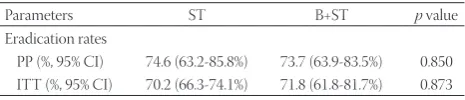
regard to H. pylori eradication rate for both ITT population (70.2, 95 of CI: 66.3-74.1 vs. 71.8, 95 of CI: 61.8-81.7, for ST and B+ST, respectively, p > 0.05) and PP population (74.6, 95 of CI: 63.2-85.8 vs. 73.7, 95 of CI: 63.9-83.5 for ST and B+ST, respectively, p > 0.05).
DISCUSSION
Th e result of our study indicated that the success of H. pylori eradication by using ST regimen with or without bis-muth was not satisfactory in our region. In addition, it showed that addition of bismuth subcitrate to the ST regimen did not provide a signifi cant increase in eradication rates.
Th e major factor aff ecting the success rate of H. pylori eradication therapy is resistance to antibiotics. Resistance rate for clarithromycin has been reported as 8-30 and for metronidazole as 15-66 in the world [10]. Amoxicillin resis-tance has been reported as under 1. Since the presence of dual resistance theoretically removes both clarithromycin and metronidazole leaving only the PPI + amoxicillin dual regimen. Fourteen-day dual therapy with standard dose PPI provides approximately 50 of treatment success and approx-imately one-half that at 7 days [11]. Th erefore, ST is likely to be
an unacceptable choice in regions where both clarithromycin and metronidazole resistance are common. Recently, in our region, metronidazole resistance was reported to be more than 40 and clarithromycin resistance was reported to be more than 30 [12-14]. So that ST is also not suitable treat-ment protocol for our region. Previous studies from our coun-try are in accordance with our results [15-16].
Th ere is growing data about useful eff ects of bismuth com-pounds in H. pylori eradication treatment. Bismuth containing quadruple treatment has been showed to provide better erad-ication rates comparing to standard triple treatment [9], and it has been recommended as a fi rst-line treatment in regions which have high clarithromycin rates [17]. However, it is unclear whether the addition of bismuth to all protocols in any way increases the eradication rate invariably or not. Th ere is some unconvincing data in the literature. One of these studies from our country which is conducted by Ergül et al., have reported high eradication rates (90.7) with the addition of bismuth to the standard triple regimen. However, they had not compared the same regimen without bismuth simultaneously [8]. Th ey have compared their results with previously reported data and showed a spectacular increase (nearly 30) in eradication rates. If these results were applicable generally, the eradication prob-lem would have been solved by the addition of bismuth with-out the need for various antibiotic combinations. In addition, it has been known that success of H. pylori eradication varies according to race, region, virulence and impact of bacteria [18]. All these factors aff ect the homogeneity of the results. In another study from Turkey, Songür et al. [19] have showed no signifi cant diff erences in eradication rates between protocols which include lansoprazole, tetracycline, and metronidazole with or without bismuth.
Besides the PPI-based treatments which contain PPI, amoxicillin, clarithromycin and bismuth, ranitidine bismuth based treatments which contain ranitidine bismuth, amoxicil-lin, and clarithromycin have been also reported not to provide suffi cient success [20,21].
In our study, we did not found a signifi cant diff erence in eradication rates between the protocols with and without bismuth. Despite the undeniable eff ect of bismuth, there may be several possible reasons of unsatisfactory eradication suc-cess. Administration time of drugs is a very important factor, which infl uence the eff ectiveness. Bismuth has been reported to facilitate the passage of the antibiotic into the microorgan-ism. Coadministration of bismuth compounds with antibiot-ics has been demonstrated to reduce antibiotic resistance or increase the eradication rates of antibiotic resistant strains [22]. In an in vitro study, bismuth has been found to act as syn-ergistic eff ect with metronidazole and clarithromycin against antibiotic resistant H. pylori strains in agar dilution or E-test methodology using time-kill method [23]. A simple addition
TABLE 1. Baseline characteristics of the treatment groups
(ıntention to treat population)
Parameters ST B+ST p value Number of patient 75 75
Mean age (years) 44.8±12.7 40.8±11.9 0.075 Sex (n, %)
Female 45 (60) 48 (64) 0.453 Male 30 (40) 27 (36)
Endoscopic fi ndings (n, %)
NUD 69 (92) 67 (89.3) 0.420
GU 0 3 (4)
DU 6 (8) 5 (6.7) 0.632
Data are presented as number (%) and mean±SD. ST: Sequential treatment; B+ST: Bismuth plus sequential treatment; NUD: Non-ulcer dyspepsia; GU: Gastric ulcer; DU: Duodenal ulcer
TABLE 2. Frequency of adverse eff ects in both treatment groups
Parameters ST (%) B+ST (%) Vomiting 2 (2.6) 1 (1.3) Abdominal pain 1 (1.3) 1 (1.3)
Data are presented as number (%). ST: Sequential treatment; B+ST: Bismuth plus sequential treatment
TABLE 3. Treatment success of the two treatments
Parameters ST B+ST p value Eradication rates
PP (%, 95% CI) 74.6 (63.2-85.8%) 73.7 (63.9-83.5%) 0.850 ITT (%, 95% CI) 70.2 (66.3-74.1%) 71.8 (61.8-81.7%) 0.873
Data are presented as number (%). ST: Sequential treatment;
of bismuth compound to an antibiotic has been suggested not to overcome the established antibiotic resistance [24,25]. However in the most applications, using of bismuth has been recommended before meal because of it acts at low pH and using of antibiotics have been recommended after meal because of their dyspeptic side eff ects. We also recommended our patients to use bismuth before meal. Since coadminis-tration is more eff ective than simple addition, we may fail to demonstrate the real eff ect of bismuth.
Bismuth salts are compounds that act topically. Less than 1 of the oral dose of commonly used bismuth compounds is absorbed. Its eff ect is pH dependent. In acidic pH, it is insolu-ble and forms complex polymers [26]. In this form, it is cyto-protective, it accumulates in ulcer crater and heal ulcer by pre-venting acid infl ux. It has also antibacterial eff ect by inhibiting of various enzymes produced by H. pylori - including urease, catalase, and lipase/phospholipase-; adhesion of H. pylori to surface epithelial cells; ATP synthesis; cell wall synthesis and membrane function [27,28]. For these eff ects bismuth must be taken by bacteria. It has been shown that bismuth enter into the H. pylori cell, but the mechanism of the entrance is unclear [28,29]. It has been suggested that bismuth may enter into the microorganism by diff usion or ion channel transport system [30]. In polymerized form, bismuth may not enter the microorganism and administration of bismuth in fasting con-dition may result in cytoprotective eff ect but not antibacterial eff ect. Th is practice may aff ect the bioavailability of the drug. In a study performed by Ciccaglione et al., bismuth had been administrated nearly after the meal time and they have shown 15 of favorable eff ect with addition of bismuth comparing to the same regimen without bismuth [7].
Bismuth has been suggested to damage the H. pylori in dif-ferent ways such as destroying glycocalyx wall [28], DNA dam-age, competitive inhibition of bacterial enzymes. Although it has been suggested that H. pylori did not develop resistance against bismuth, compensatory changes have been reported in the microorganism after administration of bismuth. Nap A - a 150 kDa DNA-binding protein that protects cells from DNA damage - is found to be upregulated after administra-tion of bismuth in vitro [31]. Although it has been suggested that bacteria can not gain resistance against destruction of glycocalyx wall, development of microbial resistance has been described in vitro for mutated microorganism which dimin-ished production of glycocalyx [32]. Bismuth is from heavy metal class. It has been reported that bacteria could develop resistance to metals or show long-term adaptation [33].
H. pylori has also various virulence factors to cope with the human systemic and local defense mechanisms, such fi ghting mechanisms of the bacteria may act in bismuth treatment. H. pylori response against to eff ects of bismuth is still unclear and likely to be the subject of further studies. However, over
the time bismuth-based quadruple therapy has been showed to fail showing improvement in eradication rates comparing to standard triple treatment [34].
Th e main limitation of the present study is the lack of any specifi c susceptibility testing for antibiotics. However, antibiotic susceptibility tests are not routinely performed in the fi rst-line eradication treatment of H. pylori regarding our study. Our primary outcome was to investigate whether there is a benefi cial eff ect of the addition of bismuth subcitrate to ST. Th is is the fi rst study which reported the eff ect of original ST with bismuth in H. pylori eradication. Further multicenter studies are needed with large sample size and without our limitations.
In conclusion, in areas with a high prevalence of met-ronidazole and clarithromycin resistance, the current for-mulation of ST is likely to provide grade F results. Although the published studies with ST conclusively and repeatedly demonstrated its superiority to legacy triple therapy and our results (74.6) are better than known eradication rates with triple therapy in our country (<60). It is not a suitable choice to consistently achieve grade A results. Moreover, the addi-tion of bismuth subcitrate did not provide a benefi cial eff ect. Diversity in terms of drug administration or bacterial defense mechanism may have a role in this result.
DECLARTION OF INTERESTS
Th e authors declare no confl ict of interest.
REFERENCES
[1] Graham DY, Lu H, Yamaoka Y. Th erapy for Helicobacter pylori infection can be improved: Sequential ther-apy and beyond. Drugs 2008; 68(6):725-36. http://dx.doi. org/10.2165/00003495-200868060-00001.
[2] Zullo A, Vaira D, Vakil N, Hassan C, Gatta L, Ricci C, et al. High eradication rates of Helicobacter pylori with a new sequential treat-ment. Aliment Pharmacol Th er 2003; 17(5):719-26. http://dx.doi. org/10.1046/j.1365-2036.2003.01461.x.
[3] Greenberg ER, Anderson GL, Morgan DR, Torres J, Chey WD, Bravo LE, et al. 14-day triple, 5-day concomitant, and 10-day sequential therapies for Helicobacter pylori infection in seven Latin American sites: A randomised trial. Lancet 2011; 378(9790):507-14. http://dx.doi.org/10.1016/S0140-6736(11)60825-8.
[4] Chung JW, Jung YK, Kim YJ, Kwon KA, Kim JH, Lee JJ, et al.
Ten-day sequential versus triple therapy for Helicobacter pylori
eradication: A prospective, open-label, randomized trial. J Gastroenterol Hepatol 2012; 27(11):1675-80. http://dx.doi. org/10.1111/j.1440-1746.2012.07249.x.
[5] Kim JS, Kim BW, Ham JH, Park HW, Kim YK, Lee MY, et al.
Sequential Th erapy for Helicobacter pylori Infection in Korea: Systematic review and meta-analysis. Gut Liver 2013; 7(5):546-51. http://dx.doi.org/10.5009/gnl.2013.7.5.546.
[7] Ciccaglione AF, Cellini L, Grossi L, Marzio L. Quadruple ther-apy with moxifl oxacin and bismuth for fi rst-line treatment of
Helicobacter pylori. World J Gastroenterol 2012; 18:4386-90. http:// dx.doi.org/10.3748/wjg.v18.i32.4386.
[8] Ergül B, Dogan Z, Sarikaya M, Filik L. Th e effi cacy of two-week quadruple fi rst-line therapy with bismuth, lansoprazole, amoxicil-lin, clarithromycin on Helicobacter pylori eradication: A prospec-tive study. Helicobacter 2013; 18(6):454-8. http://dx.doi.org/10.1111/ hel.12086.
[9] Xu MH, Zhang GY, Li CJ. Effi cacy of bismuth-based quadruple therapy as fi rst-line treatment for Helicobacter pylori infection. Zhejiang Da Xue Xue Bao Yi Xue Ban 2011; 40:327-31.
[10] McLoughlin R, Racz I, Buckley M, O’Connor HJ, O’Morain C. Th erapy of Helicobacter pylori. Helicobacter 2004; 9 Suppl 1:42-8. http://dx.doi.org/10.1111/j.1083-4389.2004.00251.x.
[11] Tanimura H, Kawano S, Kubo M, Abe T, Goto M, Tanabe J, et al. Does Helicobacter pylori eradication depend on the period of amoxicillin treatment? A retrospective study. J Gastroenterol 1998; 33(1):23-6. http://dx.doi.org/10.1007/PL00009962.
[12] Bakir OS, Ozakin C, Keskin M. Antibiotic resistance rates of
Helicobacter pylori isolates and the comparison of E-test and fl uo-rescent in situ hybridization methods for the detection of clarithro-mycin resistants trains. Mikrobiyol Bul 2009; 43(2):227-34. [13] Aygul K. Th e isolation of Helicobacter pylori from antral biopsy
specimens and antibiotic susceptibility. Turkey, Van YuzuncuYil University Pub; 2006.
[14] Cagdas U, Otag F, Tezcan S, Sezgin O, Aslan G, Emekdas G. Detection of Helicobacter pylori and antimicrobial resistance in gas-tric biopsy specimens. Mikrobiyol Bul 2012; 46(3):398-409. [15] Kadayifci A, Uygun A, Kilciler G, Kantarcioglu M, Kara M,
Ozcan A, et al. Low effi cacy of clarithromycin including sequen-tial regimens for Helicobacter pylori infection. Helicobacter 2012; 17(2):121-6. http://dx.doi.org/10.1111/j.1523-5378.2011.00924.x. [16] Dolapcioglu C, Koc-Yesiltoprak A, Ahishali E, Kural A,
Dolapcioglu H, Soylu A, et al. Sequential therapy versus standard triple therapy in Helicobacter pylori eradication in a high clarithro-mycin resistance setting. Int J Clin Exp Med 2014; 7(8):2324-8. [17] Malfertheiner P, Megraud F, O’Morain CA, Atherton J, Axon AT,
Bazzoli F, et al. Management of Helicobacter pylori infection – the maastricht IV/fl orence consensus report. Gut 2012; 61(5):646-64. http://dx.doi.org/10.1136/gutjnl-2012-302084.
[18] Onal IK, Gokcan H, Benzer E, Bilir G, Oztas E. What is the impact of Helicobacter pylori density on the success of eradication therapy: A clinico-histopathological study. Clin Res Hepatol Gastroenterol 2013; 37(6):642-6. http://dx.doi.org/10.1016/j.clinre.2013.05.005. [19] Songür Y, Senol A, Balkarli A, Bastürk A, Cerçi S. Triple or
quadru-ple tetracycline-based therapies versus standard triquadru-ple treatment for Helicobacter pylori treatment. Am J Med Sci 2009; 338(1):50-3. http://dx.doi.org/10.1097/MAJ.0b013e31819c7320.
[20] Köksal AS, Parlak E, Filik L, Yolcu OF, Odemis B, Ulker A, et al. Ranitidine bismuth citrate-based triple therapies as a sec-ond-line therapy for Helicobacter pylori in Turkish patients. J Gastroenterol Hepatol 2005; 20(4):637-42. http://dx.doi. org/10.1111/j.1440-1746.2005.03801.x.
[21] Avsar E, Tiftikçi A, Poturoglu S, Erzin Y, Kocakaya O, Dinçer D, et al. A multicenter, randomized, prospective study of 14-day ranitidine bismuth citrate- vs. lansoprazole-based triple therapy
for the eradication of Helicobacter pylori in dyspeptic patients. Turk J Gastroenterol 2013; 24(4):316-21. http://dx.doi.org/10.4318/ tjg.2013.0509
[22] Goodwin CS, Marshall BJ, Blincow ED, Wilson DH, Blackbourn S, Phillips M. Prevention of nitroimidazole resistance in Campylobacter pylori by coadministration of colloidal bismuth subcitrate: Clinical and in vitro studies. J Clin Pathol 1988; 41(2):207-10. http://dx.doi.org/41(2):207-10.1136/jcp.41.2.207.
[23] Cheng H, Jiang LI. Vitro activity of bismuth potassium citrate against clinical isolates of antibiotic-resistant Helicobacter pylori. Chin J Gastroenterol Hepatol 2008; 7:1-5.
[24] Chiba N, Rao BV, Rademaker JW, Hunt RH. Meta-analysis of the effi cacy of antibiotic therapy in eradicating Helicobacter pylori. Am J Gastroenterol 1992; 87(12):1716-27.
[25] Chiba N. Eff ects of in vitro antibiotic resistance on treatment: Bis-muth-containing regimens. Can J Gastroenterol 2000; 14(10):885-9. [26] Paradies HH. Bismuth — from the element to the tablet: Th e general
chemistry of bismuth with relevance to pharmacy and medicine. In:
Helicobacter Pylori, Gastritis and Peptic Ulcer. Berlin: Springer Berlin Heidelberg; 1990. http://dx.doi.org/10.1007/978-3-642-75315-2_60. [27] Keogan DM, Griffi th DM. Current and potential applications of
bismuth-based drugs. Molecules 2014; 19(9):15258-97. http://dx.doi. org/10.3390/molecules190915258.
[28] Stratton CW, Warner RR, Coudron PE, Lilly NA. Bismuth-mediated disruption of the glycocalyx-cell wall of Helicobacter pylori: Ultrastructural evidence for a mechanism of action for bis-muth salts. J Antimicrob Chemother 1999; 43(5):659-66. http://dx. doi.org/10.1093/jac/43.5.659.
[29] Stoltenberg M, Martiny M, Sørensen K, Rungby J, Krogfelt KA. Histochemical tracing of bismuth in Helicobacter pylori after in vitro
exposure to bismuth citrate. Scand J Gastroenterol 2001; 36(2):144-8. http://dx.doi.org/10.1080/003655201750065889
[30] Salvador JA, Figueiredo SA, Pinto RM, Silvestre SM. Bismuth com-pounds in medicinal chemistry. Future Med Chem 2012; 4(11):1495-523. http://dx.doi.org/10.4155/fmc.12.95.
[31] Ge R, Sun X, Gu Q, Watt RM, Tanner JA, Wong BC, et al. A pro-teomic approach for the identifi cation of bismuth-binding proteins in Helicobacter pylori. J Biol Inorg Chem 2007; 12(6):831-42. http:// dx.doi.org/10.1007/s00775-007-0237-7.
[32] Nicas TI, Hancock RE. Outer membrane protein H1 of Pseudomonas aeruginosa: Involvement in adaptive and mutational resistance to ethylenediaminetetraacetate, polymyxin B, and genta-micin. J Bacteriol 1980; 143(2):872-8.
[33] Silver S, Phung LT. Bacterial heavy metal resistance: New surprises. Annu Rev Microbiol 1996; 50(1):753-89. http://dx.doi.org/10.1146/ annurev.micro.50.1.753.
[34] Luther J, Higgins PD, Schoenfeld PS, Moayyedi P, Vakil N, Chey WD. Empiric quadruple vs. triple therapy for primary treatment of