DOI: 10.30954/2249-6637.06.2018.2
©2018 New Delhi Publishers. All rights reserved
Virtual Groups: An Effective Tool for Knowledge Sharing
and Dissemination
N. Shamna
1*and M. Jayasree Krishnankutty
21 Department of Agriculture Extension, College of Horticulture, Kerala Agricultural University (KAU), Kerala, India
2Department of Agrl. Extension, College of Horticulture, Kerala Agricultural University (KAU), Vellanikkara, Thrissur, Kerala, India
*Corresponding author: [email protected]
ABSTRACT
A virtual world is a computer-based online community environment that is designed and shared by individuals so that they can interact in a custom-built, simulated world (Bartle,2003). A group of people who share similar interests and exchange information and ideas via computer networks are called virtual group or online community (Rheingold, 1993). Mousavidin and Goel (2009) developed a conceptual model of virtual group life cycle. In this model, the life of a virtual community is influenced by four elements namely socially shaped aspects, individually demonstrated characteristics, technologically facilitated features and the external influence. Virtual group formats can be broadly classified into virtual groups through social media networks and virtual groups through other media like email, video conferencing, voice conferencing, bulletin board system, drop box, text chat and virtual groups. Most popular virtual groups are virtual groups of social media networks such as facebook, youtube and whatsapp groups. Alexander et al. (2003) reported that moral obligations, conducive environment and community interest were motivational factors for contributing knowledge to virtual communities and doubtful nature about accuracy and relevancy of information, fear of criticism and information hoarding were demotivating factors. Virtual groups allow people to bond without being in close proximity either spatially or temporally. It improves interpersonal relationships and facilitates crowd funding. People may use fake identities which often lead to inconsistency and discontinuance of communication. Moreover, authenticity of information in virtual groups also cannot be assured. Hence an appropriate policy to limit the freedoms of users has been the need of the hour.
Keywords: Virtual group, virtual world, virtual group formats, virtual group life cycle, motivating and demotivating factors for virtual group participation.
Computer networks allow people to create a range of new social spaces in which to meet and interact with
one another. Instead of people talking to machines, computer networks are being used to connect people to people (Wellman et al. 1996). In cyberspace the economies of interaction, communication, and coordination are different than when people meet face-to-face. These shifts make the creation of thousands of spaces to house conversations and exchanges between far-flung groups of people practical and convenient. Using network interaction media like email, chat, and conferencing systems like the Usenet, people have
formed thousands of groups to discuss a range of topics, play games, entertain one another, and even work on a range of complex collective projects. These are not only communication media, they are group media, sustaining and supporting many-to-many interactions (Licklider et al. 1978; Harasim 1993).
online interaction. How do the economies of social life shift, what becomes easier to do, what becomes more difficult and what are the aggregate consequences of these changes. The outcomes are not uniformly positive or negative. The new opportunities and constraints online interaction creates are doubled-edged, leading to results that can amplify both beneficial and noxious social processes (Smith and Kollock, 1999).
VIRTUAL WORLD
A virtual world is a computer-based online community environment that is designed and shared by individuals so that they can interact in a custom-built, simulated world (Bartle,2003).
VIRTUAL GROUP
A virtual group is a group of people who share similar
interests and exchange information and ideas via computer networks (Rheingold, 1993).A virtual group
can also be defined as a group of individuals who work together from different geographic locations and rely on communication technology services in order to collaborate (Powell et al., 2004) Virtual groups can also called as virtual environments, virtual publics or virtual community.
A virtual group may be a group of employees who work in different offices or people who work from their homes. As technological advances have made video conferencing, email, and other forms of communication possible, the virtual team has become more popular. Working virtually may also be referred to as working remotely, telecommuting, or in some situations, working from home.
Types of Virtual groups
Armstrong and Hagel (2000) described about the following four types of virtual groups:
Groups of Transaction facilitate the buying
and selling of goods and services and provide
information about these transactions. Participants
are encouraged to interact to make informed
purchase decisions.
Groups of Interest bring together participants who
interact extensively about specific topics of interest. Participants not only carry out transactions with one another, but their interactions are generally focused on a specific topic area.
Groups of Entertainment allow participants to
create new personalities, environments, or stories of fantasy. Here, individuals can take on the persona of an imaginative or factual being and act out roles like members of a spontaneous improvisational theatre.
Groups of Relationship is based on intense personal experiences and generally adhere to masking identities and anonymity. Examples include cancer survivors and rape victims. Here,
participants discuss the pain associated with these
experiences, talk about how to deal with personal issues, and exchange information about medical research and treatments.
Virtual groups are effective for work that is highly independent. For instance, writers, editors, and graphic designers often work remotely. They can effectively work on their projects at home or separate from the rest of the team. When the assignment is completed, they can get feedback and notes on what changes need to be made without having to physically be present.
Many sales organizations operate as virtual groups, especially when the representatives meet with clients on an on-going basis and those clients are not located near headquarters. For instance, a sales person who sells books to schools may cover a region that is several states away from the company’s headquarters. It is more cost-effective and provides greater customer service to have a sales person live in the region he or she covers. This allows the employee to meet with school administration on a regular basis, handle problems immediately, and find opportunities to provide more products to the schools in the area each year. Additionally, this person does not need to be in the company office to do their work. In fact, in such cases, work is more effectively completed outside of the office.
An increasingly popular form of virtual groups is
emerging as more people are starting their own small
marketing professionals, and website management are more easily accommodated as virtual teams. Each
person can work from the comfort of their own home
and be connected with company networks, digital phone systems, and online conference meetings. Rather
than walking down the hall to talk to someone in their
office, a quick phone call or email becomes the method of communication. There are companies that have gone completely remote, allowing all of the employees to work from remote locations and be connected through technological tools.
CONCEPTUAL MODEL OF VIRTUAL GROUP
LIFE CYCLE
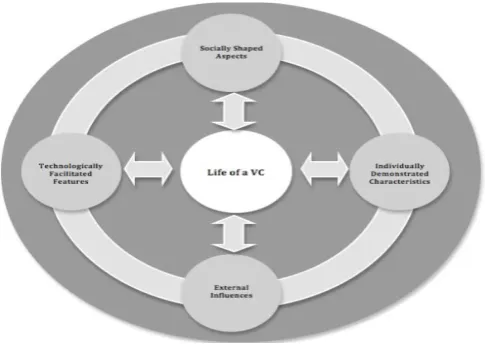
Fig. 1: Conceptual model of virtual group life cycle
Mousavidin and Goel (2009) presented a conceptual model that depicts the elements related to the life
of a virtual group. In this model, they defined the
life as active participation and further generation of
community-specific content by its members. As shown in this life cycle model, the life of a virtual group is influenced by four elements namely socially shaped aspects, individually demonstrated characteristics, technologically facilitated features, and the external media. However, this is a dynamic cycle. Hence, as the life of a virtual group changes, there are changes in socially shaped aspects such as the size of the group, its critical mass, scope and culture. As the life of a virtual group changes, individually demonstrated characteristics such as tangible and intangible returns and utility may change. For example, a group with high
participation could be more valuable and helpful to a member than a group with low participation. As the life of a virtual group changes, technologies may evolve to support the changing needs of the members. Finally, as the life of a virtual group changes, external factors such as the interest of media in the virtual group may change. This model has implications for research in virtual groups. While there is little attention paid to dead groups, i.e. groups that have low active participation,
this conceptual model proposes that such groups have
the potential to be revived based on these four elements.
FEATURES OF VIRTUAL INTERACTION
Virtual interaction is aspatial: the amount of physical distance that separates participants does not significantly limit the interaction.
Virtual interaction is asynchronous: participation
cannot be simultaneous, as is possible with face-to-face interactions.
Most virtual interaction is conducted using only textual symbols.
Limited bandwidths regulate the amount of information that can be practically exchanged in virtual interactions.
Participants in virtual interactions are often
anonymous or partially anonymous.
The Internet is a strategic research site in which to study fundamental social processes. It provides a level of access to the details of social life and a durability of the traces of social interaction that is unprecedented. The
new opportunities and constraints online interaction
creates are doubled-edged, leading to results that can amplify both beneficial and noxious social processes (Smith and Kollock, 1999).
FACTORS AFFECTING PRODUCTIVITY OF
VIRTUAL GROUPS
Clear communication: A clear and effective
communication is important factor for enhancing the
productivity of virtual communication. It’s important to remember that virtual teams do not share body language like on-ground group members. A clear
the team members get to know one another, putting faces with names.
Culture of trust: For remote employees, touching base on the progress of a project is not as easy as walking to another team member’s cubicle. The virtual team members need to know that they can rely on one another from a distance. The leader or admin can help team members build their levels of trust by encouraging them to answer emails on time, follow up on questions, and meet deadlines.
Use of active listening skills: By paying careful attention to each speaker as he or she speaks. This can be done by paraphrasing the team member’s thoughts, asking relevant questions and clarifying main points Productive collaboration: Itmeans each and every team member is working towards meeting the shared goals, which will improve the productivity of virtual groups. Cloud-based technology allows members to access and modify shared documents. Video conferencing allows teams to set up and attend virtual meetings. Smartphones are great for quick calls or text messages. Even instant messaging programs are fast and easy to use. But no team will productively collaborate unless there is a shared goal, mutual trust, and clear communication (Turkle, 1996).
VIRTUAL GROUP FORMATS
Virtual group formats can be broadly classified in to
two as vitual group in socila media networks such as
facebook, youtube, blogs, whatsapp etc. and virtual groups through mail discussion groups, bulletin board system, text chat, drop box video conferencing and audio conferencing.
Virtual groups in social media networks
Social media are computer-mediated technologies that facilitate the creation and sharing of information, ideas, career interests and other forms of expression via virtual communities and networks (obar et al. 2015). Social
media facilitate the development of online social
networks by connecting a user’s profile with those of other individuals or groups. The main feature of social
media is user-generated content which include text posts, comments, digital photos, videos or other data.
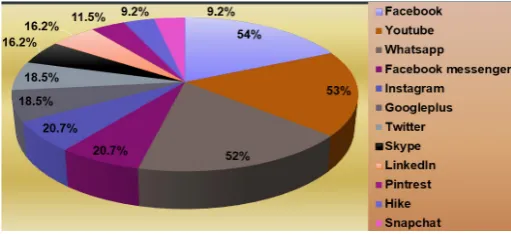
In India, average active usage penetration of social media network in india is 19%. Penetration is a measure of the
amount of adoption of a product or service compared to
the total theoretical market for that product or service. This is a figure (Fig. 2) showing share of active usage penetration rate of leading social networks in India
(Statista, 2017).
Fig. 2: Share of active usage penetration rate of leading social networks in India
Out of over 460 million internet users in India, 250 million people use facebook (Statista, 2017). Facebook is a most popular social media platform in India. India claimed to be in first place in facebook usage with 270
million users. Facebook is widely used as a tool to popularize the extension programs, exhibitions and seminars etc. It help in online marketing.. Many growers and processing units maintain and update facebook pages through which they get order which help in product promotion. Facebook also used for Information sharing having community interest. Facebook is highly useful for advisory services to tap knowledge from a wider pool of experience and expertise.
You Tube groups
in comment section thus generate deep interest among
the subscribers.
Blog
A blog is short for web log, an online journal organized by day of entry (Blood and Rebecca, 2000). As a favourite tool of many growers, a blog allows them to showcase, personal and seasonal nature of direct market farms. Research shows that customers value the relationship with the service providers, and the journal format helps cement this relationship. Some employ blogs as their only website, while others use blogs to drive traffic to their primary website. Like simple website programs, blog software is easy to use, maintain, and update. Entrepreneurs can create a blog and start posting entries within minutes where they can interact with customers via their comments on blog. Commitment is critical to blogging and needs updating in a timely manner. Otherwise, readers will think the blog is out of date and might stop reading it. The major free blog providers are: Blogger at http://www.blogger.com and Word Press at http://www.wordpress.com. Each of the above, offers pre-designed templates and the ability to create a blog with your own look and feel. To get started, visit Blogger or Word Press and follow the prompts to create an account and set up your blog page.
Whatsapp groups
Whatsapp groups are most popular and widespread mobile messenger app worldwide. Even small local farmer/ community groups formed for information exchange, knowledge update, buying and selling of products, consultation and for closer connectivities.
Institutions based virtual groups
Various state, national and international level agriculture based institutions have their own online groups in different social media platforms such as facebook, twitter etc. The major objectives behind forming such groups are to popularize the motto of such institutions. For example the motto of FAO (Food and Agriculture Organization) this year is working for zero hunger world, therefore throughout its social media pages of facebook and twitter, they popularize and promote this concept. Other
examples of agriculture related institutions maintaining social media pages are: IFAD (International Fund for Agricultural Development), CGIAR (Consultative Group for International Agricultural Research), ICRISAT (International Crop Research Institute for the Semi-Arid Tropics), NAARM (National Academy of Agricultural Research Management), various KVK`s(Krishi Vigyan Kendras) and Krishibhavans.
Virtual groups other than social media networks
Email and discussion lists
Email and discussion lists are the oldest and most popular form of interaction on the Internet.5 Email allows an individual to send a message directly to another person. However, email is often used to go beyond a one-to-one interaction. In an email discussion list a message sent
to a group address is then copied and sent to all the
email addresses on a list. When people direct a series of messages and responses to the list, a group discussion can develop. As of 1998, there are tens of millions of email users and thousands of public mailing lists as well
as hundreds of thousands of less formal discussion lists
in existence. These lists are maintained for the discussion and distribution of information on thousands of topics. This may be the most common form of group interaction on the Internet, and a number of lists contain thousands or tens of thousands of members.
Email discussion lists have some important qualities that
distinguish them from other Internet communication
lists operate as benign dictatorships sustained by the monopoly power that the list owner wields over the boundaries and content of their group. As a result, email lists are often distinguished by their relatively more ordered and focused activity (Powell et al. 2004).
Text chat
Text chat differs from email lists and BBSs in that it supports synchronous communication– a number of people can chat in real time by sending lines of text to one another. Chat is one of the most popular forms of interaction on the Internet, and accounts for a sizeable
proportion of the revenue of the commercial online
providers such as America Online. Text chat is often organized around the idea of channels on a text-based “Citizens’ Band (CB) radio” system. Most chat systems support a great number of “channels” dedicated to a vast array of subjects and interests. Text chat also uses
a centralized server that grants the server owner a great
deal of power over access to the system and to individual channels. In the commercial chat services, chat channels frequently are policed by the provider’s staff or by appointed volunteers. In the largest non-commercial system–Internet Relay Chat (IRC)–each channel has an owner who can eject people from the channel, control who enters the channel, and decide how many people can enter.
Bulletin Board System (BBS)
Bulletin board systems (BBSs–also known as conferencing systems) are another form of asynchronous communication that refine email discussion lists in a number of ways. Most BBSs allow participants to create topical groups in which a series of messages, similar to email messages, can be strung together one after another. There are a number of conferencing systems. Well-known ones include the Usenet, the WELL (picospan), ECHO (caucus). Bulletin board discussion groups run on the commercial online services. Each sustains a wide collection of topics of discussion and an on-going give-and-take between participants. BBSs differ from email discussion lists in another way. Email is a “push” media– messages are sent to people without them necessarily doing anything. In contrast, conferencing systems are
“pull” media–people must select groups and messages they want to read and actively request them (Smith and Kollock, 1992).
Dropbox
Dropbox is a personal cloud storage service (sometimes referred to as an online backup service) that is frequently
used for file sharing and collaboration. This software help to have access to all our documents, files, articles to all other members. Dropbox is mainly used for collaboration of members, for example, after a training session, members may be connected through dropbox and they will have access to the training report, articles and can give feedback etc.
Video conferencing
A video conference is a live, visual connection between
two or more people residing in separate locations for
the purpose of communication. At its simplest, video
conferencing provides transmission of static images and
text between two locations. At its most sophisticated, it provides transmission of full-motion video images and high-quality audio between multiple locations.
Audio conferencing
Audio conferencing is the conduct of an audio
conference (also called a conference call or audio teleconference) between two or more people in different
locations using a series of devices that allow sounds to
be sent and received, for the purpose of communication and collaboration simultaneously. An audio conference may involve only two parties, or many parties involved at the same time. Audio conferencing can be conducted either through telephone line or the Internet by using devices such as phones or computers. If one only wants to listen, he/she just needs speakers. If he/she decides to speak as well, he/she may need a microphone as well.
FRAME WORK FOR SUSTAINABILITY OF
ONLINE ASSOCIATIONS IN A VIRTUAL
GROUPS
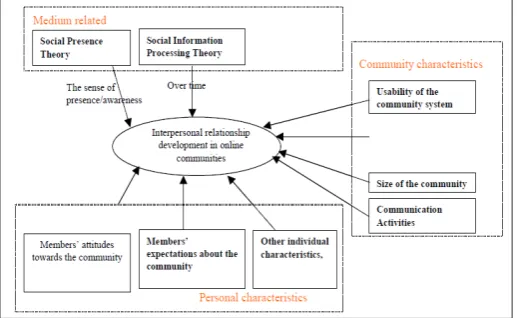
online community are not just seeking information; more importantly, they treat it as a place to meet other people, to seek help, support, friendship, love, etc. In another words, they are driven to develop social relationships with other people inside the community. Thus, it is very critical for an online community to help its members establish interpersonal relationships. The framework consist of three aspects; they are community related characteristics, medium related characteristics and personal characteristics, which are the major factors determining the sustainability of online associations in a virtual community.
Fig. 3: Frame work for sustainability of online associations in a virtual group
Media Aspects
Based on social presence theory (Short et al. 1976),
people communicating via computer mediated
communication (CMC) has less capability to convey the presence of communicating participants. They perceive less communication context and interpret less meaning from the conversation. Social Information Processing Theory (SIP) argues that the difference between the two media is rate. It states that social identity and relational cues can be transmitted by plain text, but this occurs
at a slower rate than would occur in a richer channel
such as voice, or face-to-face meeting. SIP predicts that over time computer mediation should have very limited effects on relational communication, as users process the social information exchanges via computer mediated communication.
Community related aspects
Community size and communication activities are undoubtedly factors that attract and retain members. For online communities, a community thrives only if there are sufficient people and enough activity to make it attractive. Usability of the community system, the volume and quality of information provided, and the timeliness of the community content are also factors that affect members’ engagement in the community. If there is not enough information, people will not be interested to join; if there is no updated information, there is no reason for members to come revisit; if there is too much information, it may cause individual information overload, which may also frighten members away.
Individual aspects
Individual factors such as willingness of anonymous, concerns of privacy and safety; shy about public posting, and limited time. Users’ skeptism towards the CMC environment and their expectation for the virtual interaction (Hiltz, 1984; Utz, 2000) will influence their relationship development online.
MOTIVATORS AND BARRIERS FOR
PARTICIPATION IN VIRTUAL COMMUNITIES
Alexander et al. (2003) conducted a qualitative study in a multinational company called Caterpillar Inc. In which they could sort out the motivators and barriers to employee participation in a virtual knowledge sharing community existed in that company. They examinedthe factors that lead to motivation and demotivation
for contributing information to that virtual community. They could find following motivating and demotivating factors (Table 1).
COMPARISON OF VIRTUAL COMMUNITIES
AND REAL COMMUNITIES
or forums can accommodate many more individuals than off-line meeting rooms can accommodate. Online communities have much stronger memories than off-line communities. Finally, people can explore new relationships or even new identities online; they are not constrained by their physical appearance or off-line identity.
Real communities are better than virtual communities in communicating affect, identifying participants and holding them accountable, and in providing group feedback. Several studies show the advantage of mixed person-machine systems over pure interpersonal or computer-mediated systems. In the future, such communities, whose members have close in-person relations and are connected virtually as well, may benefit from a high volume of asynchronous communication and strong memory (features of online communities) and also from the accountability and communication of affect allowed by off-line communities (Etzioni and Etzioni, 1997).
STUDIES RELATED TO USE OF VIRTUAL
GROUPS IN AGRICULTURE
Perception of agricultural extension personnel on the requirements for effective use of virtual groups
Kumari (2016) studied the perception of agricultural extension personnel about the basic requirements for using virtual groups. She did survey among agricultural officers and agricultural assistants of various krishibhavans of Kerala.
She found out that majority have perceived internet connectivity as first and foremost basic requirement
followed by knowledge on devices, English language proficiency and tech savvy.
English Internet Co h language pT Knowledge
onnectivity proficiencyTech savvy on devices
0 2
P
20 40
Percentage o
0 60
of responden
74.5 62 76
80 nts
91 5
100
Fig. 4: Perception about essential requirements for using virtual groups by extension personnel
Usage of virtual groups among tribal farmers of Meghalaya
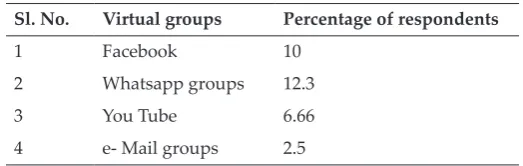
A study was conducted by Syiem and Raj (2015) to find out the level of usage of different virtual groups by tribal farmers of Meghalaya state of India. A total of 120 farmers were randomly selected for the study during November 2013 to May 2014. The results showed that majority of the farmers use facebook followed by Whatsapp groups, You Tube and e-Mail discussion groups respectively.
Table 2: Usage of virtual groups among tribal farmers of Meghalaya
Sl. No. Virtual groups Percentage of respondents
1 Facebook 10
2 Whatsapp groups 12.3
3 You Tube 6.66
4 e- Mail groups 2.5
Table 1: Motivators and barriers for contributing knowledge to virtual knowledge-sharing communities Motivators for contributing knowledge to virtual
knowledge-sharing communities Barriers for contributing knowledge to virtual knowledge-sharing communities
Moral obligation Doubtful about the accuracy of information
Conducive environment and organization’s culture Doubtful about the relevancy or importance of information
Community interest Information hoarding
STUDIES RELATED TO VIRTUAL GROUPS
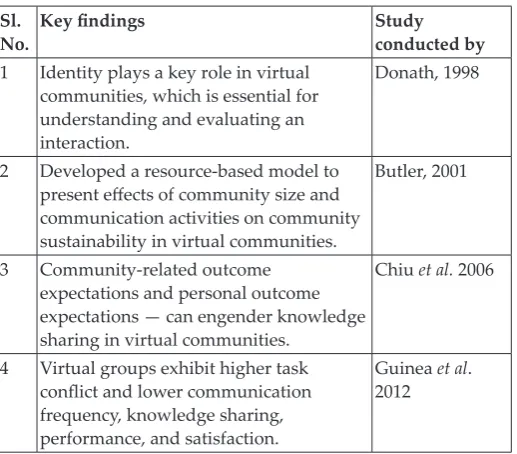
The following are few studies and their key findings related to virtual groups conducted in various countries.Table 3: Studies related to virtual groups Sl.
No. Key findings Study conducted by
1 Identity plays a key role in virtual communities, which is essential for understanding and evaluating an interaction.
Donath, 1998
2 Developed a resource-based model to present effects of community size and communication activities on community sustainability in virtual communities.
Butler, 2001
3 Community-related outcome expectations and personal outcome expectations — can engender knowledge sharing in virtual communities.
Chiu et al. 2006
4 Virtual groups exhibit higher task conflict and lower communication frequency, knowledge sharing, performance, and satisfaction.
Guinea et al. 2012
ADVANTAGES OF USE OF VIRTUAL GROUPS
Virtual group help to improve the interpersonal relations.
Virtual groups can evolve across national borders and time zones.
Virtual teams are effective for work that is highly independent. For instance, writers, editors, and graphic designers and independent farmers often work remotely. They can effectively work by getting feedback and notes on what changes need to be made without having to physically be present. Thus, it allows for corrections, modifications and improvisations in information shared.
Virtual groups help in crowd funding. Crowd funding is a participatory mode of funding for a common shared cause for that particular group. Here the members collectively raise the fund and utilize according to the interest of majority of the members.
Virtual groups help in participatory content
development. Participatory content development is a mode of developing content or a subject through contribution of members to a wider pool of knowledge.
Virtual groups help in knowledge sharing and dissemination.
Virtual groups help in marketing by using various product promotional strategies.
DISADVANTAGES OF USE OF VIRTUAL
GROUPS
Online communities are more isolated than
“real-life” groups.
Basic feelings of fear, love, and anger, not usually
transmitted online as such, because the participant knows “intellectually, but more importantly, intuitively, that he can turn off the machine”.
People may fake identities online which might lead
to multiple issues.
Consistency and continuity of communication often
lost. It is a major drawback in use of virtual groups, which leads to lack of interest among members.
Authenticity of information cannot be assured in the virtual groups.
Some people use virtual groups as a tool to spread
their hatreds and malicious intentions (Dertouzos and Collins, 2009).
FUTURE PROSPECTS
Social media intelligence: It refers to use of collective
tools and solutions, that allow organizations or institution to monitor social channels and conversations, respond to social signals and synthesize social data and social trends and analysis based on the user’s needs.
Social media audit: It is the process of reviewing
what’s working, what’s failing and what can be improved upon across your social media channels. Performing a social media audit can help an entrepreneur or a grower stay on top of their online presence. And improve its market and outreach.
Policy development for virtual communities and
policy need to be framed to restrict the spread of hatreds.
Lack of impact studies on the virtual group use
CONCLUSION
With continual advances in computer technologies, we have natural tendency to explore and colonize new space,
and the transformation real communities in to virtual
communities can be seen. In real life, virtual communities seem to have a long and prosperous life ahead. If we look at the current state of virtual communities, we can see that they are under development. Virtual communities therefore are in a crucial but exciting phase of development”. We should support and allow them to grow but they should also be carefully monitored. Virtual communities may allow users to explore their potential, share and disseminate knowledge from a wider pool of experience and expertise and lower their social inhibitions and communicate without the social tensions of real life, In order to avoid the spread of
hatreds and malicious intensions virtual communities
should carefully limit the freedoms of users through social sanctions and system constraints.
REFERENCES
Alexander, A., Page, V., and Wentling, T. 2003. Motivation and barriers to participation in virtual knowledge-sharing communities of practice. J. Knowl. Manag.,7(1): 64-77.
Armstrong, A. and Hagel, J. 2000. The real value of online communities. In: Eric, L., Lesser, E. L., Fontaine, M.A. and Slusher, J.A. (eds), The Knowledge Communities Elsevier, pp. 134–141.
Bartle, R.A. 2003. Designing Virtual Worlds. New Riders Publishing, Indianapolis, 17p.
Blood and Rebecca, R. 2000.Weblogs: A History and Perspective. Anchor Books, New York, 231p.
Butler, B.S. 2001. Membership size, communication activity, and sustainability: A resource-based model of online social structure, J. Inf. Syst. Res., 12(4): 346-362.
Chiu, C. M., Hsu, M.H. and Wang, E.T.G. 2006. Understanding knowledge sharing in virtual communities: an integration of social capital and social cognitive theories. Decision Support Systems, 42: 1872–1888.
Dertouzos, M.L. and Collins, H. 2009. What Will Be: How the
World of Information Will Change. Herper Collins Publishers, New York. 83p.
Donath, J.S. 1998. Identity and deception in the virtual community, In: Smith, M. and Kollock, P. (eds), Communities in Cyberspace. Imprint Routledge Publishers, London, 65p. Etzioni, A. and Etzioni, O. 1997. Communities: virtual vs. real.
Science, 277(7): 295-298.
Guinea, A.O.D., Webster, J. and Staples, D.S. 2012. A meta-analysis of the consequences of virtualness on team functioning. J. Inf. Manag., 49(3): 301-308.
Harasim, L.M. and Linda, M. 1993. Net worlds: networks as social spaces in global networks. In: Harasim, L. M. (ed.), Computers and International Communication, MIT press, Cambridge, 432p.
Hiltz, S.R. Online Communities: A Case Study of the Office of the Future. 1984. Ablex Publishing Co, Norwood, New Jersey, 46p. Kumari, N.K. 2016. Tools and service for m- extension: problems
and prospects. MSc(Ag) thesis, Kerala Agricultural University, Thrissur, 57p.
Licklider, J.C.R., Taylor, R. and Herbert, E. 1978. The computer as a communication device. Int. Sci. Technol., 9(4): 147-154. Mousvidin, E. and Goel, L. 2009. A Life Cycle Model of Virtual
Communities. Proceedings of the 42nd Hawaii International
Conference on System Sciences, 05-08 Jan. 2009, Washington DC, USA. IEEE Computer Society, pp. 121-129.
Obar, S., Jonathan, A. and Wildman, S. 2015. Social media definition and the governance challenge: an introduction to the special issue. Telecommun. Policy, 39(9): 745–750.
Powell, A., Piccoli, G. and Ives, B. 2004. Virtual teams: A review of current literature and directions for future research. DATA BASE Adv. Inf. Syst - Winter,35(1): 108-116.
Rheingold, H. 1993. The Virtual Community: Homesteading on the Electronic Frontier. Addison Wesley Publishing Company, Boston, 25p.
Short, J., Williams, E. and Christie, B. 1976. The Social Psychology of Telecommunications. John Wiley, New York, 123p.
Smith, M. and Kollock, P. 1999. Communities in Cyberspace. Imprint Routledge Publishers, London, 32p.
Statista. 2017. [online]. Available: https://www.statista.com/ statistics/284436/india-social-network-penetration/ [10 Aug. 2018].
Turkle, S. 1996. Virtuality and its Discontents: Searching for Community in Cyberspace. The American Prospect Publishing, New York, 57p.
Utz, S. 2000. Social information processing in MUDs: The development of friendships in virtual worlds. J. Online Behav. 4(1): 165-172.
Wellman, Salaff, J., Dimitrova, D., Garton, L., Gulia, M. and Haythornthwaite, C. 1996. Computer networks as social networks. Annu. Rev. Sociol., 22: 211–238.