Iran J Public Health, Vol. 45, No.8, Aug 2016, pp.1044-1053
Original Article
A Simple and Fast Method Based on New Magnetic Ion
Im-printed Polymer as a Highly Selective Sorbent for
Preconcentra-tion and DeterminaPreconcentra-tion of Cadmium in Environmental Samples
Zahra PANJALI
1, Ali Akbar ASGHARINEZHAD
2, Homeira EBRAHIMZADEH
2,
Niloofar JALILIAN
2, Rasoul YARAHMADI
3, *Seyed Jamaleddin SHAHTAHERI
4, 51. Dept. of Occupational Health Engineering, School of Public Health, Shahid Beheshti University of Medical Sciences, Tehran, Iran 2. Dept. of Applied Chemistry, School of Chemistry, Shahid Beheshti University, Tehran, Iran
3. Dept. of Occupational Health Engineering, School of Public Health, Iran University of Medical Sciences, Tehran, Iran 4. Dep.t of Occupational Health Engineering, School of Public Health, Tehran University of Medical Sciences, Tehran, Iran
5. Institute for Environmental Research, Tehran University of Medical Sciences, Tehran, Iran
*Corresponding Author: Email: [email protected]
(Received 04 Dec 2015; accepted 23 Apr 2016)
Introduction
As industries are extensively developed, large amounts of heavy metals are released more into the environment causing serious environmental pollution and threaten animals as well as human health, even at low concentrations. The analysis of heavy metals at trace levels is one of the most important environmental toxicologists concerns, due to their vital rules in human`s life. Cadmium,
as a heavy metal, appears in the environment due to industrial processes such as coal and oils com-bustion, smelting, mining, and alloy processing. Cadmium can be located in the kidneys and dam-ages their filtering function. Furthermore, it can be preserved in human organs for a long time (1,
2). However, because of low concentration and
matrix effect, various separation and
pre-Abstract
Background: The analysis of heavy metals at trace level is one of the main toxicologists concern, due to their vital rules in human`s life. Cadmium is one of these toxic heavy metals, which released to the environment from various industries.
Methods: In order to determine Cd (II) ions in various matrices magnetic ion-imprinted polymer (IIP) method has been developed and applied. This nano-sorbent has been synthesized by coating an IIP compound on Fe3O4
nanopar-ticles core to achieve highest surface area. This polymer has been used to evaluate Cd (II) levels in food, river, and wastewater in Tehran, Iran.
Results: Fe3O4@Cd-IIP was stable up to 300 ᵒC. The various factors such as sample pH (optimized as 7),
elu-tion/sorption time (5 min), eluent amount (4 mL HCL), and its concentration (2 mol L-1) were optimized. Analysis
instrument in all steps was Flame Atomic Abortion Spectrophotometer (FAAS). In this study, the detection limit was determined down to 0.6 μg L-1.
Conclusion: This method was applied successfully for the preconcentration and determination of Cd (II) ions in envi-ronmental samples obtained from rivers, various foods and wastewater. In addition, the accuracy of the method was confirmed by analyzing a certified reference material (Seronorm LOT NO2525) and spiked real samples.
concentration methods are used prior to its de-termination. Different treatment methods such as liquid-liquid extraction , solid-liquid extraction (3), liquid-phase Micro-extraction (4), solid-phase micro extraction (5), molecular imprinted poly-mer phase extraction (6-10), solid-phase extrac-tion (11-14), cloud point extracextrac-tion (15), co-precipitation (16) and various technique like flame atomic absorption spectrometry (17) and graphite furnace atomic absorption spectrometry (18) have been used for determination of cad-mium in the environmental samples. One of the frequently used techniques among these methods is solid phase extraction (SPE). SPE is a simple, fast and relatively cheap technique for determina-tion of heavy metals (19, 20). New sorbent based on ion-imprinted polymer (IIP) has recently been developed along with special properties resulting in selectivity and sensitivity of sorbent (21). IIPs have specific sites with high selectivity and affini-ty for the target metal ions. Ion imprinting has been synthesized by polymerization reaction be-tween functional and cross-linking monomers in the presence of the template (22).
Recently, imprinted polymer equipped with mag-netic particles (M-IIP) has attracted much more attention. Compared to the conventional im-printed polymers, because of nano particles, magnetically imprinted polymers have large sur-face area and high extraction efficiency and there-fore, fast extraction dynamics can be achieved by using such sorbent (23, 24). Nowadays, tech-niques combining Fe3O4 particles with different
sorbents for extracting metal ions from complex matrix have been developed (25).
In this study, magnetic ion imprinted polymer has been synthesized as a new sorbent for extrac-tion and preconcentraextrac-tion of Cd (II) from real samples including food, industrial waste, and riv-ers, followed by its determination by FAAS.
Methods
Instruments and apparatus
An AA-680 Shimadzu (Kyoto, Japan) flame atomic absorption spectrometer equipped with
an air-acetylene flame and a deuterium lamp background correction was used for the determi-nation of Cd (II). Conventional hollow cathode lamp with wavelength 228.8 nm was used as the radiation source (Kyoto, Japan). All pH mea-surements were carried out by a digital WTW Metrohm 827 Ion analyzer (Herisau, Switzer-land). Fourier transforms infrared spectra (4000-400 cm−1) were recorded on a Bruker IFS-66
FT-IR Spectrophotometer (Massachusetts, USA). Morphology and size of the magnetic IIP were observed on a Philips Scanning electron micro-scope (XL-30, Almelo, and The Netherlands). The thermal gravimetric and differential thermal analysis (TG-DTA( was carried out on a BAHR-Thermo analysis GmbH (Hüllhorst, Germany) under air atmosphere at the heating rate of 10 ˚C/min. The X-ray diffraction (XRD) patterns were achieved on a Philips-PW12C diffractome-ter (Amsdiffractome-terdam, The Netherlands) with Cu Kα radiation.
Chemicals and reagents
All reagents were of analytical grade (were pur-chased from Merck, Darmstadt, Germany,). A 1000 mg L-1 standard solution of Cd(II), as well
as HCl, HNO3, N(CH2CH3)3, toluene,
acetoni-trile, 2-aminobanzothiazol, FeCl3, FeSO4, NaOH,
NH4OH (32 % solution), azobisisobutyronitrile (AIBN), ethylene glycol dimethacrylate (EDG-MA), 3-Choloro-1-propene and trimethoxy vinyl silane were purchased from Merck (Darmstadt, Germany). The working solutions of Cd (II) were obtained by diluting the standard solution with deionized water, and diluted HCl and NaOH was used to adjust pH values to the various ranges. All the required solutions were prepared using deionized water provided by a Milli-Q (Millipore, Bedford, MA, USA) purification system.
Synthesis of magnetic ion imprinted polymer
Fe3O4 NPs were synthesized according to the
previously reported procedure (22). Briefly, 10.4 g of FeCl3.6H2O and 4.0 g of FeCl2.4H2O were
Then, 15 mL of NH4OH (32 % solution) was
added drop wise to the solution. After 15 min the solid was separated by a magnet and washed three times with 0.1 mol L-1 NaCl solution. In the
next step, vinyl functionalization of Fe3O4 NPs
was performed (24). To prepare vinyl functiona-lized Fe3O4 NPs, 1.0 g of prepared Fe3O4 NPs
was suspended in 50 mL of toluene, following this, 1.0 g of 3-vinyltriethoxysilane was added to the solution and the mixture was stirred for 24 h. Simultaneously, the vinylated ligand was prepared by reaction of 2-aminobanzotiazol as a ligand (1 mmol) and of 3-choloro1-propen (1 mmol) in 50 mL solutions of triethylamine and methanol (1:4 v/v) at room temperature. After 4 h the solvent was removed under the reduced pressure.
Then, one mmol of the vinylated ligand and 1.0 g of vinyl functionalized Fe3O4 were dispersed in
100 mL of methanol, then, the mixture tempera-ture was raised to 70 ºC and afterward 0.08 g of AIBN and 1.1 mL of EGDMA were added. The composite was separated by a magnet, and after 48 h the template was removed by a solution containing 1 mol L-1 of HCl. Finally, the
forma-tion of this IIP was confirmed by IR spectrosco-py, TG/DTA analysis, XRD and SEM.
Extraction procedure
The extraction procedure consists of two steps: in the sorption step, pH of the sample solution was adjusted at 7.0, then, 10 mg of magnetic IIP was suspended in the aqueous solution contain-ing 1 mg L-1 of Cd (II) and stirred for 5.0 min. In
desorption step, elution of adsorbed Cd (II) ions was performed by 4.0 mL of 2 mol L-1 HCl
solu-tion. After 5.0 Min, the concentration of Cd (II) in the eluent was determined by FAAS.
Preparation of certified reference materials and real samples
Fruit and vegetables samples
The fruit samples including Fenugreek, Canta-loupe, cucumber skin and green beans were col-lected from Tehran fields (Shahriyar-Tehran). The fruit samples were put in the cleaned polye-thylene bags. After delivery to chemistry
labora-tory, each sample was washed with distilled water thoroughly, and then the samples were dried at
100 ̊C for about 2 d. For the preparation of
spiked samples, 1.0 mL of the standard working solution was added to 1.0 g of each sample. They were then allowed to stand at room temperature for the evaporation of the solvent; therefore, the equilibration between the analyses and the fruit samples was achieved. After grinding the dry fruit and vegetable (spiked or non-spiked), microwave-assisted acid digestion was carried out by adding 2mL of distilled water, 4 mL of nitric acid 65%, and 2 mL of hydrogen peroxide 33% (w/v) to 0.5 g of each sample (22). The reactors were then subjected to the microwave program (2.5 min at room temperature, 6 min at 140 ̊C, and 5 min at
200 ̊C in power of 550 W). When acid digestion
was complete, the acid digests were diluted up to 25 mL with distilled water and kept in a refrigera-tor before magnetic solid phase extraction.
Wastewater samples
The wastewater sampling was done from the ra-diology waste of a hospital and waste of washing of painting process in an automobile industry in Tehran, Iran. Samples were collected in clean and vacuumed glass bottles. No pretreatment has been carried out in order to evaluation of Cd (II) by the mentioned method in this study.
River Water samples
The water sampling was done from the various zones of Iran; including Tehran, Kermanshah and Ilam cities. In this study, tap water and rivers were examined. Samples were collected in clean and vacuumed glass bottles.
Reference material
Ultimately, the preconcentration procedure was applied to the resulted solutions.
Results
Sorbent characterization
Formation of Fe3O4 NPs has been identified by
FT-IR, SEM and XRD. The synthesized im-printed polymer was characterized by IR spec-troscopy, scanning electron microscopy (SEM), thermo gravimetric and differential thermal
anal-ysis (TG/DTA). The FT-IR spectra of IIP showed following bands: C=S (1145 to 1149 cm -1), C=N (1629 to 1632 cm-1) and N-H (3415 to
3437 cm-1). However, the thermal stability of this
nano-composite was determined up to 300 ᵒC according to the TG/DTA analysis. Also, the nano surfaces and sorbent`s morphology were confirmed by SEM (
Fig. 1, a-b) and XRD (
Fig. 1:(a) and (b) SEM micrographs of synthesized magnetic IIP; (b) XRD pattern of magnetic IIP
Optimization of the preconcentration method Effect of sample pH
To achieve the optimized sample pH condition during the extraction process of sample solutions containing 0.5 mg L-1 of Cd (II), pH adjusted in
the range of 3.5-8. After stirring for 5 min, the adsorbed Cd (II) ions were eluted by 4.0 mL of 2 mol L-1 of HCl, subsequently, the amount of
Cd(II) ions in the eluent were determined by FAAS. Optimized sample pH for adsorption of Cd (II) on this compound was 7.0.
Effect of eluent type, volume and its concen-tration
In order to elution of Cd (II) from IIP, HCl was selected between H2SO4 and HNO3. The
inspec-tion of the effect of eluent volume on the recov-ery of Cd (II) showed that 4.0 mL of the 2 mol L -1 of HCl is the optimum volume for desorption
of Cd (II) ions. Therefore, to obtain higher pre-concentration factors, 4.0 mL of 2 mol L-1 HCl
was selected in this work. In the batch method, solid phase was separated by the magnet (1.4 Tes-la).
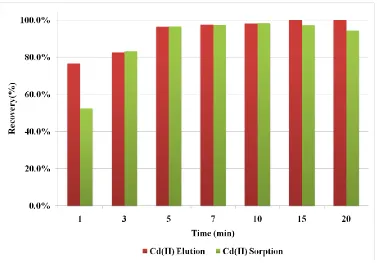
Optimization of sorption and elution time
In order to evaluate the effect of time, 25 mL of solutions containing 0.5 mg L-1 of Cd (II) were
adjusted to pH=7.0 and 10 mg of magnetic IIP were suspended to the solutions and stirred for various durations. At the end, the sorbent was separated by placing a strong magnet and the pre-concentrated analyte was determined by FAAS after eluting by 2 mol L-1 HCl. According to
Fig. 2, 5.0 min were chosen for both optimized sorption and elution times.
Fig. 2: Effect of sorption and elution times on the recovery of Cd (II)
Potentially influence of interfering ions In order to investigate the selectivity of the
this purpose, 0.5 mg L-1 Cd(II) ions solutions
contained individually the interfering ions, Na+,
Pb+2, Zn2+,and Cu2+ were analyzed under the
op-timum condition. The tolerable amount was de-fined as the maximum concentration causing a change of less than 5% in signal compared to the signal of each ion without any interference (24). None of these ions do interfere with the concen-trations encountered in aqueous samples.
Analytical figure of merit
In order to prove the precision and accuracy of the present technique, reproducibility of the op-timized method was validated for day-to-day and within-day reproducibility using spiked aqueous samples. 25 mL samples were used at low, me-dium, and high concentrations of 2, 10, 50 µg L-1
respectively. A linear standard curve was ob-tained for extracted sample over the range con-centrations every day for 6 consecutive days
(n=6) with the correlation coefficient of 0.997 or greater (Table 1).
Method validation
The accuracy of the current method the concen-tration of Cd (II) ions was compared to the exact concentration of this ion in the certified reference material (Seronorm LOT NO2525) and the result was in good agreement with the certified value.
Real environmental samples analysis
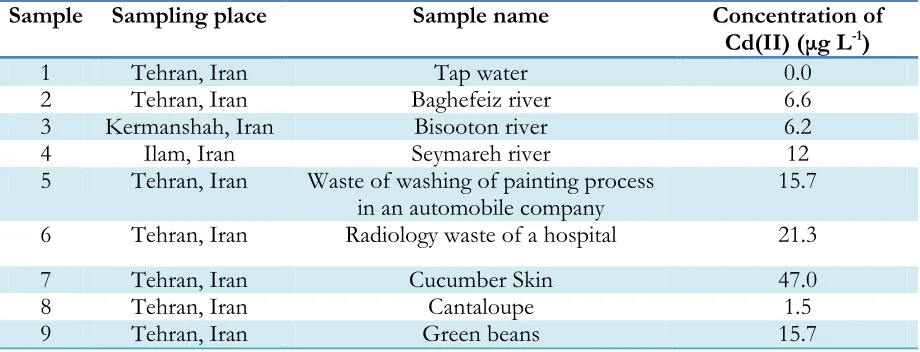
The mentioned method was applied for determi-nation of Cd (II) ions concentration in food samples, rivers water, and industrial wastes. After sample preparation, each sample divided into 4 parts. Subsequently, by adding 10 mg of prepared sorbent under the optimized condition and by consequently using standard addition method Cd (II), levels were evaluated in each sample. The results have been presented in
Table 2.
Table 1:Day-to-day (D-day) and within day (W-day) reproducibility of cadmium determination in aqueous
sample. Sample volume 25 mL, N = 6
Statistical data Concentration added (µg L-1)
2 10 50
D-day W-day D-day W-day D-day W-day
Mean 4.63 3.49 11.76 11.29 50.91 50.69 SD 0.43 0.51 0.79 0.66 0.88 0.70 CV(%) 0.092 0.146 0.064 0.058 0.017 0.014
Table 2: Measurement of Cd (II) in environmental samples by using Fe3O4@IIP
Sample Sampling place Sample name Concentration of Cd(II) (μg L-1)
1 Tehran, Iran Tap water 0.0
2 Tehran, Iran Baghefeiz river 6.6
3 Kermanshah, Iran Bisooton river 6.2
4 Ilam, Iran Seymareh river 12
5 Tehran, Iran Waste of washing of painting process
in an automobile company 15.7 6 Tehran, Iran Radiology waste of a hospital 21.3
7 Tehran, Iran Cucumber Skin 47.0
8 Tehran, Iran Cantaloupe 1.5
10 Tehran, Iran Fenugreek 52.5
Discussion
Sorbent characterization
According to the FT-IR plot, both spectra before and after Cd (II) leaching are structurally same, but because of metal leaching from IIP men-tioned band raised. Important band regarding metal banding in the presence of Cd (II) is 1145 (C=S), 1629 (C=N), and 3415 (N-H) cm-1. For
leached polymer, they raised as 1149, 1632, and 3437 cm-1 respectively.
Besides, Fe3O4@Cd-IIP was stable up to 300 ᵒC.
Nevertheless, according to 20% loss of the com-posite weight, 20% of this sorbent is consists of polymer burned at high temperature and the rest of mass was Fe3O4. By extracting of SEM, the sorbent can be consisted of spherical nano-particles with more or less than 40 nm in diameter. Since the magnetic nano-particles are coated with polymer, they will not destroy in acidic solutions (24).
According to the XRD pattern, the Fe3O4
struc-ture remained unchanged after polymerization; the Fe3O4 did not decompose or convert into Fe2O3. However, according to the
Fig. 1-c, as well as, the Scherrer equation, the broad peaks in the XRD pattern showed that, Fe3O4 is at nanosized scale. The average crystal-lite size of magnetic IIP was estimated from the XRD pattern using Scherrer formula:
D =
kλ
β cos θ
Where D, is the average crystallite size, λ is the X-ray wavelength, β is the full-width at half max-imum (FWHM) and θ is the diffraction angle. Here, K=0.9 is for spherical shape. The crystallite size of magnetic IIP was computed from XRD pattern and found to be about 28 nm. TheXRD pattern of Fe3O4@IIP showed that, the length of
peaks has been reduced comparing Fe3O4 XRD
pattern. Fe3O4 nano particles have been coated with polymer compounds.
Optimization of the preconcentration me-thod
The pH factor has the ability to change the coor-dination sites of the ligand, so it will be one of the most controlling parameters for adsorption of Cd (II) on the synthesized polymer. According to the pH optimization tests, optimum sample pH was 7.0. This is because at low pH values, an excessive protonation of the lone pair of elec-trons on nitrogen and sulfur can be seen, result-ing in the decrease of the Cd (II) ions sorption (25). Moreover, in the alkaline pHs, the Cd (II) precipitate as Cd (OH)2 may cause decreasing in
removal efficiency (22).
The volume of 4 mL of elusion showed that high concentration factor for cadmium ions and cause reduce solvent usage. Interestingly, at larger vo-lumes, the recoveries were not significantly raised by increasing the eluent volume. Also according to the elution type selection HCl has prepared more recoveries.
Time of sorption and desorption which have a strong influence on extract procedure efficiency were investigated as the insufficient time reduces the procedure efficiently and extra ones cause waste time. The result of tests showed that 5.0 min was the optimum time for both factors. This fast extraction and elution duration could be at-tributed to the high surface area dealing with these IIP nano-particles. Batch extraction tech-niques will reduce these factors. Fast extraction and elution duration could be attributed to the high surface area dealing with these IIP nanopar-ticles (10). Compared to the column technique, batch method takes shorter sorption and desorp-tion times (23).
Potentially influence of interfering ions
in-terfering ions should be removed or reduced. Cadmium and other ions may be released into rivers by natural or industrial activities. Due to this fact, the used sorbent should be selective enough to extract Cd (II) in the presence of other material especially metallic ions, which cause a decrease in recovery. The method of extraction is enough selective to measure an accurate value of Cd (II) even in complex matrices. This high se-lectivity could be attributed to the highly selective sites, the size, and shape was specifically fitted to the Cd (II) ions. Therefore, the method was se-lective toward the Cd (II) extraction at pH=7. Furthermore, extraction is not affected by high concentrations of Na ions, which are may exist on earth.
Method validation
According to the table 1 in within-day experi-ments evaluation, six experiexperi-ments were per-formed each day for three consecutive days. The extraction procedure was reliable and
reproduci-ble from day-to-day and within-day (13). The coefficient of variations (CV%) of 0.092, 0.064, and 0.017 was obtained for 2, 10, and 50 µg L-1
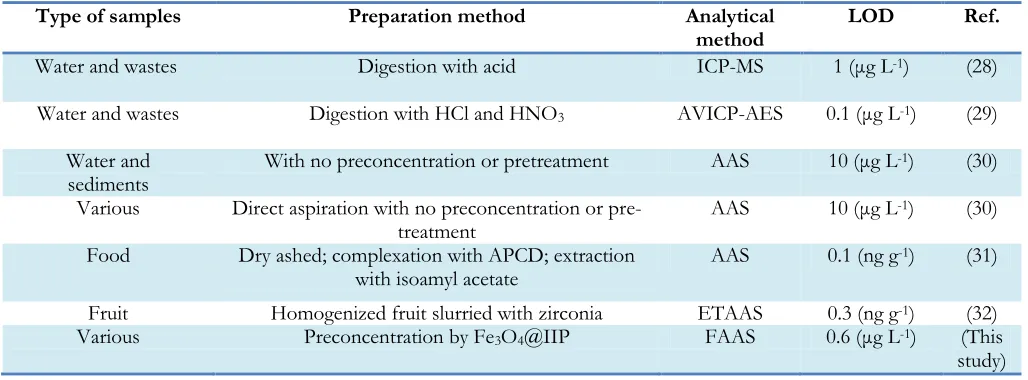
respectively for day-to-day and 0.146, 0.058, and 0.014 at the same concentrations respectively for within-day, showing appropriate accuracy and precision for the optimized method (11). Also compare to the reference material the result have good agreement whit certified material. Further-more, according to the ATSDR profile of Cd (II) the lowest LOD of determination of Cd (II) by ASS in environmental samples is 10 μg L-1 (26),
While, LOD of this study obtained down to 0.6 μg L-1 (Table 3). High selectivity and appropriate
preconcentration of this method allow the environmental analyst to determine the low con-centration of Cd (II) in various samples without the need for instruments like GFAAS or ETAAS. In addition, evaluating of Cd (II) by Fe3O4@IIP
method needs no pretreatment experiments like acidic digestion, filtration or centrifuge for semi-clear samples like waste or river water (27).
Table 3: Comparative of LOD of a various method for determination of Cd (II) in environmental samples
Type of samples Preparation method Analytical
method LOD Ref.
Water and wastes Digestion with acid ICP-MS 1 (μg L-1) (28)
Water and wastes Digestion with HCl and HNO3 AVICP-AES 0.1 (μg L-1) (29)
Water and
sediments With no preconcentration or pretreatment AAS 10 (μg L
-1) (30)
Various Direct aspiration with no preconcentration or
pre-treatment AAS 10 (μg L
-1) (30)
Food Dry ashed; complexation with APCD; extraction
with isoamyl acetate AAS 0.1 (ng g
-1) (31)
Fruit Homogenized fruit slurried with zirconia ETAAS 0.3 (ng g-1) (32)
Various Preconcentration by Fe3O4@IIP FAAS 0.6 (μg L-1) (This
study)
Conclusion
The novel magnetic IIP has been synthesized by coating an IIP on Fe3O4 nanoparticles for the
achievement of the highest surface area for ex-traction aims. Selectivity of this ion imprinted polymer has made it be a suitable and selective
and easy as possible without unintelligible in-strument like GFAAS or ETAAS causing reduce expenses as well as saving time. On the other hand, according to day-to-day and whiten-day reproducibly experiments, this technique gains acceptable reliability degree for analysis of envi-ronmental samples.
Ethical considerations
Ethical issues (Including plagiarism, informed consent, misconduct, data fabrication and/or fal-sification, double publication and/or submission, redundancy, etc.) have been completely observed by the authors.
Acknowledgment
This research has been supported by Tehran University of Medical Sciences grant (Project No. 22850). The authors acknowledge the University for all valuable supports. The authors declare that there is no conflict of interests.
References
1. Soylak M, Narin I (2005). On-line preconcentra-tion system for cadmium determinapreconcentra-tion in environmental samples by flame atomic ab-sorption spectrometry. Chem Analityczna, 50 (4): 705-15.
2. Tokalioglu S, Oymak T, Kartal S (2007). Copre-cipitation of lead and cadmium using copper (II) mercaptobenzothiazole prior to flame atomic absorption spectrometric determina-tion. Microchim Acta, 159 (1-2): 133-9.
3. Taher MA (2003). Differential pulse polaro-graphic determination of cadmium after solid liquid extraction and preconcentration using PAN. Turk J Chem, 27 (4): 529-38.
4. Nazari S (2008). Determination of trace amounts of cadmium by modified graphite furnace atomic absorption spectrometry after liquid phase microextraction. Microchem J, 90 (2): 107-12.
5. Ghavidel F, Shahtaheri SJ, Jazani RK, Torabbeigi M, Froushani AR, Khadem M (2014). Opti-mization of Solid Phase Microextraction Pro-cedure Followed by Gas Chromatography
with Electron Capture Detector for Pesticides Butachlor and Chlorpyrifos. Am J Analyt Chem, 5 (09): 535-546.
6. Koohpaei A, Shahtaheri SJ, Ganjali M, Forusha-ni AR (2008). Molecular imprinted solid phase extraction for determination of atrazine in environmental samples. Iran J Environ Health Sci Eng, 5 (4): 283-296.
7. Rahiminejad M, Shahtaheri SJ, Ganjali M, Foru-shani A, Golbabaei F (2009). Molecularly im-printed solid phase extraction for trace analy-sis of diazinon in drinking water. Iran J Environ Health Sci Eng, 6(2): 97-106.
8. Koohpaei A, Shahtaheri SJ, Ganjali M, Forusha-ni AR, Golbabaei F (2009). Optimization of solid-phase extraction using developed mod-ern sorbent for trace determination of ame-tryn in environmental matrices. J Hazard Ma-ter, 170 (2): 1247-1255.
9. Rahiminezhad M, Shahtaheri SJ, Ganjali M, Koohpaei A, Forushani AR, Golbabaei F (2010). An experimental investigation of the molecularly imprinted polymers as tailor-made sorbents of diazinon. J Anal Chem, 65 (7): 694-698.
10. Omidi F, Behbahani M, Samadi S, Sedighi A, Shahtaheri SJ (2014). Coupling of molecular imprinted polymer nanoparticles by high per-formance liquid chromatography as an effi-cient technique for sensitive and selective trace determination of 4-chloro-2-methylphenoxy acetic acid in complex ma-trices. Iran J Public Health, 43 (5): 645-657. 11. Shahtaheri SJ, Ghamari F, Golbabaei F,
Rahimi-Froushani A, Abdollahi M (2005). Sample preparation followed by high performance liquid chromatographic (HPLC) analysis for monitoring muconic acid as a biomarker of occupational exposure to benzene. Int J Occup Saf Ergon, 11 (4): 377-388.
12. Shahtaheri SJ, Mesdaghinia A, Stevenson D (2005). Evaluation of Factors Influencing Re-covery of Herbicide 2, 4-D from Drinking Water. Iran J Chemstry and Chemical Eng, 24 (1): 33-40.
14. Shahtaheri SJ, Ibrahimi L, Golbabaei F, Hosseini M, Fouladi Dehghi B (2007). Solid phase ex-traction for 1-hydroxypyrene as a biomarker of occupational exposure to PAHs prior to high performance liquid chromatography.
Iran J Chemstry and Chemical Eng, 26(4): 75-81. 15. Wen X, Wu P, Chen L, Hou X (2009).
Determi-nation of cadmium in rice and water by tungsten coil electrothermal vaporization-atomic fluorescence spectrometry and tungsten coil electrothermal atomic absorp-tion spectrometry after cloud point extracabsorp-tion.
Anal Chim Acta, 650 (1): 33-38.
16. Oymak T, Tokalioglu S, Yilmaz V, Kartal S, Aydın D (2009). Determination of lead and cadmium in food samples by the coprecipita-tion method. Food Chem, 113 (4): 1314-1317. 17. Gaspar A, Berndt H (2000). Thermospray flame
furnace atomic absorption spectrometry (TS-FF-AAS)—a simple method for trace ele-ment determination with microsamples in the μg/l concentration range. Spectrochim Acta Part B At Spectrosc, 55 (6): 587-597.
18. Ueda M, Teshima N, Sakai T, Joichi Y, Motomi-zu S (2010). Highly sensitive determination of cadmium and lead in leached solutions from ceramic ware by graphite furnace atomic ab-sorption spectrometry coupled with sequen-tial injection-based solid phase extraction me-thod. Anal Sci, 26 (5): 597-602.
19. Shahtaheri SJ, Abdollahi M, Golbabaei F, Rahi-mi-Froushani A, Ghamari F (2008). Monitor-ing of mandelic acid as a biomarker of envi-ronmental and occupational exposures to sty-rene. Int J Environ Res, 2(2): 169-176.
20. Tuzen M, Saygi KO, Soylak M (2008). Novel solid phase extraction procedure for gold (III) on Dowex M 4195 prior to its flame atomic absorption spectrometric determination. J Hazard Mater , 156(1): 591-595.
21. Rao TP, Kala R, Daniel S (2006). Metal ion-imprinted polymers—novel materials for se-lective recognition of inorganics. Anal Chim Acta, 578 (2): 105-116.
22. Asgharinezhad AA, Jalilian N, Ebrahimzadeh H, Panjali Z (2015). A simple and fast method based on new magnetic ion imprinted poly-mer nanoparticles for the selective extraction of Ni (II) ions in different food samples. RSC Adv, 5 (56): 45510-45519.
23. Asgharinezhad AA, Mollazadeh N, Ebrahimza-deh H, Mirbabaei F, Shekari N (2014). Mag-netic nanoparticles based dispersive micro-solid-phase extraction as a novel technique for coextraction of acidic and basic drugs from biological fluids and waste water. J Chromatogr A, 1338: 1-8.
24. Sayar O, Torbati NA, Saravani H, Mehrani K, Behbahani A, Zadeh HRM (2014). A novel magnetic ion imprinted polymer for selective adsorption of trace amounts of lead (II) ions in environment samples. J Ind Eng Chem, 20 (5): 2657-2662.
25. Ebrahimzadeh H, Moazzen E, Amini MM, Sa-deghi O (2012). Novel magnetic ion im-printed polymer as a highly selective sorbent for extraction of gold ions in aqueous sam-ples. Anal Methods, 4 (10): 3232-3237.
26. Toxicological Profile for Cadmium [Internet]. (2012). U.S. Department of Health and Hu-man Services Public Health Service
27. Rezvani M, Asgharinezhad AA, Ebrahimzadeh H, Shekari N (2014). A polyaniline-magnetite nanocomposite as an anion exchange sorbent for solid-phase extraction of chromium (VI) ions. Microchim Acta, 181 (15-16): 1887-1895. 28. EPA (1994). Methods for derivation of
inhala-tion reference concentrainhala-tions and applicainhala-tion of inhalation dosimetry. U.S. Environmental Protection Agency. EPA600890066F. 29.EPA (2008). Hazardous Waste Test Methods /
SW-846, Method 6010C. U.S. Environmental Protection. https://www.epa.gov/hazardous-waste-test-methods-sw-846.
30.USGS (2008). Methods of analysis by the U.S. Geological Survey National Water Quality Laboratory-Preparation procedure for aquatic biological material determined for trace met-als. Denver, CO: U.S. Geological Survey. http://nwql.usgs.gov/Public/pubs/OFR96-362/OFR96-362.pdf.
31. Bruhn J, Franke A (1976). Lead and cadmium in California raw milk. J Dairy Sci, 59 (10): 1711-1717.