188 | P a g e
FAILURE MODE EFFECTIVE ANALYSIS FOR
REQUIREMENTS PHASE IN SMALL SOFTWARE FIRM
1
Mr. Piyush Kumar Pareek,
2Dr.A.N.Nandakumar
1
Assistant Professor, Department of CSE, Kammavari Institute of Technology, Bengaluru , Visvesvaraya
Technological University, Belgaum, Research Scholar, Jain University, Bengaluru
2Principal , R.L.Jalappa institute of Technology , Doddaballapur, Visvesvaraya Technological
University, Belgaum & Research Guide, Jain University, Bengaluru
ABSTRACT
Failure mode and effects analysis (FMEA) is a risk management technique. If implemented properly this can be a
great addition to the best quality assurance processes to be followed, FMEA is mostly used by the upper
management or stakeholders. In practice, the testers get little insights into this technique. In this paper we have
carried out FMEA in software firm to identify potential effects of failure in Requirements Phase in SDLC.
Keywords: FMEA, Management, Quality Assurance & SDLC .
I INTRODUCTION
The FME(C)A is a design tool used to systematically analyze postulated component failures and identify the
resultant effects on system operations. The analysis is sometimes characterized as consisting of two sub-analyses,
the first being the failure modes and effects analysis (FMEA), and the second, the criticality analysis (CA).
Successful development of an FMEA requires that the analyst include all significant failure modes for each
contributing element or part in the system. FMEAs can be performed at the system, subsystem, assembly,
subassembly or part level. The FMECA should be a living document during development of a hardware design. It
should be scheduled and completed concurrently with the design. If completed in a timely manner, the FMECA can
help guide design decisions. The usefulness of the FMECA as a design tool and in the decision-making process is
dependent on the effectiveness and timeliness with which design problems are identified. Timeliness is probably the
most important consideration. In the extreme case, the FMECA would be of little value to the design decision
process if the analysis is performed after the hardware is built. While the FMECA identifies all part failure modes,
its primary benefit is the early identification of all critical and catastrophic subsystem or system failure modes so
they can be eliminated or minimized through design modification at the earliest point in the development effort;
therefore, the FMECA should be performed at the system level as soon as preliminary design information is
189 | P a g e
Remark: For more complete scenario modelling another type of Reliability analysis may be considered, for examplefault tree analysis(FTA); a deductive (backward logic) failure analysis that may handle multiple failures within the item and/or external to the item including maintenance and logistics. It starts at higher functional / system level. An
FTA may use the basic failure mode FMEA records or an effect summary as one of its inputs (the basic events).
Interface hazard analysis, Human error analysis and others may be added for completion in scenario modelling.
II LITERATURE SURVEY
The advancement and proliferation of information technology has made it possible for specified functions of
systems including safety-critical systems to be software driven. Traditional failure analysis techniques existed before
computers and are widely used in the failure analysis of hardware. Typically, hardware failures are random while
software failures are systematic and this makes software failure analysis difficult to be addressed. However, similar
approaches used in hardware failure analysis can be applied in the failure analysis of software at its architecture
level. Such analysis informs design modifications in software and likely hardware to mitigating design weaknesses
[1]
Driver Assistance Systems like Adaptive Cruise Control (ACC) can help to prevent accidents by reducing the
workload on the driver. ACC is an automotive feature that allows a vehicle's cruise control system to adapt the
vehicle's speed to the traffic environment. A radar system attached to the front of the vehicle is used to detect
whether slower moving vehicles are in the ACC vehicle's path. If a slower moving vehicle is detected, the ACC
system will slow the vehicle down and control the clearance, or time gap, between the ACC vehicle and the forward
vehicle. If the system detects that the forward vehicle is no longer in the ACC vehicle's path, the ACC system will
accelerate the vehicle back to its set cruise control speed. This operation allows the ACC vehicle to autonomously
slow down and speed up with traffic without intervention from the driver. The purpose of this paper is to describe
Failure Modes and Effects Analysis (FMEA) and fault tree analysis (FTA) based safety-critical approach towards to
development of Adaptive Cruise Control system from a safety perspective [2]
Failure Mode and Effects Analysis (FMEA) is a methodology to find potential failures before they occur. While
FMEA identifies individual failure modes, its primary benefit is the early identification of system failure modes so a
solution can be designed to mitigate the potential failure. It is a methodology to design reliability into a system. In a
FMEA, numerical weights can be applied to the likelihoods of each failure, as well as the severity of the
consequences. FMEA is a very cost-effective, easy to learn, and productive way to design a more reliable system.
Although this method was not originally created for software systems, we can translate the principles over to
software and take advantage of the many benefits that FMEA has to offer. These benefits include:
• Facilitates early identification of failure points and system interface problems
190 | P a g e
• Provides a single worksheet summary of analysis• Requires minimal training to participate, or even lead a FMEA • Increases reliability in products [3]
The concept of software failure mode and effects analysis (FMEA) has grown in attractiveness over recent years as a
way of assessing the reliability of software. Like its hardware counterpart, software FMEA is immensely tedious for
an engineer to perform, as well as being error-prone.
The method provides results at a level where they can be understood and acted on by software engineers. A tool
implementing this method has been applied to a travel expenses payment program, and some of the automatically
produced results are presented. Such automation extends significantly the range of software for which software
FMEA becomes a realistic proposition. The analysis is tractable, and has been shown to provide useful results for
software engineers.
One important use of this analysis is to focus further testing. The software FMEA can be used to improve automated
or source code embedded testing since tests can exonerate many potential faults allowing the FMEA analysis to
present an engineer with a reduced set of potential faults. [4]
Conditions that lead to more severe failure effects in the presence of other anomalies (e.g. failures of monitoring
software that normally causes no effect but very severe effects if the monitored function fails)
· Effects that can be overcome by automated or manual measures at the system level
· Failure modes for which the higher level effects and their severity must be assessed by
Probabilistic methods (by convention, the entries for these reflect the most severe possibility)
It will have become apparent that the generation of the FMEA, even with the computer support, requires much
insight into the software and system design. It is a purpose and benefit of our approach that much less FMEA
expertise is required, and that software designers and system engineers can therefore assume a more active role in
FMEA generation. [5]
Failure Mode and Effect Analysis (FMEA) was first developed as a formal design methodology in the 1960s by the
aerospace industry with their obvious reliability and safety requirements. FMEA is a systematic method of
identifying and preventing system, product and process problems before they occur. It is focused on preventing
problems, enhancing safety and increasing customer satisfaction. Ideally FMEA„s are conducted in the product
design or process development stages, although conducting an FMEA on Existing products or processes may also
yield benefits. FMEA is a tool that allows us to prevent System, Product and Process problems before they occur. It
reduces costs by identifying system, product and process improvements early in the development cycle. It prioritizes
actions that decrease risk of failure.
FMEA analyses
1. Potential failure modes of product or machine,
191 | P a g e
3. Potential causes for failure (like Material defects, Design deficiencies, Processing and manufacturingdeficiencies, and Service condition etc.)
4. Assesses current process controls, and
5. Determines a risk priority factor
One of the most powerful methods available for measuring the reliability of products or process is FMEA.
Customers are placing increased demands on companies for high quality, reliable products. The increasing
capabilities and functionality of many products are making it more difficult for manufacturers to maintain the
quality and reliability. [6]
Failure Modes and Effects Analysis (FMEA) and Failure Modes, Effects and Criticality Analysis (FMECA) are
methodologies designed to identify potential failure modes for a product or process before the problems occur, to
assess the risk. Ideally, FMEA‟s are conducted in the product design or process development stages, although
conducting an FMEA on existing products or processes may also yield benefits.
The FMEA team determines, by failure mode analysis, the effect of each failure and identifies single failure points
that are crucial. It may also rank each failure according to the criticality of a failure effect and its probability of
occurring. The FMECA is the result of two steps:
Failure Mode and Effect Analysis (FMEA)
Criticality Analysis (CA). [7]
III FMEA FOR REQUIREMENTS COLLECTION PHASE
192 | P a g e
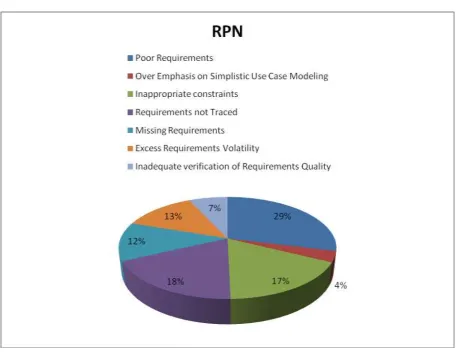
Figure 2: Risk Priority Number of Potential Effects of Failure in Requirements Phase
193 | P a g e
IV CONCLUSION
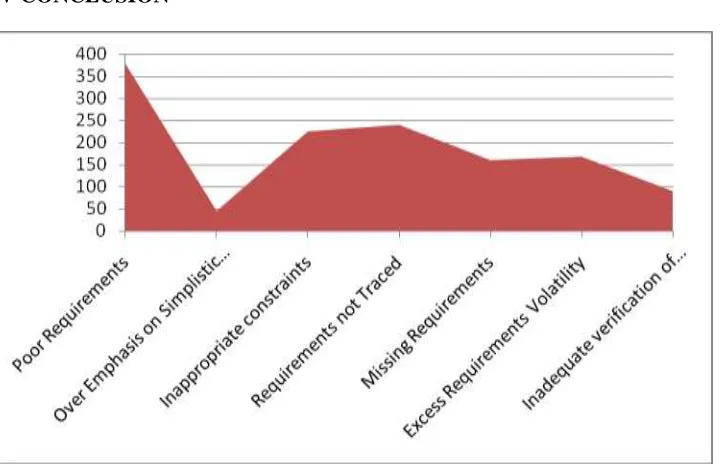
Figure 4: Scatter Plot for Risk Priority Percentage of Potential Effects of Failure in Requirements
Phase
1. It has been observed that because of Poor requirements 29 % of Projects have been affected.
2. Inappropriate contents and Requirements Untraceable accounts to 35 % of Problems.
3. Excess Requirements Volatility and Missing Requirements constitute 25 % of Problems.
Poor requirements quality is currently the number one problem in requirements engineering, and solving it will go a
long way towards improving software and system development. Requirements engineers, stakeholders with whom
they must collaborate, and requirements evaluators (e.g., inspectors and reviewers) need to be properly trained in
the characteristics of good requirements including examples of both good and bad requirements, and they need to
be taught how to tell the difference between them. [9]
REFERENCES
1. Shawulu Hunira Nggada , “ Software Failure Analysis at Architecture Level using FMEA ” , International
Journal of Software Engineering and Its Applications Vol. 6, No. 1, January, 2012.
2. M.Ben Swarup , M Srinivas Rao , “Safety Analysis of Adaptive Cruise Control System Using FMEA and
FTA , International Journal of Advanced Research in Computer Science and Software Engineering ,
Volume 4, Issue 6, June 2014
194 | P a g e
4. Chris Price and Neal Snooke, “ An Automated Software FMEA”, Department of Computer Science,
Aberystwyth University , Proceedings the International System Safety Regional Conference, Singapore, April 2008
5. Herbert Hecht, Xuegao An and Myron Hecht , “ COMPUTER-AIDED SOFTWARE FMEA ” , SoHaR
Incorporated, Culver City CA
6. Rakesh.R, Bobin Cherian Jos, George Mathew, “ FMEA Analysis for Reducing Breakdowns of a Sub
System in the Life Care Product Manufacturing Industry ” ,International Journal of Engineering Science
and Innovative Technology (IJESIT) Volume 2, Issue 2, March 2013
7. Lefayet Sultan Lipol & Jahirul Haq , “Risk analysis method: FMEA/FMECA in the organizations”.
International Journal of Basic & Applied Sciences IJENS Vol: 11 No: 05 74 117705-3535
IJBAS-IJENS © October 2011 IJBAS-IJENS I J E N S
8. http://en.wikipedia.org/wiki/Failure_mode_and_effects_analysis
9. Donald Firesmith , “Common Requirements Problems, Their Negative Consequences, and the Industry
Best Practices to Help Solve Them ”, Software Engineering Institute, U.S.A , Published by ETH Zurich,
Chair of Software Engineering JOT, 2007