A CONVENTIONAL KEY GENERATION FOR FILE
ENCRYPTION METHOD AND PROTECTION USING
UNIVERSAL SERIAL BUS (USB) STORAGE DEVICE
Manoj Prajapat
1, Anurag Maloo
21
M. tech Pursuing,
2Assistant Professor, Institute of Technology & Management, Bhilwara (India)
ABSTRACT
USB File Lock Using USB Storage Device and Digital Keys (Signature) is a high performance File encryption /
protection program, password securing your file against outside unauthorized access by the use of an USB
stick/Dongle. You should provide facility to send password on sms and even email so that authorized person can
use for decrypt a file. You should provide facility to encrypt all type of files without restrictions. Password
encryption process should be there so no one can access password specified directly from the encrypted file.
Most of the file bulwark software's provide either one level bulwark of the simple encryption method or two
level protections which is password bulwark and encryption utilizing simple key generation algorithm which key
is engendered by the software by utilizing characters of password given by the users.
Keywords: Encryption, Decryption, RSA, Digital Signature
I. INTRODUCTION
Nowadays, the most comfortable removable astronomically immense-capacity data contrivances are connected to the system via the bus Universal Serial Bus (USB). Such contrivances include flash recollection RAM with a capacity of several tens of GB and hard disk drives with a capacity of several TB. The popularity of these contrivances forces the desideratum for mechanisms to ascertain an adequate level of bulwark of data stored on them.
II. SYSTEM REVIEW
• Generates a unique key. • Encrypt pristine file.
• Generate digital keys desultorily.
• Denies access to unauthorized users or invalid Storage. • Preserves encryption status even after reboot.
• Facility to upload file.
• Facility to decrypt file via SMS on any mobile contrivance. • Compress file
• Encryption/decryption
There are two phases first one is Registration phase and second one is verification and key generation phase. In this proposed system we are using RSA algorithm, which was developed by Rivest, Shamir and Adleman in 1977, for key exchange agreement and Digital Signature proposed by schnorr in 1989.
III. CRYPTOGRAPHIC ALGORITHMS
In universal, there are two types of encryption algorithms utilized in cryptography. They are symmetric and asymmetric algorithms.
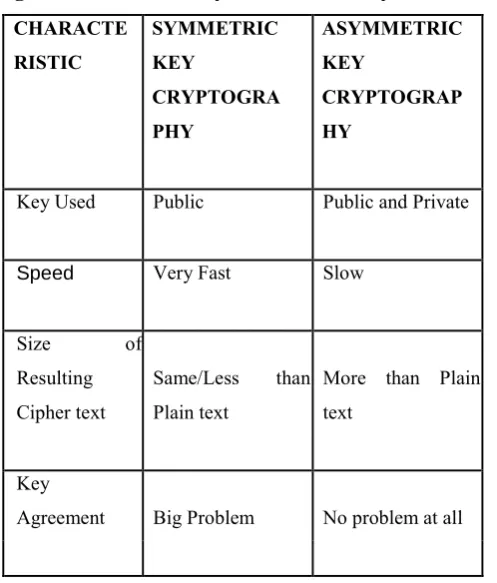
The distinguishment between Symmetric and Asymmetric algorithms is listed below in Table 1.[2]
Table 1: Distinguishment Between Symmetric and Asymmetric Cryptography
CHARACTE RISTIC
SYMMETRIC KEY
ASYMMETRIC KEY
CRYPTOGRA PHY
CRYPTOGRAP HY
Key Used Public Public and Private
Speed Very Fast Slow
Size of
Resulting Cipher text
Same/Less than Plain text
More than Plain text
Key
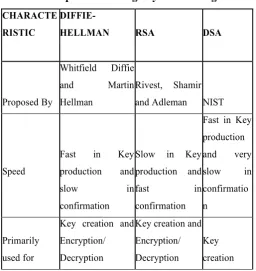
Table 2: Comparison Among Asymmetric Algorithms
CHARACTE RISTIC
DIFFIE-HELLMAN RSA DSA
Proposed By
Whitfield Diffie
and Martin
Hellman
Rivest, Shamir and Adleman NIST
Speed
Fast in Key production and
slow in
confirmation
Slow in Key production and
fast in
confirmation
Fast in Key production and very slow in confirmatio n
Primarily used for
Key creation and Encryption/ Decryption
Key creation and Encryption/ Decryption
Key creation
3.1 RSA Algorithm
Key production
1. Select two distinct large massive prime numbers p and q. 2. Compute n = pxq where n is utilized as modulus.
3. Compute φ(n) = (p - 1)x(q - 1), where φ is Euler’s totient function.
4. Select an integer e such that 1 < e <φ(n) and e and φ(n) are co-prime. Gcd(e, φ(n))=1.
e is relinquished as the public key exponent.
5. Verify d = e–1 mod
φ(n) i.e. calculate d given (d*e)mod φ(n) = 1.
d is kept back as the private key exponent.
6. The public key consists of the modulus n and the public (or encryption) exponent e. The confidential key consists of the modulus n and the confidential (or decryption) example d which must be kept secret.
Encryption
Message M is to be transmitted
Change M into an integer m, such that 0 < m < n by padding system then compute the cipher text c matching to c = me (mod n). Then transmit c.
Decryption
Recover m from c by utilizing private key exponent d via computing m = cd (mod n).
3.2 Digital Signature
Schnorr digital signature scheme is utilized to reduce the number of signatures. For common verification, we will be utilize Digital Signature proposed by Schnorr in 1989.
Key Generation Algorithm 1. Select two prime numbers p and q. 2. Select a random integer g such that
gq =1 mod p.
3. (g,p,q) are global parameters to all. 4. Select a random integer x such that
1 ≤ x ≤ q − 1
5. Calculate y = g -x mod q.
6. Sender’s public key is (p, q, g, y), and Sender’s secret key is x.
Signature Algorithm
1. select an random secret integer k,
1 ≤ k ≤ q – 1
2. Compute r = gk mod p, e = H(m||r), and
s = k + x.e mod q
3. Sender’s signature for m is the pair (s, e).
Signature Verification
1. Compute v = gs • ye mod p, and
ē =H(m||v)
2. Allow the signature if and only if e = ē [3][4].
IV. PROPOSED SYSYTEM DESIGN
Utilizer has to first register to the scheme. After registeration phase, when utilizer connects USB set-up and have to go throw confirmation and information encryption stage where session key will be engender which is utilized to encrypt/decrypt file.
4.1 Registration-Phase
Parameters and Symbols:
1. Select two prime numbers p and q
2. Select a random integer g such that gq =1 mod p
3. (g,p,q) are global parameters to all.
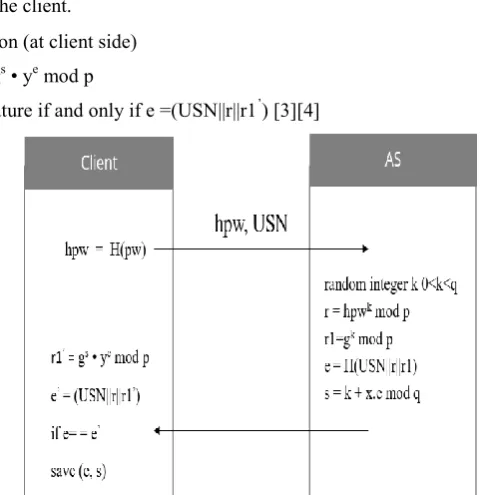
AS generate signature by:-
1. Select an random secret integer k,
1 ≤ k ≤ q – 1
2. Compute r = hpwk mod p, r1=gk mod p, e= H(USN||r||r1), and s = k + x.e mod q. 3. Send (e,r,s) to the client.
Signature Verification (at client side) 1. Compute r1’= gs • ye mod p
2. Allow the signature if and only if e =(USN||r||r1’) [3][4]
Figure 1: Registration Phase
4.2 Verification and Key Generation Phase
Parameters and Symbols:
4. p, q : Two hugely massive primes p and q, where q | p-1
5. g : g is an integer such that gq = 1 mod p
6. USN, pw : USB Serial Number and password
7. x, y: Server's private key and public key; y = g-x mod p
8. h(.), H(.) : One way collision-resistant hash functions; h(.) maps randomly extended strings to strings of fine-tune length, and H(.) maps to elements of the cyclic group G.
9. ||: Concatenate operate
10. Fn : Filename for encryption
11. File : File for encryption
12. Ek[.] : Symmetric encryption purpose with respect to a key K
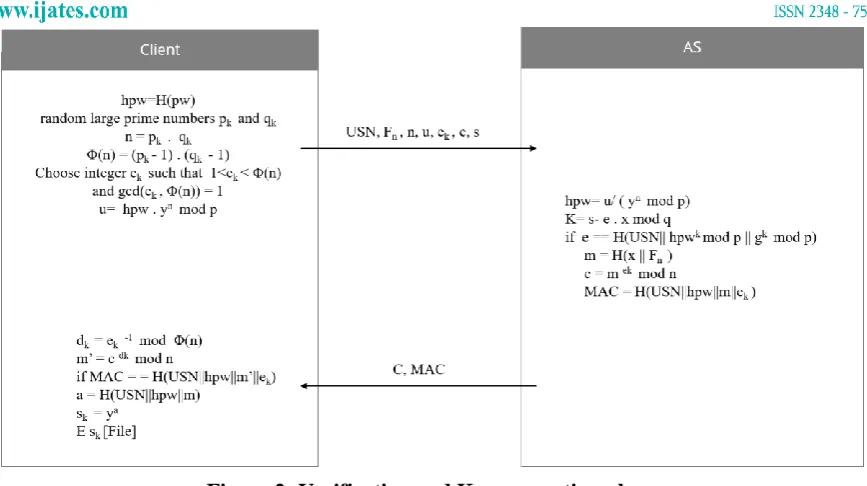
Figure 2: Verification and Key generation phase
After consummate the register stage, and when access the USB storage space set-up, the utilize wants to get shared verification with the verification server utilize the USN and pwd, which engender an encryption key. The announcement process is described in feature below. Figure 2 shows the full procedure of verification and key generation phase.
Step 1
The utilizer affix the USB storage space set-up to a computer from side to side an ordinary process and input the right pw. At this instant, the utilizer (client) will utilize pw to compute hpw utilizing the one way hash function H(.). Then the utilizer culls a random hugely massive prime information pk and qk and compute modulus
n=pk.qk. Euler’s totient purpose Φ(n)=(pk-1)(qk-1) is withal calculated. Public key exponent ek co-prime with
Φ(n) is culled such that 1<ek< Φ(n). Calculate u = hpw . yn mod p. Determinately, the utilizer will send mail of
{USN, Fn, ek, n, u, e, s} to the Authentication Server.
Step 2
After getting {USN, Fn, ek, n, u, e, s}, the AS will use its long word confidential key x to calculate hpw = u / (yn
mod p) and k = s - e .x mod q. Then, the confirmation server will employ parameter it engender to validate whether e = H(USN || hpwk mod p || gk mod p). If assenting, then the utilizer in this message is licit. If not, the
statement is ended. then, the confirmation server will use the conventional file name Fn and the lasting private key x to calculate m = H(x || Fn), and carry out encryption on m, to engender ciphertext c= mek mod n.
Determinately, the confirmation server calculate a message confirmation code MAC = h(USN || hpw || m || ek) and sends the engendered communication {c, MAC} to the utilizer.
Step 3
After receiving the message {c, MAC}, the utilizer utilizes the public key exponent ek and Φ(n) to compute
confidential key exponent dk. m is retrieved by decrypting c utilizing dk to compute a utilized in production of
Step 4
After the utilizer and the confirmation server complete these steps, the assembly key sk can be planned by sk = g-xa mod p. When a utilizer needs to right to use the storage set-up via the USB interface, this encryption key, can be acclimate to encrypt the File, i.e., as Esk [File], to for fend the file and provide private and secure access
to the USB set-up. For file decryption, the utilizer wants to endure the similar confirmation steps and get the same key sk to decrypt the file (Dsk [Esk [File]]) when accessing it on the USB contrivance.
V. SECURITY ANALYSIS
Organization Analysis denotes determining whether the scheme is inexpensively, extrovertly, technically and directorially feasible.
Correctness
Our procedure will turn away any secret file loss via USB concept storage space set-up. In our protocol design file move via USB boundary is fruitless till the utilizer does not pass through confirmation process. If the utilizer is applicable then the necessary files are transfer to unimportant set-up (USB) in encrypted arrangement. The key utilize for encryption is compute utilize Username, key and filename. After encryption if utilizer desire to read that folder he has to first decrypt it. For decryption, utilizer has to go from side to side same confirmation process and have to find same key utilize for encryption.
Offline password conjecturing
If the USB is disoriented or purloin, yet USB right of entry is controlled as for decryption, username and password is necessary. Thus obviating secret data stored in USB set-up. If utilizer endeavors to inference code word, it will be hard to him as it include solve separate Logarithmic dilemma [6].
Discrete Logarithmic quandary
1. In confirmation and information encryption stage if attacker actions to guess the worth of limitation for that he has to bypass from end to end separate Logarithmic predicament.
2. Discrete Logarithmic predicament where changeable have number of solution 3. eg: X%2=1; to get reply as 1 ,X having number of value(X=3,5,7, ... )
Session Key is engender for each validation communication in our procedure. Without kenning pk and qk and confidential key x, assailer cannot decrypt the file. So our procedure resists offline password attack [7].
Replay attack and Purloined verifier attack
If assailer events to use a capture wiretap validate communication and he obtain some limit but he don't ken pk and qk, denote he don't ken m used to work out session key sk. Albeit he finds sitting key still code word is required, so our procedure can oppose the glommed verifier attack [8].
VI. CONCLUSION
The proposed system provides three level of protection by generating a symmetric key. If unauthorized person get encrypted file then he must know password and USB serial number. However it is difficult to guess the password but its near about impossible to guess the USB serial number, as each USB has a unique hardware serial number. That’s why this system enhancing the security level.
REFERENCES
[1] Z. Zieliński et al., “Secured workstation to process the data of different classificationlevels”, J. Telecom.
Inform. Technol., no. 3, pp. 5–12,2012.
[2] A. Kozakiewicz, A. Felkner, J. Furtak, Z. Zieliński, M. Brudka, and M. Małowidzki, “Secure workstation
for special applications”, in Secure and Trust Computing, DataManagement, and Applications, C. Lee, J.-M. Seigneur, J. J. Park, and R. R. Wagner,Eds., Com- munications in Computer and Information Science, vol. 187. Berlin: Springer, 2011, pp. 174–181.
[3] J. Chudzikiewicz, “Zabezpieczenie danych przechowywanych na dyskach zewnętrznych”, in Metody
wytwarzania i zastosowania sys- temów czasurzeczywistego, L. Trybus and S. Samolej, Eds.Warszawa:
Wydawnictwo Komunikacjii Łączności, 2010, pp. 211–221 (in Polish).
[4] [Imperva 2010] Imperva. Consumer password worst practices.
http://www.imperva.com/docs/WP_Consumer_Password_Worst_Practices.pdf, 2010
[5] Hyun Sook Rhee, Jeong Ok Kwon, and Dong Hoon Lee, “A remote userauthentication scheme without using smart cards”, Computer Standards & Interfaces,Vol. 31, No. 1, pp. 4-13, 2009.
[6] Technical Documentation“Microsoft Windows Driver Kit (WDK)”, Microsoft Corporation, Redmond,
2009.
[7] [Geambasu 2009] Roxana Geambasu, Tadayoshi Kohno, Amit Levy, and Henry M. Levy. Vanish: Increasing data privacy with self-destructing data. In Proceedings of the 18th USENIX Security Symposium, 2009.
[8] Technical Documentation ”Microsoft Windows Driver Kit (WDK)”, Microsoft Corporation, Redmond,
2009.
[9] EncFS 2008] EncFS. EncFS encrypted file system. http://www. arg0.net/encfs, 2008.