decentralized to a centralized pharmacy and acceptance of a CPOE platform that did not allow simultaneous users to enter/review medications were counterintuitive in a busy critical care unit. Furthermore, it seems that computer terminals were not optimally placed or were immobile and insufficient in number to allow nurses to carry on their work at the bedside, thus interfering with patient care.
Between April and December 2002, the Cincinnati Children’s Hospital Medical Center (CCHMC) imple-mented CPOE throughout the institution. CCHMC is a 423-bed facility with 1045 physicians and 1750 nurses. The PICU has a capacity of 25 beds and an average daily census of 18 children. The CPOE application is part of a larger integrating clinical information system, the core applications of which include a Web-based portal, CPOE, clinical documentation, and a data repository (Invision; Siemens Medical Solutions, Malvern, PA). These core ap-plications interface with other hospital-based information systems including radiology PACS, laboratory, pharmacy, admissions, and dietary. The CPOE platform is linked to numerous intranet- and Internet-based resources and clin-ical decision-support tools such as medication dose-range checking, hospital policies, the medication formulary, a discharge summary system, and an Internet search engine. The CPOE system is accessed through fixed and wireless workstations throughout the institution. Each week, 30 000 orders are generated through the system, 90% of which are entered directly into the computer by physicians or advance practice nurses.
Our experience with implementing CPOE in a PICU setting was quite different from that noted by Han et al. Critical care physicians, nurses, and respiratory thera-pists were heavily involved in our CPOE system de-sign before implementation. Pediatric-specific informa-tion (including critical care order sets, pathways for the entry of continuous infusions, and critical care–specific medication dose-range checking) was developed by critical care clinicians and incorporated into the sys-tem well in advance of implementation. Workflow in-compatibility with the CPOE system was analyzed and deficiencies corrected in advance of implementation. The system was implemented in a stepwise fashion, with entry into the critical care unit only after a successful pilot in a medical unit. Live user support was offered 24 hours/day, 7 days/week, until no longer needed. Ongo-ing feedback was not only accepted, but was solicited. Other important issues such as optimal workstation (fixed and wireless) numbers and location and standard-ized nomenclature (ie, centigrade versus Fahrenheit) were addressed before implementation.
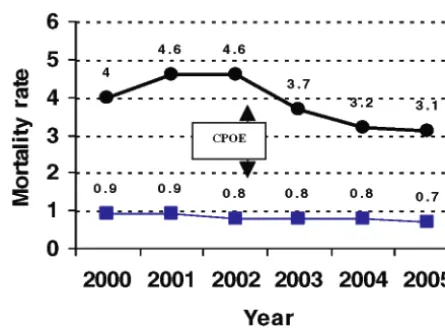
Unlike CHP, the CCHMC did not observe a rise in mortality rates in its critical care unit after implementing CPOE. In fact, the raw mortality rate has declined, and the severity-adjusted mortality ratio has remained stable (Fig 1).
The CHP is to be congratulated for adopting an im-portant technology and persevering despite imim-portant challenges in their critical care setting. The pediatric community will benefit from the lessons they have learned. The study confirms the importance of having a well-supported plan for adopting and implementing CPOE. Our experience at the CCHMC validates the no-tion that CPOE can be implemented successfully with numerous benefits and without an adverse impact on mortality rates.
Brian R. Jacobs, MD Richard J. Brilli, MD Kim Ward Hart, MA Division of Critical Care Medicine Cincinnati Children’s Hospital Cincinnati, OH 45229
REFERENCES
1. Han YY, Carcillo JA, Venkataraman ST, et al. Unexpected in-creased mortality after implementation of a commercially sold computerized physician order entry system.Pediatrics.2005;116: 1506 –1512
2. Ash JS, Stavri PZ, Kuperman GJ. A consensus statement on considerations for a successful CPOE implementation.J Am Med Inform Assoc.2003;10:229 –234
3. Ahmad A, Teater P, Bentley TD, et al. Key attributes of a successful physician order entry system implementation in a multi-hospital environment. J Am Med Inform Assoc. 2002;9: 16 –24
doi:10.1542/peds.2005-3116
To the Editor.—
Han et al1describe a retrospective study in which the
mortality rate for interfacility transfers into an ICU was compared before and after implementation of a comput-erized provider order entry (CPOE) system. The authors found that the mortality rate increased from 2.8% (30 deaths of 1394 patient transfers during 13 months) be-fore CPOE implementation to 6.6% (36 deaths of 548 FIGURE 1
transfers during 5 months) after. The authors conclude that the increased mortality was associated directly with modifications in standard clinical processes, including the following changes: (1) not allowing order commu-nication until the patient was physically present and registered in the admitting system; (2) relocating medi-cation dispensing to a central (rather than a satellite) pharmacy; (3) increasing the physical separation of nursing and physician staff during the time that orders were generated; (4) implementing computerized order entry; and (5) system-wide provider role changes to support the CPOE system.
Perhaps the most important lesson from this study is that there exists an intimate association between care-delivery processes and health information technology. Any shift in the methods used to manage patient care (such as implementing and using a CPOE system) is associated with significant changes in clinical workflows, communication among providers, and distribution of responsibilities.2–4 Decades of research in medical
infor-matics have underscored the importance of this ob-servation, a message that was not lost on the authors. In this study, they note that the increased unadjusted mortality may reflect problems with the process of change, including the extremely rapid implementation plan adopted by their organization. The authors de-scribe other major changes in workflow and patient care processes that occurred coincident with the CPOE sys-tem implementation. For example, their institution changed its policies to prohibit providers from entering patient orders before the patient had physically arrived and had been registered. This change was not a function of the CPOE system but rather of how the institution chose to implement it. The authors list other similar workflow changes that occurred coincident with the CPOE system implementation, such as the elimination of bedside stocks of critical drugs, resulting in the need to request these drugs when needed from a remote phar-macy.
The authors’ findings merit additional scrutiny be-cause, as they noted, there are numerous limitations to the study’s design. The primary study outcome, mortal-ity rates, naturally change over time with trends that are sensitive to many factors including policy changes at the hospital, staffing ratios, and seasonal variations in dis-ease. In a pre-post single-crossover design, as this study used, there is no way to disentangle trends associated with time from the effects of the CPOE system-imple-mentation process. In cases such as this, investigators must aggressively adjust for all possible measured con-founders, taking pains to identify and include all that might reflect changes occurring over calendar time, in-cluding seasonal effects, primary diagnoses, a large num-ber of comorbidities,5staffing levels, and any changes in
care-delivery and hospital-workflow processes. This lim-itation is amplified by the concern that many of the
statistical methods used in this study have known prob-lems that can invalidate apparently significant statistical associations.6–8 For observational studies such as this
one, in which the number of deaths is limited, the pre-ferred method for adjusting for confounding is propen-sity score analysis.9The propensity model should include
all measured confounders regardless of whether they are statistically significant. A more rigorous approach that pays attention to identifying and including all known confounders in an appropriate statistical analysis might influence the outcomes observed in this study. It is also important to realize the very unique population of crit-ically ill children in this study. Interfacilty transfers occur under a variety of conditions. Mortality in this group may be a result of factors including suboptimal diagnosis and management at the transferring site, delays in trans-fer, problems during transit, and other factors remote from the study site.
Implementing health information technology such as CPOE and electronic health record systems is a complex process.10In the commentary that accompanied the
ar-ticle by Han et al, Gesteland et al emphasized this lesson: “Deploying a sophisticated clinical-applications platform including CPOE in 6 days is an audacious task and leaves little margin for error in adapting highly evolved work processes to the new environment.”11 There exist
well-established approaches to enabling high-risk organizational change.12 Untoward effects have been well described
when the process is not performed appropriately.13–15
Additional studies need to be designed and conducted to understand whether there are unique implications of process change in ICU and other acute care environ-ments and to determine how pediatric health care affects these implications.16,17However, as noted recently by the
Institute of Medicine,18,19the preponderance of evidence
to date strongly suggests that CPOE systems can reduce medication-related errors of commission and may be useful for improving compliance with errors of omis-sion.20,21Readers of the article by Han et al should not
abort plans to implement CPOE systems under the belief that CPOE itself can increase harm; rather, they should proceed with implementations cautiously, applying the lessons about systems implementation learned and pub-lished by others. In this regard, a more appropriate title for the article might have emphasized that any increase in observed mortality at the authors’ institution was associated with the process of implementing change rather than with the CPOE system itself.
All systems designed to deliver health care, comput-erized or not, will fail at certain points. The process for implementing new systems should be designed to iden-tify potential failures and to assure that they do not result in sentinel or catastrophic events. Key steps in the implementation of CPOE systems, for example, should include detailed flowcharted analyses of current and proposed workflow processes, failure analyses
con-PEDIATRICS Volume 117, Number 4, April 2006 1453
at Viet Nam:AAP Sponsored on August 29, 2020
www.aappublications.org/news
ducted throughout the design and implementation pro-cess, usability testing in a controlled environment, and a stepwise rollout in which each subsequent institutional unit learns from challenges experienced by the previous unit. Pertinent system evaluations should supplement classic technical software and hardware analyses with human-interface and human-interaction testing. There also should be extensive end-user testing in realistic situations that takes place with a “frozen” software de-sign. Finally, there must be well-designed “break-the-glass” functionality that allows users to do what they think is best for the patient even when the computer system does not allow it (eg, writing orders before a critically ill patient is registered in the hospital).22
The CPOE system-implementation process described by Han et al did not incorporate steps or elements known to ensure system dependability and usability. For example, CPOE systems commonly include tools de-signed to improve safety and time efficiency, such as “order sets.”23 Order sets allow providers to select and
order multiple related items such as medications and diagnostics tests with only a few mouse clicks or key-strokes. According to the authors, their institution chose an implementation approach that did not include order sets, although the commercially available system they implemented offered the ability to construct them. The authors also describe unforeseen technical problems that occurred during the rapid implementation process (eg, overloaded wireless networks that slowed down CPOE systems). Technical problems such as these should have been evident in testing that typically takes place before system implementation.
Over the past 5 years, numerous investigators have outlined case studies documenting successful and failed CPOE implementations.14,24Many successful
implemen-tations have received the Nicholas E. Davies award (these case studies are available at www.himss.org/ASP/ daviesAward.asp). Fortunately, there now exists enough shared and published experience with CPOE implemen-tation that each institution should not need to rediscover problems that others have found. However, with the increasing demand for technology infrastructure in med-icine, there continues to be an insufficient number of individuals trained in biomedical informatics to provide consultation. Efforts such as the American Medical In-formatics Association’s 10 ⫻ 10 program and the Na-tional Library of Medicine’s short course in medical in-formatics, fellowship training programs, and career development grants all promise to improve the penetra-tion of informatics knowledge in the pediatric workforce. Awards such as the Davies award recognize best practices for CPOE and electronic health record system implemen-tation. Ongoing efforts by the Certification Commission for Health Information Technology (CCHIT) are designed to inform purchasers about the quality of commercial sys-tems. These nationally visible products and programs add
to the knowledge that can be applied to CPOE and elec-tronic health record system implementation.
S. Trent Rosenbloom, MD, MPH Departments of Biomedical Informatics and Pediatrics Vanderbilt University School of Medicine Nashville, TN 37232 School of Nursing Vanderbilt University Nashville, TN 37235 Frank E. Harrell, Jr, PhD Department of Biostatistics Vanderbilt University School of Medicine Nashville, TN 37232 Christoph U. Lehmann, MD Department of Pediatrics and Division of Health Information Sciences Johns Hopkins University Baltimore, MD 21287 Joseph H. Schneider, MD, MBA Department of Pediatrics University of Texas Southwestern Medical Center Dallas, TX 75390 Children’s Medical Center Dallas, TX 75235 S. Andrew Spooner, MD, MS Department of Pediatrics University of Tennessee College of Medicine Memphis, TN 38163 Kevin B. Johnson, MD, MS Departments of Biomedical Informatics and Pediatrics Vanderbilt University School of Medicine Nashville, TN 37232
ACKNOWLEDGMENT
The project was supported by US National Library of Med-icine grant 1K22 LM008576-01 (to Dr Rosenbloom).
REFERENCES
1. Han YY, Carcillo JA, Venkataraman ST, et al. Unexpected increased mortality after implementation of a commercially sold computerized physician order entry system. Pediatrics.
2005;116:1506 –1512
2. Braude RM. People and organizational issues in health infor-matics.J Am Med Inform Assoc.1997;4:150 –151
3. Lorenzi NM, Riley RT. Knowledge and change in health care organizations.Stud Health Technol Inform.2000;76:63– 69 4. Lorenzi NM, Riley RT. Organizational issues ⫽ change. Int
J Med Inform.2003;69:197–203
5. Stukenborg GJ, Wagner DP, Harrell FE Jr, et al. Hospital dis-charge abstract data on comorbidity improved the prediction of death among patients hospitalized with aspiration pneumonia.
J Clin Epidemiol.2004;57:522–532
6. Sun GW, Shook TL, Kay GL. Inappropriate use of bivariable analysis to screen risk factors for use in multivariable analysis.
J Clin Epidemiol.1996;49:907–916
8. Greenland S. When should epidemiologic regressions use ran-dom coefficients?Biometrics.2000;56:915–921
9. D’Agostino RB Jr. Propensity score methods for bias reduction in the comparison of a treatment to a non-randomized control group.Stat Med.1998;17:2265–2281
10. Kuperman GJ, Gibson RF. Computer physician order entry: benefits, costs, and issues.Ann Intern Med.2003;139:31–39 11. Gesteland PH, Nebeker JR, Gardner RM. These are the
tech-nologies that try men’s souls: common-sense health informa-tion technology.Pediatrics.2006;117:216 –217
12. Stablein D, Welebob E, Johnson E, Metzger J, Burgess R, Classen DC. Understanding hospital readiness for computer-ized physician order entry. Jt Comm J Qual Saf. 2003;29: 336 –344
13. N.V.: Cedars slips on CPOE; The editors and reporters ofModern Physicianchose the following as the 12 most important stories of the past year.Modern Physician.2003;7:19
14. Shane R. Computerized physician order entry: challenges and opportunities.Am J Health Syst Pharm.2002;59:286 –288 15. Sittig DF, Stead WW. Computer-based physician order entry:
the state of the art.J Am Med Inform Assoc.1994;1:108 –123 16. Johnson KB. Barriers that impede the adoption of pediatric
information technology. Arch Pediatr Adolesc Med. 2001;155: 1374 –1379
17. Johnson KB, Davison CL. Information technology: its impor-tance to child safety.Ambul Pediatr.2004;4:64 –72
18. Institute of Medicine, Committee on Quality in Healthcare in America.To Err Is Human: Building a Safer Health System. Wash-ington, DC: National Academy Press; 1999
19. Aspden P, Corrigan JM, Wolcott J, Erickson SM, eds.Patient Safety: Achieving a New Standard for Care. 1st ed. Washington, DC: National Academies Press; 2004
20. Bates DW, Teich JM, Lee J, et al. The impact of computerized physician order entry on medication error prevention.J Am Med Inform Assoc.1999;6:313–321
21. Potts AL, Barr FE, Gregory DF, Wright L, Patel NR. Comput-erized physician order entry and medication errors in a pedi-atric critical care unit.Pediatrics.2004;113:59 – 63
22. Bates DW, Kuperman GJ, Wang S, et al. Ten commandments for effective clinical decision support: making the practice of evidence-based medicine a reality.J Am Med Inform Assoc.2003; 10:523–530
23. McAlearney AS, Chisolm D, Veneris S, Rich D, Kelleher K. Utilization of evidence-based computerized order sets in pedi-atrics.Int J Med Inform.2005; In press
24. Aarts J, Berg M. A tale of two hospitals: a sociotechnical appraisal of the introduction of computerized physician order entry in two Dutch hospitals.Medinfo.2004;11:999 –1002
doi:10.1542/peds.2005-3163
In Reply.—
We appreciate the insightful comments of Longhurst et al, Jacobs et al, and Rosenbloom et al in response to our study findings. They all emphasize the critical impor-tance of careful planning and preparation for successful computerized provider order entry (CPOE) implementa-tion. We wholeheartedly agree. However, these authors also assert that our observations probably resulted from inadequate planning or foresight exercised by the CPOE project team at the Children’s Hospital of Pittsburgh (CHP). Although we cannot, ourselves, refute this asser-tion, we note that members of CHP’s CPOE project team seemed to have been well aware of the many potential
pitfalls that can impede successful CPOE implementa-tion.1The report by Upperman et al,1which described in
great detail how CPOE was introduced at CHP, suggests that considerable thought and effort went into our in-stitution’s adoption of CPOE technology. This endeavor was rewarded, in fact, with a significant reduction in harmful adverse drug events.2In this regard we ask, had
we not performed our independent investigation specif-ically examining mortality outcomes, would anyone have questioned the adequacy of the preparations made at CHP? Clearly, debating the potential merits and short-comings of various CPOE implementation strategies is important and necessary, but we submit that this debate must first proceed with a uniform definition of success. Because the mandate for widespread implementation of CPOE throughout all US hospitals stems from the prom-ise that this technology will save patient lives, we further submit that the realization of this promise should serve as the “gold-standard” definition of success.
Longhurst et al, Jacobs et al, and Rosenbloom et al also seem to make a clear distinction between CPOE and the implementation process, implying that our observation resulted entirely from faulty implemen-tation and not from CPOE technology, itself. Although we acknowledge this possibility in our article, we find it extremely difficult to separate one element from the other. A CPOE system does not operate in isolation, and its proper functioning requires its seamless inte-gration into a strong and dynamic health information technology (HIT) infrastructure. In its broadest sense, implementation encompasses not only solving poten-tial clinical workflow problems but also building this HIT infrastructure, resolving systems-integration glitches, and overcoming machine-human–interface obstacles. Al-though CPOE, itself, may not be to blame for undesired patient outcomes, a well-designed, well-programmed, user-friendly CPOE software architecture constructed “from the ground up” with a clear understanding of how clinicians think and operate in real-life situations can only serve to facilitate the implementation process. Conversely, a general, minimally modifiable, clinically awkward CPOE platform may require considerable creative efforts to “retrofit” this technology into operational form. Al-though CPOE, itself, may not be at fault for network problems related to ever-present threats from Internet worms and viruses, the vulnerability or resilience of a specific CPOE platform and its HIT infrastructure to properly function during periods of attack and after fire-walls and other network security upgrades have been installed seem to be considerations intrinsic to the adop-tion of this technology.
Rosenbloom et al caution careful interpretation of our data because of inherent limitations of study design and raise questions regarding the statistical approach used. We have openly acknowledged and enumerated our study’s limitations and share in their sentiment to
cau-PEDIATRICS Volume 117, Number 4, April 2006 1455
at Viet Nam:AAP Sponsored on August 29, 2020
www.aappublications.org/news
DOI: 10.1542/peds.2005-3163
2006;117;1452
Pediatrics
Schneider, S. Andrew Spooner and Kevin B. Johnson
S. Trent Rosenbloom, Frank E. Harrell, Jr, Christoph U. Lehmann, Joseph H.
With Computerized Physician Order Entry
Perceived Increase in Mortality After Process and Policy Changes Implemented
Services
Updated Information &
http://pediatrics.aappublications.org/content/117/4/1452
including high resolution figures, can be found at:
References
http://pediatrics.aappublications.org/content/117/4/1452#BIBL
This article cites 20 articles, 4 of which you can access for free at:
Subspecialty Collections
http://www.aappublications.org/cgi/collection/federal_policy_sub Federal Policy
http://www.aappublications.org/cgi/collection/advocacy_sub Advocacy
following collection(s):
This article, along with others on similar topics, appears in the
Permissions & Licensing
http://www.aappublications.org/site/misc/Permissions.xhtml
in its entirety can be found online at:
Information about reproducing this article in parts (figures, tables) or
Reprints
http://www.aappublications.org/site/misc/reprints.xhtml
DOI: 10.1542/peds.2005-3163
2006;117;1452
Pediatrics
Schneider, S. Andrew Spooner and Kevin B. Johnson
S. Trent Rosenbloom, Frank E. Harrell, Jr, Christoph U. Lehmann, Joseph H.
With Computerized Physician Order Entry
Perceived Increase in Mortality After Process and Policy Changes Implemented
http://pediatrics.aappublications.org/content/117/4/1452
located on the World Wide Web at:
The online version of this article, along with updated information and services, is
by the American Academy of Pediatrics. All rights reserved. Print ISSN: 1073-0397.
the American Academy of Pediatrics, 345 Park Avenue, Itasca, Illinois, 60143. Copyright © 2006 has been published continuously since 1948. Pediatrics is owned, published, and trademarked by Pediatrics is the official journal of the American Academy of Pediatrics. A monthly publication, it
at Viet Nam:AAP Sponsored on August 29, 2020
www.aappublications.org/news