A REVIEW ON AMRUTOTTARA KASHAYA
Madhur Shobitha1, Hussain Gazala2, Kadibagil Vinay R3
1
2nd year PG scholar, 2Associate Professor, 3Professor
Department of Rasashastra and Bhaishajya Kalpana, Department of Agada Tantra and Vyava-harayurveda, SDM College of Ayurveda and Hospital, Hassan, Karnataka, India
INTRODUCTION
Kwatha Kalpana is one among the
Panchavidha Kashaya Kalpana and is con-sidered as primary dosage form in
Bhaisha-jya Kalpana. Amrutottara Kashaya is a
common formulation used in Jwara that contains Guduchi/Amruta (Tinospora cor-difolia), Haritaki (Terminalia chebula)
and Shunti (Zingiber officinale).1This for-mulation is widely used in Ayurveda prac-tice for the treatment of Jwara. The ingredi-ents of this formulation are easily available and it’s easy to prepare and is cost effective in nature. The Sanskrit word “uttara” means predominant/later/followed by/latter/ more powerful/chief/excellent/ superior. Thus the name Amrutottara Kashaya sug-gest a kwatha preparation in which the drug
Amruta is more powerful, predominant
among others, have powerful action and used as chief ingredient.
The reference of this formulation is first mentioned in “Sahasra Yogam”. Later on this formulation got a mention in “Ayur-vedic Formulary of India”(AFI) as
“Na-garadi Kwatha churna” (Amrutottara Kwa-tha churna).1
MATERIALS AND METHODS
Kwatha is a filtered decoction obtained by boiling coarse powder of drugs in pro-portion of 4 and 8 times of water for Mrudu
and Madhyamadravya (Soft and moderately
soft drugs) respectively and reduced to one-fourth and 16 times of water for Kathina dravya (Hard drugs) and reduced to one – eight. In this process water soluble active principles present in the drugs are extracted. Review Article International Ayurvedic Medical Journal ISSN:2320 5091
ABSTRACT
Kwatha Kalpana is one among the Panchavidha Kashaya Kalpana. It is considered as primary and potent dosage form in Bhaishaya Kalpana which is widely prescribed. Amrutottara Kashaya is used in Ayurveda practice for the treatment of Jwara. The reference of this formula-tion is first menformula-tioned in “Sahasra Yogam”. Later on this formulation got a mention in “Ayurve-dic Formulary of India” (AFI, an authentic and standard book for Ayurvedic formulations) as
“Nagaradi Kwatha churna” (Amrutottara Kwatha churna).There are 6 formulations with the name Nagaradi Kashaya and one Amrutottara kashaya as such in Sahasra Yogam. But the
“Na-garadi Kwatha” having Nagara (Zingiber officinale), Amruta(Tinospora cordifolia) and
Haritaki(Terminalia chebula)is considered as “Amrutottara Kashaya” in the ratio of 2:6:4 re-spectively. This paper is an attempt to review the formulation “Amrutottara Kashaya” explained in various literature of Ayurveda Pharmaceutics.
366
www.iamj.in IAMJ: Volume 4; Issue 03; March - 2016 5Amrutottara Kashaya contains drugs of
Madhyama hardness and hence the drug
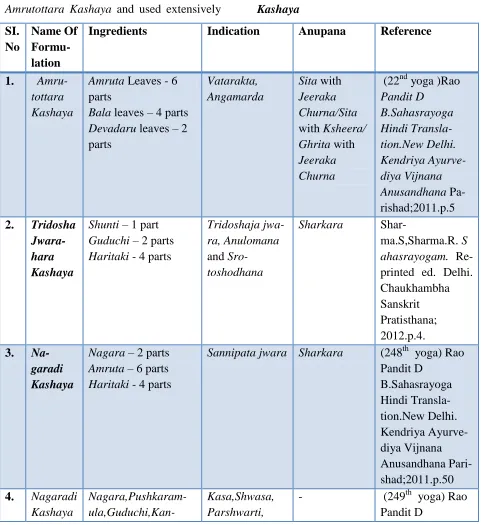
wa-ter ratio taken generally is 1:8 and reduced to 1/4th. There are different opinions regard-ing the proportion of drugs to be taken in this formulation. There are 6 formulations with the name Nagaradi Kashaya in Sa-hasra Yogam.2 Among them the first men-tioned Nagaradi Kashaya is considered as
Amrutottara Kashaya and used extensively
in treating Jwara. The same yoga has been named as “Tridosha jwara hara Kashaya” by Sharma.S in his Hindi translation book of
Sahasra yogam.3 There is one more formu-lation named “Amrutottara kashaya” which is therapeutically used for Khudavata (Vata-rakta) and Angamarda.4
Table 1: Different formulations with the
name Nagaradi Kashaya/Amrutottara
Kashaya
SI. No
Name Of Formu-lation
Ingredients Indication Anupana Reference
1.
Amru-tottara Kashaya
Amruta Leaves - 6 parts
Bala leaves – 4 parts
Devadaru leaves – 2 parts
Vatarakta, Angamarda
Sita with
Jeeraka Churna/Sita
with Ksheera/ Ghrita with
Jeeraka Churna
(22nd yoga )Rao
Pandit D B.Sahasrayoga Hindi Transla-tion.New Delhi. Kendriya Ayurve-diya Vijnana
Anusandhana
Pa-rishad;2011.p.5
2. Tridosha Jwara-hara Kashaya
Shunti – 1 part
Guduchi – 2 parts Haritaki - 4 parts
Tridoshaja jwa-ra, Anulomana
and Sro-toshodhana
Sharkara
Shar-ma.S,Sharma.R. S
ahasrayogam.
Re-printed ed. Delhi. Chaukhambha Sanskrit Pratisthana; 2012.p.4.
3.
Na-garadi Kashaya
Nagara – 2 parts
Amruta – 6 parts
Haritaki - 4 parts
Sannipata jwara Sharkara (248th yoga) Rao
Pandit D B.Sahasrayoga Hindi Transla-tion.New Delhi. Kendriya Ayurve-diya Vijnana Anusandhana Pari-shad;2011.p.50
4. Nagaradi
Kashaya
Nagara,Pushkaram-
ula,Guduchi,Kan-Kasa,Shwasa, Parshwarti,
- (249th yoga) Rao
367
www.iamj.in IAMJ: Volume 4; Issue 03; March - 2016takari
Vatashleshmot-tara jwara
B.Sahasrayoga Hindi Transla-tion.New Delhi. Kendriya Ayurve-diya Vijnana Anusandhana Pari-shad;2011.p.50
5. Nagaradi
Kashaya
Naga-ra,Ativisha,Musta,Bh unimba,Amruta, Vatsaka
All types of
Atisara and
Jwara
- (250th yoga) Rao
Pandit D B.Sahasrayoga Hindi Transla-tion.New Delhi. Kendriya Ayurve-diya Vijnana Anusandhana Pari-shad;2011.p.51
6. Nagaradi
Kashaya
Nagara,Ativisha,
Musta/Dhanyaka and
Nagara
Trish-na,Atisara,Shul a,Laghu,Deepan a,Pachana
- (251th yoga) ) Rao Pandit D
B.Sahasrayoga Hindi Transla-tion.New Delhi. Kendriya Ayurve-diya Vijnana Anusandhana Pari-shad;2011.p.51
7. Nagaradi
Kashaya
Naga-ra,Ativisha,Musta
Amapachana - (252nd yoga) )
Rao Pandit D B.Sahasrayoga Hindi Transla-tion.New Delhi. Kendriya Ayurve-diya Vijnana Anusandhana Pari-shad;2011.p.51
8. Nagaradi
Kashaya
Naga-ra,Balamula,Bilwamu la sidha jala/
Kashaya used for preparation of Lajap-eya
Daha ,Trishna - (253rd yoga) )
368
www.iamj.in IAMJ: Volume 4; Issue 03; March - 2016Anusandhana Pari-shad;2011.p.51
9.
Amru-tottara Kwatha Churna/ Na-garadi Kwatha Churna
Nagara (Shunti rhi-zome) – 2 parts
Amruta (Guduchi
stem) – 6 parts
Haritaki (Pericarp) – 4 parts
Jeerna jwara, Sannipata jwara
Sarkara
Anonymous.Gov-ernment of India Ministry of Health and Family Wel-fare. The Ayurve-dic Formulary of India. 2nd ed. New Delhi: National Institute of Sci-ence Communica-tion and Infor-mation Resources; 2003.p.53
Among these formulations, SI.No 2, 3 and 9 are taken as Amrutottara kashaya generally.
Proportion of drugs:
TABLE 2: Ratio of drugs in Amrutottara Kashaya
DRUGS Acc. to AFI & D B Pandit Rao
(Sahasra yoga hindi transla-tion)
OPINION 1
Acc. Shrirama Sharma
(Sahasra yoga hindi transla-tion)
OPINION 2
Nagara 2 1
Amruta 6 2
Haritaki 4 4
This difference of opinion is due to the per-ception done by the simile given for the
pramana of drugs to be taken.
Opinion 1: In the commentary, word
“Na-ga” has three meanings viz 2 1. Nara (Human being)
2. Triphani Sarpa (3 Headed snake)
3. Gaja (Elephant)
In this context if all the three taken respec-tively as the indicators of the ratio of the drugs i.e. Nagara, Amruta and Haritaki the formulation should be as follows.
Nagara – Nara hasta bhaga – 2 parts
Amruta – Triphani sarpa nayana bhaga – 6
parts
Haritaki – Hasti anghri bhaga – 4 parts
Opinion 2: The word “Naga” is considered as elephant. In this context, if this is taken as the indicator for the ratio of the drugs ie Na-gara, Amruta and Haritaki, the formulation should be as follows.3
Nagara – Naga hasta bhaga ie trunk of ele-phant – 1 part
Amruta – Naga Nayana bhaga – 2 parts
Haritaki – Naga Anghri (foot) bhaga – 4 parts
Drug water ratio: In Amrutottara Kashaya
369
www.iamj.in IAMJ: Volume 4; Issue 03; March - 2016 to one-fourth.5 Based on the therapeuticac-tion intended, for instance Pachana, Deep-ana, Shoshana etc, the drug water ratio can be varied.6
CONCLUSION
Amrutottara Kashaya is also known as
“Nagaradi Kashaya” and “Tridoshaja jwa-ra hajwa-ra Kashaya”. There is a formulation named as “Amrutottara Kashaya” as such, with Amruta, Devadaru and Bala as ingredi-ents, which is indicated in Vatarakta condi-tion. There are 6 yogas with the name
“Na-garadi Kashaya” with Nagara as an ingre-dient along with other drugs. But the
“Na-garadi Kwatha” having Nagara, Amruta
and Haritaki is considered as “Amrutottara
Kashaya” as AFI. The drugs Nagara,
Amru-ta and Haritaki is taken in the ratio of 2:6:4 respectively as per the opinion of commen-tator of “Sagasrayogam”. Even AFI takes this ratio into account. This formulation is generally indicated in case of Jwara of dif-ferent etiology and is been practiced clini-cally by many Ayurvedic Physicians. REFERENCES
1. Anonymous.Government of India Minis-try of Health and Family Welfare. The Ayurvedic Formulary of India. 2nd ed. New Delhi: National Institute of Science Communication and Information Re-sources; 2003.p.53
2. Rao Pandit D B.Sahasrayoga Hindi Translation.New Delhi. Kendriya Ayur-vediya Vijnana Anusandhana Pari-shad;2011.p.50-51
3. Sharma.S,Sharma.R. Sahasrayogam.
Reprinted ed. Delhi. Chaukhambha San-skrit Pratisthana;2012.p.4.
4. Rao Pandit D B.Sahasrayoga Hindi Translation.New Delhi. Kendriya Ayur-vediya Vijnana Anusandhana Pari-shad;2011.p.5
5. Anonymous.Goverment of India. The Ayurvedic Formulary of India. 2nd ed. New Delhi. The Controller of Publica-tion Civil lines; 2003.p.353
6. Harita,Pandey Jaymini. Harita Samhita Nirmala. 1st ed,Varanasi:Chaukhambha Vishwabharati Orientalia;2010.p.187
CORRESPONDING AUTHOR Dr. Shobitha Madhur
PG Scholar, Department of Rasashastra and Bhaishajya Kalpana,
SDM College of Ayurveda and Hospital, Hassan, Karnataka. India.
Email: [email protected]