Research Article
THE EFFECT OF SELECTED YOGA TECHNIQUES AND VACĀ CHŪR
MEMORY OF HIGH SCHOOL STUDENTS
Deepa S1*, Delvin T. Robin2, Jyothilal. K3
1PG Scholar; 2Co-Guide, Assistant Professor;
Dept. of Swasthavritta, School Of Ayurveda, Amrita University, Amritapuri, India
Email:[email protected]
ABSTRACT
Background: Effective and efficient memory is critical for school children for their success. The memory demand for school children is much greater than that of adult. The stress from the school and home environment are too high for high school students as they were promoted from upper primary to high school. Constant attention and concentration inside the classroom is required for the sensory inputs to enter the short term memory store
dents is due to lack of their concentration a
Nādi Shudhi Pranayama proved that it has a beneficial effect on the respiratory function and improves the ability to stay focused during difficult mental tasks. It stimulates
thus enhancing spiritual progress1. Also Surya Namaskara
makes a person rested and refreshed, bestows strength, awareness and joy, r
emotions2. Several Medhya Rasayanas are described in our classics either in single form or in combination with other drugs. From the vedic times itself, references of administration of
ing lucidity of mind. Vacā is considered as a brain tonic which promotes higher mental functions. to evaluate the combined effect of administration of
high school students. Study Design: it was a randomised clinical study.
was assessed by tests with pictures, words and mini mental state examination questionnaire. Students with less scoring in the tests were randomly assigned into two groups according to the inclusion criteria (N=40). Group A (N=20) were a ministered with 125mg of Vacā chūrṇa and
one month the short term memory was again assessed by another set of same tests with another sample tests. results were statistically assessed. The group with both the procedu
other group. Conclusion: The present study proved that there is an add on effect in the administration of along with the proved yoga techniques in improving the short term memory of high school
Keywords: short term memory, Nādi Shudhi Pranayama, Surya Namaskara, Vacā chūr
INTRODUCTION
The memory demand for school children especially the high school students is much greater than that of adults. School children are constantly bombarded with new knowledge irrespective of their interest. So
effective memory is critical for their success. Firstly, the auditory, visual and other sensory memo
AYURVEDIC
MEDICAL JOURNAL
ISSN: 2320 5091
SELECTED YOGA TECHNIQUES AND VACĀ CHŪRṆA ON SHORT TERM
MEMORY OF HIGH SCHOOL STUDENTS
3
Guide, Assistant Professor; 3Guide, Professor and HOD;
hool Of Ayurveda, Amrita University, Amritapuri, India
Effective and efficient memory is critical for school children for their success. The memory demand for school children is much greater than that of adult. The stress from the school and home environment are too high for high promoted from upper primary to high school. Constant attention and concentration inside the classroom is required for the sensory inputs to enter the short term memory store. The delayed short
dents is due to lack of their concentration and attention in the class and is mainly due to their mental stress.
proved that it has a beneficial effect on the respiratory function and improves the ability to stay focused during difficult mental tasks. It stimulates Ajna and Mooladhara chakras and balances Ida and
Surya Namaskara is effective for mental quietness, for ease or peace of mind, makes a person rested and refreshed, bestows strength, awareness and joy, removes somatic stress, worries and negative are described in our classics either in single form or in combination with other times itself, references of administration of Vacā chūrṇa is available. Vacā
is considered as a brain tonic which promotes higher mental functions.
to evaluate the combined effect of administration of vaca churna and selected yoga techniques in short term me it was a randomised clinical study. Materials and Methods:
was assessed by tests with pictures, words and mini mental state examination questionnaire. Students with less scoring in were randomly assigned into two groups according to the inclusion criteria (N=40). Group A (N=20) were a
and yoga procedures. Group B (N=20) were given yoga techniques only. After one month the short term memory was again assessed by another set of same tests with another sample tests.
results were statistically assessed. The group with both the procedures showed significant improvement as compared to The present study proved that there is an add on effect in the administration of
along with the proved yoga techniques in improving the short term memory of high school students.
Nādi Shudhi Pranayama, Surya Namaskara, Vacā chūrṇa
The memory demand for school children especially the students is much greater than that of adults. School children are constantly bombarded with new knowledge irrespective of their interest. So, efficient and effective memory is critical for their success. Firstly, the auditory, visual and other sensory memory inputs are
stored in a short term store. Short term memory is the c pacity for holding a small amount of information in mind in an active, readily available state for a short period of time3.
In our classics, several medhya rasāyanas
either in single form or in combinations. Traditionally Impact Factor: 4.018
ṆA ON SHORT TERM
Effective and efficient memory is critical for school children for their success. The memory demand for school children is much greater than that of adult. The stress from the school and home environment are too high for high promoted from upper primary to high school. Constant attention and concentration inside the . The delayed short-term memory in stu-nd attention in the class astu-nd is mainly due to their mental stress. Studies on proved that it has a beneficial effect on the respiratory function and improves the ability to stay and balances Ida and Pingala Nadis, is effective for mental quietness, for ease or peace of mind, emoves somatic stress, worries and negative are described in our classics either in single form or in combination with other acā is well known for induc-is considered as a brain tonic which promotes higher mental functions. Aim: The study aimed
and selected yoga techniques in short term memory of
Materials and Methods: The short term memory was assessed by tests with pictures, words and mini mental state examination questionnaire. Students with less scoring in were randomly assigned into two groups according to the inclusion criteria (N=40). Group A (N=20) were
ad-procedures. Group B (N=20) were given yoga techniques only. After one month the short term memory was again assessed by another set of same tests with another sample tests. Results: The res showed significant improvement as compared to The present study proved that there is an add on effect in the administration of vacā churna
students.
stored in a short term store. Short term memory is the ca-pacity for holding a small amount of information in mind in an active, readily available state for a short period of
IAMJ: Volume 7, Issue 1, January - 2019 (www.iamj.in) Page 51
‘vacā’ or Acorus calamus is used along with honey for new born babies. By referring our classics about ‘vacā’ it is told to be medhya or drug to improve memory. There are minimal studies done regarding the effect of ‘vacā’ in memory boosting. Considering modern science there are many limitations regarding the dosage, duration and side effects of the internal medications for memory improve-ment. Even though several memory boosting exercises are there, it is not effective in reducing the stress among school children. So it is essential to implement an alterna-tive and cost effecalterna-tive solution for the problem concerned. Yoga techniques which are proved to be effective in re-ducing the stress and it can be adopted as a healthy life style itself for the prevention of many diseases. Various studies on surya namaskara and nādi shudhi pranayama prove its effectiveness in reducing the stress and improv-ing the attention and concentration especially in school going children. So it will be beneficial to find an effective single drug along with proven yoga techniques for reduc-ing the stress and improvreduc-ing the short term memory of students.
AIM AND OBJECTIVES:
To evaluate the combined effect of administration of vacā churṇa and selected yoga techniques in short term mem-ory of high school students.
MATERIALS AND METHODS
Null hypothesis: Vaca churna has no add on effect with yoga techniques in improving the short term memory of high school students.
Alternate hypothesis: Vaca churna has add on effect with yoga techniques in improving the short term memory of high school students.
Materials
Vaca churna, Honey, Short term memory test material, Mini Mental state examination questionnaire
Method of study: clinical study
Source of data: High school students from S.N.G.S. High school Ezhukone, Kollam
Study design:
Clinical study comprising of two groups
Group A – 20 students were given 125mg of vacāchurṇa and yoga techniques.
Group B – 20 students were given yoga techniques only
Methodology
The methodology adopted is the randomised clinical study comprising of two groups. Group A with 20 students, ad-vised to take 125mg of vacā churṇa with honey early in
the morning and to do yoga techniques and Pranayama, and Group B with 20 students advised to do yoga tech-niques and pranayama. Yoga procedures include Sury-anamaskara 12 rounds with intermittent relaxation with Shavasana and 12 rounds of Nādisudhi Pranayama. The whole procedure was done for one month. The source of data was from a government school. On the first visit, an awareness class was given regarding the study to students of 8th and 9th standard from S.N.G.S High School Ka-dakkode, Ezhukone, Kollam. On the next visit short term memory was assessed and 40 students with less scoring were selected for the study. Consent was obtained from the parents of the students. On the next visit, they were assigned into two groups by lottery method of randomisa-tion and those fulfilling inclusion criteria. Yoga tech-niques and Nādisudhi Pranayama were taught to all 40 students. After one month the short term memory was again assessed by another set of same tests. The scores were compared by statistical tests. Assessment Criteria includes Tests for assessment of short term memory, Short-term memory test – Pictures, Serial effects test – Words and Mini Mental State examination.
Inclusion criteria
High school students of both sexes between 12-15 years
Students with less scoring in short term memory as-sessment tests
Exclusion criteria
Age below 12 years and above 15 years
Students with Mental retardation, Epilepsy and any other systemic disorder
Assessment criteria
Short term memory test – pictures
Short term memory test – words
Mini Mental state examination questionnaire
RESULTS:-
In the study 42 students were selected for the study ac-cording to the assessment criteria and 40 students com-pleted the study. The results were statistically analysed. Statistical Analysis was done using SPSS VER. 20
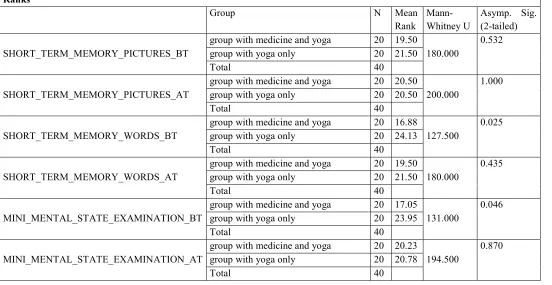
Mann-Whitney U test is done on parameters, to interpret the changes between the groups
PIC-IAMJ: Volume 7, Issue 1, January - 2019 (www.iamj.in) Page 52
TURES by comparing the Mean ranks between the groups, the group with medicine and yoga having greater mean rank than Group with yoga only at AT of treatment.
It can be concluded that Group with medicine and yoga having more effect than Group with yoga only with U=200, P-value=1.000 (>0.05)
Table 1: Ranks
Group N Mean
Rank
Mann-Whitney U
Asymp. Sig. (2-tailed)
SHORT_TERM_MEMORY_PICTURES_BT
group with medicine and yoga 20 19.50
180.000
0.532
group with yoga only 20 21.50
Total 40
SHORT_TERM_MEMORY_PICTURES_AT
group with medicine and yoga 20 20.50
200.000
1.000
group with yoga only 20 20.50
Total 40
SHORT_TERM_MEMORY_WORDS_BT
group with medicine and yoga 20 16.88
127.500
0.025
group with yoga only 20 24.13
Total 40
SHORT_TERM_MEMORY_WORDS_AT
group with medicine and yoga 20 19.50
180.000
0.435
group with yoga only 20 21.50
Total 40
MINI_MENTAL_STATE_EXAMINATION_BT
group with medicine and yoga 20 17.05
131.000
0.046
group with yoga only 20 23.95
Total 40
MINI_MENTAL_STATE_EXAMINATION_AT
group with medicine and yoga 20 20.23
194.500
0.870
group with yoga only 20 20.78
Total 40
Wilcoxon signed rank test showed increase in Short Term Memory score Analysis between BT and AT was found significant in both the groups with P-Value=0.0001 which is <0.05. On considering the Positive rankings on each group, it is found that 18 students having
improve-ment in the short term memory scores for words in Group A and only 16 students got memory improvement in Group B. So there was improvement in Group A than in Group B.
Table 2:
SHORT_TERM_MEMORY_PICTURES Ranks
N Mean Rank
Z-Value Asymp. Sig.
(2-tailed) GROUP
A SHORT_TERM_MEMORY_PICTURES_AT -
SHORT_TERM_MEMORY_PICTURES_BT
Negative Ranks 0a .00
-3.852
0.0001
Positive Ranks 18b 9.50
Ties 2c
Total 20
GROUP
B SHORT_TERM_MEMORY_PICTURES_AT -
SHORT_TERM_MEMORY_PICTURES_BT
Negative Ranks 0a .00
-3.624
0.0001 Positive Ranks 16b 8.50
Ties 4c
Total 20
SHORT_TERM_MEMORY_WORDS Ranks
N Mean Rank
Z-Value Asymp. Sig.
IAMJ: Volume 7, Issue 1, January - 2019 (www.iamj.in) Page 53 GROUP
A SHORT_TERM_MEMORY_WORDS_AT -
SHORT_TERM_MEMORY_WORDS_BT
Negative Ranks 0d .00
-3.946
0.0001 Positive Ranks 19e 10.00
Ties 1f
Total 20
GROUP
B SHORT_TERM_MEMORY_WORDS_AT -
SHORT_TERM_MEMORY_WORDS_BT
Negative Ranks 0d .00
-3.947
0.0001 Positive Ranks 18e 9.50
Ties 2f
Total 20
DISCUSSION
Socio economic status: - All students who participated in this study are from BPL families. Studies on humans and animal models suggest that socio economic status have strong influence with the brain development, cognition, academic achievement and mental health4. Also the influ-ence of parenting quality has an effect in determining the cognition and mental status of the students. Mostly the educational qualifications of the parents are also very low in low socio economic status families. It can have a direct effect on the mental functions of the student.
Sleep:- The sleep pattern of 37% of students are disturbed. The studies in animal and human models suggest that the quantity and quality of sleep have some impact on learn-ing and memory, even though the exact mechanism of relation is not identified properly.
Satva:- Among the 40 students 35% of students were of alpasatwa. They were too much disturbed by emotions and stress. It is told in Ayurvedic science that the distur-bance of manovaha srotas occurs mainly in alpasatva per-sons.
Academic Performance:- the students enrolled in the study were academically low performing as compared to other students in the class. After the study there was im-provement in overall academic performance of the stu-dents. This shows that yoga has strong influence in im-proving the quality of an individual both mentally and spiritually.
Discussion on results
Short term memory assessment test pictures:- The test result comparison in between groups were not statistically significant. But when compairing the mean ranks of the groups, the group with medicine and yoga shows im-provement in short term memory tests with pictures more than that of the group with yoga only. Also by clinical assessment there was marked improvement in scoring in the short term memory assessment tests in group A. In overall assessment the group with medicine and yoga showed 56.25% improvement of short term memory. It shows that in this test yoga has more influence than medi-cine.
Surya Namaskara is not a mere sequence of Asanas. It combines body movement with breath and awareness. This practice can increase the parasympathetic activity of the autonomous nervous system. It reduces the anxiety and other stress related problems. There is increased blood flow to each system of the body during the practice of Surya Namaskara. Also, there may be sequential activa-tion of each chakra and the individual is benefited physi-cally mentally and spiritually.. Nādi shudhi pranayama is the best method of pranayama for beginners. In the start-ing stage of pranayama the ratio of puraka: kumbhaka: recaka is 1:1:2. By regular practice we can increase this ratio to 1:2:4 and so on. Nādi shudhi pranayama improves the normal functioning of both the eda and pingala nadis. When the Ida nadi is not functioning smoothly or is blocked, one experiences cold, depression, low mental energy etc., whereas when the Pingala nadi is not smoothly functioning or is blocked, one will experience MINI_MENTAL_STATE_EXAMINATION Paired t-test
Mean MD Std. Deviation Std. Error Mean t-value df p-value
GROUP A Mini Mental State Examination_BT 3.80 -.750 .910 .204 -3.684 19 .002
Mini Mental State Examination_AT 4.55
GROUP B Mini Mental State Examination_BT 4.45 -.200 1.105 .247 -.809 19 .428
IAMJ: Volume 7, Issue 1, January - 2019 (www.iamj.in) Page 54 heat, quick temper and irritation. These all can be
re-moved by practicing nādi shudhi pranayama.
Short term memory tests words: - In this test, the be-tween group comparison showed significant results. The short term memory improvement of Group A is more as compared to the other group. In overall assessment also there was 51.02% improvement in group A and only 40% improvement in Group B. This shows that the vacā churṇa has action in improving the short term memory of stu-dents. It may act by Prabhava or Rasa or Guna or Virya. It is difficult to predict the exact mechanism and mode of action of drug. Certain drugs can act with their rasa, some other by its Vipaka, some other by its vīrya and some oth-ers acts by its prabhava. The katu rasa of vāca itself stimulates the agni and purifies the srotas and act as medhya and rasāyana. Its laghu thiksṇa guṇa stimulates the normal functioning of prāna vāta, udana vāta and sadhakapitta and thereby improving the budhi,smṛti and medha. By its srotoshodhana action it can remove the Avarana of Tamas and thus improve Grahanashakti and smaranashakti.
Mini mental state examination: - In this tests, the be-tween group comparison has no significant results. But comparing the means of BT and AT between groups, there was marked improvement in mental state examination scores. In overall performance also there was improve-ment upto 19.48% percentage in Group with both medi-cine and yoga and in Group with yoga only is 4.49%. This shows that both the yoga and medicine had strong influ-ence in improving the mental state of the student. The mental state of the student is very much influenced by the various stresses in daily life at school and home environ-ment. Yoga procedures and pranayama helps to bring about the balance of mind and may help to remove the mental stresses. According to Ayurveda the normal func-tioning of tridosas with the presence of manas help in the normal perception of indriyas, medha, budhi and smriti. By normalising the tridosa and improving the mental qualities of an individual, normal perception of all these can be brought about.
It can be concluded that the drug vacā had showed influ-ence in improving one of the tests of short term memory. On the other hand the yoga procedures showed consider-able influence in improving the overall performance of the students.
Conclusions
The present study proved that there is an addition on effect in the administration of vacā churna along with the proved yoga techniques in improving the short term mem-ory of high school students. Further studies are to be done with large sample sizes and longer durations to assess its effect in overall performance of students.
References
1. Dr Swami Nirmalananda Saraswati, Psychophysiological
Effects of Nadi Shodhana Pranayama, Yoga Research Foundation, Yoga journal, Bihar school of yoga
2. Effects of Suryanamaskara on relaxation among college
students with high stress in Pune, India, PUBMED, PMCID: PMC4278130
3. http://www.human-memory.net/types_short.html
4. Socioeconomic Status and Neurocognitive Development:
Executive Function Gwendolyn M. Lawson, Cayce J. Hook, Daniel A. Hackman, & Martha J. Farah
Source of Support: Nil
Conflict Of Interest: None Declared
How to cite this URL: Deepa S et al: The Effect Of Selected Yoga Techniques And Vacā ChūrṆa On Short Term Memory Of High School Students. International Ayurvedic Medical Journal {online} 2018 {cited January, 2019} Available from: