CLINICAL REPORT
Hypothermia and Neonatal Encephalopathy
abstract
Data from large randomized clinical trials indicate that therapeutic hypothermia, using either selective head cooling or systemic cooling, is an effective therapy for neonatal encephalopathy. Infants selected for cooling must meet the criteria outlined in published clinical trials. The implementation of cooling needs to be performed at centers that have the capability to manage medically complex infants. Because the ma-jority of infants who have neonatal encephalopathy are born at com-munity hospitals, centers that perform cooling should work with their referring hospitals to implement education programs focused on in-creasing the awareness and identification of infants at risk for enceph-alopathy, and the initial clinical management of affected infants. Pediatrics2014;133:1146–1150
BACKGROUND
In 2005, the National Institute of Child Health and Human Development (NICHD) convened a workshop to evaluate the status of knowledge regarding the safety and efficacy of hypothermia as a neuroprotective therapy for neonatal hypoxic-ischemic encephalopathy.1 Shortly
thereafter, the Committee on Fetus and Newborn of the American Academy of Pediatrics published a commentary supporting the rec-ommendation of the workshop that the widespread implementation of hypothermia outside the limits of controlled trials was premature.2In
2010, theEunice Kennedy Shriver NICHD organized a follow-up to the 2005 workshop to review available evidence.3 The purpose of this
clinical report is to review briefly the current knowledge regarding the efficacy and safety of therapeutic hypothermia, to point out major gaps in knowledge that were identified at the 2010 workshop, and to suggest a framework for the implementation of hypothermia. The intended audience is neonatal/perinatal medicine practitioners.
PRELIMINARY STUDIES
Neuronal rescue of encephalopathic newborn infants using induced hy-pothermia is one of the few therapeutic modalities in neonatology that was studied extensively in animal models before clinical application in humans. From animal studies, it was noted that cooling the brain to approximately 32°C to 34°C starting within 5.5 hours after a hypoxic/ischemic insult and continuing to cool for 12 to 72 hours resulted in improved neuropatho-logic and functional outcomes.4After showing consistent benefit in animal
models, the safety, feasibility, and practicality of using induced hypo-thermia in infants who have neonatal encephalopathy were investigated in
COMMITTEE ON FETUS AND NEWBORN
KEY WORDS
hypothermia, hyperthermia, neonatal encephalopathy, infant, head cooling
ABBREVIATIONS
aEEG—amplitude-integrated electroencephalography EEG—electroencephalography
CI—confidence interval
NICHD—National Institute of Child Health and Human Development
RR—relative risk
This document is copyrighted and is property of the American Academy of Pediatrics and its Board of Directors. All authors havefiled conflict of interest statements with the American Academy of Pediatrics. Any conflicts have been resolved through a process approved by the Board of Directors. The American Academy of Pediatrics has neither solicited nor accepted any commercial involvement in the development of the content of this publication.
The guidance in this report does not indicate an exclusive course of treatment or serve as a standard of medical care. Variations, taking into account individual circumstances, may be appropriate.
All policy statements from the American Academy of Pediatrics automatically expire 5 years after publication unless reaffirmed, revised, or retired at or before that time.
www.pediatrics.org/cgi/doi/10.1542/peds.2014-0899
doi:10.1542/peds.2014-0899
PEDIATRICS (ISSN Numbers: Print, 0031-4005; Online, 1098-4275).
several small studies. Data from these preliminary clinical studies indicated that reducing body temperature by 2°C to 3°C for a prolonged period of time was possible and that the changes in blood pressure, heart rate, and cardiac output noted were of little clinical sig-nificance.5–7
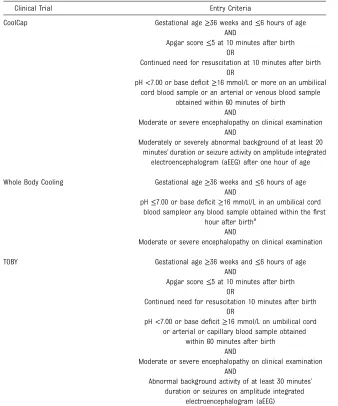
Large Randomized Clinical Trials of Hypothermic Neural Rescue (Table 1)
Six large randomized clinical trials of induced hypothermia for neonatal
encephalopathy were published from 2005 to 2011.8–13Although there were
some differences in the method of cool-ing and selection of subjects, in all trials infants were at least 35 weeks’gestation at birth; randomization was completed within 6 hours of birth; the target tem-perature was 33.5°C to 34.5°C; the inter-vention period was 72 hours, followed by slow rewarming (0.5°C/hour); and the primary outcome measure was the combined rate of death or disability, assessed at 18 to 22 months of age. Some trials used preferential head
cooling with mild body cooling,8,11 and
others used whole-body cooling9,10,12,13;
however, all trials continuously moni-tored both the degree of cooling and core body temperature. In addition, 3 trials used either amplitude-integrated electroencephalography (aEEG) or elec-troencephalography (EEG) for the as-sessment of severity of encephalopathy and enrollment of infants.8,10,12
Each of the 6 published trials was powered to detect a difference in the primary composite outcome of death or disability at 18 to 24 months of age, and all showed a benefit with cooling; in 4 of the 6 studies, this reached statistical significance. Rates of death or disability were similar in the control groups for 4 of the 6 studies, sug-gesting that patient selection and treatment were likely similar in these trials.8–10,13 A published meta-analysis
that included a small pilot study5 as
well as the 6 large published clinical trials demonstrated a reduction in the relative risk (RR) of the composite outcome of death or major neuro-developmental disability at 18 to 24 months of age by 24% (RR, 0.76; 95% confidence interval [CI], 0.69–0.84).14A
beneficial effect was noted both in infants who had moderate encepha-lopathy (RR, 0.67; 95% CI, 0.56–0.81) and those who had severe encepha-lopathy (RR 0.83; 95% CI, 0.74–0.92). The number of infants who need to be treated to prevent 1 infant from dying or becoming disabled is 6 for infants who have moderate encephalopathy and 7 for those who have severe encepha-lopathy. A review by the Cochrane col-laboration that included 11 randomized controlled trials comprising 1505 term and late preterm infants who had moderate/severe encephalopathy demon-strated similar results.15The reduction
in death or major neurodevelopmental disability to 18 months of age for treated infants was 25% overall; 32% for infants who had moderate encephalopathy and TABLE 1 Therapeutic Hypothermia Clinical Trials
Clinical Trial Entry Criteria
CoolCap Gestational age≥36 weeks and≤6 hours of age AND
Apgar score≤5 at 10 minutes after birth OR
Continued need for resuscitation at 10 minutes after birth OR
pH<7.00 or base deficit≥16 mmol/L or more on an umbilical cord blood sample or an arterial or venous blood sample
obtained within 60 minutes of birth AND
Moderate or severe encephalopathy on clinical examination AND
Moderately or severely abnormal background of at least 20 minutes’duration or seizure activity on amplitude integrated
electroencephalogram (aEEG) after one hour of age
Whole Body Cooling Gestational age≥36 weeks and≤6 hours of age AND
pH≤7.00 or base deficit≥16 mmol/L in an umbilical cord blood sampleor any blood sample obtained within thefirst
hour after birtha AND
Moderate or severe encephalopathy on clinical examination
TOBY Gestational age≥36 weeks and≤6 hours of age AND
Apgar score≤5 at 10 minutes after birth OR
Continued need for resuscitation 10 minutes after birth OR
pH<7.00 or base deficit≥16 mmol/L on umbilical cord or arterial or capillary blood sample obtained
within 60 minutes after birth AND
Moderate or severe encephalopathy on clinical examination AND
Abnormal background activity of at least 30 minutes’ duration or seizures on amplitude integrated
electroencephalogram (aEEG)
a
If blood gas is not available or pH is between 7.01 and 7.15 or base deficit is between 10 and 15.9 mmol/L on blood sample obtained within thefirst hour of birth, two additional criteria are needed: a history of an acute perinatal event (eg, cord prolapse, fetal heart rate decelerations) and either the need for assisted ventilation initiated at birth and continued for 10 minutes or an Apgar score≤5 at 10 minutes after birth.
Follow-up beyond infancy has been reported for subjects enrolled in the CoolCap trial and the NICHD Whole-Body Cooling trial.16,17 Because the
follow-up rate at 7 to 8 years of age was only 50% in the CoolCap trial, there were insufficient data to ascer-tain the long-term risk or benefits of selective head cooling. In the NICHD follow-up study, there was no statisti-cal difference in the composite pri-mary outcome of death or IQ<70 at 6 to 7 years of age between the treated and usual care cohorts (P= .06). Hy-pothermia treatment was associated with a reduction in the secondary outcomes of death (RR, 0.66; 95% CI, 0.45–0.97) and death or cerebral palsy (RR, 0.71; 95% CI, 0.54–0.95).
Observations From Large Clinical Trials
Adverse effects observed with hypo-thermia were infrequent in the target temperature ranges used in published clinical trials. The most common ad-verse effects were sinus bradycardia and prolongation of the QT interval on electrocardiogram, both of which are physiologic responses to hypothermia. Reddening or hardening of the skin (systemic hypothermia) and on the scalp (selective head cooling) and sub-cutaneous fat necrosis occurred rarely. The reported rates of coagulopathy, sepsis, and pneumonia were essen-tially the same in treated and control infants. When published studies were aggregated in a meta-analysis, the adverse effects of hypothermia in-cluded an increase in sinus brady-cardia and a significant increase in thrombocytopenia (platelet count <150 000/mm3).15
Both the TOBY and NICHD trial noted an adverse effect of pyrexia on neu-rologic outcome among infants allo-cated to standard care.18,19 In both
temperature greater than 38°C recorded on at least 1 occasion. The risk for death or disability among infants who had an elevated rectal temperature was increased by threefold in the TOBY trial, whereas in the NICHD trial, the risk for adverse outcome was in-creased threefold to fourfold, with each degree Celsius increase in the highest quartile of esophageal tem-perature. It is not known whether the elevated temperatures observed in the 2 trials caused additional brain injury or whether the elevated tem-peratures were the manifestation of existing hypoxic-ischemic brain injury.
Knowledge Gained From Large Clinical Trials
Approximately 1200 infants were en-rolled in the 6 large clinical trials of therapeutic hypothermia. Analyses of aggregate data, as well as data from registries, indicate that moderate hypo-thermia initiated within 6 hours of birth and continued for 72 hours is a safe and modestly effective neural rescue strategy for infants born at greater than 35 weeks of gestational age who have clinical ev-idence of moderate or severe neonatal encephalopathy.
Areas of Uncertainty
Because there was little variability among published clinical trials, ques-tions remain regarding the optimal timing for the initiation of cooling and the depth and duration of therapy. There are several ongoing randomized clinical trials that are designed to assess the efficacy of initiating cooling between 6 and 12 hours of age, using a deeper depth of cooling (32°C), or cooling for a longer duration (120 hours) (NCT 01192776, NCT 00614744). In addition, information regarding the safety and efficacy of cooling treat-ment of encephalopathic infants born
may be available in the near future (NCT 1793129).
There is also uncertainty regarding the safety and efficacy of initiating cooling before transfer to a center offering therapeutic hypothermia. However, data from the Vermont Oxford Encephalo-pathic Registry indicate that as many as a third of encephalopathic infants, many of whom were born in other facilities, were not admitted to a neonatal ICU until after 6 hours of age.20In a study in
which active cooling with cool packs was started on arrival of the transport team at the referring center, approxi-mately one-third of the 35 infants had a rectal temperature below 32°C on arrival at the cooling center.21A similar
rate of excessive cooling on arrival was noted when passive cooling was used (3 of 18 infants).22 Using a carefully
designed protocol for passive cooling at the referral hospital and on trans-port, Kendall et al noted that 67% of the 39 infants were within target temper-ature range (33°C–34°C) on arrival at the cooling center, and 11% had a rec-tal temperature below 32°C.23 There
have been 2 observational studies from the United Kingdom of servo-controlled cooling in the field.24,25 Application of
this mode of cooling led to significantly less overcooling and greater success in maintaining rectal temperature in the target range when compared with passive cooling.
Clinical Trials of Adjuvant Therapies for Neonatal Encephalopathy
melatonin, and xenon. Phase I and II trials of xenon (NCT 00934700, NCT 01545271) and topiramate (NCT 01241019, NCT 01765218) as adjuvant therapy to hypo-thermia are underway. A phase II study of erythropoietin using doses of 1000 U/kg intravenously in infants undergoing cool-ing is planned (NCT 01913340) and a phase I and II study of darbepoetin as concurrent therapy with cooling is in progress.26
There is also a phase I–II study assessing the safety and efficacy of clonidine ther-apy during cooling for neonatal enceph-alopathy (NCT 01862250).
CONCLUSIONS
1. Medical centers offering hypother-mia should be capable of providing comprehensive clinical care, in-cluding mechanical ventilation; physiologic (vital signs, tempera-ture) and biochemical (blood gas) monitoring; neuroimaging, includ-ing MRI; seizure detection and monitoring with aEEG or EEG; neu-rologic consultation; and a system in place for monitoring longitudi-nal neurodevelopmental outcome.
2. Infants offered hypothermia should meet inclusion criteria outlined in published clinical trials (see Ta-ble 1). Eligibility criteria include a pH of ≤7.0 or a base deficit of
≥16 mmol/L in a sample of umbil-ical cord blood or blood obtained during the first hour after birth,
history of an acute perinatal event, a 10-minute Apgar score of <5, or assisted ventilation initiated at birth and continued for at least 10 minutes. In addition, a neuro-logic examination demonstrating moderate to severe encephalopa-thy is essential. If preferential head cooling is used, an abnormal back-ground activity on either EEG or aEEG also is required.
3. Training programs and infrastruc-ture need to be established and maintained in a highly organized and reproducible manner to en-sure patient safety. Each center of-fering hypothermia therapy needs to develop a written protocol and monitor management and out-comes. Training needs to include awareness and timely identification of infants at risk for encephalopa-thy and an appropriate assessment of infants who have encephalopathy. Educational endeavors need to in-volve obstetric care providers; labor, delivery, nursery, and postpartum personnel; and pediatric care pro-viders.
4. Outreach education to community hospitals needs to be implemented. Specific issues include the aware-ness and timely identification of infants at risk for encephalopathy and prevention of extreme hypo-thermia and hyperhypo-thermia.
5. Cooling infants who are born at less than 35 weeks’ gestation or those who have mild encephalopa-thy, cooling for longer than 72 hours, cooling at a temperature lower than that used in published clinical trials, and the use of adju-vant therapies should only be per-formed in a research setting and with informed parental consent.
LEAD AUTHOR Lu-Ann Papile, MD, FAAP
COMMITTEE ON FETUS AND
NEWBORN, 2012–2013
Lu-Ann Papile, MD, FAAP, Chairperson Jill E. Baley, MD, FAAP
William Benitz, MD, FAAP James Cummings, MD, FAAP Waldemar A. Carlo, MD, FAAP Eric Eichenwald, MD, FAAP Praveen Kumar, MD, FAAP Richard A. Polin, MD, FAAP Rosemarie C. Tan, MD, PhD, FAAP Kasper S. Wang, MD, FAAP
LIAISONS
CAPT Wanda Denise Barfield, MD, MPH, FAAP–
Centers for Disease Control and Prevention
George Macones, MD – American College of Obstetricians and Gynecologists
Ann L. Jefferies, MD– Canadian Paediatric Society
Erin L. Keels APRN, MS, NNP-BC – National Association of Neonatal Nurses
Tonse N. K. Raju, MD, DCH, FAAP – National Institutes of Health
STAFF Jim Couto, MA
REFERENCES
1. Higgins RD, Raju TNK, Perlman J, et al. Hy-pothermia and perinatal asphyxia:
execu-tive summary of the National Institute of
Child Health and Human Development workshop.J Pediatr. 2006;148(2):170–175
2. Blackmon LR, Stark AR; American Academy
of Pediatrics Committee on Fetus and
Newborn. Hypothermia: a neuroprotective therapy for neonatal hypoxic-ischemic
en-cephalopathy.Pediatrics. 2006;117(3):942–
948
3. Higgins RD, Raju T, Edwards D, et al. Hy-pothermia and other treatment options for
neonatal encephalopathy: an executive summary of the Eunice Kennedy Shriver
NICHD Workshop.J Pediatr. 2011:159(5).e1– 858.e1
4. Gunn AJ, Gunn TR. The ‘pharmacology’of
neuronal rescue with cerebral hypother-mia.Early Hum Dev. 1998;53(1):19–35
5. Gunn AJ, Gluckman PD, Gunn TR. Selective
head cooling in newborn infants after
perinatal asphyxia: a safety study. Pediat-rics. 1998;102(4 pt 1):885–892
6. Azzopardi D, Robertson NJ, Cowan FM,
Rutherford MA, Rampling M, Edwards AD. Pilot study of treatment with whole body
hypothermia for neonatal encephalopathy.
Pediatrics. 2000;106(4):684–694
7. Gebauer CM, Knuepfer M, Robel-Tillig E,
Pulzer F, Vogtmann C. Hemodynamics among neonates with hypoxic-ischemic
8. Gluckman PD, Wyatt JS, Azzopardi D, et al. Selective head cooling with mild systemic hypothermia after neonatal encephalopa-thy: multicentre randomised trial. Lancet. 2005;365(9460):663–670
9. Shankaran S, Laptook AR, Ehrenkranz RA, et al; National Institute of Child Health and Human Development Neonatal Research Network. Whole-body hypothermia for neo-nates with hypoxic-ischemic encephalopathy.
N Engl J Med. 2005;353(15):1574–1584
10. Azzopardi DV, Strohm B, Edwards AD, et al; TOBY Study Group. Moderate hypothermia to treat perinatal asphyxial encephalopa-thy.N Engl J Med. 2009;361(14):1349–1358
11. Zhou WH, Cheng GQ, Shao XM, et al; China Study Group. Selective head cooling with mild systemic hypothermia after neonatal hypoxic-ischemic encephalopathy: a multi-center randomized controlled trial in China.
J Pediatr. 2010;157(3):367–372, e1–e3
12. Simbruner G, Mittal RA, Rohlmann F, Muche R; neo.nEURO.network Trial Participants. Systemic hypothermia after neonatal en-cephalopathy: outcomes of neo.nEURO.net-work RCT.Pediatrics. 2010;126(4). Available at: www.pediatrics.org/cgi/content/full/126/4/e771
13. Jacobs SE, Morley CJ, Inder TE, et al; Infant Cooling Evaluation Collaboration. Whole-body hypothermia for term and near-term newborns with hypoxic-ischemic
encepha-14. Tagin MA, Woolcott CG, Vincer MJ, Whyte RK, Stinson DA. Hypothermia for neonatal hyp-oxic ischemic encephalopathy: an updated systematic review and meta-analysis.Arch Pediatr Adolesc Med. 2012;166(6):558–566
15. Jacobs SE, Berg M, Hunt R, et al. Cooling for newborns with hypoxic ischaemic enceph-alopathy. Cochrane Database Syst Rev
2013;(1):CD003311. doi: 10. 1002/14651858. CD003311.pub3. Review
16. Shankaran S, Pappas A, McDonald SA, et al; Eunice Kennedy Shriver NICHD Neonatal Research Network. Childhood outcomes after hypothermia for neonatal encephalop-athy.N Engl J Med. 2012;366(22):2085–2092
17. Guillet R, Edwards AD, Thorenson M, et al. CoolCap Trial Group. Seven-to eight year follow-up of the CoolCap trial of head cooling for neonatal encephalopathy.
Pediatr Res. 2012;71(2):205–209
18. Wyatt JS, Gluckman PD, Liu PY, et al. Cool-Cap Study Group. Determination of out-comes after head cooling for neonatal encephalopathy. Pediatrics. 2007;119(5): 912–921
19. Laptook A, Tyson J, Shankaran S, et al; Na-tional Institute of Child Health and Human Development Neonatal Research Network. Elevated temperature after hypoxic-ischemic encephalopathy: risk factor for adverse out-comes.Pediatrics. 2008;122(3):491–499
athy Registry: rationale, methods, and ini-tial results.BMC Pediatr. 2012;12:84
21. Fairchild K, Sokora D, Scott J, Zanelli S. Therapeutic hypothermia on neonatal transport: 4-year experience in a single NICU.J Perinatol. 2010;30(5):324–329
22. Hallberg B, Olson L, Bartocci M, Edqvist I, Blennow M. Passive induction of hypother-mia during transport of asphyxiated infants: a risk of excessive cooling. Acta Paediatr. 2009;98(6):942–946
23. Kendall GS, Kapetanakis A, Ratnavel N, Azzopardi D, Robertson NJ; Cooling on Retrieval Study Group. Passive cooling for initiation of therapeutic hypothermia in neonatal encephalopathy. Arch Dis Child Fetal Neonatal Ed. 2010;95(6):F408– F412
24. Johnston ED, Becher J-C, Mitchell AP, Stenson BJ. Provision of servo-controlled cooling during neonatal transport. Arch Dis Child Fetal Neonatal Ed. 2012;97(5): F365–F367
25. Chaudhary R, Farrer K, Broster S, McRitchie L, Austin T. Active versus passive cooling during neonatal transport. Pediatrics. 2013;132(5):841–846
DOI: 10.1542/peds.2014-0899 originally published online May 26, 2014;
2014;133;1146
Pediatrics
COMMITTEE ON FETUS AND NEWBORN
Hypothermia and Neonatal Encephalopathy
Services
Updated Information &
http://pediatrics.aappublications.org/content/133/6/1146
including high resolution figures, can be found at:
References
http://pediatrics.aappublications.org/content/133/6/1146#BIBL
This article cites 24 articles, 11 of which you can access for free at:
Subspecialty Collections
http://www.aappublications.org/cgi/collection/neonatology_sub
Neonatology
sub
http://www.aappublications.org/cgi/collection/fetus:newborn_infant_
Fetus/Newborn Infant
_newborn
http://www.aappublications.org/cgi/collection/committee_on_fetus_
Committee on Fetus & Newborn
http://www.aappublications.org/cgi/collection/current_policy
Current Policy
following collection(s):
This article, along with others on similar topics, appears in the
Permissions & Licensing
http://www.aappublications.org/site/misc/Permissions.xhtml
in its entirety can be found online at:
Information about reproducing this article in parts (figures, tables) or
Reprints
http://www.aappublications.org/site/misc/reprints.xhtml
DOI: 10.1542/peds.2014-0899 originally published online May 26, 2014;
2014;133;1146
Pediatrics
http://pediatrics.aappublications.org/content/133/6/1146
located on the World Wide Web at:
The online version of this article, along with updated information and services, is
by the American Academy of Pediatrics. All rights reserved. Print ISSN: 1073-0397.