797 | P a g e
WEB IMAGE SEARCH ENGINE USING
QUERY SPECIFIC SEMANTIC SIGNATURES
M. Athilakshmi @ Dhivya Rani
1, S. Siva Nandini
2,
N. Senthil Madasamy
31,2
Department of Information Technology, Kamaraj College of Engineering and Technology,
Virudhunagar, Tamil Nadu, (India)
3
Assignment Professor, Department of Information Technology, Kamaraj College of Engineering and
Technology, Virudhunagar , Tamil Nadu, (India)
ABSTRACT
Image search engine, as an effective way to provide matching of images in a semantic space which used
attributes or reference classes closely related to the semantic meanings of images as basis. Given a query
keyword, a pool of images is first retrieved based on textual information. By asking the user to select a query
image from the pool, the remaining images are re-ranked based on their visual similarities with the query
image. In this paper, we propose a image search framework, which automatically offline learns different
semantic spaces for different query keywords. The visual features of images are projected into their related
semantic spaces to get semantic signatures. The proposed query-specific semantic signatures significantly
improve both the accuracy and efficiency of image re-ranking.
Keywords : Image Search, Semantic Signatures, Image Re–Ranking, Keyword Expansion,
Semantic Space
I INTRODUCTION
Web - image search engines mostly use keywords as queries and rely on surrounding text to search images.
They suffer from the ambiguity of query keywords, because it is hard for users to accurately describe the visual
content of target images only using keywords. For example, using “apple” as a query keyword, the retrieved
images belong to different categories, such as “red apple”,”apple logo”, and “apple laptop”. In order to solve
the ambiguity, content-based image retrieval[9] is widely used. It requires users to select multiple relevant and
irrelevant image examples, from which visual similarity metrics are learned through online training. Images are
798 | P a g e
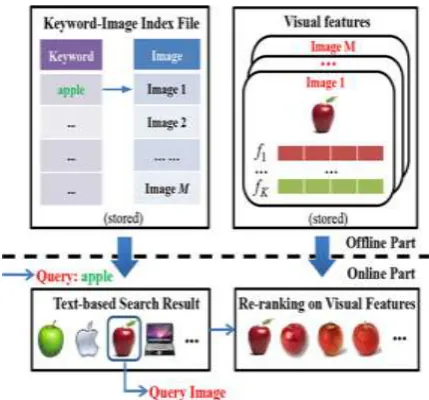
Fig. 1: The conventional image re – ranking framework.
In this paper, a novel framework is proposed for web image re-ranking. Instead of manually defining a universal
concept dictionary, it learns different semantic spaces for different query keywords individually and
automatically.
II.
EXISTING
SYSTEM
In the current commercial search engines, user given a query keyword a pool of images are first retrieved based
on textual information. They suffer from the ambiguity of query keywords, because it is hard for users to
accurately describe the visual contents of target images only using keywords. Large amounts of junk images
which are irrelevant to the given keyword – based queries.
Fig. 2: System Design
III.
PROPOSED
SYSTEM
Here, we have proposed a query – specific semantic spaces can more accurately provide the images to be re –
ranked. For example, if the query keyword is “apple,” the concepts of “mountain” and “Paris” are irrelevant and should be excluded. Instead, the concepts of “computer” and “fruit” will be used as dimensions to learn the semantic space related to “apple.” The query-specific semantic spaces can more accurately model the images to
799 | P a g e
effective, where it is crucial to reduce the semantic gap when computing the similarities of images. Theproposed system which refined image search with relative attribute.
Fig. 3: System Design
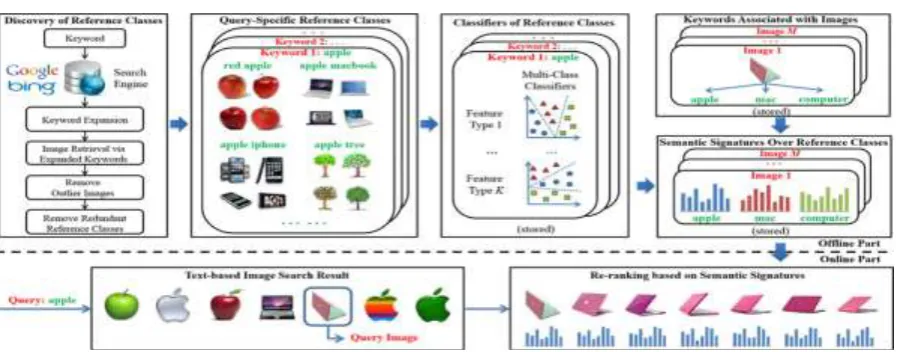
Fig. 4: Web Image Search Engine Using Query Specific Semantic Signatures
At the offline stage, the reference classes related to query keywords are automatically discovered. For each
query keyword, its reference classes forms the basis of its semantic space. The semantic signature of an image is
extracted by computing the similarities between the image and the reference classes of the query keyword.
IV.EXPERIMENTALS RESULTS
The images for testing the performance of re-ranking and the training images of reference classes can be
collected at different time (since the update of reference classes may be delayed) and from different search
engines. Given a query keyword, 1,000 images are retrieved from the whole web using a search engine. As
summarized in Table 1, we create three data sets to evaluate the performance of our approach in different
800 | P a g e
120 query keywords in July 2010. These query keywords cover diverse topics including animals, plants, food,places, people, events, objects, and scenes, etc. The training images of reference classes were also collected
from the Bing Image Search around the same time. Data set II uses the same testing images as in data set I.
However, its training images of reference classes were collected from the Google Image Search also in July
2010. In data set III, both testing and training images were collected from the Bing Image Searchbut at different
time. All the testing images for re-ranking are manually labeled, while the images of reference classes, whose
number is much larger, are not labeled.
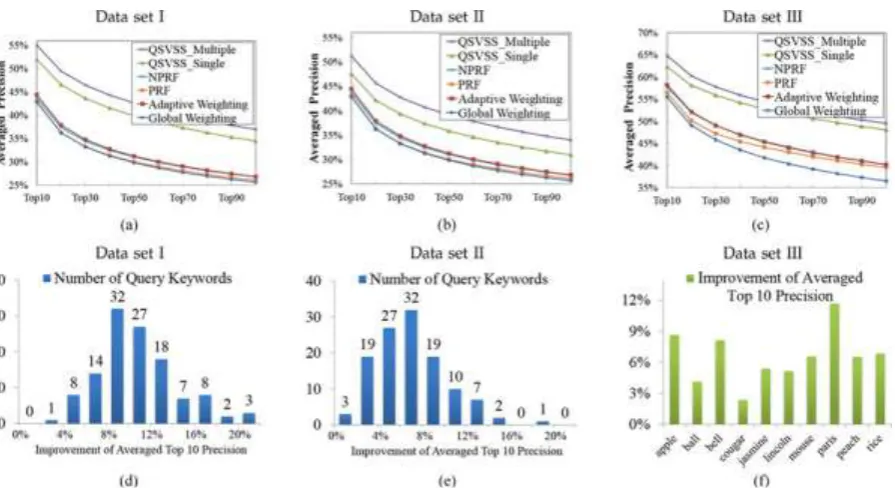
Fig. 5. (a)-(c) Averaged top m precisions on data sets I, II, III. (d) and (e) Histograms of
improvements of averaged top 10 precisions on data sets I and II by comparing QSVSS
Multiple with Adaptive Weighting. (f) Improvements of averaged top 10 precisions on the 10
query keywords on data set III by comparing QSVSS Multiple with Adaptive Weighting.
V.
CONCLUSION
We propose a image framework, which learns query – specific semantic spaces to significantly improve the
effectiveness and efficiency of online image re – ranking. The visual features of images are projected into their
related semantic spaces automatically learned through keyword expansions offline.
VI.
ACKNOWLEDGEMENTS
We kindly thank our honorable guide and staff members who have provided their motivation and support for
801 | P a g e
REFERENCES
[1] Xinmei Tian, Yijuan Lu, Member, IEEE, and Linjun Yang, Member, IEEE , ”Query Defficulty Prediction
for web Image Search,” IEEE Transactions On Multimedia, Vol. 14, No. 4, August 2012.
[2] Jun Yu, Member, IEEE, Yong Rui, Fellow, IEEE, and Dacheng Tao, Senior Member, IEEE, “Click
Prediction for Web Image Reranking Using Multimodal Sparse Coding,” IEEE Transactions On Image
Processing, Vol. 23, No. 5, May 2014.
[3] Yuli Gao, Jinye Peng, HangzaiLuo,DanielA.Keim, and Jianping Fan , “An Interactive Approach for
Filtering Out Junk Images form keyword – based Google Search Results,” IEEE Transactions On Circuits
And Systems For Video Technology, Vol. 19, No. 12, December 2009.
[4] Ruofei Zhang, Member, IEEE, and Zhongfei (Mark) Zhang, Senior Member, IEEE, “Effective Image
Retrieval Based on Hidden Concept Discovery in Image Database,” IEEE Transaction Image Processing,
Vol. 16, N0. 2, February 2007.
[5] Shikui Wei, Dong Xu, Xuelong Li,Fellow, IEEE,and Yao Zhao,Senior Member, IEEE, “Joint Optimization
Toward Effective and Efficient Image Search,” IEEE Transactions On Cybernetics, Vol. 43, No. 6,
December 2013.
[6] Wei-Hao lin; Rong Jin, and Hauptmann,A. , “Web Image Retrieval Re-Ranking with Relevance Model,”
IEEE/WIC international conference, 2003.
[7] Boqing Gong , Jianzhuang Liu, Xiaogang Wang, Member, IEEE and Xiaoou Tang, “Learning Semantic
Signatures for 3D Object Retrieval,” IEEE Transactions On Multimedia, Vol. 15, No. 2, February 2013.
[8] R.Fergus,P.Perona,and A.Zisserman, “A Visual Category Filter for Google Images,” IEEE Transactions On
Multimedia, 2009.
[9] Y.Rii,T.S Huang, M.Ortega, and S.Mehrotra, “Content – Based Image Retrieval,” IEEE Tran. Circuits and