Indian J. Plant Physiol., Vol. 7, No. 4, (N.S.) pp. 309-313 (Oct.-Dec., 2002)
PHENOTYPIC DIFFERENCES IN RESPONSE TO SUBMERGENCE IN RAINFED
LOWLAND RICE
ANURADHA SINGH, P.C. RAM, A.K. SINGH* AND 8.8. SINGH
Centre of Advanced Studies in Plant Physiology, Department of Crop Physiology N.D. University of Agriculture & Technology, Kumarganj, Faizabad-224229
Received on 30 April, 2002, Revised on 21 Sept., 2002
SUMMARY
Phenotypic differences in response to submergence was studied in tolerant and intolerant rainfed lowland rice varieties. Increase in submergence duration, in general, induced shoot elongation, root porosity and decreased the plant survival, tiller number per plant and root and shoot dry weight. The survival was higher in tolerant varieties FR 13A (87%) and Vaidehi (80%) than in intolerant varieties Mahsuri (27%) and IR 42 (13'Yo). Tolerant varieties invariably had higher vigor (plant height and dry matter) before submergence though underwater shoot elongation was more in intolerant varieties. A correlation study between change in root porosity and plant survival showed a positive linear relationship with R2 value of0.57 and 0.88 for Sd and
1 Od submergence respectively. It is evident that root porosity has a significant impact on the survival behaviour of rice plants after submergence.
Key words: Porosity, rainfed lowland, rice, shoot elongation rate, submergence.
INTRODUCTION
Rice environments in India are extremely diverse ranging from r.ainfed upland to lowland and deep water where water hydrology vqries from deficit to waterlogging and ponding up to 2-3 metres, respectively. Of the 42 million ha of rice lands, 33% is rainfed lowland, 45% irrigated, 1 YYo rain fed upland and 7% flood prone (IRRI 1993 ). Rainfed lowland represent about one-third area, but the productivity is very low ( 1.0 to 1.5 t/ha). Eastern India adversely effected by waterlogging and flash floods each year (Reddy and Sharma 1992). In the rainfed lowland environment submergence especially at early stages is the most important limitation to rice production.
Flooding or submergence is known to create hypoxia or anoxia in the plant system due to 104 time slow
diffusion of gases in water (Armstrong 1979). Low 02, High C02 and ethylene are often encountered in flooded and submerged rice plants (Ram et al. 1999).
*Corresponding author
Indian J. Plant Physiol., Vol. 7, No.4, (N.S.) pp. 309-313 (Oct.-Dec., 2002)
In areas where rainfed lowland rice is subjected to flash floods, elongation growth results in lodging and additional effect may be associated with desubmergence and post hypoxic injury (Palada and Vergara 1972). Hence, plants adapted to these areas must have submergence tolerance. In majority of cases the successful strategy is probably the combination of morphological, anatomical and metabolic adaptation (Jolly 1991 ). The present investigation, therefore, aims to understand the possible physiological traits associated with tolerance/ susceptibility to submergence in rainfed lowland rice.
MATERIALS AND METHODS
The experiment was conducted under pot culture condition at experimental site of Department of Crop Physiology, Narendra Deva University of Agriculture and Technology, Kumarganj, Faizabad. The experiment was laidout in complete randomized block design involving four rice varieties and three replications. Ten sprouted
seeds were sown 1 em deep in pots containing 8.0 Kg normal farm soil fertilized with recommended doses ofN,
P, K (120: 60:60 kg/ha). Thirty days old plants were used for 5 and 10 days of complete submergence. Growth observations like plant height, survival(%), till ern umber per plant, root and shoot dry weight were taken before submergence and just after 5 and 10 d submergence durations. Subsequently, survival and tiller mortality were recorded 1 Od after termination of submergence treatments. Root porosity was measured using the method ofRaskin(1983). This method isbasedonthemeasurement of the buoyancy oftissue before and after they are vacuum infiltrated with water. Porosity was calculated by formula given below :
Porosity= [(Wt4-Wt2)/(Wt1-(Wt3-Wt2)] X 100
Where Wt1 =air weight,
Vv\
=holder weight in water, Wt3 =buoyant weight (sample+ holder in water), Wt4= weight of vacuum infiltrated tissue filled with water.RESULTS AND DISCUSSION
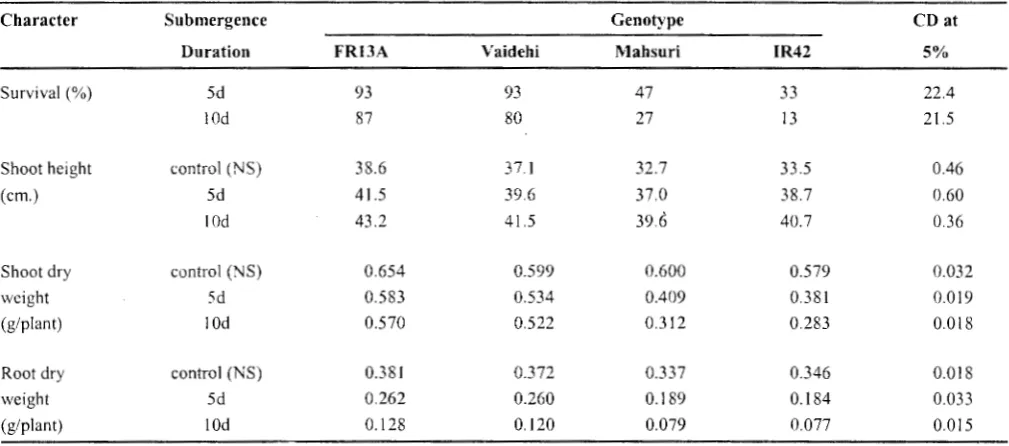
Significant differences for survival in intolerant and tolerant varieties were observed following 5 and 10 days complete submergence. Intolerant varieties like Mahsuri
and IR 42 showed only 27 and 13 per cent survival respectively after 10 d submergence, which were significantly lower than tolerant varieties (Table 1).
On submergence plant height increased due to leaf sheath elongation irrespective of the variety and submergence duration (Table 1 ). Shoot elongation rate was rapid during early stage of submergence ( Sd) in all the genotypes. However, with subsequent submergence duration (1 Od) the elongation continued but the rate was slower than the Sd submergence treatment (Table 2). Per cent elongation was significantly higher in intolerant variety IR 42 (21.4%) and Mahsuri (21. 1%) as compared to the tolerant FR13A (11.9%), Va1dehi (11.8%) respectively. Singh et al. (2001) reported better survival with lower shoot elongation during submergence. Rice varieties Mahsuri and IR 42, with greater shoot elongation during submergence had poor survival (Tables I & 2). Number of tillers produced by 30 d old plants of tolerant and intolerant varieties was almost similarranging between 3 to4. Tillermortalityofvaryingdegree occurred in all the varieties with 10 d submergence whereas with Sd submergence only Mahsuri and IR 42 showed tiller mortality. Maximum tiller mortality was observed in Mahsuri (67%) during 10 d submergence followed by IR
Table 1. Effect of submergence on survival, shoot height, shoot and root dry weight of rice varieties (30 d old plants,
submerged for 5 and 1 0 d)
Character Submergence Genotype CD at
Duration FR13A Vaidehi Mahsuri IR42 5%
Survival (%) 5d 93 93 47 33 22.4
IOd 87 80 27 13 21.5
Shoot height control (NS) 38.6 37.1 32.7 33.5 0.46
(em.) 5d 41.5 39.6 37.0 38.7 0.60
IOd 43.2 41.5 39.6 40.7 0.36
Shoot dry control (NS) 0.654 0.599 0.600 0.579 0.032
weight 5d 0.583 0.534 0.409 0.381 0.019
(g/plant) IOd 0.570 0.522 0.312 0.283 0.018
Root dry control (NS) 0.381 0.372 0.337 0.346 0.018
weight 5d 0.262 0.260 0.189 0.184 0.033
(g/plant) IOd 0.128 0.120 0.079 0.077 0.015
NS =Non-submerged
RESPONSE TO SUBMERGENCE IN LOWLAND RICE
Table 2. Effect of submergence on shoot elongation rate, root porosity and tiller number plant1 of rice varieties (30 d old plants, submerged for 5 and 10 d).
Character Genotype Non-sbmerged Submergence duration
5d 10 d
Shoot elongation FR 13A 0.58 (7.5) 0.46 (11.9)
rate (em d ')
Vaidehi 0.50 (6.7) 0.44 (I 1.8)
Mahsuri 0.86(13.1) 0.69(21.1)
IR42 1.04 (15.5) 0.72 (21.4)
CD at 5% 0.57 0.54
Root porosity(%) FR 13A 19.0 30.5 32.9
Vaidehi 16.9 25.2 29.7
Mahsuri 16.0 18.3 21.7
IR42 14.2 19.7 20.3
CDat5% 0.55 0.59 0.24
Tiller plant·' FR 13A 3.0 3.0 (0) 2.0 (33)
Vaidehi 3.0 3.0 (0) 2.0 (33)
Mahsuri 3.7 2.0 (46) 1.0 (67)
IR42 3.0 2.0 ( 46) 1.0 (67)
CD at 5% 0.54 0.54 0.24
• Figures m parentheses are% shoot elongation over non-submerged control and per cent tiller mortality.
42 (46%). FR 13A and Vaidehi each showing 33% tiller mortality (Table 2). Tilleringmight be adversely affected as a result of rapid increase in plant height during submergence which exhaust plant reserves (Reddy and Mittra 1985).
The tolerant varieties FR13A and Vaidehi showed almost identical reduction in shoot dry weight during 5 and 10 d submergence (Table 1). However, per cent reduction in shoot dry weight in Mahsuri was 31 per cent with 5 d and 48 per cent with 10 d submergence duration which was significantly higher than the tolerant varieties. The pattern of root dry weight before submergence was almost similar to shoot dry weight in tolerant and intolerant varieties. However, the magnitude of reduction in dry weight was much higher in root than that in shoot irrespective of the tolerance levels of the varieties. It is evident, therefore, that roots suffer more than shoots during submergence probably due to reduced
Indian J Plant Physiol., VoL 7, No.4, (N.S.) pp. 309-313 (Oct.-Dec., 2002)
photosynthetic supply from the shoots and accelerated dark respiration.
Earlier studies have also reported that submergence tolerant genotypes accumulating higher dry matter before submergence and they still maintain enough dry matter to sustain rapid growth and development after desubmergence (Chaturvedi eta!. 1995, Singh eta!. 2001 and Ram et al. 2002).
Data presented in Table 2 revealed that submergence increased the porosity of roots in all the varieties. Before submergence root porosity in FR13A and Vaidehi was higher than Mahsuri and lR 42. During initial stage of submergence, root porosity increased which was much faster in tolerant than intolerant varieties. Further increase in submergence duration from 5d to 1 Od, only a slight increase in root porosity was observed irrespective of the varieties. Change in root porosity in plants in response to
submergence is yet another adaptive feature which help in gas transport through plants especially during submergence. Increase in root porosity seems to have beneficial effect on 02 transport which probably helped in plant survival during submergence (Armstrong and Wright 1975). A correlation study between change in root porosity and survival showed a positive linear relationship with R2
value ofO .57 for 5d submergence. This correlation further improved to R2 value of 0.88 with 10d submergence (Fig.1). Itisthusamplyclearthatporosity has a significant role to play in survival of plants. Development of aerenchyma in plants in response to submergence has been reported which facilitates gas transport through plants and porosity is the resultant of aerenchyma development. Rogers and West (1993) also showed that roots produced by waterlogged T. fragiferum and
T repens has higher porosity than roots grown in drained
soil. Root porosity also helps in radial diffusion of oxygen besides vertical transport (Armstrong 1979, Gibbs eta/. 1999).
120
y = 6.3148x + 23.2 100 R' = 0.5756
tx:l 40 20 0 0
•
10 Increase In rca porosity(%)y = 8.3038x -27.912 R'=0.8832
1CX:f
12 14
Fig. 1. Correlation between survival and increase in root porosity during submergence in lowland rice varieties
16
It is concluded that lowland rice needs only moderate shoot elongation to avoid complete submergence but for a short period of submergence, zero elongation would be quite useful. The available reserves in moderate elongating plants will be available for maintenance processes during submergence and recovery growth after the submergence. Setter and Laureles (1996) have clearly shown the beneficial effect of reduced elongation during submergence on survival of a number of rice genotypes.
312
Present investigation also revealed the relationship between survival and elongation and survival and dry matter production. Increase in root porosity in response to submergence is an adaptive feature which helps in gas transport through plants especially during submergence and rescues plant from the effects of hypoxia or anoxia. However, relationship between root porosity and survival of submergence needs validation in large number of rice genotypes.
REFERENCES
Armstrong, W. (1979). Aeration in higher plants. Advan. Bot. Res. 7: 225-232.
Armstrong, W. and Wright, E.J. (1975). Radial oxygen loss from roots: The theoretical basis for the manipulation of flux data obtained by the cylindrical platinum electrode technique. Physiol Plant. 25: 21-26.
Chaturvedi, G.S., Misra, C.H., Singh, O.N., Pandey, C.B., Yadav, V.P., Singh, A.K., Dwivedi, J.L., Singh, B.B. and Singh, R.K. (1995). Physiological basis and screening for tolerance for flash flooding. In: K.T. Ingram (ed.), Rainfed Lowland Rice: AgricUltural Research in High Risk Environments, pp. 78-96. International Rice Research Institute. Los Banos, Philippines.
Gibbs, J., Morell, S., Valdez, A., Setter, T.L. and Greenway, H. ( 1999). Regulation of alcoholic fermentation in coleoptiles of two rice cultivars differing in tolerance to anoxia. Aust. J. Plant Physiol. (Submitted).
IRRI, International Rice Research Institute (1993). Rice, Almanac. International Rice Research Institute, Manila, Philippines.
Jolly, C.A. (1991). Flooding tolerance in tropical trees. In: M.B. Jackson, D.O. Danies and H. Lambers ( eds.), Plant Life Under Oxygen Stress, pp. 23-24. SPB Publishing. The Hague, The Netherlands.
Palada, M. and Vergara, B.S. (1972). Environmental effect on the resistance of rice seedlings to complete submergence. Crop
Sci. 12: 209-212.
Ram, P.C., Singh, A.K., Singh, B.B., Singh, V.K., Singh, H.P., Setter, T.L., Singh, V.P., Singh R.K. and Ziegler, R.J. ( 1999). Environmental characterization of flood water in Eastern India. I. Relevance to submergence tolerance of low land rice. Exp. Agri. 35: 141-152.
Ram, P.C.,Singh,B.B.,SinghA.K., RamParashu, Singh,P.N. Singh, H.P., Boamfa, I.E., Harren, F.S.M., Edi Santosa, Jackson, M.B., Setter, T.L., Reuss, J., Wade, L.J., Singh, V.P., Singh R.K. (2002). Submergence tolerance in rainfed lowland rice: Physiological basis and prospects for cultivar improvement through marker-aided breeding. Field Crops Res. 76: 131-152.
RESPONSE TO SUBMERGENCE IN LOWLAND RICE Raskin, I. (I 983 ). A method for measuring leaf volume, density,
thickness and internal gas volume. Hart. Sci. 18: 698-699. Reddy, M.D. and Sharma, A.R. (1992). Agrotechniques for rice
grown on rain fed flooded lands of Eastern India. Indian Farming
22-23.
Reddy, M.D. and Mittra, B.N. (1985). Effect of complete plant submergence at different growth stages on grain yield, yield components and nutritional content of rice. Plant & Soil 86:
379-386.
Indian J. Plant Physiol., Vol. 7, No.4, (N.S.) pp. 309-313 (Oct-Dec., 2002)
Roger, M.E. and West, D.W. (1993). The effects of root zone salinity and hypoxia on shoot and root growth in Trifolium species. Ann. Bot. 72: 503-509.
Setter, T.L. and Laureles, E. V. (I 996). The beneficial effect of reduced elongation growth on submergence tolerance of rice.
J. Exp. Bot. 47: (303): 1551-1559.
Singh, H.P., Singh, B.B. and Ram, P.C. (2001). Submergence tolerance of rainfed lowland rice: Search for marker traits. J. Plant Physiol. 158: 883-889.