158 |
P a g e
VISUAL OBJECT TRACKING AND DETECTION IN
COMPUTER VISION
Mr. S. S. Athatey
1, Prof. Y. M. Kurwade
2, Dr. V. M. Thakare
3SGBAU, Amravati, (India)
Abstract
Visual tracking is one of the most important topics in computer vision due to its wide potential applications,
such as motion analysis, video surveillance, and human–computer interaction. This paper proposed a method
for visual tracking which is based on local sparse descriptors and DML tracker. To detect target from the
background positive and negative training samples are extracted from the target region and the background
regions respectively. Then these samples are input to DML tracker, with the help of feed forward neural network
and distance metric DML tracker can find true match.
Index Terms – DML tracker, local descriptor, DSS map, visual tracking
I. INTRODUCTION
Visual tracking is one of the most important topics in computer vision due to its wide potential applications,
such as motion analysis, video surveillance, and human– computer interaction.Visual object tracking still
remains a challenging problem in computer vision due to large appearance variations in visual objects such as
varying deformations, illuminations, out-of-plane rotations, occlusions, and cluttered backgrounds [1].
Generally, the distribution of objects is usually in a nonlinear manifold due to various variations such as
deformations, illuminations, and occlusions, and hence, it is desirable to employ nonlinear discriminative
methods to exploit such information [3].Generative methods focus on searching for the regions that are the most
similar to the tracked targets, including template-based, subspace-based, and sparse representation-based
models. While discriminative methods cast tracking as a classification problem that distinguishes the tracked
targets from the surrounding backgrounds [2],[3].Sparse coding based appearance models have been
successfully applied to visual tracking [3].The main problem with current pooling methods for visual tracking
lies in the fact that final features considering the sparse codes of all patches are usually sensitive to occlusion
and other interfering factors. When the target undergoes a long-time partial occlusion or heavy deformation,
performance of these methods would degrade greatly.With DSS map, candidates are evaluated in both
directions: not only how similar it is to the target object but also how different it is from the background [4].A
nonparametric data-driven local metric adjustment methodminimizes the deviation of the empirical
misclassification probability to obtain the optimal metric such that the asymptotic error as if using an infinite set
of training samples can be approximated [5].
This paper, first take overview of five existing methods for visual tracking and object detection and proposed a
159 |
P a g e
sparse descriptors with DML tracker. The sparse descriptors are used to find the target object from scene. Alsostructural local descriptors with local patches that are not occluded can achieve good discrimination. Descriptors
of positive and negativetraining samples are extracted from the target region and thebackground regions
respectively.Then it is input to DML tracker. DML tracker then track object and find out the true match.
II.BACKGROUND
A deep metric learning (DML) approach for robust visual tracking under the particle filter framework. The
proposed DML tracker can explicitly learn several hierarchical nonlinear transformations to map data points into
another subspace via feed-forward neural network architecture so that these nonlinear transformations are
explicitly solved by maximizing the interclass variations of negative pairs and minimizing the intra-class
variations of positive pairs simultaneously [1].
A novel linear regression method, least soft-threshold squares (LSS), which assumes that the error vectors
follow the independent identically distributed Gaussian–Laplacian distribution. Second, an efficient iteration
method to solve the LSS problem and propose an LSS distances to measure the dissimilarity between the
observation vector and a dictionary of basis vectors [2].
The structural local sparse descriptor to represent the target region. When the target suffers from partial
occlusion, our structural local descriptors with local patches that are not occluded can achieve good
discrimination. Moreover, an occlusion-aware template update scheme can handle appearance changes during
tracking especially caused by occlusion. For background clutter, the proposed tracker considers the background
information to train our classifiers, which ensures the good separating capacity of distinguishing the target from
the cluttered background [3].
A reversed multitask sparse tracking framework which projects the templates matrix (both positive and negative
templates) into the candidates space. By selecting and weighting the discriminative sparse coefficients, the DSS
map and pooling method lead to the best candidate [4].
A nonparametric data-driven local metric adjustment method. It finds a spatially adaptive metric that exhibits
different properties at different locations in the feature space, due to the differences of the data distribution in a
local neighborhood. It minimizes the deviation of the empirical misclassification probability to obtain the
optimal metric [5].
The rest of the paper is organized as follows. In this paper, Section II gives us background details, Section III
provides work which is done previously, Section IV gives idea about existing technology, in Section V
analysis and discussion about techniques is carried out, proposed methodology is explained in Section VI,
Possible outcomes and Result is described in Section VII, Section VIII concludes the paper.Finally, Section IX
described future scope of the paper.
III. PREVIOUS WORK DONE
Junlin Hu et.al.(2016)[1] proposed a deep metric learning (DML) approach for robust visual tracking under the
particle filter framework.The DML tracker can explicitly learn several hierarchical nonlinear transformations to
160 |
P a g e
transformations are explicitly solved by maximizing the interclass variations of negative pairs and minimizingthe intra-class variations of positive pairs simultaneously. It overcomes both the nonlinearity and scalability
problems of conventional metric learning methods and kernel based method.
Dong Wang et.al. (2016)[2] present a robust tracking algorithm based on linear regression. Also introduce a
linear regression method and least soft-threshold squares (LSS) method is introduced. The observation
likelihood of each candidate is computed based on the LSS distance and is improved by introducing negative
templates.
Bo Ma et.al. (2014)[3] proposes the structural local sparse descriptor to represent the target region. A target
represented by using the collection of local sparse descriptors, where each descriptor represents partial
appearance of the target.For background clutter, the proposed tracker considers the background information to
train our classifiers, which ensures the good separating capacity of distinguishing the target from the cluttered
background.
BohanZhuanget.al.(2014)[4]proposed a reversed multitask sparse tracking frameworkwhich projects the
templates matrix (both positive and negative templates) into the candidates space. By selecting and weighting
the discriminative sparse coefficients, the DSS map and pooling method lead to the best candidate.With this
DSS map, candidates are evaluated in both directions: not only how similar it is to the target object but also how
different it is from the background.
Nan Jiang et.al.(2014)[5] proposes a nonparametric data-driven local metric adjustment method. It finds a
spatially adaptive metric that exhibits different properties at different locations in the feature space, due to the
differences of the data distribution in a local neighborhood.It minimizes the deviation of the empirical
misclassification probability to obtain the optimal metric such that the asymptotic error as if using an infinite set
of training samples can be approximated.
IV. EXISTING METHODOLOGIES
A. Robust tracking algorithm :- It is based on linear regression. A novel linear regression method, least
soft-threshold squares (LSS), which assumes that the error vectors follow the independent identically distributed
(i.i.d.) Gaussian–Laplacian distribution. Second, an efficient iteration method to solve the LSS problem and
propose an LSS distances to measure the dissimilarity between the observation vector and a dictionary of basis
vectors. Third, design a robust tracker using the LSS method, where the dictionary consists of principal
component analysis (PCA) basis vectors. The observation likelihood of each candidate is computed based on the
LSS distance and is improved by introducing negative templates. Furthermore, update the tracker using an
effective update scheme and speed up the tracker using an particle selection mechanism.The proposed LSS
161 |
P a g e
B. Structural local sparse descriptors :- In this method a target representation using the collection of localsparse descriptors, where each descriptor represents partial appearance of the target. When the target suffers
from partial occlusion, our structural local descriptors with local patches that are not occluded can achieve good
discrimination. Moreover, an occlusion-aware template update scheme can handle appearance changes during
tracking especially caused by occlusion. For background clutter, the proposed tracker considers the background
information to train our classifiers, which ensures the good separating capacity of distinguishing the target from
the cluttered background.
Algorithm1 :- Local Sparse descriptor algorithm
C. Reversed multitask sparse tracking framework :- It projects the templates matrix (both positive and
negative templates) into the candidates space. By selecting and weighting the discriminative sparse coefficients,
the DSS map and pooling method lead to the best candidate. A discriminative sparse similarity map (DSS map)
based upon that similarity relationship. The discriminative information containing in this map comes from a
large template set composed by multiple positive target templates and hundreds of negative templates. With this
DSS map, candidates are evaluated in both directions: not only how similar it is to the target object but also how
different it is from the background.
D. Nonparametric data-driven local metric adjustment method :- In this method a data-driven and local
approach to metric adjustment in the context of visual target tracking. A global metric is such that is stationary
(or the same) at all locations in the feature space, but local metric is spatially-adaptive, i.e., it varies at different
162 |
P a g e
exhibits different properties at different locations in the feature space, due to the differences of the datadistribution in a local neighborhood. It minimizes the deviation of the empirical misclassification probability to
obtain the optimal metric such that the asymptotic error as if using an infinite set of training samples can be
approximated.
E. Deep metric learning (DML) :- It is based on the particle filter framework. The DML tracker can explicitly
learn several hierarchical nonlinear transformations to map data points into another subspace via feed-forward
neural network architecture so that these nonlinear transformations are explicitly solved by maximizing the
interclass variations of negative pairs and minimizing the intra-class variations of positive pairs simultaneously.
It overcomes both the nonlinearity and scalability problems of conventional metric learning methods and kernel
based method.
Algorithm2 :- DML Tracker
V. ANALYSIS AND DISCUSSION
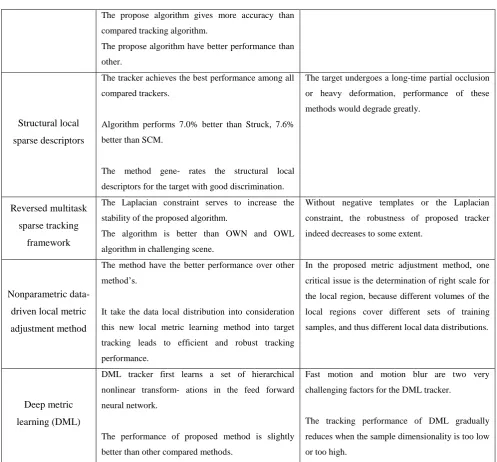
This section present some observation about the above existing visual tracking method.The table shows the
comparison between five existing methods and also shows advantages and disadvantages of five methods.
Object Detection and
Tracking Technique Advantages Disadvantages
Robust tracking
algorithm
The propose a robust tracker based on the linear representation model, which is able to handle the outliers and therefore effectively provides an accurate match.
It is not useful in offline tracking.
163 |
P a g e
The propose algorithm gives more accuracy than compared tracking algorithm.
The propose algorithm have better performance than other.
Structural local
sparse descriptors
The tracker achieves the best performance among all compared trackers.
Algorithm performs 7.0% better than Struck, 7.6% better than SCM.
The method gene- rates the structural local descriptors for the target with good discrimination.
The target undergoes a long-time partial occlusion or heavy deformation, performance of these methods would degrade greatly.
Reversed multitask
sparse tracking
framework
The Laplacian constraint serves to increase the stability of the proposed algorithm.
The algorithm is better than OWN and OWL algorithm in challenging scene.
Without negative templates or the Laplacian constraint, the robustness of proposed tracker indeed decreases to some extent.
Nonparametric
data-driven local metric
adjustment method
The method have the better performance over other method’s.
It take the data local distribution into consideration this new local metric learning method into target tracking leads to efficient and robust tracking performance.
In the proposed metric adjustment method, one critical issue is the determination of right scale for the local region, because different volumes of the local regions cover different sets of training samples, and thus different local data distributions.
Deep metric
learning (DML)
DML tracker first learns a set of hierarchical nonlinear transform- ations in the feed forward neural network.
The performance of proposed method is slightly better than other compared methods.
Fast motion and motion blur are two very challenging factors for the DML tracker.
The tracking performance of DML gradually reduces when the sample dimensionality is too low or too high.
TABLE 1: Comparisons between different Object Detection and tracking techniques
VI. PROPOSED METHODOLOGY
This section, provides the proposed methodology which have used a concept of deep metric learning and sparse
coding method. Sparse coding based appearance models have been successfully applied to visual tracking. The
proposeda target representation using the collection of local sparse descriptors, where each descriptor represents
partial appearance of the target. Descriptors of positive and negative training samples are extracted from the
target region and the background regions respectively. For tracking purpose use the DML tracker. As DML
tracker can explicitly learn several hierarchical nonlinear transformations to map data points into another
164 |
P a g e
solved by maximizing the interclass variations of negative pairs and minimizing the intra-class variations ofpositive pairs simultaneously.
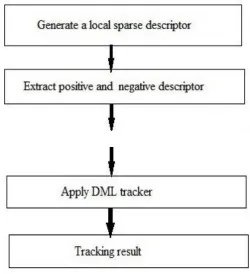
Algorithm:- Combination of sparse descriptor with DML tracker for object tracking and detection.
Step1: Extract structural local sparse descriptors from a fraction of all patches by performing a pooling
operation.
Step 2:To find the target from background extract descriptors of positive and negative training samples from
target region and background regions.
Step 3: Apply the DML tracker approach to find or identify a true target.
Fig 1:- Process flow diagram
VII. POSSIBLE OUTCOMES AND RESULTS
When the target suffers from partial occlusion, structural local descriptors with local patches that are not
occluded can achieve good discrimination. Also, an occlusion-aware template update scheme can handle
appearance changes during tracking especially caused by occlusion. For tracking purpose use the DML tracking
approach, it overcomes the nonlinearity issue of conventional metric learning methods and scalability issue of
165 |
P a g e
VIII. CONCLUSION
This paper, proposed a method which includes sparse coding and DML tracker in order to track accurate target
from scene. Combination of sparse coding and DML tracker improves visual tracking by overcoming the issues
like nonlinearity and scalability. Also sparse descriptor considers the background information to train our
classifiers, which ensures the good separating capacity of distinguishing the target from the cluttered
background.
IX. FUTURE SCOPE
From the observation found that the fast motion and motion blur are two very challenging factors for the DML
tracker. Also tracking performance of DML gradually reduces when the sample dimensionality is too low or too
high. Future study tries toovercome this issue to get high performance.
REFERENCES
[1] Junlin Hu, Jiwen Lu and Yap-Peng Tan, Senior Member, IEEE, “Deep Metric Learning for Visual
Tracking”, IEEE Transaction on Circuits and Systems for video technology, Vol. 26, No. 11, PP.
2056-2068, November 2016.
[2] Dong Wang, Huchuan Lu and Ming-Hsuan Yang, Senior Member, IEEE, "Robust Visual Tracking via Least
Soft-Threshold Squares", IEEE Transaction on Circuits and systems for video technology, Vol. 26, No. 9,
PP. 1709-1721, September 2016.
[3] Bo Ma, JianbingShen, Yangbiao Liu, Hongwei Hu, Ling Shao and Xuelong Li, "Visual Tracking Using
Strong Classifier and Structural Local Sparse Descriptors", IEEE Transaction on Multimedia, Vol. 23,
Issue no. 4, Page. 1872-1881, April 2014.
[4] BohanZhuang, Huchuan Lu, Senior Member, IEEE, Ziyang Xiao, and Dong Wang, "Visual Tracking via
Discriminative Sparse Similarity Map", IEEE Transaction on Image Processing, Vol. 23, No. 4, PP.
1872-1881, April 2014.
[5] Nan Jiang and Wenyu Liu, Member, IEEE, "Data-Driven Spatially-Adaptive Metric Adjustment for Visual