
FORMULATION OF DEXIBUPROFEN SOLID LIPID NANO PARTICLES AND ITS EVALUATION BY IN VITRO DISSOLUTION STUDY
5
0
0
Full text
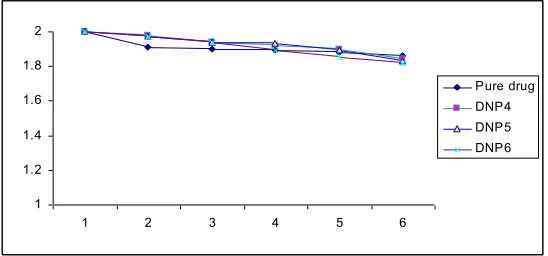
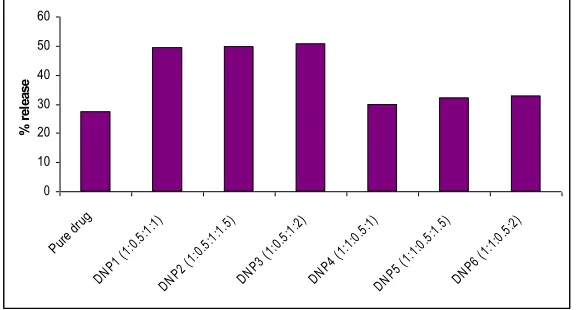
(2) Shumaia Parvin et al. Int. Res. J. Pharm. 2014, 5 (10) the homogenization of emulsion. The organic phase was prepared by dissolving the drug and surfactant in acetone and mixing it with the melted stearic acid, which was further, poured into aqueous tween-80 solution (maintained at the same temperature as that of organic phase) of various concentrations which acts as a stabilizer and emulsified by a homogenizer at 12000 rpm for 2 hours. The formulation was then removed from water bath and the dispersion of SLNs was mixed gently by slow magnetic stirring (1 hour) at room temperature until cooling. In general, higher temperatures result in lower particle sizes due to the decreased viscosity of the inner phase and high kinetic energy of the particles (Table 1). In vitro dissolution studies of dexibuprofen SLNPs In vitro dissolution studies of the pure drug and dexibuprofen SLNs were carried out to estimate the cumulative% of drug release with respect to time. Distilled water (900 ml) was placed in each vessel of the USP type II rotating paddle dissolution apparatus (Veego Vda6 DR, Germany). Two SLNs granules were placed in each vessel and the medium was allowed to equilibrate at 50 rpm to a temperature of 37°C ± 0.5°C for 50 minutes. 5 ml of the sample was withdrawn at definite time interval (10, 20, 30, 40 and 50 minutes) consecutively and replaced by fresh media to maintain the sink condition. The absorbances of sample were measured spectrophotometrically at λmax 222 nm on a UV-Visible spectrophotometer (UVmini-1240, Shimadzu, Kyoto, Japan) and the values of dissolution efficiency were calculated. It was made clear that none of the ingredients used in the formulations interfered with the assay15. Release Kinetic modeling There are a number of kinetic models, which described the overall release of drug from the dosage forms. Because qualitative and quantitative changes in a formulation may alter the drug release and in vivo performance, developing tools that facilitate product development by reducing the necessity of bio-studies is always desirable. In this regard, the use of in vitro drug dissolution data to prdict in vivo bioperformance can be considered as the rational development of controlled release formulations16. Zero order release In zero order kinetics the release rate is independent of the concentration of drug at GIT; i.e. whatever the amount of drug at GIT or absorption site release rate remains constant throughout the period of release.. Ct = C0 + K0t Where, Ct is the amount of drug dissolved in time t, C0 is the initial amount of drug in the solution (most times, C0 = 0), K0 is the zero-order release rate constant expressed in units of concentration / time and t is the time in hours. To study the release kinetics, data obtained from in vitro drug release studies were plotted as cumulative % of drug released versus time17. First order release Most currently marketed sustained release formulations, however, do not release drug at a constant rate. In many instances, the rate of appearance of drug at the absorption site can be approximated by an exponential or first order process in which the rate of drug release is a function only of the amount of drug remaining in the dosage form18.. Log C = Log C 0 -. kt 2.303. Where, C is the concentration of drug at time t, C0 is the initial concentration of drug, K is the first order release rate constant expressed in units of time-1.. The data obtained are plotted as log cumulative % of drug remaining versus time. RESULTS In-vitro drug release study of dexibuprofen from various SLN formulations was done by USP type-Π apparatus. The in vitro dissolution data of all the formulations were satisfied by different kinetic models. The zero order rates describe the systems where the drug release is independed of its concentrations. Figure 1 and 2 shows the cumulative amount of drug release vs time for zero order kinetics. The first order which describes the systems where release rate is concentration dependent is illustrated by Figure 3 and 4, which shows the log cumulative percent of drug remaining vs time. Cumulative % of drug release (Figure 5) for different formulations (DNP1 to DNP6) shows that the release rate is much higher from the SLN formulations than the pure drug. The reason for the poor dissolution of pure drug could be poor wettability and agglomeration of particles. DNP3 with the stabilizer concentration 2 % gives 50.74 % drug release that is higher dissolution rate than other formulations in 50 minute period of time. Hence 2 % stabilizer concentration is considered as optimum for this type of formulations. Further, in case of DNP6 with same stabilizer ratio but reduced surfactant concentration, no marked increase in dissolution was observed.. Table 1: Formulation of dexibuprofen SLNPs through hot homogenization method Formulation code with ratio DNP1 (1:0.5:1:1) DNP2 (1:0.5:1:1.5) DNP3 (1:0.5:1:2) DNP4 (1:1:0.5:1) DNP5 (1:1:0.5:1.5) DNP6 (1:1:0.5:2). Drug (mg) 1000 1000 1000 1000 1000 1000. Lipid (mg) 500 500 500 1000 1000 1000. Surfactant (mg) 1000 1000 1000 500 500 500. Stabilizer (ml) 1 1.5 2 1 1.5 2. Acetone (ml) 20 20 20 20 20 20. Water (ml) 20 20 20 20 20 20. *DNP = Dexibuprofen nano particle. Page 761.
(3) Shumaia Parvin et al. Int. Res. J. Pharm. 2014, 5 (10) 60 50 40. Pure drug. 30. DNP1 DNP2. 20. DNP3. 10 0 1. 2. 3. 4. 5. 6. Figure 1: Zero order plot of release kinetics of dexibuprofen from different SLNPs (DNP1, DNP2 and DNP3). 35 30 25. Pure drug. 20. DNP4. 15. DNP5. 10. DNP6. 5 0 1. 2. 3. 4. 5. 6. Figure 2: Zero order plot of release kinetics of dexibuprofen from different SLNPs (DNP4, DNP5 and DNP6) 2 1.8. Pure drug. 1.6. DNP1 DNP2. 1.4. DNP3 1.2 1 1. 2. 3. 4. 5. 6. Figure 3: First order plot of release kinetics of dexibuprofen from different SLNPs (DNP1, DNP2 and DNP3). 2 1.8 Pure drug. 1.6. DNP4 DNP5. 1.4. DNP6. 1.2 1 1. 2. 3. 4. 5. 6. Figure 4: First order plot of release kinetics of dexibuprofen from different SLNPs (DNP4, DNP5 and DNP6). Page 762.
(4) Shumaia Parvin et al. Int. Res. J. Pharm. 2014, 5 (10) 60. % release. 50 40 30 20 10. :0 .5 :2 ) P6. DN. P5. (1. :1. (1. :1. :0 .5 :1 .. 5). :0 .5 :1 ) DN. P4 DN. P3 DN. (1. :0 (1. :1. .5 :1 :2 ). 5) .5 :1 :1 . :0 (1 P2. DN. DN. P1. (1. :0. Pu. re. dr. .5 :1 :1 ). ug. 0. Figure 5: Graphical representations of drug release efficiency of dexibuprofen from different SLNPs as compared to pure drug (DNP1, DNP2, DNP3, DNP4, DNP5 and DNP6). DISCUSSION The use of solid lipid instead of liquid lipid is beneficial as it has been shown to increase control over release kinetics of encapsulated compounds and to improve the stability of incorporated chemically-sensitive lipophilic ingredients. These potentially beneficial effects are because of a number of physicochemical characteristics associated with the physical state of the lipid phase. Firstly, the mobility of reactive agents in a solid matrix is lower than in a liquid matrix and so the rate of chemical degradation reactions may be retarded. Secondly, micro phase separation of the active ingredients and carrier lipid within individual liquid particles can be controlled, thereby preventing the accumulation of active compounds at the surface of lipid particles where the chemical degradation reactions often occur. Thirdly, absorption of poorly absorbed bioactive compounds has been shown to be increased after incorporation into solid lipid nano particles. The use of solid matrix instead of liquid matrix can slow down lipid digestion thereby allowing for a more sustained release of the encapsulated compound19. The surfactant molecules were also necessary for emulsification as well as stabilization of SLNs. Entrapment efficiency were increased significantly by increasing both amount of surfactant and amount of lipid. This effect may be explained by increased viscosity of medium which prevents rapid diffusion of dexibuprofen into the bulk of medium increasing its entrapment efficiency20. With increasing surfactant concentration, it is possible that dexibuprofen gets entrapped in surfactant layer covering SLNs surface leading to higher entrapment efficiency. Higher amount of lipid also provides additional number of particles into which the drug gets entrapped. The lipid molecule also reduces the drug crystallinity followed by reduction of particle size and increases solubilization of drug as well as dissolution rate. SLNs size range bellow 300 nm is considered suitable for absorption across Peyer’s patches and villi of the gastrointestinal tract21,22. Consequently, by considering all the above conditions it is also possible to enhance bioavailability of dexibuprofen by SLNs formation. So, the present study confirmed that dexibuprofen SLNs with lipid, surfactant and stabilizer (1:0.5:1:2) can be formulated as tablet with better dissolution characteristic. CONCLUSION By investigating of some effective factors, an optimized set of method variables were determined and validated for new. SLN preparation. From the data shown here, it could be concluded that it is possible to produce the dexibuprofen SLNs with stearic acid, surfactant and stabilizer (1:0.5:1:2) and capable of encapsulating and enhancing bioavailability of dexibuprofen which may prove beneficial in the treatment of patients with pain and inflammation. ACKNOWLEDGEMENT The authors are thankful to Beximco Pharmaceuticals Ltd, Dhaka, Bangladesh for providing the gift sample of dexibuprofen and to the chairman of the Department of Pharmacy, University of Rajshahi, Rajshahi 6205, Bangladesh for sophisticated analytical instrumentation facilities. This work was also supported by the Department of Pharmacy, North South University, Bashundhara R/A, Dhaka-1229, Bangladesh. REFERENCES 1. Kathleen parfitt and Marindale. The Complete Drug Reference Part-I, Anti-inflammatory Drugs and Antipyretics, 32nd ed. Philadelphia Pharmaceutical Press; 1996. p. 1-11. 2. Adams SS, Bresloff P, Mason CG. Pharmacological differences between the optical isomers of ibuprofen evidence for metabolic inversion of the (-) isomer. J Pharm Pharmacol 2004; 28: 256-257. http://dx.doi.org /10.1111/j.2042-7158.1976.tb04144.x 3. Bonabello A, Galmozzi MR, Canaparo R, Isaia GC, Serpe L, Muntoni E. Dexibuprofen [S (+) isomer Ibuprofen] reduces gastric damage and improves analgesic and anti-inflammatory effects in Rodents. Anesth Analg 2003; 97: 402-408. http://dx.doi.org/10.1213/01.ANE.00000 73349.04610.42 4. Sakaeda T, Okamura N, Nagata S, Yagami T, Horinouchi M et al. Molecular and pharmacokinetic properties of 222 commercially available oral drugs in humans. Biol Pharm Bull 2001; 24: 935-940. http://dx.doi.org/10.1248/bpb.24.935 5. Viet M, Siegel MG, Higgs RE, Watson IA, Robertson DH, et al. Characteristics physical properties and structural fragments of marketed oral drugs. J Med Chem 2004; 47: 224-232. http://dx.doi.org/ 10.1021/jm030267j 6. Wenlock MC, Austin RP, Barton P, Davis AM, Leeson PD. A comparison of physicochemical property profiles of development and marketed oral drugs. J Med Chem 2003; 46: 1250-1256. http://dx.doi. org/10.1021/jm021053p 7. Kumar PD, Subas DC, Subrata C, Soumen R. Formulation and evaluation of solid lipid nano particles of a poorly water soluble model drug ibuprofen. Int Res J Pharm 2012; 3(12): 132-137. 8. Mashaghi S, Jadidi T, Koenderink G, Mashaghi A. Lipid nanotechnology. Int J Mol Sci 2013; 14: 4242-4282. http://dx.doi.org/ 10.3390/ijms14024242 9. Aswale RH, Meshram JH, Kumbhar VB. Solid lipid nano particle as drug delivery system: an overview. Pharmacie Globale Int J Comprehensive Pharm 2014; 1(5): 1-10. 10. Zhang C, Peng F, Liu W, Wan J, Wan C, Xu H et al. Nanostructured lipid carriers as a novel oral delivery system for triptolide: induced changes in pharmacokinetics profile associated with reduced toxicity in male rats. Int J Nano Med 2014; 9: 1049-1063. 11. Vyas SP, Khar RK. Targeted and Controlled Drug Delivery Novel Carrier System, 1st ed. CBS Publication; p. 15-16.. Page 763.
(5) Shumaia Parvin et al. Int. Res. J. Pharm. 2014, 5 (10) 12. Krishna Sailaja A, Amareshwar P, Chakravarty P. Formulation of solid lipid nanoparticles and their applications. CPR 2011; 1(2): 197-203. 13. Ahlim P, Kristl J, Kobar S. Optimization of procedure parameters and physical stability of solid lipid nano particles in dispersion. Acta Pharm 1998; 48: 257-267. 14. Jahnke S. The theory of high pressure homogenization. In: Muller RH, Benita S, Bohm B editors. Emulsions and nano suspensions for the formulation of poorly soluble drugs. Stuttgart Medpharm Scientific publishers; 1998. p. 77. 15. Khan CA and Rhodes CT. The concept of dissolution efficiency. J Pharm Pharmacol 1975; 27: 48-49. http://dx.doi.org/10.1111/j.20427158.1975.tb09378.x 16. Dash S, Murthy PN, Nath L, Chowdhuri P. Kinetic modeling on drug release from controlled drug delivery systems. Acta Poloniae Pharmaceutica Drug Res 2010; 67(3): 217-223. 17. Hadjiioannou TP, Christian GD, Koupparis MA. Quantitative Calculations in Pharmaceutical Practice and Research. New York: VCH Publishers Inc; 1993. p. 345-348. 18. Bourne DW. Pharmacokinetics. In: Banker GS, Rhodes CT, editors. Modern Pharmaceutics. 4thed. New York: Marcel Dekker Inc; 2002. p. 67-92. http://dx.doi.org/10.1201/9780824744694.ch3. 19. Helgason T, Awad TS, Kristbergsson K, McCements DJ, Weiss J. Effect of surfactant surface coverage on formation of solid lipid nano particles (SLN). J Colloid Interface Sci 2009; 334: 75-81. http://dx.doi.org/ 10.1016/j.jcis.2009.03.012 20. Yang Y et al. Effect of preparation conditions on morphology and release profiles of biodegradable polymeric microspheres containing protein fabricated by double-emulsion method. Chem Eng Sci 2000; 55: 2223-2236. http://dx.doi.org/10.1016/S0009-2509(99)00503-5 21. Das S, Chaudhury A. Recent advances in lipid nano particles formulations with solid matrix for oral drug delivery. AAPS Pharm Sci Tech 2011; 12: 62-76. http://dx.doi.org/10.1208/s12249-010-9563-0 22. Awaad A, Nakamura M, Ishimura K. Imaging of size depended uptake and identification of novel pathways in mouse Peyer’s patches using fluorescent organosilica particles. Nanomed Nanotechnol 2012; 8: 627636. http://dx.doi.org/10.1016/j.nano.2011.08.009 Cite this article as: Shumaia Parvin, Md. Abu Shuaib Rafshanjani, Md. Abdul Kader, Most Afia Akhtar. Formulation of dexibuprofen solid lipid nano particles and its evaluation by in vitro dissolution study. Int. Res. J. Pharm. 2014; 5(10):760764http://dx.doi.org/10.7897/2230-8407.0510154. Source of support: Nil, Conflict of interest: None Declared. Page 764.
(6)
Figure
Related documents
PARP expression; serum levels of 8-hydroxy-2-deoxyguanosine, nitrotyrosine, and 8-isoprostane; and the apoptosis index of sciatic nerve cells were signi fi cantly higher than those
Then, podocyte study showed that curcumin signi fi cantly increased the expression levels of beclin1, UVRAG and ATG5 and decreased the expression of p62 in dose-dependent manner
These selectable markers will help promote genetic and molecular biology studies of otherwise oner- ous drug-resistant strains, while avoiding the generation of pathogenic
It revealed that employees low in extraversion, agreeableness, and emotional stability are more likely to be ostracized in workplace, and that workplace ostracism
We processed the traces left by , Flickr users in the US (about million pictures) in order to obtain mobility flow matrices which represent human flows between
Three hundred samples of N1 acrylic resin were used: 100 samples for color stability and microhardness tests (each test was performed on the opposite side of each sample), and
ancient times has been of interest to citizen,But in the modern era with the construction Structure gone out of human scale and neighborhood boundaries can not be
Earlier experimental investigations have highlighted that the incorporation of an adequate amount of steel fibers (1-2%) into the concrete matrix significantly improves the
