A COMPARATIVE STUDY OF MICROWAVE
HEATING TECHNIQUE WITH CONVENTIONAL
HEATING METHODS
Yogesh Kamble
1, Shital Patil
2, Rohit Ghulanavar
3 1Asst.Professor, Dhananjay Mahadik Group of Institutions Vikaswadi Kagal, Maharashtra (India)
2
P.G. Student, Singhgad Institute of Tecnology Lonavala. Maharashtra (India)
3
Asst.Professor, Saint Gajanan Maharaj College of Engineering Mahagaon-Gadhinglaj,
Maharashtra (India)
ABSTRACT
The microwave heating technology began with heating food and later on extending applications to the processing of a wide variety of materials, like ceramics, polymers and composites; now offers wide applications in the area of metallic material processing too. The microwave processing of materials is a relatively new technology that provides new approaches to improve the physical properties of materials; provides alternatives for processing materials that are hard to process; reduces the environmental impact of materials processing. The growing interest is partly the result of increased awareness among scientists, processing engineers, and potential users about the benefits of microwave processing. Microwaves for metallic material processing are a challenging area of research owing to reflection of electromagnetic waves by most of the metals at ordinary conditions.
Keywords: Electromagnetic Spectrum, Microwaves, Potential Heating Mechanism, Volumetric
Heating
.
I. INTRODUCTION
The spectrum of electromagnetic waves spans the range from a few cycles per second in the radio band to
1020cycles per second for gamma rays. Microwaves occupy the part of the spectrum from 300 MHz (3 × 10⁶ cycles/s) to 300 GHz (3× 10¹² cycles/s). Within this portion of the electromagnetic spectrum there are frequencies that are used for cellular phones, radar, and television satellite communications. For microwave
heating, two frequencies, reserved by the Federal Communications Commission (FCC) for industrial, scientific,
and medical (ISM) purposes are commonly used. The two most commonly used frequencies are 0.915 and 2.45
GHz. Recently, microwave furnaces that allow processing at variable frequencies from 0.9 to 18 GHz have been
developed for material processing. [1] Originally, microwaves were principally used for communication. In
1950, the use of microwave energy to heat materials was discovered. Now microwave ovens have became
common for heating food products in the home. The potential advantages of microwave heating have led
researchers to design and implement new processes for industrial use. Although some non-thermal microwave
effects have been observed and claimed by researchers, the main application of microwave processing of
is quite different from conventional heating where the heat must diffuse in from the surface of the material.
Volumetric heating means that materials can absorb microwave energy directly and internally and convert it to
heat. It is this characteristic that leads to advantages using microwaves to process materials. [3] Beginning in the
late 1980s, there was growing interest in high temperature microwave processing of materials. With some
successful applications at laboratory scale, for example, sintering of ceramics, microwaves are justified as a
potential heating mechanism to replace some conventional heating methods. [4]
Melting metals in traditional furnaces such as cupola furnace, blast furnace, crucible furnace etc. consumes
significant amount of energy along with possibilities of material and energy losses and some safety risks.[5] In
order to overcome the inherent disadvantages of conventional melting, one or more of the advanced melting
technologies such as electron beam melting, infra red melting, plasma melting, microwave melting, solar
melting etc. are preferred according to the specific requirements and applications. Microwave heating receives
considerable attention due to its major advantages such as high heating rates, reduced processing time, low
power consumption and less environmental hazards [6].During microwave heating, large amount of heat may be
generated for a lossy material throughout the volume, whereas for conventional heating, the material is heated
via an external heat source and subsequent radiative transfer.[7]
II. EXPERIMENTATION
Two trials were carried out in a 1050 W domestic microwave oven which was modified later with glass wool
insulation to reduce heat loss. Figure 3.2 shows the inner view of the MW oven. This oven was then fixed with a
thermocouple along with PID controller. Figure 3.3 shows the schematic of the MW oven after insulation. Also
two trials were conducted in muffle furnace of 3500W capacity for conventional heating. Metallurgical heating
of EN9 steel in bulk form has been achieved in this work. Experiments were conducted using a batch of three
tensile specimens of commercial grade EN9 steel bar shown in figure 3.1. Suitable susceptor was used for initial
coupling of microwaves with metallic materials in MW heating. Bulk pieces were exposed to microwave
radiation for 14 minutes in a multimode applicator and 136 minutes in muffle furnace. Photograph of red zone
inside the insulation box of microwave oven and muffle furnace as shown in Figures3.4 and 3.6 respectively.
The schematic of muffle furnace is as shown in Figure 3.5.
Samples were heated at 875°C, and soaking time of 20 minutes was maintained. After heating, the specimens
were removed from both the furnaces and were subjected to air cooling, oil quenching and water quenching
respectively.
III.RESULTS AND OBSERVATIONS
Observation from Mechanical Tests.
Heating of bulk material can be considered a universal necessity however there has been need for developing
faster, accurate and sustainable techniques for heating of engineering materials. In this work both microwave
heating as well as conventional heating is carried out. Trials were conducted for heating of bulk EN 9 steel
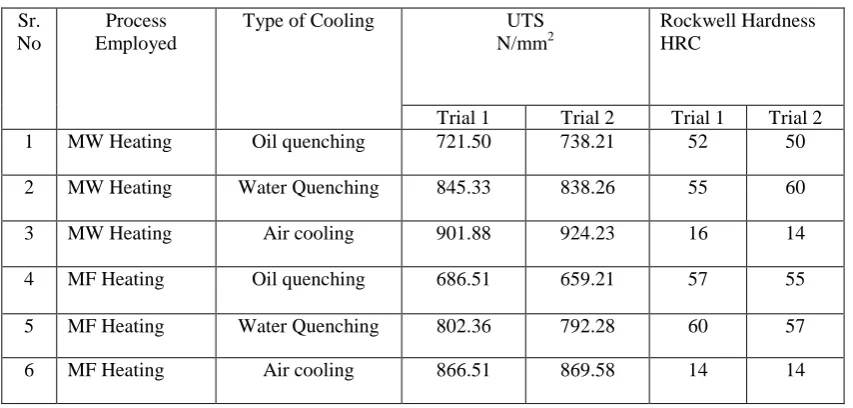
successfully. The results obtained for original specimen in terms of U.T.S. and Hardness values are listed in
Tables 4.1 and 4.2 respectively.
Table 4.2: Hardness Values of Sample Test Specimen Before Heating
Sr.No. Specification Brinell hardness BHN
Rockwell Hardness HRC
1 Original specimen 627 60
After preparation of specimen for tensile test, heating is carried out at temperature 875°C with soaking period of
20 minutes. A batch of three components was heated in microwave oven as well as in muffle furnace for oil
quenching, water quenching and air cooling respectively. Table 4.3 shows the strength and hardness values
obtained after two trials in MW heating and MF heating.
Table 4.3: Strength and Hardness Values After Trial 1 and Trial 2.
From above experimental results, inference can be made that UTS values obtained out of microwave heating are
higher than the values of conventional heating. Similarly hardness values for microwave heating are betters
compared to that obtained from conventional heating. Results derived from Trial Nos. 1 and 2 are almost same
which indicates the better repeatability of the process. Impact Test. (Charpy Test)
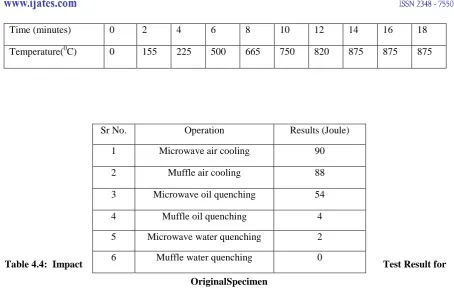
Table No. 2.1:Time Temperature Chart of Conventional Heating
Time (minutes) 0 10 20 30 40 50 60 70 80 90 100 110 120 130 140
Temperature(0C) 0 90 245 350 780 560 605 690 730 780 800 850 860 870 875
Table No. 2.2: TimeTemperature Chart of Microwave Heating
Sr No. Specification U.T.S. N/mm2
% Elongation After Fracture
% Reduction in Area
1 Original Specimen 708.79 26.96 38.64
Sr. No
Process Employed
Type of Cooling UTS
N/mm2
Rockwell Hardness HRC
Trial 1 Trial 2 Trial 1 Trial 2
1 MW Heating Oil quenching 721.50 738.21 52 50
2 MW Heating Water Quenching 845.33 838.26 55 60
3 MW Heating Air cooling 901.88 924.23 16 14
4 MF Heating Oil quenching 686.51 659.21 57 55
5 MF Heating Water Quenching 802.36 792.28 60 57
Time (minutes) 0 2 4 6 8 10 12 14 16 18
Temperature(0C) 0 155 225 500 665 750 820 875 875 875
Table 4.4: Impact Test Result for
OriginalSpecimen
Rise in the temperature per unit time was recorded. Required temperature is achieved in muffle furnace took 140
minutes whereas; in microwave the same is achieved in 14 minutes. It is also represented in table as shown
above table.
Table4.5: Impact Test Result after Treatment
Observation on Microscope.
Figure 4.1 shows the microstructure of the sample before heating which reveals ASTM Grain size 7 to 8 and
appearance of Elongated & Equiaxed Grains with 55 to45% ferrite.
Figure 4.1: Micrograph of original specimen at 250X
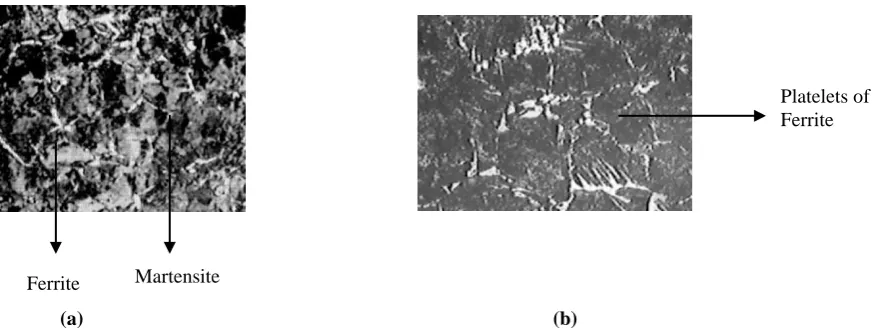
Figure 4.2(a) shows the microstructure of Oil quenched specimen (Trial 1) of muffle furnace having coarse
structure of martensite and Figure 4.7 (b) shows microstructure of oil quenched specimen of microwave heating
having fine bainite structure which gives better machinability properties. Widmanstatten platelets of ferrite at
prior austenite Grain boundary and within grain in a matrix of martensite in fig 4.2(b)
Sr No. Operation Results (Joule)
1 Microwave air cooling 90
2 Muffle air cooling 88
3 Microwave oil quenching 54
4 Muffle oil quenching 4
5 Microwave water quenching 2
6 Muffle water quenching 0
Sr.No. Operation Result(Joules)
1 Original specimen 70
Ferrite
(a) (b)
Figure 4.2: Micrograph of oil quenched specimen at 250X. (a) MF Heating, (b) MW Heating.
Figure 4.3(a) shows microstructure of the water quenching specimen(Trial 1) of muffle furnace, martensitic
structure is observed. Figure 4.3 (b) shows microstructure of the water quenched specimen of microwave
heating, coarse structure has been observed. Specimen has fine structure, along with high toughness. Hardness
value increased in MW heating.
(a) (b)
Figure 4.3: Micrograph of water quenched specimen at 250X. (a) MF Heating, (b) MW Heating.
Figure 4.4(a) shows microstructure of the muffle furnace, air cooled (Trial 1) specimen, ASTM Grain size 7 to 8 elongated & equiaxed. Grains predominantly pearlitic matrix with grain boundary ferrite is observed. Air cooling requires maximum time and therefore grain size reduces. Figure 4.4(b) shows microstructure of the air cooled specimen of microwave heating, Widmanstatten platelets of ferrite at prior austenite grain boundary & within grain in a matrix of martensite. From above microstructure coarse structure obtained also machinability has been improved.
(a) (b)
Figure 4.4: Micrograph of air cooled specimen at 250X. (a) MF Heating, (b) MW Heating.
Figure 4.5 (a) shows the microstructure of oil quenched specimen(Trial 2) of muffle furnace having coarse structure of martensite and Figure 4.5(b) shows microstructure of oil quenched specimen of microwave heating having fine bainite structure which gives better machinability properties. Widmanstatten platelets of ferrite at prior austenite grain boundary and within grain in a matrix of martensite in Figure 4.5 (b)
Platelets of Ferrite
Pearlite
(a) (b)
Figure 4.5: Micrograph of oil quenched specimen at 250X. (a) MF Heating, (b) MW Heating
Figure 4.6 (a) shows microstructure of the water quenching specimen (Trial 2) of muffle furnace, martensitic
structure is observed, coarse structure is seen..Figure 4.6 (b) shows microstructure of the water quenching
specimen of microwave heating, which shows >95 % martensite with fine structure and high toughness.
Hardness value increased in MW heating.
(a) (b)
Figure 4.6: Micrograph of water quenched specimen at 250X. (a) MF Heating, (b) MW Heating.
Figure 4.7(a) shows microstructure of the muffle furnace, air cooled specimen, Martensite with grain boundary
ferrite is observed. ASTM Grain size 7 to 8 Elongated & Equiaxed. Grains Predominantly pearlitic matrix with
grain boundary ferrite is observed. Air cooling require maximum time that’s why grain size reduces. Figure 4.7
(b) shows microstructure of theair cooled specimen of microwave heating, Widmanstatten platelets of ferrite at
prior austenite grain boundary & within grain in a matrix of martensite. From above microstructure coarse
structure obtained also machinability has been improved
(a) (b)
Figure 4.7: Micrograph of water quenched specimen at 250X. (a) MF Heating, (b) MW Heating
Platelets of Ferrite
Martensite
Ferrite
IV. CONCLUSION
Heating of bulk materials using MW energy is very difficult because owing to reflection of microwaves. This
present project work reports the results of on development of microwave hybrid heating process. Further
development of MW heating process is in progress. The work establishes the basis for potential of heating bulk
materials, which is eco-friendly and significantly fast. The following major conclusions could be drawn from the
present work. Metallurgical heating of EN9 steel in bulk form has been achieved in this work .UTS values of
microwave heating are improved than conventional heating .Hardness values of microwave heating are better
than conventional Heating. The energy stored by components of microwave heating are more than Components
heated in muffle furnace. Required temperature is achieved in muffle furnace takes 136 minutes whereas in
microwave it is achieved in 15 minutes. As power is proportional to time, which reflects that power required for
mufflefurnace is higher than microwave oven. Further advantages are rapid energy transfer, volumetric and
selective heating, and uniformity of heating, compact equipment.
REFERENCES
[1] “David E. Clark and Willard H. Sutton”, Microwave Processing of Materials (1996).
[2] “Xiaofeng Wu, M.S.”, Experimental and Theoretical Study of Microwave Heating Of Thermal Runaway
Materials, December 2002.
[3] “John m. Osepchuk”, IEEE Transactions on Microwave Theory And Techniques, VOL. MTT32, NO. 9,
SBPTEMRER 1984 , A History of microwave heating and applications.
[4] EBook : Microwave Processing Of Materials Committee On Microwave Processing Of Materials: An Emerging
Industrial Technology National Materials Advisory Board Commission On Engineering And Technical
Systems National Research Council.
[5] Avijit Mondal, Dinesh Agrawaland, Anish Upadhyaya, Microwave Heating of Pure Copper Powder with
Varying Particle Size and Porosity (2008)
[6] P. Yadoji, R. Peelamedu, D. Agrawal, R. Roy, Materials Science and Engineering B 98 (2003) 269–278
[7] M.S. Srinath, Apurbba Kumar Sharma, Pradeep Kumar, Investigation on Microstructural And Mechanical
Properties of Microwave Processed Dissimilar Joints, Journal of Manufacturing Processes 13 (2011) 141–146
[8] E.T. Thostenson, T.-W. Chou “Microwave Processing: Fundamentals and Applications” Composites: Part A
30 (1999)
[9] S. Chandrasekaran, Tanmay Basak, S. Ramanathan”Experimental And Theoretical Investigation On Microwave Melting Of Metals.”
[10]. Morteza Oghbaei, Omid Mirzaee “Microwave versus conventional sintering: A review of fundamentals,
advantages and applications.” Journal of Alloys and Compounds 494 (2010).
[11] K.Y. Chiu, F.T. Cheng, H.C. Man.” A Preliminary Study of Cladding Steel with NiTi by Microwave-Assisted
Brazing.” Materials Science and Engineering A 407 (2005).
[12] A.K. Sharma, S. Aravindhan, R. Krishnamurthy, “Microwave glazing of alumina–titania ceramic composite
coatings”. Materials Letters 50 Ž2001.
[13] Metaxas, A.C. “Foundations Of Electro Heat: A Unified Approach,” John Wiley And Metaxas, A. C. And