Original Research Article
Progression from tuberculosis to multi drug resistance-TB in
revised national tuberculosis control programme: perspectives
from health system care givers
Ashutosh Kumar
1, Rishabh Kumar Rana
1*, Shalini Sundram
1,
Sudipta Kumar Sinha
1, Richa Jaiswal
2, Vivek Kashyap
1INTRODUCTION
Drug-resistant TB has been known from the time anti-TB drugs were first introduced for the treatment of TB. Currently, the WHO estimated incidence of Rifampicin (R) and MDR-TB in India is estimated to be around 147000. This translates to around 11 patients per 100 000 population annually as per the Global TB Report, 2017.1 Drug resistance continues to be a public health crisis. It is
estimated that in 2017, 558,000 people developed rifampicin (the most effective first line drug) resistant TB and of these 82% had multidrug-resistant TB (MDR-TB). In 2017, 160,684 cases of MDR-TB and rifampicin resistant TB (RR-TB) were notified and 139,114 were enrolled for treatment.2
High quality tuberculosis (TB) treatment is a key factor of the directly observed treatment short-course (DOTS)
ABSTRACT
Background: The aims and objectives were to study the progression from tuberculosis to multi drug resistance-TB in revised national tuberculosis control programme: perspectives from health system care givers.
Methods: The study was carried out in TB Sanatorium ITKI, Sadar Hospital Ranchi and RIMS Ranchi. The interview of various health personnel including SAHIYAs was taken using a semi-structured questionnaire based on programmatic management of multi drug resistant tuberculosis guidelines -2016.
Results: Among Doctors knowledge level was good compared to other health personnel which had mean value 7.33 (±2.79), laboratory technician 3.45 (±2.64), STS 4.67 (±1.59), Sahiya 2.1 (±0.73). Regarding capacity enhancement level all health personnel needed refresher trainings in which doctors got 4.67 (±1.58), laboratory technician 3.45±2.64, STS 1.72±0.34, and Sahiya 0.5±0.52. Specially sahiya needs training regarding MDR-TB because they are the connecting link between health system and community. Regarding execution level, Doctors got 1.86 (±0.74), laboratory technician 1.64 (±0.56), STS 1.64 (±0.56) and Sahiya (ASHA) 2.2 (±0.44). Sahiya were better than other health personnel at execution level.
Conclusions: Advocacy, communication, and social mobilization are important aspects of TB control, Policy makers and administrators should be sensitized for need of adequate and sustained funding for TB control to ensure quality capacity building. They need to provide continuous and quality training of staff at different levels and retention of trained staff and periodic reviews to identify gaps and take corrective steps.
Keywords: MDR-TB, RNTCP, PMDT-guidelines 2016
1
Department of Preventive and Social Medicine (PSM)/Community Medicine, RIMS, Ranchi, Jharkhand, India
2
University of Illinois Urbana–Champaign, USA
Received: 14 April 2019
Revised: 02 May 2019
Accepted: 06 May 2019
*Correspondence:
Dr. Rishabh Kumar Rana,
E-mail: [email protected]
Copyright: © the author(s), publisher and licensee Medip Academy. This is an open-access article distributed under the terms of the Creative Commons Attribution Non-Commercial License, which permits unrestricted non-commercial use, distribution, and reproduction in any medium, provided the original work is properly cited.
strategy. In combination with a high case detection rate it is expected to reverse the TB epidemic. The targets for case detection and treatment success are 70% and 85% respectively.3 TB treatment outcomes are influenced by bacterium characteristics such as drug resistance, patient characteristics, patient behavior, and quality of health care.4 Poor adherence to anti-tuberculosis treatment is considered the most important factor leading to non-cure in patients infected with strains susceptible to the drugs.5 The previous retrospective cohort analysis titled operational challenges in diagnosing MDR-TB and initiating treatment in Andhra Pradesh India by reviewing RNTCP records and reports, showed 169 out of 265 cases were diagnosed as MDR-TB.6 Globally, with an estimated annual incidence of more than half a million cases, multi-drug resistant-tuberculosis (MDR-TB) i.e. tuberculosis resistant to at least isoniazid and rifampicin, is a public health threat.7 The global stop TB strategy outlines and defines the programmatic management of drug resistant TB (PMDT) within National TB Programmes based on the principles of DOTS (directly observed treatment short course). Timely identification of MDR-TB cases and prompt initiation of treatment is crucial to prevent the transmission of disease and reduce related high morbidity and mortality.8 In India, with the highest burden of Tuberculosis globally, the prevalence of MDR-TB is estimated to be <3% amongst new cases and 14–17% amongst the re-treatment cases.9 It is also estimated that ∼99,000 MDR-TB cases occur in the country annually.10 To address the challenge of MDR-TB, the revised national tuberculosis control programme (RNTCP) of India has initiated MDR-TB services, at a sub-national level, in 2007 in a limited geographical area and is in the process of expanding these services, in a phased manner, to cover the entire country by 2012. Due to limited quality assured laboratory capacity the programme enrolls only those patients identified to be at a high risk of MDR-TB (MDR suspects) for diagnostic assessment and subsequent treatment.11 Poor living
condition, malnutrition, shanty housing and
overcrowding are the main reasons for the spread of the disease.12
HIV and TB form a lethal combination, each speeding-up the others, progress. In India, 30% of the people are infected with tuberculosis infection, who are healthy and if such infected persons acquires HIV, the chances of developing active TB increases to 60%, whereas an HIV negative person infected with TB bacillus has only a 10% life time risk of developing TB.13 The disease remains
concentrated in the growing population of
socioeconomically disadvantaged persons, immigrants from areas where drug resistance is common, certain racial groups, persons in extended-care facilities, alcohol and drug abusers, and persons infected with the human immunodeficiency virus. Because people in these groups are much less likely than others to seek regular medical care, it is difficult to identify and treat active tuberculosis in these populations. Contacts of patients with tuberculosis are equally difficult to identify.14 The Senior
Treatment Supervisor (STS) has to assume different roles at different junctures in the RNTCP. He has to play the role of a field worker, treatment organizer, trainer, colleague, subordinate, teacher, health educator, advisor, well wisher, supervisor, etc. While discharging these roles, the STS have to act with simplicity and responsibility. By virtue of his position, he has various roles to play at the Tuberculosis Unit (TU), Microscopic
Centres (MC) and Treatment Centres.15
Under RNTCP, ASHA (accredited social health activist) workers have been trained as provider of the DOTS. They help the programme by identifying and referring patients with history of cough for more than two weeks to the nearest designated microscopy centre for sputum examination. They also keep a track and ensure that the patient takes medicines and completes the treatment. In addition, they also spread awareness about the TB and the
services available under the RNTCP.16 NRHM
framework encourages ASHAs engagement in outreach activities of health programmes; involvement of ASHAs themselves in disease control programmes is lacking. Compartmentalization of activities or low capacities or incentives or overburden could be possible reasons restraining ASHAs engagement in disease control programme.17 Most of the studies related to TB has been done from the perspective of the TB –patients and not from the perspective from the health system care givers.
METHODS
Thisstudy was carried out in TB Sanatorium ITKI and sadar hospital Ranchi and RIMS Ranchi. The interview of various health personnel care takers had been taken
through semi-structured questionnaire based on
programmatic management of multi drug resistant tuberculosis guidelines -2016 just like as Doctors, laboratory technicians, senior treatment supervisors and DOTS Providers (ASHA).
Study design
This was a cross sectional descriptive observational study.
Study period
Total duration of study: 5 months (August 2018 to December 2018).
Study population
transferred to ITKI Sanatorium for pretreatment evaluation for TB. All transferred cases of MDR-TB from Sadar hospital Ranchi and RIMS Ranchi who had been admitted in ITKI Sanatorium for pre-treatment evaluation for MDR-TB, between September 2017-August 2018 and willing to participate in the study, had been selected. Doctors involved in outdoor patient department for tuberculosis in Sadar hospital Ranchi, ITKI sanatorium, RIMS Ranchi and various Community health centres of Ranchi district, laboratory technicians of Sadar hospital Ranchi, ITKI sanatorium and RIMS DOTS centre Ranchi, were interviewed regarding operational guidelines for management of drug resistant tuberculosis in India-2017. Senior treatment supervisors (STS) of Ranchi district, senior treatment laboratory supervisors (STLS) of Ranchi district, and ASHA (SAHIYA) workers of various community health centres of Ranchi involved as DOTS providers were also interviewed regarding operational guidelines for management of drug resistant tuberculosis in India-2017.
Sampling technique and sample size
Simple random sampling had been done to identify various medical officers of Sadar Hospital, Ranchi, medical officers of various community health centres, medical officers of RIMS Ranchi and Itki Sanatorium. I had selected 15 medical officers, 15 senior treatment supervisors and 15 ASHA workers and 5 laboratory technicians. A pre-tested semi- structured questionnaire had been given to all various category of respondents after taking permissions. Questionnaire was based on PMDT guidelines -2017 to check knowledge level, capacity building and execution level to implement RNTCP. There were different sections to check various levels of knowledge assessment.
Development of data collection tool
A semi-structured questionnaire which includes questions pertaining to the variables was used for data collection. The questionnaire had following components
Socio demographic profile, knowledge and capacity building of Doctors, laboratory technicians, senior treatment supervisors, senior treatment laboratory supervisors, and Sahiya (ASHA).
Ethical clearance
Ethical approval for the study was obtained from Institutional Ethics Committee of RIMS, Ranchi. Interview with study subjects were conducted after written informed consent in Hindi language.
Data collection techniques
The subjects were explained about the purpose of study. Data was collected by interview method using the pre
tested questionnaire. Interview was done after taking informed consent from each study subjects.
Data entry and analysis
A standard template was created in Microsoft-Excel sheet for data entry. Data entry was done and 10% of data were randomly checked to assure the quality of data entry under the supervision of guide. The data were analyzed by using software- Statistical Package for Social Science (SPSS) 20.0 version.
RESULTS
Inabove mentioned tables to assess the knowledge gap, capacity enhancement and execution, there were huge gaps among doctors, laboratory technicians, senior treatment supervisors and Sahiyas regarding the operational guidelines for multi-drug resistant tuberculosis in India-2017. Among Doctors knowledge level was good compared to other health personnel which had mean value 7.33 (±2.79), laboratory technician 3.45 (±2.64), STS 4.67 (±1.59), Sahiya 2.1 (±0.73). Regarding capacity enhancement level all health personnel needed refresher trainings in which doctors got 4.67 (±1.58), laboratory technician 3.45±2.64, STS 1.72±0.34, and Sahiya 0.5±0.52. Specially Sahiya needs training regarding MDR-TB because they are the connecting link between health system and community. Regarding execution level, doctors got 1.86 (±0.74), laboratory technician 1.64 (±0.56), STS 1.64 (±0.56) and sahiya (ASHA) 2.2 (±0.44). Sahiya were better than other health personnel at execution level.
A common questionnaire based on management of drug resistant Tuberculosis guidelines-2016 had been also given to doctors, ANMS, Senior treatment supervisors and ASHA (SAHIYA) having total score was 10. The scores obtained by various health personnel were as
The score obtained by doctor is 7.8±0.68, by ANMs 5.67±1.04 by STS 5.00±1.13, by ASHA 5.00±1.13. The questionnaire was same for all different health perssonels. Maximum score (Mean±SD) 7.8 ±0.68 OUT OF 10 was obtained by doctor and lowest 5.00±1.13 by STS. The causes for progression to multidrug resistant tuberculosis from simple tuberculosis is not concerning to tuberculosis patient only but as well as health care delivery system also. There is lack of counselling at every step of contacts to patient to health systems.
Table 1: Various score level of different health personnel's at the knowledge level, capacity enhancement level and execution level.
Types of health personnels Numbers Parameters Mea006E±SD Maximum score
Doctors 15
Knowledge level 7.33±2.79 13
Capacity enhancement 4.67±1.58 6
Execution 1.86±0.74 3
Laboratory technician 05
Knowledge level 3.45±2.64 10
Capacity enhancement 2.34±1.72 6
Execution 1.64±0.56 3
STS 15
Knowledge level 4.67±1.59 8
Capacity enhancement 1.72±0.34 3
Execution 3.54±0.74 6
Sahiya (ASHA) 15
Knowledge level 2.1±0.73 6
Capacity enhancement 0.5±0.52 2
Execution 2.2±o.44 4
Table 2: Scores obtained by different health personnel of same questionnaire.
Health personnel Mean value±SD Total score
Doctors 7.8 ±0.68 10
ANMS 5.67±1.04 10
STS 5.00±1.13 10
Sahiya (ASHA) 5.15±0.98 10
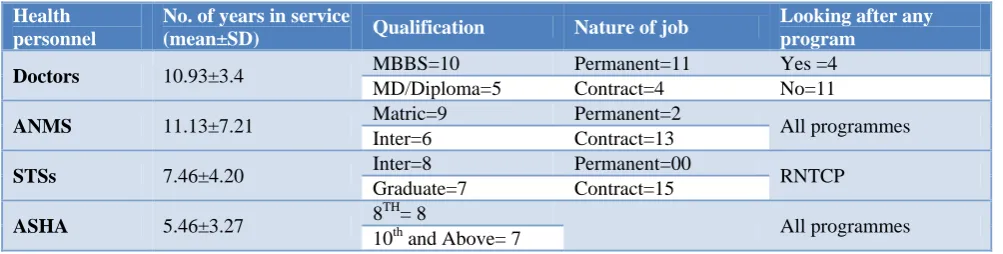
Table 3: Details of various health perssonnels (n=15 each).
Health personnel
No. of years in service
(mean±SD) Qualification Nature of job
Looking after any program
Doctors 10.93±3.4 MBBS=10 Permanent=11 Yes =4
MD/Diploma=5 Contract=4 No=11
ANMS 11.13±7.21 Matric=9 Permanent=2 All programmes
Inter=6 Contract=13
STSs 7.46±4.20 Inter=8 Permanent=00 RNTCP
Graduate=7 Contract=15
ASHA 5.46±3.27 8
TH
= 8
All programmes 10th and Above= 7
DISCUSSION
Resistance to tuberculosis (TB) drugs is a formidable obstacle to effective TB care and prevention globally. Multidrug-resistant TB (MDR-TB) is multi factorial and fuelled by improper treatment of patients, poor management of supply and quality of drugs, and airborne transmission of bacteria in public places. Case management becomes difficult and the challenge is compounded by catastrophic economic and social costs that patients incur while seeking help and on treatment.18
India currently has 628 Gene Xpert machines and 74 RNTCP certified laboratories to perform susceptibility testing. In 2017, under the RNTCP, India performed 1.07 million Xpert MTB/RIF tests, 93 989 LPA tests, and second-line DST for 26 832 samples.19 However, to diagnose the estimated 2.8 million cases of TB and
Research priorities include the development of a strong evidence base for the optimal use of preventive therapy in high-risk populations, determining the protective efficacy of novel vaccines, developing sensitive and rapid diagnostic tests for DR-TB (directly from sputum samples), identifying biomarkers to predict future disease risk, identifying pragmatic methods to enhance case detection, testing new models of care to reduce time to effective treatment, developing treatment regimens that are short, safe and durable and improving infection control in all high-transmission settings. 26 A staggered approach is currently being used to diagnose MDR TB in India. MDR TB is suspected in all patients who fail the first-line drug regimen, all patients whose sputum is positive after 4 months of treatment, and all smear-positive contacts of MDR TB patients. These criteria will be changed over the years as laboratory capacity expands. DST is conducted at an accredited laboratory, with the line probe assay (LPA) being the preferred testing method if available. Treatment is initiated on the basis of results for rifampicin resistance, since resistance only to rifampicin is rare.
A strategy that focuses on smear-positive patients for MDR TB testing will be more likely to miss these new cases. There is an estimated annual incidence of 99,000 cases of MDR TB in the country (RNTCP Status Report, 2011); thus, the majority of MDR TB patients are undiagnosed. Scale-up of the DOTS-Plus program is essential to increase the number of MDR TB patients receiving treatment, but strengthening of the health care system also is necessary. Health system strengthening is defined as an array of initiatives and strategies that improves one or more functions of the system. It leads to better health through improvements in access, coverage, quality, or efficiency. TB remains a high priority for health system strengthening, especially in view of the threat of drug-resistant forms of the disease.
The global burden of MDR-TB weighs heaviest in middle-income countries, and this is partially explained by the fact that the two countries with the highest population in the world, India and China, now belong to this income group. However, it is also likely that whilst there is good access to isoniazid and rifampicin in middle-income countries, this might not be matched by effective measures to ensure their rational use and to forestall the development of resistance. The quality of the medicines available may also be an issue. These factors may explain the high risk of MDR-TB among TB patients, particularly in countries of the former Soviet Union, where anti-TB drug shortages and a disruption in healthcare services characterized the early years following their independence over two decades ago.27
CONCLUSION
Advocacy, communication, and social mobilization are important aspects of TB control, Policy makers and administrators should be sensitized to the need for
adequate and sustained funding for TB control and strong political commitment. We should have to share the available resources with other public health programs. We shall have to provide continuous and quality training of staff at different levels and retention of trained staff and periodic reviews to identify gaps and take corrective steps. There is need to increase the communication with patients to improve adherence and with people to encourage them to demand free diagnosis and care so that TB control becomes a people's movement. There is a need to disseminate the national plan for advocacy, communication, and social mobilization to field staff. There is most important fact which will prevent the progression of MDR-TB from simple Tuberculosis is counselling that is lacking at every step of contacts of tuberculosis patients to health care delivery system.
Funding: No funding sources Conflict of interest: None declared
Ethical approval: The study was approved by the Institutional Ethics Committee
REFERENCES
1. WHO (2017). Global TB Report. World Health Organization, Geneva, 2018.
2. WHO (2018). Global TB Report. World Health Organization, Geneva, 2017.
3. Dye C, Garnett GP, Sleeman K, Williams BG. Prospects for worldwide tuberculosis control under the WHO DOTS strategy. Lancet. 1998,352:1886-91.
4. Santha T, Garg R, Frieden TR, Chandrasekaran V, Subramani R, Gopi PG, et al. Risk factors associated with default, failure and death among tuberculosis patients treated in a DOTS program in Tiruvallur District, South India, 2000. Int J Tuberc Lung Dis. 2002;6:780-8.
5. Xu W, Lu W, Zhou Y, Zhu L, Shen H, Wang J. Adherence to anti-tuberculosis treatment among pulmonary tuberculosis patients: a qualitative and quantitative study. BMC Health Serv Res. 2009;9:169.
6. Chadha SS, Sharath BN, Reddy K, Jaju J, Vishnu PH, Rao S, et al. Operational challenges in diagnosing multi-drug resistant TB and initiating treatment in Andhra Pradesh, India. PLoS One. 2011;6(11):e26659.
7. Margaret C. Director-General of the World Health
Organization. 2009. MDR-TB: overcoming
resistance is essential. Opening remarks at the panel on “Funding and implementing innovation”, 2009 Pacific Health Summit. Seattle, Washington, USA, 2009.
8. Stop TB Partnership and World Health
Organization, Geneva. Global PlantoStop TB 2006– 2015.
drug-resistant tuberculosis in the state of Gujarat, India. Int J Tuberc Lung Dis. 2009;13:1154–60. 10. World Health Organisation, Geneva. Multidrug and
extensively drug-resistant TB (M/XDR-TB). 2010. Global Report on Surveillance and Response (WHO/HTM/TB/2010.3), 2010.
11. Central Tuberculosis Division. 2010. DOTS Plus Guidelines, Directorate General of Health Services,
Ministry of Health and Family Welfare,
Government of India, 2010.
12. Govt. of India, TB India 2008, RNTCP status report,I am stopping TB, Ministry of health and family Welfare, New Delhi, 2008.
13. Tb and HIV Coinfection, Statistics, diagnosis and treatment : Assessed on 2nd April 2019 available on https://www.tbfacts.org/tb-hiv/
14. Levin AC, Gums JG, Grauer K Tuberculosis. The primary care physician's role in eradication. Postgrad Med. 1993;93(3):46-60.
15. Central TB Division, New Delhi: Operational Guidelines for Senior Treatment Supervisors, Part-l, Ensuring proper treatment; Ministry of Health & Family Welfare, Directorate General of Health Services, New Delhi, 2002: 27.
16. Press Information Bureau: Ministry of Health and Family Welfare, Involvement of Asha to combat TB, 2012.
17. Conference Paper, Conference : World Conference on Infectious Disease-2013, Chennai, Tamil Nadu, India, 18th - 22nd December 2013, Banuru Prasad, ASHA’s Role in Tuberculosis Control Programme, 2013.
18. Treatment of Drug Resistant TB. WHO, 2019. 19. Chatterjee S, Poonawala H, Jain Y Drug-resistant
tuberculosis: is India ready for the challenge? BMJ Global Health. 2018;3:e000971.
20. Dheda K, Umbo T, Maartens G. The epidemiology,
pathogenesis, transmission, diagnosis, and
management of multidrug-resistant, extensively drug-resistant, and incurable tuberculosis. Lancet Respir Med. 2017;5:291–360.
21. Law S, Piatek AS, Vincent C. Emergence of drug resistance in patients with tuberculosis cared for by the Indian health-care system: a dynamic modelling study. Lancet Public Health. 2017;2:47–55.
22. Parmar MM, Sachdeva KS, Rade K, Ghedia M, Bansal A, Nagaraja SB, et al. Airborne infection control in India: baseline assessment of health facilities. Indian J Tuberc. 2015;62:2117.
23. Manson AL, Abeel T, Galagan JE, Sundaramurthi JC, Salazar A, Gehrmann T, et al. Mycobacterium tuberculosis Whole Genome Sequences From
Southern India Suggest Novel Resistance
Mechanisms and the Need for Region-Specific Diagnostics. Clin Infect Dis. 2017;64(11):1494-501. 24. Stagg HR, Lipman MC, McHugh TD, Jenkins HE. Isoniazid-resistant tuberculosis: a cause for concern? Int J Tuberc Lung Dis. 2017;21(2):129-139.
25. Chatterjee S, Poonawala H, Jain Y. Drug-resistant tuberculosis: is India ready for the challenge? BMJ Global Health. 2018;3:e000971.
26. The NIAID tuberculosis research strategic plan working group, 2018. TB research strategic plan, 2018.
27. Workicho A, Kassahun W, Alemseged F. Risk factors for multidrug-resistant tuberculosis among tuberculosis patients: a case-control study. Infect Drug Resist. 2017;10:91-6.