Original Research Article
A study on unhealthy cervix and its risk factors among currently
married women of reproductive age group attending an urban
health centre of Kolkata
Aparajita Dasgupta
1, Rabindra Nath Sinha
2, Bobby Paul
1, Lina Bandyopadhyay
1,
Rajarshi Banerjee
1, Sweta Suman
1*
INTRODUCTION
Cancer of cervix is the third most common cancer in women and is one of the leading cause of cancer death among women globally.1 Worldwide, 528,000 new cases and 266,000 deaths from cervical cancer were recorded in 2012.2 Developing nations contribute to 86% of all cervical cancer cases and 88% of all cervical cancer deaths.1,3,4 In India, 122,844 women are diagnosed with cervical cancer annually and 67,477 die from the
disease.5 It is responsible for 21.7% of cancer deaths
among women.6
Unlike other cancers, cervical cancer is preventable, detectable and even treatable if detected at early stages.7 It can be detected and treated with evidence-based, inexpensive solutions that make it suitable for low-resource contexts. Facilities for early detection of cervical cancer through opportunistic screening is being provided at the Regional Cancer Care Centers or medical colleges
ABSTRACT
Background: Cancer of cervix is the third most common cancer in women in India accounting for 21.7% of cancer deaths among women. Unhealthy cervix, characterized by presence of any abnormal growth, ulcer, or vasculature, is a clinically detectable early stage in the life history of cervical cancer. Very few studies have been conducted to determine risk factors of unhealthy cervix.
Methods: A clinic-based cross-sectional study was conducted among currently married women of reproductive age group attending Urban Health Unit and Training Centre, Chetla, Kolkata. A total of 189 women attending the clinic was selected using systematic random sampling method was who were interviewed and examined using pre-designed pre-tested schedule. Analysis was done using (SPSS version 16).
Results: Among 189 women, 45.5% were diagnosed with unhealthy cervix. Hierarchical logistic regression showed that educational status, PCI, frequency of cleaning external genitalia and extramarital relationship of the spouse were significantly associated with unhealthy cervical condition.
Conclusions: Most of the risk factors of unhealthy cervix are behavioral and modifiable. Health education and behaviour change communication of women of reproductive age group would help in reducing their morbidity as well as mortality from cervix related conditions that includes cervical cancer.
Keywords: Cervical cancer, Unhealthy cervix, Risk factors
1
Department of Preventive and Social Medicine, 2Department of Health Education and Prevention, All India Institute of Hygiene & Public Health, Kolkata, West Bengal
Received: 21 February 2019
Accepted: 02 March 2019
*Correspondence:
Dr. Sweta Suman,
E-mail: [email protected]
Copyright: © the author(s), publisher and licensee Medip Academy. This is an open-access article distributed under the terms of the Creative Commons Attribution Non-Commercial License, which permits unrestricted non-commercial use, distribution, and reproduction in any medium, provided the original work is properly cited.
under National Programe for Prevention and Control of Cancer, Diabetes, Cardiovascular Disease and Stroke.8
Unhealthy cervix is a clinical diagnosis by naked eye evaluation. If abnormal growth, ulcer, or vasculature is present, the cervix is clinically diagnosed as unhealthy which may be considered as a primitive stage in the progression of many cervical lesions, including cancer. Health personnel, in different health care settings, frequently come across women with evidence of “unhealthy cervix” while examining cervix.9,10
Risk factors of cancer cervix are largely known, but risk factors of unhealthy cervix are not yet clear and needs to be studied.11-15 As cervical cancer if detected at early stage is treatable, screening for early detection may play a pivotal role in reducing morbidity and mortality due to cancer cervix but the screening facilities are not yet being utilized by general population.16 In light of the current status of poor utilization of screening facilities by the Indian women and preponderance of cervical cancer victims diagnosed at late stage of the disease, this study was conducted among the currently married women of reproductive age group attending the family planning clinic at Urban Health Unit & Training Centre, Chetla, Kolkata with the objective to assess the proportion of women suffering from unhealthy cervix and to highlight
socio-demographic, behavioral, lifestyle and the
reproductive factors affecting cervical health.17
METHODS
It was a clinic-based observational study with cross-sectional design conducted over a period of one year (March 2017 to February 2018) among currently married women of reproductive age group (15-49 years) attending Family Planning Clinic of Urban Health Unit & Training Centre, All India Institute of Hygiene & Public Health, Kolkata. The clinic caters to the population living in nearby 18 slums. Services provided at the clinic are family planning advice, supply of condoms, oral contraceptive pills, insertion of intra uterine contraceptive devices (IUCDs), screening for cervical cancer through visual inspection of acetic acid (VIA), treatment of reproductive tract infections (RTI), treatment of any gynecological and obstetric conditions and referral services.
Sample size was estimated based to the patient turn-over and times required to interview and examine one patient. The Annual report of previous 3 years of the Centre showed that on an average 800 clients attend the clinic annually.18-20 The clinic runs weekly for 3 hours, thus, on an average expected number of attendees daily is 15-18. A pilot study was conducted to get an estimate of the time required that showed it takes 35-40 minutes per patient. Thus, it was decided to include every 3rd patient after assessing for the inclusion and exclusion criteria. In this way, a total of 189 study participants were interviewed and examined in 12 months.
Exclusion criteria: Women who were pregnant or were in puerperal period, women who were menstruating at the time of visit, diagnosed cases of carcinoma cervix, post-hysterectomy cases, critically ill or intellectually disabled patients and women who did not give informed consent either for interview or examination or both were excluded.
Study participants were interviewed for back-ground characteristics and history of symptoms related to lower reproductive tract pathologies using pre-designed and pre-tested schedule. Clinical findings of per-speculum examination done by specialist Gynaecologist were also recorded in the schedule. of the clinic were recorded.
Ethical Issues
The protocol was approved by the Institutional Ethics Committee. Participants were explained that the purpose of the study was academic and data provided by the participants would be kept confidential and anonymous. Informed written consent was taken from them in their mother tongue (Bangla or Hindi). Women were examined and interviewed maintaining privacy and in the presence of a female attendant. Women diagnosed with unhealthy cervix were treated by the specialist of the clinic.
Operational definition
Unhealthy cervix - If on per speculum examination, any bleeding or white discharge was seen coming out or any polyp or tumor or inflamed area
Satisfactory toilet facility - Sanitary latrine available with adequate water supply (as perceived by the woman) inside the latrine.
Satisfactory bathing facility - Bathroom available for bathing purpose with adequate water supply (as perceived by the woman) inside the bathroom and where privacy was considered to be maintained.
Smoke nuisance - Smoke nuisance at the cooking place was considered to be absent if separate kitchen was available, cooking fuel used was only LPG and cross ventilation present.
Years of menstruation - It was the time (in years), the women had been exposed to the sex hormones during the menstrual cycle. It was computed since age at menarche till the current age or the age of menopause, whichever is earlier.
Statistical analysis
Data were entered and analyzed using SPSS (version 16). Descriptive statistics was done. Logistic regression was done to find association of unhealthy cervix with various
independent variables. Variables with significant
association with unhealthy cervix were divided in three
domains. [Domain 1: socio-demographic and
was employed to assess domain-wise contribution in the change of the outcome variable.
RESULTS
Among 189 women included in the study, 45.5% were diagnosed with unhealthy cervix. Most common finding was discharge that was present in more than one-fourth of the women. Findings of inspection of cervix by per speculum examination among the study participants is shown in Table 1.
Study revealed that about one third (65.6%) of women had suffered foul smelling vaginal discharge any time during last one year. Similarly, 45.7% and 22.8% complained of genital itching and dysmenorrhea, respectively. Only 34.6% of the attendees of the clinic didn’t complain about any symptom relating to lower
genital tract pathologies. Surprisingly, 49% of these women had unhealthy cervix.
Table 1: Cervical condition by per speculum examination (n=189).
Findings Number (%)
Discharge 54 (28.6)
Erosion 26 (13.8)
Bleeding 16 (8.5)
Inflammation 14 (7.4)
Polyp 5 (2.6)
Ulcer 1 (0.05)
Bleeds on touch 1 (0.05)
Tear, endometrial tissue visible 1 (0.05)
Cyst 1 (0.05)
*Multiple responses
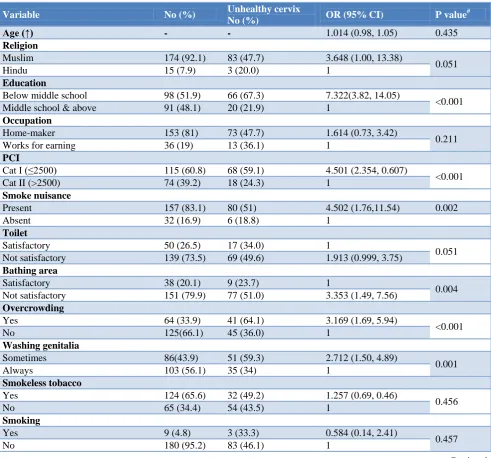
Table 2: Bivariate logistic regression: association of unhealthy cervix with various independent variables. (n=189).
Variable No (%) Unhealthy cervix
No (%) OR (95% CI) P value
#
Age (↑) - - 1.014 (0.98, 1.05) 0.435
Religion
Muslim 174 (92.1) 83 (47.7) 3.648 (1.00, 13.38)
0.051
Hindu 15 (7.9) 3 (20.0) 1
Education
Below middle school 98 (51.9) 66 (67.3) 7.322(3.82, 14.05)
<0.001
Middle school & above 91 (48.1) 20 (21.9) 1
Occupation
Home-maker 153 (81) 73 (47.7) 1.614 (0.73, 3.42)
0.211
Works for earning 36 (19) 13 (36.1) 1
PCI
Cat I (≤2500) 115 (60.8) 68 (59.1) 4.501 (2.354, 0.607)
<0.001
Cat II (>2500) 74 (39.2) 18 (24.3) 1
Smoke nuisance
Present 157 (83.1) 80 (51) 4.502 (1.76,11.54) 0.002
Absent 32 (16.9) 6 (18.8) 1
Toilet
Satisfactory 50 (26.5) 17 (34.0) 1
0.051
Not satisfactory 139 (73.5) 69 (49.6) 1.913 (0.999, 3.75)
Bathing area
Satisfactory 38 (20.1) 9 (23.7) 1
0.004
Not satisfactory 151 (79.9) 77 (51.0) 3.353 (1.49, 7.56)
Overcrowding
Yes 64 (33.9) 41 (64.1) 3.169 (1.69, 5.94)
<0.001
No 125(66.1) 45 (36.0) 1
Washing genitalia
Sometimes 86(43.9) 51 (59.3) 2.712 (1.50, 4.89)
0.001
Always 103 (56.1) 35 (34) 1
Smokeless tobacco
Yes 124 (65.6) 32 (49.2) 1.257 (0.69, 0.46)
0.456
No 65 (34.4) 54 (43.5) 1
Smoking
Yes 9 (4.8) 3 (33.3) 0.584 (0.14, 2.41)
0.457
No 180 (95.2) 83 (46.1) 1
Variable No (%) Unhealthy cervix
No (%) OR (95% CI) P value
#
Passive smoking
Yes 113 (59.8) 59 (52.2) 1.983 (1.09, 3.60)
0.025
No 76 (40.2) 27 (35.5) 1
Extramarital relation of spouse
Yes 15 (7.9) 13 (86.7) 8.993 (1.97, 41.07)
0.005
No 174 (92.1) 73 (42.0) 1
Age at menarche (↑) - - 0.893 (0.737, 1.081) 0.246
Duration of marriage (↑) - - 1.042 (1.01, 1.08) 0.022
Parity (↑) - 1.354 (1.07, 1.71) 0.012
H/O Abortion
Yes 106 (56.1) 53 (50) 1.515 (0.85,2.71)
0.161
No 83 (43.9) 33 (39.8) 1
Number of abortions (↑) - - 1.127 (0.82, 1.54) 0.458
Family history of cancer
Positive 19 (10.1) 11 (57.9) 1.742 (0.67, 4.55)
0.257
Negative 170 (89.9) 75 (44.1) 1
Clinical history
Asymptomatic 49 (25.9) 24 (49) 1.208 (0.63, 2.32)
0.570
Symptomatic 140 (74.1) 62 (44.3) 1
#p value less than 0.05 was considered significant.
Table 3: Hierarchical logistic regression: association of unhealthy cervix with socio-demographic, behavioral and reproductive characteristics (n=189).
Variable AOR (95% CI)
Model 1 Model 2 Model 3 PCI
Cat I (≤2500) 3.574 (1.784, 7.322) 3.625 (1.543, 8.652) 3.364 (2.753, 8.952)
Cat II (>2500) 1 1 1
Education
Below middle school 6.276 (2.970, 13.263) 6.691 (2.900, 15.439) 5.981(2.509, 14.247)
Middle or above 1 1 1
Overcrowding
Yes 2.199 (1.021, 4.739) 2.051 (0.887, 4.742) 1.776 (0.75, 4.205)
No 1 1 1
Bathing facility
Not Satisfactory 3.510 (0.680, 18.112) 5.080 (0.867, 29.775) 5.834 (0.914, 37.228)
Satisfactory 1 1 1
Smoke nuisance
Present 4.004(1.301, 12.316) 3.330 (1.044, 10.618) 3.343 (0.902, 12.397)
Absent 1 1 1
Washing genitalia
Sometimes 3.173 (1.413, 7.126) 2.974 (1.305, 6.778)
Always 1 1
Passive smoking
Yes 2.394 (1.033, 5.546) 1.947 (0.823, 4.606)
No 1 1
Extramarital relation of spouse
Yes 11.84 (2.073, 67.638) 11.08 (1.874, 65.564)
No 1 1
Duration of marriage (↑) 1.003 (0.835, 1.264)
Socio-demographic factors
Mean age of the study participants was 32.84 years with a standard deviation of 8.2 years. Maximum percentage (41.8%) of the study participants belonged to the age group of 25-31 years. Majority of the study participants followed Hinduism. 17.5% of the women were illiterate. Majority (63%) could not continue their education beyond Class VIII. 44.4% belonged to middle class followed by lower-middle (26.5%) and upper-middle (20.1%).
Environmental characteristics
Less than one-third of the women reported to have kitchen. 10.4% of them still didn’t have access to provision of LPG. Cross-ventilation was reported to be present in the cooking area of only around one-fifth of the women. Smoke nuisance was present in 83.1% of the households.
Behavioral characteristics and family history
Less than half of all used commercially available sanitary napkins. 43.9% reported the habit of washing external genitalia after coitus/ micturition with water. More than half of them were exposed to passive smoking. Five women were exposed to all the 3 forms while one fourth were not exposed to any form. Out of all, 137 women were found to be exposed to tobacco in any form. 10% of the study participants gave history of cancer among the family members.
Reproductive parameters
Mean duration of marriage was 14.2 years with a SD of 8.4 years. Age at marriage ranged from 12-28 years. With increasing duration, proportion of unhealthy cervix was found to increase. Among those married for more than 20 years, more than half had unhealthy cervix. High parity (3 or more children) was found in 52.9% of the women. Teenage pregnancy was found among one third of the study participants. 56.1% had a history of abortion either once or multiple times.
Association of unhealthy cervix with various factors
On bivariate analysis, low per capita income, poor educational status, presence of smoke nuisance in the
cooking area, overcrowding in the household,
unsatisfactory bathing facility, poor frequency of washing external genitalia, passive smoking, extramarital relation of the spouse, longer duration of marriage and higher parity were found to be significantly associated with unhealthy cervix. (Table 2)
All the significant factors were grouped in three domains.
Domain 1 included socio-demographic and
environmental characteristics, domain 2 comprised of behavioral characteristics and domain 3 had reproductive
parameters in it. Hierarchical logistic regression was performed to ascertain their association with unhealthy cervix. Goodness of model fit was checked by Hosmer Lemeshow test. (Table 3)
Model 1: PCI, educational status, smoke nuisance in the cooking area and overcrowding in the household together explain 44.8% of the change in the outcome (Negelkerke’s R Square = 0.448)
Model 2: PCI, educational status, smoke nuisance in the cooking area, passive smoking, frequency of cleaning external genitalia and extramarital relationship of the spouse together explain 53.5% of the change in the outcome (Negelkerke’s R Square = 0.535).
Model 3: educational status, PCI, frequency of cleaning external genitalia and extramarital relationship of the spouse of the study participant were found to be significantly associated with unhealthy cervix in the final model. These 4 variables explain 54.1% change in the outcome variable.
DISCUSSION
The current study showed that unhealthy cervix is not a very uncommon condition among the women of reproductive age group. Women attending the clinic for some other reasons had chances of incidentally being diagnosed with cervical ill health. It was found that 86 out of 189 (45.5%) women examined were unhealthy. Similar results were concluded by Malathi P et al by a study conducted at a tertiary hospital in Hyderabad where 19% of women were screened positive. 59.5% cervices they examined, were found to be unhealthy. [21] In a hospital based study in New Delhi in the year 2012, 55.7% of patients were diagnosed with unhealthy cervix on per-speculum examination. Of these, 62.8% had benign histopathological changes on biopsy. [22]
Risk factors of cancer cervix are known but as the risk factors of unhealthy cervical condition are not yet substantiated by research, the findings if the current study about the risk factors cannot be compared.
Limitations
It was a clinic-based study; so, the results cannot be generalized to all women of the community. Most of the data were self-reported by women, which might not be authentic due to social desirability and recall bias.
CONCLUSION
reduce burden of this cancer and thus reducing cancer deaths among women.
Raising awareness in favor of cancer cervix screening and popularizing screening is the need of the hour. Capacity building of health personnel through on-the-job training and supportive supervision will enable them to maintain / enhance their skills of detection of unhealthy cervix. Activities like observation of World Cancer Day (February 4) at the community and innovative use of mass / social media etc. should also be undertaken.
Funding: No funding sources Conflict of interest: None declared
Ethical approval: The study was approved by the Institutional Ethics Committee
REFERENCES
1. WHO/RHR/15.23, Trends in maternal mortality
1990 to 2015: Executive summary -
http://apps.who.int/iris/bitstream/handle/10665/1939 94/WHO_RHR_15.23_eng.pdf;jsessionid=1D2A2A D2DEE9608E03C12E64A9EED4E4?sequence=1]. Accessed 02 February 2019.
2. United Nations Development Programme,
Millennium Development Goals,
http://www.undp.org/content/undp/en/home/sdgover view/mdg_goals.htm. Accessed 02 February 2019.
3. Singhrao R, Huchko M, Yamey G. Reproductive
and Maternal Health in the Post-2015 Era: Cervical Cancer Must Be a Priority. PLoS Med. 10(8); 2013;10(8).
4. Ferlay J, Shin HR, Bray F, Forman D, Mathers C, Parkin DM. GLOBOCAN 2008, Cancer Incidence and Mortality Worldwide: IARC Cancer Base No. 10 Lyon, France: International Agency for Research
on Cancer; 2010. Available at:
http://globocan.iarc.fr. Accessed 02 February 2019.
5. The Lancet Global Health Blog
http://globalhealth.thelancet.com/2017/11/10/cervic al-cancer-deaths-blind-spot-global-womens-health. Accessed 02 February 2019.
6. Arbyn M, Castellsagué X, de Sanjosé S, Bruni L, Saraiya M, Bray F, et al. Worldwide burden of
cervical cancer in 2008. Annal Oncol.
2011;22(12):2675–86.
7. Jemal A, Bray F, Center MM, Ferlay J, Ward E, Forman D. Global cancer statistics. CA Cancer J Clin. 2011;61(2):69-90.
8. Nandakumar A, Ramnath T, Chaturvedi M. The
magnitude of cancer cervix in India. Indian J Med Res. 2009;130(3):219–21.
9. Ramesh G, Sudha R, Jayashree K, Padmini J.
Colposcopic Evaluation of the Unhealthy Cervix. J Clin Diagn Res. 2012;6(6):1026-8.
10. Verma A, Verma S, Vashist S, Attri S, Singhal A. A study on cervical cancer screening in symptomatic women using Pap smear in a tertiary care hospital in rural area of Himachal Pradesh, India. Middle East Fertility Soc J. 2017;22(1):39-42.
11. Makuza JD, Nsanzimana S, Muhimpundu MA, Pace
LE, Ntaganira J, Riedel DJ. Prevalence and risk factors for cervical cancer and pre-cancerous lesions in Rwanda. Pan Afr Med J. 2015;22:26.
12. Sharma P, Pattanshetty SM. A study on risk factors of cervical cancer among patients attending a tertiary care hospital: A case control study. Clinical Epidemology and Global Health. 2018;6:83-7. 13. Kour P, Lal M, Panjaliya R, Dogra V, Gupta S.
Study on Risk Factors Associated with Cervical Cancer. Biomed Pharmacol J. 2010;3(1).
14. Kumar HNH, Tanya S. A Study on Knowledge and
Screening for Cervical Cancer among Women in Mangalore City. 2014;4(5):751-56.
15. Roy AG, Roy A, Bandyopadhyay AR. A Study on Cervical Cancer Awareness among the Bengalee Women, Kolkata, West Bengal. Int Clin Pathol J. 2017;4(3):00097.
16. ICO/IARC Information centre on HPV and Cancer.
Human Papilloma Virus and Related Cancer Fact sheet. 2017.
17. Dutta S, Biswas N, Mukheriee G. Evaluation of sociodemographic factors for non compliance to treatment in locally advanced cases of cancer cervix in a rural medical college hospital in India. Indian J Palliat Care. 2013;19(3):158–65.
18. All India Institute of Hygiene and Public Health, Kolkata. Annual report. 2014.
19. All India Institute of Hygiene and Public Health, Kolkata. Annual report. 2015.
20. All India Institute of Hygiene and Public Health, Kolkata. Annual report. 2016.
21. Malathi P, Reddy VE, Sirisha SM. Cervical
cytology in healthy and unhealthy cervices with acetic acid as agent for visual inspection. Asian Pac J Health Sci. 2016;3(3):325-32.
22. Ghosh P, Gandhi G, Kochhar PK, Zutshi V, Batra S.
Visual inspection of cervix with Lugol's iodine for early detection of premalignant & malignant lesions of cervix. Indian J Med Res. 2012;136:265-71.
Cite this article as: Dasgupta A, Sinha RN, Paul B,
Bandyopadhyay L, Banerjee R, Suman S.A study on