Original Research Article
Assessment of knowledge of risk factors and prevention of obesity
among school children: a cross sectional study
Praveena R. Gunagi, Shobha S. Karikatti*, Sunanda B. Halki
INTRODUCTION
Obesity is one of the common health problems and a complex condition, with serious medical, social and psychological dimensions affecting virtually all ages and socioeconomic groups. Obesity has gained the attention in the field of public health as one of the major risk factors of non-communicable diseases worldwide. Globally obesity has reached the epidemic proportions and has become pandemic in the history of world. Recent data reveals 2.1 billion (30%) of the world’s population
are either obese or overweight; 25% global deaths are premature and are attributed to the obesity related problem. Obesity increases the risk of cardiovascular disease deaths by three times. A phenomenal rise has been observed in the prevalence of overweight and obesity among adolescents all over the world. Over the past 25 years the prevalence of overweight and obesity has doubled in children of 6-11 years age group and tripled in adolescents of 12-17 years of age group. India is the third most obese country in the world. The prevalence
ABSTRACT
Background: Childhood obesity is a major contributor to the global burden of chronic diseases and is an important determinant of cardiovascular diseases, type II diabetes etc. This can largely be attributed to the transformation in the lifestyles of children. There is still lack of knowledge about obesity among high school children. Objective of this study was to assess the knowledge of risk factors of obesity among school children and to find out the knowledge of hazards and preventive measures of obesity among school children.
Methods: A cross-sectional study was conducted among school students aged between 13-14 years from 9 randomly selected schools. The total sample included 480 students.
Results: Out of 480 subjects 70.4% had heard about obesity, 62.3% were aware about the increasing prevalence of obesity among the youngsters, 26.7% thought unhealthy dietary factors and 29% thought mental stress were the main factors leading to obesity and non-communicable diseases. More than 75% students had correct knowledge of dietary factors associated with obesity like eating larger portion of food, eating fried foods, having junk foods. 51-75% of the students responded correctly for the factors i.e. using motorcycle for short distance.
Conclusions: More than half of the students had knowledge of specific dietary and physical activity risk factors. Majority of the students identified high blood pressure, diabetes and heart problem as hazards of obesity. Only one third of the students knew preventive measures like adequate intake of fruits and vegetables, limiting unhealthy snacks and limiting screen time to prevent obesity.
Keywords: Knowledge, Preventive measures, Risk factors obesity
Department ofCommunity Medicine, Belagavi Institute of Medical Sciences, Belagavi, Karnataka, India
Received: 01 December 2019
Accepted: 18 December 2019
*Correspondence:
Dr. Shobha S. Karikatti, E-mail: [email protected]
Copyright: © the author(s), publisher and licensee Medip Academy. This is an open-access article distributed under the terms of the Creative Commons Attribution Non-Commercial License, which permits unrestricted non-commercial use, distribution, and reproduction in any medium, provided the original work is properly cited.
of overweight and obesity among Indian adolescents varies between 10 and 30%.1,4
The large attributes for emerging problem of overweight and obesity comes from changing lifestyles due to growing economy, technology and globalization. These lifestyles have contributed to obesity and metabolic risk factors like dyslipidaemia, impaired glucose metabolism, etc and morbidities like type 2 diabetes mellitus, polycystic ovarian disease, hypertension and depression among urban children.5,6 The increasing trends in childhood obesity, metabolic risk factors and the morbidities are cause of grave concern among health care professionals and parents. The knowledge about obesity, importance of lifestyle risk factors, metabolic risks, the emergence of obesity related hazards, are lacking in school children, teachers and parents.
Understanding school children's knowledge regarding obesity and its risk factors may be the cornerstone to the success of preventive programs for childhood obesity. With this background of assessing the knowledge of obesity and its risk factors the present study was planned and conducted in study settings.
METHODS
The study was conducted in Belagavi city, an urban area of North Karnataka which is one of the fastest growing cities and is at risk of lifestyle changes. The present cross-sectional study is a part of non-randomized controlled trial and conducted in secondary school setting. This study was conducted for a period of one year i.e. during January to December 2017. Ethical clearance was obtained from the institutional ethical committee. Based on the pilot study results and expecting the 15% increase in the knowledge and skill, we calculated the required sample size using following formula
p1 = 25% p2 =40% effect size = 15%
n = 2(Z α + Z β)2 p (=p1+p2 / 2) * q(=100-p) /d2 = 2*(1.96+1.28)2 *32.5* 67.5 / 152 = 205 in each group Considering the dropout rate to be 15% n = 241 ~ 240 in each group. The sample size of 480 students from both groups was included in baseline survey for the present study. The study was carried out in nine randomly selected schools. Written informed assent was obtained from school children and permission was also obtained from school authorities.
School children from 8th and 9th standards of selected schools who gave consent for participation in the study were included in the study.
School children who were absent on the day of data collection were excluded from the study.
Data was collected using a predesigned pretested self-administered questionnaire. The details of socio demographic profile of participants, knowledge regarding obesity i.e. dietary factors, physical activity, hazards of obesity and preventive measures of obesity was collected. Data was analysed using Microsoft excel. Results were presented in simple proportions.
RESULTS
The socio-demographic profile of children and their parents were analysed and the results were as follows. Out of the 480 students who participated in the study 280 (58%) were males and 200 (42%) were females. Most of the students 396 (82.5%) belonged to the age group of 13-14 years. In the present study 82 (17.1%) mothers were graduates and 150 (31.3%) were illiterates and similarly 118 (24.6%) fathers were graduates and 144 (30%) were illiterates. Majority 170 (35.4%) belonged to the class V socioeconomic status. As per the history 20 (4.1%) parents were having morbidities like diabetes, hypertension and obesity.
Table 1: Distribution of students based on knowledge of obesity.
Non-communicable disease Number % Heard about obesity
No 142 29.6
Yes 338 70.4
Description of overweight/obesity
Excessive weight/age 148 30.8
Excessive weight/height 37 7.7
Excessive fat 162 33.8
Fatty belly 43 9.0
Any of above 59 12.3
None 31 6.5
Obesity in young
Yes 299 62.3
No 27 5.6
Don’t know 154 32.0
Factors contributing to obesity
Unhealthy diet 128 26.7
Decrease physical activity 52 10.8
Mental stress 139 29.0
Family history 73 15.2
Health problems 108 22.5
The knowledge regarding obesity was assessed and the study showed that 338 students (70.4%) had heard about obesity, 299 (62.3%) were aware about increasing prevalence of obesity among the youngsters, 128 (26.7%) thought unhealthy dietary factors, and 139 (29%) perceived mental stress were the main factors leading to obesity (Table 1).
found that more than 75% students had correct knowledge for the factors like eating larger portion of food, eating fried foods, having junk foods whereas 51-75% of the students responded correctly for the factors i.e. eating while watching TV, snacking in between meals and consumption of non-vegetarian food and alcohol. Similarly knowledge regarding physical activity factors
associated with obesity was assessed and the study revealed that 51-75% of the students responded correctly for the factors i.e. using motorcycle for short distance, spending more time with computers/laptops, excessive watching of TV/videos, using lifts whereas less than 50% answered correctly for the item playing indoor games (Table 2).
Table 2: Distribution of the students according to the correct knowledge of risk factors of obesity.
S. no. Dietary risk factors N % Physical in activity N %
1. Eating large portion of food 367 76.5 Playing in home 237 49.3
2. Eating while watching TV 245 51.0 Using motorcycle for short distance 300 62.5
3 Eating fried food 410 85.4 Spending more time with
computers/laptops 335 69.8
4 Snacking in between meals 314 65.4 Excessive watching TV/videos 305 63.5
5 Consumption non-veg food 251 52.3 Using lifts 346 72.1
6 Drinking alcohol 261 54.4 Spending more time with mobiles 330 68.75
7 Having Junk foods 379 79
8 Skipping breakfast 282 58.8
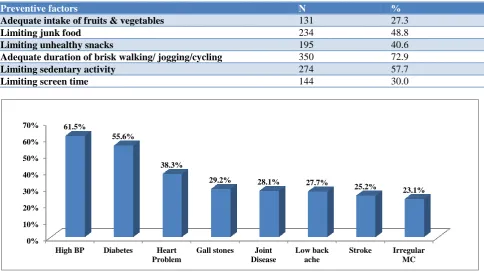
Table 3: Distribution of the students according to the knowledge of preventive factors of obesity.
Preventive factors N %
Adequate intake of fruits & vegetables 131 27.3
Limiting junk food 234 48.8
Limiting unhealthy snacks 195 40.6
Adequate duration of brisk walking/ jogging/cycling 350 72.9
Limiting sedentary activity 274 57.7
Limiting screen time 144 30.0
Figure 1: Knowledge of health hazards of obesity.
Among the participants 295 (61.5%) perceived high blood pressure as one of health hazard of obesity, 267 (55.6%) stated diabetes and 184 (38.3%) thought heart problem to be health hazards of obesity (Figure 1).
Knowledge of preventive factors in obesity was assessed and the study revealed that 131 (27.3%) students knew about the adequate intake of fruits and vegetables, 234 (48.75%) and 195 (40.6%) knew about the limiting junk foods and unhealthy snacks respectively. The proportion of the students who had correct knowledge regarding
adequate duration of brisk walking/cycling/jogging, limiting sedentary activity and limiting screen time in the prevention of obesity was 350 (72.9 %), 274 (57.08%) and 144 (30%) respectively (Table 3).
DISCUSSION
The present study assessed the knowledge of school students regarding the risk factors, hazards and prevention of obesity.
0% 10% 20% 30% 40% 50% 60% 70%
High BP Diabetes Heart
Problem
Gall stones Joint
Disease
Low back ache
Stroke Irregular
MC 61.5%
55.6%
38.3%
29.2% 28.1% 27.7%
In the present study 70.4% had heard about obesity, 62.3% were aware about the increasing prevalence of obesity among the youngsters, 26.7% thought unhealthy dietary factors and 29% thought mental stress as the main factors leading to obesity. A study done in Tanzania among school students showed that 51.1% had heard about obesity and 44.6% correctly defined obesity. However, 72.1% were aware that obesity affects young children and less than half (45.4%) had knowledge about the risk factors for childhood obesity.7
Another study done in Bhagdad among secondary school students regarding the causes of obesity showed that about 90% of students agreed that eating excessive fat can lead to obesity and about 69% of students mentioned that eating excessive sweet and insufficient physical activity while 52% thought psychological upset and 24% stated drugs and disease can lead to obesity.8 A study done in Nepal found that 75% of the adolescents had knowledge regarding meaning of obesity.9
In our study with respect to awareness regarding dietary risk factors for obesity; 76.5% knew eating large portion food, 85.4% eating fried food, 79% eating junk food as the risk factors. This was similar to the studies done by Mythily et al at Mandya which showed that 90.6% perceived eating oily food, 88.8% eating junk food, 87.5% eating more than required as the risk factors for developing obesity.10 In another study done in Nepal, it was found that 59.2% had mentioned high calorie intake as a risk factor of obesity.9
In this study more than half of the students had correct knowledge regarding physical activity factors associated with obesity. The study found that 72.9% of the students had correct knowledge regarding adequate duration of brisk walking/cycling/jogging in the prevention of obesity, whereas in a study done in Nepal 98% percent of the students mentioned regular exercise as a preventive measure of obesity.9 In our study only 27.3% of the students knew about adequate intake of fruits and vegetables in the prevention of obesity similar to the study done by Rakshanderou et al wherein only12.4% knew about the minimum recommended amount of fruits and vegetables.11
In this study 61.5% identified high blood pressure and 55.6% of the students identified diabetes as hazards of obesity similar to a study done at Nepal wherein 52.5% adolescents stated diabetes mellitus as consequence of obesity.9 A study done in Gujarat showed baseline knowledge of the students regarding hazards of obesity like hypertension, cancer, heart attack and diabetes mellitus was 19.7%, 16.1%, 16.5% and 24.5% respectively.12
Our study and various other studies have found that students have good knowledge regarding specific dietary, physical activity risk factors but the knowledge was poor regarding hazards and prevention of obesity. In spite of
good knowledge of obesity, the prevalence of obesity is increasing and there is a gap in attitude and practice which needs to be addressed.
Limitations of this study was the data was taken from a baseline survey of non-randomised controlled trial, we analysed only knowledge of risk factors, hazards and preventive measures of obesity. Due to the time constraints attitude and practice of the students towards the same couldn’t be assessed.
CONCLUSION
More than half of the students had knowledge of specific dietary and physical activity risk factors. Majority of the students identified high blood pressure, diabetes and heart problem as hazards of obesity and lacked knowledge regarding other hazardous factors. Only one third of the students knew preventive measures like adequate intake of fruits and vegetables, limiting unhealthy snacks and limiting screen time to prevent obesity.
Recommendations
As the knowledge was poor among students regarding hazards of obesity, there is a need to impart knowledge on hazards a part of health education programs among school children which motivates in changing the behaviour of children. Inspite of having good knowledge of obesity and its risk factors, the status of obesity is increasing which indicates that there is a gap between knowledge and practice. Hence there is a need for sustainable lifestyle modification programs and interventions at school settings which can bring a huge change in lifestyle and healthy practices to provide an ability to take care of their own health.
ACKNOWLEDGEMENTS
The current study was published as a part of project “Assessment of obesity and knowledge of risk factors among school children through school based self-care model: a new strategy for prevention” funded by Rajiv Gandhi university of health sciences, Karnataka Bangalore [M-56;2015-2016] who had no influence on the content of this paper. The authors would like to thank the Institute, Staff, Teachers, Assistants and the participants for allowing us to carry out this research and also for their support and participation.
Funding: Rajiv Gandhi university of health sciences, Karnataka Bangalore [M-56;2015-2016]
Conflict of interest: None declared
Ethical approval: The study was approved by the Institutional Ethics Committee
REFERENCES
Community Medicine 1st ed. Dept of Community Medicine, AFMC Pune in collaboration with WHO India Office New Delhi. Gayo Enterprises Gayo printers: 2009: 1184.
2. Singh AK, Maheshwari A, Sharma N, Anand K. Lifestyle associated risk factors in adolescents. Indian J Pediatr. 2006;73(10):901-6.
3. Sawant AM, Shetty D, Mankeshwar R, Ashavaid TF. Prevalence of dyslipidemia in young adult Indian population. J Assoc Physicians India. 2008;56:99-102.
4. Raj M, Kumar K. Obesity in children and
adolescents Indian. J Med Res. 2010;132(5):598-607.
5. Murray CJL, Lopez AD. Global Health Statistics. Global Burden of Disease and Injury Series. Boston, MA: Harvard School of Public Health; 1996. 6. Narain JP, Garg R, Fric A. Non-communicable
diseases in the South-East Asia region: burden, strategies and opportunities. Natl Med J India. 2011;24(5):280.
7. Njelekela MA. Knowledge and attitudes towards obesity among primary school children in Dar es Salaam, Tanzania Niger Med J. 2015;56(2):103-8. 8. AlKhafaji HT, Abdullah SK, Abdl-Jalil R. Assess
knowledge, attitude and practice about obesity among a Sample of Secondary School Students in
Al-karkh District-Baghdad City. Res J Pharm Tech. 2018;11(4):1649-54.
9. Pandey A, Sapkota S. Prevalence and knowledge on obesity among school going adolescents of Kaski, Nepal. J Nepal Paediatr Soc. 2018;38(2):63-8. 10. Mythily MR, Vinay M, Harish BR. Awareness
regarding obesity and healthy lifestyle practices among college students in Mandya. Natl J Community Med. 2018;9(8):580-4.
11. Rakhshanderou S, Ramezankhani A, Mehrabi Y, Ghaffari M. Adolescents' awareness of fruit and vegetable consumption in Iran: An unacceptable status. Ann Trop Med Public Health. 2017;10:1746-51.
12. Shah V, Jain UJ, Thakor N. Impact of educational intervention regarding hazards of obesity and its preventive measures among students of commerce colleges of Ahmedabad city, Gujarat, India. Int J Res Med Sci. 2016;4:3820.