IJSRSET196457 | Received : 05 Jan 2018 | Accepted : 28 Jan 2018 | January-February-2018 [(4) 6 : 230-235]
© 2018 IJSRSET | Volume 4 | Issue 6 | Print ISSN: 2395-1990 | Online ISSN : 2394-4099 Themed Section : Engineering and Technology
230
Study of Mie Scattering Efficiency using Lorenz-Mie Theory
Parthkumar B. Dodiya
Research Scholar, Sardar Patel University, Vallabh Vidyanagar, Gujrat, India
ABSTRACT
This Paper analyses the mathematical character of the scattering efficiency and studies the numerical computation of it. Maxwell's equations under given boundary conditions has been used to solve electromagnetic scattering by a spheroidal particle of small size . The Mie scattering coefficients an and bn are
determined by using the boundary conditions. The paper discusses the relations of the scattering efficiency and the size parameter x. We give the relations of the approximate periodicity of the ripple structure and relative refractive indices m. The effects of absorption part of refracting index (mi) and size of particle on scattering are
illustrated by means of diagrams.
Keywords: The Lorenz-Mie theory, scattering of light, scattering efficiency, refracting index, Mie scattering coefficients
I.
INTRODUCTIONThe scattering of a plane wave from homogeneous spheres is an old object of research, but it is still maturing as new applications demand more detailed understanding. Particulate scattering is a useful concept in various branches of science. Since exact analytical solutions to the single-scattering problem have been worked out only for a few special shapes, the scattering particles are assumed to be spherical regardless of their real shape. Its rigorous mathematical solution was obtained as the
well-known infinite series of partial waves, generally
known as the Mie solution. Due to wide availability of computer programs for spherical shape, the spherical1 and infinite circular cylindrical2 solutions
are by far the simplest. To perform Mie calculation so many methods have been discussed by many authors. After many years of research, the Mie calculation has been perfectly developed. The important contributors are Mie1 Infeld3, Dave4, Lentz5 and Wiscombe6 and
this list is by no means complete. An excellent description of Mie theory is provided by Liou K. N7
and the notation in his book is thus adopted. Programming language FORTRAN has been used to compute parameters obtained by using Mie Theory. This code provides accurate results for small and large particles with size parameters.
In this paper our purposes are to comment on the connection between scattering efficiency and refractive index of particle. The corresponding relationship of the ripple structure of scattering curve and the size parameter (x) and the corresponding relationship of the peak value ripple structure are discussed. Moreover, the corresponding relationship of the approximate period of the ripple structure of scattering curve and the relative refractive index (m) is studied.
II.
Theoretical Backgroundheat energy which is known as absorption. The sum of these two processes is called extinction8. Mainly
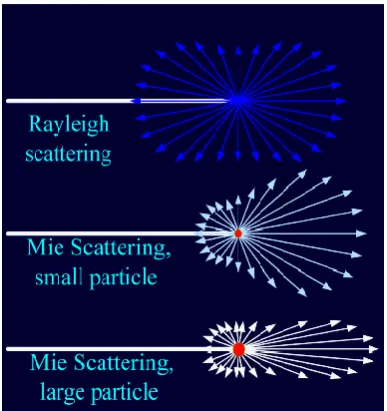
two type of scattering exist in nature, elastic scattering and inelastic scattering. When the wavelength of the scattered radiation is same as the wavelength of incident radiation then it is known as elastic scattering. In inelastic scattering, the wavelength of scattered radiation is different from the incident radiation. The elastic scattering can be further classified into Rayleigh scattering, and Mie scattering depending on the size of the particle as compared to wavelength of incident radiation. The scattering is called Rayleigh scattering when the particle size is much smaller than the incident wavelength. When the particle size is same as the incident wavelength, the scattering is called Mie scattering7. This scattering produce pattern like an
antenna lobe with sharper and more intense forward lobe for larger particles which is shown in below figure.
Figure 1. Types of scattering
Mie theory, also called Lorenz-Mie theory was independently developed and named for Gustav Mie (1868 – 1957) and Ludvig Lorenz (1829 – 1891). It givess a complete mathematical theory for scattering by small particles9. Smallness of particles
are define by size parameter: 𝑥 =2𝜋
𝜆 𝑎; where a is
radius of the particle and λ is incident wavelength. This theory is applicable for size parameter having
range between 0.1 to 100; commonly known as Mie region. There are three assumptions10 in Mie theory,
The particle is sphere in shape, The scattered field from the particle is very large. Particle is homogeneous so it is characterized by single refractive index. In this theory, the effect of particle geometry, particle index with respect to surrounding medium and angular dependence of incident beam can be studied9. Thus, The Mie scattering theory can be
constructed starting with basic electrodynamics equations. In any scattering phenomena, a scatterer first absorbs incident energy and re-radiate in different directions. In this scenario, scattered radiation is considered due to multipole-expansion radiation from the scatterer. With this understanding a scatterer is assumed to be made up of monopole, dipole, etc. The largest contribution comes from a monopole, and then decreases with higher order pole distributions. Thus total scattering phenomenon, i.e. to calculate total scattered intensity, we can sum such all contributions. To achieve this end, we require an electromagnetic wave equation to be solved.
Now, we discuss the scattering of plane wave by a homogeneous sphere. For that, we shall assume that outside the medium is vacuum (m=1), that the material of the sphere has index of refraction m, and the incident radiation is linearly polarized. We select the origin of a rectangular system of coordinates at the centre of the sphere, with the positive Z axis along the direction of propagation of the incident wave. If the amplitude of the incident wave is normalized to unity, the incident electric and
magnetic field vectors are given by, E𝑖 =a𝑥𝑒−𝑖𝑘𝑧, H𝑖=
a𝑦𝑒−𝑖𝑘𝑧, (1)
for incident waves outside the sphere, we have
𝑟𝑢𝑖
=1
𝑘∑(−𝑖)
𝑛(2𝑛 + 1) 𝑛(𝑛 + 1) ∞
𝑛=1
𝜓𝑛(𝑘𝑟)𝑃𝑛1(cos 𝜃) cos 𝜙 (2)
𝑟𝑣𝑖
=1
𝑘∑(−𝑖)
𝑛(2𝑛 + 1) 𝑛(𝑛 + 1) ∞
𝑛=1
𝜓𝑛(𝑘𝑟)𝑃𝑛1(cos 𝜃) sin 𝜙 (3)
𝑟𝑢𝑠
=1
𝑘∑(−𝑖)
𝑛(2𝑛 + 1) 𝑛(𝑛 + 1) ∞
𝑛=1
𝑎𝑛𝜉𝑛(𝑘𝑟)𝑃𝑛1(cos 𝜃) cos 𝜙
𝑟𝑣𝑠
=1
𝑘∑(−𝑖)
𝑛(2𝑛 + 1) 𝑛(𝑛 + 1) ∞
𝑛=1
𝑏𝑛𝜉𝑛(𝑘𝑟)𝑃𝑛1(cos 𝜃) sin 𝜙, (4)
The coefficients 𝑎𝑛, 𝑏𝑛have to be determined from
the boundary conditions at the surface of the sphere. The conditions are that the tangential components of E and H be continuous across the sphere surface r=a,
𝐸 𝜃𝑖 + 𝐸 𝜃𝑠 = 𝐸 𝜃𝑡, 𝐻 𝜃𝑖 + 𝐻 𝜃𝑠 = 𝐻 𝜃𝑡, 𝐸 𝜙𝑖 + 𝐸 𝜙𝑠 = 𝐸 𝜙𝑡 , 𝐻 𝜙𝑖 + 𝐻 𝜙𝑠 = 𝐻 𝜙𝑡 (5)
By Applying boundary condition11 and matching the
transverse field at sphere leads to the following expressions of the Mie coefficients.
𝑎𝑛=
𝜓𝑛′(𝑦)𝜓𝑛(𝑥) − 𝑚𝜓𝑛(𝑦)𝜓𝑛′(𝑥) 𝜓𝑛′(𝑦)𝜉𝑛(𝑥) − 𝑚𝜓𝑛(𝑦)𝜉𝑛′(𝑥)
(6)
𝑏𝑛=
𝑚𝜓𝑛′(𝑦)𝜓𝑛(𝑥) − 𝜓𝑛(𝑦)𝜓𝑛′(𝑥) 𝑚𝜓𝑛′(𝑦)𝜉𝑛(𝑥) − 𝜓𝑛(𝑦)𝜉𝑛′(𝑥)
(7)
Above Eqs. (6) and (7) are known as scattering Mie coefficients.
where, 𝑚 = 𝑚𝑟− 𝑖𝑚𝑖 is index of refraction, with 𝑚𝑟
and 𝑚𝑖 representing the real and imaginary parts of
refractive index, respectively.Here 𝑦 = 𝑚𝑥 and 𝜓𝑛(𝑥)
are the Spherical Bessel functions7 of order n.
𝜓𝑛(𝑥)
= √𝜋
2𝑥∑(−1)
𝑘 1
𝑘! 𝛤 (𝑛 +12 + 𝑘 + 1) (𝑥
2) 2𝑘+𝑛+1
2 (8) ∞
𝑘=0
The function 𝜉𝑛(𝑥) is the half-integral-order Hankel
function of the second kind,
𝜉𝑛(𝑥) = 𝜓𝑛(𝑥) − 𝑖𝜒𝑛(𝑥), (9)
The is Spherical Neumann function𝜒𝑛 is given by,
𝜒𝑛(𝑥)
= √𝜋
2𝑥∑(−1)
𝑘 1
𝑘! 𝛤 (−𝑛 −12 + 𝑘 + 1) (𝑥
2) 2𝑘−𝑛−12
(10) ∞
𝑘=0
By using scattering Mie coefficient we may now define the scattering efficiency.
𝑄𝑠= 2
𝑥2∑(2𝑛 + 1)(|𝑎𝑛|2+ |𝑏𝑛|2). (11) ∞
𝑛=1
Where,𝑥 is given by,𝑥 =2𝜋
𝜆 𝑎 , 𝑎 is radius of particle
and λ is the wavelength of incident radiation
III.
RESULTSThe previous formation is now used to compute efficiency within the Lorenz-Mie theory. In this calculation Wavelength λ=500 nm of incoming wave and Radius (a) of particle vary between 0.9 to4.5 µm. Through, the solution of a in the present study is arbitrary and represent only a test-case. Further, we have tested and analyzed the result for two refractive indices; Only with real part (mr), Including imaginary
refractive index (mi). FORTRAN-90 code is
constructed to program calculations.
3.1 Scattering efficiency 𝑸𝒔 for different refractive
index (m) having only real part (mr):
Figure: 2 Comparison of Scattering efficiency (𝑸𝒔) as
Figure 2 shows scattering efficiency for particle. For x<2, Qs is critically dependent on x. The position of
first maxima and the frequency of oscillation are dependent on the index of refraction, increasing value of m corresponding to smaller value of x at maximum. The smoothness of curve decrease i.e ripple structure arise as refractive index increase. Some of the energy beyond the dimensions of the particle is scattered also.
According to Babinet’s principle, if the particle is very
large compared to wavelength, an amount of energy proportional to geometry of cross section is abstracted from beam by scattering and absorption, but a like amount is diffracted out of beam12.
In the graph of Qs there are series of maxima,
minima and ripples. The ripple structure is caused by scattering resonance of individual partial waves in the multiple expansion of scattered field. The ripple structure become faint as x is large. When the relative indices m is real and it is less than 2, the ripple structure has single periodicity and the position of the peak value of ripple structure is corresponding to those of Re(an) and Re(bn)13.
The major maxima and minima are due to interference. The interference structure has been interpreted as being caused by the interference either of the forward-scattering light and the incident beam or the diffracted and transmitted light wave in near forward direction14.
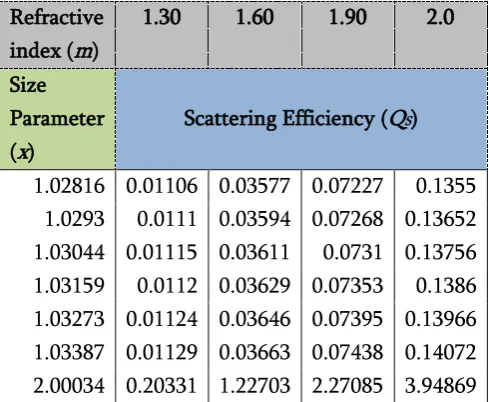
Refractive index (m)
1.30 1.60 1.90 2.0
Size Parameter (x)
Scattering Efficiency (QS)
1.02816 0.01106 0.03577 0.07227 0.1355 1.0293 0.0111 0.03594 0.07268 0.13652 1.03044 0.01115 0.03611 0.0731 0.13756 1.03159 0.0112 0.03629 0.07353 0.1386 1.03273 0.01124 0.03646 0.07395 0.13966 1.03387 0.01129 0.03663 0.07438 0.14072 2.00034 0.20331 1.22703 2.27085 3.94869
2.00148 0.20388 1.22909 2.27218 3.96406 2.00262 0.20445 1.23115 2.27354 3.97946 2.00377 0.20502 1.2332 2.27491 3.99489 2.00491 0.20559 1.23525 2.2763 4.01036 3.23641 1.02728 3.19333 4.02602 2.81355 3.23755 1.02825 3.19503 4.02149 2.81953 3.2387 1.02922 3.19674 4.01699 2.82575 3.23984 1.03018 3.19846 4.01251 2.83225 3.24098 1.03115 3.2002 4.00804 2.839 5.13508 2.50537 3.76686 1.92352 3.19434 5.13622 2.5062 3.76524 1.91541 3.1852 5.13736 2.50702 3.76367 1.90723 3.17705 5.1385 2.50785 3.76204 1.89916 3.16902 5.13965 2.50867 3.7604 1.89117 3.16202
Table:1 Comparison of Scattering efficiency (𝑸𝒔)
3.2 Scattering efficiency (𝑸𝒔) for different refractive
index (m=mr+imi):
Figure: 2 Scattering efficiency (𝑸𝒔) as a function of
size parameter for mr =1.30, mi=0.00, 0.02, 0.04, 0.06.
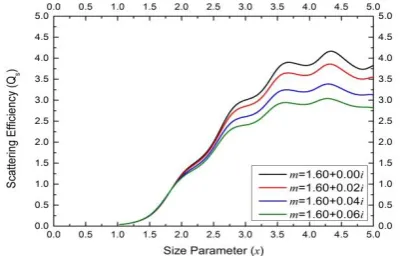
Figure: 3 Scattering efficiency (𝑸𝒔) as a function of
size parameter for mr =1.60, mi=0.00, 0.02, 0.04, 0.06.
Fig. 3 shows scattering efficiency (𝑸𝒔) as a function of
size parameter for mr =1.60, mi=0.00, 0.02, 0.04, 0.06.
Here we found that for size parameter (x<2) there is no absorption of incoming electromagnetic wave. We found that maxima and minima observed in scattering efficiency as value of mr increase.
Figure 4. Scattering efficiency (𝑸𝒔) as a function of
size parameter for mr =1.90, mi=0.00, 0.02, 0.04, 0.06.
Figure 5. Scattering efficiency (𝑸𝒔) as a function of
size parameter for mr =1.90, mi=0.00, 0.02, 0.04, 0.06.
The scattering efficiency decrease as the imaginary part of refractive index increase. When the imaginary part is added in refractive index, true absorption occurs and due to that the dependency of 𝑄𝑠 on
particle size is modified. As 𝑚𝑖 increase from zero, the
principle maximum of curve is decreases in magnitude and shift towards the smaller value of x. The amplitude of the secondary oscillations are correspondingly reduced. When the imaginary part is greater than 0.1 the oscillation completely damped out. So as the imaginary part increases the absorption efficiency increases13.
When the imaginary part of m becomes large, Re(𝑎𝑛)
and Re(𝑏𝑛) become small and the interference
oscillation amplitudes decrease. The phenomena indicated that the absorption of the sphere becomes strong and the interference become weak when the imaginary part of m become large14.
IV.
REFERENCES[1]. Mie G., "Beitrage zur Optik trdber Medien speziell kolloidalerMetallosungen," Ann. Phys. 25 (1908) 377.
[2]. Wait J. R., "Scattering of a Plane Wave from a Circular Dielectric Cylinder at Oblique Incidence," Can. J. Phys. 33 (1955) 189.
[3]. Infeld L., “The influence of the width of the
gap upon the theory of antennas,” Q. Appl.
Math. 5 (1947) 113– 132.
[4]. Dave J. V., “Scattering of electromagnetic radiation by a large, absorbing sphere,” IBM J.
Res. Dev. 13 (1969) 302–313.
[5]. Lentz W. J, “Generating Bessel functions in
Mie scattering calculations using continued
fractions,” Appl. Opt. 15 (1976) 668 –671. [6]. Wiscombe W. J., “Improved Mie scattering
algorithms,” Appl. Opt. 19 (1980) 1505–1509. [7]. Liou K. N, An Introduction to Atmospheric
Radiation, Academic Press (2009).
[8]. E. Boesche, Influence of aerosols on polarization of skylight in gaseous absorption bands, Scientific report/ WR-2008-04.
Dmitri Petrov, New J. Phys., 11 (2009) 013046.
[10]. W. A. de Rooij and C. C. A. H. Van der Stap, Astr. and Astrophys., 131 (1984) 237-248. [11]. Griffiths D. J, Introduction to Electrodynamic,
Pearson Addison-Wisley, 2012 [12]. Coulson K. L, POLARIZATION AND
INTENSITY OF LIGHT IN THE ATMOSPHERE, A. DEEPAK Publishing (1988).
[13]. Chylek Petr, J. Opt. Soc. Am, 66 (1976) 285-287.
[14]. Lock J. A and Leiming Yang, J. OPT. Soc. Am. A, 8 (1991) 1132-1134.
Cite this Article
Parthkumar B. Dodiya, "Study of Mie Scattering Efficiency using Lorenz-Mie Theory", International Journal of Scientific Research in Science, Engineering and Technology (IJSRSET), Online ISSN : 2394-4099, Print ISSN : 2395-1990, Volume 4 Issue 6, pp. 230-235, January-February 2018.