REVIEW ARTICLE
REAL TIME EMBEDDED BASED DRINKING WATER VENDING MACHINE
1,*Sasikala, G.,
2Kuldipsing Rajput,
3Sarfaraj Hussain and
4Aastha Shrivastava
1
Assistant Professor Department of ECE, Veltech Rangarajan Dr. Sagunthala R and D Institute of Science and
Technology, Chennai, Tamil Nadu, India
2,3,4
M.Tech Students, Embedded System Technologies, Veltech Rangarajan Dr. Sagunthala R and D Institute of
Science and Technology, Chennai, Tamil Nadu, India
ARTICLE INFO
ABSTRACT
Now-a-days, automated vending machines are most in use as they make various activities not only easier but also more efficient. This paper introduces the self-serviced drinking water machine. This machine has numerous input and outputs to provide service to the customer. This machine is similar to vending machine. It is coin operated machine. It accepts only coins as input like Rs.1, Rs.2, and Rs.5 in any sequence and delivers drinking water. The main motto of this system is to avoid the environmental pollution and also to avoid the wastage of water with the help of water control valve.
Copyright © 2014 Sasikala, et al. This is an open access article distributed under the Creative Commons Attribution License, which permits unrestricted use, distribution, and reproduction in any medium, provided the original work is properly cited.
INTRODUCTION
We know that the available water resources has initiated towards the end. This problem is quietly related to poor water allocation, inefficient use, and lack of adequate and integrated water management. Since last few decades, several monitoring systems integrated with water level detection have been accepted; therefore water controlling system implementations have potential significance in the society. In this paper (Pradeepa et al., 2013; Bhuvaneswari et al., 2013 and Muhammad Ali Qureshi et al., 2011) vending machine is going to be developed in such a way that water will get served to the customers. As it is coin operated machine, the required quantity of water and respective amount of money is decided that are affordable for common people. (Carlosena et al., 2007) Coin discriminator is the mechanism used to insert the coin of Rs.1, Rs.2and Rs.5 into the machine. (Carlosena et al., 2007 and Marcel Tresanchez et al., 2009) Coin discriminator will be developed with the help of optical mouse sensor which works on image processing technique which is best suitable than the other techniques.
*Corresponding author: Sasikala, G.,
Department of ECE, Veltech Rangarajan Dr. Sagunthala R and D Institute of Science and Technology, Chennai, Tamil Nadu, India
The mechanism used in optical mouse sensor will generate different signals for the different coins to be inserted in coin discriminator. These signals are consider as input for the microcontroller. To control the input output action microcontroller 8051 will be suitable. The LCD (Liquid Crystal Display) is interfaced with this microcontroller to indicate the quantity of water for the respective coins. Customer has to take the water in the paper glass or his own water container. The water will be saved after the desired quantity of water is provided into the water container with the help of surface sensor. So the wastage of water will be reduced.
Existing Systems
In most of the developed countries the vending machines are situated at public places. These machines dispense the snacks, cold drinks, coffee, tea, etc. to the people. Also in developing countries the vending machines are used to provide these things. (Hong Gu, and Shuang Qiao Jiang Tian, 2006; Bhuvaneswari et al., 2013 and Ana Monga Balwidar Singh, 2012) The invention of coin operated vending machine is done in London. Initially it was used to dispense the post cards. As time passes the vending machines become much popular because of its numerous advantages. Coin operated
ISSN: 0976-3376
Vol. 5, Issue 12, pp.804-809, December, 2014Asian Journal of Science and TechnologySCIENCE AND TECHNOLOGY
Article History:
Received 18thSeptember, 2014 Received in revised form 24thOctober, 2014
Accepted 16thNovember, 2014 Published online 30thDecember, 2014
Key words: Coin Discriminator, GSM module, IC 555 timer, LCD,
Microcontroller AT89C51, Surface Sensor,
vending machines are most popular in all the vending machines. The costumer is able to get required quantity of product by inserting coins in vending machine through coin discriminator. The basic idea of proposed system is originated from these existing systems. Majorly we are developing a system in which there are two water tanks to provide water to customer.
The two major water tanks are as follows
Primary Tank (Front Tank)
Secondary Tank (Back Tank)
Primary tank is only to give the required quantity of water to customers after inserting a coin in machine & secondary tank is connected to the hub tank (Central Tank) through the technique of pipelining. Pipelining is useful to provide the water to the back tank (secondary tank) from the Hub tank (central tank). The Central Tank will be the main source of water to distribute water to secondary tank. Secondary tank will have two water levels empty & full respectively. These two water levels are controlled with the help of IC555 & GSM module. Here microcontroller will be interfaced with IC555 & GSM Module to maintain the constant water in the secondary tank. (Hong Gu, and Shuang Qiao Jiang Tian, 2006; Bhuvaneswari et al., 2013). The GSM Module will be able to control the operation of water pump which is near to central tank. Thus the water pump present at hub tank will be able to provide continuous water supply to the secondary tank.
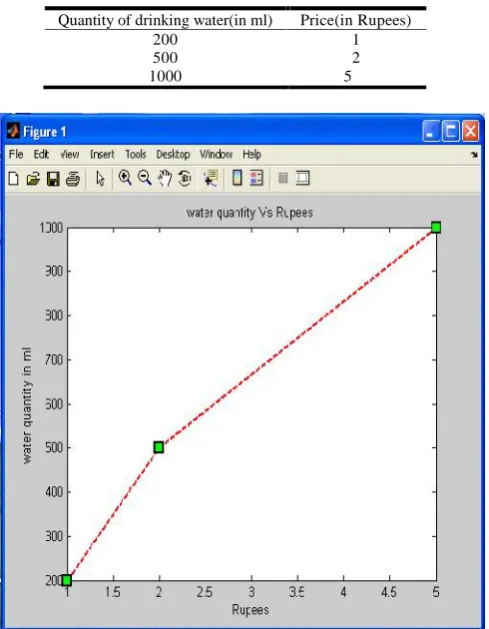
The product specifications are as
Fig.1. Graph for water quantity Vs Rupees
Block Repesenteation of Proposed System
Fig.2. Block Representation of proposed system
Component Required for the Proposed Systems
Microcontroller AT89C51
Microcontroller is a computer on a chip that is programmed to perform almost any control, sequencing, monitoring and display the function. Because of its relatively low cost, it becomes the choice of designer. It is designed to be all of that in one. Its great advantage is no other external components are needed for its application because all necessary peripherals are already built in to it. Thus, we can save the time, space and cost which is needed to construct low cost devices.
Coin Discriminator
(Carlosena et al., 2007) to develop the coin discriminator there are many techniques available. But in all of them the most suitable technique will be the image processing (Marcel Tresanchez et al., 2013). Here to develop the coin discriminator optical mouse sensor will be useful as it includes the Digital Signal Processors and CMOS camera of 30x30 pixels to capture he image. Various internal registers are also available in the coin discriminator.
Level Indicator
To get required quantity of water in the primary tank there will be a tap in between secondary tank and primary tank. For Rs.1, Rs.2 and Rs.5 coin, there will be separate time allotted for tap to be on and allow water of required quantity to the primary tank.
IC555 Timer
This timer IC is useful to indicate the water levels of secondary tank. This timer IC will be able to indicate that water is going to be full or empty in secondary tank. As the water is going to be empty then this IC circuitry will generate signal and the GSM Module will send SMS to central tank water pump to provide water to the secondary tank. Same action it will do when the water is going to be full in the secondary tank.
Table 1. Specification of Products
Quantity of drinking water(in ml) Price(in Rupees)
200 1
500 2
GSM Module
(Hong Gu, and Shuang Qiao Jiang Tian, 2006; Bhuvaneswari et al., 2013). There are number of Secondary tanks are connected with Hub tank (central tank) through the pipelining. Water pump is connected to the central tank. This pump will be operated on the SMS sent or received by secondary tank when it crosses the low level of water. GSM module will be helpful to achieve this purpose.
Surface Senor
This sensor is at outlet of drinking water machine. It will open the water outlet when water container is present below it. With this technique we will minimize the wastage of water.
LCD
At the front panel of this machine the quantity of waterbe able to know that for Rs.1, Rs.2, Rs.5 the water quantity will be 200ml, 500ml, and 1000ml respectively
SYSTEM DESCRIPTION
Probably this proposed system is divided into two panels as
Front Panel
Back Panel
Front Panel
In this panel, we will place the machine model to provide the service to the customers. The coin discriminator, LCD (Liquid Crystal Display), primary tank and secondary tank will be there in this panel. The customer will be able to see water quantity and respective amount on LCD screen which is situated in front panel of this proposed system. (Marcel Tresanchez et al., 2013) When a coin is inserted in coin discriminator the coin image gets captured with the help of optical sensor camera. After that, the coin image is compared with existing coin images.
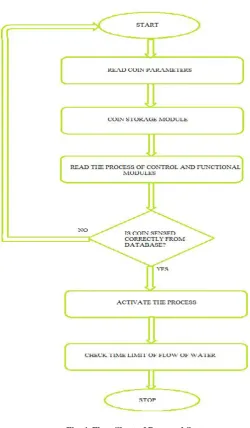
If the inserted coin image is matched with the database, then optical sensor will generate the signal as input to microcontroller. The optical sensor is most suitable in this case because other sensors will not be able to identify the correct coin structure. Optical sensor scans the edge, shape and other parameters of coins so that the fake coin can be easily identified. Three different signals are generated for Rs.1, Rs.2 and Rs.5 coins (Marcel Tresanchez et al., 2013). According to the input signal, respective sensors will get triggered in primary tank. The activation of sensors according to the input signal is achieved with the help of programming of microcontroller.
The level sensor will indicate the level of water to be filled in primary tank. As the controller gets input from the coin discriminator module, it will open the valve between primary tank and secondary tank. The water gets filled in primary tank to a certain level from secondary tank through the open valve. Thus all the input and output operations are managed with
programming of microcontroller. LCD interfacing with microcontroller is also done with programming. Various messages are to be displayed on LCD after certain operation of proposed system. The coin discriminator and control unit are main parts of front panel.
Back Panel
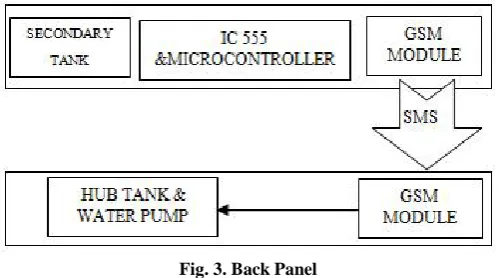
Fig. 3. Back Panel
Secondary tank will be the storage tank for the proposed system. There are two water levels assigned to this tank. These two levels are assigned such as the water filled in the secondary tank will not be empty and will not get overflow. IC555 timer will be suitable for this purpose. As IC555 timer has facility that it will generate these two required signals to indicate the tank is empty or full.
The IC555 timer is not able to interface directly with GSM module. (Hong Gu, and Shuang Qiao Jiang Tian, 2006; Bhuvaneswari et al., 2013). So the microcontroller is used to interface GSM with the timer circuit. Thus, this timer circuit with microcontroller and GSM module will be able to send message to central tank water pump. These messages will be sent and received with the help of GSM module which is interfaced with microcontroller.
Thus we require minimum two GSM module interfaced circuitry one is at secondary tank and another one is at central tank where the main water pump will be situated. We prefer GSM based SMS service to switch on/off the water pump because it is most advanced system to control the proposed system water pump, so we can reduce the human effort to do the respective work (Hong Gu, and Shuang Qiao Jiang Tian, 2006; Bhuvaneswari et al., 2013). Probably the secondary tank will be more in numbers and also they will be situated at long distance from the central tank.
Flow Chart
Fig. 4. Flow Chart of Proposed System
Work Flow Diagram
Fig.5 shows that the proposed system works flow details. The demonstration of system is possible as shown in fig.5.
Block ‘A’ is the main part of this system. This includes the primary and secondary tank. Also the arrangement of the display and water outlet will be made available to block ‘A’. All other blocks B, C, D etc. are also have same structure like block ‘A’. To provide water
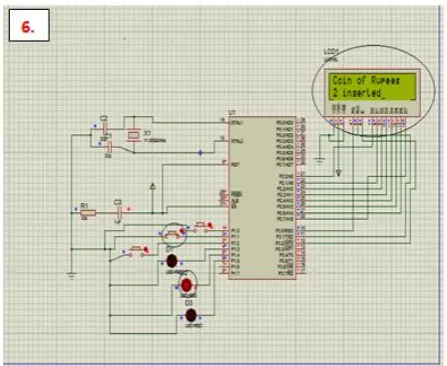
The primary level circuit is developed with the help of Lab Center Electronics and Kiel software. Microcontroller and LCD is interfaced to show some of the primary results of this proposed system is as shown in following figures
Future Enhancement
As an added advantage in this paper, we can add the feature that we will get hot water or cold water according to the change in season and requirement. For this purpose, we can attach temperature control device like water heater or cooler with secondary tank and also some arrangements to maintain the temperature of water at required level in the tank. In addition to this, it is possible to use solar panel to provide power supply to this machine so that the power is saved by this machine. It will be the added advantage for this machine that it will work in the absence of electricity. Thus, the establishment of this machine will be possible in remote sensing areas where the water crises. Thus, this machine will be more eco-friendly. (Archana Bade and Deepali Aher, 2013) In improvement of the coin discriminator it is possible to make note to coin exchanger, so that customer can be able to get water and exchange with note We can also add the IVR in the system so as to help people understand the instructions clearly and increase the reliability of machine.
Fig. 6-At the initial stage the LCD will continuously
and display the message “Please insert the coin”
Fig.7. In this the LCD will display the amount and the respective quantity of water. For Rs.1 it will give 200ml water
Fig.8. In this the LCD will display the amount and the respective quantity of water. For Rs.2 it will give 500ml water
Fig.9. In this the LCD will display the amount and respective quantity of water. For Rs.5 it will give 1000ml water
Fig.10. In this the LCD will display the message after the coin of Rs. 1 is inserted. Here encircled switch is considered as input for Rs.1.
Fig.12-In this the LCD will display the message that “coin of rupees 5 inserted” after the coin of Rs.5 is inserted. Here encircled switch is considered as input for Rs.5.
Conclusion
Implementation of Coin-Operated Automatic Drinking Water Machine is the step towards the future technology and it is a step to enter in eco-friendly world. This machine is easy to use and can be easily accessed by the ordinary person. This proposed system can be implemented almost everywhere even in the remote sensing areas and the places where there is water crises. This system is most suitable in trains because it takes less space and in each bogie of train we can place it easily. It will also help in reducing the diseases which are being spread because of using contaminated or unhygienic water by people.
REFERENCES
Ana Monga Balwidar Singh, 2012 April. “Finite State Machine Based Vending Machine With Auto-Billing Features” in journal of VLSI design and communication Systems (VLSICS) Vol.3, No.2.
Archana Bade, Deepali Aher, Prof. Smita Kulkarni, 2013 March. Note to Coin Exchanger Using Image Processing. International Journal on Recent and Innovation Trends in Computing and Communication, ISSN 2321– 8169Volume1, Issue: 3.
Bhuvaneswari, M., S.Sukhumar, Divya, N. and Kalpanadevi, S. 2013 Nov. Embedded System Based Automatic Ticket Vending Machine for Modern Transport in International Journal of Advanced Research in Computer and Communication Engineering, Vol. 2, Issue 11.
Biplab Roy, and Biswarup Mukherjee 2010. Design of A Coffee Vending Machine Using Single Electron Devices. International Symposium on Electronic System Design.
Carlosena, A., Antonio, J. López-Martín, Fernando Arizti, AneMartínez-de-Guerenu, JoséL. Pina-Insausti, J. 2007. Miguel García-Sayés “Sensing in Coin Discriminators” in Sensors Applications Symposium, SAS '07. IEEE.
Change In The Organization Of The Supply Of Notes And Coins – establishment of the limited company Norsk Kontantservice AS (NOKAS), Trond Eklund, director, and Leif Veggum, assistant director, Chief Cashier’s Department.
Chitrangana Holker, Manoj Gupta, Sagar Ahuja, Sarvesh Upadhyay, Vishaldutt Parsai, 2013 January. VHDL Environment for Smart Vending Machine. International Journal of Emerging Technology and Advanced Engineering, ISSN 2250-2459 Volume3, Special Issue2. Hong Gu, Shuang Qiao Jiang Tian, 2006. “A Wireless
Vending Machine System Based on GSM” in “Intelligent Control and Automation”, Vol-2, 2006.
Karin Siebenhandl, Günther Schreder, Michael Smuc, Eva Mayr, and Manuel Nagl, June 2013. “Case Study-A User-Centered Design Approach to Self-Service Ticket Vending Machines” in IEEE Transactions On Professional Communication, Vol. 56, No. 2.
Marcel Tresanchez, Tomàs Pallejà, Mercè Teixidó and Jordi Palacín, 2009.“Using the Optical Mouse Sensor as a Two -Euro Counterfeit Coin Detector” inwww.mdpi.com/journal ISSN 1424-8220/ Sensors.
Muhammad Ali Qureshi, Abdul Aziz, Hafiz Faiz Rasool, Muhammad Ibrahim, 2011. Design and Implementation of Vending Machine using Verilog HDL 2nd International Conference on Networking and Information Technology, vol.17 2011 © 2011 IACSIT Press, Singapore.
Pradeepa, P., Sudhalavanya, T., Suganthi, K., Suganthi, N. and Menagadevi, M. 2013. “Design and Implementation of Vending Machine Using Verilog HDL” in International Journal of Advanced Engineering Technology, Volume-IV/ Issue I/Jan.-March.