Original Research Article
Assessment of compliance to the COTPA 2003 legislation in tertiary
healthcare institutes of Shimla: a smoke free city in India
Anita Thakur
1, Ankit Chaudhary
1*, Tripti Chauhan
1, Anmol Gupta
1, Anjali Mahjan
1,
Vijay Barwal
1, Shaina Chamotra
2, Nidhi Chauhan
1INTRODUCTION
Tobacco addiction being a global phenomenon kills more than AIDS, illegal drugs, road accidents, murder, and suicide combined.1 Scientific evidence has shown conclusively that all tobacco forms cause health problems throughout life, frequently resulting in death or disability.1 World Health Organization (WHO) has provided an estimate that tobacco use, in any form currently can be held responsible for the death of about seven million people across the globe each year with many of these deaths occurring prematurely. By 2030,
unless an urgent action is taken, the death toll will exceed eight million a year.2 Mortality due to tobacco in India is estimated in the tune of 1.3 million.3,4
Though consuming tobacco in any form is hazardous; smoking poses a threat to both smokers as well as non-smokers. There are more than one billion smokers globally, who can potentially expose all others to second-hand smoke (SHS).5 It is now unequivocally established that exposure to SHS is as harmful as active smoking and causes death, disease and disability. An approximate one
ABSTRACT
Background: Tobacco smoking is a pandemic affecting populations and contributing to global morbidity and mortality. It is well known that the second hand smoke is equally hazardous like first hand smoke. Cigarette and other tobacco products act 2003 is an effort put forth by Government of India in order to curb this menace and protect people from ill effects of second hand smoke.
Methods: The present study was conducted to assess the compliance to smoke free act in tertiary healthcare institutes in Shimla city, Himachal Pradesh. A total of 57 public places and 8 shops in five Tertiary healthcare institutes were evaluated for various provisions of the act. Compliance to different sections of the act was assessed using a structured observational checklist.
Results: Signage indicating ban on smoking was seen at 71.9% places. Active smoking was absent at 77.2% places. About 25% shops around the institutes were found selling tobacco products. Signage displaying ban on sale within 100 m of educational institution and sale to minors was not observed at any shop. Tobacco product vendor was seen around 80% of educational buildings. Tobacco free institution signage was seen at 60% of educational premises.
Conclusions: The study highlights that the level of compliance did not meet the standards laid down for a smoke free city. Timely and periodic assessment of the compliance must be conducted by the administrative authorities of the institutes for ensuring the adherence and strict implementation of the provisions of the act.
Keywords: COTPA 2003, Tertiary healthcare institutions, Smoke free city
1
Department of Community Medicine, 2Department of Obstetrics and Gynaecology, Indira Gandhi Medical College Shimla, Himachal Pradesh, India
Received: 10 January 2019
Accepted: 09 February 2019
*Correspondence:
Dr. Ankit Chaudhary,
E-mail: [email protected]
Copyright: © the author(s), publisher and licensee Medip Academy. This is an open-access article distributed under the terms of the Creative Commons Attribution Non-Commercial License, which permits unrestricted non-commercial use, distribution, and reproduction in any medium, provided the original work is properly cited.
million people are estimated to die each year from the effects of second-hand smoke.6
To curb down the global tobacco epidemic, WHO came up with the comprehensive response in the form of framework convention on tobacco control (FCTC).7 Recognizing adverse health impact of SHS among non-smokers, Government of India translated FCTC into “cigarettes and other tobacco products (prohibition of advertisement and regulation of trade and commerce, production, supply, and distribution) act, 2003” (COTPA) to prohibit and regulate tobacco use in India.8 This legislation is intended to protect and promote public health, encompass evidence based strategies to reduce tobacco consumption, to curb smoking in public places and impose penalties to the violators.
Among various states in India Himachal Pradesh has been a better performer under this legislation with state itself along with its capital having been declared smoke free.9,10 Varying levels of compliance have been demonstrated to different sections of the legislation in the state, which tends to decline with the passage of time.11,12
Though many surveys to assess compliance have been conducted in public places globally, yet this parameter has been explored minimally in academic tertiary health care institutions. A tertiary institute serves both as a provider of health-care as well as medical education to the budding doctors. A smoke free hospital campus can display an example for commitment towards good health. On one hand, it communicates a health oriented message to the community and patients, and on the other hand it can certainly reduce exposure to harmful tobacco smoke. It further discourages initiation of smoking amongst non-users of smoking and motivates smokers to quit.
Keeping all this in mind, the present study was undertaken with an objective of assessment of compliance to smoke free act (COTPA 2003) in tertiary healthcare institutes and associated facilities in Shimla city, Himachal Pradesh.
METHODS
Study area
The study was conducted in the tertiary health care academic institutes of Shimla city, Himachal Pradesh comprising of Indira Gandhi Medical College Shimla, Government dental college Shimla, Kamla Nehru hospital for mother and child Shimla, regional cancer centre, Sister Nivedita Government nursing college; and associated hospitals and facilities.
Study population
The study was conducted in the public places of the institutions as defined in COTPA 2003. The public places such as hospital buildings, educational buildings,
accommodation facilities, eateries, offices, other „most frequently visited public places (parking lots, thorough fares)‟ and public transport were included for the purpose of study. A list of all such public places and shops in and around institutes was prepared for study purpose.
Study design
An observational cross sectional study.
Study period
The study was conducted for a period of 3 months from August 2018 through November 2018.
Study sample
After a survey of the institutes, 57 public places and 8 shops were included in study for assessment of COTPA compliance.
Study tool
A structured observational checklist adapted on the COTPA 2003 specifications and guidelines; and a guide jointly developed by John Hopkins school of public health, tobacco free kids and international union against tuberculosis and lung disease was used to record the observational findings.13,14
Procedure
A list ofdifferent categories of public places as defined by COTPA 2003 was prepared. Data was collected from various public places using the structured observational checklist. Offices, educational buildings were observed in official hours, shops and eateries during peak business hours and public places during peak visited timings. Out of various sections of the act, the compliance to Section 4, Section 5 and Section 6 of the COTPA 2003 was assessed during the study.
Statistical analysis
The data was collected, cleaned and entered into Microsoft Excel spreadsheet and was transferred to Epi info version 7.2.2.6 software. The discrete variables were expressed in terms of frequencies, proportions and percentages with 95% confidence intervals. The continuous variables were expressed as means±standard deviation. Pearson‟s Chi-squared or Fisher exact test was used to test the statistical significance of dichotomous categorical data. Two tailed p<0.05 was considered as statistically significant.
Ethical considerations
Prior permission was taken from Institute Ethical Committee to go ahead with the study. Institutional
confidentiality and anonymity. Necessary prior permission for the study was obtained from concerned Administrative authorities of the Shimla city.
RESULTS
The present observational cross-sectional study was conducted among 57 public places and 8 shops of the tertiary care institutes of Shimla city. The distribution of various categories and sub-categories of the public places included in study is summarized in Table 1. The mean time of observation of was 30.17±9.90 minutes (15 to 60 minutes).
COTPA section 4 compliance
COTPA section 4 prohibits persons from smoking in public. Table 2 shows the compliance of section 4 in the public places of the institutes.
Active smoking was seen in about 22.8% of places. About 71.9% places displayed a signage signaling ban on smoking inside building. About 63.2% places displayed the standard warning signage saying “no smoking area: smoking here is an offence”. In 36.8% places, signage showing name of authority to which a complaint can be
made in case of violation of act was seen. Smoking aids were observed at less than 5% of places. Tobacco remains were observed at about 26.3% places. No „designated smoking area (DSA)‟ was seen anywhere in institutes. In 35.1% places, a person violating the act was imposed fined in past one year.
Table 1: Study sample distribution.
Category (n) Sub-category Number (%)
Public places (n=57)
Offices 19 (33.3)
Eateries 12 (21.1)
Hospital/college
buildings 11 (19.3)
Most visited public
places 9 (15.8)
Residential buildings 3 (5.3) Transport facilities 3 (5.3)
Shops (n=8) 8 (100)
Table 3compares different categories of public places for the compliance COTPA 2003 section 4. Overall the offices, hospital buildings and transport facilities displayed better compliance; however the difference was not statistically significant except for issuing challans to violators.
Table 2: COTPA section 4 compliance of all public places of tertiary institute (n=57).
Indicator Number (%) 95% CI
Signage signalling ban on smoking at entrance 29 (50.9) 37.3-64.4
Signage signalling ban on smoking inside public place 41 (71.9) 58.5-83.0
Signage of „no smoking area: smoking here is an offence‟ 36 (63.2) 49.3-75.6
Signage of 60 cm×30 cm inside the building 25 (43.9) 30.7-57.6
Signage displaying authority for making complaint 21 (36.8) 24.5-50.7
Message displayed in a language specified in act 57 (100) 93.7-100
No active smoking during observation 44 (77.2) 64.2-87.3
No visible ashtrays/ashbins indoors 55 (96.5) 87.9-99.6
No lighter/matchbox observed indoors 57 (100) 93.7-100
No cigarette/bidi stubs inside location 42 (73.7) 60.3-84.5
No matchsticks on floor 40 (70.2) 56.6-81.6
No odour of tobacco inside location 47 (82.5) 70.1-91.3
Absence of designated smoking areas indoors 57 (100) 93.7-100
Any awareness regarding COTPA 2003 54 (94.7) 85.4-98.9
Facility issued challan to violator in past one year 20 (35.1) 22.9-48.9
COTPA 2003 Section 5 and 6 (a) compliance
COTPA 2003 section 5 prohibits advertisement of cigarettes and other tobacco products except in certain conditions as clarified under the act. Section 6 (a) of COTPA 2003 prohibits sale of cigarette or other tobacco products to a person below the age of eighteen years. However as tertiary care institutes are also educational institutions, such advertisement and sale is not permissible within the premises of institutes.
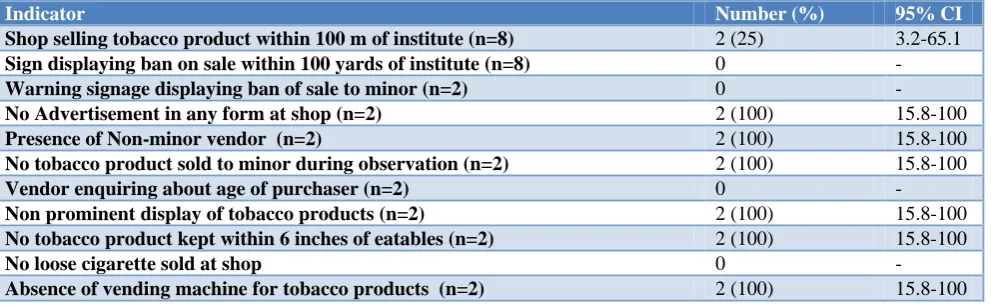
The compliance of the shops for section 5 and 6 (a) is shown in Table 4. About 25% shops were observed selling tobacco products, clearly violating act. No shop displayed any kind of tobacco advertisement at site. Signage displaying ban on sale within 100 m of educational institution and sale to minors was not seen at any shop.
COTPA 2003 Section 6 (b) compliance
one hundred meters of any educational institution. In addition Government has also issued tobacco free
educational institution guidelines.
Table 3: COTPA section 4 comparison of public places.
Indicator Offices (n=19) %
Eateries (n=12) %
Hospital or college buildings (n=11) %
Most visited places (n=9) %
Residential (n=3) %
Transport
(n=3) % P value
Sign of smoking ban at entrance
9 (47.4) 4 (33.3) 7 (63.6) 6 (66.7) 0 N/A 0.117
Signage of ban on smoking inside
12 (63.2) 7 (58.3) 11 (100) 7 (77.8) 1 (33.3) 3 (100) 0.060
Sign “no smoking area: smoking here is an offence”
12 (63.2) 4 (33.3) 9 (81.8) 7 (77.8) 1 (33.3) 3 (100) 0.081
Signage of 60 cm by 30 cm inside
8 (42.1) 4 (33.3) 6 (54.5) 3 (33.3) 1 (33.3) N/A 0.419
Sign displaying authority‟s name for complaint
5 (26.3) 3 (25) 8 (72.7) 4 (44.4) 1 (33.3) 0 0.087
Message in a specified language
19 (100) 12 (100) 11 (100) 9 (100) 3 (100) 3 (100) -
No active smoking during observation
17 (89.5) 10 (83.3) 8 (72.7) 4 (44.4) 2 (66.7) 3 (100) 0.133
No ashtray
inside 19 (100) 10 (83.3) 11 (100) 9 (100) 3 (100) 3 (100) 0.299
No lighter or matchbox inside
19 (100) 12 (100) 11 (100) 9 (100) 3 (100) 3 (100) -
No cigarette stubs inside location
15 (78.9) 9 (75) 10 (90.9) 3 (33.3) 2 (66.7) 3 (100) 0.076
No
matchsticks on floor
14 (73.7) 9 (75) 9 (81.8) 3 (33.3) 2 (66.7) 3 (100) 0.188
No tobacco
odour inside 16 (84.2) 9 (75) 11 (100) 6 (66.7) 2 (66.7) 3 (100) 0.296 Absence of
DSA 19 (100) 12 (100) 11 (100) 9 (100) 3 (100) 3 (100) -
Prior sensitization regarding act
16 (84.2) 12 (100) 11 (100) 9 (100) 3 (100) 3 (100) 0.474
Facility fined violators in past one year
Table 5 highlights the compliance of COTPA section 6 (b) in the institutes. No tobacco product vendor was observed within 100 m in 20% of institutions. „Tobacco
free institution‟ signage on was observed in almost 60% institutions. No tobacco POS was seen inside anywhere. Active smoking was seen inside 60% educational buildings.
Table 4: COTPA section 5 and 6 (a) compliance of shops.
Indicator Number (%) 95% CI
Shop selling tobacco product within 100 m of institute (n=8) 2 (25) 3.2-65.1
Sign displaying ban on sale within 100 yards of institute (n=8) 0 -
Warning signage displaying ban of sale to minor (n=2) 0 -
No Advertisement in any form at shop (n=2) 2 (100) 15.8-100
Presence of Non-minor vendor (n=2) 2 (100) 15.8-100
No tobacco product sold to minor during observation (n=2) 2 (100) 15.8-100
Vendor enquiring about age of purchaser (n=2) 0 -
Non prominent display of tobacco products (n=2) 2 (100) 15.8-100
No tobacco product kept within 6 inches of eatables (n=2) 2 (100) 15.8-100
No loose cigarette sold at shop 0 -
Absence of vending machine for tobacco products (n=2) 2 (100) 15.8-100
Table 5: COTPA section 6 (b) compliance of educational institution buildings (n=5).
Indicator Number (%) 95% CI
No tobacco product vendor within 100 m of institution 1 (20) 0.5-71.6
„Tobacco free institution‟ signage on boundary wall or entrance of institution 3 (60) 14.7-94.7
Signage displaying ban on sale within 100 m of institution near main
gate/boundary wall 3 (60) 14.7–94.7
Signage showing “no smoking area: smoking here is an offence” of specified size
inside institution 5 (100) 47.8- 100
No tobacco shop inside the institution building 5 (100) 47.8-100
No active smoking inside institution 2 (40) 5.3-85.3
DISCUSSION
The present study was undertaken to study the compliance to section 4, section 5 and section 6 of COTPA 2003 in tertiary care institutes located in a smoke ‑free city of India. In the present study no active smoking was seen in 77.2% of places which was similar to a study conducted in medical institute of North India (75%).15 In contrast to a similar study conducted in Chandigarh, active smoking was not observed in 47.5% of places.16
Signage signaling ban on smoking inside public place was observed in 71.9% places. This compliance was better than what was observed in two similar studies where signage was seen at 20% and 28% places respectively.15,16 In 36.8% places, signage showing name of authority to whom a complaint can be made in case of violation of act was observed in the present study. Only 5% of places displayed such signage in a study by Tripathy et al, while Sharma et al reported absolute absence of such signage.15,16
In our study, the smoking aids were seen at mere 4.5% of places. In contrast such aids were seen at about 65% places in an institute in Chandigarh.16 No tobacco remains (cigarette/bidi stubs) were seen at 73.7% places.
About 70% places were found to be tobacco litter free in a study by Sharma et al while Tripathy et al reported such proportion to be only 7.5% places.15,16
Indirect smoking indicators like matchsticks on floor and odour of tobacco were found to be absent at 70.2% and 82.5% places respectively. An absolute non-compliance was reported by Sharma et al for this provision of the act.15
As tertiary care institutes are also the educational institutes, as per COTPA 2003, no tobacco product can be sold within 100 m of the institution. However, in present study 25% of total shops were found violating act by selling tobacco products. In a similar study tobacco products were not sold at about 75% places around institution.15
CONCLUSION
adherence to the provisions of the act. The administration
should take appropriate measures for relevant
implementation of smoke free act.
Limitations
The duration of observation was taken arbitrarily for 15 to 60 minutes, which may have led to the underestimation of the violation of the act.
ACKNOWLEDGEMENTS
We acknowledge the support of administrative authorities of Shimla City and health care institutes for granting necessary permission for the study.
Funding: No funding sources Conflict of interest: None declared
Ethical approval: The study was approved by the Institutional Ethics Committee
REFERENCES
1. Mackay J, Eriksen M. The tobacco Atlas: World
Health Organization; 2002. Available at:
https://www.who.int/tobacco/media/en/title.pdf. Accessed 01 December 2018.
2. WHO, WHO the global tobacco crisis. Available at: https://www.who.int/tobacco/mpower/mpower_repo rt_tobacco_crisis_2008.pdf. Accessed 01 December 2018.
3. Jha P, Jacob B, Gajalakshmi V, Gupta P, Dhingra N, Kumar R, et al. A nationally representative case– control study of smoking and death in India. New England J Med. 2008;358(11):1137–47.
4. Sinha D, Palipudi K, Gupta P, Singhal S,
Ramasundarahettige C, Jha P, et al. Smokeless tobacco use: a meta-analysis of risk and attributable mortality estimates for India. Indian J Cancer. 2014;51(1):S73–7.
5. WHO Report on the Global Tobacco Epidemic
2008: The MPOWER package. Available at: https://www.who.int/tobacco/mpower/2008/en/. Accessed 1 December 2018.
6. WHO Tobacco fact sheet March 2018. Available at:
https://www.who.int/news-room/fact-sheets/detail/tobacco. Accessed 1 December 2018.
7. WHO Framework Convention on Tobacco Control.
Geneva: World Health Organization (WHO), 2005. Available at: http://apps.who.int/iris/bitstream/ handle/10665/42811/9241591013.pdf?sequence=1. Accessed 12 December 2018.
8. Cigarette and Other Tobacco Products (Prohibition of Advertisement and Regulation of Trade and
Commerce, Production, Supply and Distribution) act-2003. New Delhi: Ministry of Health and Family Welfare, Government of India; 2003.
9. Tobacco free initiatives in Himachal Pradesh: Smoke free Shimla. Shimla: Department of Health and Family Welfare, Government of Himachal Pradesh, Department of Health and Family Welfare 2010. Available at: http://hphealth.nic.in/pdf/2010 CaseStudySmokeFreeHimachal.pdf. Accessed 12 December 2018.
10. Gupta S, Gupta N. Journey from smoke free Himachal Pradesh to tobacco free to Eco-friendly hills of the adolescent state. Pediatric Education Res. 2014;2(1):5-13.
11. Goel S, Kumar R, Lal P, Singh R. How effective is tobacco control enforcement to protect minors: Results from subnational surveys across four districts in India. Int J Non-Commun Dis. 2016;1:116-21
12. Kumar R, Chauhan G, Satyanarayana S, Lal P, Singh R, Wilson N. Assessing compliance to smoke-free legislation: Results of a sub-national survey in Himachal Pradesh, India. South East Asia J Public Health. 2013;2:52-6.
13. Assessing compliance with smoke free laws, Second edition: A “how to” guide for conducting compliance studies. International Union against Tuberculosis and Lung Disease. 2014. Available at:
https://www.theunion.org/what-we- do/publications/technical/english/compliance-guide_v4smallerfile.pdf. Accessed 12 December 2018.
14. Guidelines for Law Enforcers for effective
implementation of Tobacco Control Laws 2013. Ministry of Health and Family Welfare Government of India; 2013.
15. Sharma N, Chavan B. Compliance to tobacco-free guidelines (Cigarettes and Other Tobacco Products Act) in medical institute of North India. Indian J Soc Psychiatry. 2018;34:213-6.
16. Tripathy J, Goel S, Patro B. Compliance monitoring of prohibition of smoking (under section-4 of COTPA) at a tertiary health-care institution in a smoke-free city of India. Lung India. 2013;30:312-5.