Abstract—This study focused on the generation of the licensure examination performance models implementing PART and JRip classifiers. Specifically, it identified the attributes that are significant to the response attribute; it generated prediction models using the PART and JRip classifiers of WEKA; and it determined how likely is a reviewee to pass the LET. The respondents were obtained from the Education graduates of Isabela State University Cabagan campus who took a LET review and eventually took the September 2013 LET. The results obtained indicate the significance of the mock board exam, general weighted average of the reviewees in GenEd and MajorCore in predicting LET performance. The reviewee is predicted to fail the LET if he will obtain a mock board rating lower than 34% of the total points. It is further predicted that if the general weighted average in all the general education subjects is fair, or the general weighted average in all the general education subjects is fairly good and has a kinesthetic learning style, then the reviewee will fail the LET.
Index Terms—JRip, LET, PART, performance prediction.
I. INTRODUCTION
Higher education institutions are presently giving much attention to licensure examination performance of their graduates. Thorough review of examination content is given to reviewees, review materials are carefully prepared and the best reviewers are selected. They gauge the reviewees‟ readiness to take the licensure exam by giving a mock board exam after the series of reviews. However, majority of the institutions conducting the review focus less on the result of the mock board exam. There were no feedback and support given to the reviewees after taking the said exam.
We previously conducted a research in response to the need of resolving this shortcoming. We identified significant predictors, derived prediction models using different classification techniques, and selected the best model based from their classification accuracy. This is to enable prediction of licensure examination performance of reviewees and eventually give review assistance on those who are most likely to fail. However, we recommended in the research that
Manuscript received November 30, 2013; revised March 3, 2014. This work was supported in part by the Isabela State University, Isabela, Philippines under the University Scholarship grant.
I. M. Tarun is with the Isabela State University, Isabela, Philippines (e-mail: [email protected]).
B. D. Gerardo, is with West Visayas State University, Iloilo, Philippines (e-mail: [email protected]).
B. T. Tanguilig III is with the College of Information Technology Education, Technological Institute of the Philippines, Quezon City, Philippines (e-mail: [email protected]).
similar studies should be undertaken with the inclusion of other predictors and that thorough testing should be done using real institutional data.
Anticipating the foregoing situation, we decided to embark on a similar study with the inclusion of other predictors but keeping the Licensure Examination for Teachers‟ (LET) Performance as the response variable. The predictors to this study include the reviewees‟ (1) General Weighted Average (GWA) in General Education subjects, Professional Education subjects and Major or Core subjects, (2) review and participation, (3) learning style, and (4) mock board exam result. The PART and JRip algorithms were selected as they performed best in terms of classification accuracy and True Negative (TN) as well as False Negative (FN) ratings respectively in the previous study. Rule-based classifiers such as JRip and PART make use of the collection of if-then statements to present the rules derived which ensures that every record is covered by at most one rule. These algorithms will help determine the likelihood of a reviewee to pass the licensure exam by generating set of rules.
This study specifically sought to answer the following questions:
1) Which among the predictors are significant to the LET performance of the students?
2) What are the LET prediction models that can be derived from the predictors?
3) How likely is a reviewee to pass the LET based from the predictors?
II. RELATED WORKS
There have been several attempts to discover models in predicting the performance in licensure examination but most studies recommend for an extensive study covering other independent variables and other approaches.
For instance, Arce, S. E. and Belen, J. L. undertook a study that revealed the relationship of In-House review to LET performance using descriptive – correlational method [1]. They found out that pre-board and LET results are significantly correlated. They recommended that similar research must be undertaken to include content courses and field of specialization of BEEd and BSEd respectively.
Roehrig, S. M. also made a study regarding the prediction of licensing examination scores in Physical Therapy graduates. American College Testing (ACT) scores, prerequisite and nonprerequisite grade point averages (GPAs), and interview and recommendation scores were used to predict licensing examination scores [2]. Hierarchical
Generating Licensure Examination Performance Models
Using PART and JRip Classifiers: A Data Mining
Application in Education
multiple regression analyses using the SPSS-X "regression" program were used in the analysis of data. The author said that the procedures used in the study could be applied by other institutions using their own data but can be modified to include other variables.
Ong, M. B. et al. determined the predictors of licensure examination performance of nursing graduates in their study using inferential techniques.The variables used were College Entrance Examination performance on IQ test, nursing aptitude test, the composite score of science, math and English tests, college grade point average and pre-board examination performance [3]. They concluded that students‟ academic performance in their baccalaureate program and their performance in the pre-board examination are important variables in establishing the success and failure of students‟ licensure examination performance.
Hafalla, V. and Calub, E. attempted to profile board passers and non-passers of the Electronics Engineering licensure examination and develop a discriminant function model using derived factor constructs from the pre-determined variables. Orthogonal rotation resulted in three factor constructs, namely, 1. Student‟s Academic Demographics, 2. Student‟s Exam Demographics, and 3. Interval Between Graduation and Exam. The authors suggested the inclusion of a “much broader set of predictor variables” in the re-estimation of discriminant function [4].
Cognitive and non-cognitive records of the education graduates were the concentration of Soriano, H. A. S. in her study. She aimed to determine the best predictors to LET performance. She found out that General Education grade point average, college entrance test score, course, and sex best predicted the LET performance of the respondents. She recommended however that “a follow-up study be conducted involving other variables such as class schedule, review attended, Field Study ratings, school environment, and teacher factor” [5].
On the other hand, the subsequent literature justifies the capabilities of data mining techniques in the prediction of students‟ performance which were considered helpful in the establishment of the framework of this study.
Fire, M. and his co-authors utilized regression and machine learning techniques using the R-project software and Weka respectively to predict the success of student in a course using social network data. They found out that “students‟ final grades are closely related to those of his friends‟ grades” [6]. They were able to prove using multiple linear regressions that a students‟ final grade is related to that of their friends.
Sembiring, S. et al. applied kernel method of data mining in their study to “analyze relationships between the student‟s behavior and their success and to develop the model of student performance predictors” [7]. Based from their study, they stated that data mining is useful particularly on the prediction of student‟s final performance.
Mellalieu, P. J., also stated in his study that predicting accurately the students‟ final course performance is feasible through data mining investigation using WEKA Explorer [8]. He created a prototype Decision Support System which was implemented as an interlocked series of spreadsheets known as ReXS.
Another relevant study was undertaken by Baradwaj,
Brijesh Kumar and Pal, Saurabh. They used decision tree method to predict the students‟ performance at the end of a semester [9]. Attendance, Class test, Seminar and Assignment marks were used as variables.
III. WORK DONE/CONTRIBUTIONS
A. Framework of the Study
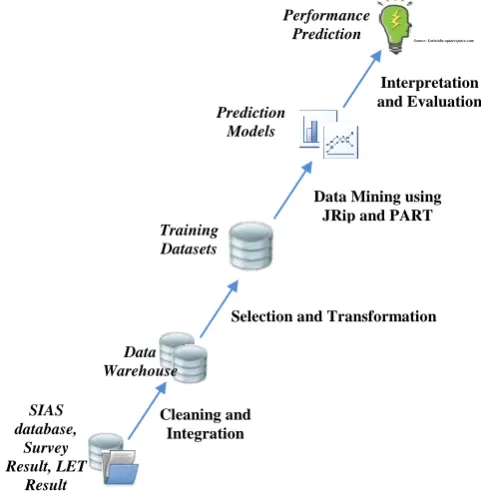
The framework of the study was based on the Knowledge Discovery Process (KDP) illustrated by Jiawei Han and Micheline Kamber in their book Data Mining: Concepts and Techniques, Second Edition. The KDP was modified to suit the objectives of the study. The modified version is presented on Fig. 1 following the process from cleaning and integration, selection and transformation, data mining, and interpretation and evaluation to gain knowledge.
Fig. 1. Framework of the study.
B. Methodology
The respondents of this study were the March 2013 Education graduates of ISU Cabagan campus who participated in the LET review and took the September 2013 LET. The academic records of these graduates were taken from the Students Information and Accounting System (SIAS) of ISU Cabagan campus while the data for review and participation and learning style were taken from the survey result. The LET performance was taken from the official website of the Philippine Regulatory Commission.
These data that were stored in different tables were cleaned by removing duplicate records. Records that contain empty values were likewise deleted. We integrated the different tables into one data warehouse, the data of which were transformed to create meaningful groups within the attributes to match that of the objectives of the study. The predictor and response attributes derived were shown in Table I.
We adapted the adjectival rating used by ISU as categories for GenEd, ProfEd and MajorCore. On the other hand, we personally selected the categories of the MBResult. Their Source: Loristohs.squarespace.com
Interpretation and Evaluation
SIAS database,
Survey Result, LET
Result
Cleaning and Integration Data
Warehouse
Selection and Transformation Training
Datasets
Prediction Models
Data Mining using JRip and PART Performance
corresponding range is given in Table II. TABLEI:ATTRIBUTES AND THEIR VALUES
Attribute Description Values
GenEd (Predictor)
This is the general weighted average of the reviewee in his general education subjects taken from his academic records.
E, VS, S, FS, G, FG, F, BF, P
ProfEd (Predictor)
This is the general weighted average of the reviewee in his professional education subjects taken from his academic records.
E, VS, S, FS, G, FG, F, BF, P
MajorCore (Predictor)
This is the general weighted average of the reviewee in his major subjects (for BSEd) or core courses (for BEEd) taken from his academic records.
E, VS, S, FS, G, FG, F, BF, P
SelfReview This tells if the reviewee conducted self review.
Y, N
PeerStudy This tells if the reviewee participated in a peer review.
Y, N
AskQuest This tells if the reviewee asks questions during the review sessions.
Y, N
TDNotes This tells if the reviewee takes down notes during the review sessions.
Y, N
GiveIdeas This tells if the reviewee shares ideas during the review sessions.
Y, N
Visual This indicates the rank of the reviewee‟s visual learning style.
F, S, T
Auditory This indicates the rank of the reviewee‟s auditory learning style.
F, S, T
Kinesthetic This indicates the rank of the reviewee‟s kinesthetic learning style.
F, S, T
MBResult This tells the score in the Mock Board Exam.
VG, G, F
LETPerf (Response)
This is the LET performance of the reviewee which makes use of 2 classes.
Passed, Failed
TABLEII:NUMERICAL RANGE OF PREDICTORS‟VALUES
Value Grade/ Numerical
Equivalent For GenEd, ProfEd and MajorCore:
E- Excellent 100-98
VS- Very Satisfactory 97-95 S- Satisfactory 94-92
FS- Fairly Satisfactory 91-89
G- Good 88-86
FG- Fairly Good 85-83
F- Fair 82-80
BF- Below fair 79-77
P- Passed 76-75
For MBResult:
VG Very Good 100-150
G Good 50-99
F Fair 0-49
We used Weka in this study as the data mining tool since it is platform independent and portable. It offers a wide range of classification algorithms that can be easily applied to any dataset.
In order to evaluate the worth of the attributes, we computed the value of the chi-squared statistic with respect to the class. In this case, ChiSquaredAttributeEval of Weka was used.
For the generation of models, we used PART and JRip of Weka which are both classification algorithms.
C. Simulation Results
Before applying PART and JRip classifiers to the dataset, attribute evaluation was first done in order to select attributes that are significant to the response variable which is the LET performance.
1) Attribute evaluation
ChiSquaredAttributeEval of Weka was used to determine the importance of the predictors to the response attribute. The predictors were ranked according to their chi-square values as presented on Table III. MBResult attribute topped the rank in terms of chi-square values followed by GenEd, and MajorCore. The same result was established by Arce, S. E. and Belen, J. L. that pre-board result and LET result are significantly correlated [1]. It is interesting to note that GenEd and MajorCore were noted in our previous study to be the two most significant predictors to the same response attribute using a different dataset. SelfReview and TDNotes attributes have zero chi-square values which may suggest its exclusion in the dataset. However, all the predictors were still included in the dataset as they can be necessary to a specific instance. A similar case was experienced by Kovačić, Z. (2010) where in all available predictor variables in his dataset were included in the classification tree analysis in spite their insignificance detected during feature selection [10].
TABLEIII:ATTRIBUTE EVALUATION
Attribute Average Merit
MBResult 24.833 + - 2.284
GenEd 25.122 + - 2.647
MajorCore 15.719 + - 3.009
ProfEd 12.17 + - 2.288
Visual 6.921 + - 1.301
Auditory 3.963 + - 1.053
Kinesthetic 3.373 + - 0.912
AskQuest 2.387 + - 0.697
PeerStudy 1.638 + - 0. 854
GiveIdeas 0.759 + - 0.575
SelfReview 0 + - 0
TDNotes 0 + - 0
2) PART prediction model
PART is a classifier that generates decision list. The prediction model generated using Weka by PART in a 10-fold cross validation and a confidence factor of 0.25 is presented in Fig. 2. It consists of four rules as interpreted below:
If the mock board exam result falls in the range of Good, then the reviewee is predicted to pass the LET.
If the general weighted average in all the general education subjects is fair, then the reviewee is predicted to fail the LET.
education subjects is fairly good and has a kinesthetic learning style, then the reviewee is predicted to fail the LET.
Otherwise, the reviewee is predicted to pass the LET.
Fig. 2. PART decision list.
The model generated 82.54% correctly classified instances as shown in Table IV. There are only 11 incorrectly classified instances which indicate that the model is incorrect for 17.46% of the cases in the dataset.
TABLEIV:PARTCONFUSION MATRIX
Actual Class Predicted Class
Passed Failed Percent Correct
Passed 41 5 89.13%
Failed 6 11 64.71%
Overall Percentage 87.23% 68.75% 82.54%
3) JRip prediction model
JRip is an inference and rule-based learner, Repeated Incremental Pruning to Produce Error Reduction (RIPPER), which tries to come up with propositional rules that can be used to classify elements [11]. The prediction model generated using Weka by JRip in a 10-fold cross validation and a confidence factor of 0.25 is presented in Fig. 3. It consists of the following two rules:
If the mock board exam result falls in the range of Fair, then the reviewee is predicted to fail the LET.
Otherwise, the reviewee is predicted to pass the LET.
Fig. 3. JRip rules.
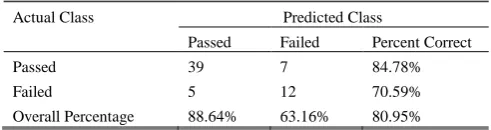
The overall percentage of correct classification of JRip is 80.95% as shown in Table V. There are only 12 incorrectly classified instances which indicate that the model is incorrect for only 19.05% of the cases in the dataset.
TABLEV:JRIP CONFUSION MATRIX
Actual Class Predicted Class
Passed Failed Percent Correct
Passed 39 7 84.78%
Failed 5 12 70.59%
Overall Percentage 88.64% 63.16% 80.95%
IV. CONCLUSION
In light of the results obtained in attribute selection, we conclude that the result of the mock board exam along with general weighted average in the General Education and Major or Core subjects are considered significant to the response attribute which is the LET performance. In case of the prediction models obtained using PART and JRip classifiers, we conclude that a reviewee is predicted to fail the LET if the reviewee will obtain a mock board rating lower than 34% of the total points. It is further concluded that if the general weighted average (GWA) in all the general education subjects is fair, or the general weighted average in all the general education subjects is fairly good and has a kinesthetic learning style, then the reviewee is predicted to fail the LET. Other than these specified rules, the reviewee is predicted to pass the LET. These models can be of help to the reviewer as it identifies students who needed special review assistance and eventually increase the licensure exam passing rate.
V. FUTURE WORKS
This study simply shows that mining educational data is possible and hence useful in gaining knowledge, in this case, the prediction of licensure examination performance. Having tried this kind of endeavor, we are looking forward to integrate the model generated into a Decision Support System. Customized attribute selection for data mining using specific classification techniques can be a good feature which could be incorporated to the system.
ACKNOWLEDGMENT
We would like to thank the Isabela State University Cabagan Campus for the continued support of providing the needed data for this research.
REFERENCES
[1] S. Arce and J. Belen, “The pre-board examination part of the in-house reviews as predictor of LET results,” MSEUF Research Studies, vol. 13, no. 1, Feb. 2011.
[2] S. Roehrig. Prediction of licensing examination scores in physical therapy graduates. PHYS THER. [Online]. 1988(68). pp. 694-698. Available: http://ptjournal.apta.org/content /68/5/694
[3] M. Ong, D. Palompon, and L. Bañico. (January 2012). Predictors of nurses‟ licensure examination performance of graduates in Cebu normal university, Philippines. Asian Journal of Health. [Online]. 2(1). Available: http://dx.doi.org/10.7828/ajoh. v2i1. 122
[4] V. Hafalla Jr. and E. Calub. (2011). Modeling the performance of electronics and communications engineering students in the licensure examination. UB RJ. [Online]. 35(1). Available: http://www.ubaguio.edu/rdc/?cat=23
[5] H. A. Soriano. (2009). Factors associated with the performance of USM College of Education graduates in the 2007 licensure examination for teachers. USM R & D. [Online]. 17(2). pp. 151-159. Available:
http://www.usm.edu.ph/rd-journal/rd-july-to-december-2009/factors-associated-with-the-performance-of-usm-college-of-education-gradua tes-in-the-2007-licensure-examination-for-teachers
[6] M. Fire, G. Katz, Y. Elovici, B. Shapira, and L. Rokach, Active Media
Technology, Springer Berlin Heidelberg, 2012, pp. 584-595.
[7] S. Sembiring, M. Zarlis, D. Hartama, S. Ramliana, and E. Wani, “Prediction of student academic performance by an application of data mining techniques,” in Proc. 2011 International Conference on
Management and Artificial Intelligence, 2011, vol. 6, pp. 110-114.
mining-based decision support system in a first year tertiary education programme,” in Proc. International Conference of the International
Council for Higher Education, New Zealand, 2010.
[9] B. Baradwaj and S. Pal, “Mining educational data to analyze students‟ performance,” International Journal of Advanced Computer Science
and Applications,vol. 2, no. 6,2011.
[10] Z. Kovačić, “Early prediction of student success: mining students enrolment data,” in Proc. Informing Science & IT Education
Conference, New Zealand, 2010.
[11] A. Hindle, D. German, R. Holt and M. Godfrey. (August 2009). Automatic classification of large changes into maintenance categories.
[Online]. Available:
http://swag.uwaterloo.ca/~ahindle/pubs/hindle09icpc.pdf
Ivy M. Tarun was born in Cabagan, Isabela, Philippines on September 3, 1978. She is a graduate of bachelor of science in Computer Engineering last 2000 at the University of Saint Louis, Tuguegaro City. She earned her master„s degree in information technology on 2004 at the University of La Salette, Santiago City. She is currently taking her doctorate studies in the field of information technology at the Technological Institute of the Philippines, Quezon City. She became a member of IAENG and IACSIT last February 2013.
She is a faculty member of the Isabela State University, Isabela Philippines. She has co-authored the book entitled “ICT @ First Glance: A Coursebook in Basic Software Applications” which was published last 2012. She has embarked last 2010 a research study entitled “Attitude of the Education Students toward Electronic Portfolio Assessment as a Substitute to Traditional Tests” which was awarded as best paper during the Agency In-house Review in the institution where she was working. The paper was eventually published in the institution„s Research Journal last 2011. She is currently interested on researches involving the educational application of data mining, system development and web services.
Bobby D. Gerardo finished his BS in electrical engineering in 1994, with high distinction from Western Institute of Technology at Iloilo, Philippines. He took his master of arts in education major in mathematics from University of the Philippines in Diliman Quezon City in 2000 being the grantee of DOST-SEI scholarship for Math and Science Faculty. He pursued his Ph.D. in information and telecommunications with major in distributed systems at Kunsan NationalUniversity, Korea in 2007 being the grantee of Korean Scholarship for Brain Korea (BK-21) project.
He is currently the vice president for administration and finance of West Visayas State University, Iloilo City, Philippines. His dissertation is : “Discovering Driving Patterns using Rule-based intelligent Data Mining Agent (RiDAMA) in Distributed Insurance Telematic Systems.” He has published 54 research papers in national and international journals and conferences. He is a referee to international conferences and journal publications such as in IEEE Transactions on Pattern Analysis and Machine
Intelligence and IEEE Transactions on Knowledge and Data Engineering.
He is interested in the following research fields: distributed systems, telematics systems, CORBA, data mining, web services, ubiquitos computing and mobile communications.
Dr. Gerardo is a recipient of CHED Republica Award in Natural Science Category (ICT field) in 2010. His paper entitled “SMS-based automatic billing system of household power consumption based on active experts messaging” was awarded best paper on December 2011 in Jeju, Korea. Another best paper award for his paper was “Intelligent decision support using rule-based agent for distributed telematics systems,” presented at the Asia Pacific International Conference on Information Science and Technology, on December 18, 2008. An excellent paper award was given for his paper “Principal component analysis mechanism for association rule mining,” on Korean Society of Internet Information‟s (KSII) 2004 Autumn Conference on November 5, 2004. He was given a university researcher award by West Visayas State University in 2005.
Bartolome T. Tanguilig III was born on February 24, 1970 in Baguio City, Philippines. He took his bachelor of science in computer engineering in Pamantasan ng Lungsod ng Maynila, Philippines in 1991. He finished his master degree in computer science from De la Salle University, Manila, Philippines in 1999. His doctor of philosophy in technology management was awarded by the Technological University of the Philippines, Manila in 2003.
He is currently the assistant vice president of Academic Affairs and concurrent dean of the College of Information Technology Education and Graduate Programs of the Technological Institute of the Philippines, Quezon City. His research entitled “J-master: an interactive game-based tool for teaching and learning basic java programming” was awarded the best research in the 10th National Convention for IT Education held in Ilocos Norte, Philippines in 2012. He published a research entitled “Predicting faculty development trainings and performance using rule-based classification algorithm” in Asian Journal for Computer Science and Information Technology.